
The PE Umbrella · Ryan Ellis
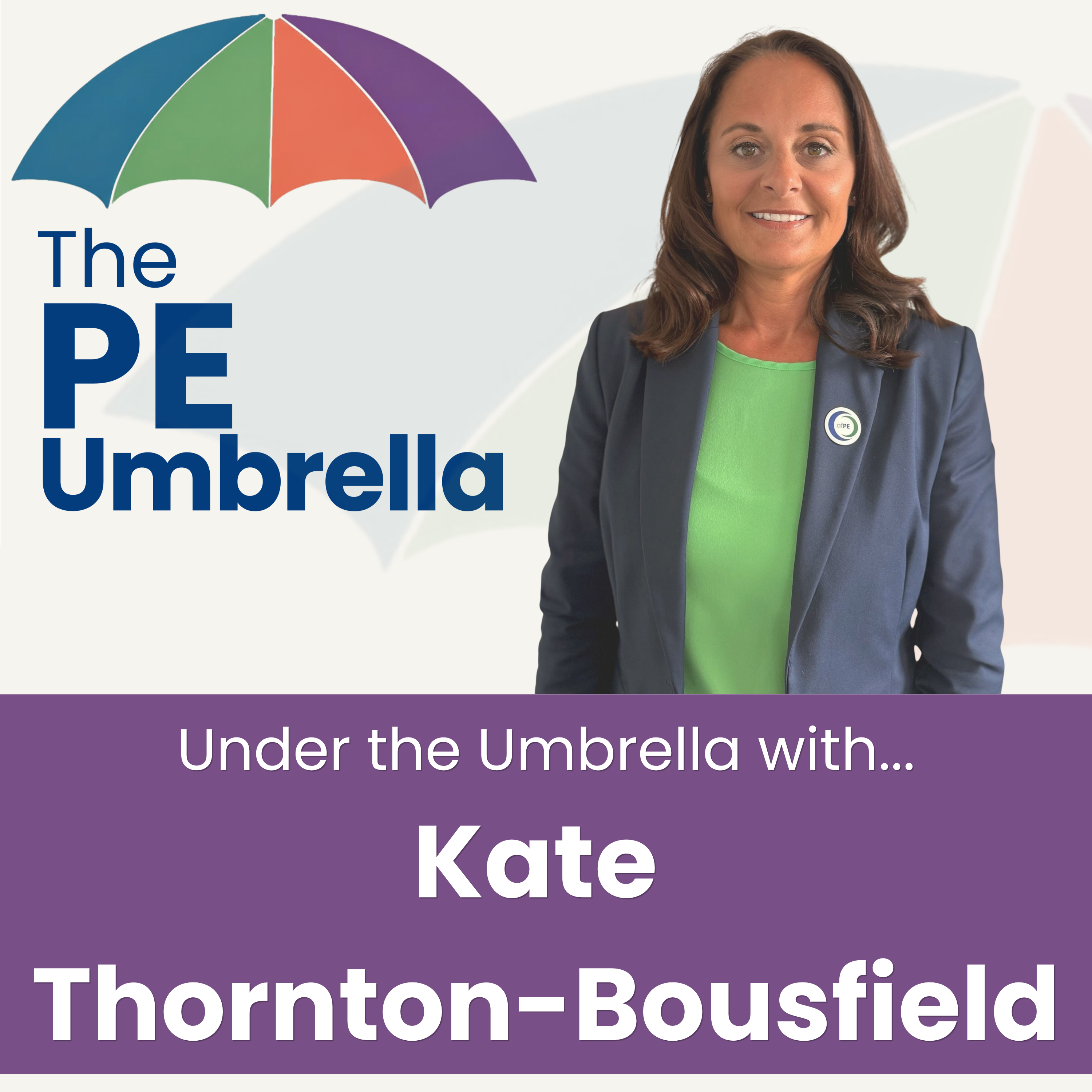
In this episode of The PE Umbrella podcast I am joined by AfPE CEO Kate Thornton-Bousfield. We have a wonderful conversation about where primary PE is heading, the changes taking place across the curriculum, and what all of this might mean for the experiences children have in PE. We explore physical literacy, inclusion and what it really means to put the learner at the heart of our decision-making. We also talk about the important role of teachers and coaches, the opportunities that curriculum change can bring, and why we shouldn’t wait for someone else to tell us what great PE should look like. It’s an honest conversation about taking ownership of our curriculum, making thoughtful choices and, ultimately, creating PE experiences that children genuinely want to be part of. So what are you waiting for? Come and join us under The PE Umbrella
Intro Kate pod: One of the things I love about the PE Umbrella is that it brings together people who are asking better questions about primary PE. If you'd like to be a part of that, make sure you're following the podcast. And if you've enjoyed an episode, a quick rating or review would mean a lot. Now let's get started. Welcome back to the PE Umbrella Podcast, episode 268. Ryan: Hello there, everybody, and welcome to the PE Umbrella Podcast, the place that we discuss and share practical ideas to help you deliver better primary PE. As always, thank you so much for taking the time to join me today. With me under the umbrella this week is the CEO and of the Association for Physical Education, Kate Thornton Bousfield, one of the actual OGs in YouthSpeak of the PU Umbrella Podcast. We first recorded in 2015, November, no less. Full lifetime ago almost. Thank you so much, Kate, for joining me today. How are you doing? Kate: Oh, Ryan, it's so lovely to see you and thank you for having me back on. I am doing okay. That is quite scary though. 2015, wow, a lot has happened since then in both our worlds, but certainly in the physical education world from me being at YST to now being at AFPE. Wow, we've got a lot to unpick. Ryan: We certainly do, and it's amazing that we're still in the sort of the realms of of primary P and PE in general, and our paths are able to cross. And you know, I really appreciate you taking the time in the madness and busyness of the current world of P as we're speaking right now. So hugely appreciated. And I'm really excited to get stuck into an interesting conversation today. Now I don't think it's an exaggeration to say that primary P is one of its most interesting points. In recent years, perhaps we've got a curriculum reform on the horizon, if you will, changes to funding and understandably lots of questions from teachers and PE leads and other people in the space. Now, rather than trying to predict exactly what might happen, I'd like today's conversation to help teachers think about what great primary PE should continue to look like through all of this change. So let me start with this, if I may. When all of these changes have settled. What do you hope children experience differently because of the changes? Kate: great question, Ryan. And I think it's really quite simple that every child in the primary setting and secondary setting, but let's keep it primary for now, that every child has a really fantastic, enjoyable experience of physical education, that they go to every lesson with hope in their heart, with I think the ability to know they're going to succeed and whatever success looks like in the eyes of that child, there's something for everybody, but ultimately that through their primary physical education experience, that the doors open to them, that they can then take the skills, the learning, the knowledge, their attitude, their love of movement into extra-critical activity, physical activity beyond the school day, sport if they choose to do so, but just a love of movement and a love of being free and being able to utilise the movement skills that they've developed to whatever end they want to use them. Ryan: Mm-hmm. And and and I think there you've you've almost answered where I was hope maybe pivoting to next, which was centered around if a year six child finishes school under a really successful curriculum that they've had on their primary journey. I was going to ask you what you would hope they would leave with. And you've just said there actually, a love of movement. That's stood out to me as a message you mentioned there. Is there anything else you would add to that list of something you would hope they would leave with? Kate: Yeah, absolutely. I think the confidence and the skills to do whatever it is they want to do. I think also those life skills, those life skills that we know that get developed in and through high quality physical education and the other experiences that wrap around physical education. I think confidence to then go and embrace physical education and whatever that then looks like in their in their next school experience, because I think we've got some children that leave with a, you know, a hop in their step. and can't wait to get into physical education in the secondary space but at the moment we've got some children that are quite daunted by what physical education looks like in the secondary space and a real move away from maybe what they've learnt in primary and for me it's trying to meet the learners where they're at and ensure that that transition is seamless and that energy and that enthusiasm for physical education is retained and sustained right the way through their secondary experience as well. So for me, mean, I think, you you've hit the nail on the head already. We're in a huge period of curriculum reform and where that curriculum is potentially going to take us. But it's understanding that physical education has something different for every learner. And this is the opportunity that we've now created through this new curriculum. Hopefully that whether they're a performer, whether you're an enthusiast, whether you're a coach, whether you're an official, whether you're somebody who just wants to recreate that you leave with the skills that you need to then choose your own path. know in life but to be able to lead a fulfilling lifestyle that physical activity becomes a bedrock and part of that and so that you know health and well-being of our young people is critical and certainly the challenges of the past few years particularly since Covid as well we've got a real challenge with our young people we're trying to navigate a digital age we're trying to you know increase movement we're trying to break down some of those social barriers that are there to our young people at the moment. And the best way to do that is by being physically active and build back the confidence there and social interaction and what a better place to do and start with it than in physical education. Ryan: Mm-hmm. And and a lot of the things you touched upon there, those wider life skills, you know, in my day-to-day world or my my language, that is their P umbrella that they're carrying around with them. Sort of protecting them and helping them embrace what life's got to throw at them. And I always talk about this notion of whether it's they need to run for a bus into adulthood, whether they've got to maybe had a bit of a setback in a job application interview or they've got a problem to solve, these skills that have been nurtured and refined. Through a quality PE program is their PE umbrella they take with them. And you also touched upon that enthusiasm, maybe infectious enthusiasm they take with them to want to be movers and be active from primary school into high school. And a former guest and a friend of mine, from the P Umbrella podcast, Stuart Owen, who was a former secondary PE teacher, he said to me on the podcast: he he just wants children who come to him in high school. If they're enthusiastic, that's amazing. And sometimes Secondary school teachers have spoke to me about the physical competences not being where they would hope. But he said, Well, actually I don't mind if they're still struggling. Yes, we'd love the foundational movements to be in place and a and a standard. But if they're not, he doesn't mind as long as they enjoy the subject and they're enthusiastic, because you can teach anybody who's enthusiastic anything, even when they get to high school. And he'd prefer a class full of enthusiasts as opposed to those maybe potential disparities in ability level, if you will. so I think that's really, really important to touch upon. I've just had a thought pop into my mind now though, you know, there's all this reform and change going on. And maybe it this is a bit of a broad sweeping s question or statement, because I realise PE looks very different in every single primary school that we could ever hope to go in. But what might look different if you went into a a general primary school PE classroom now or over the past six months on a Wednesday afternoon? And then if we did the same thing in a couple of years' time after all of these changes have come in, what do you think would look obviously different? Or do you not think there would be a difference just to to see? Or what would you hope to to see? Kate: Well, that's a great question again, Ryan. And quite a challenging one actually, because we're asking a lot of this curriculum reform. Obviously, the curriculum reform also coincides with the Children and Schools Wellbeing Act, which talks about now the qualified teacher status of the workforce and new teachers working in school coming in from 2027 having that QTS. So I think what we may see is a change in maybe who is delivering and teaching physical education. I think we're going to see potentially see a shift away. from the coaches that have been in the space for the last 14 years and supporting delivery of curriculum to actually being a teacher, delivering that again, maybe back to the class teacher. In some schools, that's never changed. It's always been the class teacher delivering physical education in the primary space. In some schools, we have a specialist primary PE teacher and we may see that model coming back. But again, what I really want to stress is it's not one size fits all here. It's making sure that we've got the most knowledgeable, skillful, enthusiastic, passionate, qualified person delivering that physical education lesson to ensure that it's physical education that is being taught, not necessarily sport. And I think what has happened over the course of last 14 years, particularly because of the use of the of primary school school premium funding is we have really gone down a rabbit warren in terms of. it being sport that's being delivered in lessons as opposed to physical education. And that's been been an interesting journey for our practitioners and for our pupils. What it has led to is maybe some pupils not engage with physical education because of maybe the sport that's being taught, or for some actually enthused them in terms of the physical education because they've not necessarily enjoyed the skills, the fundamentals and the application of art through various different types of activities. So I think we're going to see a bit of a shift in the landscape in terms of personnel delivery. But I also think what we're going to see is a shift back towards ensuring that every child has that basic competency of movement. We're going to see every child being able to have basic fundamental skills, being able to combine those fundamental skills into patterns of movement, those areas of activity broadening out. So, you know, the curriculum assessment review was very critical of the lack of a broad curriculum, particularly in the primary space, where we had a lot of games based activities going on, predominantly being taught by a coach, but not a lot of aesthetic activities, very little OAA going on. And I think what the Curriculum Assessment Review is allowing us to do is hone back in and say, okay, what does a broad balance curriculum look like? And what is it that our deliverers of physical education need to be equipped to be able to deliver that curriculum? So There's going to be a huge mind shift here. There's going to need to be a lot of support for the profession. There's going to be a lot of support for initial teacher education as well, so that anybody coming out with a generalist teaching degree for primary teachers will be able to teach physical education. Now that's not going to change overnight, so there's going to be a lot of support in place for those teachers of tomorrow to make sure they can come in equipped to deliver physical education. But at the same time, we've absolutely got to protect. those fantastic coaches that have helped physical education get to where it is, but also the support that they've given to a school and they added knowledge and value that they brought to a school community. Because, you know, some schools don't just parachute somebody in and off they go. That coach becomes part of that wide workforce in that school. And I think with the new enrichment framework, the new PE and school sport partnerships that are down the line, those coaches are going to have a critical role to play. in being able to provide the enrichment opportunities, but also be a real conduit, the link between school and community to make sure that those children stay physically active and actually stay physically active as they transition from primary school to secondary school as well. And we mustn't lose that workforce. And at the moment, I think there's a lot of nervousness around what is happening between where we are now and where we're heading in the future. Ryan: Mm. So some so many things there that you've just touched upon, I think, are really fascinating. And I like the fact you started off with almost that I don't want to sort what see sometimes tension between the muddy and the waters of maybe just simple definitions of PE, school sport, physical activity. You can throw other ones in there more recently, physical literacy, all kinds of things which sometimes I feel can occasionally overcomplicate what what we need don't need to be complicated at the end of the day. And I think with the the PE and the sport thing, beyond what happens in the school, for me it's that that narrative that then goes back into society society with parents because they then see PE as sport as well. Because when they ask little Johnny or little Sally what they've done that day, they say, I did football today. So then parents think it's just sport. And then you just get this constant cycle of seeing it the same. And I'm not sitting here villainising sport. I'm the most sport mad person you'll ever come across in your life. I love sport, love playing sport, and I've always seen it that way. but we can't confuse the two. And that's not to say we couldn't even use sport as part of the curriculum, because as you said, the mere name-drop of a sport for a cohort of children might put them off PE. It will, it just will. But then for some others, it could be the f the fuel under fire and the catalyst to inspiring somebody to take up hockey or tennis. So I think it it's more about the way it's pitched and the way it's taught and devised. It's not, or for me, it shouldn't be. I'm teaching you how to play hockey or tennis, but we are developing skills here across a range of things which would enable you to play hockey or enable you to play tennis, multi-skill rounded athletes. And I think what's interesting, a recent conversation I had with Dr. Gerald Griggs is he spoke about this notion from a research paper that we always have bias towards the children who remind us of ourselves. And I've done that so much in my career. And being a sporty person. And if you think about a lot of the workforce around PE, let's be honest, we're all PE enthusiasts. I'd imagine the majority would say that they're quite sporty. So even if we don't mean to, our biases mean we'll draw ourselves to those who remind others of us when we're teaching. And sometimes we might forget the those who maybe do need the attention so we can make those changes. so I think that what is coming is is really important to consider. And I'm excited to see how this all plays out. And and how that shifts over the next sort of three, four, five years to to see how this PE space evolves. Kate: think so, Rhyna. I think you've hit the nail on the head, but I think I'm going to give you a good run for your money because there's not a sport that I don't love, don't embrace, don't enjoy, whether it's playing it, whether it's watching it, whether it's just recreating or competing. There's so many good things that we need to take from sport. And you're absolutely right. It's not villainizing sport. It's knowing its place within the curriculum and making sure that we can give those children the opportunities to. understand maybe the different formats and the different level of our sport being taught in and through the physical education curriculum and trying to find the balance there because there's so many good things that we learn from sport, whether it's competing, whether it's learning to win and lose, whether it's learning to empathise, whether it's strategising. We have to understand those scenarios that those children are going to face in a sport to be able to teach them to overcome them, to plan them, how they work as a team, how they work as an individual, how they challenge themselves, how they reflect. all those different things we have to embrace and that is something that government have been really strong towards us as the drafting team to ensure that we retain that and we are working really closely with national governing bodies to ensure that their sport can still be accessed via this new curriculum that is being created by just understanding the key principles, the key movement patterns that are needed, the lessons that we want to learn in and through those physical activity sessions and the transfer of knowledge and learning from one activity to another. And for me, it's the inclusive lens, which is the real mind change here in the curriculum that we're creating, that there's something for everybody, that no child should be left on the sidelines, not engaging in physical education. No child should not be in that classroom because they've got a disability or something that's preventing them from taking part. That lesson is fully inclusive. And what I want the curriculum to do is recognise that we've got seated volleyball in there, we've got goalball in there, there are activities that we need to be teaching in and through so that we understand society as well. Like you said, I would always be biased towards my hockey or my athletics Ryan: Mm. Kate: or tennis because they were the things I love to teach. But I always look at the younger version of me now and if I was going back in to start my teaching career again, oh my, there's things I would certainly do differently. And it's again, making sure that I am talking to 100 % of children in my lessons, not just that 9%, 10 % of the people that are reflective of me. And that's the mind shift we want to see. And I think through being able to develop that whole person through the physical, the social, the emotional, the cognitive angle of physical education and physical literacy, this is what this curriculum will enable us to do, that every child can see their progression through physical education, even if they're not the best at performing. For me, it's not about excellence in the physical skill, that opportunity needs to be there to develop that, but it's around every child finding and understanding the value of physical education in everyday life. Ryan: Yeah, a hundred a hundred percent. And you know, the the the one of the lines you picked up and you said there was this something for everybody notion. And that that will look different school to school. If we've got the autonomy and ownership over what the you know, we'd see what the curriculum is. We then have to be able to craft and offer a recipe or a menu, if you will, for the children in front of us in our school. And that's something for everybody in one school down the road in Leeds might look different to the one two miles down the road, which is also in Leeds, but it's for the context and the individuals. Kate: And so it should be absolutely spot on. This is not going to be a curriculum that's prescriptive. Every child should have the opportunity to learn in and through different types of activity. And if you look at the AFPI position in paper around what a future physical education curriculum could look like, I would like to think that the curriculum we're going to get is going to be very similar to the asks of all that consultation that we did as an organization. well just as the curriculum assessment review was going through in terms of what our children need, what our teachers need, but most importantly what a community needs and like you've just said let's take Leeds for an example. You know you've got rural parts of Leeds, you've got inner city Leeds, those kids are going to need different things and we've got to have the ability to put a curriculum together that meets the needs of those learners and those learners change day by day, week by week, year on year and that curriculum's got to have that flexibility in it. for a teacher to be able to say, actually, this class needs something different. The curriculum is going to give you the scope to be able to deliver through that and put together a curriculum that is going to meet the needs of those learners. And that's the exciting thing around this. What we've got to try and make sure happens is that what is delivered is quality, that the teachers delivering it have got the right knowledge and understanding and have got the right support, that that physical education experience is the most positive it can possibly be. So a child does fall in love with movement. Ryan: For sure. And I just want to make one one last final point if we go back to the whole sport piece of narrative as well. Because again, we're I think we're both on the same page as sport lovers. I mean, it's it's been my life. That's what's led me to what I'm doing now. But I've just seen time and again so many times with in-service teachers and trainee teachers who will who will come to a point where their dislike of PE and their one reason is because I don't like sport or I can't play sport. That's their reason. And I have to then say, well, no, let's separate the two. I mean That's that sings to me as the experiences that they've had which have been very sport heavy. And whilst absolutely I've probably developed in my lifetime the skills you mentioned of competing, knowing how to compete fairly and well, showing empathy, strategizing challenge, probably nurtured a lot of that in myself through playing and competing in sport. But I think a lot of those skills can also be nurtured in things that wouldn't be branded as sport as well. I think I've taught enough of P lessons myself now where I feel I could put on an activity, a session that you might be developing skills you could use in hockey or netball or something, but still develop those, but it's not labeled a sport. And I'm trying to find this middle ground in the limited time that I sometimes get in my day-to-day job working with these future teachers so they can at least see both sides of the coin that, yeah, sport can be used as a great vehicle and tool within primary physical education. But it doesn't have to be. And I think sometimes that misconception I've seen is they come and they think it has to be just that and they don't know anything else. So I'm trying to change that narrative. And then I've got to give them the the subject knowledge and understanding. So when they enter that primary space, they feel comfortable of being able to adapt their lessons, make it an inclusive space to be, consider that whole child development as well as the physical side, which is ultimately our USP as a subject as well. So then they they can look at a range of ways and if they then still get more comfortable with sport, that's great as well. But I've just that shifting of the narrative of it, which I've seen for years, where some corners think P and sport is the only thing. Whereas actually we can see we can see both. We can see how they can go hand in hand and be a partner going together. Kate: And it's a challenge Ryan, and you know, I absolutely take my hats off to every single primary teacher out there because you are teaching 12, 13 different subjects in that curriculum. You're going to have curriculum change in every single subject. And here's me just talking about PE, but bless those primary teachers. They've been changing every subject area. we had a real challenge and probably conundrum to try and solve. Did we create a curriculum that anybody could just pick up and run with now? was going to be okay, but actually does it equip the children with the skills that they're going to need later on in life? No. Or do we go with the curriculum that is so far out there that we lose the profession, but have a real out there for those kids? That wasn't an option. So we've had to find the middle ground. Now, when the curriculum comes out, there'll be some out there that say you haven't gone far enough, but we've got to look after the professionals and we've got to make sure we take the teachers with them and show they've got the right support. And you're absolutely right. We've got to make sure they've got the right CPD along the way, that they understand the right pedagogies to be able to do this, making sure they understand the difference between one lesson and another and what's going to work with some children is going to not work with others. And we as the association have got to be that body that provides that support. And that's what our role is as a subject association. Every single subject association, no matter what subject they're in, are doing exactly the same role as we are and ensuring that that support is there for the profession. Ryan: Yeah, and that C P D is and will continue to be absolutely key because as we as we know it's well documented, the finite number of hours that someone like myself and many others have to try and boil down what knowledge these future teachers need to deliver some great primary physical education. I could I could teach hundred plus hours. So when I'm given I can count on two hands how many hours I'm given sometimes with students, I've then got to decide. what is the absolute utmost importance, but then there has to be what's next when they get into schools, what is that follow on as well? Kate: think you're right and that comes back to kind of like the curriculum drafting that we're involved in. You the question DfE always say to me as I'm know heading that team up is what are the essentials that that child is going to leave with so therefore what are the essentials that that teacher needs to be able to teach that lesson and we've had to really look at language and show that the language is clear. We've had to make sure the supportive guidance is really clear, the clarity is there for the teacher. But at the same time, we're putting additional support together, ready for the profession. So the day the curriculum gets launched, there'll be supportive guidance to go with that curriculum to help that teacher and those people in the workforce be able to deliver those lessons. And at the same time, the right support that's there along the way, because you're absolutely right. We've got to look after the profession. We want them to be enthusiastic about what they're teaching. We don't want them to be scared. about what they're teaching and just moving the lens slightly away from the sport lens back to physical education will hopefully take those teachers with us. Ryan: Yeah, I'm excited to see to see the the journey play out for sure. Now, when teachers listening or anybody listening, Kate, hear phrases such as, you know, curriculum reform and funding changes, I want to know, what do you hope that they don't do when they hear those phrases? Kate: I don't them to panic. I don't want them think that everything's disappeared because it really hasn't now. It's really probably easier for me to sit here and say that because I'm involved in some of the policy decisions and we can kind of understand the direction of travel that this is moving and it is moving at pace. But I also want to sort of say at this moment in time, how do I say this? Trust us. We know where we're headed with this. What we're not in control of are the timelines. And if you could have said to me, you know, what are the realistic timelines for all of this? For me, I wouldn't have gone for change right now. I'd have said, yeah, we're going on a slightly different path. Stick with us. Let's have a year of consultation, a year of developing what the new partnerships may look like and then transition the schools into those partnerships in September 2027 rather than mid-year or, you know, Christmas as it was intended to be. Because I think what's happened is... There's been a lot panic in the sector as soon as it was announced that there was going to be changes to the PN School for premium funding. What we've had is schools stop doing things and that is the worst case scenario. But it's been a reality check and we've been able to feedback raw insight. People that have phoned in to us and not just us but to YST, people that have shared the positions where they currently are, people that have talked to us about the coaches lost its role, we've lost this funding opportunity. We've lost our pool time. We can't afford to go and swim now because we haven't got money to pay for this, that and the other. That is the concern and they're the concerns that we're flagging to DfE straight away. We need that continual narrative. We need the communication to be clear so that schools don't stop providing these opportunities for young people because what is still happening is schools are still getting their funding and it was announced last week that you're getting actually an uplift to that transition funding. So for me, you've still got to protect your top up swimming. kids must be able to address the water safety particularly. And at this moment in time, it's safety over strokes. And we've had a really horrendous spring and summer so far in the amount of deaths in and around water. And that is not necessarily to do with a child not being able to swim. It's to do with a lack of understanding of what is happening to their body temperature from being really hot to then submerging into very, very cold water or water in a quarry or water in a canal, whatever it may be. Nothing about the child not being able to swim, but how to survive in water. So, you we know that that that narrative around water safety is in the PSP, PSHE curriculum as well. We've got to keep teaching these things. We must keep providing the opportunities for children to be active beyond the school day as well. So for me, you keep teaching your physical education, you ensure top of something can still happen. Do not start withdrawing from your pool time. Do not start taking opportunities away from from those young people. We've got to keep, you know. the children moving and the teachers teaching and the coaches doing their bit as well and that you know before we know it the national delivery partner will be chosen and then the new partnerships will be rolled out and schools will then hopefully be able to position and transition into these new partnerships and hopefully it will be quite seamless but I'm really worried about what I'm hearing around you know things stopping already and coaches being let go or funding being withdrawn or head teachers saying no we haven't got the opportunity to do this. Physical education still needs to be taught. So for me, you don't stop your top up swimming. You keep that teacher as highly qualified as they possibly are. You utilize those coaches in the spaces that we still can. But you ensure that moving forwards, that between now and even next September, that class teachers are able to teach physical education. What is the CPD our general teachers need to be able to teach physical education? Because in some schools, those teachers actually haven't taught PE for nearly 14 years because we've had those coaches in that space. So we always knew the premium wasn't going to be around forever. We've always stressed that it's around sustainable and sustainable solutions. Where we've had displacement, that's the challenges that we now face is getting that workforce back to where they need to be now to teach physical education. Ryan: Yeah. I like how you opened that up though with the statement of don't panic, but I think you've just touched upon some real things that we can focus on or that the the sector can focus on instead. rega with regards to that. And a question popped into my head actually as you were speaking towards the end there, as we start to s shift towards the new curriculum. So in the next twelve to twenty four months or so, you know, if s if schools are worrying about getting the new curriculum right, whatever that may look like, of course, how how do we stop? compliance, as it were, becoming more important than the children's experiences. How can we stop that being the case? Because ultimately the children's experiences has to come first, right? Kate: absolutely should come first and you actually shouldn't be waiting for curriculum reform to change your curriculum. You are absolutely in charge of your curriculum. That curriculum belongs to you, belongs to your school and belongs to your young people. So you don't need to wait for the national curriculum changes to come into place. You actually start thinking about what is it that our children need. Now we've got Oak National Academy. You've got their, you know, access to all their free resources that are online now and the primary resources are brilliant. That's a great starting point for somebody who maybe is not. hasn't taught physical education for a long time, go and have a little look at their resources and see what support is on offer there and start to get your head around that direction of travel there because we've got physical literacy built into those resources as well. And I think through how they're taught and how they're presented, you've got an idea of maybe how the curriculum could look and feel. For me, it's about making sure you understand what your children need. And then you identify, if our children need this, what is it we need to be able to provide as a group of staff in this school to make sure that that physical education experience is the right experience? So tapping into the resources that you've already got there. You've got SGOs working with you, you've school partnerships working with you. Some schools have still got a peer advisor in their local authority. Absolutely tap into all those resources that are there. Talk to us at the association. We've got free resources, free support for all our member schools as well. But also, you know, make sure you buddy up with people, you've got colleagues in other schools that may be a little step ahead of you, talk to them. The best thing around physical education is we're not afraid to ask for help, we're not afraid to share our vulnerabilities, we're not afraid to say you know actually we're really good at this, we can help you there. Tap into your support resources as well and don't just be stuck on you know on that compliance we must do this, this and this. At the end of the day you're there to provide a real positive experience around physical education regardless of what the rules are. Just make sure that curriculum is as broad and balanced as it possibly can be and it's the best experiences those young people can have. Ryan: Mm-hmm. And I think that should be really reassuring to anybody who's listening now, who maybe had those worries, those concerns. Ultimately you've got to put on the best offer you can for your school, your context, your pupils in front of you to give them the most best experience that you can. I always find the conversations, certainly more recently in the past twelve months around physical literacy very interesting because I know I understand for some teachers who it might be newer to that definition, if you will, or what that is or entails, it can be a useful tool to hang your hat on, especially when you look at the new context of that that move, think, feel and connect. And it's interesting because it for me, it's always been something. If I look back right at the start of my career, before it was in its current guise, if you will, I've always just seen that as being good as good PE teaching. If I then I put that sort of lens of the PE umbrella, if you will, on it and the blue, the green, the red and the purple umbrellas, physical, cognitive, social, emotional. I've always looked at trying to teach primary PE through those different intricate Lenses that weave together to make this blanket of skill, if you will. and for some teachers, that using physical literacy as a term might give them a hat to hang on to. I I worry that for some it might overconfuse what's already a space with lots of definitions as well. But for me, it's just that's great PE. If you can draw out that wider learning of of social skills and collaboration of problem-solving tasks whilst developing, great-I've said this recently, great teachers for me. in a PE space. And this is what I hope to pass on to my trainees, is they can spot moments of that learning happening and amplify them when they choose. They can see those moments in lessons. They can see a physical task and activity and amplify the social learning out of that or the problem solving skills. So I think that's something which I I'm really keeping a close eye on and I just want people to understand wherever they sit, whether they use that terminology often, it's it's just great PE. That's what really wonderful primary P looks like and feels like. Kate: I could not agree with you more. And for me, physical education has always been around that. It's always around how you teach it to get the best out of the developing that whole person. And whether back in the day, we used to talk about the me's when I was at YST, the thinking me, the social me, the physical me. Now we talk about that language of think, feel, move, connect. For me, it's around the experience that is created and knowing that children can access physical education and learn through those different lenses. But ultimately, how a child then defines their relationship with movement is what is then important. As long as they leave that PE lesson knowing what they're going to do with the learning that they've just taken, that's really important for me. I think the term physical literacy is still quite confusing. know actually Department for Education don't use it at all. You won't see the term physical literacy within the new curriculum. But what you will see is that development of that whole person through those different lenses and through the different aims. That new curriculum will give us a real strong rationale for why physical education is needed. what a young person is going to develop in and through that physical education experience and how they will then utilise everything that they've learnt, whether it be the life skills, it be the thinking skills, whether it be the check and challenge, whether it be the physical skill, Ryan: Mm. Kate: how they then apply those to whatever it is that they go on and do. it really is critically important. Now, some people will use the think, feel, move, connect. You basically use the language that's going to work for you and your learners. But for me, it's that whole Ryan: Mm. Kate: experience of high quality physical education. And I think that's maybe where we get the different lens on PE through that PL approach. It's very much that as opposed to the sport lens. And I think sometimes when we went down the sport lens, that's maybe where the whole person maybe didn't get developed. And hopefully we can bring a little bit of it back in now through the new curriculum. Ryan: Yeah. And I think as a profession we are becoming better at recognizing, you know, those four areas. It seems to be as years have gone by, we're slowly getting better and better. And I think we have absolutely made big strides and I can see that as the way it's reflected in what the new curriculum was shaping up to be. If I had to break those down again into that physical, cognitive, social, emotional four areas, which one of those four do you think still deserves more attention? Kate: For me, it has to be the physical. We've got to get pupils moving. We've got a real barrier at the moment. We're still not hitting our 60 active minutes a day for some children in our primary schools or even in our secondary schools. We need that physical activity to be just part of everyday life. And it's not just around physical education, it's around the whole school environment that's created as well. But also parents and carers buying into that. We've got to try and find that balance so that children haven't got those mental... breakdowns as well. We've got to see physical activity as a way of being the antidote to the antidote to someone becoming poorly as well. actually, know, the gift is that they're moving. When children move, they feel better. We know ourselves when, you know, in your arms of the weather at the moment as well, first thing you want to do is go and go for a walk and get some fresh air. And we know what physical activity does for us. And we've got to try and find that balance again. So the physical for me is massively important, but also the health and wellbeing connected with that is understanding and valuing the physical activity. think what we've got at the moment is children not necessarily valuing the experiences they get in physical education. And that's not just the children. That's some of our colleagues that we work with. And you hit the nail very early on in our conversation when you talked about perceptions of some of the parents and carers as well. They don't understand physical education. And this is our time to redefine what physical education is about. And it absolutely has to be through the physical. And think one of the dangerous moments that we have is even as we're writing the new curriculum, some of the challenges that DFE feedback to us, even when we're talking about some of the social elements or the cognitive elements of things, it's still got to be through movement. When we talk about developing cognitively, that isn't sitting down and going to a classroom and planning something. That isn't sitting down on the floor and strategizing. That is as we're moving. Because for some children, that physical education lesson is the only one guarantee that we've got to get them moving. We're not in control of what they do at breaks and lunchtimes. We're not in control of what they do at the end of the day. We're certainly not in control of what happens in summer holidays and at weekends. So we get their love of movement right in the physical education lesson. We hope that they then choose to be physically active over being on a tablet or in front of another screen. And I think we're starting to see a shift change. I know that the good weather does help. I'm seeing more and Ryan: Mm-hmm. Kate: more children now out on bikes. out moving, out playing in the streets again. We've got to normalise that again. We've got to see those boundaries grow. And I know it's around safeguarding as well, but we've got to allow those children to explore, those children to take that step, those children to take a risk. And as parents, we've got to embrace that as well. I know it's a hard thing to do, but you know, probably like yourself, Ryan, I was still climbing trees and scraping my knees and came in when it was going dark out on my bike. I think we're starting to shift to that again. but we've got it, that societal change, but that's only going to come when we have great physical education lessons where children are taught to take a risk and are able to explore for themselves. We've got parents and carers understand what physical activity is and where physical education fits in creating that narrative. And we need parents and carers to embrace that and give the children the space to grow and learn and play together. Cause when children play, we see those, the, you know, we see the endorphins flow. We see the... being able to strategize, see them problem solve, we see them fall out, we see them just having a great time and that's what's missing for me and we get physical education right alongside an active school. We're on a good road to recovery. Ryan: Mm. I I'm glad that you chose the ph physical as the one still needing more attention because it you know, there is that danger when we start talking, yes, why do it's all so important, of course, but it's physical education. It is the USP, it's getting that right. And it's one of the things that I wish more parents, early career teachers, trainee teachers, had more input on first, even if they're not intending to teach lots of PE, is the importance of early movement from when children are literally twelve, six months old beyond and And why that movement is so important. And think when more people understand that, it's like a light bulb moment. It was for me a number of years ago when reading certain texts and researching, thinking, my goodness. I but it took me. I had to go away because of the passion I have for this space and research and find this out myself. But I feel like it's hidden under a rock for so many people. They would never know the links between movement and a whole world of flourishing. Kate: It really is true, Ryan, and we've got to get it right in early years. And early years foundation stage is one of the most critical stages of development for a child. We've got to make sure children have tummy time. We've got to make sure our nurseries and our preschools are doing a lot of movement. We need parents and carers. When you get your bounty pack, when you leave hospital with your brand new baby, we need information in there on what to do with your child in terms of the development goals as well. and we've become a real society that's just easy to click the baby in the car seat, put them in the pram, wheel them in. Now some babies are not moving from that car seat for a number of hours and that's really then starting to limit the development of that child. Both brain development and physical development. We know the cortexes aren't working together. We know children aren't able to track objects now because they're literally watching a screen. We've got screens attached to prams. We've got screens in restaurants. We've got screens in coffee shops. We need to be doing more with our babies. And I think, you we've got a fantastic screening program going on that Dr. Vanessa King's working on around early years foundation stage, the diagnostic testing of what is missing in our children. We are then able to then put together and support to get those children to where they need to be, because if we, they still got some of those primitive reflexes and they can't cross the midline and they can't grasp things, they can't let go of things, they can't track things, they're never going to be able to access physical education. So we've got to understand where our children are at when they enter school and reception to then start to build that physical development before they even get into physical education. So it becomes the critical fundamental building block. If that's not right, they're never going to be able to experience physical education. And that's why the physical is so important, because if we don't get that, they're never going to be able to go on and do what they want to do physically, mentally, socially, because it becomes a barrier. and you know yourself and the children that you have taught through your years in school as well, that you know that child that's maybe got those missing fundamentals, they become scared. They become scared about going into a PE lesson if they then know they can't do a certain movement, which is why it's so important to get that building block in place, but also then build the support network around that actually, if we improve their confidence and their competence, it doesn't matter whether you go confidence or competence or competence, and then confidence doesn't matter which way around the circle you go. That child will get there, but we've got to ensure that we address what those children's needs are as early as possible. Ryan: Yeah, I I I love the the the penny drop moments I've seen with some of our students who come into to teaching in ITE, primary school teacher trainees. And when they do a PE session with me and I take it right back to early movement and the importance and if I was to ask them in that first session why is PE important or why they liked it or not, it would always go back to, well, I don't want to play sport anyway and I don't need to know our sport and X, Y, and Z. Then when I start taking them on this journey and tell them about their the proprioception and the vestibular system and how the vestibular system directly taps into emotional regulation and the way to fire up the vestibular system is through opportunities to move. And actually, have you ever seen a crying baby or a a baby who's upset? And when a parent holds them, they might bounce them on their knee or spin them and it soothes them. And you know the reason that is is because that's directly tapping into the vestibular system develop and they sat there almost open mouth thinking, hang on a minute. And I said, Do you understand now? why moving from an early age. It isn't about I'm preparing you to represent England for the national football team. It's about I'm preparing you for a life of flourishing. And that's what we're doing for our children. We can't just compartmentalize PE into just being sport. And I completely empathize with the experiences you've you sat in front of me have. You may have had really negative experiences and I can't take those back away from you. But what I can do now is hopefully just give you some information to check and challenge that narrative you've got. So that when you go into school and teach, you see it with a different light through a different lens and can provide the offer which our children need, which is early movement opportunities to move more. Kate: things though Ryan and I think you know when when your child's in reception you get get sent home the letters and the sounds and then the words to learn and then we get the same with numbers the same should be there for physical education there should be some movements that we're expecting children to do at home and that you know what a wonderful thing to do with your child learn through play that's what our children should be doing in reception is you know, learning their numbers through play, learning their letters through play. It's a great opportunity for parents to be working with their youngsters in a physical environment, learning great things, but actually addressing some of the movement challenges that some of our young people have. And it's so, so important. We just need to ramp it up a little bit more and make sure Ryan: Yeah. Kate: that that narrative drops. Ryan: For sure. Now I'm I'm hoping to jump into a what I'm gonna call a quick fire question round, but it's more of me starting a sentence and you've got to finish my sentence, Kate. That's what we're going to try and do. So we've only got three of these, so let's see how we get on. So first one is primary PE is at its best when. Kate: It's taught by somebody who understands what the children need. Ryan: Next one. Every child deserves to leave PE feeling Kate: gosh, every time, having experienced success, I'm looking forward to the next physical education lesson. Ryan: Great. I I didn't share any answer with Kate by the way, but I if I was to answer my own question there, I would always say to to have had at least a moment of success and done something. okay, last one. The biggest opportunity for primary PE over the next five years is Kate: to get it right. Ryan: To get it right. Kate: to it right for our young people. This is a warm moment in history to ensure those physical education lessons are the best they can possibly be. Ryan: Hm. I think and and actually getting it right might look very different for everybody listening right now as well. It just depends where you are, what you're doing, your school context, what space you've got, what equipment you've got, what children you've got. All of that plays into this big melting pot of what getting it right means for you. So and it can be difficult in a world surrounded by social media and everybody's small wins to compare and despair, can't it? I I talk about it in terms of children in school, in PE who compare and despair and that's why they sometimes don't engage well. But I think we're bad at it sometimes as adults. And you might see another school doing something particularly well. I think, they're doing that thing. But that's that school. We need to focus on our own, don't we? I think that's important. Kate: Definitely right and everybody should have confidence. If you know what your children need and you're able to put a curriculum together that meets their needs, you're doing the right thing. Don't compare yourself to others because what one school does is not necessarily right for what your school needs and this is some of the challenge with some of the curriculum resources out there that teach this lesson, this lesson, this lesson. No, you meet your learners where they're at. Just because one school is doing it this way does not mean that's going to work for you, your learners and your workforce. Ryan: Yeah. And I I as I wind down now to just the last couple of questions to our discussion, Kate. This is kind of a two question in one, if I may. I I I want to know from your perspective, from your role and all the things you see and the conversations you're privy to, what's one debate or topic in primary PE that you think recently we've been spending too much time on? And on the inverse, what's a conversation we're not having enough of? Kate: We're probably spending too much time on debating whether it's the sport or physical education Ryan: Ha ha. Kate: narrative, if I'm really honest. For me, it's about getting the experience right and ensuring that it is the most appropriate person teaching that lesson. Now, I'm always going to say it's the teacher because physical education should be a professioned subject, just like every other subject in the curriculum. And that's never not been the case. But the premium has kind of taken us down a path that we was never intended to be. So it's now trying to get us back onto the right path, as it were. And that's hard. And I know that's hard, and that's hard for people listening to me say that, but I have to be brutally honest. That's where it needs to be. But at the same time, it's then embracing those people that have been a fantastic support to physical education over the course of the last 14 years and ensuring they stay part of the workforce, but redeploying them in the right way. What haven't we spent enough time on? Really understanding the needs of learners. and the assessment of physical education. I suppose it's always a grey area assessment, but for me we need to understand what our children need to then understand the path that we're going to take them on. And that will be something hopefully we can address once the curriculum is in place and once we kind of move things forward in terms of what our young people need. Ryan: Yeah, and actually that could be an entire podcast episode in itself talking about assessment. We don't want to open that can of worms just yet, but I Kate: Not yet. Ryan: think what I would say is is teachers having a really strong sound subject knowledge and an idea of identity in their P is a great foundation for assessment because it allows them to do that in the moment, even if it's just more formatively, is the questioning, it's the feedback, it's the little nuance of the context in front of you as as the assessment. The other stuff can wait for a future conversation. Now, the final question everybody on the cot on the podcast gets Kate, although this wouldn't have be existed when we first spoke in 2015, of course. But I always like to finish with this one. And I'd like to know what you have learned either about the PE space or it can be about yourself over the past 12 months that you didn't know or believe before that. Kate: I suppose if I go to probably myself to start off with, think the enormous sense of responsibility this role brings with it. But also having the courage to speak out, to do the right thing for the subject and do the right thing for the profession. My role isn't about making friends. My role is about doing the right thing for our children. And there's some people that don't agree with what I'm doing. but I will stand by the decisions that I've made and you know, I'm not going to get every decision right, but I've learned a lot of myself, a lot about myself and a lot around my leadership style. I certainly wouldn't be where I was today without the group of mentors I've had around me, certainly my experiences at Youth Sport Trust, but I've also learned around the power of collaboration. And actually, has become quite divisive over the last 14, 15 years. It's seemed to have become a bit of competitive mess. And for me, it shouldn't be. we can achieve so much more when we're on the same page and we can acknowledge where people have got strengths, where also we've got areas for development and when we work together, we can certainly go faster together, we can go further together. So that's the one thing that I've learned, the power and collaboration. In terms of the subject, we've got still got a lot to do. I'm very nervous around the next 12 months. where we may have to get to before we can move forwards. And I'm really conscious about supporting the workforce and making sure that as a subject association, we are here to support the change and support the workforce on that. But also just the trust and backing yourself as well. You know, I've had to make some tough decisions in my first 20, 21 months in this role. And you don't, as I said before, you don't get every decision right, but there's method in my madness sometimes. and it's just like trusting your instincts that you know that gut feeling is often the right thing to do and trust it. Ryan: Amazing. Well, thank you for being so open and honest. And I think that will resonate an awful lot with anybody who's listening today. And and for those who are listening who aren't already doing so, Kate, how can they stay in touch with all things AFP and follow you and what Af P are up to? Kate: So yeah, so we are the Subjects Association for Physical Education. There's no other Subjects Association for our subject. It is us. So you can be a member as a primary school, as a secondary school, as an individual. You can go to www.afp.org.uk and have a little look at our website. You get a monthly newsletter, which really does bring you up to speed with what's happening in the education space, but really what's happening within physical education. You get monthly webinars, you get support. Obviously with the curriculum, we are leading the team of drafters. So we are going to be your one-stop shop for curriculum development there. But we're also there, we've not even talked about safe practice, which we hate to be the health and safety police, but somebody's got to do it. But for me, particularly as our workforce is diversified, it's making sure we are teaching physical education safely. So if you're unsure about what you should be doing and what you shouldn't be doing, please just pop us a line, drop onto the website, come and talk to us, come and chat to us. And if there's something you think we're not doing that you need, let us know. If you don't tell us, we don't know. Ryan: Yeah, great. And I think actually, now you've mentioned the health and safety piece there as well. If I go back to my role and what I do in my limited hours, that that has to come into that 'cause that underpins everything. There's no point in talking curriculum and teaching styles and beyond if we can't make the environment safe. Safe physically, but also safe emotionally. I'm gonna add that one in there as well. Now, Kate, thank you so much for joining us today. One thing I think teachers sometimes forget is that organizations like HP are made up of people who care deeply about improving children's experiences. So thank you for everything you and the team continue to do. I appreciate that. I think today's conversation has been really helpful reminder that, you know, while curricular funding and policy will inevitably involve and continue to evolve for years and decades to come, the purpose of great primary PE remains the same. It's creating meaningful experiences that help every child develop a positive relationship, hopefully with movement and physical activity. Everyone listening, thank you so much for choosing to spend part of your day under the PE Umbrella. If you've enjoyed today's conversation, I'd really appreciate it if you could follow the podcast, leave a late rating and review, or share it with a colleague, friend, or family member. It genuinely helps more teachers discover the show and these conversations about the subject that we love so much. For now though, I want you to all keep on motivating, engaging, and inspiring the children that you teach. And I will catch you all again very soon under the PE umbrella. Thanks again, Kate. Kate: Thanks, Ryan.