
The PE Umbrella · Ryan Ellis
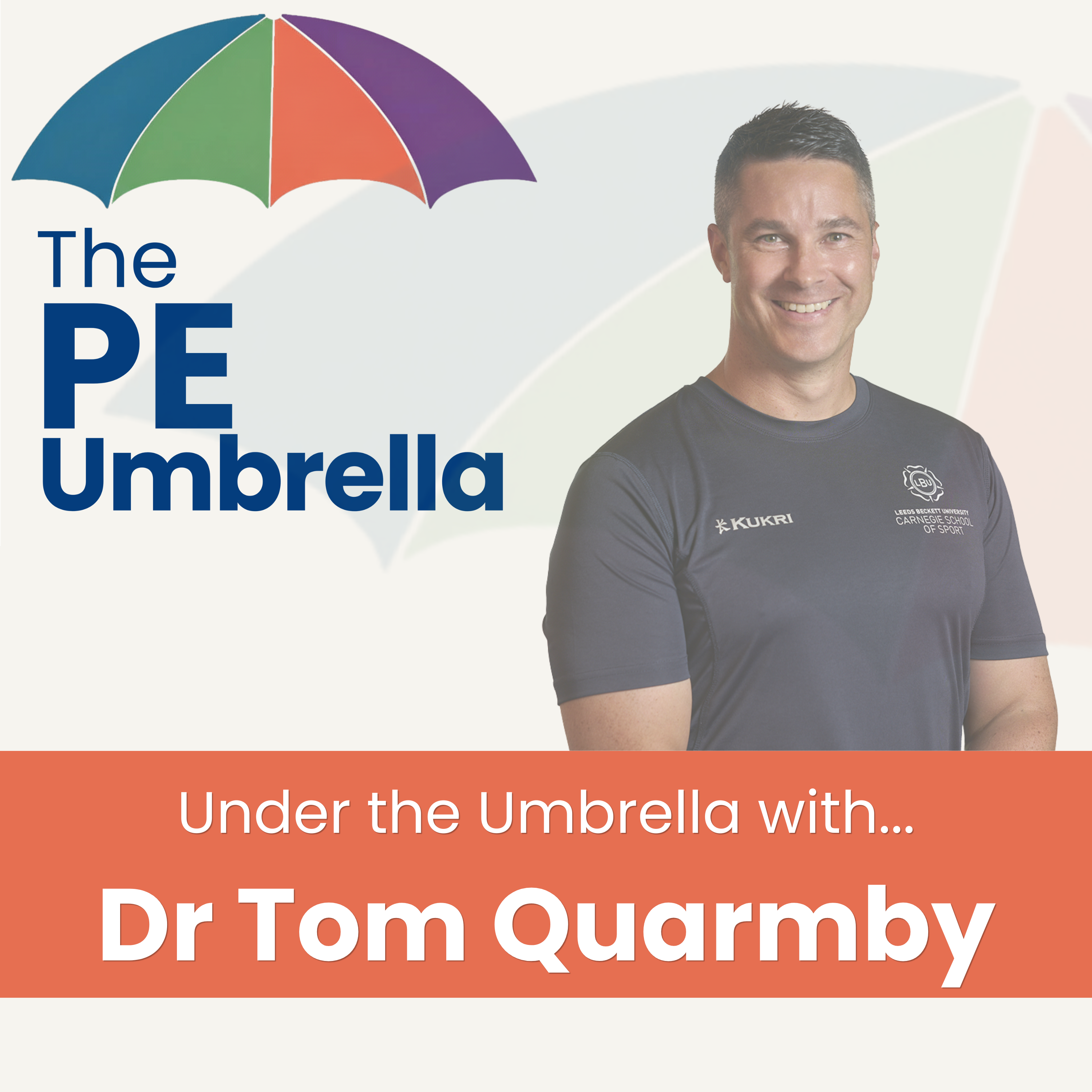
In this episode of The PE Umbrella podcast I am joined by reader in PE & sport pedagogy at the Carnegie School of Sport, Dr Tom Quarmby The conversation explores trauma-informed practice in primary PE, discussing the impact of trauma on children's behaviour and the role of physical education in supporting pupils who have experienced trauma. Tom shares insights on trauma, its manifestations, and the principles of trauma-aware practice in PE. We also delve into facilitating and responding to youth voice, creating routines and structures, and reframing competition in a trauma-informed way. This is a conversation you can't afford to miss. So what are you waiting for? Come on over and join us under the umbrella.
The PE Umbrella: Hello there, everybody, and welcome to the PE Umbrella podcast, the place where we discuss and share practical ideas to help you deliver better primary PE. As always, thank you so much for taking the time to join me today. With me under the umbrella this week is reader in PE and sport pedagogy at the Carnegie School of Sport, Dr. Tom Kwambi. ⁓ Thanks for joining me today, Tom. How you doing? If there's one thing that I care really deeply about with the PE umbrella, it is helping to elevate conversations around primary PE and physical development. Every listen, ⁓ share, comment or rating genuinely helps those conversations reach more teachers, schools and educators. If the podcast has supported your practice in some way, Tom Quarmby: I'm great. Thank you, Ronan. Thank you very much for having me. The PE Umbrella: leaving a quick rating on Spotify or Apple or indeed anywhere you listen to the show would mean a great deal. Thank you so much for continuing to support the P.E. Umbrella podcast. But for now, let's dive into today's episode. Welcome back to the P.E. Umbrella and episode two hundred and fifty five. It is my absolute pleasure. I'm very excited to chat with you today. Today's conversation is one that I think many of us in education have probably heard referenced more and more over recent years. Trauma informed practice is going to be our topic of discussion. We'll be talking about things such as what it looks like in practice and perhaps more importantly, what does it look like practically in a busy primary school setting? But before we get there into all that good stuff, could we maybe start Tom by getting a sense of you and your background in the space and maybe this space in general as well. Tom Quarmby: Yeah, certainly. So I'm going back years now showing a little bit of my age, but I did a undergraduate degree in physical education and was all set to sort of go on and work in schools and then got roped into doing a PhD at the University of Birmingham, which was a slight pivot on where I initially see myself going. a PhD at the University of Birmingham, which was around different families, so people from two-parent traditional, what would be classed as nuclear families, step-families, lone-parent families. And when I'd finished that, came to work at Leeds and decided that I needed to extend what I'd started to do because as part of my PhD, I started to work with young people who were care experienced. And my naivety at the time was I thought, well, if I just got friends to speak to me in a pair, then I would generate lots of really useful data. And it worked for most of the young people that I spoke to, but it didn't work for the young people who were care experienced. And what I found was they just repeated basically everything that I'd said. you know, what, what'd you like about PE? Well, I really like how active it is. And they would go, yeah, I really like how active it is as well. And so from there, I. started to work in the space of working with young people who are care experienced up and down the country with some fantastic colleagues from Loughborough University, Rachel Sanford, Oliver Hooper. And that sort of started to spiral into getting an understanding of the background of those young people to see what works well when working with those types of young people. And that led to this sort of recognition of trauma. and adversity and how that impacted those individuals in particular, because if we think about care experience, young people, you might not always know who they are in a primary school setting. We should do, I think, but we might not always get that information when we need to. And a lot of those young people are in care because of a variety of different adverse experiences, and that can affect the way that they engage, react to situations, etc. So then we ended up working with Rachel Green from Australia, a university in Australia at the time, who was doing a lot of really great work around sort of trauma-informed practice in the state of Victoria. And as a result of that, we started to look specifically around what could trauma-informed or trauma-aware, trauma-sensitive, various different terms for it, PE look like for those individuals, but for other individuals as well. The PE Umbrella: Mm. Great, love that. So you've taken on as a bit of a journey from your starting point and the number of avenues and crossroads that you came to to get to where you are, sat talking with me today, of course. So if I use the term trauma informed throughout our discussion, perhaps, so Tom, for listeners who are maybe unfamiliar with that area, maybe today is the first time they've heard it, where is the best place to begin? Tom Quarmby: Great question. think with trauma, so trauma seems to be a bit of a buzzword at the moment. It's being used a lot more and more frequently across a variety of different settings. And I think what we mean when we're talking about trauma-informed practice, trauma-informed physical education is having an understanding of what trauma is, how it manifests in particular contexts, and how we can be sensitive to the needs of those individuals who might have experienced some form of trauma. When we say trauma, trauma is recognised as something that impacts an individual's capacity to cope. Now that might stem from their prior experiences. So there was a study in America by Felletti and colleagues years ago that looked at adverse childhood experiences. and adverse childhood experiences were things like abuse and neglect and other things related to sort of household dysfunction. And at the time, what they believed was that if a young person experienced abuse, neglect, household dysfunction, any of those, then what it could do is it could impact on the way in which they develop to the point where ⁓ In some cases, it alters the DNA and myelination of the brain, the development of the brain, and leads for them to react in different ways that you would, I'm going to use my bubble, speech bubbles, my bunny ears, ⁓ normal children and young people might. The PE Umbrella: And I think what I think is interesting about that as I'm sitting and learning as you are discussing there as well, you spoke about the concept, you know what it is and how it might manifest. But I think that almost definition, if you will, gave there about something which impacts individual capacity to cope from their prior experience. And I'd imagine there's an array of things that have a greater or lesser impact depending on what said experiences and where they come from. What, if anything, have you seen? few years gone by or even today, what might teachers misunderstand about this term? Tom Quarmby: Yeah, great. think the challenge is having an understanding of how those different types of adversity can impact an individual that might then cause them to react in particular ways. So I'll go back a step further in order to get to where your question was. And bear with me because I'm going to try and not a neurobiologist or anything like that. But my understanding is The PE Umbrella: You Tom Quarmby: If an individual experiences some form of adversity, so whether that's physical, emotional, sexual abuse, whether it's physical, emotional neglect or anything related to the household, which might be a parent going to prison, a ⁓ divorce, something as what we might think as simple as a divorce, because every individual react to these types of adversity in a different way, in essence. So if an individual experienced those types of events, then what it does is it generates a stress response in the individual. And there are three different types of stress response in essence. So there's something like a positive stress response, which is what we want everyone to experience. So that might be a child having an injection. My own children have an injection for instance, and they absolutely lose it. It's uncontrollable, but a Haribo will bring them around quite quickly. So it's a brief increase in heart rate, elevations of the stress hormone, but it's in a sort of controlled environment. They get a cuddle, get a Haribo and stress comes back down to normal. If it's slightly more serious, but again, temporary, it's known as tolerable stress. So that might be, for instance, the death of a relative. So it's not a nice environment to be in. The stress levels are elevated, but they're mitigated by positive supporting relationships. If on the other hand, an individual is experienced to different forms of adversity. So those ACEs that I mentioned earlier, and that's prolonged over a period of time, then the stress response becomes hyper-activated. And in the absence of any protective factors, that's when that stress response becomes really toxic. And It's an individual's response to those ACEs that determine whether or not that becomes traumatic. So if that toxic stress gets to the point where they cannot cope with it, it might mean that they act out in particular ways. And they might do that because they, they're pushed outside of their window of tolerance. So you're still with me here. Yeah. So basically if an individual experiences toxic stress, The PE Umbrella: Yep, still following. Tom Quarmby: over a prolonged period of time, it impacts their ability to regulate their emotions to cope. It means that their window of tolerance becomes a lot narrower. And if we push an individual outside of that window of tolerance by triggering them in some way, shape or form, shouting at them, bumping into them, something like that, then it means they either become dysregulated in the sense that they become hyper aroused. So really distraught, panicked. enraged, hypervigilant, not thinking clearly and have really rapid breathing. Or they might be hypo aroused. So if we push them out the other side of that window, for instance, disassociated, withdrawn, shut down, there's sort of the lights are on, but no one's home sort of look. And it's those sort of reactions that I think you do occasionally see in classrooms in PE settings where an individual has been knocked outside of that window of tolerance and you can't communicate with them. They're not regulated and therefore they're disassociated and sat down in the corner. The PE Umbrella: Mm. Yeah. And I'm sure I can think of people in my mind now, pupils years gone by that I've taught who fall in both of those categories. I'm sure the listeners right now could probably picture individuals as well. If there's a reaction either side of that spectrum, hyper, hypo aroused, is it always as a result of trauma or could there be other factors at play which maybe have nothing to do with Tom Quarmby: Hmm. Absolutely. It could be a range of different factors that cause an individual. We've all got a window of tolerance. I don't, for instance, if I look at myself, I don't think I've experienced different types of adversity, but we all react differently to different situations. So I know that I could be triggered by something, but it's not directly related to trauma. The likelihood of an individual being pushed outside of a window of tolerance and experiencing hypo or hyper is more likely if they have experienced adversity when they're younger. And so, you know, that leads to a range of different things in a, in a PE context that you might see. So if we think about PE specifically, things that might trigger an individual and knock them out of that window might be an inability to handle a pressure situation. The PE Umbrella: Mm, yeah. Tom Quarmby: ⁓ it might be a small foul that escalates into a full blown brawl. ⁓ from nowhere that you just see it in. I've seen it at the weekend on my son's, ⁓ training where accident accidentally one child clipped another child's heels and it just blew up out of absolutely nowhere. you know, individuals who might refuse to be part of a team. in a PE environment, that might be the result of a prior adverse experience or sort of traumatic experience. Not forming connections with teammates is probably one of the most overt ones that you might see, especially if the young person has been subjected to abuse or neglect. And then struggling to follow rules. Now, again, there's lots of kids. that struggle to follow rules. So again, it's not always that it's mapped back to a traumatic experience, but some of these things are things that you might see because the PE environment is an environment unlike any other. It's a brilliant environment in terms of being able to build relationships, to build rapport with young people, to have a laugh, to experience different things, but it's not like a classroom when they're sat down doing maths, where there's no physical contact, where there's no loud noises, where you're not asking somebody to perform in front of others. And those things heighten the PE environment for individuals who might have experienced trauma or adversity. The PE Umbrella: Yeah. Yeah, you're absolutely right. It is that as I sometimes branded that compare and despair environment, isn't it? It's everyone can see what everyone else is doing, whether or not you pitch it as being performative or competitive. They're in that space, the hall, the field, the playground, and they can visually see what's going on. Sometimes in the classroom, it's a bit safer. They might know what their partner's doing or someone on their table, but maybe not everyone else. Whereas PE, you definitely get that sense. And it was as you were talking through Tom Quarmby: Yeah. The PE Umbrella: Maybe what early traumas might look like and they'll be subjective to different people. I can by no means claim to have anything to the extremes of some of the examples you gave, but it did spark a memory of mine as you were talking then that I had. And I've mentioned this on the podcast before when I was very young, I think I was nine. We were in the semifinal of a road to the world cup, 98 football tournament. And I missed a penalty in the semifinal hit the bar and it knocked us out. And I was playing for the age group above. I was mortified of course, because we didn't get a chance to go to the final, but I was absolutely berated and ridiculed by my teammates. They called me Gareth Southgate. This was obviously close to Euro 96. And I got for want of a better phrase, hammered. Maybe close to being bullied might be the better word for it for a number of years till those kids left primary school and they were no longer there. And I was mortified. And I look at the path I took in a physical activity and sport environment years after that. And the way that impacted my confidence or mentality in pressure situations, which led to me at times feigning injury because I didn't want to be in a penalty shootout or other things, obviously more mild in some senses, but that early trauma, the feeling that was personal to me really impacted how I interacted and engage with a stressful situation because my only memory of it was I went wrong last time and the outcome was an incredibly negative one. Tom Quarmby: Mm. Yeah. The PE Umbrella: So how can I avoid that happening again? And for me, it's avoiding that situation altogether. Tom Quarmby: Yeah. Yeah, absolutely. Becoming withdrawn from it. ⁓ and it's a really interesting point you raised because I think the original study around ACEs were all sort of household based. They were all, you know, if you experienced these forms of adversity, it might lead to a traumatic experience. And since then there's been a study that had recognized, actually the experiences that individuals encounter are broader than that. They occur in the community setting. ⁓ so you mentioned you know, similar to being bullied. Being bullied is now recognised as another form of adverse experience. Similarly, as in having a small, very small, limited stock of social capital, a small friendship group being rejected by your peers, similar to the experience that you talked about, you know, for other young people having a lack of food and all of those different things witnessing community violence. All of those other experiences are things that might impact on the way in which an individual behaves or reacts in particular contexts. The PE Umbrella: And it's really interesting what you're saying there as well, because it's got me reflecting on that, job of a primary school teacher who are spinning a number of plates as it is. And there'll be some more obvious, I guess, traumas or knowledge about some pupils in school. But then some of them, like mine, would have never been, mine was more hidden. Let's take my example. Teacher would never have known, never made, because it was those small conversations or words that were said to me in the dinner hall. Tom Quarmby: Yeah. Hmm. Yep. Hmm. The PE Umbrella: but they've still got to maybe adapt accordingly. So a teacher's got a very difficult job. And if we look at perhaps a PE context then, primary PE in particular for today's conversation, Tom, if we've got this knowledge of the vast array of different children in our care, in our class, if we're looking at trauma informed as that term we've spoken about, of course, is it then about changing PE completely or are we just simply changing how we understand and respond to the children within that setting? Tom Quarmby: So I think there's two elements to it. think first and foremost, it's not a let's throw everything we've ever done out of PE out the window because PE, sport, physical activity is really, really valuable for all children, but equally valuable for those who might have experienced adversity. So we don't want to take away some of the elements of competition, the elements of challenge, because Bruce Perry's talked about previously that sport as delivered through PE can provide moderate pattern predictable doses of challenge that are beneficial for young people and help them to counter those earlier experiences. It provides a positive social setting, a sensory and regulatory activity where individuals can learn new skills, which again is beneficial for those who might have experienced adversity. It's the patterned and repetitive movements that we do in physical education that are said to be really, really beneficial for those who have experienced adversity. So Nike, for instance, have got a couple of comics that they've got about patterned and repetitive rhythmic movements, and they use skateboarding as a means of helping children to regulate. So for instance, I see children at school scooting around. in the morning before school, because it helps them to regulate. there's elements within PE that we want to keep. We still want to keep the other elements of physical education. think what we have argued for, and when I say me, I'm going to throw all of my colleagues under the bus here. you know, Rachel Sanford, Oliver Hooper, Shirley Gray at Edinburgh, Rachel in Australia. What we've sort of argued for is if The PE Umbrella: you Tom Quarmby: teachers are more aware of trauma, the impact of trauma and how it manifests, then we might be better able to predict and respond to those moments where there are triggers and flashpoints. And so we'd identified, well, not we, working with young people across a range of different contexts, the young people have told us that there are a set of principles that they think would be beneficial when delivering PE. So it's not necessarily throw everything out that is already happening in PE. It's about what are we doing in PE and how can we do some of those things a little bit better? So the principles that we'd sort of identified in terms of, and we talked about them in terms of being trauma aware principles, because it's a stepping stone towards being ultimately a whole school trauma informed approach was around how do we Currently, and how can we do more of facilitating responding to youth voice? Because if young people think that they're being listened to and heard, then it's beneficial. How can we establish routines and structures? What do we already do in that space? Because if an individual has experienced adversity, they likely feel that they have a lack of control. And so being clear on those routines and structures is really beneficial. What do we already do? And then what else could we do to develop positive relationships and foster a sense of belonging? How do we promote strengths and build individual self belief, because a lot of young people that have experienced adversity, their self belief is likely through the floor. And then equally, and no particular order to these, how do we ensure that the environment that they're in feels psychologically and physically safe and supportive for them? So those are some principles that we have argued would support teachers to work with children and young people in a PE space. The PE Umbrella: And I'm thinking, and I will go back to some of these principles to maybe get some practical bits and pieces in a moment, Tom, if I may. But some of them also, as I'm looking at them, I'm thinking, yeah, well, this absolutely can be PE facing, but also I could consider this in my classroom. Tom Quarmby: Yeah. The PE Umbrella: if I'm teaching maths or if I'm teaching science as well. But since we're on the PE umbrella and we're talking about PE, you know, what is it about the subject of PE? Why might PE be one of the most powerful spaces for supporting pupils who've experienced trauma? And then we might get into some of these actionables. Tom Quarmby: Yeah, yeah. So I think some of the points that we'd mentioned earlier, so the value of sort of physical activity in that particular context, which you can't do in necessarily a maths lesson unless that is the most active maths lesson ever, which, you know, I'm an advocate for. But I think the thing that stands out for me is PE is probably one of the most relational spaces imaginable. ⁓ If I think about some of the work that we've done in alternative provision, context, we know that in an alternative provision school, whether that's primary or a secondary school, all the teachers, so geography teachers, English teachers, history teachers are going down to PE and engaging in PE with young people because they recognize that that's the space where they can build relationships. And if they can build those relationships there, it's going to transfer back into other settings. If you ask a lot of children, young people to identify their favourite teacher. teachers are right up there. It's a really, really valuable space. But equally, some of those are the points. know, PE does things that other subjects just can't do. The general benefits of PE, helping to regulate children through movement is really, valuable. The PE Umbrella: Yeah, good. I like that. And I think as you're saying it, I'm sitting here nodding and thinking about instances in years gone by working in school educational settings and that relational aspect and building relationships and times when I've done that as a teacher, might be, know, maybe not even PE, but when I've gone out at playtime and I've got a group of children and then they start throwing the ball to me and then I'm just you just chatting while you're throwing the ball back and it's just those opportunities are such a wonderful space for that. So if we Tom Quarmby: Exactly. The PE Umbrella: Have a little delve then back into some of those concepts you shared a few moments ago. And they were in no particular order, but in my mind, I'm picturing the listener today who might be a primary PE specialist. Maybe they teach primary PE all the time. They also might be a classroom teacher who is or isn't a PE lead who teaches PE once or twice a week, and maybe don't feel as comfortable doing so and spinning many places we know. The first one you mentioned was youth voice. So... What might that look and feel like for a teacher? How might they be able to start taking steps towards incorporating that in their busy curriculum, their busy day, especially if they're in such a school where the head teacher has said, here's the scheme I want you to use, follow that. Tom Quarmby: Absolutely. So I think the sort of principle around facilitating and responding to youth voice comes down to, and again, it's the key thing about these principles are they're reflective of good pedagogy in general, and they cut across what people are already doing. So it's about elevating that. So it's recognizing that young people are diverse and complex learners. And then it's sort of, if we're thinking tips for facilitating responding to youth voice, then we might be thinking about remembering that children and young people, and I'm terrible at this one, certainly with my own children, but remembering children and young people's emotions are real and valid and not dismissing those outright as they come to you. Recognizing that relationships are strengthened when adults can co-regulate, actively listen and reflect on children's thoughts and feelings and communicate ⁓ empathy. And so we worked with a range of different pre-service teachers and asked them to say, well, the principles are great, but can we come up with some tangible things that you could do almost like a little crib sheet that you could just draw from? And again, we use the principles in a reflective capacity to say, what do you already do? Great. Share that with others. And then what else could we do? So they came up with a range of different strategies. So if you're thinking about how do we listen and respond to youth voice, some people talked about having a traffic light system, a very simple traffic light system. I've seen our university students use this really, really well. Red, orange, green, ⁓ cards placed around the room that act as a means of checking for understanding. But also if somebody's starting to feel like they're moving towards the red, they don't understand or they're getting a bit agitated. They could go and stand by the red and then a teacher's aware of it and goes, okay, maybe, maybe we need to do something here. So the traffic light system works really well. ⁓ other things around, how do we capture youth voice as a range of different things that use sport trust street games have got all their youth voice toolkits and it's things like drawing on those. I use post-it notes. as a sort of checkout before and after sessions. How, how do you feel? How's this gone? I've got an emoji card. ⁓ it's on my, I'd show you it's on my shelf over there. ⁓ that I just go around with, I use it for university students and it works at all ages where at times somebody can just tap a different emoji. And I know that they are feeling great or not feeling great, ⁓ feeling quite upset. And if they're upset, I need to take a little bit of time to. The PE Umbrella: Hmm. Tom Quarmby: figure out why that is and how we can then get them engaged when they're ready within that particular context. The PE Umbrella: Love that. And it reassures me and makes me feel a little bit better because when you mentioned the emoji card, that's something I used for a number of years just prior to stepping out of that mainstream class teaching. I actually used to use it in the classroom as well as in a PE setting, but I'd have the range of emojis and upon entering the PE space, I'd encourage the pupils just to tap whichever emoji reflects how they're feeling then. And again, at the end, but with a view to, I would just keep a close eye and see who's tapping which emoji and... Tom Quarmby: Yeah. Hmm. The PE Umbrella: If little Johnny or little Sally have tapped one which is maybe a bit negative, I'd try and I'd be mindful of that. And it would try and it would dictate how I interacted with them. But I would also go and have that quiet word because in a school day, this PE lesson might have been just after lunchtime and little Sally might have fallen out with a friend and I didn't know that, but I can get to the bottom of it. The thing which was sometimes the challenge then is playing the balance between I have a lesson to teach Tom Quarmby: Hmm. The PE Umbrella: And I've got content to deliver to 29 others and that takes a bit of time and they need me because I have no teaching assistant, but I do need to deal with this child and I want them to make sure they feel safe included and heard. But how much time can I give them when that's going on? And I used to, I used to find that quite challenging and I don't know if you've seen it and felt it or I've seen anybody who's found ways to overcome that, or is that just the reality of Tom Quarmby: Yeah, I think it's the reality of the situation. think the sort of weighing scales there are, like you say, managing the, I've got 29 other kids that seem to be regulated and ready to engage with one who is either unregulated or upset for a variety of reasons. And it's weighing up, if I focus on the 29, does that one then become disruptive and impact... The other 29 or can I get the other 29 off on a little, so I do a rolling warmup quite a lot. ⁓ you know, we go straight into a rolling warmup. We, we, they know what they're doing straight in whilst they're doing the rolling warmup. can use that time to check in. ⁓ and then they can reengage and then I'll pause the rolling warmup and we'll go over the content, et cetera. So I think it's about it's, it's almost trial and error and. recognizing what works for you and with the young people in the context that you're in and having sort of a this has worked before I might try this or in this context this has worked and no this absolutely hasn't worked. The PE Umbrella: Yeah, and that ties nicely into a bit of advice I've given many times on the podcast as a tip or a key ingredient to PE if you like is try and have an instant starter or something where you can get them busy straight away. It might be a familiar tag-based game, but something that requires little instruction. This is what we're doing because then if you've seen that check-in, you can use that time to see what's going on and try and help and support. Tom Quarmby: Mm. Yep. The PE Umbrella: And I suppose that kind of guides me into what one of the second points you mentioned Tom, which was about routines and structure. So for me, I advocate for these notion of it. Can you have an instant start? Something to get the children busy straight away. Can you tell me a little bit more about this particular space and how it can nurture or support and regulate children? Tom Quarmby: Yeah, absolutely. So I think that the value of this one is that it ties in quite nicely with some of the other principles. So we know that routines and consistency help to create safety, a sense of safety and can help with regulation. And as I said earlier, structure is really important because if a young person has been impacted by trauma or adversity, they feel a lack of control. And so knowing that the same things are likely to happen in a similar order. That helps them to feel safe. helps them to regulate in that particular context. it's not, you know, it might be a case of just repeating expectations, even in situations that are familiar with them. Because again, those patterned and repetitive experiences are thought to be therapeutic and supportive of educational growth. So when we were again asking pre-service teachers around, what does that look like for you? A lot of them talked about, actually it's just being predictable. It's about greeting and welcoming participants in the same place at the same time, ⁓ ending sort of the sessions on sort of a similar note. It's about, from a whole school perspective, it's about being consistent with how we transition between we've finished PE now, now we're going to move back to the classroom. ⁓ some have spoken about actually having a transition song. So, and I love this idea. play music when students, ⁓ come in for lectures with me, but having a transition song when they move between activities or between stations or when they're exiting or whatever it might be even better if that song is between 60 to 80 beats per minute, because that mimics the beat of a human heart rate. So it's, and the other thing is like just forewarning of changes. If the lesson is disrupted because of weather or because of whatever it is, it's as early as possible identifying those ⁓ changes and making pupils aware of it in essence. The PE Umbrella: Yeah, and I'm thinking now, dare I ask you to sing such a song? I don't know any transition songs, Tom, you don't have to sing it. I presume you've got a bank of these songs that you you distribute and tell students they could try. I've never tried one of these songs and I'd be keen to do so. Maybe you can tell me after recording today, but they sound tremendously exciting, I have to say. But what strikes me is the fact that, you know, those five points you mentioned and we've touched upon some there, are very much interconnected between each other. Tom Quarmby: Yeah. The PE Umbrella: And when it comes to this podcast, the PE Umbrella, I obviously often explore on the podcast, wider learning and how that might happen through PE and talk about the blue umbrella physical, green umbrella cognitive, red social, purple umbrella emotionally. When it comes to, I guess, trauma informed PE and looking through that lens, do some of those areas almost become even more important than the physical itself? Tom Quarmby: Absolutely, I think the physical is still valuable because again, learning new skills is beneficial. ⁓ But if I think, sort of from an emotional perspective, ⁓ allowing a lot of the work around trauma related PE stems from social emotional learning, stems from teaching personal social responsibility. ⁓ But if we can use PE to help children and young people understand name and then manage their emotions. That is really, valuable from my perspective. So for instance, there's a couple of activities that you could sort of weave in and incorporate into PE that might work really, really well. So simple things like Duck Duck Goose is a great little activity that You could then stop and have a conversation about, how did you feel when you were doing that? what sort of emotions did it bring up and how did you manage those emotions? I, my, my favorite one, and I'm not advocating this because it can get a bit messy, but my favorite one is blowing bubbles with children, with really young children. ⁓ and telling the young children that you've, you've got 30 seconds, I'm going to blow as many bubbles as possible. And in 30 seconds, I want you to pop as many bubbles as possible. And then we stop and then I say, now I'm going to do it again, but you're not allowed to touch the bubbles. So even if they land on your nose, you're not allowed to pop them. And it works really, really well because we then have a conversation around self-control. ⁓ and I found that really, really, I've done it with adults as well. And what was great with doing it with adults was they said, well, actually I may have looked really calm, but I was actually digging my keys into my pocket because I was really struggling not to pop the bubbles. The PE Umbrella: Hahaha. Tom Quarmby: So yeah, the sort of the emotional aspects, managing your emotions, I think are really, really valuable, the social element, the sort of social dimension of learning in physical education, again, really, really valuable as well. The PE Umbrella: Yeah, I love that activity and idea of self-control with the bubbles. I think I would be hugely struggling if that was me, to not pop the bubbles. But when you spoke about the importance of identifying and naming emotions or feeling different ways, this is something I advocate for all the time is, other than play times, PE is the only other space where you get, I think, such a range of emotions and... Tom Quarmby: Ha ha. The PE Umbrella: I say to the students I work with and anywhere that I go and speak, look, I don't think, I'll be wrong on some counts, but I don't think many children are having these conversations at home with their parents anymore. Not around the table on an evening when they're eating their tea or eating their dinner. I didn't, as a lad from Leeds, that certainly didn't happen in my household. So if they're not having the conversations at home with their own parents, where are they having them? And actually, PE provides the perfect environment. Tom Quarmby: Exactly. The PE Umbrella: force such conversations to happen, doesn't it? Where you can identify a sense of frustration or were annoyed or even even the other side is when you've had success and you're delighted, but what does that feel and look like and how to express it in a respectful way potentially and having those conversations. And I don't see it as a huge detriment taking away from look, we have to be active. Of course we do. It's physical education. Tom Quarmby: Yeah, absolutely. The PE Umbrella: But I see no harm in taking 30 seconds, minute, a minute or two here and there. If we are developing that side of children's understanding, I think it is immensely valuable. Fantastic. OK, so if I just sort of ping you down then, Tom, for any teachers listening again now, what's A small? You can do one or a couple if you want. Practical change that a teacher could make tomorrow, then that might help children feel safer and more successful in PE. Tom Quarmby: Absolutely. The PE Umbrella: You have to think, okay, there's one thing I can try. I've got PE tomorrow. Where can I begin? Tom Quarmby: ⁓ cool. Great question. Again, think the challenge with that is, is it's all driven by context. so what I might say might work wonderfully for one in one context and really not very well in the other context. I think the starting point for any teachers would be to use these five principles and reflect on what they already do. So build it. from, already do this in this space. And then the ones that you think you already do, just try and elevate those. So if it is, let's say, how do I promote strengths and self-belief in children and young people? And if you use that as a principle to reflect on what you already do and then go, actually, what I do quite a lot is I invite children, give them a choice to come up and be a model performer. to model and demonstrate it to their peers, which I think is really valuable for helping them to feel an element of success. I can do this and I'm sharing it with others, but I'm giving them the choice whether or not to do it. If that's a starting point for somebody, fantastic. I think because of how different all young people are, all children are, of how different the different contexts are, I would start with here's some principles. Use those to reflect on what you already do and then pick one and elevate that because it's good for everybody. It's really good for those impacted by adversity. The PE Umbrella: Yeah, yeah. And then it reminds me of a quote that somebody said to me before on the podcast, and it applies whether it's trauma informed or not. But somebody once said to me, good sense teaching is just good teaching for all. It's just good across the board. Do that thing. So if we look at the five you mentioned in terms of youth voice, routines and structures, relationships and belonging foster in that sense, strengths and self belief amongst pupils that you're working with and actually having a psychologically and physically safe environment. Tom Quarmby: Absolutely. The PE Umbrella: which of those can you do more of or amplify and have that self-reflection as a teacher. So if you're listening, maybe consider which of those you could have a go with tomorrow. Now, as we've been discussing, one of the questions that's popped into my mind, maybe even selfishly as I'm hosting the show, but there might be listeners thinking about the same thing. I think we've gleaned from the conversation so far that competitive environments could maybe unintentionally trigger anxieties, threat responses in children, of course, and... Sometimes in PE that happens. I was once told that even if you removed all competitiveness from PE, some children will still find it anyway because that's just what some children do. But equally then, how do we as teachers avoid becoming overly cautious or even lowering expectations to ensure that that status quo is maintained? Tom Quarmby: Yeah, great point. I think there is always a danger when you sort of read any of the literature around anything to do with trauma, aware trauma, informed trauma sensitive work, that there's an assumption that competition is bad. It's not bad. I think we just need to flip the narrative around it. So we know, for instance, again, pattern predictable, small doses of challenge are really, beneficial. So it might be that we say, well, how can we reframe competition so that it's not a, you know, if you watch some really bad YouTube clips of PE, it's not a we'll all compete and we'll put everybody's name on a scoreboard and see who's last. ⁓ but we'll work with you to sort of work on your personal best and how can you achieve, better than you did before. in that particular sense. again, if I think, think of some of the work that we've, we've done in alternative provision settings, where again, a lot of the young people there are, have experienced adversity and have experienced trauma in various guises, they've talked about, well, actually, we do like competition, because it helps us to feel a sense of achievement, but we don't always like competing against everybody else. So maybe competing against ourselves in particular contexts is really, valuable. So I think it's just a reframing of the competition. The PE Umbrella: Yes, I think very much so that notion of you should be looking to be your own best at all times. You are your own biggest opponent as it were. Can you go one more, one further, one better than what you did last time? And really celebrating that should be a focus point. And you mentioned there that notion of when it's everyone against everyone, our names visible. And I've got this image in my head because I know for a fact there are schools who still do this. with things like behavior systems, when there's all the names at the front of the classroom and they move up and down or left to right across. And it's got me reflecting on how's that working out? How's that making children in the class feel? And I still see it. I'll go visit schools. I'll observe students working in them. And it happens. So whilst we're thinking about a PE environment, of course, there are other environments in the school day which may be conducive to these things happening. And we do need to reflect on that as a whole. Tom Quarmby: Yeah, absolutely. The PE Umbrella: Now, as we've moved through this discussion, Tom, I'm keen now to get into what I'll brand, if you will, the quick fire section, but we'll see how quick indeed you can be. I've got three questions for you. The first question in this quick fire section, Tom, is what's one thing every PE teacher in primary PE should stop doing? Tom Quarmby: shouting. The PE Umbrella: that. Stop shouting. Fantastic. Second question. What's one question teachers should ask themselves more often? Tom Quarmby: shouting at pupils. ⁓ Why has this child reacted in the way that they've reacted? The PE Umbrella: And even though it is quick fire, just to add to that, should they be asking that in the moment or should it be afterwards? How deeply should they reflect on that one? Tom Quarmby: I mean, ideally in the moment, in order to better respond, but that's not always possible. And so even if it's reflecting on the after, it might help inform the way that they respond to an incident, an outburst further down the line. The PE Umbrella: Great. And then final question for this section. Tom, what does a truly safe PA environment feel like for a child? Tom Quarmby: That is a great question. This is where you've ruined the quick fire. ⁓ I think it's one where they... An environment, I don't know what it looks like, but it's one where a child goes into an environment and feels that they can express themselves without fear of judgement. The PE Umbrella: I don't mind. I like that. When where a child feels they can express themselves without fear of judgment. And I think that's something we can all consider and take away and on board tomorrow, this week, next month when we're working with the classes that we do. Now, the final question of the PE Umbrella podcast today, is a question I ask many a guest and all guests who have appeared on the show in recent years. And I'd like to know what you have learned about yourself or the PE space, maybe trauma informed space, in the last 12 months that you didn't know. or believe before that. Tom Quarmby: ⁓ I think I have a far greater appreciation of ⁓ the way in which children might respond to particular situations or scenarios and a greater understanding of how I should respond to them that I know that I can take forward into my own delivery at university. When I do go into schools, when I coach football, the way in which I engage with children and young people, simple things like I now go to any discussions that I have, we have circle time. So we all sit down on the floor. I sit down on the floor. So I'm at the same height as the children, which isn't, you know, hard because I'm only five, eight or whatever it is. And we have a conversation there. So I think that's something that I've learned. throughout this process that probably I didn't always recognize or implement previously. The PE Umbrella: I love that. What a great way to wrap things up. Now people listening have no doubt got so much useful insight from this episode and there's lots of things to mull over. But of course, how could the listeners of the P.E. Umbrella podcast stay in touch and follow all the good things that you're up to, Tom? Tom Quarmby: So I'm on LinkedIn. I can't for the life of me remember what my LinkedIn is, but there's not too many Tom Quambies around. Equally, any of my colleagues work. So Rachel Sunford, Oliver Hooper, Shirley Gray, who are all working with me in this sort of trauma aware pedagogy space. If you Google any of our names, you should be able to find some stuff. The PE Umbrella: Okay And today was such an important discussion. hope if you've listened to this episode, there's something to take away, consider, mull over and even action and implement. And this is just the tip of the iceberg scratching the surface. We could have probably been talking for hours, Tom. So maybe that leaves the door open for in next time. So thank you so much, Tom, for sharing your thoughts and your work with us today. It is hugely appreciated. Thank you, of course, to everybody who has tuned in and listened to the show. It wouldn't exist without you. If you enjoyed the episode, be sure to like and subscribe it, or indeed share it with a colleague, a friend, a family member, to somebody who you think may gain value from listening to this conversation. But for now though, I want you to all keep on motivating, engaging, and inspiring the children that you teach. And I'll catch you all again very soon under the PE umbrella. Thanks again, Tom.