
The PE Umbrella · Ryan Ellis
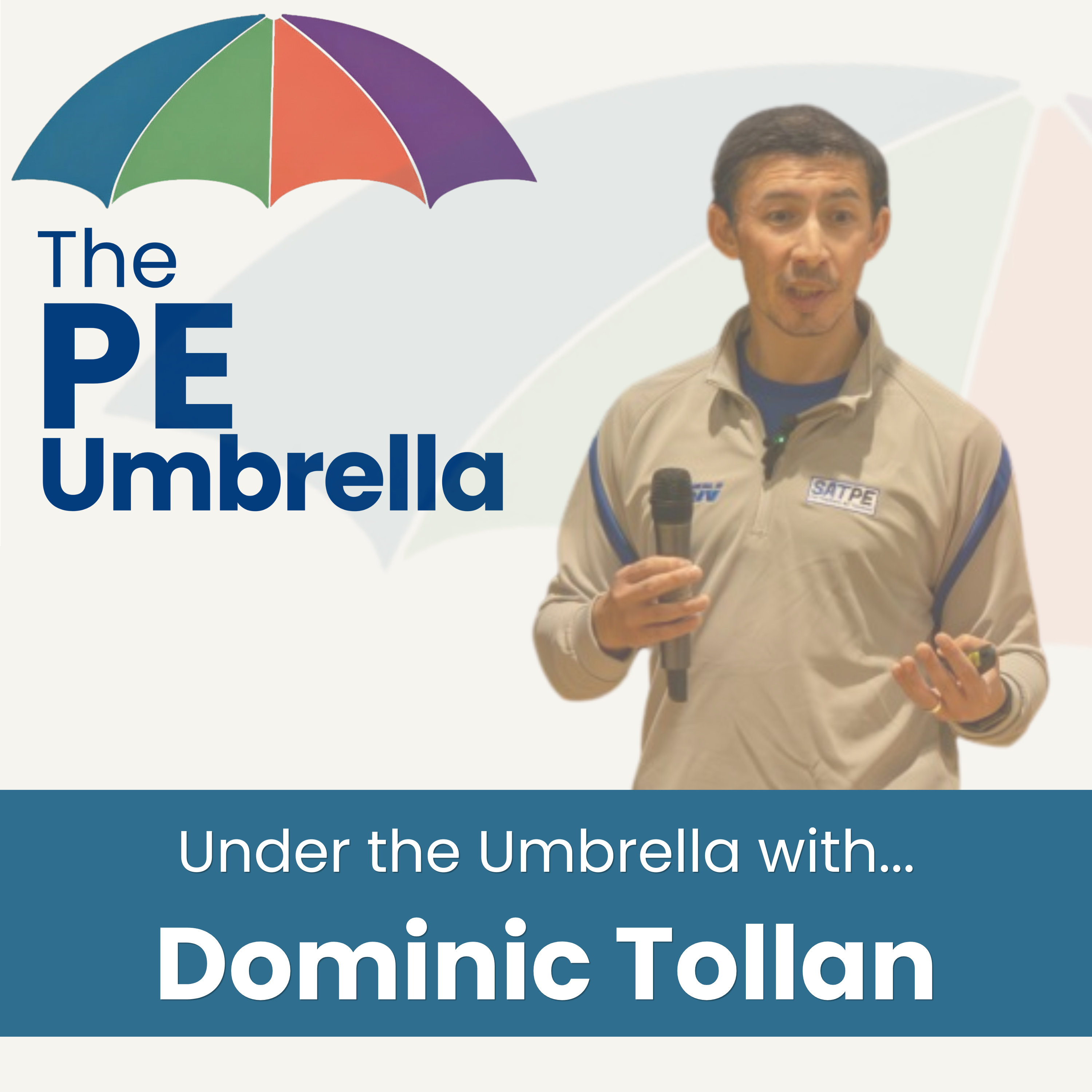
In this episode of The PE Umbrella podcast I am joined by Dominic Tollan for a wide-ranging conversation about what primary PE is really for, and what we might be missing when we reduce it to sport and physical skills. We talk about the role of the primary teacher, the lasting impact of COVID-19 on children's movement experiences, and why fundamental movement skills still matter, but perhaps not in the way we sometimes think they do. We also explore the Make Time for PE campaign and the case for giving primary PE the time, attention and support it deserves. Along the way, we have a really interesting conversation about the relationship between play and PE, and whether we've sometimes made children's movement experiences more complicated than they need to be. We also get into something that sits at the heart of The PE Umbrella: purpose. Why are we teaching PE in the first place? What do we want children to take from it? And how might a clearer sense of purpose influence the confidence, enjoyment and engagement we see in our lessons? It's a conversation about confidence, purpose, play, movement and enjoyment and a reminder that primary PE has the potential to influence far more than what a child can physically do. So what are you waiting for? Come and join us under The PE Umbrella
Ryan: Before we dive into today's episode, a quick thank you for being here. Whether you've been listening since the very beginning or you've only recently discovered the PE umbrella, I'm incredibly grateful you've chosen to spend part of your day with us. If you're enjoying these conversations, I'd really appreciate it if you could take a moment to follow the podcast and leave a rating or review on your favorite platform. It only takes a few seconds, but it genuinely helps more teachers, coaches, and educators discover the show. Together we can continue sharing ideas, challenging thinking, and improving children's experiences of PE. Now welcome back to the PE Umbrella Podcast, episode two hundred and sixty four. Hello there, everybody, and welcome to the PE Umbrella Podcast, the place we discuss and share practical ideas to help you deliver better primary PE. As always, thank you so much for taking the time to join me today. With me under the umbrella this week is the Scottish Association of Teachers Physical Education President, Secondary PE teacher, and returning guest to the PE Umbrella, Dominic Tollen. Thanks so much for joining me today, Dom. How are you? Dom Tollan: A very good round thanks for having me back. It's great to be chatting to you again. Ryan: It's be it's an absolute pleasure, and it has been a number of years since we last spoke, of course. So I suppose for listeners who may not may not know or even heard that episode from a number of years ago, could you just start off by telling us a little bit about maybe your current role with SAT PE or even the facts that your current role is now back in the secondary PE classroom? Dom Tollan: Yeah, so the last time we spoke, I don't want to you a long history, the last time we spoke I think it was 2019. I was working as a PE specialist in a primary school and I think I was the only one in our authority. Since then the funding has been unfortunately cut for that. I moved back into secondary school, but I'm still involved in primary PE through various SAP PE initiatives. I took up the presidency role of SAP PE. I think I'm almost finished my two year tenure for that. That finishes up November time. But basically we're trying to run a lot of different initiatives and things like that to promote primary PE and also to support teachers in their delivery of that as well as doing all the secondary based things that we do as well. Ryan: Amazing. And one of the things we just spoke before recording actually, obviously stepping back into that secondary space as well. Just give me a flavour of something that's maybe been a light bulb moment, or what have your eyes opened to since going back into secondary, which might have shifted a perspective or some kind of lens on primary. Dom Tollan: Well, I think even just having that kind of Covid time, because it was 2019, the last time we spoke, when we went back after Covid, even the pupils had been teaching for all that time within primary school, it was almost as if they'd forgotten what to do and how to connect with each other and how to play games and play with one another. And then when I was moved back to secondary school, we had pupils in primary two, or I can't remember the English, the age is equivalent, but six, seven year olds that were. We were able to serve a shuttle over the net and throw and catch, you know, play certain games. And when I moved back to secondary school, obviously COVID had happened by that point, but some pupils weren't able to do some of those basic skills. And that's not on the pupils, but I think that just shows that there's maybe some gaps there that need to be filled with, you know, the MP provision in primary. And especially when we're getting to secondary school, we're towards, you know, attainment is part of that, but also that kind of lifelong learning aspect. And I think it's really important that we get, you know, these... fundamental skills embedded as early as possible because you can see the impact of that once you get to secondary school and there's all these other kind of implications and stresses and things that pupils have when they move up so I think Ryan: Mm. Dom Tollan: it's important that we take those stresses away or the stresses we can control away from them when they when they move up to secondary school. Ryan: Sure. And that that fundamental lens is something we absolutely will dive into and have a chat about today. I guess my starting point, and I've spoken about this with a few guests recently on the PE umbrella, is I'd like to know from your perspective, Don, what currently excites you right now in the I guess in primary PE in general. You can look at a more localized context or even international. Is there something that is exciting you in the space? Maybe since last time we spoke? Dom Tollan: Yeah, I think that obviously the diversity of primary PE, we've got a lot of primary PE specialists within our kind of SAP PE groups. We've got a specific primary PE specialist group. There's lots of interesting things happening. We've had a lot of discussions about PE and sport and how PE is more than just sport. And it's about the kind of joy of movement. And you can deliver it in variety of different ways. And we've had lots of interesting discussions around that about how to empower teachers. Because when we put the survey out, we'll talk about the campaign shortly. Teachers have got this perception, non-special teachers, that they can't deliver P because they're not sporty. But actually, if we get the kind of basics right and we give them the information that they need and the kind confidence to deliver, I think that they are more than capable and there's a lot of really skilled teachers out there who can deliver things in really interesting ways, which would actually educate us in many respects. Ryan: Yeah, I completely agree with you. And it's interesting that that still seems to be a narrative that goes around of I can't teach PE because I'm not sported, because I don't play sport. Because it's a narrative that seems to have existed for a long time, ever since I've been in this space, which is well over a decade towards two decades, and long before that. And I've tried to change that narrative, but the fact it still exists is suggesting that something's not quite sticking and something hasn't quite changed. You briefly touched upon there something I want to touch up in into which is the the campaign that you've been heavily involved with, which is Make Time for PE. So maybe give the PE umbrella listeners today a flavor of, you know, what sits behind that campaign and actually, why is this conversation still necessary in twenty twenty six? Dom Tollan: I know the last kind of statement there I could go on for hours about talking about why is it still happening. But I think when I moved out of primary school, PE, one of my thoughts was I still need to take the skills that I've learned, the knowledge that I've got, and obviously within my role in staff PE, use that to try and make PE better across all levels. I think that's always our ultimate aim. And I think that, again, looking to that connection into secondary school, you look at where where can we fix or what do we need to address? And think primary P is fundamentally important to that. And we look at that physical literacy journey, that kind of lifelong journey of pupils participating in a variety of different movement activities for health, for wellbeing, for friendship groups and things like that. And we looked at that and thought that's, we really need to package that and this is something that we can really push to try and help, not just within PE circles, but within the kind of wider health, obviously Scotland's had. negative reports back about the health of the nation and things like that and I think this is something that really contributes to that. But the physical literacy journey, if we can start that as early as possible, and I'm preaching to the converted, but we start that journey as early as possible, we can embed the fundamental skills, again we get that across to those pupils that it's not just about sport, it's about, you know, we can take part in a lot of different ways. You can enjoy the movement, you can enjoy the friendship groups, you can try and find your purpose is one thing that we're trying to see that everyone has a purpose in PE. is trying to help pupils find that and I think that if we just narrow it down to sport and you know and there's that perception of PE as sport and that's how it's delivered in primary schools then I think then we really narrow that scope for and that interest for pupils who are missing out on that. So the campaign basically focuses on three main things. We're looking for a national strategy for primary PE so I'm working with Nicola Karrs at the University of Edinburgh. We've had a lot of discussions about that. are in the process of setting up a PE kind of steering group who will help to kind of offer more professional learning for teachers, which is a second point on our campaign as well, to provide more professional learning for teachers to learn about PE, to gain confidence in PE, to learn how to deliver it, to support teachers in that delivery. And then also we'd like more specialist support. And that becomes a bit more political because currently, I don't know if you're aware that the non-class contact time for teachers in Scotland has increased, or there's an agreement for that by 2027. So with the Scottish Government, we've had some discussions with a lot of MSPs, we're still trying to kind of push for that. There's an additional 90 minutes. So what we're trying to ask for is could we have one hour of those 90 minutes so we can put a specialist in to work with the class, but then also be able to network with the teacher who can then take the class forward as well. Because a lot of teachers, primary teachers, enjoy taking PE. and I think it just gives them that kind of confidence. If they don't have that specialist provision at some point, I think they're then building confidence and they're developing their skills and their abilities with that. Ryan: Mm-hmm. And can I can I ask on that, when when you talk about specialist and using that term, what does that mean for you? So is this someone with a particular level or qualification? The only reason I ask is I I I've seen the term specialist be used all over the place, sometimes quite rightly, but also I've heard the term specialist be used in schools over here. And then it's somebody who rocks up in a white van with a bag of footballs and they're teaching PE because they're a PE specialist. So what does that mean in from your lens and perspective? Dom Tollan: I mean, in some ways, I would rather kind of avoid the kind of specialist art because I think every teacher is a specialist in their own way. And I think that's what we're trying to get across when we're doing this campaign. It's not about saying that teachers can't teach. It's about saying that we can support you. know, we need more support in certain areas and the PT environment is so different. I think obviously in Scotland, you know, I'm not quite 100 % sure how it fits down south, but it has to be GTCS registered teachers who deliver within the curriculum time. obviously make connections with coaches and with sports leaders and things like that beyond that. think that specialists are those that have maybe got a kind of additional training in PE. Secondary teachers are qualified to go into primary schools and deliver in primary physical education. But a number of years ago as well, there was a primary physical education in PGDE that was funded by the Scottish government. So think we're going back to about 2011, 2012, I actually did that myself, even though I was a qualified PE teacher at the time. And there's a different scope to primary PE, it's a different kind of type of delivery. And I think even for secondary teachers delivering a primary PE, I think they still need that kind of additional grounding to say, is how primary PE should be delivered. So I think that more kind of specialists, could be a teacher, it could be a class teacher who's got an interest in PE, but who's just, who's got that kind of understanding of what primary PE is all about. But ideally teachers with that additional professional learning with maybe some sort of accreditation and that's another thing that we're looking at at the moment to see how can we get some sort of accreditation. Can we go back to that PGD course, primary PE specifically or is there some sort of way to do that in a more flexible route basis that teachers can then gain some sort of credit for primary physical education. Ryan: Yeah. I I I like what you touched upon there though as well, acknowledging that even you know with with your training and experience as secondary and such, there's still to go back and have a look at that primary space because it is vastly different. And in it and we can't simply think we can take what might be a secondary model or approach and just go that'll work in primary, because we know it is vastly different. The reason I also asked and went down that specialist route is I know that it's been mentioned in the past there'll be a specialist going in, and that specialist will be a very, very good football coach, outstanding football coach. But they're specialists in football and they are a football coach, which is a sport. And then it takes me back to that narrative of it not being just about sport. And it then is no surprise that we're still having these conversations of his PE and sport the same thing, because it's the football coach or the local cricket coach who's coming in with great expertise. But if they are then delivering that sport, it's no wonder we're running in circles with these narratives. And I also think another Potential culprit in terms of these feeding these narratives, of course, is is parents and what children are seeing outside of the school walls. You know, we can bang a drum and we can try and shape their physical literacy journey, if you will, and talk about it not being all about sport. But if then our actions and who's delivering doesn't match up to that, and the messages from parents from their experiences doesn't match up to that, it's difficult to break through those walls. Is is how how how, if at all, is that a conversation you've had regarding people like parents or that wider network who are maybe feeding a narrative. Dom Tollan: I think, you know, when you think about what happened during COVID, there's obviously certain things that happened during COVID in terms of, know, PE teachers and verticals starting to emerge, they gave that kind of different perception of PE. People thought PE was just about fitness and, you know, PE was just about, you know, again, that kind of sports narrative. And I think that there was great areas where, you know, even in schools I'm aware of, know, there was coaches going in to deliver PE lessons, you post-COVID. And that's great to have the support and it's not talking that you know I've done coaching myself and I've been involved in those kind of programs. But I think that it's trying to promote those messages about movement, about skills for life, about health and well-being. And if we go back to COVID, even if we just think about people were encouraged to go out and be active and to walk and that kind of film, the kind of the family aspect of that is being able to participate with your family and do movement activities. We're on to summer games blocks just now on our PE curriculum and I'm thinking. Part of my thinking with that is it's things that you can do when you go to the beach, when you go on holiday, you can, with your family, with your brothers, your sisters, your parents, can we throw a frisbee, can we play a game around this? And I know that's sport in a sense, but it's more about the movement, it's more about the engagement, it's about those kind of connections with people, with friends and with family, so that we can participate outwith, beyond the curriculum, which is the ultimate world looking for. Ryan: course. And I remember back in that the COVID times, of course, we all had a bit of a chuckle about it because of course Joe Wicks became the nation's PE teacher, Dom Tollan: Yeah. Ryan: didn't he? And it was all about bouncing around the living room and staying active that way. And you know, I say that with with a bit of tongue in cheek, of you know, he of course meant well. And for some it was a brilliant lifesaver, but we we could never brand that as physical education as we know it and what we intend for it. You know, w when PE time for whatever reason, whether it's in England, Scotland or around the world then is is squeezed Don, what is it Specifically, that children potentially miss when PE time is maybe narrowed or it's just sil focused entirely on sports. What el what are children missing? Dom Tollan: I think it goes back to that kind of joy of movement and those connections that they can make. think obviously a sporting environment is very different, it's very competitive and even if it's not necessarily geared to be competitive in the class, I think if you put a football lesson on, football is probably the best example, there will be because of the perceptions of that, especially up in Scotland where it's a culture up here, but it does kind of put that perception of this has got to be competitive, this has got to be a certain way and I think it's trying to broaden that and then... to broaden the number of different skills that pupils can learn so they can engage with one another. It doesn't always have to be game based, it doesn't always have to be competitive based. It could be just participating in a variety of different skills and different activities for the joy of it and being able to connect with others and communicate with others and gain that aspect of it. Dance isn't technically part of PE curriculum. In Scotland, think we're undergoing curriculum change, so I know if that will change, but social dance and Scottish country dance is one of those things that we have, as we seem to own that still as a staple of our curriculum diet. And I think if you look at things like that, about being able to socialise, being able to move to music, enjoy movement, enjoy that kind of movement to music, the rhythm and timing aspect of that, again, that's not a sport, but there's so many boxes ticked with that, that pupils can take on for life. And obviously we've been working with the Scottish Country Dance Society recently and we put together, we tried to make those connections with the World Cup. So we produced a World Cup dance that incorporated the McTominay Scissor Kick and things like that. And that just shows you that, you know, it's not just about, you know, even if you've got a sport there, you can use that as an example, but there's other ways to weave that into your lessons and make it more accessible for more people, for more pupils. Ryan: Mm-hmm. And I suppose building on what you've just saying there, you've mentioned the start of that piece, the joy of movement and connection, has been quite vital and and quite key. And I know that when a lot of people, classroom teachers and parents, whoever, think about PE and APE, they do think about physical outcomes and again, maybe even sports. Building on some of what you've just said there, then, how do you individually and how have you over the past number of years? helped others, including those classroom teachers, understand the wider value of PE. You know, what sort of messages are you saying? What practical things are you asking them to implement to help them understand the wider value of PE? That lens for me is the PE umbrella of course. There are a number of ways of looking at that. You know, what is it that you've been saying or doing to help? Dom Tollan: So there's been, you know, we were saying before we came on that there's actually been a lot happening in the kind of time since we last spoke, but I think that through the kind of teaching unions, I was involved in delivering a course, you know, that was looking at primary PE pathways and looking at how we develop PE all the way through the curriculum, but it's looking at different stages within that. So you're kind of early years PE, you're kind of four or five, six year olds, but it's a different approach at that kind of level. But it's also showing that, you know, how we progress through that. So. maybe at the early phase we're looking more at play, we're looking more at fundamental skills, we're looking at fun games that we can develop these skills in, free play. And then as we start to move up the primary school, it's looking at teaching games for understanding, trying to maybe make more connections with sports but not more in a loose sense. And then as we get towards school leaving age for primary going into secondary, yes, we do incorporate some of those sports aspects into that. Again, it's looking at that kind of wider aspect, maybe use some sport education, maybe look at developing some of these skills so they can participate in the more sports oriented secondary curriculum. But I think that looking at that and showing teachers that you've got a really important part to play throughout the whole process. So if you're embedding these skills, look at where they can go, look at the different things that they can take on beyond school. And I think that I'm doing some work with the local authority at the moment in what we are. One of things we've got is it's not quite an assessment sheet, it's more a self-reflection sheet for pupils. And for younger pupils, it's a smiley face chart with all the different skills and they can maybe put a smiley face if it's something they enjoy or if it's something that they're good at. And as they move up, they'll maybe start to go into more profile wheel kind of types of that or like-out skills. So again, they're always reflecting those types of movements. And I think that's shown the teachers that, yes, PE's got a number of different ways to deliver it, but... Fundamentally, we need to have these things underpinning it, but you can deliver it in any sort of way that you want to. I think, going back to the kind of play aspect, I think that's a really good start in place because, in more ways than one, because we can say to teachers who are experts in play, look, you're really good at what you do, the kind of organization of what you do, and how you let pupils explore and develop and create. And I think if you can apply that in a PE setting, that's the skills that you have. Again, it's going back to that specialist aspect, that you're a specialist, the pupils that you have. We're just giving you some of the tools and some of the knowledge that you can use to take that forwards. And I think if we can get that message across throughout the curriculum, for teachers and students, it's not just about sport, but look at what we're contributing. We're contributing to the bigger picture, this kind of lifelong wellbeing. Yes, sport will be part of that and performance will be part of that for pupils who are going to do that, but we don't want to just focus on them. We want to give everyone as accessible a PE curriculum as possible. Ryan: Mm-hmm. And you and you started there to to venture down, bringing in the the concept of play and mentioned play. And I did want to go down this avenue with the conversation with you today. Cause I know you're very passionate about this space about play and PE and where maybe that intersection happens. I know some people will see them as completely separate things. Here's PE over here, here's play over there. How do you then see that relationship between the two when it comes to play and PE? How does that relationship play out? Dom Tollan: So I think that ultimately, when we're looking at, if I'm talking from a secondary perspective, one of the main aims you want to do when you're pupils the different skills that they're having to take part in, ultimately you want to be able to say, right, we've set the game up, go and play at that point, and you want them to be independent within that. So we can take a step back, we can observe, and we can let them take that forward. Because if they go outside the school, again, it's going back to that summer aspect that if they're outside the school or if they're on their holidays. Hopefully they may get a group together and if it's at break times, they'll get a group together and they would set up a game and they can play independently. And ultimately that's what we're looking for because that's encouraging healthy habits and socialization with others as well. And I think that the kind of play aspects really can feeds into that at an early age because yes, it's about giving those skills across. And we've spoken to a couple of play associations as well. And they agree, well, free play is encouraged. from a PE point of view, we need to make sure that we are focusing on certain skills so they can participate and they can engage in some of these activities. Otherwise, it's not as focused, it's not as meaningful. So I think that's looking at, can we embed these skills, but also don't be afraid to take a step back and actively observe and see what pupils are coming up with. And one of the great ones, I used to do kind of small video clips and things at the end of each, you know, for the end of each year for compilation videos. And one of the great things I saw was we would have a theme for the week, so maybe throwing for the week. And then we would say to pupils, here's all the equipment, take out one thing at a time, don't take everything out. So we'd have a free play Thursday. They would pick something up, they would share the equipment, they would share the space, and then they would go and set up their own small games in little pockets. And one of the ones I can remember seeing was we didn't have a basketball hoop in the hall, but one boy took a hoop, stood up on a bench, and somebody was playing basketball with him. And I thought, that's really creative, that's fantastic that they've actually taken the initiative to do it. We haven't encouraged that. but we can watch and we can see some of the things that they're coming up with. And then we can actually as well use some of those ideas to help take things forward. What are their interests? What are the things that are good at? What are the of the creative aspects that they're good at? What are the kind of thought processes they're going through? Whereas somebody might just walk into that lesson and say, is absolute chaos. There's equipment everywhere. are doing 101 different things. But I think if you're actively observing, if we get that point across, that it doesn't have to be all organized and structured and linear. It can just be. it can be controlled in such a way that we can allow people to express themselves and to take some of that independence and can start Ryan: Mm-hmm. Dom Tollan: to again explore and enjoy movement. Ryan: Yeah, and then the the the word coming into my head now is is controlled chaos, but it's not even that. I think chaos is such a strong word. What what that reminded me of when you were speaking there is a term that I've used, which I took from a a podcast guest from a number of years ago from Australia. I don't know if it was Sean DeMorton or Daniel Zito. He used the word expression session. He called them phys ed expression sessions. I use them now. Dom Tollan: Yeah. Ryan: university with my students where we've we've done a bit of work and we've done some activities, but then I give them free reign of the equipment and they've got to design and create their own activities and tasks and they go away, they explore, they play. And I think if we do that with pupils in a primary school setting, and this is why I'm such an advocate of making the pupils in a primary school aware of some of my adaptive teaching approaches, like the STEP principal, space task equipment people, or you can throw time in there if you wish. And I let them know about that because I think our pupils are more than capable of using that framework to adapt and alter some of their own tasks themselves. They absolutely are. And I've seen it. So when we are working on a particular activity, yes, as a teacher, might be my duty to go around and make slight tweaks where possible when I'm helicoptering around the classroom. But I think if we give them that autonomy as well and they have knowledge of that framework. Children, pupils are fantastic at creating things that are maybe just right for them and tweaking an activity and being creative and maybe playing through concepts that you want to align to. So I'd absolutely advocate for that. You did mention though that teachers therefore might want to potentially step back and actively observe. So if you've got a teacher, I'm thinking of these generalist teachers in my mind now, in primary, if a teacher says, I love the idea of play. But I would just wouldn't know what to look for. What should teachers be trying to notice in play? And then what are they doing with that information? Dom Tollan: So I think that we'll be kind lucky still, again, we're undergoing curricular change, but we have a thing called the significant aspects of learning that we have, they're up in every gym hall across Scotland. And that looks at their physical competencies, their physical fitness, their personal qualities, their cognitive skills. And it's got things like communication, like responsibility and leadership, some of these kind of intangible things that you might not see straight away. We're always trying to kind of push that, the importance of PE. Whenever you speak to a non-PE person, say it's not just about throwing a ball, it's about all these other different things they were trying to develop. And I think that if you get that across, that it's not just about the physical skills aspect of it, there's a wider aspect to play here. Pardon the pun. Ryan: Okay. Dom Tollan: you look at what the people, know, so if they are kind of setting up a wee game on their own, they are communicating with one another, they're working together, they're problem solving, they're using space, they're creating different things. And then we can say... here's the fundamental skills we need to develop. And again, it's looking at that. If it's the really younger pupils, we're embedding those fundamental skills of throwing, catching, skipping, running, jumping. looking at that, if teachers are aware that that will positively impact them outside of school and when they get to upper primary and to secondary school, I think if teachers can see that bigger picture, I think then they'll be able to look and see and hopefully be able to recognize that over time and become more confident. Ryan: Mm. Dom Tollan: looking at that I think that's why we can keep reinforcing the messages about this is what PE fundamentally is about but you're a teacher so you should be able to identify these things using the skills and using Ryan: Yeah. Dom Tollan: the tools that you have as well. Ryan: So So is it therefore is it more of a case of being aware of those skills, those tools, those wider things, have knowledge of it so you can in the moment feedback, respond, act upon like a narrative, or is it a case of are they walking around you would you expect them with a clipboard and pen and ticking off boxes and saying, little Johnny's done yeah, I can see that over there? Or is it of balance between the two? Dom Tollan: I think it's a balance between the two in the sense that obviously that's why the pupil individual sheets, we're trying to work towards a pupil passport for pupils that they can carry through primary school. And I think that if the teachers look at that and they're aware of what the pupils are looking for, then hopefully the teachers will be saying, right, this is what we're looking for as well. So there might be an element, some teachers, everyone's different in how they approach things. And I think it comes down to that kind of confidence aspect that... We had 44 % of teachers in Scotland said that they weren't as confident in their delivery of PE and I think that yes, initially I always remember when I go back to my own coaching days, you're taking out a small lesson plan and a post-it note or you're taking notes out with you and over time those started to get put away and you started to develop that confidence and that kind of knowledge and that kind of real kind of natural reaction to what you're doing and being able to tweak things as you go and being able to recognise, you know... when to make small changes, when to step in, when to stop the lesson. And I think that that'll just take time and take confidence of teachers. And I think that there's no right or wrong in that because again, it's the teachers, they can, they in charge of their own classroom, in charge of their own domain within that. And that's what we're trying to get across that yes, you know, there are certain things that you need to know. There's certain things you need to be able to do. But fundamentally, as a teacher, we want to trust you, we want to give you agency and want you to put your own stamp and authority on it. Because you're a trained teacher and... and we trust you in everything that you do beyond PE, so we'll just help you build that confidence within the PE setting, is, to be fair, very different and very more physical in that sense in terms of the domain, in terms of what pupils are having to do in the environment that they're having to teach in. Ryan: Yeah. And and what what you were touching upon there in terms of the current skill set and maybe knowledge of a teacher, I know that preparing for this conversation, one thing you did mention was the belief that every teacher is already an expert. You've already said it once, I believe, in the conversation so far. So could you maybe just put a bit of flesh on the bones of that, Dom, for me and just unpack what you mean by that. Give me some specifics. What do you mean when you're telling me every teacher is already an expert and how give confidence to those listeners maybe who are tuning in now as to so they can go away and go, actually, yeah. I do have these tools. Dom Tollan: My wife's a primary teacher as well so I probably need to make sure I big that up but I think just in terms of the organisation, terms of that, you know, being a generalist teacher, I know you mentioned that word the other and I know that sounds demeaning in some sense but I think in some ways it's actually a real kind of, you know, a lot of praise for primary teachers because they have to deal with so many different things on the curriculum and I think that adaptability and that kind of wider aspect knowledge, the literacy aspect, the kind of numeracy, how to deliver. different topics and different plans and then having to incorporate that into the kind of outcomes that they're having to work towards. I think that takes a lot of skill and a lot of versatility. And I think that if we can get that across in a PE setting, I think actually, and again, going back to that kind of wider aspect of PE, a lot of these things are organic in the lesson anyway. And if you can make that connection to the class topics, if they're doing a class topic on the Titanic or on gardening or something like that, or the World Cup or... lots of different kind of, or Rome, know, things like that. How can they make those connections to say, right, this is how I'm going to deliver my PE lesson. I'm going to make those connections with what we're doing in the classroom. We're still going to develop these fundamental skills, but we're going to do it in a really unique and interesting way that everyone can engage with and the pupils can engage with in a different way. And actually that widens that further experience because maybe pupils will never have that experience again about, you know, I did PE today on ancient Egypt and about carrying the stones to build the pyramid or. or some of these things. And I think there's really interesting concepts in there that I think if we can tap into that expertise of primary teachers in all the training they've got and all the skills that they've got to be able to adapt, I think we could have some really fantastic lessons, some real sharing of good practice. And I think in the wider aspect of it, we start to then change the narrative and change the perception of what not just primary PE, but also PE in general is all about. Ryan: Yeah. And what you're saying there, I completely agree with, and and I fully believe that all primary school teachers can deliver fantastic PE. But you've worked with enough teachers over the years to know that they don't all feel that way for whatever reason. They they maybe do lack com confidence. Where do you think that lack of confidence comes from? Is it purely their own experiences when they were in school, or is there some other missing piece of the jigsaw somewhere? Dom Tollan: So I think it's a little bit of both and when I'm delivering my lessons now, I'm always thinking, and certainly with secondary pupils, we could have a future PE teacher in our class. And I think that their experiences will shape how PE goes forwards in the future. And I think that, I'm always thinking, how can we get that quality aspect across? How can we talk about the wider aspect of PE, not be so narrow about what we're talking about, give positive experiences, and again, going back to that aspect about. the purpose in PE and what is your purpose in PE and why are we delivering it or why are you taking part in it? How's it going to benefit you? And I think that maybe some of these teachers haven't had that positive experience when they've been in primary school, secondary school. And that of breeds a little bit of a kind of a, I don't want say negative mindset, but it sets a certain kind of mindset when it comes to PE and delivering it. Maybe they're dreading going in. And again, maybe again, it's that perception of I'm not sporty, so I can't do it. I don't play sports. But a lot of people are, you are looking at the health and wellbeing just now they're going to gyms, they're taking part in classes and things and actually a lot of these teachers that aren't as confident taking PE will go to some of these gym classes and fitness classes outside the school so it's just again about trying to kind of harness that from an earlier age so that maybe it's not just about the fitness aspect maybe it is about there's loads of different activities that you can participate in throughout your life and throughout your kind of lifespan it doesn't have to be you get to a certain age and you have to go to the gym all the time. There's loads of other different ways you can do this in a more social sense, or more engaging sense that you'll enjoy even further. Ryan: Yeah. And one of the things that's I'm thinking through in my mind as you're speaking as well is and I'm no expert at all when it comes to secondary PE, but that duty of the experience then into secondary needs to be equally as captivating, engaging, and fulfilling for pupils because they could have the best primary school, early years primary school experience of PE. But if that's all unraveled then in secondary, I've worked with a lot of students in ITE and I always start off any new modules with asking about their relationship with the subject, their perspectives on PE. And as you'd expect, some are great, some are not. And oftentimes again, the ones that are not, they'll reflect on an experience from secondary school. I had to do this, that, or the other. We had to play this sport or that sport. Of course there's positives in there as well, but often that's the ones you would expect to enjoy it because they play for the local team and they are, for want of a better phrase, very sporty. So it's I've always thought in my mind, even if we get the Primary bit right, there's still that responsibility because it at secondary it could be undone, and it's the same could be the other way around, of course. So I it it's that through line which is is going right through, which I think is very important, so that when those pupils, students leave secondary school, they've still had a wonderful experience. They might choose to become teachers and then they can reflect that experience back on the next generation. And I think we're in a game, I've mentioned this for years now on the podcast where It is that whole concept of we're planting the seeds of the trees whose shade we'll never sit in. Because we we need to get it right now for years and years, and we might never see the impact it has, but those children currently in reception year one, year two, we need to give them that experience that's phenomenal right the way through. So if that small percentage of them choose to become teachers, educators, and parents. They can then feed back that positive narrative. And we don't still get the same narrative we've already had for many years now. So, what do you think, Dom, is is one thing that every classroom teacher is already doing, maybe in the classroom, that transfers directly to PE. So they could maybe leave, having listened to this tomorrow, they've got a PE lesson. What could they do to immediately enhance their primary PE lesson? Because they're already doing it well in the classroom. Dom Tollan: I think it's, mean, primary teachers are the most prepared teachers that I know because again, because they've got to be, they've got so many different things on and I think it's using first of all those skills and I think on top of that though, it's also been able to let go a little bit and that will come with confidence, that will, you know, about letting pupils explore within the classroom, you know, deliver those kind of fundamental skills but let, you know, don't be afraid to step back a little bit, let things kind of develop and then try and build your own confidence and if this was a a numeracy lesson or a literacy lesson, when would I step in or when would I step back? And I think it's just trying to apply some of those same principles when they go into the gym hall or outside. You've got the skills there as a teacher, it's just a different space that you're working in and it's just different skills that you're trying to develop. And I think it's trying to use those transferable skills across the way and gain more positive experience, deliver PE in a way that you enjoy it as well and have... make most of it when you're in the class and enjoy it yourself as well because PE is really enjoyable if we get the right kind of flavour with it, we get the right combination of how to deliver it and the right kind of themes and topics and an environment for that. think that if teachers can use those skills that they already use in their classroom and put that into the PE setting, I think that they'll be a Ryan: Hmm. Dom Tollan: big part of the way there. Ryan: Yeah, even something simple. I remember working with teachers in the past, and I'm pretty sure at the time they had some form of scheme or generic thing they'd written. And this was maybe a year one class. and they were following it and they had to do let's just I think it was football, but I might be wrong on this. Doing football with year one. You know, I love football, don't get me wrong, but I could see they were visibly not the most confident. And just the mere suggestion of me saying to them, well, why don't you just deliver some of these skills it's asking you to do just through stories? Just tell t tell a story and the children can be mice in a field or they can be animals in a jungle or whatever that may be. The f it was almost as if they were waiting for my permission to tell them they could do that and it was okay. Almost really? I'm allowed to do that, Ryan. I said, Well yes, because you know, we don't have to teach them how to become the next international footballers here. These children are six years old. How are you going to engage them? Because they do it so well in the classroom. If you've got thematic learning in the classroom, these are teachers who will set up before the day starts, pretend dinosaur footprints that have rampaged through the classroom overnight and tip chairs upside down and show AI generated footage of a dinosaur standing in the classroom to really get that buy-in from children and their learning. All right, so let's do that in PE. You know, we can use themes, we can use stories, and they've got such a talent for doing that. And you know, if you haven't heard that before, I'm telling you now on this podcast, you have permission to do that. Absolutely. I'd Dom Tollan: I'll see you in the next video. Ryan: I I wouldn't I'll I'll you turn in a roundabout way at this point in the conversation, Don. Cause I know you mentioned earlier that that free play Thursday, and I don't know if that links in with free play days that you've done before. If it's one and the same thing, I'm not sure. But I do want to go back to that just for you to maybe again reiterate what it actually is. But I want to know what you observed. When doing that that surprised you that maybe you didn't expect to see. Dom Tollan: I think it was the engagement between pupils. think it was being able to step back. When you do that, even for the first time when you do that, there's always a risk element of that. And it could go south really quickly. But actually, you set the parameters up, you step back, and the pupils really bought into it and really engaged really well. Obviously, when there's only one frisbee there or one type of ball there, you may get know, a couple of pupils that are fighting over it, but actually they managed to work some of these things out on their own as well. And I think that was really kind of impressive that, you know, there's lots going on, they're able to share that space, they're able to work with others and take a bit more initiative. And there was occasionally times we had to step in and maybe reset those parameters again and we can reinforce those. But I think just again, it's that kind of risk, you know, no risk, no reward that you give the pupils that ownership, you give them that responsibility. And actually they... they can tend to surprise you a lot of the time in a really good way. Ryan: Is there anything that from your experience now doing that that absolutely needed to be in place before to enable that to be a success? and I when I I'm saying that more broadly, when I say in place, is there certain ethos, lens, structures, rules, routine? What needed to be in place before in order for that to run as smoothly as it could? Dom Tollan: I mean, this probably goes beyond the PE curriculum, but I think even you look at a lot of PE chats and we're always sharing pictures of our nice tidy cupboards and things like that and about how everything's organized. And I think first and foremost, if you've not got an organized setting, if it's not set up in a certain way, I think that's when the chaos can occur. And I think that if you've got all of your things, I was very particular about small balls would go in this box. know, fluff balls will go in this box, hoops will go here. Pupils knew where everything was. So I think to have that organisation for things to take place, kind of almost, if we're going back to football, like getting your kind of back four set up so you've got that foundation to play and let things happen more creatively. I think that you need to have that really from the start so the pupils know, yes, we're able to explore and create and have a bit more kind of freedom, but fundamentally we need to also have that kind of more controlled environment so it's not. It's not absolute chaos in the class. And I think that from that, when they went into, know, picking their own, choosing their own equipment, they were able to put it back. They were able to tidy up at the end. You know, you look at the Japanese fans at Ryan: Mm. Dom Tollan: the World Cup just now, you know, tidying up and cleaning up the stadiums afterwards. And I think, again, that kind of wider aspect is about trying to instil some of these other good habits that aren't just necessarily about PEE, they can really kind Ryan: Mm. Dom Tollan: of, you know, develop really high, you know, really confident individuals, responsible individuals. Ryan: for for me it i it goes back to almost the culture. Maybe maybe it's a specific to PE culture, but the whole school culture. I remember hearing on a podcast a few years ago and I don't even remember which podcast it was, definitely wasn't mine. But it was they were talking about culture of an organization and saying that actually if the culture in a in an organization or a setting is weak, then the people become the culture. They turn into that weak culture. But if the culture is strong, then the culture becomes the people. They will rise that and and and I and I think your example there of the Japanese fans is fantastic. And a lot of people raving about that. But it's not the first time I've seen it. Almost every international fixture or Dom Tollan: Yeah. Ryan: something they're involved with, I'm always seeing these videos crop up because it's just what they do. And I think it's absolutely Dom Tollan: Yeah. Ryan: wonderful. Dom Tollan: In some ways it's a shame that we look at that as if this is a high, know, it does constitute high praise, maybe constitutes high praise because we're not used to that and it needs to be part of our culture so that we're looking at that and going, that's Ryan: Yeah, a hundred percent. Dom Tollan: fantastic, but that's what we already do anyway and that's where you want to kind of get to, isn't it? Ryan: Yeah, surely that's just the standard. That's what we'd expect. You know, if we were all doing that, it'd be a much better place, wouldn't it? Now I'm keen to to hear, and you did actually touch upon some of this already, Don. So forgive me if you feel like you want to veer back to maybe the s a similar answer. But I want to know if in the this this play, the free play days and free play free play Thursday, do you recall any of the children or pupils maybe revealing competences that may be wouldn't have emerged in a more traditional structured lesson. And if you can pinpoint something, you know, what did that look like and how did it raise its head? Was there anything which you thought, actually if we'd have done this the traditional normal way, there's no way I would have seen that or that wouldn't have Dom Tollan: I mean, I would probably go back to that. That was a more striking example of the, you know, the people standing on the bench with the basketball hoop and throwing the ball in. I think that even just for pupils to have that kind of level of balance and stability and being able to hold that kind of hoop in that sense, the other people being able to throw the ball high and into the hoop as a target. I think that's just taken one example of, you know, you may not have seen that in a lesson where you're just doing basic throwing and catching or throwing towards targets. that was them actually, you know, actually raising the level, raising the level that they're trying to challenge themselves and trying to look at different ways to challenge themselves and try different things. And I think even the different types of throwing implements as well that we had in the class, I think even things that you might not be able to cover within the curriculum because there's so many different things that we can deliver. I think that it was given the opportunities to look and see what the pupils engage with, what is the first thing that they all rush to kind of pick up and how can I use that in future lessons because maybe... that, you know, that nerf of rocket that they're all picking up, they were all engaged with that. How can I incorporate that into my lessons in future because that's something that they're really enjoying, that's something that they're really good at. So I think it's using some of these kind of things, using that kind of opportunity to look and see, yes, you know, what are the kind of skills that they're developing that I might not have been able to harness necessarily through the lesson and what are the kind of interests that they have that I've not maybe seen because they've been within the confines of a more structured lesson. Ryan: Yeah, in it's fascinating. And I and I suppose I this is why I'd encourage there always to be some element at some point in a unit of work or a child PE journey to to create a culture where we can pass on that element of agency or autonomy, if you will, in lessons to to children, let them explore, that let them experiment, whether it's a standalone day or whether it's just a an aspect of a lesson. I used to begin some lessons like that with my physical scribbling. giving them five or ten minutes just to explore, show me what they can do and what they know was always really powerful. some of the work at SAT P that I know again prior to this conversation we spoke about is is it the find your purpose campaign or find your purpose as well. So I'm gonna hang hang my hat on that just for a few minutes now, Dom, if I will, and just I want to know from your perspective, what does finding your purpose mean in a PE context? Dom Tollan: So something that we kind of developed, it was actually the theme of last year's conference. We had Jack Carlin, who was a former pupil of mine, international cyclist, and actually listened to him talking about his purpose in PE through school, through sport. It was really interesting to kind of connect that to what we are trying to get across. We've also done a kind of the PE, know, the PE and the purpose and the E, which is PE and everything within that. So we've tried to wee bit creative with the wording for that. I think that... you know, trying to find purpose. There's a lot of different reasons for participating. It's looking at that physical literacy journey and it's looking at why, you know, why am I taking part in this lesson? Why am I doing what I'm doing? Will have pupils that will be in a P setting going, what's the point in this? And I think it's again trying to see and we kind of did have that kind of word map that had a number of different things in it and that's not extent, that's not fully extensive, but is it the social connections you want to make? Is it developing skills for performance, for going to take part in sport? Is it for that, just that movement for wellbeing? Is it because you want to participate with your family outside the school? Is it because you really enjoy what you're doing? There's lots and lots of different things that are within that that I think is just trying to harness that because if you can take ownership of that within your class, it's not just for the pupils, I think it's also for the teachers as well. It's that we may be taking ownership and finding your why within the class, within PE, and then being able to take that forward and find the pathway that you can explore and develop. you know, out with school or out with, you know, for lifelong learning. And I think Ryan: Yeah. Dom Tollan: that really ties in nicely with the physical literacy journey about why we're doing what we're doing. How can I find my why so that I can participate in PE sport, physical activity movement for life. And that might not just be, you know, from a kind physical participation point of view. It could also be that I want to find my why in terms of I like those connections. I like that kind of coaching element. I want to develop as a coach. wanted to go and become a play leader, I wanted to do some of these other types of careers that might at the other end of the scale. But I think it's trying to embed that first of all at an early age, but then continuing that all the way through their Ryan: Mm. Dom Tollan: school journey. And I think that again, if teachers, we're going back to future primary teachers become disengaged in PE, that's because we're not helping them to find their purpose within their setting as well. And if we're looking at that from a teaching perspective. we're not helping primary teachers or non-specialist teachers find their purpose because they're still lacking that confidence to be able to go and deliver PE with all the skills and all the interests that they have. Ryan: Inter interesting. And and it's got my cogs ticking as I'm sat sat here listening as well. And I'd I'd like to know, and this maybe ties back to some of the physical literacy stuff you've mentioned then, if children leave primary school physically competent, but they lack confidence, lack motivation, and/or enjoyment, has PE succeeded and failed? And I'm also going to flip it and say, if I think about that from the lens of let's say English. A lot of the measuring sticks certainly over here being SATs at the end of primary school. If a child is a fantastic writer and a fantastic reader, but they're still, for whatever reason, are not very confident in their ability and they're not motivated to do it and they absolutely don't enjoy it, has English teaching succeeded or failed? Well, actually looking at SATS results, by all accounts, the school would say, we've succeeded. Look at this wonderful progress. Look at this fantastic grade. But actually looking on deeper down, For that child's future has it succeeded if they can't be bothered doing it. And it takes me back to the analogy I've shared a lot recently, which is the Lego analogy from Alan Aaron Beatley saying, you know, actually if you've got loads of Lego, like fundamental movement skills, competences, you can build loads of stuff. There's loads you can do, but it doesn't matter how much Lego you've got if you don't want to use it. So, you know, if a children then leaves primary school, super competent, really physically competent, but lacks the other things like confidence, motivation, enjoyment, then do you think PE succeeded or failed? Dom Tollan: think that there's always going to be external factors that will come into play and I think that if we can control what we can control within our own lessons and get some of those fundamental skills embedded as a first and foremost and try and work on all the other things, again I think that's where the active observation comes into play as well, that as a pupil they might be throwing, catching, striking a shuttle or whatever in the class but they're not really enjoying themselves or they're standing on their own, they're not with other people. So again... we can observe and can see is there something else that we need to try and fix there, we need to try and identify. And then when you go up to secondary school, obviously that transition, having those conversations through the transition, but also then I think trying to, there's always gonna be factors in terms of hormones will kind of kick into play. For girls, the girl participation rate drops about 40 % when it gets to about 14, 15 year old, I think. And I think that... If they can at least engage in the PE lessons with the skills that they've got, yes, these other external factors will come into play, but at least they can still participate. And at least then again, it's about trying to help them find their purpose within that. It's about, yes, they can do these things. We'll control the controllables and control the things we've got and we'll try and then we don't need to work on those things. We can focus on the things that they need as an individual in terms of their confidence, in terms of their enjoyment. But think that getting that again, it's going back to that kind of solid base, having that solid base to work from. If they don't have those kind of fundamental skills as a minimum then we can't really work on the other things that are there because we're having to go back to the basics and kind of try and fix all these things so they can actually engage in the first place and that's real challenge to do that, to have to try and fix a lot of different things at one time. Ryan: Yeah. Yeah. And obviously the USP of our subject is physical. It's in the name as well, isn't it? We can we can't neglect that and we can always talk about, of course, the wider learning and benefits, which is absolutely there. But it is physical and and we have to. And, you know, I I have said many times on the podcast, some of my physical competences, the majority of them I learned from my context growing up on my cul de sac at home with hanging out with my brother five years older than me and his mates and just kicking about the streets and throwing a tennis ball, playing cricket with a wheelie bin, whatever it is, that's where mine was developed. I don't think a lot of mine was developed in a PE context and I came quite proficient. But for some children who don't have that, their context is very different. PE is the only place they're going to be exposed to and learn that. So from your Dom Tollan: in a second. Ryan: perspective then, Dom, if every child left primary school believing just one thing about themselves as a mover, What would you hope it was? Dom Tollan: think it's just knowing that they're good at something. I think it's just knowing that, you know, it's not to dismiss PE as, don't like PE, I can't do it, I can't, you I don't like it. I think that we should be providing a broad range of experiences and a broad range of opportunities for pupils so that even if they don't like football or tennis or basketball, they still say, well, I really like that thing, I really liked, you know, the dancing, I really liked the movement activities, I really liked the target games or... all these, you know, a number of different things that maybe they can hook into and we can just use that as a, like you're saying about that, that seed's been planted there. So if we can then have that conversation with those people, what do you enjoy, what do you like, what are you good at? It's them having the confidence to say, I really like this and this is what I'm really good at. So then we can work with that and we can take that forwards for them and we can find them avenues that they can explore and they can maybe try and find their kind of purpose, you know, from there on in. Ryan: Yeah. And I suppose that confidence is i is almost a key to so many doors when opportunities arise in life, or do you want to try this? Would you like to have a go at that? They're able to say, Yeah, okay. Yeah, I I feel like I can have a go at it. At least I can access that. but all too often that's not the case. And I some I have sometimes in the past seen it with maybe my own parents, where they're bes I know they're older now, of course, but not trying things based on that notion of their own physical competency and not wanting to feel embarrassed. So they don't try it. And I wonder how many doors they've walked past that have remained closed over the years simply because they've not left with that I can do it or confidence attitude. Now, before we finish things today on the podcast, Dom, final question I've got for you. because it has been such a long time since we last spoke, but I want us to hone in on the last 12 months. And I want to know what you have learned either about the PE space or about yourself personally in those last 12 months that you didn't know or believe before that. Dom Tollan: I think that there's a lot to unpack with that. think the last 12 months has been a really busy year. We've worked with lot of different partners and individuals. I I've really enjoyed doing the presidency and that's opened up lot of doors for that. And I think it's just seeing the different connections you can make with people. Again, I'm at the other end of that finding your purpose. It's making connections with people that you would thought we would have never spoken before if it wasn't for that PEE journey and that sport journey. And I think First of all, it's about those connections there. It's also about the kind of the things that you can do if you put your mind to it and you stick to it and you kind of, and you keep going with it. I think it's that determination that we're always trying to encourage in our pupils that there's a kind of small seed there and it's about trying to make that grow and try to make that happen. Yes, you're going to hit brick walls at certain points, so you're to have hurdles, but I think it's, if you really believe in something, I think it's important to kind of keep going with that. And we've got a real belief in this and the kind of primary PE and trying to kind of push it in. Yes, we're kind of, you know, meeting hurdles along the way for that. But, you know, we've had such a positive response back from that, that you then start to think, well, actually what I'm doing as a teacher, as, you know, the president of SATPE and trying to kind of push that kind of national kind of aspect. I think you then start to get a wee bit more confidence within yourself as well to say, I'm doing the right things for the right reasons. And hopefully this can make a difference if we can find the right avenues to do that. And I think that that's probably one of the things that... As I say, go back to the... We had a World Cup day of dance last week that we'd done with the Royal Scottish Country Dance Society. We had 100 schools taking part across 25 different local authorities. And if you told me at the start of my presidency that we would have had that reach, I wouldn't have believed you at that point. And I think that's just a small example, but think that, again, with the PE campaign, we've got an idea there that a lot of people buy into, and I think it's just about that kind of endeavour and that try to get those positive messages out there and trying to make... And I think, on top of that... people start to feel good about themselves and people start to enjoy that wider aspect of PT as well as the fundamental aspect of PT which we all don't need to buy in for but I think it's getting that out to people who maybe aren't like us who don't buy into PT in the same way. I think it's being able to get that message out there has been really encouraging and really inspiring as well. Ryan: Great. And speaking of connection then, Don, how can the listeners of the P umbrella stay in touch with and follow you and your journey and what you're up to? Dom Tollan: So I was in X, but I'm still on X, but I'm probably gonna try to deviate from using that one nowadays. But I'm at Domtp on Instagram. And if you want to look at the SAPP, SAPP, I do a lot of the social media and stuff like that for that as well. So it's at SAPP1 on Instagram. We have a Facebook page as well. our website is sappe.co.uk. We've got our make time for P. If you look up make time for P on Google or. However, you'll see all the different videos and things that we've done to promote that. Actually, one of our big ones was we Judy Murray to provide a quote for us as well, which was massive for us to talk about the value of PE and why we need specialists as well. there's lots of things there. And we're always looking at different initiatives. We've been involved with the Scottish government, with Women and Girls in Sport Week and things like that. We've met so many fantastic individuals. Rose Riley, Scotland's only World Cup winner. So many fantastic people there. If you have a look at that, you'll see some of these things that'll pop up and you can explore that. Ryan: Amazing. Thank you so much. And there we have it. Thank you, Don, for sharing with us your thoughts and your work today. There's so much there to unpack and hopefully action and consider in our own contexts. Thank you to everybody who has tuned in and listened. Of course, the show would not exist without you. If you enjoyed the episode, be sure to like it, subscribe to the P Umbrella, and maybe even share this episode with a colleague, friend, or family member. But for now, I want you to all keep on motivating, engaging, and inspiring the children that you teach. And I will catch you all again very soon under the PE umbrella. Thank you, dog. Dom Tollan: Thanks Ryan, been a pleasure. Thank you.