
The PDHPE & CAFS Podcast with Kelly Bell · Kelly Bell
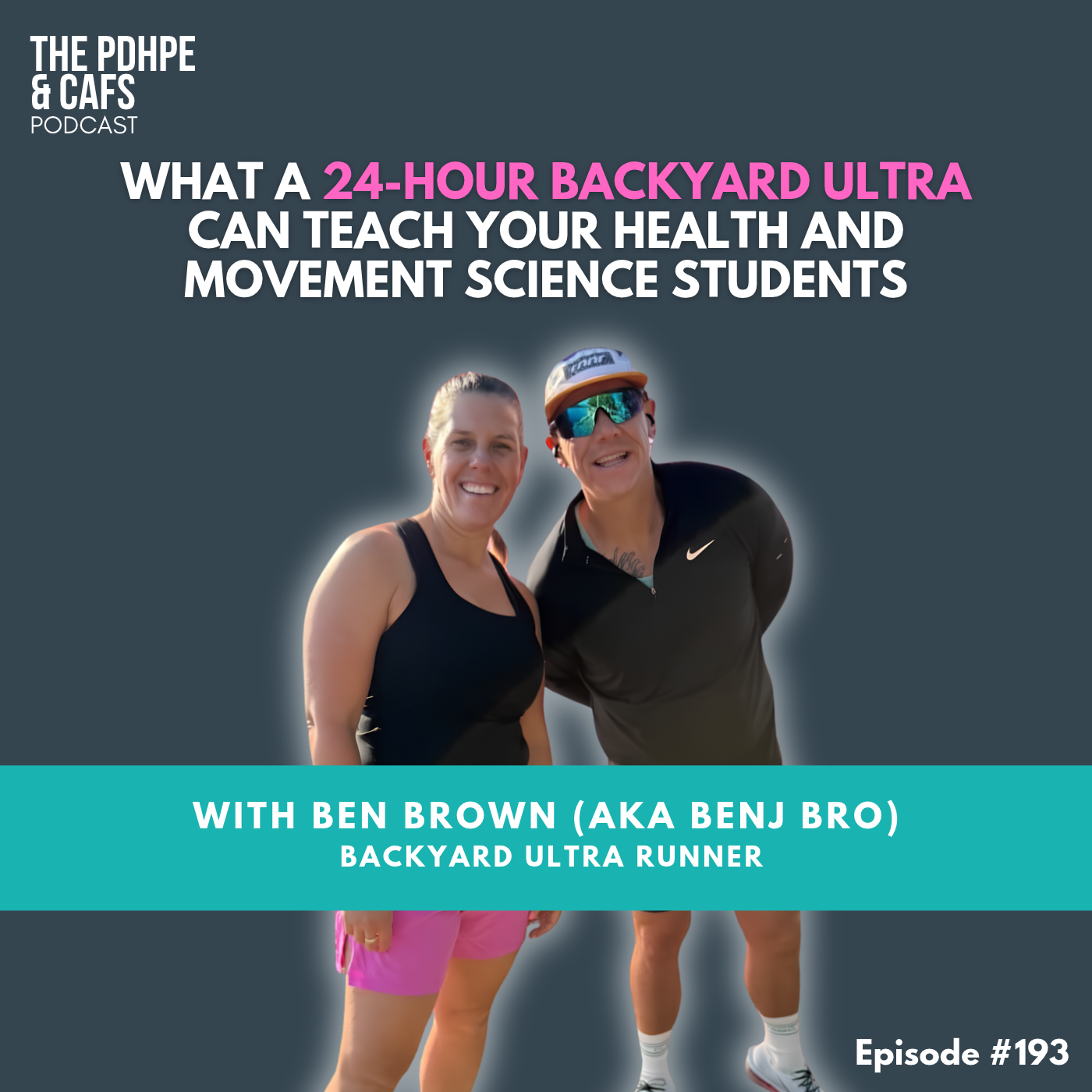
What does it actually take to run 160 kilometres in 24 hours? This week on The PDHPE and CAFS Podcast, Kelly Bell is joined by her brother Ben Brown, fresh from his first backyard ultra. That’s 6.7 kilometres, every hour, on the hour, until you can’t. A year ago, Ben wasn’t a runner. In September, he ran 100 miles. Then he stopped. Not because his body gave out. Because his brain decided he was done. In this episode, we unpack: ✅ Why Ben believes 80% of a backyard ultra is mental ✅ How ultra training differs from marathon training ✅ Gut training and why 60 to 90 grams of carbs an hour matters If you teach Health and Movement Science, this is psychology, nutrition and training brought to life. These are real examples your students will remember. 🎧 Listen now and let’s make it happen. Join The Health and Movement Science Membership 👉 thelearnnet.com/hms
#193 Benj Bro: Hi everyone, and a huge welcome back to the PDHP and CAFS podcast. We're in the home studio and we're with one of my favourite people, my brother Benjamin Brown. Hi Bench. You've never caught me, Benjamin, ever. Welcome to the podcast. Thanks for having me. Pleasure. We're here today to talk about your backyard ultra. First of all, listeners who have no idea what a backyard ultra actually is, what is it? So basically it's running 6.5. Point seven one kilometers every hour on the hour until you can't basically finish a lap. Okay. So basically it could go for ten hours, you could go for twenty hours, thirty hours. What's the record? unofficial record a hundred and fifty two, I think it is. Wow. They call it a yard, so a hundred and fifty two laps on the hour, every hour. Far out. And when did you do your back out Ultra? End of September. Nice. At Sinailes Showgrounds. Okay. So like I was there to witness the start of it. It was something I've never seen before. Like tent set up, gazebos, people had it like all kind of sorted. Mm-hmm. Why the hell did you just decide to go back out Ultra? I went down to they have two a year, one in March, April, one towards the end of the year and went down to watch some friends and just at the time I've been doing a lot of running and got the bug for it and I just thought it would fun to actually do and test myself and see where I'm at. my god. And we like we trained for our marathon this year with dad, so 70, Melissa 55. Something along that me, Millie 45. You? Forty. Forty. And when I think Dad put the message out, do we actually want to do this? Well, I was already signed up for it. I'd already knew you. Yeah, I was already doing it. Yeah, I already committed to doing it. And then used jumped on the B wagon. Yeah. It was sort of the same time. Okay. 'Cause I've always had it on my bucket list. Have you? To do a marathon? Yeah. No. Okay. Up until probably six months ago I never would have thought I'd run a marathon in my life. Yeah. And then so we trained for the marathon, probably started well for me it was a long time starting. We know that. We trained together a lot. You had a six six month training block, that went for a month. Yep. I stopped started, you know, people have heard that story. How is training for the backyard ultra different? And was that like the the plan to go into the marathon and then the backyard ultra but or was that an afterthought? No, it was more of an afterthought. I've kind of I started my marathon training block probably the end It was either the end of last year or the start of this year. I started. We did in January, remember? Yeah. Yeah in Bonnie Hills. Yeah. So that was kind of start of my marathon block and the marathon was in April, May? June? June. Okay. Yeah. June the 15th? I don't It'll tell them the story. so I had like a five-week five-month training block for the marathon. I actually rolled from a half marathon training block straight into the marathon block, straight into the backyard training block. So I kinda haven't stopped since last year. And what was your record before that? Like you you look, you're not a runner on paper. You found running how long ago? Probably probably this time last year, I would say. I ran for, well, I ran for 180 days straight. I started at the gym and just wanted to get my steps up and decided that the quickest way to get my daily steps up was to run instead of trying to walk because I have a busy life working. And so I decided to run to try and get my steps up for the day and then ended up 180 days straight of running, averaging about 7Ks a day. which I think that actually is a testament to where it all started. And build a a really good base for I think the things to come from that. Yeah. Okay, so Back Out Ultra kind of came around, it was last month, and like I I I don't like even I can't even imagine what you actually did, but can you talk us through your training plan and how it was different to marathon training? So marathon training is probably very very specific. There's a lot of training plans online. A lot of people doing the marathon do the same programming. they'll do generally like a a recovery run at the start of the week. They'll do maybe something a bit faster throughout the week. Like a tempo run. Like a tempo run or you know, a threshold run. And then generally they'll do like a long run on a Saturday or Sunday. That's generally the marathon block. It's three runs, maybe four, depending on fitness levels, sh like a recovery run, maybe. Or one run if it's you. And so yeah, it was my marathon block was recovery. Recovery run on Monday, interval or threshold run generally on a Wednesday. Sometimes I had a nice easy run on a Friday and then a longer run on a Saturday or Sunday. And it's very specific. You start at twelve, thirteen Ks for your long run and it slowly builds up. it's like we got to twenty or you've two thirty two. Thirty, yeah, thirty two thirty-five. Yeah, I think I got to thirty f thirty-two was my biggest biggest run. and you look up any marathon plan, that's pretty much where it stops. Yeah. where the backyard training was a little bit different was you train probably a lot more time on legs. still speed sessions, but I had to introduce hill runs. So I was doing hill repeats, trying to get six six or seven hundred metres of elevation in like a eighteen kilometre run. So it's basically kilometer up as far like either as fast as you can or as slow as you can and then back down either slow as you can or fast down the hills. Problem with the backyard is it's different undulations, different terrains. You've got hills, you've got different gravel, dirt roads, bitumen. So you kinda you have to train for everything. So my training block was with an actual backyard coach who's like an athlete who's an athlete who's done it. he's done a lot of ultra stuff. He won the Sydney Backyard Ultra earlier in the year as well. I didn't know that. And he did 70, I think he did 75 yards, which is one yard is one loop. So So that's what's that about 400 and something K's I think? How many days? I think it was about four days, three days, four days. and then so it was similar concept to a marathon in terms of you have that easy run on a Monday, that recovery run, you still got your long run on the weekend, but It was built up then of some really fast sessions, but it was long fast sessions with the marathon. I was probably maxing out at maybe a 10k threshold efforts. So warm up maybe 1k five times and then your cooldowns. Where this was thresholds but over 15, 16, 17 kilometers. it was a long run, but the long runs where the marathon peaked at about 30 odd Ks, my long runs in week one was about 22 Ks. Wow. At the start of the training block and then built up from there. I think to give you an indication, my weekly totals for my marathon training was probably about forty to fifty kilometres and my ultra was about a hundred hundred or so kilometres a week. And so some people do that in a month? if they're training like a half marathon. Yep. Even marathon training, I was doing kind of that sort of distance. Yes. But I was starting from the back foot. We know that. Mm-hmm. That's a lot of training. How the hell did you fit it in? a lot of time running at night, and that's the other thing with the with the backyard, you're gonna be running through the night. So a lot of my training was done at night, and I kind of think that was a blessing in disguise as well, because obviously I work like a nine to five kind of job. So for me, I'd still go to the gym three or four times a week as well. So I was running after I'd go to the gym, I'd come home and run from there. So a lot of my runs during the week were at night, or you know, if I had like a fast interval session it'd be straight from work straight to do some laps and then go from there. So and then yeah long run on a Saturday or a Sunday. So it was a lot to squeeze in. There was a couple of sessions where I was doing like double days like a double threshold day as well. So I was doing 10 Ks before work and then doing 10, 12 Ks after work as well. So if someone would like maybe me who would like to do it maybe next year, I need to really up my training. Yeah. I think the biggest key is this this time on legs. Yeah yeah With the backyard it's not fast. Like There is actually a combination of walking and part of my training was a little bit of walking. getting used to running at set certain paces, but then slowing it right down again, and then like getting used to sitting down for five minutes and then running again, slowing down, walking for a couple of hundred meters, running again. so you're not actually running at your say your marathon pace. it's actually quite a slow run when you're actually doing the event. Yeah. And you get every time there's a hill, most people will generally walk the hills. you do did that so I I held I probably held a 545 to six minute pace when I was running yep and then anything anytime there was a hill any sort of any sort of decent elevation yeah you just basically walk the walk them walk the hills walk the hills yeah because the average don't quote me exactly but I think it's about eight eight minutes forty or eight minutes fifty is the actual time per kilometre that you have to get around to finish the lap in under an hour. And how much time would you have left over to rest? I averaged between. Like sorry, if you if you did that pace. If you did that, if you did that 8 minutes 50, 8 minutes 40 pace, that gets you on the hour every hour. You literally start again. Yeah. Whereas, you know, I could potentially do it in half an hour and get half an hour break. But you're gonna gas yourself after two laps. So there's a lot of strategy involved. A lot of strategy involved. I mean with any sport, with any like it's not elite, but it's coming to you actually have to train for this. You're not like an everyday athlete preparing for this. it's actually har pretty hardcore training, the preparation, the nutrition. Mm-hmm. So you're like you're not an elite athlete, but you're also then not amateur doing it from nothing. You're kinda acting even though you're not an elite athlete, you're doing everything that an elite athlete does. Yeah. You're having to recover because you're doing so many kilometres. Yeah. You've got to look after your nutrition. even on the day itself, you've got to have a nutrition plan in place ready to go to know what you're gonna be eating. you don't have time to think about what you actually what you feel like. You've got to have it all pre planned, ready to go. You've only got ten, twelve, fifteen minutes of time. to you know to sit down and rest, eat, rest, have a little bit of a nap, and then do it all again. So we'll sh we'll share photos of your setup. You're not O C D at all. No. Your setup was crazy and I think maybe like people kind of walked past and said, you've got the best setup here. This is awesome. I think best setup of the backyard ultra. I will say it was the best setup by far. Yes. Very very overplanned, but do you think that plan like did it work? What what kind of during the race did Did it help? I think I just went in with it. I've watched a lot of I I enjoy watching YouTube, I enjoy listening to a lot podcasts. So for me, I'll absorb a lot of that. And I kind of took away, no one told me the setup to have, no one told me what I should have. But for me, I just I took everything that other people have done and set up and you know, spent some time with ChatGPT and we actually came up with a plan. of what I needed to take and what I wanted to have. And I had everything, I had medical. Boxes, you know, whether I got blisters, cuts, grazers, sprains, bit of chafe, you know, Erigard, everything I had, so I didn't have to think about it. If I got back from a lap and something was wrong or I needed something, I had everything hopefully planned enough just there. And look. And it looked good too. It looks good as well. Yes. But it's always looked like, you know, with you, always make sure like the outfit, the shoes, yes, the hat. Yes, everything had to be coordinated, different Lots of different shoes. I do have a problem with shoes. Yes, and we'll talk about that in a s in a second relation to technology. Mm-hmm. do you like how what was your what was your main plan with the Backout Ultra? Like did you just want to finish? Like just going in, I watched some friends do it and they Were they female? Yeah. Yep. Yep. and the girls did it and they ran a hundred kilometers. How many hours? that was fifteen. Yeah. Yeah. That's fifteen fifteen hours. Yeah. So I looked at that and it wasn't easy, but I thought to myself, like, I can do that. Like if that that seemed to be the yeah. Yeah. That seemed to be the If you look at the s the stats of when people finish the backyard, the number one stat generally when people finish is a hundred Ks. Wow. And that's where I I think like for me, if I was to do it next year, no promises, I would like to double the marathon. Yep. But I think first goal, fifty K's and eighty, then a hundred would be like, my god, that's amazing. Yeah, and I think because a lot of it's during the day, it makes it a lot easier. So for me, the first six or eight laps you're in the daytime Yeah, you're not fatigued, everyone's there, it's a bit of a vibe. Yeah, the vibe is insane, you got seven hundred people running. Yeah. there's gazebos everywhere. People everywhere, music blending. Coming and going. Yeah, so it was the first you don't notice the first six or seven loops anyway. Like that's just all a blur. I think do you think that's good for mindset? I know I've been thinking about this, like you do a lap, you're like, okay, yep, let's go, like I can go another lap, another lap. I think so, yeah. For the fur and you bank that you bank those K's early on. Yeah. So before you know it, you're like Wow, I've done a marathon. wow, I've just done an ultra marathon, which is anything over 42.2 K's. So by that stage you've done 50 Ks and it's what is it? It might be four o'clock in the afternoon. You've done 50 Ks, you're like, okay, sweet, I've just got to do another one, another 50. So that was my first goal. My first goal was just I I thought that would be a cool number to get. when we were down there, there was a couple of ex-NRL players who were running. Well, you know that. Who was that? Jeremy Lattimore. James Graham. Yeah, I didn't know that. Yeah, they were running, they stopped at 100. A lot of people we watched all just stopped at 100. Yeah. Whether they were tired or whether that's just a number in their head, which we'll touch on. That was just a number that I think they picked, and everyone has said that's when I was gonna stop. So that was my first goal, and my second goal was probably I thought 24 hours was a cool number to get to. Which is a mistake. Why? Because When you're running for that long, when you got something in your mind that you're training for or where you've got a goal, generally when we hit that goal, that's when our body shuts down and says, that's enough. Yeah, I can't keep doing that. Yeah, well I've I've made my goal now. What what have I got to prove? And that's where I was doing I I worked it out. I was averaging about forty seven minutes a lap. Yeah. So I had about thirteen minutes. Yeah, I I remember in the early case, like we only stayed for four laps, you were like forty five was like your general time coming back. Yep. And there was a couple of lap, I think I had one slow lap of about 50 minutes. I think it was 50 minutes and 20 seconds was my slowest lap. Yeah. and everything else was yeah, 45, 47 minutes generally. even my last lap was still 48 minutes. Like I wasn't I didn't hit. You weren't struggling. No, it wasn't struggling. I was I was sore, I was hurt, I had a sore knee. mentally I was fatigued, but I could have kept going. But because I think in my head I'd said to myself, I want 24 hours. soon as I hit twenty-four hours, that was it. My my brain sorta shut off. I seen the one of the girls that was doing it with us, she'd already finished, they were packing up the gazebo. Dad was down and a mate of mine crude the whole time and they were sort of starting to pack up the gazebo and start to organise a few things. And I think in my brain I thought, well I'm inconveniencing them now. They're I'm in the way now. So I thought to myself, well 24 is a good number so I'll stop. You've got regrets. Yeah. Yeah. Yeah. You you said that because you came back to I picked you up. No, I you came back to our dad Dad brought you back, came back to ours, you had a shower, you tried to rest, tried to have a sleep. Yeah, I wasn't allowed to drive my car home. you said, I don't think you said it that night, but I think the next day you're like I have regrets. Yeah. Only because I put so much time and energy into it and it's twenty-four hours, like I could have had two more laps, I don't know. Yeah, yeah. three, five. I could have had yeah, I did I bashed my toe on the second last lap that I finished. On what? On a rock. Yeah, okay. just like kick my toe on a rock and because I'd already had blisters and, you know, sore feet already, kicking your toe, I had blood coming through my shoe, that was painful. But I would have got over that. Yeah, yeah. but yeah, I I regret not trying to find what my limit was. More because I don't know. Was it another two laps? Maybe I could have got one more lap and that was it. But maybe looking at my times and looking at I listen to as I said to a lot of podcasts and a lot of videos on people, like it takes six or seven loops of starting at like 45, 46, then they start to get to 47, 48, then they get to you know 51, 52 minutes, then they get to 55 minutes. Generally they don't go from a 45 minute lap to then stopping because they can't make that next lap. So they There there's generally a a a trend a trend line going like that up where you see for five or six laps that they've really started to struggle. and I didn't hit that wall as I said. My second last lap was a forty that was really fast. Forty four-minute loop on my second, yeah. Because we're watching obviously, like keeping track of you. Yep. And I'm like, what the hell's happened with that? Yeah. You just get like a second wind or something. Yeah. So my second last lap was my second fastest lap of the the whole thing. I think it was like a 44. four minute lap. Yeah wow yeah what what do you like we we teach like in health and movement science and in the old Petty HP course we we teach about like psychological strategy so what your head's doing like mental rehearsal watching yourself feeling yourself how much you know does our head have to do with what we're doing like I'll put it back to me because sometimes I do I think a like for the marathon it's a lot of head like so So You've done the training. You've done the training and I I I came to the party late. I reckon I started training maybe May, a month before. You probably trained at about twenty percent of what you should have done, yep. Exactly right. but how much of the backyard ultra was like mental? I think probably eighty percent of it's mental. I think if you want to take it on, you've done the training, you've done the time on legs. so I actually honestly think a lot of people could do a backout ultra to a certain degree. I think most people would be able to run A six point seven kilometer run in under an hour. Most people, if they're relatively fit, can move their body okay. Yeah. no matter the age. I think most people would be able to go run six point seven K's. How many times would they be able to back that up and do that again on the hour every hour? That's yeah, that's ten, maybe ten. No, probably not that. Probably someone well statistically a five K race for someone is a hard race. Yeah, true. You know, which is a lot faster. Yeah. Some people have never run 10Ks before. I think after two or three laps if you've never ran before that's when it would be I think a like the barrier. In the training side of things, you know, doing a hundred kilometer weeks, you know that you're I should be able to run you know decent amount of kilometers because you've done you know you've done a 30-40 kilometer run in a day. So you split that over, for an example, I might run I did a I think I did thirty K's in three hours. So if I break that down to six point seven kilometre loops, that might be what's that, about five, six hours of actual backyard time. So I look at that and go, it took me three hours to run th you know thirty kilometers, but in the backyard space I get to run thirty kilometers over five or six hours instead. So therefore I get a lot more time Off my feet. So if I can do 30 kilometers in one hit in three hours, if I get six hours to do the same run, then obviously it means I should be able to go longer. Yeah. So I think you're going into the same as the marathon. They say that all your training, everything that you do prior to the marathon, is where all the work is done. Yeah. The marathon is just a celebration. Yeah, yeah. Same as the backyard. The day of the backyard is a celebration for what you've done. Yeah. And so for me I knew I'd done the training, I knew I had time on legs. Yeah. I built a really good base for the kilometer side of things. So for me, I reckon eighty percent of it was mental. I proved it. As soon as my brain shut down and thought 24 hours is up. And it's funny, the coach that I was working with, Tim, he said the same thing. Do not go into the backyard with a goal. Yeah, that's annoying. Because if you have a goal of what you want to hit, then your brain will literally switch off and say, Okay, you've done that goal now, that's it. Tip done. Done. And that's the way your body works. Your body, you know, your mind may makes excuses it tells you if you like it wants you to stop you stop before you probably should stop because your brain's telling you to stop. You have more in the legs, you have more in the tank, but your brain tells you to stop so you stop. Yeah. And I always think and and I've said this I think you know, like our our long runs in the leader and we we did a lot of long runs together because like s I needed someone to hold my hand. Very painful with you, yes. but like s some actually my long runs were were in Monday. If we hadn't done one, like I think from sixteen to about twenty two, I had done a lot of like You did a lot of them yourself. We did that one long run at Port Douglas. Yeah, twenty eight. Yep. Yeah. Which took about five hours with you. Yes it did. Yeah. But but I think our our mind is so powerful and I think a lot of you know a lot of athletes who are like doing this all the time I think that's the secret ingredient. our bodies will get us partway there, but our mind is I think what really sets people apart. Well what do they say? They say that we only use about 50% of our body's capacities. Interesting. Yeah. And then the rest of it is that we just don't mismantle, we don't use the rest of it. Because our brain doesn't let us get to that point. Tim told me that you get to a certain point and your brain says no. if you can get past that point, it's smooth sailing for a while at least. And then obviously gets harder it gets yeah it gets little niggles and little things that harder little phantom injuries I had this is mental I had a really bung knee at lap fifteen I think it was, just after we got to the hundred K's. Yeah. My knee started to play up. I messaged one of the girls who was crewing for me. and I said, I'm done. I'm out. I like I can't can't run. I was walking at that stage, my knee was throbbing. She said to me, just get back, just finish this lap, we'll get back and strap it up and just see what happens. Just get back. Yeah. I got back, I put strapping tape on it, it felt terrible. I thought that was it. I I wonder if that a little bit of that was my brain because I'd hit the hundred K's I already Another goal. Another goal. I hit the 100Ks. It was literally the lap after the 100Ks. Put the strapping tape on, and the strapping tape lasted about a hundred metres and it started to peel off, I ripped it off, threw it in the bin, and within probably two minutes after that, the pain disappeared. Yeah, so funny. And they call that like phantom pain. Yeah, and it happens like you know, you do lots of reading and research. They talk about it happening during marathon training, like the week before, two weeks before, the day old. Yeah, you get these little niggles. Why is my ankle sore now? What's happening here? Yeah. Yep. Can we talk about nutrition? Because that's something I learnt the very long and hard way during marathon training. And obviously like I'm very special. dairy free, gluten free-ish. Non-diagnosed. Yeah, yeah. How important was nutrition during training and then on the days days? There's two components to the nutrition side of things. One is nutrition training in terms of energy and the other one is nutrition in terms of gut training. Because what are we taught as a kid? When you eat a meal, you wait half an hour to go for you know, go play outside or or whatnot. This sport literally tells you you have to eat something and then go for a run or take something with you and eat on the run. Yeah. So part of the training was when I had my long runs was to start practicing gut training. Yeah. So that was eat a banana, go run. Stop. See, I think I'll be okay with that. Yeah, but then it gets more gnarly when you're having eat a ham and cheese sandwich and then go run. Smash two gels and then go run straight away. Yeah. Have two LCM bars and then run straight away. So that's where, you know, have 600 mils power raid, things like that and then keep running. So those quick carbs. The quick cubs. Yep. Getting into your body. And look, HMS students learn that, the importance of carbohydrates. And for someone who for myself, like I haven't really I don't I eat very clean. I don't eat junk food. My treat is like a you know, a chocolate dairy-free, gluten-free chocolate. I don't I remember like Jaden who would did both of our running marathon training plans, you know, like the carbs, the L C bars, the day before, like nearly two litres of apple juice. Mm-hmm. Apple juice, orange juice, it's all carbohydrates. But it's it's instant sugar. Yep. Converts and then you need to use it in your body. Yeah. Well it's this it's in your it's all to do with your depletion of your glycogen stores. Yeah. So the more those typical quick carb foods are it's Increasing your glycogen stores. And then therefore obviously the gets energy stores. Otherwise your body then has to try and search for other other other means, other sources. So once you're depleted, it's gone. So that's why for me on the on the backyard, you would take a drink out with you every single lap. And what'd you have in that? there's a product called Tailwind, and basically it's just a carbohydrate mixed drink. Yeah. So it's got 30, 40 grams of carbohydrates in that drink already, plus whatever meal you would have every single lap. Whether it be a banana, some custards, some rice, whatever it may be, disgusting foods, lollies, they were good. you know, you might have some overnight oats, you know, a half a sandwich. Little little cooked up toasty on your A little toasty, you know, that's and that's what you look forward to, those little little things. But it's you might get 20-30 grams of carbohydrates from that, yeah. 30-40 grams of carbohydrates from your drink that you take around every single loop, and that's how you keep your. What to drink, what to eat, what to have. I employed a nutritionist, like a sports nutritionist, to help me with that. in terms of knowing roughly how many carbohydrates I think the statistics are for my size is sixty to ninety grams of carbohydrates per hour every hour. Yeah. Yeah. Yeah. I think that's probably an area of weakness for a lot of people. Yeah, hundred percent nutrition. The and I like it's not the water. It's the actual it's all the other stuff. Mm-hmm. Not like, you know, they're hydrated but they're not actually able to use that fuel during that long train training. And it's it's also, you know, if you don't if you don't employ someone or speak to someone who knows what they're talking about, you don't understand how much energy your body uses. Yeah. If you you look at what Dad did on the weekend. Yeah. I spoke to Dad about his So So Dad did the half Iron Man. Half Iron Man. Seventy point three. Seventy point three. On his half marathon run, for his size, he probably should have had they a gel probably every half an hour for Dad. So he was on his and Dad's a tiny top. Dad's a tiny top. But it doesn't so it goes time and legs. It doesn't go on your body weight. Yeah, it goes on time and legs. So Dad did his half marathon in I think it was maybe three hours, was it? Yeah, let's let's call three hours. I think it might have been bit longer. So but that would be probably six gels that dad should have had on on his room. He had one gel. Yeah. And that was it. That's just not enough. Which is not not enough. Our our body doesn't produce enough to then go to the Dad would've dad would have used his energy stores within probably the first hour. Yeah. And then that's it. What did he say to us and that and that video three quarters of the way through that video? Yeah. What did he say at that I think it was the the fourteen, thirteen kilometre mark? Yeah, I feel depleted. I feel depleted. I got no energy. Why? Yeah. Because he's complet and throughout the day, he dad comes from a mindset where I'll have half he's old school. Yeah. I'll have a half a vegemite sandwich and that'll get me through the ride. Dad had just done a 1.9 kilometer swim into a 90 kilometer bike ride into a 21.1k run. Yeah. And he had a banana and a half a a half a veggie mite sandwich and thought that was gonna be okay. When you look at the professionals there, they've got three or four bottles of carbohydrates. Mixes they're probably on their bikes, they probably had six or eight gels on the bike. Then they're gonna have six gels on the on the run. they would have had a gel as soon as they got out of the water, they would have either had a gel stashed in their wetsuit ready to go, or they would have had one at the transition station ready to go, keeping up those those stores. And obviously, the more elite you get, you know, the more energy you're using, the more you need to replace it. But even for someone like dad, he should have been doing 60 to 90 grams of carbs every day. Every single hour on the hour. And Dad, you know, took him X amount of time, seven hours. You know, he should have had, you know, probably what 14, probably 14 gels or equivalent to that. And he had a veggie mite sandwich, a bit of a banana, and a couple of lollies and one gel. But but don't you think it's exciting like to think dad's 70, imagine what potential he actually has? Like that's scary. Yes. Yeah. Can we because I'm almost conscious of time. Because our listeners liked, you 20 to 30 minutes, and think we've gone over time. can we talk about technology and shoes to finish off? Yep. and and then obviously we need to talk about what you actually did. So technology, what what sort of what were you wearing? Were you wearing your garment, your whoop? and did you did you look at any technology while you were doing your laps? so I had my garment on, Garmin Phoenix eight. Yeah and just basically I just had my lap times on there. There's a for the backyard, there's a certain way you can set it up where you can see what your loop is, how long you've been running for, what pace you're running at, you know, at the time, and what pace you need to be going to make sure that you're back in time as well. So setting it up to the right way. So I know that you know, my average pace versus what I'm doing right now. So your average pace, you know, I wanted to be at about six and a half minutes average pace, including walking, so I knew I was gonna get in about 40. five or so minutes if that started to creep up a little bit I knew I'd been going a little bit slow and then you have a pace which is then telling you what you're running right now. They're two very different things because you could look at that after five K's that's an average over five K's but you're running really slow now or vice versa you've ran really fast you know and then you're in front of your time. So I wore my garment I Did wear my whoop, but I didn't really use it until afterwards. I looked at my day strain, it was like twenty three or something like that. But I I wore it just more just I just wanted to see the day strain and my recovery side of things. I think it s took me five days to for my whoop to actually get back to the order. So physically I think were very drained afterwards. Like you could see visually, like just I reckon for like for weeks. Yeah. Yeah. Well it I think it even said like I'd Burnt fifteen thousand calories. Wow. And I definitely didn't eat fourteen thousand calories of of food. So but yeah, in terms of technology that was it. It was literally just the garmin and just the woot, which was only more for recovery, just to see just to my score of where I got to and how long it took to actually for the body to actually recover. Yeah. in terms of shoes, and again we'll share a photo. Okay, yep. so yeah, I do have a a shoe problem. I do like Lots of pairs of shoes. every shoe for every adventure. Just in case. Just in case. I think for the whole time I wore just Asics Superblasts the whole time. Yeah. They're a nice soft cushion shoe, they're not a carbon shoe or anything like that. They've just got a nice high stack on them, they're really cushiony. I did take some trail shoes in case it was gonna rain and get slippery. I had I probably took eight pairs of shoes maybe. maybe nine I think. But I had different shoes and and a lot of people do. You look at a lot of the like the elite guys, they do take a lot of pairs of shoes. More because your feet might swell. So therefore you might want a different pair of shoes that feels a bit different. A lot of people say that they'll get blisters in certain spots from certain shoes. If you get constant blisters in that spot, if you change the pair of shoes, then it'll actually help your feet because you might start rubbing in a different spot. So I took the chance and started with superblasts and they felt really good. I have. Do you have two super blasts? five. Okay, but did you wear two different I think I ended up wearing three different colourways, yeah. Yeah. Just to change it up a bit. Just to change it up a Yeah. One of them had blood coming through on so that's gross. but yeah, I think I had three different colourways on throughout the day. But that's all I wore. Yeah. So and different outfits. Different outfits. Singlets and shirts and hats. Preference preference. I am a very heavy sweater, so for me a hat or a singlet will last me two laps and it's disgusting and gorgeous. So And you did have them very nicely like presented and like ch chosen. I did. Yes. I did, don't worry. Can we finish off talking about how far you got? Yeah. And what was it like towards the end of the backyard ultra? So I got 24 hours, which was 160 kilometers, which is 100 miles, plus some change because the laps aren't exactly 6.7. I think my Garmin set ended up running about 175 Ks in the end. And And I felt like as soon as I'd stopped, I felt like the pain and felt the heavy legs and like I had to sit down straight away and that was like I could that was it. But it's funny, again, the the mental side of things, your brain doesn't know that yet until you actually stop, and then they say that it just it just vomit basically, just vomits itself out and it says, nah, that's it. So up until that I was yeah, I was for the first hundred meters of every lap, it was hard to get going and like get your body to start, you know, ticking over again 'cause you're starting to cool down. But after that I was running the same paces for the whole time. But as soon as I stopped and my told my brain that that was it, then everything just came flooding out and niggles and pains came in everywhere and I just had to sit down. I think for probably two hours I just sat there and and didn't basically move and then probably two days afterwards, struggling to walk and struggling to move. but yeah, no, I actually felt pretty good afterwards. and yeah, that's probably my one one regret that I probably I didn't find my limit and with this race it's meant to be You quit out on the course. On my on the twenty fifth lap, I literally walked I started the twenty fifth lap, I walked to the end of the corral, turned around and came back. So And we'll show that as well. Like that was that was emotional, I think. Yeah, it w and it was nice. But I did that because that was me just had I'd had enough. I was I'd already decided I was stopping. Your your your head decided before your body did go through. I I'd already had that goal that it was gonna be twenty-four hours. As soon as I got that, my brain had s said to myself, That's it, that's it, Ben, that you're not doing it anymore. You don't need to, you got nothing else to prove. I will do it again more for the And you've signed up. I've signed up for another one. For when? April. Yeah. And I just want to see, I wanna I want to get to a point where whether that, you know, when you turn up on the day, you may not feel well, you might get injured. I could do 10 laps and that's it. but I just want to get to a point where this time I'm not gonna have a goal, I'm not gonna set anything at all. I'm just gonna turn up on the day and I'll take enough food and enough clothing and I have a good setup again. That gets me twenty-four hours, that gets me thirty hours, great. Like thirty hours would be nice now, that would probably be the the soft. Not gonna say goal, but yeah, thirty hours I think would be the next challenge. And probably getting back into that second night would be the That's cool. That's probably the the the part 'cause that's when sleep starts. I didn't sleep at all the first night. I think I had a micro sleep, maybe one lap for a minute. but that's where they reckon after the second night. It's like delirium. Yeah, and that's when it starts to kick in. so I just want to get to a point where I physically run out of energy and I physically can't finish the lap anymore. That's where I want to get to. Like you're you're being dragged. Yeah, or like like physically get timed out. I get DNF because I don't make it back in time. Yeah. That's where I want to get to. And wherever that lap is, whether that's twenty-four again, whether that's thirty, whether that's twenty, who knows? but that's where we'll we'll aim for. It's exciting. I always ask our guests, like, what would what's some advice that you'd give to your younger self? Can we finish on that? Yep. It's a nerd question, I know. No. I think little spiky hair, Ben Brown. Yeah. don't take it for granted. What? That we're all gonna be skinny and fit and you can eat anything you want, if I'm honest. I d I think my late teens I started to put on a fair bit weight. Why? Food. Just started to enjoy takeaway food and driving. Driving. Getting your own stuff. Getting your own stuff. And you go from being a young child where your parents tell you what to eat because it's on the it's on the dinner table or it's in your lunchbox. When you become 17, 18, you get your licence, you can go eat what you want. And that's where it's sort of probably changed for me. And so Yeah, probably don't take it for granted. like your body that you have. we only get one of them. And in terms of the backyard, if you wanted to take on a backyard, time on legs. Good advice for k for K B even for you as well. Yeah, honestly, just the biggest thing that I feel is that hundred and eighty days that I did that I ran every day, it wasn't fast runs, they were a lot of them were slow runs. and it was just time on legs. And by the end of it, you can see progression. That's the best thing. About running, and that's a really rewarding thing. Is there's it's not a part of a team where you know there's six or seven or twelve, thirteen people on a team. That's literally you hide, yeah, it's you versus your garment, and that's it, or you versus the stopwatch, you versus the pavement, that's it. Yeah, and so for me, you get a lot of reward out of seeing those little wins. So for me, two years ago, I ran 3.2 kilometers, my heart rate was 160 and And it would have taken me, seven and a half minutes per K to finish that. Now I can go do that in, I did threshold runs today at four minutes. So there's a difference of, you know, you can see like a year makes a big difference. And I put that down to a lot of that is just time on legs. So and don't go in with a goal. If you do it, don't have a goal. Go have fun and see where you get to. Good finish. Thanks for having me. Thank you.