
The PDHPE & CAFS Podcast with Kelly Bell · Kelly Bell
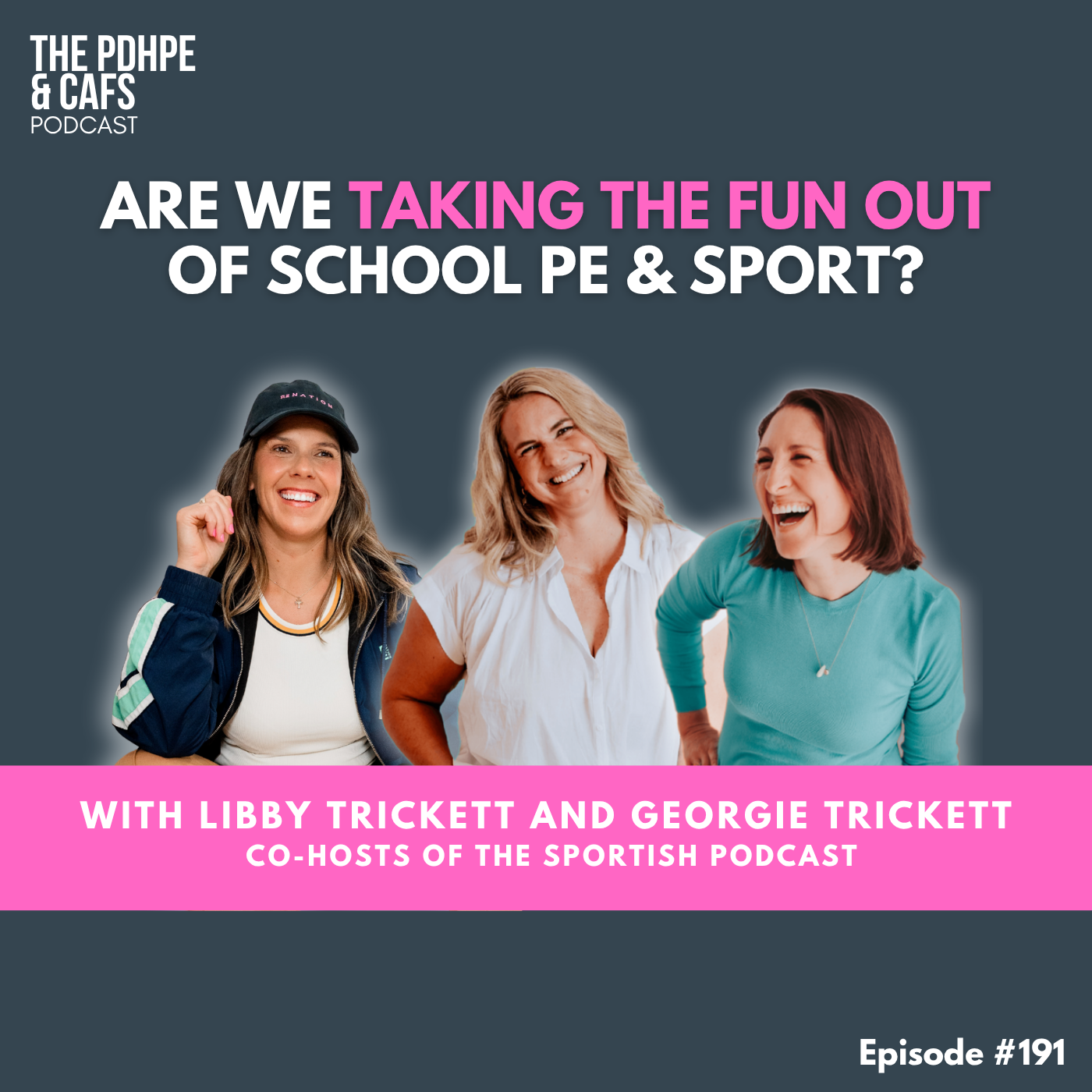
Are we taking the fun out of PE and sport for Australian kids? This week on The PDHPE and CAFS Podcast, I'm joined by Olympic gold medallist Libby Trickett and Georgie Trickett, an everyday athlete, health professional and passionate advocate for inclusive sport. Together, they're the team behind Sportish and ambassadors for the Australian Sports Commission's Play Well Strategy, which is all about helping more Australians find their place in sport. We're diving into a conversation that I think every teacher, parent, coach, school leader and politician needs to hear. Have we become so focused on winning, competition and performance that we've forgotten the real purpose of PE and sport in the first place? Helping kids discover the joy of movement, build confidence, feel a sense of belonging and develop a lifelong love of being active. From primary school PE to secondary PE, we explore the challenges facing young people and the important role schools play in building positive relationships with movement. In this episode, we unpack: Why fun, inclusion and participation need to be at the heart of PE & sport. How we can create opportunities for every student, not just those who make the A team. Why fundamental movement skills and physical literacy are so important. What's contributing to teenagers dropping out of sport and how we can keep them engaged. How the Australian Sports Commission's Play Well Strategy is helping make sport more accessible. Why physical education deserves greater recognition and priority in Australian schools. Whether you're a primary teacher, PE teacher, school leader, parent, coach or politician, this episode will challenge you to rethink what success in PE and sport really looks like. PE and sport should be about so much more than competition and results. They're about giving every young person the opportunity to move, participate, build confidence, experience belonging and discover what their bodies are capable of. And if we truly value these experiences, we need to start giving physical education and sport the time, resources and priority they deserve in Australian schools. This is a conversation Australia needs to have. Hit play, challenge your thinking and share this episode with a teacher, parent, coach, school leader or decision-maker who can help make a difference. It's time to rethink how we value PE and sport, put participation and enjoyment back at the centre, and make movement a priority for every young Australian.
Kell Bell: Hey everyone and a huge welcome back to the PDHP and Caps podcast. If you're watching our recording via video, we are joined by two very special guests in Libby Trickett and Georgie Trickett. A huge welcome to the podcast girls. GT: Thank you for having us. Kell Bell: Thank you so much for joining us. Sportish: Yes, love to be here. Kell Bell: Look, this is a bit of our Yeah, thanks girls. It's been some time in the making. We were very lucky enough to have Libby as our keynote speaker at our K to 10 PDHP forum. All the way back the beginning of May, we were just saying I'm not really sure where the year has gone, but look, it has absolutely flown. girls, I would love for you to introduce yourselves to our listeners. for those of you who aren't aware of who you are, what you guys are up to, at, you know, like in this part of the year. So if you would love to introduce yourselves, that would be awesome. Who would like to go first? GT: I will vote. Okay, Lib, thank you. Sportish: I'll let Georgie go first. GT: my name's Georgie Trickett, and it's so lovely to be here and and and it's it shouldn't have taken us this long to get into your studio, Kel. That's on us. We have been running around like headless chooks, and part of that is because Lib and I are both parents. I am a mum of three and Lib is a mum of five. So our life is very consumed with looking after those Three, not so little for some of them kids anymore. I have always had a relationship with sport. I absolutely love sport. for me as a kid, I was a a softballer primarily, but I also played touch footy and cricket and athletics. I threw a javelin, ran cross-country. I really enjoyed inv getting involved in all sport and and it really was something that always excited me. I didn't make it at Kell Bell: Yeah. GT: all to the highest level. I made it to like a state team at the age of twelve and then a a state squad at the age of fifteen and and I didn't see my softball progress to a point where I would make more state teams or even an Australian team, but I absolutely had those dreams and had those dreams, watched those dreams not become reality. and I know for a lot of kids that can be a point where they step out of sport and I was just incredibly lucky that I had built a great relationship with sport quite by accident, I would say, and and had a love of lots of different parts of it. And in fact, missing out on those teams was probably one of the best things that could have happened to me, although it certainly didn't feel like it at the time. And it Kell Bell: Okay. GT: meant that instead of my world becoming smaller, it became bigger and and the sports opportunities I took up were much broader. And I'm very excited to now as a 44 year old be working in sport in a way where we get to talk about all the different ways that you can connect to sport, not just through elite as as Libby has done so incredibly successfully, but also through those everyday steps and and really advocate, particularly for kids, to be lifelong participants of sport and to have a great Sportish: you GT: starting journey in sport. It's it's amazing work to do. We love talking about it at all times and yeah, I love that I get to do it with Libby. Kell Bell: Nice, look, you're you're very lucky Sportish: Aww. Kell Bell: to have someone to share your love. And I think sometimes, you know, as sporty people we have you know dreams of making those teams and certainly I was in your position, I never made a state team, always at zone, did very well at zone, but kind of never progressed after that. I always say like I'm a jack of all trades, master of none. But anyway, look, Libby Many of our listeners know who you are, but I would love to hear your introduction of yourself these days. Sportish: Yeah, look, think Georgie's summarized what we do with Sportage so beautifully. So for those who don't know, I had the privilege of swimming for Australia for almost a decade and amongst that got to go to three Olympic Games, which is, you know, just the best thing ever. But outside of that, was, you know, it was definitely a journey and before I made it to the highest level in swimming, I, like Georgie, did everything as a kid. I did athletics and gymnastics and touch footy and tennis. I did diving for a period of time. I really just loved moving my body and seeing how strong I could get, how fast I could get. And that was kind of very... motivating to me. And so, like, as I said, I did all sports all the way through my high school, all the way through school in general, and didn't start to focus on swimming until I actually left school, which is also something that we like to talk about on the podcast as well, because I think a lot of people think that if you're going to make it to the elite level, that you have to specialize in focus. very, very young and that is just absolutely not the case. Like Georgie, I am incredibly passionate about the participation aspect of sport because we know that I think it's like less than 1 % of kids will actually make it to the highest level in elite sport. But what sport can bring you, I mean, I was even just thinking about it today. You know, I was really lucky that I got to win Olympic gold medals and break world records and do all of those things. But my favourite thing that sport has taught me is the ability to trust myself and in that I will work it out. You know, that's the stuff that every single kid who does sport can actually, you know, engage with and utilise. And if we as, you know, parents, as organisers, as teachers can't allow these children to experience sport in lots of different ways, expose them to as many different sports as possible. As Georgie said, we will create lifelong lovers of sport. And that's not necessarily to go to the elite level, it's to coach, it's to volunteer, it's to be amongst the sports administrators who can actually be part of it, be part of this incredible thing that we all get to enjoy and be part of every single week. Kell Bell: Yeah, and and look, I think you you hit on quite a few things that I think would definitely resonate with our teachers. so we support primary PE here in Australia and that's kind of a growing area for us. most of our teachers know us for our high school PE support, especially New South Wales. And we always talk about You know, first of all, like we're not teaching elite sport, we're teaching our kids to Sportish: Mm. Kell Bell: love movement, like to move their bodies, to feel what it what it's like to, you know, try a new skill, to test it out. to feel that kind of self awareness as well, let alone all the other, you know, health benefits and social benefits that go on top of that. I think that, you know, that awareness of your own body and that body control is like things that you learn as a kid that you can then take into your your future well into your forties, fifties, sixties and seventies. Yeah, yeah. Sportish: And you can return to it, right? Because, know, particularly as women of certain ages, like we're learning Kell Bell: Yeah. Sportish: to understand our bodies. We're going through a different type of puberty, perimenopause and menopause. Like we're learning Kell Bell: Okay. Sportish: about our bodies where, you know, a lot of us are postpartum. And so we're learning and we can go back to those things that we learned as kids in our sport and go, yeah, I can learn to trust my body again. can. set through these challenges and tap into that resilience that I actually learned as a kid. Kell Bell: Yeah. And look, I think I would love to hear your perspective of what what you think sport does for us in our country, like we of are obviously a sporting nation. that goes without saying we have always been like that. What what do you think sets us apart as a country and where can we kind of work together to improve that, I suppose? GT: Ooh, this is like a favourite topic for Liv and I. I think w it goes without saying I think in this digital age that sport gives us the opportunity to have those collective shared moments that are so rare nowadays and to to feel something that you wouldn't otherwise feel that idea of collective eff effervescence where we're all in it and we're all experiencing it at the same time and and and that's something that we can that we can be a part of even as observers of sport. And I think that's quite a wonderful thing in terms of what makes us unique. I think Australia is incredibly good at being greater The sum of its parts. So by all accounts, we shouldn't be as Kell Bell: Mm-hmm. GT: good a sport as we are, and yet we we perform incredibly well in in particular sports, but overall as well on that international stage. I think we are unique in that way that we work together. I think we are very good at throwing off the idea that you have to have completed 10,000 hours of something to be the best at it. Sportish: Okay. GT: We have Kell Bell: Mm-hmm. GT: this incredible resilience, and maybe that's forged Sportish: Okay. GT: out of you know the things that Australia has had to deal with as a country, but it it's certainly you don't see that in every nation. And I think the fact that we value sport so much and we watch it so much, these are all parts that contribute. I also think you know it's quite rare to have millions and millions of people volunteer for something. So sport in Australia is It represents our our biggest volunteer base. It's bigger than any other volunteer group that we have. That's not by accident and that that has a profound effect on what sport looks like here. Sportish: Okay. Okay. Kell Bell: Mm. Yeah. Sportish: And I would only add to that, you know, it's the final element of realness. know, everything is so contrived, everything is so produced, you know, there's so much production in everyday life, you know, whether it's social media or television or anything like that. Like sport is that last realm where you don't, you never know what the result is going to be. And the anxiety and anticipation of all of that is really exciting to be part of. In terms of what we need to do better, I would say there are definitely some systems in place now that kind of prioritise that early specialisation. And that is certainly a mindset and a perspective and the commoditisation of sport. is making sport less accessible to a lot of people around Australia. And Georgie can speak so beautifully to the cost of sport and the research that's coming out around that as well. I just think we need to create more access. Like Australia is really good at this, but I think we can do better in terms of providing Kell Bell: Yeah. Sportish: as much access as possible to as many kids as possible. you know, as the person who... bloody loves elite athletes and loves elite performance. Like the bigger the participation and the talent pool that we can draw on in terms of kids participating, that's only gonna make us more successful on the world stage. Kell Bell: Yeah. And I think there's like a disparity between what's happening in our country. Like we are great at elite sport, but then we come to a school setting and it's not given the care I will say, the financial backing, and the you know, the the respect I would say out loud. in a school system. So everyone is all for elite sport in a school, you know, winning you know, s state finals or Australian championships, all those sorts of things, that's all well and good. But the actual participation and the physical education that's happening our school in our schools is often the first thing to go. It's rainy outside, we don't have money for that, no, the kids aren't going, the buses are too expensive, we're not doing that. P isn't a real thing. But then I'm like, well hang on, as a country, it is like, you know, it is a thing that brings us together. so often, but then in a school setting, for some reason, principals and leaders still still don't give it the time it deserves. And I and I'm not sure where schools fit in this big kind of picture, but that's something that's been getting really made really fired up lately. Like we spend all this money and time on NAPLAN and literacy and numeracy, but we have like a secret, you know, secret magical pill in moving our bodies. Like imagine if we actually invested more money and more time in our PE courses and lessons. what impact that would have on our young kids. Look I I don't know if you guys have had conversations with people but yeah. GT: Yeah, I think that that movement piece, and the opportunity of movement to work in with academics is so crucial and so overlooked and we know from the Kell Bell: You know. GT: research that you know your performance in academics is improved greatly by movement and yet it it seems to almost be that PE is othered and not seen as an incredibly powerful tool and it you know I find it really upsetting when I hear that you know things like PE in grade 11 and 12 are optional or not offered when really that's a time when we need to be helping kids to establish a really positive relationship with movement and understanding how powerful that can be for them in their studies. And it it just seems like such a a loss and and not really understanding how integrated it should be to into our everyday lives. Kell Bell: Yeah. Sportish: And I think, like, for kids who are neurodiverse, so I was diagnosed with ADHD, I have a child who has ADHD, like, the importance and the value that we need to place on intelligence in movement is so important for me to advocate for because I went through my entire schooling thinking that I was dumb. And that's because school was not set up for a brain like me and, you know, therefore I felt completely out of place. But if the support and encouragement and the priority and the value was placed on, you know, how you move your body and those types of intelligence, which is different, then I would... hope I would assume and I would hope that I would feel differently about my level of intelligence and I desperately want that for my kids. I want them, you know, not just my kids but all kids around Australia. Like I just want that as an option for people to understand that there are so many different types of intelligence, you know, there's creative, there's musical, there's yes, there's academic and book intelligence and there's body, physical intelligence, which is just so valuable to not only, you know, how you can then go and apply yourself in all of those areas, but certainly how you see yourself for the rest of your life. Kell Bell: Hmm. Yeah, look look, I think a lot of work needs to be done. We like I said we spend and invest so much time and money into, you know, reading, writing and arithmetic. Like, you know, going back to the nineteen twenties I feel. But sport and movement is just so ingrained in in what we do outside of school. Why isn't it, you know, being given the time and energy that it deserves? Look. Sportish: Can I just add, the other thing that I would add is that it doesn't have to be just the A-Team that gets priority. You know, this is another hill that Georgie and I will absolutely die on. I want there to be space and teams all the way through to the amount of kids that want to participate. I want that to have access. I know they're, you know, speaking directly to Brisbane now, but, and I'm sure this is the case around Australia, but In Brisbane, there are absolutely schools who only have like an A and a B team. And Kell Bell: Mm. Sportish: there are a huge amount of kids who miss out purely because those schools do not provide the opportunity to grow it and have more, you know, less good teams. And those kids are missing out. And that makes me so incredibly angry. I want there to be as much opportunity as possible for kids to play whatever level they get to. It doesn't matter. If you are a part of that, you know, I certainly wouldn't have been part of any A-Team. That wasn't my skill set. That came over time. And, you know, if I kept getting banned for, not banned, but, you know, left out of the school teams, then I just wouldn't have continued to play. And that would Kell Bell: Mm-hmm. Sportish: have severely impacted my career long term. Kell Bell: Yeah. And I think that's probably why we see such a dropout rate, you know, when the when the girl I'm gonna say girls and and boys, but they get to a point where like, why do I keep trying? Why do I keep trying out? I'm just done, like I d I don't want to do it anymore. And I know that you guys are very big on sport participation. What what do you think in the i at the crux of it, what do you think is the cause of those dropout rates and What would you like to see happen differently to make a difference? GT: Yeah, I think it's it's interesting just when you were talking about, you know them dr these particularly girls dropping out. I think we have to sort of come back to what the definition of fun is and understand that fun can look different for different people and and it can look different for different genders and it can look different for different appetites for sport. So y typically girls find sport more fun inverted commas when they have a nice coach and they've got a good team dynamic and the pressure is off and the parents are behaving. Whereas for boys, Sportish: Okay. GT: Typically, they like a well-organised practice. they like time on the field. So that the and and they're very gendered ways of looking at things. And interestingly, when Libby and I talk about those sort of research pieces and statistics, Libby will be the first to say, hey, I'm a I I loved racing, I loved competing, I wanted to be in there, and that's definitely different Sportish: Okay. GT: to this like warm and fuzzy perspective that fun looks like. But I think Kell Bell: Yeah. Sportish: So GT: You know, at some point as we hit teenage the the those teenage years, sport doesn't feel fun anymore. And the and the emphasis on fun it really goes away when it's all about the winning. And and winning can be fun, don't get me wrong. It is it is great to win a game or a match or or a race, but it's having the ability to create an environment of fun, Kell Bell: Yeah. GT: whether or not you've got these high performers or people who like me when I was in High school just wanted to be around and with my friends and getting involved. That to me was what was fun. and I was just very lucky to be in a school system that supported that and was very encouraging of us playing all sports and as many sports as we wanted to. I don't think we sell sport enough on the fun, because we do have to sell it. Like once teenagers are busy and they've got exams and they've got friends, you know, that they want to, you know, go to the movies with and go to parties with, and they've got jobs, we have to be able to say, hey, sport's a really good alternative here. and it it's an option for you to hang out with your friends and to have fun. And I think we have to exemplify that and really spell it out a bit more than we've probably done in the past. Kell Bell: Yeah. Look, my our own daughter did that at the beginning of the no at the end of last year, so she was fifteen. Cass said, Mum, I think I want to go back to netball. And look, she played netball from under sevens to under ten. She loved it. She was a bit fiery, a little bit competty, a little bit argy-bargy, couldn't control her body all the time. But she still loved it. Anyway, I coached her in under ten A's, they put them in, they got flogged, COVID happened, she didn't go back to netball. Anyway, come last. Sportish: So, thank Kell Bell: She's like, I think I want to play. I'm gonna try out. She trialed. She didn't get into that A team. And she was really disappointed. And I said, Cass, you haven't played for like over five years. You did a great job. Like you're awesome. She's like, did I look funny? I'm like, no, you didn't look funny. You held your own. I said, I would tell you if you looked out of place. Anyway, it can kind of came to like a you know the start of the season. She said, I don't want to play. Sportish: you Kell Bell: Like, Cass, no, like this is not what we want to do. Anyway, she had stopped dancing at the end of last year. I want to focus on school. Like you said, Georgie, I want to focus on school. I want to focus on my part-time job. I don't think I can fit dancing in. Come like J July or June, I think it was. She said, I think when I do my subjects, I want to choose dancing. And she's like our creative human. Lexi, not so much. Lex is like a bit more sporty. Cassie just very, you know, very creative and She just she just can dance. She's like, I want to go back. So she she has rejoined dancing after having the first six months of the year off. And I'm like, thank God, you're actually doing something that you love, but I think she really missed the friends that she had made during dancing. So it's so funny. They go through these like little moments, I think, especially as girls. I don't know. Sportish: And can I also just say that dancing is absolutely sport. Like movement. Kell Bell: Ooh. Sportish: in any way, shape or form, whether it's organized or not, whether it's paid for or not. This is something that Georgie and I are really passionate about sharing that message is that sport and movement is amazing. You family bike rides is wonderful. Having a dance party in your house is wonderful. Like these are all things that count as sport. Because I just do know a lot of people are like, dancing is not really a sport. I'm like, no, chess may not be a sport, but dancing absolutely is. No shade to the chess people, but you know what I mean. And Kell Bell: The sorry choice. Sportish: yeah, I think there are so many barriers that we're seeing. And, know, Georgie spoke so beautifully. around those challenges. like these are the things that as parents, as organizers, as teachers, we all need to think about. It's not just the sport that the child is doing. You have to look at the whole picture. It's not just that sport that you're organizing. It's all of the sports that the kids should be playing throughout their high school. It's the academic pressure and expectation that parents and teachers are placing on the children through those phases. Yes, it's the social peer pressure of, know, I want to go to this party, but, you know, I said I'm competing at this event. So how does that translate? How do I then feel about it as a child? You know, there's so many different elements. It's going through puberty, it's periods, it's uniforms and ever-changing bodies through that phase of life. There's, you know, social media pressure and expectations about, you know, you're constantly observed and then therefore constantly kind of placed on social media with or without our permission. There's so many elements that play into a child and a teenager's experience of sport. And as Georgie said, like coming back to the fun and coming back to the why and always reinforcing that is so, so important, not just for the child, but also for the parent as well, because I think we can really easily fall into the mindset that, if you're not in the A team, then really, what's the point? not Kell Bell: Mm-hmm. Sportish: really that important anyway, because you're only in Division D. No, this is a really important opportunity for every child to get the chance to represent their school, represent their state, whatever it might be or whatever level. Kell Bell: Yeah. Look h has has the fun been taken away from kids sport? Sportish: Yes. GT: I think I think yes. And I think actually though, I would shout out to the there's many wonderful PE Teachers and sports departments that we've come into contact with who are doing incredible work in schools to change things. And things like the much-dreaded cross-country run, does it need to be, does it need to exist in its old form? Can we revisit that? Can we still meet the criteria without making it this hellscape that people have to endure? And and for some kids that is what it is. It's endurance in the in the worst possible way. Sportish: So GT: not in a fun sport way. How do we revisit these these existing sports structures so that kids can engage with it in a way that doesn't leave them, you know, scarred and forever remembering the cross country run of you know 2025 where we had to you run in the hot sun for four kilometres for kids who d who aren't you know aerobically fit and and aren't enjoying that sort of thing? How do we change that? And I get so excited when I see the the sports department. and the P departments who are looking at that and thinking, we can do this differently, we can still meet curriculum and we can make it fun for kids and find help them find their way to engage in sport. Kell Bell: Mm. Sportish: I'm also conscious that like we know that physical literacy is declining so it's not just keeping kids engaged but it's actually exposing a lot of kids, not all kids, but a lot of kids to just the ability to run, jump, skip, know, catch and throw a ball. Like that is another layer that a lot of PE teachers are having to navigate and deal with. So you're dealing with this spectrum where kids are just for the first time potentially being exposed to how to move their body, what their body feels like in space to the kids who are hyper competitive and wanting to do like elite level participation, right? So yeah, like the challenges that PE teachers are facing across the board is huge. And, you know, we're very conscious that that's where Georgie and I kind of see ourselves kind of fitting in a piece of the puzzle is like encouraging kids just to move in different ways, not. to level of competition, not to trying to compete for Australia, but just purely to see what their bodies are able to do and learning to trust it in that process. Kell Bell: Yeah, look I think we call them fundamental movement skills in schools and a lot of our kids are coming to school without those fundamental movement skills. Things like catching, throwing, basic things that, you know, Sportish: shopping. Kell Bell: yeah, hopping, us three would have been able to do probably when we're we were two. They they come into primary schools without those skills. They even come into high schools. I know when I taught, you know, in high schools for fourteen years, the the kids there were still or sixteen years, still like struggling to actually hold a ball, move it like it's just it just blows my mind to think. Sportish: Well, it's kids learn knowing how to swim 50 metres, you know, the number of 12 year olds has reduced significantly over time. like that not only, I mean, talking specifically to swimming, like that's a life skill, that's a life saving skill that kids are not learning. Like, don't even worry about the elite level athletes. Like, let's get kids safe in the water. Kell Bell: Yeah. And look we we could have a whole conversation about water and the non existent inclusion in New South Wales schools. There's a whole nother conversation that Okay, so Sportish: Hold on, wait, tell me more about that? Kell Bell: The new syllabus is coming out next year. Teachers have to teach a brand new syllabus in kindergarten tier six schools and seven to ten. So mandatory across New South Wales. They have taken out specific skills that our students did have in the syllabus about swimming, about survival skills, and Royal Life Saving actually got in contact with me after seeing a YouTube video I had put up about the new changes. I said, look, aquatics and water have been taken out of the syllabus. There are they they spoke a lot about safety in the water. Anyway, that then sparked a whole conversation with Nessa to rewrite parts of the syllabus. So I I think it needs a much better job. It needs to be very explicit, like other states in Australia. but a hundred percent. GT: Because the the reality is people will die. Like this is these are the skills This is like classic prevention work, whereas we don't get Kell Bell: Yeah. Yeah. GT: these schools want an a a a and you know, I I'm aware that a lot of responsibility is put on teachers and Kell Bell: Yeah. GT: you know, it is incredibly difficult to d complete everything in the curriculum. And I think when it comes to swimming, this is one of the things we have to protect at all costs because it is so fundamental. We live on an island, we we have pools in backyards everywhere, we can put all the fences in the world up. kids will still drown if they don't know how to swim. So it Kell Bell: Yeah. GT: it's just it's so disappointing to hear that that's where swimming Sportish: you GT: is moving to within schools for us because it's just yeah. I can see Libby's just about to jump down the screen. Sportish: I know I was just gonna say Georgie, I'm so grateful that I get to work with you because you're such a calming energy. Whereas I'm like, we need to burn it down or flip some tables or who do I need to reach out to to talk to about this? This is insane. And like Kell Bell: Yeah. Sportish: as Georgie said, children will die. Like that will Kell Bell: Yeah. Sportish: become a significant issue in the next few years if this is not part of our schooling experience. Kell Bell: Yeah. And look, Royal Life Saving were up in arms about it. They said, Look, can you can you take GT: Yeah, they're amazing. Kell Bell: us through with like a NESA perspective? So our you know, head of like curriculum in New South Wales. I said, There's been an exclusion, they've changed it. He's like, No, no, no, this is not happening. So obviously after that meetings and conversations were had. They have made a a big change to it, but I still still think they have some room for improvement. anyway, look, let let's talk very quickly Sportish: Just point us in the right direction, Kel. We'll get onto it for you. Kell Bell: Yeah, exactly. Yeah, yeah, that'd be good. Yeah. let's talk about the Playwell Strategy. I know that you guys are ambassadors alongside the Australian Sports Commission. If teachers haven't heard anything about the Playwell Strategy, how would you kind of describe it in a little nutshell and what's the whole aim of the strategy? GT: Well, I would say that we're very fortunate in Australia to have not just a an elite focus and that's the win well strategy and that's all about, you know, this green and gold runway into LA twenty eight and Brisbane twenty thirty two and the the winter games that exist in between then. It we also have the Playwell Strategy and that is a focus on participation and and that's incredibly important because as you know, Kel, and as I'm sure many of your listeners know, if you get participation settings right, the impact that it has on so many parts of our Not just sporting system but health system and community systems is quite profound. We have been working with the Sports Commission, I guess, to raise awareness of the existence of the Playworld Strategy, and it's all about making sure everybody has a place in sport and understands that they have a place in sport. And so for us, the work that we've been doing is to really highlight the different relationships that people can have with sport by talking to both our elite athletes. So we've spoken to amazing athletes like Ash Bardy and Adam Goods about their existing relationships with sport. Ellie Cole, and our amazing and most successful female Paralympian. so we've spoken to them about their elite perspectives of sport, but also to our everyday and well-known Australians, people like Ben Crow, Hugh Van Keilenberg, Jen Muir, Sportish: Adam Hills. GT: Maggie Dent, Adam Hills, Jimmy Reese, the comedian, about their relationship with sport because What we have come to understand is everyone really does have a relationship with sport. And all of those relationships are valid. Whether or not you went to an Olympic Games, and and we love our Olympians and we are so proud of the work that they do, or whether you have just played in the Under-12s netball team at your local court. Both experiences are valid. Yes, they deliver very differently in terms of medals, but they're both genuine and real, and they do have an impact on your life. And I guess what we've really wanted to do is draw out the different stories. and the different experiences people can have so that everyone can find a front door into sport. Kell Bell: Nice. Libby, do you have any other perspectives or anything else to add to that strategy? Sportish: Yeah, no, I would just entirely agree. And, you know, the wonderful thing about the Australian Sports Commission is that they have these very well, you know, kind of delivered on their website so you can fully understand all of the different elements to the strategies, whether it's the play well or the win well. But yeah, it's as Georgie said, we want sport in general, sport and movement to be super, super accessible in whatever shape that looks like. And so, you know, whether it's a club working out if they're going to change their uniforms because a bunch of girls have said, I don't like playing in this type of uniform, whether it's white pants, you know, and understanding how you can navigate those situations and those challenges that might come up in different organizations. But as Georgie said, what we have loved and I think has been so, like we kind of knew it, but then having gone through the process of creating this podcast series is that literally everyone has moments that they can Kell Bell: Okay. Sportish: speak to, whether it's them personally experiencing it when they played sport or, you know, perhaps it's watching their child coming through a system. or changing sports. know, when we talked to Huw Van Kylenberg, he was a mad keen cricket player. Absolutely loved it. And then as an adult and, you know, as a father, he's really discovered running and athletics and how important that is to actually his mental health, to him, you know, being a really great dad, a really great, you know, business owner. All of those things is quite remarkable. And I don't think we, like, we kind of had a hunch that that might be the case and that we thought it would be the case, but the profound impact that sport and movement that has had on all of the people that we've spoken to and we're sure, you know, thousands, millions of people around Australia experience the same thing. Kell Bell: Yeah. GT: The other thing I would say, Kel, is that There's lots of resources available through the Sports Commission for schools, and there's such a huge role that schools play in our sporting e-ecosystem. Participation in sport is is supported hugely by schools. They are like a cornerstone aspect or part of this ecosystem. there's resources available to schools and also the episodes that we've made, they're very family-friendly, they're very shareable. that they should be seen as a really easy tool for schools who who might be dealing with some interesting sideline behaviour, for example, to Kell Bell: Mm. GT: send around say the episode with being broke. Sportish: We have a lot of opinions about that. Kell Bell: Yeah. GT: I mean we talk about it a lot, or talk you know, a recent episode with Maggie Dent, just understanding how fundamental movement is, particularly given the wave of AI and tech that's coming out at us. These are resources that we'd love for schools to be able to use and share with their communities because it's it's a very conversational way and possibly non-confrontational way to talk about sport and how we need to change how we talk about sport and how we behave in sport. Kell Bell: Yeah. So if you were the Minister for Education in Australia, what would you change tomorrow about sport and movement in our country? Sportish: George, you go. I have an opinion. I'll say my opinion after yours. GT: It has to be integrated into everything we do at school. I think Kell Bell: Mm. GT: I I I have worked in health for over a decade, I don't anymore, but I I did for a long time, and so much of my frustration in working in that system was seeing what mental health looked like and where the issues around mental health were. And if you could just put money at the start in those low-cost, early intervention areas, the impact on mental health is just huge, not to mention physical health, but sport can be such an amazing antidote to things like mental health. And I think you cannot underestimate the improvement it can have in learning when a sports department or a PE department is working in sync and integrated with a with the the classroom teachers. Sportish: I entirely echo what Georgie said. I'm of the opinion that sports should be done every single day. I don't think it should be a once a week or twice a week deal. I think the kids need to move every single day, ideally at the beginning, to help with learning all throughout the day that I feel very strongly about that. I recognise that practically that may be difficult, but the closer we can get to getting our kids moving every single day, the better for everyone because we just know that kids are not moving at home. as much as they should be. So if we can integrate that into school, then that's going to be the best thing for our society as a whole. Kell Bell: Yeah. And I will say, at school they're not moving. They they're doing the ticker box, okay, you know Sportish: Correct. Yes. Kell Bell: how many you know, an hour and a half, they're not actually doing it properly. Look, we talk about that. Sportish: And then you have schools who are like, no, no cartwheels, no monkey bars. Like they're even remote, no balls. Like how are we gonna get kids Kell Bell: Yeah, no, yeah. No ball, no skipping. Yeah. Madness. Sportish: to learn to trust themselves, to learn to take risks, to understand and trust their bodies without creating like just an anxious group of humans that are gonna come out the other side as anxious adults. I for me, the thing that I really, really wish my younger self knew, and I touched on it earlier, is that I really thought I was very dumb for a very long time, up until my late 30s, probably. And I really wish I could go back and tell my younger self that your brain works differently. And that is okay. it's, yes, you're gonna need some scaffolding and some things put into place to help support you. But actually, you will be able to utilize the way that your brain works in a way that's really effective and powerful and that you can enjoy and is interesting and passionate to live in the world and to not worry about not fitting into the normal view of what book. intelligence is. GT: Yes, it's it was w how do I narrow it down? no, I think I think for me, what I wish I could tell my younger self is that you don't have to be An elite athlete and you don't have to be male to work in sports. So when I was a a a teenager growing up and at school, to be involved in sport, you either had to be an Olympian or play for the Australian team or you had to be a guy because I really couldn't see in Brisbane any examples of women who worked in sport and what those pathways looked like. I loved it, but I didn't want to be a players agent or an agent or a manager. So I just couldn't see where I could fit into that system. And I'm so incredibly grateful that I've like wedged my way into a place where I do now fit in this system. But I couldn't see it. And I think one of the things I'm incredibly passionate about is making sure that particularly our girls can see the amazing women who are working in sport and and the messages they're Sportish: you GT: sending. Whether it's you know in the sports department, in the PE department, it's whether it's in the media, through amazing organizations like the Female Athlete Project. There are so many different ways that women can work in sport and I just really hope that our girls at school at the moment can start to see that and have visibility of that. Sportish: Okay. Okay. GT: that was so lovely. You can always find us at Being Sportish. that's our Instagram handle. We also have a website, www.sportish.com.au. Our email address and all our details are on that. We love engaging with the teacher community Sportish: you GT: and understanding what's going on. The we we want to be a part of your toolkit. we d we're we're in support of the amazing work that you guys are doing in schools. Sportish: Yeah, thank you so much, Carol. Like, we're so grateful for the opportunity to talk to you and, like, thank you for the work that you're doing in this space. It's so incredibly important to have someone who advocates in this area. And, yeah, we're just so, and privilege that we were able to get this in. Finally, we got here. GT: Woo. And I I should also say please come and listen to us. We'd love you to like come and listen to our podcast. That's the main thing that we do. Sportish: yeah, we have a podcast. There's a whole thing. GT: Thanks, Cal. Sportish: Thank you.