
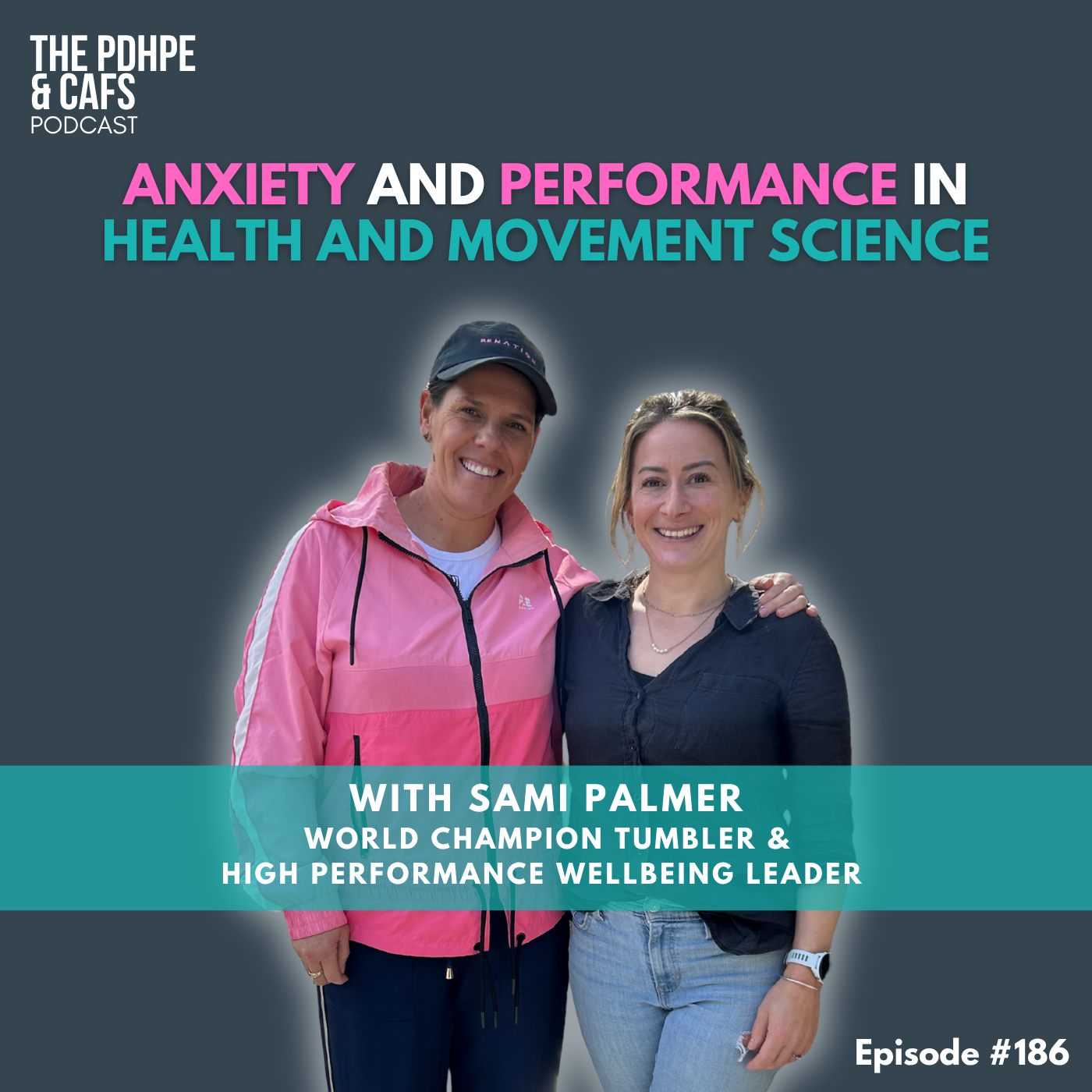
The PDHPE & CAFS Podcast with Kelly Bell · Kelly Bell
You have taught anxiety and arousal in Health and Movement Science but your students are still not sure how to apply these concepts. This week on The PDHPE & CAFS Podcast, Kelly Bell speaks with world champion tumbler Sami Palmer about what those concepts look like from inside a competition and how to bring them to life for your Health and Movement Science. Here is what is in it for you: - Mental rehearsal that helps instead of harms. - Why neutral self-talk beats positive self-talk - Concentration and attentional focus made concrete. Sami competed for Great Britain at her first World Championships five days after her twelfth birthday and now works in performance wellbeing with Australian Athletics.
speaker-0: Hi everyone and a huge welcome back to the PDHPE and CAFS podcast. We are joined by a world champion gymnast here in the studio Sami Palmer is going to be joining us today to talk about her experience as an elite athlete. Many PE teachers don't have the opportunity to really represent their state or country so we're very lucky to have you. Thanks so much for being on. speaker-1: Thank you so much for inviting me. It's a pleasure. speaker-0: Thank you. So obviously we can hear by your accent, not Australian, but Aussie now. Can you give us a bit of background as to your gymnast's experience and yeah, how you kind of like became a world champion, I suppose. speaker-1: Yeah, so I started in the gym at a very young age. Pretty much in diapers. I've got older sisters, they're twins. They did gymnastics. So when mum had me, she was coaching to be able to afford the fees and all of that. So I was just taking a lot. Being younger, I'm three and half years younger than my sisters, followed them around, tried to do everything they could do. And by the age of six, I was picked for a competitive squad. So I my first competition aged six. and I remember it very clearly because I came dead set last and I remember just my certificate looking up thinking I want to be on the podium and yeah so that really just that intrinsic drive to do better. So went through artistic, started competing internationally at the age of nine so I was lucky enough to travel to I think Hungary, Austria and Russia for artistic gymnastics. And then I found tumbling. a British tumbler came into our gym to train and saw me training my artistic and he said, you're really powerful. Come give this a try. So I went over, did some tumbling, did a little competition, won that one, went to like a regionals, qualified for a British championships, won the British championships and I was 11 at this point and a little, you know, think it was Romanian man. movie, was the national coach at the time, he said I want you to represent Great Britain at the World Championships. I'm like, cool, yeah. Mum came over and said you know what's this and that was sort of the start of it really so I hopped on a plane five days after my 12th birthday for my first World Championships. It was quite a well-written journey really. speaker-0: So from not, it was like essentially from nine to 12. speaker-1: Yeah, I'd already done about four different countries. Yeah, really, really cool. But I think really amazing at that young age to just experience some different cultures. And every time I came back, I realised how lucky I was in my own training environment. speaker-0: Yeah. speaker-1: You know, in the European countries, they didn't have as much as we did, and they didn't have the facilities we did and access to things. So yeah, never took any of that for granted. Yeah, I came seventh at World Champs, so was pretty cool. But I came home and I said, I really wanted to make the final. I was like point two off. So my coach said to me at the time, said, well, look, you can carry on doing artistic. You can probably make the Olympics. You can be very good. Or you can be the best Tumbler in the world. And you tell that to a 12-year-old. And I didn't like the artistic part of gymnastics. speaker-0: Do you speaker-1: the leaps, the flexibility was just not my cup of tea and the bars I really didn't like bars so for me it was a no-brainer it was like yeah love the power and the explosive like adrenaline of tumbling so that was it I shifted and I went full-time into tumbling speaker-0: Could you change Jim so that. speaker-1: No, my coach actually came with me. Yeah, so he just learnt the sport. We sort of went on this journey together and a few of the other girls in the gym came with me. So we ended up with this squad training together. And the rest is history really. The following year was European Championships. So was the youngest on the team to be selected. So was junior, senior, under 18s and I was 13 at this point. Had a doozy of a competition. Completely forgot my tumble. So I did three skills out of eight. And I think that was the first time I really experienced pressure in the moment and probably didn't have enough skills around communication and things to draw on to be able to like really... speaker-0: Experience. speaker-1: I was so young and yeah, it was... my coach wasn't at the competition and the national coach had sort of changed my combination of my routine and I was like okay yeah yeah you know you don't want to speak up. The fallout from that was I forgot it and just did nothing instead. So that was a really steep learning curve and I think going in there was a lot of pressure to do well because I was quite a strong team member and it was like you know you can really help the team get a medal. But that's okay, we learn from those things. the following year I went back to the World Championships, that was every two years. And my goal, my one goal going in was to just make the final, which is what I'd missed out on two years before. made the final, I actually qualified in second. And everyone around is going, you know. you can get a medal, you can really make it here. And I was like, okay, but I've made the final. Like everything else is a bonus. So I was so relaxed and I remember being asked the question of why aren't you taking this seriously? And I was like, I am, but I've achieved what I came here to do and I'm just gonna enjoy it now. Like I just wanted to have fun. So I actually made up a new tumbling pass with my coach, tried it in warmup and it, you know, pulled it off and I actually won. Which was incredible, but it was just like the pure excitement and enjoyment of being there. Like I just soaked it all in. So that was really, really exciting. So that was by this time 2001. So we're going back a little while. The following year was Europeans again. So it was a bit of a redemption for me. Obviously having gone two years before and... speaker-0: Are you 15 by this point? speaker-1: 15 by this point. So one of the more experienced members of the team, I'd done then three international competitions or big, competitions. Yeah, so went to that one. did pretty well. We got a team silver and one individually so that was really really good. So yeah very very successful junior career. Unfortunately the first year of my senior competition I completely ruptured my ACL so British Championships and it was such an exciting time. It was before London won the bid for the Olympics, so there was still a lot of funding in the sport. We used to have a centralized national program, but you had to be a senior to be in it. So I was like, yes, first year as senior, I'm going to move to the program, I'm going to do all these things, I'll get on the World Cup circuit. Like it was a really big step in my career. But that first competition just, just like I did my knee, snapped the ligaments. So it was a complete tear. I remember the call from the surgeon and he sort of said, you know, Good news, it's not your meniscus. And I was like, okay, what's the bad news? And he said, well, you don't have an ACL left, so you're gonna have to have an A reconstruction. So it was quite a big blow. At that point, I was in year, so in the UK, it's like, you can stay on at school and do sixth form. So it was like year 12, I think it was. And I was actually studying psychology and they used to call it a BTEC in sport. you probably don't have the equivalent here. So studying that but then with the rehab I had to move up to the National Training Centre for three months so fell quite behind on studies just focused on rehab while I was there it was amazing every support service around me like continual support motivation you know when you're injured especially at that time in my career it was really hard to navigate but a fantastic team around me but when I went home the wheels fell off a little bit so we might talk about that a bit later but anyway got myself back and yeah did another three years competing internationally on the circuit and yeah that's sort of... speaker-0: So quick, like a lot of people kind of spend the big part of their junior career and then building up and then you were just like throwing the deep end. Let's just see what happens. How do you, what do you think it was about your ability that people saw and were like, yep, she's got potential. speaker-1: I think there was an element of natural talent. I was very lucky. speaker-0: Gymnastics in your family like was your mom or auntie? speaker-1: did rugby and so he's very short stocky and powerful so definitely got his genes there yeah just yeah natural talent natural power I think having the coaching from an early age yeah very technical coaching from an early age so in terms of building up my spatial awareness and things like that yeah definitely definitely helped but I'm just I think some of my strengths are my determination and my stubbornness, speaker-0: Yeah. speaker-1: but they can also be a weakness because I'm incredibly stubborn, which doesn't always work in my favour. So I think just some of my characteristics and those personality traits, like if things got hard, if they went wrong, I just... Wanted to yeah, just prove you know and if anyone's are I remember actually when I'm when I after surgery the surgeon said you know Surgery went well everything was good You're probably not going to be able to do tumble and get to that level that you did before and I was like I looked at my mom and I said Did he just tell me yeah, can't Like yeah, if someone tells me I can't do something. I almost got my way to prove them Prove them wrong. So yeah, I think just that desire to to continually do better and chase and I would set quite hairy goals but just work and go, okay, well, what do I need to do to get there? And it's something we talk about with athletes a lot now and you've probably heard it with some students. They say, you know, have to sacrifice so much to get here. And I said, do you sacrifice though? Because I would actually really challenge that because I don't think we're ever really sacrificing. think we're making choices that are gonna support where we wanna go to. I've had a lot of conversations around it and yes I've missed a lot of parties and I missed a lot of hanging out with friends and holidays but I've gained so much from everything I've done in my sport so I don't ever look back and go I've sacrificed. Yeah no you know what speaker-0: system. speaker-1: I did what I wanted to do and what I chose to do to support my goals to get get where I did. So yeah, think even small shifts like that can really change the way that you move through your journey. speaker-0: Yeah. And that's not just like in competition or elite sport. It's in life. Like setting yourself small goals and you know, I want to go here. I want to do that. You know, I remember for me, like, and I shared this before, Jack of all trades, master of none have not represented my state, my zone. I went to the zone for athletics and cross country, but never really kind of made it as an athlete. But I think I had clear goals. I wanted to be a PE teacher. I then didn't get into the uni that I wanted to go in so I had to pay my first way, like my first year upfront to then get into ASU because I wanted that. know, you know the things that the small shifts and the things that you decide you want to do. There's a goal. Your head will get you there. Beginning of the year I trained for a marathon and went holy shit am I actually going to be able to do this? But your mind I think is so much more powerful than your your up your body like it's... and speaker-1: Absolutely. speaker-0: do you obviously you work with young athletes now so we can talk about like what your role is to help them. Do you think like the mind is sometimes more powerful than your body? Like 100 % 100 % speaker-1: Definitely, and you can have the most talented athletes that train incredibly, but when they get to the competition, just can't pull the pieces together and just can't perform. And it doesn't come down to physical, comes down to mentally being strong enough, know, building strategies, using those strategies to really help you perform. So yeah, I think it's, your mind is the most powerful tool that you have. speaker-0: So what do do now with young athletes to kind of harness it? speaker-1: So I work in performance wellbeing. So it's quite a broad portfolio, I would say. there's not really a specific like hard delivery. It's, every athlete, every person is unique and every journey is unique. So that's really, we meet athletes where they're at, but essentially it's all things in the wellbeing space that impact performance. that could be like holistic development. So just balancing the demands of elite sport and life, you know, it's heavy in sport. but life doesn't stop. So it's about building their skills and resourcing them to manage those things. So anything around, know, scheduling, financing, the highs and lows of sports. So even as, you know, we're having conversations with athletes at the very start of their high performance journey to go, this is actually what it could look like. There's going to be injury, there's going to be non-selection, you might have a relocation. So how do we help you prepare for these things? So it's, yeah, just really resourcing them, trying to reduce their life load where possible so that they can show up and perform the best they can. But then elements of you know the performing under pressure, the mind body, mind body breath conditioning, resourcing them with strategies around anxiety and nerves and you know how to tame all those things and use them to your advantage. We support them with career development, building their brands and their portfolio. yeah it's sort of it's a suite of resources and then it's just going okay Where are you at? What do you need? And then just pulling in on those things. speaker-0: That's pretty cool. And I think obviously as PE teachers in health and movement science, we teach these things, but I think you are obviously in a very unique position. You've lived and breathed it as a young athlete. And then you get to then impart those skills and those, you know, the continuation of resources for athletes to perform at their best. Life doesn't stop, you know, just because you're an elite athlete. speaker-1: It would be nice if that was just our sole focus, very few are in that position really. speaker-0: And because they don't have the funding, they haven't made it yet. They don't have, you know, the big, you know, pay that's attracted to this. Do you think there's a difference in, this is a curiosity thing, but in the UK versus Australia with sport and funding and for either grass roots level or? speaker-1: Hard to say I think because my journey in sport was 20, 30 years ago. Also doing a non-Olympic sport. So when London won the bid for the Olympics. I speaker-0: this up. speaker-1: reckon we're going back to about 2005-ish. They pulled all funding out of non-Olympic sports to pump into Olympic sports being home games in 2012. So I went from having, huge amounts but a little bit of funding which helped cover my physio you know all of those needs to having nothing to them being invoiced to go to World Cups and compete for my country to having to pay for my leotards and my uniform so in terms of that like it was very difficult Over here, with 20 plus years on, I do see the same. a lot of non-Olympic disciplines are unfortunately still in the same position. So, you know, you're having to invoice athletes or they're receiving these invoices to go and represent their country. You know, kit's not cheap and they're paying, you know, anywhere from $500 to sort of $1,500 just to get their Aussie uniform. It differs. It differs sport to sport. speaker-0: Yeah, so my own daughter like she's in cheerleading and it's not only level her outfits like $400. Yeah, I'm like speaker-1: They look great though. speaker-0: They look very good on stage. I'm like, imagine if it's not like a, not everyone can do some of those sports. Cause it's so expensive. Look, I think money and sport and the commodity and you know, that's a whole nother conversation, I think. And I think sport, you know, brings countries together and that community, of course, they're gonna pump money into it. But there's a lot of things that, you know, at grassroots and even like high performance, Athletes are still funding. speaker-1: It is and you know there are a lot of grants, local grants, know you can try and get sponsorship, work on fundraising but that in itself is a lot of hard work. Going back to when I competed, so as soon as I left school, once I fell behind on my studies during my rehab, they said you need to start the year again and I made a decision at that point. I said to me, know being an athlete has an expiry date, I can pick up work and you know study later. choice to just get jobs around my training so I would get up in the morning from 6 to 9 a.m. and pack supermarket shelves and then I would go and train 9 to 12 and then I'd wait through the lunchtime shift and then train in the afternoon and then sometimes do a night shift in the pub as well. Not ideal for recovery but it is possible. Hard work yes, you know working around the clock. speaker-0: Sacrifice, yes. speaker-1: Yeah, like again making choices to fund my training, to do those things, to saying no to a party on the weekend because I did need to rest after work but it just worked around my training and you know I was very aware I'm not going to be stuck in shelves in a supermarket forever. You know I was in Morrison's in the pie shop and you know is it my career? No, but it's supporting my training, it's putting fuel in my car and it's getting me getting me around and I think It is hard. think some athletes today maybe think I shouldn't have to work. Yeah, I agree. You shouldn't have to work if you're at that high level, but unfortunately it's... speaker-0: We have three. speaker-1: You do have to and if you want it bad enough and this is you know if you want something bad enough and we talk about our goals and making choices and yeah it's a hard road like elite sport is a beautiful place but if it was easy everyone would be an elite athlete. It's hard work to get there so it's about making those choices and how much do you want it you know if you'd love I loved yes I didn't love stacking shelves and serving people sausage rolls at the the pie shop but I didn't. What I did love was the opportunity to travel. It was my tumbling family from around the world. know, you're seeing people, especially being in Europe, we did a lot of international training camps and friendly competitions, World Cups, World Champs. So you're constantly seeing, you know, your people from around the world. You have this extended, beautiful family. I got to see other countries, admittedly, some of them only the airport, the hotel and the gym. But, you know, I think by the age of about 20, I've been to 23 different countries. I just go, yeah, sure, it's hard work and yes, I'm having to work a job and yes, life is busy, but look at everything that I'm doing, achieving and just having fun. I just loved what I did. speaker-0: Yeah, and you're doing your living a dream that you had as a kid now to then put that into action and see it and like you said not everyone makes it the very the cream of the crop, you know the top make it and I think look, you know, even even kids at school even our own children my own children It's hard, like life is hard, like life is hard and you have to work at it. Like if you have goals and aspirations and you you have to work towards those to make them happen. But you can make anything happen that you want, think these days. Like if the kids think it's gonna happen and think they're gonna get good HSC results or think they're gonna get the best job, no. Like you have to start from the bottom and work your way up. Can we go back to like you as an athlete and the mindset? And the anxiety and the arousal, that's the kind of part that's in our syllabus now. And I think like I haven't lived elite sport before, but you know, going around Iran or playing nipple, like that's nothing on what, know, the pressure that, you know, representing your country. First of all, did you have support and what were some strategies that you have experienced as an athlete, then also being able to impart on other young athletes? speaker-1: Yeah, so I actually run an athlete mentorship and I was talking, this was one of our topics last week, so it's very timely. A few different things, my mum, love her, went and did like a little psychology sort of course so that she could try and help me, you know, again, self-funded, everything, money was tight, so did we have, you know, funding for me to see a psychologist? No. So mum did what she could, a few different things. So I guess one thing I will say is everyone feels pressure differently. So, you know what I felt in that moment and that anxiety and arousal could be very different to someone else but also yes, you know, maybe you feel it more at a world championships but also, you know, that netball game for the young child who's doing it for the first time on a court like that's they're gonna feel the same things. if we go back to the basics, I think it's learning yourself. What do you feel naming it where you know for me so I was a bit of a chatterbox. So when I nervous and when my nerves were at like their peak I was like not about anything just jargon you know so few of my teammates needed that calm had their headphones on music didn't work for me can calm some people didn't work for me so what I needed was someone that I could just waffle to so what the team did was get me a coach essentially who just followed me from breakfast right through to the end of the comp because that's what I needed speaker-0: So. speaker-1: And it was like, and, and she would just be like, just remember to breathe. But it also then meant that I wasn't distracting any of the other girls in their preparation. So I think it's firstly recognizing what does nerves look like for you and what do you need? Like me being quiet when I'm nervous, that wasn't going to help me. I actually just needed that constant. speaker-0: And do you that was like, looking back as an adult, it too like, too now on your your head space to just stop your mind? speaker-1: Yes, so we were talking about this last week that overthinking. So I think visualisation can be a really great tool. think again at times it's playing with some tools and working out what works for you. So for me if I visualised I would have to visualise something once and then stop. Otherwise I would speaker-0: Yeah, speaker-1: start unpicking the different skills and then get into this, my god what if I forget what I'm doing? I don't know how to do it. Reminding myself, I've done it hundreds of times. You know how to do it. You do know it. So I would visualise once and then speak. speaker-0: So that be like physically closing your eyes down and then watching yourself? speaker-1: Just feeling, yeah, yeah, that sort of, I never closed my eyes, I don't know, again, I can just go into a trance, so I would pick my point on the floor, stare to the floor, go through it once. speaker-0: Yep, and got you're like you're marking out. speaker-1: Yeah, mean when you've trained something over and over, you know the movement, it's like walking. You don't have to think about it, you just do. So that was sort of it for the tumbling. I trained things so many times, it was very automatic, but when I overthought it almost had the adverse effect of like, god, now I'm gonna forget what I'm doing. speaker-0: And I think that trust in your body like I can do this. Yeah, like trust the body and it would just speaker-1: Yeah, which then comes to what the story, the internal narrative, which again, very powerful. We speak to ourselves more than we speak to anybody else. And what we tell ourselves is the most important thing. So for me, I would never go into a competition, like I'm gonna win this today. Never. Not once, not even like I'm going to compete a PB today or I'm going to get over nine today or my score never. Because the challenge we have there, if you are constantly positive and you're setting yourself these benchmarks and saying you are going to do something, if you don't achieve it, you feel like you failed. So again, has that knock on domino effect that's not a positive effect. So it was always neutral, very factual, very neutral. I know what I'm doing. speaker-0: Yeah. I've seen these. speaker-1: very many times. speaker-0: those, like, would you speak them or would you say them in In my Do you ever write them speaker-1: Yeah. speaker-0: on your body? speaker-1: I didn't, no. It was again coming back to that stubborn, determined, strong mindset. Just that speaker-0: Thank speaker-1: self-talk and it was very, yeah, very neutral self-talk. was start of the run-up, okay, I've chalked my hands, my feet are grounded, I know what to do. I would count my steps. Again, it was just, you know, and this is playing with the things that work for you. And it's silly, like I always thought it was six steps. But I always thought if I didn't count my steps, I'm gonna do the wrong amount of steps or, you know, so it's just getting. those training cues, those things that work for you. otherwise our narrative and that what if I fall, what if it doesn't go right, what if the more you tell yourself. you spiral. You spiral really quickly. what I've done with my athletes, my mentorship athletes, is say okay we're gonna build you your competition card and on that is that one or two grounding words and it's their anchor sentence. So when they feel and when they start to recognize they're going down that spiral, which can happen so quickly, especially when you get another physiological things, right? You've got your sweaty palms, you're nervous, you're like, my God, do I need the toilet? You know, it's like, ground yourself. Another one is looking around and just taking notes of senses. So name five things you can see, what's around. What can you taste? What can you smell? So again, it's that distraction. because you can't feel fear at the same time of looking and pointing things out. So there's just all these different... Yeah, and I think people just need to build their toolkit and then draw on that in those moments. Nerves are a great thing, they're brilliant. And we talk a bit about, and I don't know if it's in your syllabus, but the amygdala. So it's in the brain, like your fear centre, and it's a great thing, right? We actually need it for survival to keep us alive. doesn't know fear of like when you've presented to a judge or you're about to you know you're running for a goal and you're trying to score the goal it doesn't recognize the difference between the fear of failure and that fear versus being chased by a lion.