
The PDHPE & CAFS Podcast with Kelly Bell · Kelly Bell
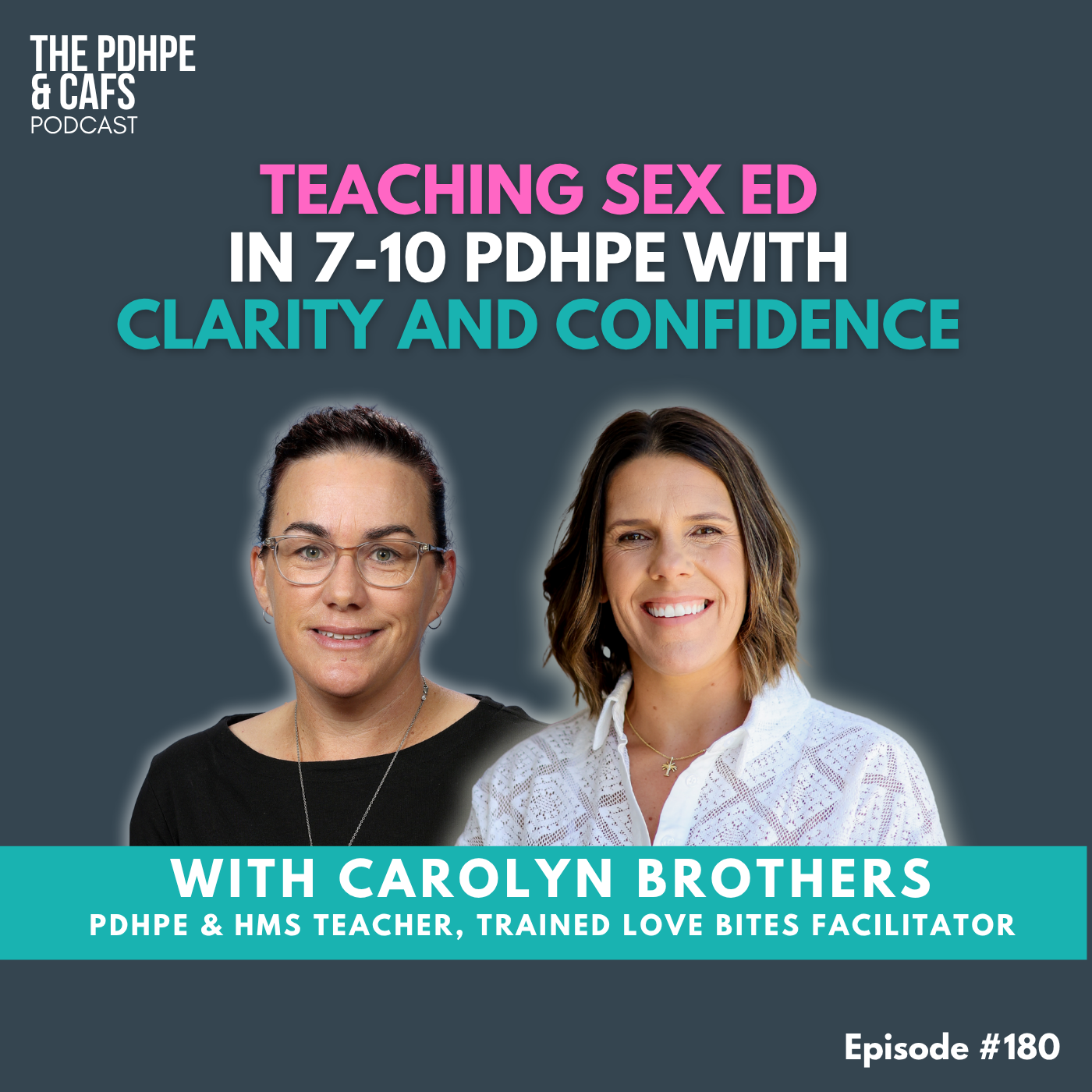
Feeling a bit rusty when it comes to teaching sex ed? You are not alone. Teaching sexual health and respectful relationships is one of the trickiest parts of 7-10 PDHPE. Students are arriving with earlier and heavier exposure than ever, the questions are getting harder and many of us are trying to teach this content without feeling fully confident or up to date on best practice. This week on The PDHPE and CAFS Podcast, Kelly Bell sits down with Carolyn, a PDHPE and HMS teacher and trained Love Bites facilitator, for an honest, practical conversation about teaching this content with clarity and confidence. Here is what is in it for you: How to move from "having a chat" to explicit skill-building that starts with the syllabus and outcomes What a trauma-informed classroom actually looks like Why you connect with students in a way no one-off wellbeing day ever can You will walk away informed on current best practice, clearer on how to structure respectful relationships teaching across 7-10 PDHPE and with real resources you can put to work this term.
Kell Bell: Hey everyone, a huge welcome back to the PDHP and CAFS podcast. Today we are joined by a special guest and we have someone who I actually know personally and Kaz and I have actually known each other for a very long time. Kaz works in a school up in Dubbo, so she can tell us a little bit about her context, but a huge welcome to the podcast, Kaz. Carolyn: Thank you. Thank you. Good to be here. Kell Bell: Yeah, thank you. Can you give our listeners a little bit of background as to yourself, your teaching background and where you're working these days? Carolyn: Yeah, so I began PDHP teaching in a little bit of an interesting kind of way. So straight out of high school I started a health science degree and within a few months of starting that degree discovered that I was pregnant. And so my first child was a surprise and a wonderful surprise at that. So my journey into becoming a teacher was as a a mature age student. So several years later, a couple of kids later. I started uni and did that at Western Sydney. So I I like to call it different to what it's called now. Western Sydney University is what it's called, but anyway, UWS is my feeling. so did PDHP teaching there. I've taught primarily within the private school context. So initially in Sydney and then in 2013 came out to Dubbo and and I'm working in a rural setting. Dubo's a fairly large town, but at the same time it's definitely on the cusp of rural and remote access to services. All those things we learn about in HMS and Petty HPE. I'm living it. so we love telehealth and probably I diverge there because we've currently been doing focus area one for HMS. So that's kind of my my experience. Yep. Kell Bell: Yeah. Kaz and look Kaz and I went to high school together so I was a year above. and then I think I kind of maybe discovered at some point when you were doing some CAFS teaching, like, I know Kaz from high school. So we were both going to CAFI at Westmead, grew up in Western Sydney and now I'm on the Central Coast. So Kaz, why did you make the move to Dubbo? I'm so curious. Carolyn: Yeah. Yeah. Yeah, so at the time there were two jobs and my husband and I of of the right KLA in Double and we kind of thought about the adventure. was drawn to the idea of the adventure, but also the quality of life. The reality is my commute to work is twelve minutes and two left turns. That's the that's the reality of it. And for my kids, previous to moving out here, they were doing before and after school care. Kell Bell: Yeah, nice. Carolyn: And here I just don't really need to do that. So it was a an active choice to find a better quality of life and balance for my family. Kell Bell: Yeah, nice. Look, I I was the same. I worked in Blacktown for fourteen years and when our girls started to get a bit older and school age, I would drop I think I would drop Cass off first. you know, it was literally like across the across the seven, but it took us so long to get there from Kings Langley. So dropped Cass off to school and then I spent so much time in traffic getting from one side of Parkley Road. what it was that Puckley, what is it? across the other side to Stanhope and it would take me so long to get to work, like half an hour, but then if I left a lot earlier, it would take me like I think the the fastest in fourteen years is maybe eight minutes. Carolyn: Mm. Yeah. Yep. Kell Bell: So like it's it's such a it's such a different life being away from Western Sydney. and you know you've got the the rural and remote and I've kinda got the the beach and the bay like the you know, it's very, very different. I don't miss Western Sydney. No no anyone Carolyn: Mm. No. I miss the people that are there. The family I miss, but the commute, the traffic, the busyness. No, I do not miss that at all. Kell Bell: N not at all. So you're at a private school in Dubbo. How many kids do you guys have on campus? Carolyn: Yep. Yeah, so Peter twelve and I'm probably gonna get it wrong somewhere between I think it's about seven hundred and eighty from prep to year twelve. So ultimately in high school it's pretty much triple streamed for each year group. And then, you know, our our high school cohort can fluctuate between thirty five through to fifty five students. Yep, in each year in year eleven and twelve. Kell Bell: Okay. Yeah. So yeah, like h how big would your HMS or CAFS classes be? Carolyn: Yeah, so my HMS class is twelve and we've got the one class and the current year twelve which I'm not on, a I think it's twelve as well. so HMS started in year eleven with twenty two. and then a couple of kids left to explore other options. Kell Bell: Okay. Yeah. Yeah. And look look, sometimes that that's okay. Like you think, okay, well, you go do your thing and let let's kind of us work on, you know, getting the kids through to the HSC and some kids just don't want to be there. So instead of pulling you like, I'll let you go free and do your thing. Carolyn: Yeah. Yeah, look, every kid has their own learning path and that's something I I know very well now, having done this for a long time. and there's a lot of hard work involved in HMS. So I'm a little bit of a taskmaster. so sometimes that can be not in line with a student's economical approach to the HSE. Kell Bell: Okay. Yeah. Nice. Very good. Well, today we're talking about HMS. We could be here all podcasting. But we're going to chat about sex ed in schools. And I know that, you know, when I taught her, I taught her at an all-girls Catholic school in Blacktown. Of course we had to have those Catholic perspectives in how we taught things towards wholeness. Do you remember that document that that was around? Like that that kind of helped you how how to teach in a language. Carolyn: Ooh. Mm. Kell Bell: to use. That was a very long time ago, like twenty something years ago. What you think has changed w in how we approach sex ed in high schools now with PE? Carolyn: Yeah. Yeah. Yeah, so I there's a few different things. I think the cold, hard, fast reality is that young people are have an exposure to images and experiences that is like none we've ever experienced before. So you know, kids as young as nine years old are accidentally stumbling across things they shouldn't online. But also I think because of perhaps the sexualization of girls and some of the gender stuff we see these days. Toxic masculinity. I think there's a increased pressure to be across it all and to feel confident. And not every PE teacher is going to feel confident going into this. And I find it is a hard conversation in the classroom. It's actually really tough. and you need a level of maturity and experience to manage those hairy questions. Excuse the pun. that that come across you come across. So students are much younger. Kell Bell: Mm. Carolyn: asking those questions, that's what I've noticed. you can just tell in the classroom that they've seen things earlier than they used to. and I guess ha, I don't want to say it, but I think parents have a role to play as well. When you put a device that is unmonitored in front of a a child and you allow them access to the internet, I think we are starting to see some of the negative aspects of that in in our classrooms. Kell Bell: Mm. Yeah, and I think, you know, when I first started teaching it was in the early two thousands and a smartphone and a an iPad didn't come out until twenty, you know, two thousand and ten. So when my daughter was born. So I think it's just that there's so much that they're exposed to and a lot of parents don't know. And obviously Carolyn: Yeah. Mm. Yeah. Kell Bell: We know like that rabbit hole that as soon as they have that device they are exposed and are very vulnerable to seeing things that we'd probably probably never want our kids to see. Carolyn: Yeah. Yeah. And I guess this problem has probably always been around. I I don't doubt that they were dealing with this twenty and thirty years ago, but I think just accessibility is huge. And then I guess our students don't necessarily have the discernment they need to know what's wise and what's not. And then peer pressure plays a role as well. you know, the the age of Snapchat disappearing images and explicit images sent Kell Bell: Yeah. Carolyn: and pressures for young girls to feel like they need to do that. it's real. You talk to the kids, it is so very real and part of their day. Kell Bell: Yeah. And that is exactly why my almost thirteen year old daughter is not having Snapchat yet, is not on TikTok because she doesn't have the maturity, I think. And Dad and I had this conversation last night, my husband, he's like, a little friend wants just to just check in, like, when can she get Snapchat? And she did have it, and when obviously the government kind of made their restrictions, I kind of sat back and went, No, actually it's it's not a it's not a necessity, like to take random Carolyn: Mm. Mm. Kell Bell: photos like for them to feel pressure Carolyn: Mm. Kell Bell: they have to capture every moment of their life and look I I am on social media for our work to get our message out there and to support you know teachers but if it wasn't for that I don't think I'd be on social media. I don't actually enjoy just the consumption of it because it is like once you go down that rabbit hole it's like you know there for hours but I've been firm with that with Lexi. Lex is and I'll say this Carolyn: Mm. Mm. Kell Bell: before we started recording. Like Lex and Cass are very different kids. but once it's in their hand and if they see something you can never take that away. Like no, no. Carolyn: Mm. Yeah, you can't unsee things. and and I think we've got a responsibility. it's really hard in PDHPE teaching. Anytime there's something contextually that the government wants to put a spotlight on, it's let's add it to the curriculum. and we do have a responsibility and we should. but it is also parent responsibility and I think that's where it gets really difficult because we feel the weight of that. And my staff certainly feel the weight of that. Yeah. Kell Bell: Yeah, and and I think I've been saying a lot recently, s with with the new changes in the syllabus and just being able to have a bit more of a voice, we have a shared responsibility. It's not just up to us and it's not just up to parents. Like we have to work together on this. Like our kids are so impressionable. we still have peer pressure, like it's a thing. But Carolyn: Mm. yeah, yeah, yeah. And and also that whole technology and I mean CAF, social impact of technology, all that kind of stuff. i it is very hard for them if they don't have access to it because they are feeling super excluded. But there is that, you know, in the workplace we talk about the right to disconnect. Our young people don't have that right. And we did, and I love that we did, and I can't even fathom what that's like for them. So this is really tough territory for them. And then I think Kell Bell: Yeah. Carolyn: it becomes even tougher when it's got to do with sexual development, relationships and respect. Kell Bell: Hmm. It's just a minefield and like it just I think it's really disheartening. Like I've got two girls and I think about Lex who is so vulnerable, impressionable. She's more like our daughter that likes skincare and like That's not come from me, like yes to like look after your face, but that that is I suppose mild obsession about, you know, products and I'm like, you don't need that. Just wash your face with a good cleanser and tone and moisturize and you'll be fine. But I think it's then that pressure of her friends and they're on Snapchat and that her parent, you know, their parents are letting their you know kids be on TikTok. I'm like, no, like no, they don't need it. It's like having junk food, like it's it's not necessary. She's spending too much time on her phone anyway, in a in her Carolyn: Mm. Yeah. Yeah. Kell Bell: her room on the phone with you know on the phone with her friends I'm like she doesn't need anything else to distract her because she's so distracted already. anyway look I'm the hard ass in our family. Not Daniel he's soft god love him. but it's from that you know that that that education I think and that I've seen it in the classroom for so long. Carolyn: Yeah. Mm. Yeah. Mm. Kell Bell: Yeah, it's such an issue. Anyway, and I but I haven't taught I haven't taught six sex ed since two thousand and seventeen. So I feel a bit outdated, I feel like a bit of a dinosaur. If I'm coming into teaching or if I'm returning from Matt Leave or whatever, what advice would you give to teachers who aren't feeling as experienced in teaching sex ed? Like what's one one? Where do you kind of start with it? Carolyn: Yeah. Yeah, well I mean I think you start with a syllabus and and having a look at what's the what's the framing for it. So what am I trying to get out of this? So I don't just want to have a chat with the kids about it. I want to look at building explicit skills. And those skills are in the identifying respectful relationships and the nature of those, what that might look like. we like to do a lot of scenario analysis to help with that. but actually being honest with students. You need to be age appropriate, that's hard. and that's difficult in my context as well in a faith-based school because there are different levels of exposure and parents are happy with different levels of information for their their child. but the cold hard reality is you need to engage with facts. So find out what is the latest data on what our st our teenagers and our young people, firstly what they're exposed to, but then thinking about when is that first interaction likely to occur. And then I think just as importantly having a look at your statistics on sexual violence. You know, you can sit in a classroom and you can know that possibly five of those young people have been the victim of inappropriate touching that they did not want. And this is where the trauma-informed classroom comes in and it's really tough work because you are talking about something that's particularly upsetting for some potentially, but it doesn't mean we don't have the conversation. So Kell Bell: Yeah. Carolyn: I I would always encourage my team not to just have a conversation, to have some really explicit teaching and get them to engage in discussion. You know, what is the status quo for them? And then recognizing what's a bit hinky or off about this particular circumstance. So critical thinking is crucial. But yeah, I think there's a lot of different things you can do, and it really does depend on your context. There's some great resources. There's a a resource called Real Talk, which we use in our primary school setting. It's a faith-based one. It's got like a Catholic stream and then a a garden variety faith-based stream. it's really quality. I rate that. And I've also done a fair amount of research into sexual violence and things like that. There's some great resources you can access online. Kell Bell: Yeah. Carolyn: about that. So and then the other one is Love Bites. So that's something that I trained in in 2017 as a professional development. And then I've been a facilitator and and worked with them on some curriculum mapping as well. So that's something that I really like because it's got a holistic approach and it's not just simply delivered through that PDHPE lens. It's a wellbeing perspective. The coolest thing about it And it this our new syllabus is actually focused on this, is it's about getting community providers into school to talk to the kids. So in our school I have a we've had a number of different presenters and often they're social workers downtown, different social support networks for kids. We actually had a a nurse who does the direct intakes for young people and women and men who are victims of sexual violence. Kell Bell: Mm-hmm. Carolyn: And she's trained and delivers the program and can talk about it from a realistic point of view. and so that that's probably an area of passion for me and I do the run against violence every year and that raises money directly for sponsorship for people in the community to do this Love Bites training. Kell Bell: Mm. That's so cool. And look, we we will put all the links to any of those resources that you've mentioned underneath the podcast. But you know, like we we're gonna talk more about the resources bec because I think I think teachers are still under resourced in teaching s sex like sexual health, sex ed. you know, you you might have done it at uni, like for us, we did because you know, AC was a bit backwards, I did exercise science and then went into P, you know, diped in my fourth year and they realized that we did a outdoor rec stream, so we actually hadn't done anything to do with sex ed and Carolyn: Mm. Mm. Kell Bell: Colo and drugs, so we had to do all this summer school stuff, mental health. Anyway, it was like a week, one week. We're gonna teach you a week how to teach sex ed or sex, you know, sexual health to students. So it hadn't done any training like you have recently for such a long time. Like I th I think I'd be nervous going back into into a school, and even though like I would go back to things that I did when I was teaching in the classroom. Carolyn: Mm. Yeah. Yeah. Mm. Mm. Kell Bell: I d I don't know like the current, you know, language or the current expectation, around delivery, so Carolyn: Yeah, and it's tough, you know, I think there's a real richness that comes from Peter HPE teachers come from a lot of different streams and ways of getting you know, we've all got that diploma or bachelor of masters of education. But the reality is you might have done an exercise sports science degree and that that would make it even tougher. and there's richness that comes from that and expertise that can bless students in lots of different ways. but it is an area of difficulty and you know, depending upon your gender as well, you know, male and female teachers have different levels of comfort. and so you just need to be mindful of that. And I don't know, I've always been pretty tenacious about finding out more. That's kind of me, but I but yeah, I stumbled across the Love Bite stuff and I I actually got it into my school when I was the year ten year coordinator and New South Wales Health used to oversee it. So That was back in those days a long time ago. Now it's the National Association for the Protection of Children Against Abuse and Neglect. Which is a mouthful, but napkin. yeah. Kell Bell: Yeah. Cool. So, yeah, like where where would you if you're introducing it, like do you guys go s like in year seven, if you're looking at a scope and sequence, like where would you best place it, say in year seven, eight, nine or ten? Carolyn: Yeah, so Love Bites in particular has a couple of different options. I am trained in the junior and their senior Love Bites. It is it can be a standalone single day for your seniors. So that's ten, eleven, and twelve. And so we would normally do it in your ten. that standalone single day. So there's two different workshops and they have a creative session in the afternoon, which in my context we actually don't do the full advocacy and creativity program. We get the kids to go to their regular Tuesday sport and they kind of regulate that way. but the junior program, there are very likely facilitators in your area. and they can come in and they can do little sessions week by week over a number of weeks, or they can do it in a single kind of standalone events. For me, my staff really deliver our sexual health respectful relationships content through seven to ten. and then we have the single day for the senior love bites. But depending on where you are, there could be a huge number of these trained facilitators that can come in and be a different voice in the room. I find that's really important. but you you obviously need to have a great foundation of that being taught already in your syllabus. It's I would say it's a value adding thing. It's not going to do it for you. yeah. Kell Bell: Yeah. Yeah, I l I love that you said that, Kaz, because I think a lot of teachers not because they don't know, but even like in primary school settings, I think a a one fit approach or like, you know, we're just gonna do a blanket solution to this and go, We've done our sexual health, we're now gonna step because someone else has done it. But Carolyn: Mm. Mm. Kell Bell: There's a lot of research out there that it's the teacher that is the one that is going to connect most with the kids and then bring those conversations to life. So I think, and that's what what we're advocating, you know, in our memberships that, and I still see it, especially in primary schools, people are taking these well-being programs. And I'm like, if you just put that time and money into teaching PDHP better. Carolyn: Mm. Kell Bell: it would be look look so different across your school. Instead of just doing a one off day, you know, six, if you actually embedded it properly, you would have much better, you know, result or teaching, you know. Carolyn: Yeah. Yeah. Yeah. Yeah, and look, I think like respectful relationships, the reality is the core and the guts of this, what we want kids to know, it happens across the board. It's not just in your PDH room, it's on the court when you're teaching kids. You know, do you congratulate the other team after the end of the game? Do you check on your mate when you accidentally scon them in the head with a basketball? Like I think these are skills that we are actively reinforcing in just being together in the same place. Kell Bell: Yeah. Carolyn: And so when you have PDHPE teachers that feel confident and empowered to I don't know, just develop these skills across the board, we are so blessed. We get the best of everything. We get the great theoretical increase your knowledge and skill set in the PDH classroom, but then we get to have fun with the kids in PE. And you know, that relational core of what we do is where you're gonna get the most bang for your bark. And I mean, there's a reason PDHPA teachers often are the ones doing the mandatory reporting, right? We we're trusted and that's a big responsibility, but it's a big privilege as well. Kell Bell: Yeah. Yeah. Hmm. Yeah, look, you have just hit the nail on the head. I have been singing this song for the last 18 months, especially in line with us, I suppose, expanding our reach to primary schools. And I have said to many people, like ch change your outfit and see what happens. Like I think the reason why a lot of kids, and I'm saying kids even in high school, is because we have sometimes and I don't know where this analogy came from, but it was like a bit of a light bulb for me. It's like we're in more cat like we look more casual. Where what we do is very relational, like you said, with we're the coach, we're the GQBed coordinator, we're then the SRC person, we're the year advisor, we're the year coordinator, the pastoral coordinator, the kids see us in a different light. We're the ones going on camp. They see us in that different context. And I remember my own children saying, I didn't realise Mrs. So and so was like that. This is from coming back from camp. I'm like, they're a real person guys. Like you just you see them the way they the way they dress, how they teach you for your literacy or numeracy block. Carolyn: Yeah. Kell Bell: If you actually saw the real person and if and if I think primary teachers took off that mask a little bit and became more relaxed in how they teach, not just, you know, this stuff. Carolyn: Mm. Mm, mm. And look, like you were saying in your course, I think a primary teacher course doesn't have embedded in it, PDHPE isn't valued across a lot of different places. But as a primary teacher, you probably got a one week summer intensive on how to teach. And we know as soon as you take kids out of the classroom in the four walls, you've got to level up in your skill set. And so we have a lot of primary teachers that absolutely have the capacity to be excellent, but they just haven't been given Kell Bell: Mm. Yeah. Carolyn: the knowledge or the time to invest in building those teaching skills. Kell Bell: Yeah. Yeah, yeah. So at your school, how many PE staff do you guys have? Carolyn: Yeah, so my team I've got five PE staff, and I'm the sixth and and a couple of part timers in that. so yeah, we've got a lovely team, great team. and you know, you talk about going away on school trips. So just to give you the taste of the rural and remote, for us to go to a gala day is a six hour trip on a coach and an overnight and straight back the next day. So my team are absolute champions. Kell Bell: Yeah. Yeah. Carolyn: of relational relational and investing in sporting opportunities. so, you know, i it's a it's a big deal. you get a lot of richness out of that, but it is a big ask also. Kell Bell: Mm-hmm. Yeah. And look I I think when I first wanted to be a PE teacher, I remembered the exact moment, I was in year eight, it was in the drama room at Macaulay. I I just was like, I wanna do this and I I love the idea that I got to be in the classroom with the kids, but also then go out and do excursions and Jukoved and Rockersteadford stupidly when I was, you know, my fourth Carolyn: Mm. Yeah. Kell Bell: teaching decided to do that at Nagel. but it's all those opportunities that build the relationships. It has that flow and effect in the class. But it's it's it's hard and having a young family, I don't know if I could could have done it then, but you make any teachers make it work because they know the benefit for the kids. It's all for the kids, like at the end of day. Carolyn: It does, it does. Mm. Absolutely. Absolutely. Yep. Kell Bell: So do you guys, do you like as you know, someone who's facilitated love bites before, would you then train your team? How do they get ongoing professional learning and this sort of thing? Carolyn: Yeah, so it's it's worthwhile and it's important to say that the facilitator training it is something that is often and most usually delivered to social workers and other allied health practitioners within on and even school nurses. So it's not built specifically for PE teachers, but the professional learning that I got, even in facilitating conversations with students. was so valuable. So it's about giving students a voice about this topic and then working that through. So it is not directly and explicitly for teachers and there are areas of divergence. So they will consider some different I guess framing from that perspective of I guess from what a service provider outside of a schooling context would do. for my team I've delivered some stuff to them that is part of that or from that and benefits that I can see. I think PDHPA teachers being in the room while an external provider comes in is super valuable. So seeing the way that they teach it and keeping in mind their teaching focuses on kind of five key areas. So you've got respectful relationships, so how to understand and build, gender stereotypes, so that's where it crosses over. abuse in relationships, so cycle of abuse, how to identify it. sex and consent, and then speaking out, speaking up and advocacy. So that that's done in that program. And you would already have an existing understanding in your students. but yeah I'd love to send more of my team on this kind of training. So for me it's such an area of passion. I actually take leave without pay to deliver it in other schools. A couple of times a year I can do that, depending upon our school calendar and my responsibilities and where things are at. so I guess my intention for reaching out, Kel, was more I would just love more PDHPE teachers to know about it. Now we are the busiest people in a school. So when an email comes in for the fiftieth time about some great program, you just don't give it waiting. But this one's worthwhile. yeah, so and I I think Kell Bell: Okay. Carolyn: The more champions we have in the PDHPE space that can see this program and what it does, the better the conversation, the richer the learning will be. but it cannot replace your everyday in the trenches learning with students. Kell Bell: Yeah. So you you've said like Love Bites is like it encompasses so many aspects. If I was a PE teacher on the Central Coast or anywhere in in New South Wales, how would I like get involved in actually going to training or reading something about it or Carolyn: Yeah, yeah. So actually, interestingly, the Central Coast Love Bites team, follow them on LinkedIn. They are one of the most active in New South Wales. Yeah, fantastic. So, look, you could easily just head over to the website, okay? heading over there, they have training there. Now, I was talking about run against violence, and I actually think this would be so good if PE teachers got on board. There's an excellent documentary that goes along with it. Kira Lee Deer ran all the way from Broken Hill to Sydney, and I do that each year. Kell Bell: Thank you. Carolyn: So this is such a active example of community action and collaborative action to address a problem. my HMS class does it as a depth study and we have a look at how it all works. But yeah, so heading on over, there will be a Love Bites coordinator in your area. You basically just enter your school's information and they reach out and connect with you. Kell Bell: Cool. And so is is there any cost involved? Is there a donation? Wow, okay. Carolyn: Absolutely free. Yeah, so it is fully funded. So NAPCAN is an NGO. and a lot of the funding or some of the funding for Love Bites is really predominantly done through Run Against Violence. So it'll cost you nothing, like literally nothing. The only cost is that and and it's not even a cost because you're already doing it, is just having that organizational discussion about dates. And then you need to make sure that there is a teacher in the room as a supervisor. just for a trauma informed approach, but also I think the PE staff could be in there and then you can have that debriefing ongoing conversation. Kell Bell: So if you like if you had a a team, would you go okay, were you guys going there first period? Like is that kind of how it works or? Carolyn: Yeah, so it depends. So if you're going to do the graduated approach where you've got a weekly session for a number of weeks. And the really cool thing is that you can actually talk to Napcan and your Love Bytes coordinator about exactly what you would like them to deliver. So if it's over multiple sessions, you basically cover different things each sess each session as a facilitator. The single day I reckon is the best bang for the buck. but that's because I'm biased and that's what I deliver. So it's like your school is intentionally choosing that all of you ten is going to look at respectful relationships and then going to learn skills, have a discussion with outside providers. and then the afternoon session is usually advocacy, so creating posters or you know, even little skits and videos and things like that. just trying to engage the brain in a bit of a debrief de stress. but also increase that advocacy. So that's how I really love to do it. all the organisation happens through the Love Bites Coordinator. Once you lock in a date, they have parent notes, they have parent information, they've got everything you need to just roll it out. Kell Bell: Yeah. Yeah, so cool. And look, I think I I don't know why I hadn't even heard of it before. I've you know, when you sent I don't know even who sent the email but like that's it's such a great resource for teachers and it's for free and I had no idea that this is fully funded. Carolyn: Yeah. Yeah, and look, the other thing is if you i I'm not sure exactly how it would work, but they actually have grant schemes for you to get trained. So particularly I think if you're in a rural school and you're feeling under prepared, put in an a a you know, an application for that sponsorship. And you know there's people that work at PCYCs, youth leaders, there's such scope for this to really spread. Kell Bell: Yeah. Yeah, and I think we you know, if you go back to kind of HMS and not just in Ottawa Charter kind of approach, it's not just the government, it's not just a school, it's all of our responsibility together, you know. Carolyn: Mm. Yeah. Yeah, and collective action, right? Like we can make a really significant difference. And even when I look at the kaleidoscope of different facilitators I've worked with in the past, you know, I worked with a police officer who was delivering it. like I said, the sexual health intake nurse and various different youth workers and social workers. And and I just think there's a richness in our student scene That collaborative approach that it is actually everyone's responsibility to teach it, to learn it, and to live it. Kell Bell: Yeah, yeah, so powerful. So Kaz if if I'm a PDHP coordinator, would I just go onto the Love Bites website, fill in our details and then Carolyn: Yeah. Yeah. And look, you can you can we can pop the link in the show notes. you know, you can have a look. They've got some really good stuff on the website about how that works. It's they've got a curriculum mapping, the whole program is mapped to the curriculum. so you've got explicit outcomes and content dot points which you can clearly see matrixed and covered. And that's without even considering the broader well being perspective. o of the programme. So really, really valuable Kell Bell: Yeah, nice. And and look, I I think a lot of teachers are like, another day out. No, this is like this is so valuable, not just now, but for the kids in the next five, ten, fifteen, twenty years later, they're probably s going to be thinking about, you know, that conversation or that skit we did or or that activity we did, like that's powerful life. Like this is their Carolyn: Yeah. Yeah. Yep. And I think often look, schools are hard. It's it's hard to have a day out and there feels like every other day is a day out. And you know, I call it the magpie effect, like the next shiny thing. and you're like, my goodness, not another acronym or another thing I have to do. But this one is well worth it. kids feel empowered. And you know, I talked earlier about those five potentially five kids in the classroom that either have witnessed domestic violence or have been a victim of domestic violence. And hey Kell Bell: Yeah, yeah. Carolyn: Possibly even a perpetrator, to some degree. We need to be honouring, I guess, not their experience, because we're not gonna broadcast that. but they can feel valued and that this is important. yeah. Kell Bell: Right. Yeah. Yeah. Yeah. So so yeah, so important. And look, you know, if teachers want to kind of be involved, we'll put all the links under the the podcast. But I think look, just start that conversation as a faculty. If you're a faculty of one or two, have a conversation with one of your leaders and then make it happen. Like it's really, really important to have these opportunities for our kids. and for like staff as well. Carolyn: Yeah. Yeah, yeah. Yeah, and look, even from just I guess my strategy in terms of timing, we quite often do it with your ten after those roser grades are due due in. definitely not in the last week of school. You need time to unpack and debrief with kids. but after the roser grades are due in and you've got that time where it's less pressured in terms of curriculum delivery, it can be really meaningful. Yeah. Kell Bell: Yeah. Yeah. Yeah, nice. Good good suggestion. Okay, so we've got one more question for you. if you could give your younger self some advice. So yeah, what would it be? Carolyn: Mm-hmm. what would it be? high school CAS. my goodness, I don't even know where to start because I was a lot. I don't know. I I think I think it comes down, and part of the reason why I ended up PDHPE teaching. we all make mistakes, right? Every day. Yeah. I like to call them brain farts with the year nine boys. Kell Bell: High school cares. Carolyn: and you know the gravity of those and the decisions that we make and the things that that happen in high school. whilst on the one hand at the time it feels like the world is ending, it's really not. so I would probably want to encourage teenage cars that it's gonna be okay and that it's okay to fail. And that you know, invest in the people around you in terms of, you know, the support services and the support you've got in school. So there's some really influential teachers that made a significant difference to my walk and I don't know, I I think like all teenagers and particularly teenage girls, you are enough. It's okay. Yeah. Yeah, that's kind of and and I guess in lots of ways in my classroom, your value is not defined by your choices. that's a really important thing and that we all learn from them. And we learn from the boo boos as much as we learn from the the big moments, the celebrations. Kell Bell: Mm-hmm. Mm. Yeah, nice, beautiful words. And look, that's life, isn't it? There are ups and downs. It's not all rosy that you know sh happens and we learn from it. Like it's it's all growth. Like I said, all the time things happen for a reason. We do and we say things that we might not have, you know, realized we should have, or we had regrets on saying. But that's learning, like that's how you learn from it. and you can learn from that. Yeah. Carolyn: Mm. Yeah. Yeah. Yeah. Yeah. Yeah. Kell Bell: Right, Cas, well thank you so much for being on the podcast today. Our PA teachers, our primary teachers, are gonna get so much out of it. so thank you for your time and your energy and also your advocacy work for this. obviously, you know, Love Bites is a great program, but you know, I'm someone who's leading you know, it says that she's leading PDHB in New South Wales, but obviously I didn't know about it. So if you're thank you. Thanks, Kaz. Carolyn: Mm. Hmm. Yeah. Awesome. Thanks, Kale.