
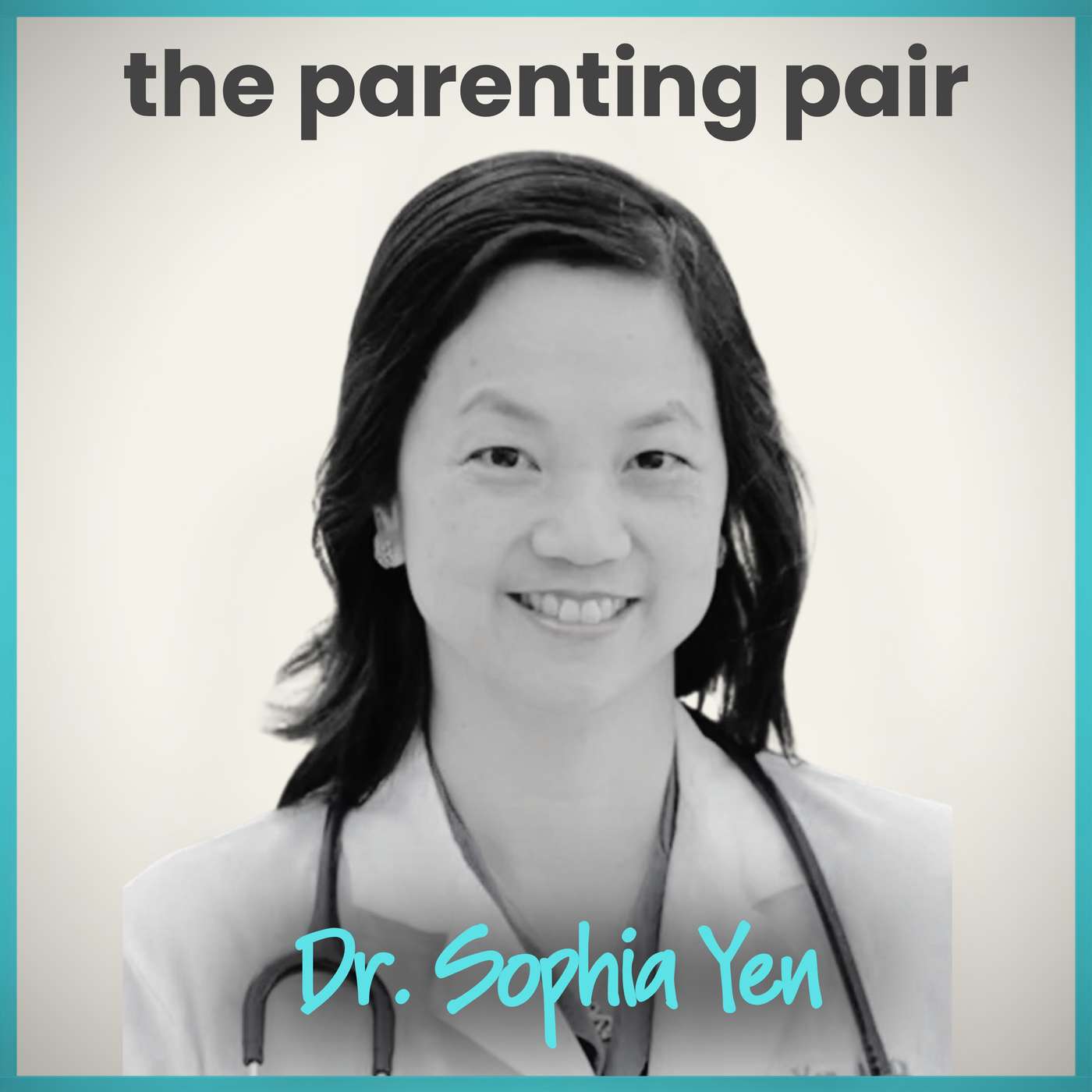
The Parenting Pair | Teens & Tweens · Dr. Annalise Caron & Dr. Suzanne Allen
Is it safe to skip your period? Dr. Sophia Yen makes the case that for many teens and women it is, and that the long-term benefits may include a significantly lower risk of ovarian cancer. In honor of Ovarian Cancer Awareness Month, we're re-sharing one of our most-talked about episodes. Dr. Suzanne Allen and Dr. Annalise Caron talk with Dr. Sophia Yen, a board-certified pediatrician and adolescent medicine specialist, about menstrual suppression, the medical option to reduce or eliminate periods with hormonal birth control, and her "Periods Optional" approach. Dr. Yen frames menstrual suppression as a risk-benefit decision and explains why she believes the benefits outweigh the risks for many women. She discusses her perspective that fewer lifetime menstrual cycles may reduce the risk of ovarian, endometrial, and colorectal cancers, noting that five years of pill, patch, or ring use can lower ovarian cancer risk by roughly half. She also addresses the small increase in breast cancer risk associated with hormonal contraception. The conversation extends beyond cancer risk to the day-to-day impact of menstruation, including heavy bleeding, missed school, anemia, and the stress of unpredictable cycles. Dr. Yen explains how stable hormone levels may benefit acne and other health conditions, and she addresses common myths, including whether hormonal birth control affects future fertility. For parents, this is a clear, evidence-informed starting point for a conversation with your daughter and her doctor. You'll learn: - What menstrual suppression is and why Dr. Yen calls periods "optional" - How periods relate to anemia, and what Dr. Yen says about cancer risk - Whether birth control affects fertility later - Who should not use estrogen-containing birth control, including those with a blood clot history or migraine with aura - Why estrogen dose matters for teen bone health - When starting may make sense, and why timing depends on how heavy periods are and how much growing a teen has left Episode highlights: 00:00 – The Real Reason Women Have Monthly Periods 02:32 – What If Periods Could Be Optional? 04:10 – To Bleed or Not to Bleed: Understanding the Risk–Benefit Balance 05:03 – Periods and Cancer Risk: Ovarian, Endometrial & Colorectal 07:32 – Menstruation and Anemia: A Common Connection 11:04 – Does Birth Control Make It Harder to Get Pregnant Later? 14:02 – How Birth Control Pills Can Support Fertility and Hormonal Health 15:07 – When Birth Control Pills Aren't Recommended 17:50 – The Unexpected Benefits of Making Periods Optional 20:00 – Dr. Yen's Algorithm for Choosing the Right Birth Control Pill 22:53 – Why Estrogen Plays a Key Role in Bone Health 26:49 – When to Consider Birth Control as a Health Tool For more on #PeriodsOptional, watch Dr. Yen's TEDx Talk, "Making Periods Optional": https://www.youtube.com/watch?v=uJ7-_MOjEeY You can also follow Dr. Yen on Instagram, TikTok, Facebook, Twitter, and YouTube, or connect with her...
Dr. Annalise Caron: Hey everyone, it's Annalise. Here in The United States, September is Ovarian Cancer Awareness Month. Given ovarian cancer is the fifth leading cause of cancer death among women, we felt it was a good time to re release two of our most shared episodes related to women's health. Their interviews with Doctor Sophia Yen, a board certified pediatrician and adolescent medicine physician. This week's episode is an enlightening discussion about the health benefits of menstrual suppression. The option to safely reduce or eliminate periods through contraception. She shares the benefits go well beyond reducing period pain and mood swings. But going period free actually can reduce the risk of certain cancers including ovarian cancer. It's a thought provoking episode that we really hope empowers you. The second episode to be re released next week covers female health across the whole lifespan from puberty to menopause and is worth the listen both for information about supporting your daughters through puberty all the way to better understanding yourself or the women in your life through perimenopause and menopause. And one quick final note, if you have a Diet Coke addiction like I do, Doctor. Young offers some reassuring information about that too. Be sure to tune in this week and next. Then in October, we will continue releasing all newly taped episodes. We just felt it was the right time to reshare this important women's health information, especially with our new listeners. So let's get to it. Dr. Sophia Yen: We're not trying to catch an embryo usually at age 12, 12.5. And on average in The United States, catch our first embryo at 26. And for those of us who have through more education, 35. So at least from 12 to 26, 12 to 35, why are we doing this every single month? And every time you build that lining, it could turn into cancer. And if people don't know already, by going on the birth control pill, patch, or ring for five years, you decrease ovarian cancer by fifty percent. Dr. Suzanne Allen: Welcome back to the Parenting Pair Podcast. I'm Doctor. Suzanne Allen. Dr. Annalise Caron: And I'm Doctor. Annalise Caron. And today we're super excited to have Doctor. Sophia Yen join us to talk about her TED Talk and her very interesting perspective on possibly making periods optional. Imagine if that was a possibility for us back in the day. Yes, right. But just by way of introduction and a little clarification about Doctor. Yen, Doctor. Yen is a board certified pediatrician, an adolescent medicine specialist with over twenty years of experience supporting kids, teens, families, really the whole, you know, the whole lifespan. She's a proud MIT grad, went on to earn her official medical degree at UCSF and her master's of public health at UC Berkeley. She now serves as a clinical associate professor at Stanford. Beyond her work with patients and students, Doctor. Yan has been a true advocate for women's and adolescent health. She co founded the Silver Ribbon Campaign to Trust Women and sheheroes.org. And she's also the co founder in her free time of Pandya Health, which is about making birth control more accessible, and stress free. And we're going to be talking about that today. You might have also heard her, as I mentioned, giving her TEDx talk or come across her many academic publications where she continues to educate and inspire. We are thrilled to welcome you, Doctor. Yen. Dr. Sophia Yen: Thank you so much for having me here. I'm excited to chat today. Dr. Annalise Caron: Yeah. Well, thank you for coming on. I think we can just sort of jump into it for our listeners who may not have had the opportunity to already hear your TED Talk. If you could just provide a little bit of background of, you know, what led you and what sort of the thesis was of your TED Talk. Dr. Sophia Yen: So my TEDx Talk was a moonshot, and it starts with, imagine a world where women don't have to be randomly hit by blood one week out of four. How much better would life be? And I also like to pitch as a tiger Asian mom from Silicon Valley. Is your young daughter going Dr. Annalise Caron: to Dr. Sophia Yen: do better on the SAT bleeding or not bleeding? In her sport, bleeding or not bleeding? On her final exam, bleeding or not bleeding. And looking back, I realized, imagine pre med, MIT, biochem final, all of a sudden, bleh. And you're like, Do I run to the bathroom? But anybody who's pre health, you know the answer. You finished that exam. Finished. Yeah, I'm finished. Dr. Annalise Caron: And we laugh about it and we joke about it, but it is so true. I think people really underestimate how women are affected, you know, by getting their periods. So, you know, menstrual cramps, you know, miss... I I remember personally myself missing school, you know, the first day, some months because I would have such terrible cramps and such heavy periods. Yeah. And people sort of blow it off as not a big deal, but that that really... It's a stressor. You worry about it coming at the wrong time. Dr. Suzanne Allen: The anticipation of it and when it's going to come and what it might interfere with or where you might be or what you might be wearing. Dr. Annalise Caron: Yeah. It's and it's it can be quite stressful. Yeah, for sure. So I love I love that imagination, you know, of that possibility. And I think if you listen to your TEDx talk, you're really saying it is possible. And in fact, it's medically advisable. Is that your stance? Dr. Sophia Yen: Exactly. So it's a risk benefit equation, and the benefits outweigh the risks, in my opinion, unless, you know, you have some other medical contraindication to making hashtag periods optional. So just to explain it a little further, I realized in getting pregnant with my first child, the only reason those of us with uteri bleed every single month is we build that lining and we're like, Embryo? Oh, no embryo. And then we build it up again, right? And we're not trying to catch an embryo usually at age 12, 12.5. And on average in The United States, we catch our first embryo at 26. And for those of us who go through more education just a wild finder significant other, 35. So at least from 12 to 26, 12 to 35, why are we doing this every single month? And every time you build that lining, it could turn into cancer, endometrial, uterine cancer. Every time you pop an egg, and we don't know if it's the popping or the healing, we feel it has something to do with the tubes, you risk ovarian cancer. And if people don't know already, the only way to decrease your risk of ovarian cancer is to take out your ovaries, which we do not recommend until end of post menopause, or by going on the birth control pill, patch, or ring for five years, by blocking that egg popping for five years, you decrease ovarian cancer by fifty percent. And then lastly, I like to bring this up so that people understand the miseries that those of us with uteri have gone through. The intestine is around the uterus. And so as that uterus is going up and down, up and down every single month, the intestine's like, I'm sorry for you. And it either runs faster, diarrhea, or slower, constipation. And when you mess up the intestine or the colon, you increase colon cancer. So by decreasing this up and down, popping in the colon situation, you decrease ovarian, endometrial, and colorectal cancer. Dr. Annalise Caron: I think that is so powerful. I think it's so powerful for parents to hear, for women to hear, because I think whenever, particularly if we're talking about adolescents or young adults, when people consider medication, I think parents often have a lot of trepidation around it and they have worries about, you know, things being unnatural or we hear, well, you know, whatever the particular side effect or certain population where this might be of concern, that gets blown up into, oh well, this is unnatural. We shouldn't do this But to think of ovarian cancer, which is so very difficult to treat and found so late and endometrial cancer and these other cancers, that is not what's advertised. You know, that is not in in the common lexicon of how we understand a potential use for the birth control pill. And so I just think you getting that message out and really educating people is so very important from a public health standpoint. It's just huge. Dr. Sophia Yen: Yeah, no, this is really my gift to the world, my realization. And as a feminist, I like to say, I can do anything a person without a uterus can, bleeding. But as a doctor who has drugs and science, how about I help alleviate you from this, you know, increased risk of cancer, as well as the number one cause of anemia in a menstruating woman is menstruation. And so I want everyone who doesn't menstruate out there to picture taking a knife and going and bleeding yourself one week out of four. Was not natural. This is not what's meant to be. And so my OBGYN professor at UCSF was like, the natural state of a female is pregnant or breastfeeding. Many periods do you have when you're pregnant? Dr. Annalise Caron: -Yeah, you don't. Dr. Sophia Yen: -None. Many periods do have when you're exclusively breastfeeding every two to three hours? -None. -And so to further hit this home, Doctor. Beverly Straussmann, she's a medical anthropologist, studies the Dogon tribe in Mali, Africa, and they die the same time we do. So we're not comparing people who die 30 to people who die 70, but we're comparing seventy, 70 years, 80 to 80. They have 100 periods in their lives. We have three fifty to 400 periods in our lives. -: Right. Part of that is nutrition. As soon as you hit one hundred pounds or 22% body fat, your body's like, Oh, I can make babies. Let's make babies. And so they don't hit their periods till 16, we hit ours at 12. But more importantly, they have eight children. Not saying we should have eight children, but they have pregnancies and children. We have two. And then they breastfeed for a year to eighteen months. We breastfeed zero, three or six months. And definitely we should increase our breastfeeding. But the TLDR, they have a 100 periods in their lives. We have three fifty to 400. We have enough periods for two or three other women. We increase our risk of ovarian endometrial colorectal cancer. They don't have ovarian endometrial colorectal cancer because they aren't doing the up and down popping egg and colon situation every single month from 12 to 52. Dr. Annalise Caron: And I think that's a you've made a very compelling case there. I'm curious, though, just for the skeptics out there, could there be any other causal factor that might account for that that that you've thought of or that others question? I'm just curious. Dr. Sophia Yen: I think the main concern is there is a slight increased risk of breast cancer, but more people die from ovarian endometrial colorectal cancer than from breast cancer. The good news is that we can catch breast cancer early and there's good treatment and most women survive. But with ovarian cancer, as you stated, we generally catch it at stage four, which means it's run through the whole body and it's too late and it is very sad. With science advancement, that'll be great. But also colorectal cancer. Your colon and your intestine is the size of a football field. And the longer you live, the greater the risk of something mutating in there and us not catching it and getting colon And so the risk of ovarian, endometrial and colorectal cancer and the death rate from that is much more than that for breast cancer. So there is definitely a slight increased risk in breast cancer, but a family history of breast cancer is not a contraindication for the birth control pill, PATRIC, or for HRT. Dr. Annalise Caron: Yeah. So you answered the, you know, unnatural. Dr. Suzanne Allen: Yeah. But I was also thinking, you know, are there other concerns that you hear sometimes from parents or for young, from young women themselves about, you know, are there any risks or downsides to making periods optional? You know, I can think about the things, you know, I remember a rumor, you know, it'll make it harder for you to get pregnant someday if you use birth control. That would be one I definitely heard growing up. Dr. Sophia Yen: Yes. So a lot of people ask, does the birth control pill patcher ring or the IUD or implant or shot make me infertile? And my joke is, while you're on it, because that's why it's called birth control. But for those of you who have taken the birth control pill patch ring, or the IUD with hormone, or the implant, as soon as that's out of your body, within a week, you get your period. And it's because the hormone was there and it was blocking everything from happening. And as soon as you take it out, and with the birth control pill patcher ring, there's three weeks hormone and then one week off if you want, or you can just skip this. That's the period's optional. But that drop in hormone signals a shedding, but that drop in hormone means the drug is out of your body. So with the pill, patch, ring, hormonal IUD, implant, pharmacologically, chemically, it is out of your body in three days. And if you wanna be anal retentive, it has to be three half lives. So maybe nine days. Or at the most, two weeks, it is out of your body. The only exception is the shot. Because the shot lasts for three months. And after, like, three shots, there might be some residual. And so with that one, it may take you eight months to get pregnant. But most people can wait eight months if they have to. Or if you know you really wanna get pregnant soon, then stop eight months. But that's only with the shot. All the other methods, two or three half lives, which is nine days, two weeks if you wanna be totally, absolutely sure, out of your body. And then to reassure about this infertility, fertility, two examples. One, they did a research study where they have a 100 people on the birth control pill, a 100 people not on the birth control pill. They waited twenty years and then they took them all off and they tried to get pregnant. Ten percent of each group had a hard time getting pregnant. It wasn't the birth control people had a lot more couldn't get pregnant. Each group had the exact same couldn't get pregnant. And that's not because the birth control made this group infertile and this group somehow infertile. Was because ten percent of people born with uteri will get polycystic ovarian syndrome. And people with PCOS, or PCOS, depending East Coast, West Coast, don't pop out eggs or have a hard time. And if you don't pop out an egg, you can't get pregnant or it's harder to get pregnant. So the difference in getting pregnant when you come off the pill is not that this made you infertile forever, this simply was hiding it, or that both groups over time will develop polycystic ovarian syndrome. As we gain more weight, as we get older, there's a greater risk of PCOS. And then the other example I give is I gave a birth control pill talk to a bunch of infertility specialists. And I'm like, why am I giving a talk to a bunch of infertility specialists? But people actually use the birth control pill to normalize the hormones in people with PCOS, who can't get pregnant. So we use it to take their hormones and normalize it. And when they come off, that is the most fertile they're gonna be. The longer they're off, the weirder their hormones And the harder it is to get pregnant. So this doesn't cause infertility, it's used for fertility. Not while you're on it, but as soon as you come off, that is the most fertile you're ever gonna be for a PCOS patient. Dr. Annalise Caron: That's such an interesting and important point for that population. I'm curious then, when are the times? I imagine medically, you know, there could be moms listening to this who have questions. You know, certainly, all I can think of, you know, back when I went on the pill, you know, years ago, when I was younger, was this idea of you know, blood clotting disorders. What are the circumstances when you might say, no, actually, I'm not going to recommend you consider making periods optional or going on the birth control pill? Who are those populations and what should we know about that? Dr. Sophia Yen: So part of it is realizing new versus old birth control pills. Back in the day, we started with 110 of ethinyl estradiol, and now we're down to thirty or 20. So we are one fifth the dose of the original pill. So one fifth the risk of blood clots. So blood clots aren't so much a concern if you're under the age of 35 and not a smoker. Luckily, much decreased smoker. Marijuana, not relevant. But not recommending marijuana, you'll already 35 for your brain development, separate talk. So if you are a smoker or greater than 35, but you have to be both. Poor is fine, but both is not okay. But then blood clot disorder. So there are people who have a family history of blood clots in the chest and other weird blood clots. They get tested for protein S, protein C deficiency. Those are the two big ones. If you have a family history of that, please get tested. And if you have them, then no, you cannot have anything with estrogen in it. You can do progesterone only methods, such as the IUD with hormone or the implant or the shot, but not the pill, the patch, the ring generally. And then if you have lupus with a blood clotting thing, so there's the anti cardiolipin antibody that increases your risk of blood clot. So not just lupus, but lupus with this blood clotting thing, then no. If you have liver cancer, no, because it's metabolized in the liver, and we don't wanna mess with your liver. And then migraine with aura, we're looking at that because with the lower dose estrogen, we're thinking that can go away, but it hasn't officially. So right now, if you have migraine, fine. But if you have migraine with aura, which is like before your migraine comes, you have some weird visual thing or part of your body doesn't move or something like that, that's migraine with aura or weird taste, then no, you cannot. Because that's like a mini stroke, and adding some estrogen to a mini stroke could theoretically lead to a stroke. And we do not want that. Dr. Suzanne Allen: I, you know, just I think your explanation, and the risk reduction that is so significant for cancers feels like a very compelling reason for all of us to consider, you know, PeriodsOptional. Are there other benefits to young people in addition to, you know, an incredibly significant reduction in the risk of cancers? Dr. Sophia Yen: Yeah, no, it's surprising that actually by going periods optional, having a stable hormone helps a lot of health conditions. So diabetes, seizures, headaches, depression, because going up and down, up and down, up and down every month was not what we were supposed to be. And by having a stable hormone that helps with diabetes, which goal is try to keep stable sugar, helps with seizures because with seizure meds, we wanna have stable hormones. And then acne is the obvious one. I used to get one giant zit every single month. I don't know if it was the popping of the egg or what, I can never remember back then. As soon as I went on the birth control pill, there wasn't the popping of the egg every month. There wasn't the up and down of the hormones, and the acne got better. And during adolescence, you already have all the changes in your body, the stressors, the random blood hitting you one week out of four. Let's get rid of the one week out of four anxiety. Let's get rid of some of the acne. So the ethinyl estradiol increases this thing called sex hormone binding globulin. And this binding globulin finds testosterone and binds it and then decreases your acne. So any of the birth control pills should generally decrease your acne. But the one random education point that you all get because you listened today is that there are eight different progesterone. There are two different levels of estrogens. There's 40 different birth control pills. So if one doesn't work, there's 39 other Not birth control all pills are made the same. And at Pimbia Health, I've written 3,000 birth control prescriptions plus, but originally 3,000 birth control prescriptions over two years, and I saw the different side effects. So I took all 40 pills and ranked them. Most likely make you bleed, least likely make you bleed. Most likely give you zits, least likely give you zits. Most likely give you munchies, least likely give you munchies. And then came up with Doctor. Yen's algorithm based on race as a proxy for genetics, because we noticed that people of Asian, Black, and Latina had more of one side effect. Based on age, to make sure everybody should be on thirty micrograms of estrogen until 30 years old to make sure you have strong bones. If you go in and you're like, I want the least amount of estrogen possible, the doctor will be like, Okay. And they'll give you the ten microgram, the twenty microgram, because they aren't adolescent medicine. They aren't focused on bone health. And when you're 50, you're gonna fall down the stairs and break your wrist, break your hip. And neither that doctor nor you will know that it was because you were on the birth control pill that was way too low estrogen. So you don't want thirty micrograms of estrogen till 30 years old and know that I have an algorithm that we pick the best pill for you with the least amount of side effects. It's good for your bones. And with that, ninety three percent of our patients are happy with the first pill we prescribe. Dr. Annalise Caron: No kidding. But it is so important to remember. I think we run into this when we'll refer to psychiatrists for psychotropic medications. It's always having that knowledge in that patients that if possibly the first medication isn't the right fit, there are multiple options and it is person specific. But if you're working with your medical provider to just stay the course, it sounds like you've really got an algorithm going, you know, from your own, you know, experience there to guide people in a in a positive way. But to have that patience is really important. I'm fascinated because I am 50 and I just got my first DEXA scan thing. And just what you're saying now, just am I'm going to make this podcast personal. Because I have Doctor. Yen here. Why not? You know, and I guess the whole world will hear this. But due to very heavy periods and very pain and missing a day of school when I was eight... Like, through high school, when I was 18, they put me on the pill. And I stayed on the pill till I was 33 when I had my first child. And they gave me such compliments. In recent years, the last five to six years, I've done the weights and all of that. But I was not a consistent person that was doing sports and doing weight activities. And I was above the fiftieth percentile for my bone situation. And they showed me the graph of where I was headed and I really wasn't headed for osteoporosis or osteopenia. Are you suggesting that it's possible that a factor that could have helped me in that is the fact that I took the birth control pill from 18 to 33? Am I understanding you correctly? Dr. Sophia Yen: Yes. So we absolutely think you need thirty micrograms of estrogen until 30. And once the other part is now that you're 50, within five years of perimenopause, your bone density goes. And so I'm also... Our company has now gone into menopause, and I'm a Menopause Society certified practitioner, probably the only pediatrician that's Menopause Society certified. But the estrogen is really key to your bone health. And so when your body's like, Thank you for your service, and it takes away your estrogen, your bone density goes... And so I was like, If that happens when you take it away, put it back to maintain that It is a drastic decrease that happens when your body takes away the estrogen. But certainly, what I'm saying is that if somebody put you on twenty micrograms, that's too low and preventing you from getting that good bone density. If they put you on thirty, then they did, you know, they did good by you to make sure. Because some athletes don't eat enough for the amount of, you know, that they're running or people of color. A lot of us are lactose intolerant and we don't get enough calcium. And so you need the estrogen to put on the calcium. You also need the calcium and you need the vitamin D. So if you are lactose intolerant, please make sure you're... At our family, we have a calcium with vitamin D giant bottle from Costco in the middle of our kitchen, and if you didn't have calcium with breakfast, lunch, or dinner, you take a pill. But if you had milk with your cereal or your bagel, you don't have to take a pill. If you had cheese or you had yogurt, you don't have to take a pill. But three times a day, I try to get that in because I know we're not gonna do it three times a day, but at least twice or But three months a I think, you know, that's a practical thing. Get enough calcium and vitamin D from now until 30 because you're building up your calcium bank. And in order to build that, you also need to have enough estrogen. So if you're on the pill patch ring, don't go for the lowest estrogen. Don't go for the highest because that increased blood clot, but go for thirty micrograms minimum. So thirty, thirty five is where most pills are, but if you ask for a low dose, that's usually for the 40 year old and up or 30 year old and up that we can switch to the low dose. But when you're under thirty, thirty micrograms. Dr. Annalise Caron: I'm gonna just allow what you just said there about perimenopause and menopause to be a little bit of a teaser because doctor Yan has been kind enough to say she will come back next week to answer some of our listener questions. So I'm gonna follow-up on that one, next week. But I do have one other question for you before we wrap up for today, doctor Yan. Is this in your mind sort of a recommendation that you wish would go to all adolescent girls? Is this something that's on a, you know, need to know timeline? And is there... I I think you did tip us off in your TEDx talk about this. Is there a certain time that you consider starting the pill and certain time that you wouldn't for adolescence? Just any thoughts on that. Dr. Sophia Yen: Yes. So really, you know, I feel this is my epiphany and my life hack, and my goal is to make those of us born with uteri's life better and to even the playing ground. What I didn't mention about that exam is I look to my left, I look to my right, two people without uteruses. Not a care in the world. And I have two daughters, and I want them going into every exam, every sports, every performance, with 100% confidence that nothing's gonna hit them randomly out of four. Or I had the retrospective epiphany that in every exam room, one out of four women is bleeding. Like, wow. We are amazing. So, yes, I think this should be shared with anybody with a uterus, but also, I wear this uterus necklace, and I love my dad, the feminist. He's like, We all came from the uterus. No one escapes the uterus. Respect the uterus. So the men should know, too. My husband, my brothers, they know about periods. They know that I do not like them, and they cause me suffering. My husband has bought me pads. My brothers will buy their daughters pads, you know, and tampons, all of that. And so I think everyone should know about it. You did ask about timing. So I come from short Asian stock. And so if you aren't missing school, you aren't losing a ton of blood, then if you throw estrogen on too early, then it can fuse your epiphyses and you could lose potentially one to two inches. Because after you get your period, you have like one to two inches of height left. But I met a woman and her daughter was like bleeding crazy and it hurt and she was missing school and her daughter was already six feet. So she was like, I'm fine. Let's turn this off, you know? And so, again, it's a risk benefit. If you are short people and it's not so bad, then wait two years. But if you are bleeding like stink and you are missing school, know that I've seen people miss two to five days of school a month. And you'll be like, two days? That's nothing. But there's only twenty days of school a month. That's 10% of her education. And at Tiger Asian mom, you lose 10%, that's an A minus. And you miss anything else, you're at an A. So that is unacceptable in the Asian community. So 10% is not okay. Dr. Suzanne Allen: And I think missing that also sets you up. I mean, I can very clearly remember missing school at certain times in high school. You know, we work with so many kids in our local high school here. If you miss a day or two of school, the amount of makeup work, the amount of stress, I mean, can set you back a week or two because high school has gotten really hard. It's a lot harder than when I was there. So I think there's a lot of repercussions in addition to missing your education. I think it also can create a lot of stress and unnecessary anxiety for young people. Dr. Annalise Caron: 100%. This has been a really instructive and educational and helpful conversation. So, we are super excited that you've decided to come back next week as well. But I think, you know, for today, we'll sign up for here and really encourage, our listeners to maybe speak to your doctor about, you know, their thoughts about making periods optional and learning more. Certainly going and finding Doctor. Yen's TEDx Talk. It's on YouTube. It's very easy to find. Dr. Suzanne Allen: Yeah, I've watched it a couple of times. It's excellent. So we would recommend that people go and watch that. If you enjoyed this today and are grateful for the information that Doctor. Yen shared, which I know we are very grateful for this information and her expertise, if you could share this episode with someone that you care about, go online and rate and review it, helps this podcast be more searchable and gets this information to more people, which would be an incredible asset to them. Dr. Annalise Caron: Yes. And as always, we love hearing from you. Don't hesitate to reach out to us on Instagram at The Parenting Pair or by email hellotheparentingpair dot com. With that, everyone, a great week.