
The Occult Rejects · The Occult Rejects
Links For The Occult Rejects https://linktr.ee/theoccultrejects Occult Research Institute https://www.occultresearchinstitute.org/ Substack https://substack.com/@theoccultrejects?r=7auau0&utm_campaign=profile&utm_medium=profile-page Cash App https://cash.app/$theoccultrejects Venmo @TheOccultRejects Patreon https://www.patreon.com/TheOccultRejects PRIMARY AND EARLY SOURCES Anonymous. Arbatel de magia veterum: summum sapientiae studium**. Basel: [Peter Perna], 1575.** This is the principal primary source for the episode and the earliest known printed appearance of Aratron, Bethor, Phaleg, Och, Hagith, Ophiel and Phul as the seven Olympic governors. The surviving 1575 copy held by the Universitätsbibliothek Basel is especially important because it allows comparison of the original Latin against later translations. The Basel catalogue identifies the edition as printed in Basel in 1575 and attributes the printing to Peter Perna. Most heavily used: Aphorisms 14–21, particularly 15–18 for the definition of Olympic Spirits, their names and governments, planetary provinces, characters, the 490-year periods, “Olympic speech,” and the warning concerning the temporary efficacy of spirit names. Turner, Robert, trans. “Arbatel of Magick.” In Henry Cornelius Agrippa, His Fourth Book of Occult Philosophy; Of Geomancy; Magical Elements of Peter de Abano; Astronomical Geomancy; The Nature of Spirits; Arbatel of Magick**. London: J.C. for John Harrison, 1655.** Turner’s translation became one of the principal routes through which English-speaking occultists encountered the Arbatel. It is also important for tracing later translation problems—particularly Turner’s rendering of the duration of efficacious Olympic names as forty years rather than the 140 given in the Latin. The Library of Congress preserves and digitizes the 1655 volume. Trithemius, Johannes. De Septem Secundeis, id est, Intelligentiis sive Spiritibus Orbes post Deum Moventibus**. Written 1508; first printed 1522/early sixteenth-century editions.** Essential for the planetary-governor system preceding the Arbatel. Trithemius describes seven secondary intelligences governing the world beneath God for periods of 354 years and four months. His Saturnian governor Orifiel is explicitly described as bearing a “name of office, not of nature” — nomen est officii, non naturae, an extraordinary conceptual parallel to the Arbatel’s later emphasis upon office over permanent names. Pietro d’Abano [Peter of Abano]. Conciliator differentiarum philosophorum et praecipue medicorum**. Early fourteenth century.** Important for the earlier planetary-spirit tradition underlying Trithemius. The planetary names associated with this current include Cassiel, Sachiel, Samael, Michael, Anael, Raphael and Gabriel. Peterson’s research traces Trithemius’s planetary-age doctrine back through this material. Paracelsus [Theophrastus von Hohenheim]. De causis morborum invisibilium [On the Causes of Invisible Diseases]. Written c....
0:02Speaker 1You see, something's going to happen. What?
0:09Speaker 2What's going.
0:12Speaker 1To happen?
0:13Speaker 2Something wonderful. What? I understand how you feel. You see,
0:22Speaker 2it's all very clear to me now.
0:24Speaker 1They are called Olympic spirits, which do inhabit in the
0:27Speaker 1firmament and in the stars of the firmament. Seven names
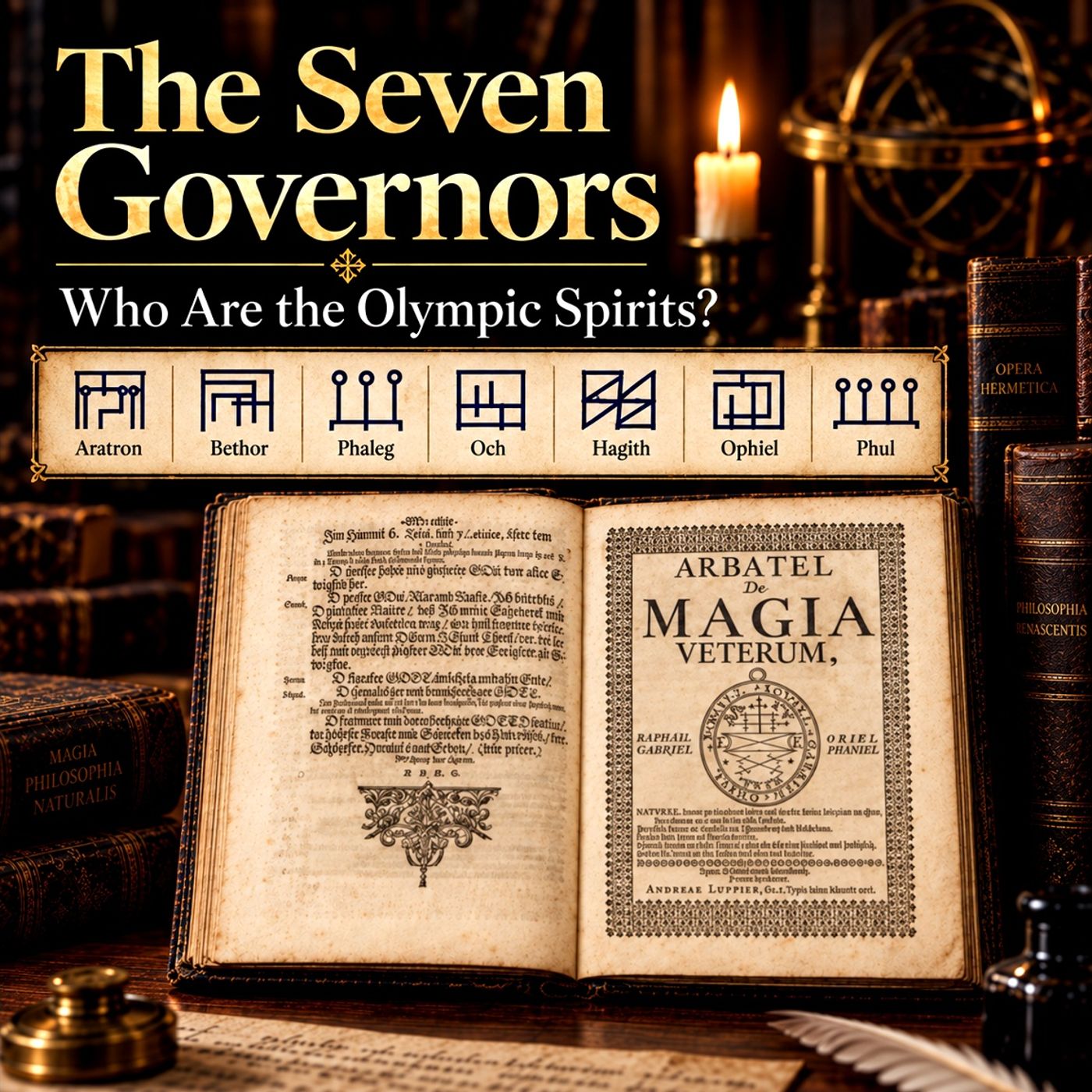
0:31Speaker 1have survived in Western magic for more than 400 years. Aratron, Bethor, Phaleg, Ach, Haggith, Ophiel, Ful. Today,
0:42Speaker 1if you open a modern book on planetary magic, search
0:45Speaker 1through occult forums, or look through tables of ceremonial correspondences,
0:50Speaker 1there's a good chance you will eventually encounter them. Aratron
0:54Speaker 1is placed beneath Saturn, Bethor beneath Jupiter, Phaleg beneath Mars,
1:00Speaker 1Each has a strange character or seal attached to it.
1:10Speaker 1Each is credited with powers that resemble the qualities traditionally
1:13Speaker 1attributed to its planet. Together, they are usually introduced as