
The New Realist Podcast · Jeanne Sheehan Zaino
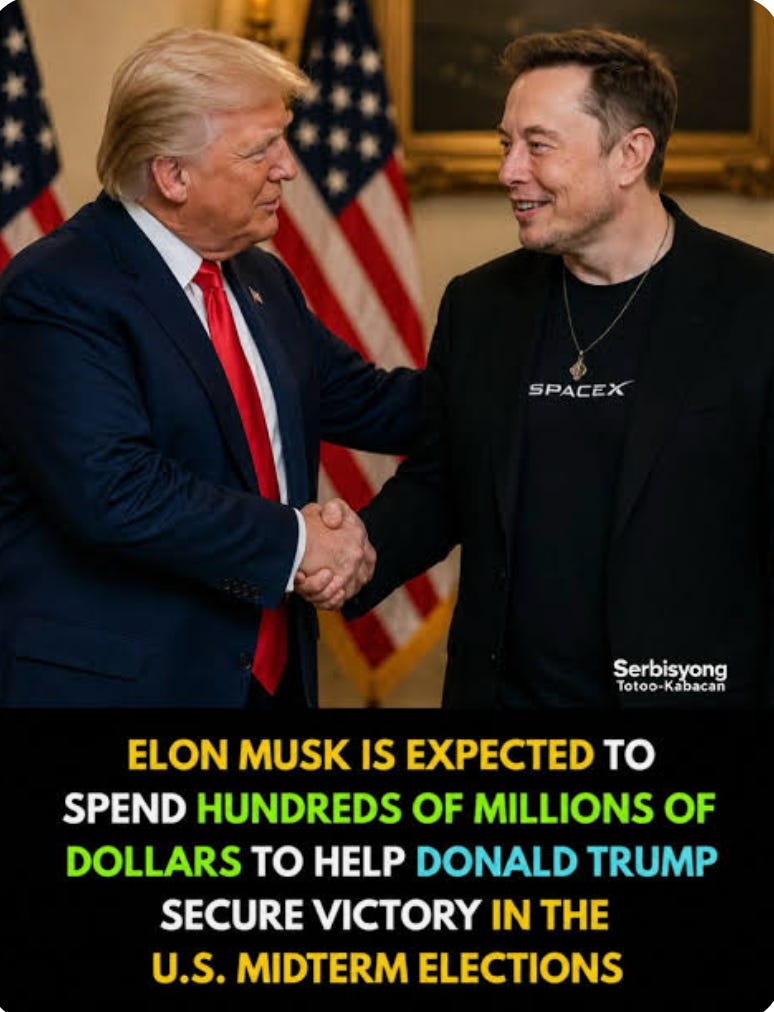
The numbers are astounding. The wealthiest person in the world and, arguably the wealthiest individual to ever walk the earth, has broken all records when it comes to spending in an election. According to a report in the New York Times today, Elon Musk has spent $366 million on this midterm cycle, far exceeding the $290 million he spent to help Republicans and President Trump in 2024. While this is less than a drop in the bucket for Musk (.037% of his estimated $1 Trillion net worth), it makes him the single largest donor of this or any other election cycle. This is not just a case of pay-for-play, political influence, or access-buying. It is, to Senator Bernie Sanders (Independent -Vermont) point, the clearest sign to date that we are living in the midst of an emerging oligarchy. In late September, Sanders spoke at Riverside Church in New York arguing that “oligarchy is ascending, working families are struggling to stay alive and democracy is in retreat.” At the time, Sanders noted that Musk was “spending some $200 million more to help Republicans keep control over the Congress” in the midterm. Little did Senator Sanders know at the time, but the actual amount of spending by Musk is nearly double that. Nevertheless, Sanders is correct to say that what we are witnessing in the U.S. today is the very definition of an oligarchy. After all what is an oligarchy but a form of government in which a very minuscule number of extremely wealthy people, such as Musk, exert an inordinate amount of economic, political, social, governmental, and technological, power. The Times revelation regarding Musk’s spending comes just a few days after a new poll found that “most young people” in the United States feel the “system is tilted toward Billionaires.” Among other things the researchers found that: * In terms of who holds power in Washington D.C., young Americans rank voters dead last and Billionaires first * The Concern about money in politics is widespread and bipartisan. * 83% of young Americans describe money in politics as a big problem (58% say it is “very big”), and just 2% say it is not a problem at all * most young Americans believe Congress and the states should be able to reasonably regulate and limit money in campaigns and elections. * Many see money as a threat to elections. Despite the focus in the Times piece on Musk, the problem is much bigger than any one individual or party. It is widespread, it permeates both parties and all aspects of our politics. It is also not enough to cast aspersions towards groups, parties, or individuals who play by the rules and follow the law. The problem is not them, but rather the law itself. To quote Michael Kinsley, “the scandal isn’t what’s illegal; the scandal is what’s legal.” That is what needs to be changed, the laws, the system and rules of the game by which we conduct our political lives. This starts with overturning the Supreme Court’s decision in Citizens United v. Federal Election Commission (FEC)...
0:00[music]
0:20SPEAKER_00Emerging Oligarchy by Jeanne Sheehan Zaino.
0:24SPEAKER_00October 12, 2026.
0:27SPEAKER_00As read by an automated voice.
0:30SPEAKER_00The numbers are astounding.
0:32SPEAKER_00The wealthiest person in the world and,
0:35SPEAKER_00arguably the wealthiest individual to ever walk the earth,
0:38SPEAKER_00has broken all records when it comes to spending in an election.
0:42SPEAKER_00According to a report in the New York Times today,
0:45SPEAKER_00Elon Musk has spent $366 million on this midterm cycle.
0:50SPEAKER_00Far exceeding the $290 million he spent to help Republicans and President Trump in 2024.
0:57SPEAKER_00While this is less than a drop in the bucket for Musk,
1:01SPEAKER_00.037% of his estimated $1 trillion net worth,
1:04SPEAKER_00it makes him the single largest donor of this or any other election cycle.
1:09SPEAKER_00This is not just a case of pay-for-play, political influence, or access buying.