
The Moreish Podcast: Caribbean History, Culture, and Cuisine · Hema Ramsingh
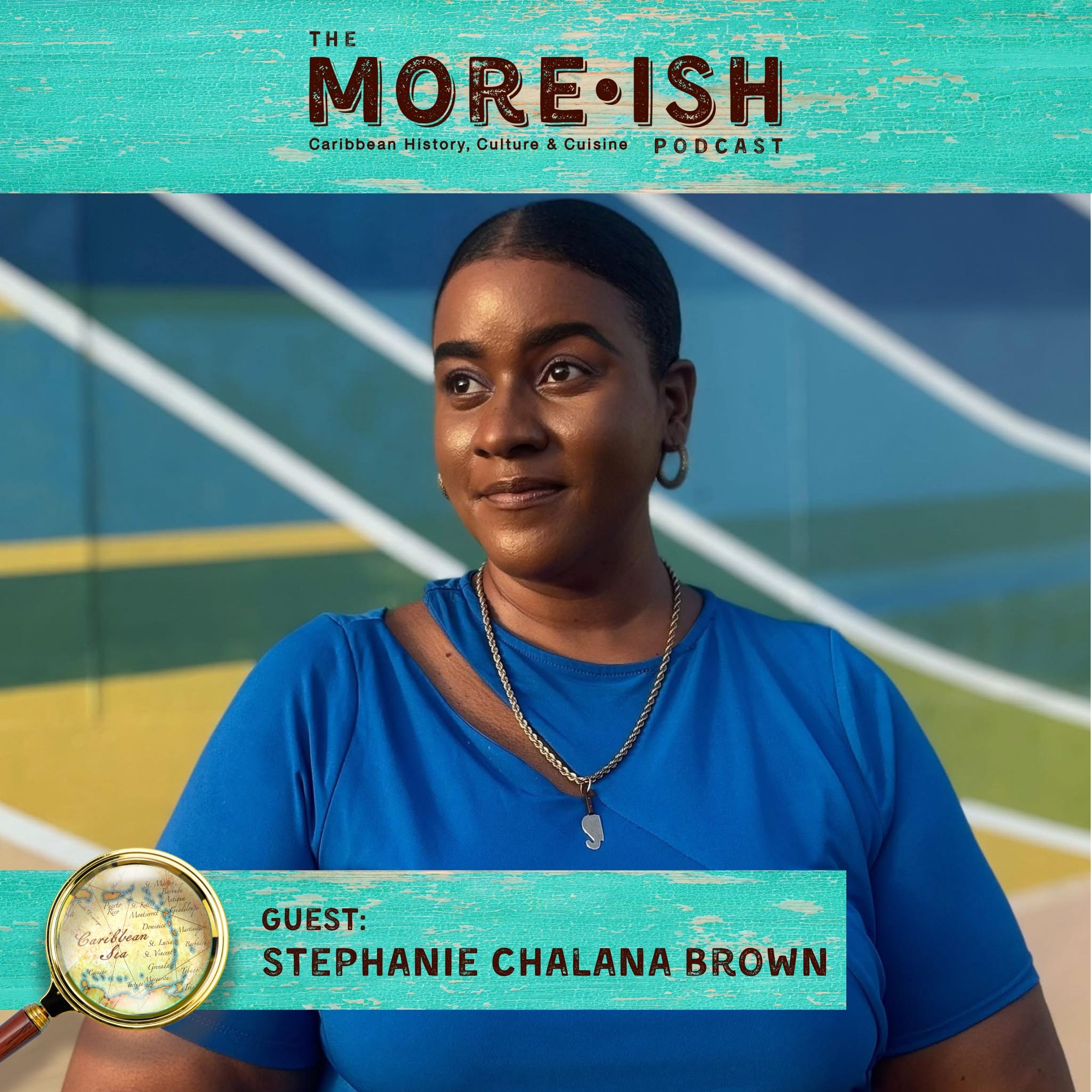
Exploring the US Virgin Islands: History, Identity, and Cultural Shifts Stephanie Chalana Brown joined me to discuss the history of the Virgin Islands, a territory of the United States. Comprised of St. Thomas, St. Croix, St. John plus smaller islets and cays, it’s often described as laid-back, with quaint towns, turquoise waters, a perfect vacation spot for sailing, divers, and sun-seekers. In this episode we go beyond that. From its indigenous Taino roots, colonial past with strong Danish influences, and present-day struggles, Chalana shares her personal insights into citizenship issues, her ancestral family history, and the importance of local scholarship, digital archives, and historical narratives. About Stephanie Chalana Brown Stephanie Chalana Brown is a Virgin Islands–based photographer, cultural thinker, and public intellectual whose work explores African diasporic history, place, and memory across the Caribbean. Her practice moves between photography, archival inquiry, and cultural interpretation. She documents everyday life, heritage spaces, and community rituals with an eye toward how history lives in bodies, streets, buildings, and shared traditions. Her work treats culture as a living record, something carried, practiced, and remembered rather than frozen in the past. Chalana’s interests sit at the intersection of African studies, Caribbean history, visual literacy, and public education. She is particularly engaged in how communities preserve memory outside of formal institutions, and how photography can function as both documentation and archive. Her work has appeared in exhibitions, publications, and national media, and she regularly contributes to conversations about heritage, representation, and cultural accountability in the Virgin Islands and the wider Black Atlantic world. She lives and works in the U.S. Virgin Islands, where she continues to photograph, research, and write in dialogue with place. Instagram These islands were bought by the US. Now they have a message for Greenland. Resources Virgin Islands Taino Welcome Tribal Members from Caribbean The Danish National Archives National Museum of Denmark Society of Virgin Islands Historians The 1733 Akwamu Insurrection Fireburn: The Uprising of 1878 The Fireburn Files The St. Croix Educational Complex Drama Club
Stephanie Chalana Brown So I love oral history, but it shifts a lot from generation to generation because I think we're very inventive with our identity, but we're inventive because we have to, because we really don't have, we're reactionary to what happens in the world and rarely do we get to be at the forefront of making policies for ourselves. And so we're continuously shifting and the stories shift. But as many perspectives that you could get to like find a truer story, that is what I’m always in search of. [music] This is The Moreish Podcast where Caribbean history meets culture & cuisine. Hema Chalana thank you so much for joining me today on The Moreish Podcast. Stephanie Chalana Brown My gosh, thanks for having me. Hema We have a lot to talk about today, and I'm excited to dive into this section of the Caribbean because it's not one that I hear talked about a lot in terms of the history and the culture. But before we get there, can you introduce yourself? Stephanie Chalana Brown Oh yeah. My name is Stephanie Chalana Brown and I document the Virgin Islands and the wider Antillean, um, through documentaries and digital arts. I'm also a photographer, so it's my way of connecting history and culture and for me to better understand and share with other Virgin Islanders the history of this space and the Caribbean that had made us so, um, transnational. Yeah, that's who I am and I'm still becoming. I would like to one day be able to be like a bona fide historian. But I'm becoming. Hema You have so much going on that I'm grateful that you're giving of your time. You said Virgin Islands, and there are the British Virgin Islands and the US Virgin Islands. Which one are you coming from? Stephanie Chalana Brown Yes, so I am… the correct name, people just say US Virgin Islands, which is not erroneous, but it is, uh, legally the Virgin Islands of the United States. We were once under colonial rule of Denmark, and the British Virgin Islands, although we share so much because of proximity, and our families moving between these spaces. They were always under the empire of England. Hema Which island do you live on? Stephanie Chalana Brown There's, uh, three, three main islands and of course we have smaller cays. That’s St. Croix and it's the largest of the islands. It's basically more agricultural historically. It's not as hilly as St. Thomas. St. Thomas is a smaller island. It is known for its port. Historically, um, it's what's driven a lot of our transnational identities because of the port there. And then there's the island of St. John, which is extremely close to the British Virgin Islands. Almost like you can't, like the same people who are from the British Virgin Islands are the same people who live in St. John, they're that much connected. But we know that borders, in terms of borders and citizenship, we are the Virgin Islands of the United States and they are the British Virgin Islands. Hema If we want to think about geographically, just so people can orient themselves, St. Croix is relatively close to Puerto Rico. Stephanie Chalana Brown Very. Like we have a really close history with Puerto Rico a lot. It's almost to the point where there's more research coming about where we could be like one of the same because historically during Danish rule, Africans who were enslaved in the Danish West Indies, they would all become Maroons and they would go to Puerto Rico a lot. And, you know, empires were fighting against each other, so the Spanish were not in a hurry to return people who were enslaved. In actuality they accepted persons, and if you became a Catholic, they integrated you into the society, and you could be almost a free person. And those spaces like Loiza and Santurce, a lot of Virgin Islanders are embedded into those free Black communities. And then we see like a second and a third wave when we now put Hispanic people, Puerto Rican people who come to the Virgin Islands, they feel so much um entwined in the culture. Well, it's because it's reciprocal, the same food, the same languages, this, you know, we're out of the Bight of Benin and Ghana and so forth. We share those things, and so it's just a reciprocal history timeline of us returning to each other. And, and more research is being done with that, where the language is the barrier between us communicating more. But we see that this, in the last five years, there's been so much more scholarly and academic, um, initiatives happening between the islands, because again, we share so much history together. Hema Let's talk about the history of the Virgin Islands of the US because there is so much history before it became a US territory. Stephanie Chalana Brown Yeah Hema Who were the original inhabitants? Stephanie Chalana Brown Yeah, I'm so glad that you said that because we just recently got some local designation for a Taino community. And so they do not have federal designation. It wasn’t certified or made into law. But we do have local designation of a Taino tribe here. And they have a Kasike. And so they lead spiritually here for the Virgin Islands. We had a strong Taino culture. And we see, you know, we have a lot of evidence of that. There's been archaeological studies. They were at Salt River. They were in St. Thomas at Tutu and in St. John, very much, uh, petroglyphs of their communication is documented. You could go on a trail and see it. It's available for anyone. So it's right at the forefront. You don't have to search far for it. It's there. It's documented and they're very much part of our culture. Hema And they have been part of the culture for way, way back in history. The first real European presence was Columbus. Is that correct? Stephanie Chalana Brown I guess we can say that. Yeah, their voyage, yes, coming here, documented, Hema Much like the rest of the Caribbean, this European presence on the island or on the islands really changes the trajectory and leads us on that trail to where culture is today. Let's talk about it. The Virgin Islands of the US changed hands and flew the flag of many different countries. Stephanie Chalana Brown Yeah, so for the most part, Denmark is one of the longest standing. Most persons, as I stated before, the harbour in St. Thomas drew a lot of people here. So the Spaniards were fighting with the Dutch and the English. And it was basically for the harbours, none of them really were, had any really strong colonies here or towns here. It was more of using the Virgin Islands as a hub for trade. So we even have a language that sort of is not spoken anymore. And there is a call to bring it back. It's called Negerhallens or Dutch Creole. Because for a long time before even Denmark colonized this space, the Dutch was really strong in St. Thomas and we brought that's how we got the Sephardic Jews that are here. We have one of the oldest synagogues in St. Thomas and so it was always a space for trade, where it's structured in the Caribbean we were always strong and being a trade space, so they didn't really have a lot of towns they were just using the ports a lot. But the Danish were the colonies that really lay foundation into this space. And there were Africans here before, through further with chattel slavery, that's where a lot of the people who would call themselves Afro-Caribbean were brought in from the Danish Empire. Hema Were there enslaved African people brought before the Danes? So if I look back at some of the literature that I was reading, there was the Spanish and then the French were there for a little while, the British, so a number of different Europeans had a presence on the island before that very lengthy time when the Danes were there. Stephanie Chalana Brown Yeah, one of my mentors, George Tyson, who has dedicated his life to Virgin Islands history specifically, he talks about merchants and these merchants, we talked about the English, the Dutch, the Spanish. They had seafaring Africans with them on their journeys, and sometimes some of these persons continue to live in the Virgin Islands, what we call the Virgin Islands at this time, and they became like free persons. So they were in these really strange spaces where, you know, all these other people left. The Spanish ran the Dutch out. The Dutch and the English started to fight. And in between that, there's people who are Africans there with these merchants. And they could have been enslaved, but they chose to stay in the Virgin Islands, what we called the Virgin Islands at the time. They became like free people. And then they're like the starts of Maroon history because now, you know, another empire is coming in and they do not see their autonomy as free people. Um, I know there's a lot of people in St. John who also tie their relationships to their bodies and movement into that space because they're saying that they were there prior to the enslavement of the Danish coming in. And so there is evidence about that and as we continue to unfold more Virgin Islands history, which is becoming at the forefront of our community, and we need to be able to dig that up, and you know we now have more availability to those resources because for a lot of decades if you didn't have the resources to actually go to these spaces, they weren't available to you. And now because we live in a digital age, there's more things online that, you know, if you are just, uh, curious about your history, you could do some research to substantiate it. And that's what we see unveiling in the Virgin Islands, that people are really taking effort into understanding more the space that we live in and making things connect with our oral history and what was written down. So I love that for us right now we're going through like a revolution in our identity making. Hema This is a really important point that you're making right now because whenever I do research and I'm reading about the history of the different places in the Caribbean, one thing that's very prevalent to me is we know that much of what's written is from one perspective and all that's being unveiled and all of the research that's being done now specifically for you in the Virgin Islands, but elsewhere across the Caribbean, is we're starting to see more of a well-rounded, truer picture of the history. Stephanie Chalana Brown Yeah, and we're even having to understand like when you read these documents, if you aren't ready to receive how people experience you, as you were saying, with that very narrow perspective, it's really hard to read some of these documents because the person who is writing it, they may be intrigued by you, but there is also a large amount of bias. So it's hard to read through that. And we also are getting students involved in that and being able to critically think about things that they could pull out and how to reinterpret that. And so it is a hard game to play about reinterpreting what people say about you. So you may see somebody say, oh the women were wearing, as you can see, I'm wearing madras, which is a lot synonymous to the women of Louisiana and the Virgin Islands, and the wider Caribbean. But you would see some their document that says they were wearing a madras head tie. But then they would go on to say something really horrendous about the woman. Like a wench or something like that. And so it's like, how do you pull out that they said that, that you knew that they were wearing madras, but then also to negate the I that they called her something derogatory. So those are the things that we're navigating. And even some of our heroes like Queen Mary and so forth, there's so many documents of them, of the queens who led this really large revolution that is derogatory about them. And how do we shift through those information and actually get the true story. Hema It's one of the reasons why I like to speak to people like you who are entrenched in the culture, who live there, who not only have the book knowledge, but you also have probably experienced the oral traditions, and the stories that are told that someone like me would not hear. Stephanie Chalana Brown Yeah, and as I said, I'm just becoming as well because for a long time I was just in culture. I was living it. We're always shifting, like our identities are sort of like the tide. Always shifting with global economics and politics, right? Um, and so with that is I always wonder for more a little bit. So I love oral history, but it shifts a lot from generation to generation because I think we're very inventive with our identity, but we're inventive because we have to, because we're reactionary to what happens in the world and rarely do we get to be at the forefront of making policies for ourselves. And so we're continuously shifting and the stories shift. So you might have one generation that believes something, and they hold a certain type of ethics and then another generation that tells a story differently. I’ve been navigating that and both could be true, but as many perspectives that you could get to like find a truer story, that is what I'm always in search of. Hema You said that more is being unearthed and researched and we're starting to get a different picture of what the history of the islands looked like. Where is this information coming from? Is it documented somewhere? Stephanie Chalana Brown The tools that the internet has made available, so about seven years ago, the Danish were able to upload a huge amount of documents. Because in 1917, when we were transferred from the possession of the Danish Empire to the United States, the Danish are really great with documents, and I have to give it to them that they value their history very much. They came and they took a lot of the documents back to Denmark where they have a huge library system that documents it. But if you didn't have the resources to get there, you didn't have the capacity to sort through this sort of history. And so a lot of the Virgin Islands history had been lost for a long time if you didn't have the capacity resource-wise. More recently, they've been publishing more data and more works which has been lovely. However, there's still a long way to go because a lot of these documents again are in old Danish so you could use some sort of Google translate but it's not like current Danish it's really old so you have to be very, um, cautious about a saying that was said then and a saying that was that it could be interpreted now it may not mean the same thing. But it had given us a little bit more insight into what was going on and what our ancestors experienced on what was happening politically and economically here in our Virgin Islands or Danish West Indies at the time. Hema What a time where the documents existed for a very long time, but it's just through digitization and the sharing of the internet that now it's being…people can, anywhere in the world, can access them. This information sharing is the key part of it, right? Stephanie Chalana Brown Yeah, I'm extremely grateful for it. I mean, it's just thousands and thousands. You can... I can get lost sometimes, because you start to shift through one thing and what happens it's not like something you could punch in like a searchable, you'll open a log. The Virgin Islands or the Danish West Indies, it was known for its port the port in Saint Thomas. The Danish never really held this space as like a lot of Danish people lived here. The government ran it and so it was very transnational because they allowed many many people to live here and have their flag and their ships come through the Danish West Indies. It was a space for business, um, and you'll see a log, and the person who was in charge of the shipping space at that time, they would write their notes down. And so many things could come out of that. But you can’t search for for a certain name. You just have to continuously read, read, read, and then you hope to connect it to make sense of what was happening in the world globally. Like one time I read a German ship just showed up and they didn't ask, they didn't send notification that they were coming and then the Danish perceived that as like them starting to bully them, um, and so those are the things that you kind of see and then you have to go back to find out like okay what was happening at that time. So, okay, you know, we're on the cusp of World War one and so them showing up was like them trying to see what are you gonna do, are you are you gonna let us sit in your port or are you gonna fire arms. And so like it was a great story to read but those are the things that you might find. You can find all kinds of different kinds of stories so it's really hard we don't have like a strong archiving institution here. That is something that we're working on to, uh, to bring forth more availability to residents. So we are a lot of smaller institutions and we have a Society of Virgin Islands historians and so forth. We also have the Society of Black Archaeologists, which is a national institution. They come to the Virgin Islands a lot. And so civic and small groups are leading a lot of this work. So it's really grassroots, but how do we make it more available that, you know, any Virgin Islander can go in and search something that they're specifically interested in? That's the kind of work that still needs to be done. Hema It’sthat kind of work, I think, that will take a while because it's not just finding the documents as you mentioned, but then also being able to A, read them and interpret them and figure out what else was going on in the world to add that context. Stephanie Chalana Brown Yeah. Yeah. Hema I wanna take a quick step back in the history andgive a little bit of a timeline. And I'm gonna tell you what I've come across and what I read and you can let me know if this is correct. We went from the Indigenous, Amerindians, Taínos, which we've already talked about, Columbus and the Spanish. And then there were in the 1600s, the French and the English. And my understanding is at that time on St. Croix is when they started developing farming and agriculture. Stephanie Chalana Brown Well, the French tried, they weren't completely successful. And so we see that there is some spaces on the South Shore that they tried to have, static spaces, but I can't say that they have this large agricultural history in the Virgin Islands. It didn't work out for them. And between the Spanish and them continuously fighting each other, it just didn't hold root very long. A lot of it went to, at that time, a lot of the energy went to St. Thomas for the port. And we do see with sugar mills that, you know, some of the older sugar mills, which are shorter because they started off as animal mills, so the French did try. So that is correct. But it didn't really last very long. But under what you were stating about the French, there's a large amount of sugar mills here in the Virgin Islands. It's part of our landscape. Like every neighborhood is formed upon an old estate. So people live right next to a sugar mill. You know? Hema Who was it that brought this plantation agriculture sugar, who really grew that industry? Stephanie Chalana Brown That's a good question. I know the Dutch, the Sephardic Jews and the Dutch, came here, um, and they were at the head of that. But the French, I would say, again, it was just so much warfare between other spaces that were trying to use this place as a hub that it didn't last very long. So I would say the French did have some animal mills, but they also didn't have the manpower to drive those spaces. They needed a large amount of bodies, and the here comes insert chattel slavery where the Danish really brought in a number of African bodies to run those plantation spaces. So there were a lot of people that came from Europe and between disease and internal European warfare, those spaces didn't last long. But there are estates where you can see that the sugar mills look a little different than the other sugar mills because they are a little bit wider than the other schematics of the other ones, and some of them again were, um, animal mills that were later developed into more windmill driven sugar mills. So yeah, I would say that, but can we…we don't have a large French presence in our culture. Hema The French weren't there for very long. But the biggest and the longest duration was was… Stephanie Chalana Brown Yeah, the Dutch held St. Croix like in 1625 and they had a lot of privateers and so forth. They had short-term and commercial success, but they were ran out. And so, it was really the Danish coming in and in terms of large-scale agriculture, uh, the Danish are more considered the persons who made that more robust. Hema So I have a note here that around 1665, 66, Denmark claimed St. Thomas, they divided the island into plantations. Sugar cane cultivation started, and the labour that they were using was convicted criminals and enslaved Africans. Stephanie Chalana Brown That would be correct, but the convicted criminals didn't last very long. The tropical heat, and the rhetoric is going around now even further that specific people from Africa were brought. So it wasn't just a roundup Africans who were available. A lot of work went into these forts that they had in Africa to communicate with the locals in those spaces, and then to find out who were more skilled and then for them to extract that and bring those persons to the Caribbean and to and it's not synonymous to the Danish, we know that, but there were people who are very skilled. So when they came here to the Danish West Indies, we even had a gentleman from Ghana just most recently came and he represents museums and archives and he gives tours and so forth of the forts. And he really gave a lot more context. There were also internal conflicts that were happening in Africa. We have a large tribe named the Akwamu and we have a lot of people who are actually, um, the ancestors of some of those people and they had an internal war and so the one end of the people who were fighting for another king that lost, they were brought to St. John. Well that was the wrongest move using colloquialism ‘wrongest’ that they could have done it was the worst thing they could have done because those people were known as really strategic warriors. And they were not known to be um agriculturalists or so forth. They used other tribes to add to their kingdom in those sort of ways. And that's where we have the 1733, um, Akwamu takeover of St. John. They took over for several months and many European persons were killed. And when other islands came to the aid, other empires on different islands came to the aid of the Danish West Indies, they then set their sights to St. Croix and they sent a large amount of the Africans who, some were Akwamu and some were people who weren't Akwamu, to St. Croix. And then St. Croix became this big agricultural space. For a lot of people, St. Croix wasn't even part of the Danish West Indies. It was more St. Thomas and St. John. And then they accumulated St. Croix, as you know, a little bit later. So that is how we came united as three islands. But yeah, that's to show you how the British Virgin Islands were even more closer. They are in proximity to St. John. So some of those same people are the same families. And St. Croix was kind of like out of the picture. And so now, you know, time has changed and now, we are considered the Virgin Islands of the United States. But a lot of those people who are from St. John are people who are from Tortola and all of those things. And now St. Croix became part of the Virgin Islands of the United States. Hema You said that St. Thomas was used for the ports quite often, and that was really the crux of why people were coming to the area. I came across something that said that in 1685 the Danish government signed a treaty allowing a American company to use St. Thomas as a slave trading post? Stephanie Chalana Brown We do know that a lot of enslaved people came to St. Thomas and then were moved to Gullaland, to South Carolina, North Carolina and so forth. But I can't substantiate that right now that it was under the US but, I mean, I wouldn't say that would be erroneous because that space wasn't specifically for Denmark. It was just a hub Denmark was using to allow other people to do business in. Hema When you say that they were using it as a hub, was there any one particular country that sort of had staked a claim or that was really, I guess for lack of a better term, running things on the island? Stephanie Chalana Brown Yeah, so in St. Thomas, the Dutch, we still have that large connection to Seba and Eustacia and so forth. And we have a large Sephardic Jewish community and they were Dutch. And that is why we have a language that's not spoken anymore, because a lot of the persons of African descent, they worked hand-in-hand with those merchants the the Dutch and they developed a language that both blended African iterations along with Dutch and it is well documented. There's even prayer books and everything in that and also, you know, Denmark and Germany have a long history together so Germany as well did a lot of business at the harbour. You see a little iteration in our speech context between St. Croix and St. Thomas, because we got a lot more Irish people who came from the English that had more plantations here. They brought over a lot of Irish people who were the overseers, and then they built themselves up and then became, um,be able to own plantations themselves. But the We have a more sing-songy way of speaking like Irish persons in St. Croix, and then in St. Thomas, you have a really strong like German speech pattern and that comes from it. So we say our vowels are different. Hema When you were talking about some of the stories you had mentioned, one of the queens and revolts. Stephanie Chalana Brown Yeah, so, it's in every debate in the Virgin Islands, the Fireburn comes up. It's not, um, very old either. It happened in 1878. It goes sort of hand in hand with a lot of labour riots that were occurring in America's and throughout Europe as well. And there's three women that have been catapulted to the forefront of it, but there were many men and many women who played a part in this, in this revolt. People say it was a revolution and then other people like to place it as a labour revolt. Both could be true. But basically after 1848, when we experienced our emancipation, things actually got worse for people who were once enslaved. Under, uh, at least when you were enslaved, certain obligations were meant for your enslaved persons because you could not bring in new enslaved people. So you had to keep up your enslaved stock as you would, some would say, in the documents, and make sure that they were nourished and so forth. And of course, I'm not negating that cruelty. We know cruelty was occurring. But because of economics I'm speaking about, we know that they had to keep us at a certain type of, a level of capabilities. After enslavement, everything went to the enslaved person to take care or newly freed rather, to take care of themselves. But they were still in enslaved-like conditions. So even to the same point where I'm just making a little mistake as I call them enslaved, some people do that all the time because they were still living in those same kind of predicaments, but now you have to provide your own food, and there's all these policies on you and your children. Your children have to go to work by five to six years old. You had to be contracted to a plantation space. You got to choose yearly if you wanted to stay at your estate, but you had to be obligated to a estate every year. So you have autonomy and you don't have autonomy. It's just this really strange space that you're in and, um, you were still sort of enslaved, right? And so...they had a big labour riot like they said, we were free, people were shot, um, people were sent to jail with very little trial or governmental investigations. And even so it would be in the framework of the Danish that you were revolting against their systems so it still wouldn't work out on their behalf. But things just got worse and they rose up and the three queens are at the head of that revolt. They were sent to Denmark along with other gentlemen, but for some way we start to reframe that where we need to give glory to the many people who played a role in it, but they are our heroines and those are the people that people love to engage with the most. They went to Denmark and they spent many years there, you know, under harsh conditions and they were ultimately brought back to the Virgin Islands but they still had really hard, harsh lives after that. Hema I don't want to call them leaders because you said there were many people who took part in this revolt, but these women, when you said they were sent to Denmark, were they sent in an imprisonment kind of a situation? Is that why they were taken off the island? Stephanie Chalana Brown Correct, they were meant to do hard labour in a Danish women's prison. And there's documents there. There is a site called the Fireburn Files and that's some really great work that's been done, um, by a Danish ally and she's been able to research and get documents of them. The only other thing that we as Virgin Islanders are still a little bit sketchy on is why aren't there any documented photos of them. Right now we only have sketches and illustrations which show them in a really unpleasant illustration. And we're sure that that is what was meant to make them look derogatory to the rest of the world and for us to have these images of people who weren't, um, gentle looking or kind looking that they were almost, derogatory spirits. And the images still play because it's the only thing that we have of them. These sketches that illustrated by newspapers in Denmark. And we know at that time that Denmark was taking pictures of their inmates and so forth. So there is still the hunt on. There is a gentleman named David Berg. He is actually a great, a great hybridity of the Virgin Islands. So he comes from both the colonial powers and the local, what we would say, black populace. And so he gets to play on that because he has a Danish last name. He was able to go to Denmark and he donated a lot of his time to the Danish Royal Library. And he was able to be able to metadata more for the websites for people to access information. But what he was really there to do is to actually find more visual history for the Virgin Islands. So he is responsible for a lot of pictures that people didn’t have access to, but he’s still on the hunt for a real-life photo of the queens. Hema These women, these queens. What are their names? Stephanie Chalana Brown There’s four and there's also a fifth that we're still researching, but she didn't go to jail. And we don't know exactly why. We're still working on that, but that we saw her in all the trials and so forth. We have Queen Mary Thomas and that is who everybody is the biggest symbol. There is Axeline Elizabeth Salomon, and she's also known as Agness. There is Matilda McBean, also known as Queen Matilda. And then there is Susana Abramsen ‘Bottom Belly’. Yeah, so I want to make sure that I also informed of what their nicknames were because a lot of time in documents and in oral history they weren't called by their actual names, they were called by the names that the community knew them as. So I wanted to make sure that I made that certain. Hema I think it's important to not only speak about them, but recognize who they are by their names and by the way that people would recognize them so that their legacy is not forgotten. Stephanie Chalana Brown Mm-hmm. Correct. Mm-hmm. Hema After emancipation, we know that the conditions for the formerly enslaved Africans were still pretty dire, but there was a need for labour. Was indentured servitude a thing in the Virgin Islands? Stephanie Chalana Brown Very much so. There is a popular play, our St. Croix Educational Complex Drama Club. They put on a play called The Queens and Dem, and it's written by a beloved Virgin Islands poet named Mr. Richard Schrader. And so our young people are able to reenact yearly the Fireburn. And by that time, as you stated, they did attempt to bring in a large amount of indentured labour from India. It did not last very long because the Indians, of course, they wanted more autonomy. They recognized that they were labourers, but they did not agree to the enslaved-like conditions that these labourers were in and did not want them for themselves as well. They had travelled to be able to make lives better for themselves, not to stay in the same kind of conditions that they had might been in, um, their space in India. And so in that play, they talk about historically a lot the tension between the newly freed Africans and themselves. Again, there is the colourism, so they had more proximity to the white class and sometimes would be able to go to events that some of the same people that they laboured with weren't able to attend. And they also were being able to become more managers and so forth over plantation gangs. I know in the continental US, you'll say like a chain gang. So there were gangs, age groups and so forth. And so there was a lot of tension there, but the Danish also did not hold up their bargains the indentured labourers that came here. And so they ultimately left and went to other islands. Hema So then with all of these different countries that, either for a very short time or for a longer time, touched the Virgin Islands, what is the population makeup now? Stephanie Chalana Brown So it's a little odd. So of course, I would say there is a lot of people who are of African descent. But as I was talking about, we're like transnational. So African hereditary rights, but because of the harbour, there's so many people who may be a French Antillean. or Dutch Antillean. So people are Afro-diasporic, but they have all these flags that have changed their identities, right? And so we do significant amount of persons who are from European colonial families still living here. And that's, it's really beautiful to see. Sometimes they can get strange in the conversations because their perspectives and your lived experiences are sort of like different. We have pride but in different sort of ways. Um, and then we have a large amount of new wave Antillean people that came to the Virgin Islands in like the 50s and so forth. And so they come with their experiences. Yes, we are all West African, but they have different experiences from the flags that they lived under that have changed their identity as well. And so we have a lot of hybridity. Although we can say that we are people of African descent, like everybody's so different they come from different paths we have the the Antilles is just really a space where so many flags and people didn't get to choose their identities. It was also their Africanness was at the lower end of the hierarchy, and in order to survive in this bubble, in this structure, the proximity to the persons or the systems that were in control, you often move towards it. And so everybody's perspective is sort of different and they have loyalty to different things. Hema Currently, it is the Virgin Islands of the United States. So let's talk about when it switched from from Denmark to the US. When did that happen? And what were the conditions that led to that? Stephanie Chalana Brown Yeah, there was a gentleman, his name is David Hamilton Jackson. I put him at the forefront of the conversation because he had went to Denmark a little bit before the transfer, and there wasn't any newspaper that um, wrote specifically to the African diasporic population. All the newspapers were held by policy by the Danish government that you have to go through a rigorous sort of editing to match what they thought is newsworthy or within their perspectives. And definitely newspapers specifically to people of African descent was sort of like imposing on their ideas, right, for this space. So he was able to travel and this is why he's so important because these are people who do not have a lot, um. the labourers. They're making like cents. And they all put their monies together and they were able to get him to be able to travel to Denmark and he was able to get a seat with the the royal monarchy at that time which is just you're no one you compared to all these global spaces where there's other monarchies, there's all these governors and so forth. He's just a common person and he was able to get the attention of the king and the king allowed him to have a newspaper and that he didn't have to work within the parameters of the policy that was made for all the newspapers in the Danish West Indies at the time. So he came home, and it's well documented that there was, all the labourers were in the streets in downtown Christianstead. They had picked a space where he would have his press, because he also pressed the newspaper. He wrote it and it was published in a pressing space. And he started to have one yearly. He wrote about not only what was happening at the time, but he wrote stories that people had forgotten. So I read one of the stories where he spoke about during Christmas, we would always have a Christmas parade, a night parade. And the governor at the time open fired on the people who wanted to participate in a Christmas celebration because there were acts of people fighting for better wages and he didn't like the African diasporic people at the time were doing. And he opened fired and tons of people died. But those stories were sort of like forgotten. So he wrote about what happened in that time prior to the transfer. And he also wrote about history so that it wouldn't be forgotten. He was a big proponent of us becoming citizens of the United States. But he was under the impression that we were going to get better qualities of life. And when it happened, I think it's one of the things that historians are saying right now that he was so saddened that we didn't get citizenship until decades later and we had to fight for that. And so, it really made us look in history that no matter….we're part of a global landscape and no matter who, uh, colonizes this space, never to look for equity straight away is something that we will always have to find within ourselves. So I think everybody thought when we became United States um possessions that we would be given all this glory and it didn't come right away. And still to this day, we still don't have complete citizenship, we don't have the right to vote for the president and so forth. Our Congress representative doesn't have a vote in Congress either. So it's something that's ongoing. It didn't happen in the past. We're still experiencing it. But it shows that even some of our strongest leaders were hoodwinked to think that we would become so equitable. So nothing changed. The Danish didn't provide us with citizenship either. We never had Danish citizenship and we went into another possession without citizenship. So we were always in sort of a limbo. Hema What year did this happen, this transfer? Stephanie Chalana Brown It happened in 1917. So you see the global, the global geopolitics of it. The harbour becomes the thing again where the harbour is able to be a strategic space in the Caribbean during what was going on at that time. Hema Why was that harbour so important? Stephanie Chalana Brown Well, the Panama Canal was at the forefront at that time as the biggest trade route and it needed this space to be able to have ships, their ships and so forth, be able to come in, get coal to continue to use their navigating of this Caribbean space to protect the Panama Canal. Also, we're strategically very close to Florida and so forth. So they need us in order to be able to say this is a US space where, you know, their submarines and their boats can be, um, navigating this space in proximity to their space in the United States. Well, I would say the continental United States. And I always want to, I just, I was part of this article most recently and I've heard good feedback and bad feedback me advocating for Greenland. And I'm not here to talk about policies. I don't have any authority over the policy, but I just wanted to lend that the same thing that is being asked of the people of Greenland happened to us. We were brought into possessions between two great empires as free people without any say. So it just shows you where humanity and equity don't always equal up to the same thing. And so it really does bother me that we never had Danish citizenship and it really does bother me that my ancestors had to fight for, and still are fighting, we still are fighting for complete US citizenship. I did get feedback about it because a lot of people on the continental US were like I should be happy that I have American citizenship. I've never argued that there isn't positives from being an American citizen, but I think one of the parts of being an American citizen is being able to actually be in conversation about what could make this country better. And I'm here to state to people that there's a large amount of people that policies are made for, and we don't have any say in how our lives are ran. We're just forever moving like with the tide in always reinventing ourselves, not because we want to but we have to live within this thing, it makes for a lot of shape shifting and I saw that possibly happening to the people of Greenland. So I’ve never not stated that I don't I'm not happy to be an American citizen, I'm happy to be a hybrid of being both Afro-Caribbean and American and I know what that feels like because there's almost like no space for you in the world. We're too American for the rest of the Caribbean and we're too Afro-Caribbean for the United States and it makes for some strange identity shifting. Hema You know, I think that's a really important part of this conversation. And it's a sentiment that I found when I was in Puerto Rico talking to people, but also when I did the episode with somebody from Puerto Rico is they sort of have this same feeling. The way she said it is they identify as Puerto Rican first, not American. And it's a different culture. It's a different acceptance. Stephanie Chalana Brown Mm-hmm. Hema And it's very similar to how you are just framing how you feel in this, while not really a space of limbo, it sort of still is in this middle space. Stephanie Chalana Brown I would agree with you. I feel like I'm in a middle space and we get to make some local policies but the policies being made after a larger framework is being sent down and then we navigate it as best as we can, but never pretend like it wasn't made from our own wanting. It is us navigating hierarchies. And then the one thing about Puerto Rico too, I do feel like Puerto Rico is a very unified space, and I guess maybe language brings them together. But because the Virgin Islands is so transnational, we have a lot of hybridity and I think it's actually beautiful. So we have people who are, we don't never say a lot that we're just Virgin Islanders. There's like Antiguan Virgin Islanders and Kititian Virgin Islanders and Puerto Rican Virgin Islands which we call them Crucian-Ricans. So we have these really strong hybridities and we're never just like, engaging about what it is to be a Virgin Islander and, unlike Puerto Rico where they could just like strongly say we're Puerto Rican, we haven't got to that part in the Virgin Islands. We're living very much hybridity of many different people from, although we have the skin color alike, where we came from different flags and economies and geographic politics and so forth. And everybody has found themselves in the Virgin Islands. And we know that we're here in the Virgin Islands, but everybody has different perspectives of their identity. Hema This has been a really interesting conversation and what I'm taking away from this, from my perspective, is the story is still unfolding and still shifting and still changing. Whereas in many other places in the Caribbean, identity and who they are really sort of settled in a long time ago. Whereas it feels like what you're saying to me is there's still movement happening in the Virgin Islands. There's still shifting maybe identities, and there's still history being uncovered which then could change perspectives. Stephanie Chalana Brown I would agree with you. I would agree with you wholly. We're still moving and we're still shifting. My ancestors come from people who were enslaved under Danish rule. There's other people who've lived here for 20 to 30 years, so they have like two to three generations, but we don't share the same ancestors in that colonial framework. Maybe their ancestors were under colonial rule from England or so and forth from another island. And so we have the transatlantic slave trade in common, and we also have our West African roots in common, but we don't always have the same framework when we come to like citizenship and like belonging. So it makes for some strange policies, because one of the questions that, um, is asked in government policy is if we were to ask Denmark for citizenship, would it be extended to people who are Virgin Islanders now? Or would it only extend to people who can prove that they had ancestors that were enslaved under Danish rule? So those are all the things that is it's so scary because I personally don't want to see a moving away from each other where you're this and I'm that. I'm more interested in us becoming more united with our differences, but I do have a claim that I think that the people of the Virgin Islands should be provided with more access to what people in Denmark receive. They have a lot more access to free education because I mean it's proven in their records that the reason why Denmark is known as one of the happiest countries and is doing so very well and I went there and I just met somebody from Denmark that is here that is representing parliament and I told them I love the country so much that when I was outside at my hotel room I started to cry. And they said, but why? And I was like, because I also want this for myself. And I think that I deserve this for myself as well. I just never seen so much people so joyful like all the time and access to so many things. Every day we struggle. Every day we wake up like the internet is out, the light is out. Water isn't available. Like just this week our schools were closed down so many times because we had light rain and then our whole infrastructure for energy, you know, many children couldn't go to school which means their parents couldn't go to work because they have to watch their children. And when I went to Denmark I was just a little bit in tears because I knew that my ancestors were the one that helped propel this wealth and I think that we're deserving of the same thing. And it makes me emotional to even think about it right now. Um, it's a hard conversation to have because I know how people will feel morally, but when it gets down to paper, I know that it will ultimately be possibly something that disjoins us rather than bring us together. Because they're not going to want to give the whole framework to everybody. So those are things I think about a lot as well. Hema Thank you for sharing that because that's a very emotional and vulnerable moment. What I find interesting about that is you're speaking about citizenship, uh, of Denmark and not the US. Why? Why that distinction? Stephanie Chalana Brown It's not been a long time under US citizenship. I think Denmark owes us a lot. I’m not saying that they weren't a country that were doing well previously, but obviously we were very lucrative for them. They did not want to give us up. They were being bullied in some sort of way, and I do recognize that we had environmental impacts where we were becoming very expensive for them to maintain. And I think that's only because they chose that because if they did great reinvestments into this infrastructure in a Virgin Islands, they would have reaped for both spaces. But that shows because race had everything to do with that and not necessarily because money could not be generated. And I think about me not giving up that conversation, because some people say that train has long, gone. And I don't think so. I think it's documented that so many people gave their energies, their lives, multiple generations to give wealth to your country. And if you say that you're such a great space, right, to the rest of the international world, well, it's time to prove it. I should be brought in as so it's some sort of hybridity with citizenship, if you claim to be this really progressive international space. In terms of the United States, that is ongoing. As I look back to 1917, I know that I have more access to social media and the TV and so forth. So maybe our leaders didn't see what we could see clearly now. We went under naval rule. So when we became possessions of the United States, our governors and so forth were Southern gentlemen, or can we even say gentlemen? Hema I'll wait to hear what you say before I call them gentlemen. Stephanie Chalana Brown (1:00:07) It was like running, you know, Confederate frameworks in a space where were, you know, populace is people of the African diaspora. And I don't…I don’t know what to tell my leaders if I could look back in the past, like what were you expecting? But there's always the hope, and we've reached this far. But I think it's for to be this generation and still be asking for equity, it's just too much when somebody can come from Europe and apply for American citizenship and then become a full-fledged, American. And we've been living in limbo for like decades and generations. When will it stop? Hema It's a travesty to hear you say, because of the rain, the schools are closed and people can't go to work because their kids are home or that the internet goes out or any of these infrastructure challenges that still happen because, if you ask the average North American person what they know about the Virgin Islands, it is a vacation spot. It is where they go to get away from their stressful life and enjoy time in the sun. But that's not the reality of people living there. Stephanie Chalana Brown And also I think it's a flattening because you know that we've become synonymous with Epstein and I just watched a video of a young person who just got a million views where he came to St. Thomas and he rented a jet ski and he went to Epstein Island and he recorded it him being chased and so forth and that becomes a story of the Virgin Islands right? And for the most part like, Virgin Islanders are people who are struggling to pay their light bill, um, who are struggling with 98 % imported food and the high rates of the cost of that which our grocery stores say they have to pay so much in import fees and then we end up, you know, absorbing those fees. When I shop at Amazon to just get basic items, the cost of the item is just almost the same the cost of the shipping. So my cart could be $200 and they want to charge me $200 to ship it. And it flattens us a lot because that is not what the average Virgin Islander, like, sort of experiences. We don't even have proximity to those kinds of people. And it really upsets me that every time I look up the news and I'm thinking about somebody who, on the ground, did something really wonderful, like raise money to make sure that children have school supplies or something, and their story is overlooked by Epstein. We don't have any proximity for the largest part to people who vacation here and visit here. If you're in the hotel industry, we are wonderful people to experience. But I don't really even know how much people come to experience the people. I think, they come to experience the landscape, which we love because we recognize that it's beautiful. But beyond we have so many layers to us and it's so beautiful. I would say that we're becoming a large space for archeology and anthropology, which I love, but that's a slow game, right? The Society of Black Archaeologists do a lot of work here. Um, we just noticed that the Denmark Senate Parliament members who are representing Parliament to the Virgin Islands to try to find out that shared history that we still have in our material culture. So those things are, to me, the things that should be making top stories. They're more on the ground. And more representative of who we are. I understand that we need tourism money and we are appreciative of everybody who steps foot in here, but we're larger than that. We have so many stories to share and to be part of global conversation, especially when it comes to what the good Prime Minister, Mia Mottley says, we're going to be at the forefront of all the degradation of larger countries that are, we're going to experience the ramifications of global warming. So we also need to be at those tables as well, and in those conversations and people stop making policies for us. But that's neither here or near because we're also have to take responsibility for us making sure that we're in those spaces. So that maybe that's a shock for our government. Hema There is more to come. And as, you know, we talked about earlier, the story is still unfolding and the path forward is still being figured out. In five years, I might reach out to you again and say, let's revisit what we talked about and let's see what kind of progress has been made. Stephanie Chalana Brown Mmm. I would love to see that. I would love to see that. Currently right now I'm engaged with our local government because I'm asking for Denmark to be able to talk about our shared experiences in terms of the 1848 Emancipation, which they also in 1848 were having emancipatory actions in Denmark for a better life. So those are things that we had shared. It was happening in Denmark and it was happening here. For us to come to conversations, there is a museum called Øregaard Museum. Specifically, um, my family was enslaved by the family that owned Øregaard, that erected it with the monies that came from the estate that they worked from. And they erected the house, a grand house in Denmark and it later became a museum that is very essential to the community that it serves. I love that for them. But again, as I stated, I sat and I cried when I was in Denmark because I want that for myself. What made me really cry more was when I was there and there was no kind of publications or anchors to show that where the money that generated this space came from. So nothing about the Danish West Indies, nothing about the people who first erected this space and, you know, they live both in the Danish West Indies and in Denmark and there's I'm asking for them to at least have one exhibit, one it should be more but at least one exhibit of shared experience yearly. I would take any time of the year but specifically during our emancipation, which happened in July. For us to just talk about our shared history together. So that's what I'm working on. And maybe in those five years, that dream will be realized. Hema The story of the Caribbean and the ties to the wealth generated for many European families, many European nations is not readily acknowledged. And I think we're coming to a place where more and more people are talking about this. You're talking about this specific to your family, your heritage, your country. And these are important conversations for us to have because history is not going to go away. We need to reckon with it. We need to understand it. And frankly, we need to not forget it. Stephanie Chalana Brown Wow, those words really resonate with me. Yeah, that's true. Hema Before we wrap, what are you working on and where can people follow your work? Stephanie Chalana Brown I do work as the Division of Virgin Islands Cultural Education Director for the larger Virgin Islands Department of Education. And I'm currently working to make sure that Virgin Islands history and identity are in our schools, in our classrooms, um, in every subject. So how do we see our identity in math? How do we see our identity in science and the trades? Everything about our story is about like built environment a lot. So a mathematical problem with using our history as primary resources is wonderful in determining dates, in determining infrastructure, in determining ratios. And so that is really one way the Virgin Islands is really progressive in putting in policy, Not just talking about it, it's in policy now that this is what needs to be infused into our school system. But that takes a lot of training. There's a lot of teachers that are not from the Virgin Islands, so now they need to... I've always had a good footing of the Virgin Islands because I grew up here, and so some things come really naturally and quickly for me. But now how do you put that in a system for people to absorb and understand. It's going to be a long journey because we have a lot of teachers now from other islands and we have teachers now from the Philippines. So now, I was telling you the hybridity, we have a lot of Filipinos walking around with really strong Virgin Islands accents because they're the children of the teachers. Yeah, because they've been here for decades now. So you walking around and a Filipino might be talking some really hard Antillian. I'll mix on some really great dynamics. Um, so those are some of things I'm working on. Again, I'm working on becoming. One thing that our institutions need to do better here in our higher institutions is that for a long time, VIrgin Islands history is something that you learned orally and we didn't have a lot of institutional structure on making archaeologists and anthropologists and historians. I'm on my journey. I hope I'm that last generation that didn't have access to that. And so I'm continuously doing my own private research and then trying to make sure that I have all the accreditations. And that's why I love to say I'm becoming a historian. I hope that our college and university institutions are able to give access to students like that because you couldn't get degrees in West Indian or Virgin Islands history for many decades. It's just something that you gained. And it will help us unfold and be able to be better representers of our history and culture at larger tables. So those are the things I'm working on, becoming a better historian, being a visual historian. Reaching out to individuals or yourself so I could be part of these great conversations that you're having with so many different people from Canada, from Jamaica. Again, as I was saying to you, we're always in limbo. We're not Caribbean enough for some people and we're not American enough. So we're in these real strange spaces, but I believe that we belong in all those spaces. Hema Thank you for taking the time to talk to me today and share not only the history, but I think as important is the current situation, the current unfolding of new information, the knowledge and your aspirations for where you see things going forward for the betterment of your community. Stephanie Chalana Brown Thank you for having me. Thank you for having this platform. [music] Thank you for listening to this episode of the podcast.
More The Moreish Podcast: Caribbean History, Culture, and Cuisine episodes →