
The Moreish Podcast: Caribbean History, Culture, and Cuisine · Hema Ramsingh
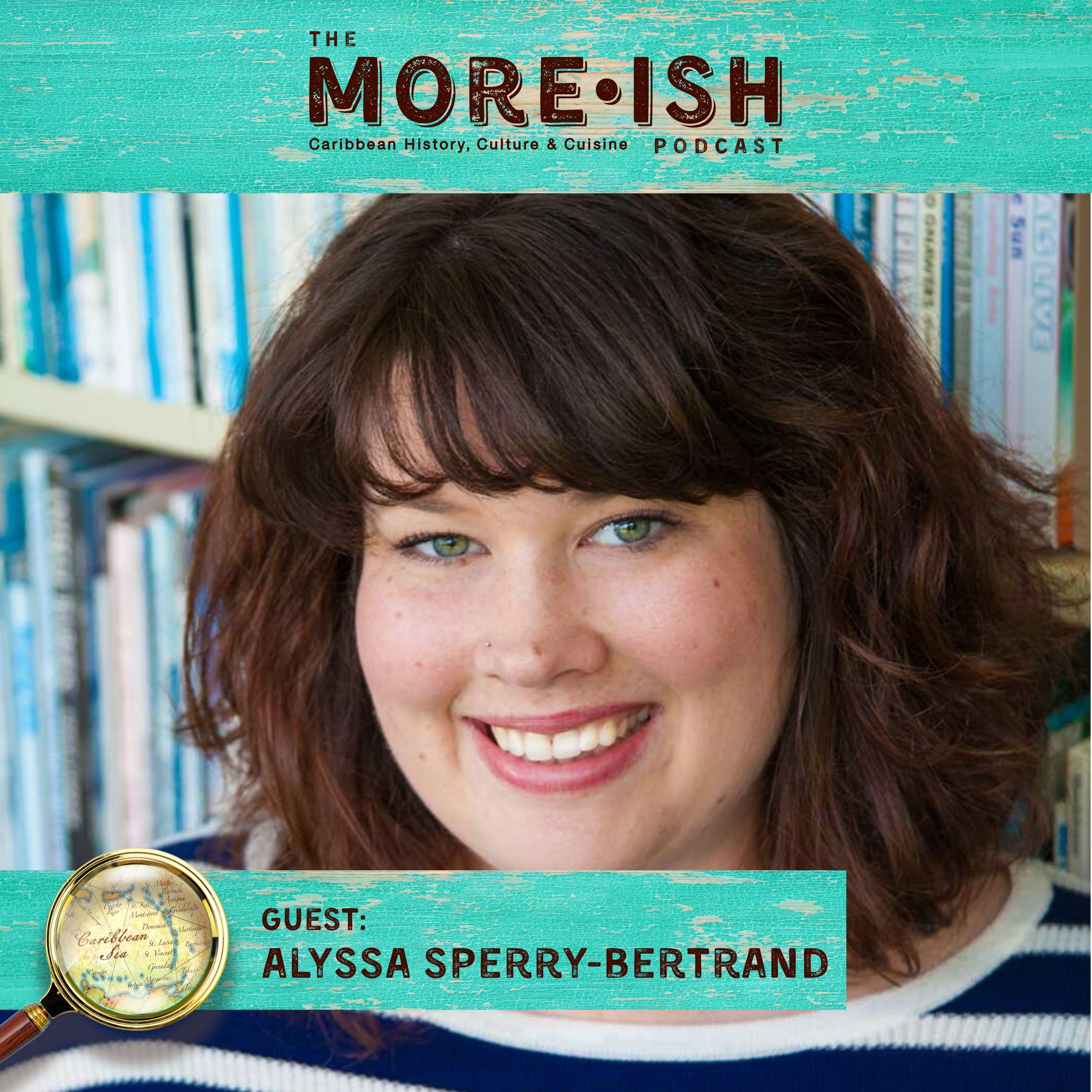
How salt shaped Jamaica’s culture and subcultures Hema is joined by Alyssa Sperry Bertrand, a retired pastry chef turned academic and historian, about her research on the historical and cultural significance of salt in Jamaica. Starting with the colonial era and the Spanish followed by the British, they explore the transition of Jamaica from a salt-producing island to a sugar-centric economy, the role of women in salt production, and the spiritual and practical implications of salt in the lives of Jamaican Maroon and Rastafarian communities. Alyssa shares how she got the nickname ‘Salt Woman’ and the amusing quest to find an out-of-the-way salt pond in Jamaica, complete with rum and a game of dominoes. Alyssa talks about her research methodology and the importance of honouring the voices of the communities she studied. The conversation highlights the multifaceted nature of salt, its impact on culture, and the ongoing relevance in understanding Caribbean history. About Alyssa Sperry Bertrand Alyssa Bertrand (Sperry) is a leading expert on salt, and its relationship to Jamaican culture(s). As a former chef, and historical ethnographer she provides insight into the role salt played in the development of culture and identities among the Maroons and Rastafarians by understanding salt’s role during the Atlantic Slave Trade and how it shaped the cultural identities of the past and present. Alyssa received her master’s degree at the Department of Global Studies at the University of Oregon and her bachelor’s degree at Washington State University in Anthropology and History. Alyssa has received numerous awards and grants for her research including the Oregon International Research Grant, Folger Shakespeare Library Scholarship, and Library Research Excellence Award at Washington State University. Alyssa is also a contributing writer to the books Salt in Eastern North America and the Caribbean (University of Alabama Press, 2021) and Women Who Changed the World (ABC-CLIO, 2021). She also published an article in the World History Connected, “Eating Jamaica: How Food is Used to as a Tool to Create and Reinforce Cultural Identity,” (Vol. 18, No.1, 2021). Currently, Alyssa serves on the board of Friends of Jamaica, a non-profit organization, helping to raise funds and provide grants to community-based projects around the island of Jamaica. Resources and Links Remembering Jah Calo William Berryman art Episodes Referenced Caribbean Foodways with Dr. Candice Goucher Music from #Uppbeat (free for Creators!) https://uppbeat.io/t/andrey-rossi/jerk-sauce
Alyssa Sperry Bertrand (00:00) She talked to me about salt in its practices in current modern day Maroons. Because you saw these in historical, but how is it in modern day? Do they still express salt in terms of a spirituality, a cultural, or has it kind of been dismissed? And that was the fundamental foundation of what I was looking at was can we use salt as an identity factor for cultural preservation or identity preservation? [music] This is The Moreish Podcast where Caribbean history meets culture and cuisine. Hema (00:00) Hi, Alyssa. Thank you so much for joining me today on The Moreish Podcast. Alyssa Sperry Bertrand (00:05) Well, thank you so much, Hema, for letting me come on and I'm thrilled and excited to just be a part of your podcast. Hema (00:13) When I was having a conversation with Dr. Candice Goucher for an episode in 2025 on the history of food in the Caribbean, she happened to bring up the work that you did on salt in Jamaica. And I took that away. I did a little bit of research and I'm really excited to have this conversation with you. Alyssa Sperry Bertrand (00:35) Well, I'm glad because it's one of my favourite topics and it's something that people don't really know about. I mean, there's a small community of salt researchers globally, but it's about 20 of us. Yes, there are the the general books out there like Kurlansky and Bitterman and things like that, but nothing in the sorts of the real research behind these different cultures, especially in the Caribbean. Hema (01:01) Before we dive right into the meat of this conversation, can you introduce yourself? Alyssa Sperry Bertrand (01:06) Yeah, so my name is Alyssa Sperry Bertrand, and kind of a little bit about myself is I'm a retired pastry chef. I worked in the culinary industry for gosh, about 10 plus years up in Portland, Vancouver area. And that's Vancouver, Washington, not Vancouver, Canada. And during that time, I fell in love with food. Unfortunately, you know, with being in the culinary industry, it's hard on your body. And so I decided that I wanted to switch and do academia. And actually, I was inspired by my father because he graduated with his PhD in technology and engineering at 60 years old. And so, you know, he started his adventure and researching in academia at 60. So it inspired me to go back. Um, I knew that I wanted to research food. I was in the anthropology department because I love culture and all that. But I so happened to meet Dr. Candice Goucher in the history department, which then just kind of trickled into her becoming my mentor and leading me into the direction of Jamaica. And so over time I spent years going back and forth to Jamaica, researching the salt industry and just culture. And what I call it as ethno-historian or historical ethnography is what I primarily focus on. During my academic career, I graduated with my master's in 2020. I went to Washington State University for my bachelor's and then I went to University of Oregon for my master's degree in global studies. And I continued my work in Jamaica with my master's degree. Recently, I've taken a little bit of sabbatical. My husband unfortunately had some medical situations so I wanted to focus on family and but now I'm back into it, just kind of getting back into my work and my research and involved in Jamaica and any way that possible. Hema (03:12) When Dr. Goucher told me that you were doing research about salt in Jamaica, initially, I kind of was like, salt? Not sugar? Because sugar is the one that we, and not specific to Jamaica, but sugar in the Caribbean is what we hear about. But then I started to dig a little bit and read a little bit about your research and the paper. And this research that you did touches on food, culture, subculture, history, folklore, all stemming and relating to salt. Alyssa Sperry Bertrand (03:55) I joke that I'm a jack of all trades. I kind of am the interdisciplinary, from my work as a culinary chef to a nutritional therapy practitioner to, you know, I'm a little bit of everything. And that's how I wanted my work to be. I want it because I feel like in this world today, we have become so interdisciplinary and it's hard just to be in one area because it does affect so many different parts. When you look at salt, it does go into culture. It does go into economics. It does go into the Atlantic slave trade in history. And there's so much, even geology. You know, I had to do, learn about geology. I also did a chemical analysis on the salts. Like, I was dabbling in so many different things. But yes, salt is kind of one of those things where it can be placed in so many different categories. And in my own work, I had to look at all of those categories to understand the holistic impact it had on Jamaica. And with the whole concept of sugar and salt, everybody does think of Jamaica as a sugar island. When I had gone to Jamaica my first time, I didn't know what I was going to do. It was more of me just getting to know the communities, getting to know the people, that was my initial exposure to Jamaica because I wanted to be open to what the possibilities were. Now, mind you, as a chef, salt is one of my favourite things. So when I started hearing a few little things like, Rastas don't eat salt or Maroons don't eat salt, I was like, well, why is that? And then I started digging a little bit and the first part of my work was actually the historical context of it. Later trailing into the cultural and humanities aspect of modern day and tying it to the past. Because the first thing I wanted to know was was salt produced on the island? And in fact, it was actually a salt island before it became a sugar island. And I'm one of the first people to document that, and changed the concept of Jamaica's history as a sugar island first, where it was a salt island. Hema (06:19) Let's talk about that history and start way back when Jamaica became a salt island. How did that come about? Alyssa Sperry Bertrand (06:27) Well, so as most people know that we've got the whole colonial Atlantic slave trade took place. In the late 15th century, Spaniards were the first group to come to Jamaica. And they came to Jamaica looking for gold and other commodities that were valuable,but they didn't find any. But what they found were salt ponds. There's the Great Salt Pond and the Little Salt Pond. And they decided to direct their resources and their energy towards producing salt. If we look at the Atlantic slave trade, we have to understand the foundation behind it in terms of how did they get from one point to the other on a long journey. They had to have provisions. And those provisions, they didn't have refrigeration at the time, needed to be preserved, which was salt. In order for them to make that long journey, salt had to be in production. And in fact, history tells us that, you know, during the silk trade, that salt was actually deemed more valuable than gold at times because of its importance in terms of the human body and existence, food preservation, as well as cultural and spiritual identity. And so they then started producing salt. I always say that without salt, you wouldn't have the Atlantic slave trade because you had to have that commodity in order to cross that long passage. It is like the foundation of everything that we see today. Unfortunately, it's got a horrible past, but it also has the… the history and the push to what we see in modern culture and identity. Basically the Spaniards came to Jamaica, they used the Taino people as well as enslaved Africans to start producing salt. Around 1655 is when the British came to Jamaica to overthrow the Spaniards and they took the island. But during that time was also a huge component in the history of salt, you have the Maroons. The Maroons were enslaved Africans that freed themselves and ran to the Blue Mountains and gained their own freedom during a long period of time. During that time, there's a side passage about salt and Maroon identity. But for the more historical context, you know, the British, overtook the island for also salt production because it was such a valuable commodity. However, surrounding islands were out producing salt. And so the British decided that they were going to put their money and resources towards producing sugar. And that's how we get the history of Jamaica being a sugar island, because it couldn't meet up with the demand of the other islands like Turks & Caicos, and even like Venezuela that were out producing them in salt. Hema (09:28) You talk about the Spaniards being the first ones to start to produce the salt, and then the British came. But there was something in your research that said some of the records were destroyed. Alyssa Sperry Bertrand (09:39) Mm-hmm Hema (09:40) And it was the British that destroyed some of these records. Alyssa Sperry Bertrand (09:45) Yes, the British destroyed a ton of records during the Spanish period. And so a lot of anthropologists and historians, they go to the archives and there's very, there's little to none, you know, research in terms of that Spanish period. To try to piece together is kind of what's happening right now. And so like I was able to get little glimpses of maps and diaries that had some of that stuff. And I will say that it is one of the most surreal experiences to look at a book from the 15th century, the 16th century in front of you and see exactly what history has done. And the, the horrific past that salt had in terms of the movement of the Atlantic slave trade. Hema (10:38) In your paper, you talked about womens role in the production of salt. Can you share a little bit about that? Alyssa Sperry Bertrand (10:47) Yeah, so interesting enough, women were the primary producers of salt, even globally. You can see that in Nigeria, you can see it in India, you can see even currently modern salt production, a lot of women are going back and taking on that role. We have evidence that through primary sources, such as painting that was done, um, you know, William Berryman, he created a watercolor picture and it depicted salt ponds in Jamaica with women. And so when I came across that, I was like, wait a minute, what is this? Because again, you don't hear anything about the salt production in Jamaica, which again, you don't hear a lot about women history. I thought that was fascinating, which then I began kind of digging into women and salt production. And I found out that there on other islands, women were the primary salt producers. There was a woman named Mary Prince who was in Bermuda. She was born to enslaved Africans in Bermuda, but she later then became a worker in the salt ponds. And her diaries are so descriptive on how painful working in a salt pond are to where she even descriptively says that working in the salt pond from before the sun rises to before the sun sets, you're in salt water and it wither aways the skin all the way down to the very bone with boils on you. It was gruelling, intensive work. And we start to see that there are these trends of women were in the salt ponds, whereas men were in the sugar cane. Hema (12:34) It's at this point in history and this conversation that a lot of things come into play. There is the Atlantic slave trade and the Spaniards and then later the British bringing enslaved Africans over to do the labour. There is the needing salt for food preservation for the long journeys. And then there is the subcultures that come out of this time in history and their relationship with salt. It's a lot to talk about at once. Alyssa Sperry Bertrand (13:10) It is. And the thing is is that there's so many moving parts, that you can start to go down one path and then it takes you down another. And when I was doing my work, of course, I started off with the historical context because I had to identify Jamaica as a salt island, which was the foundation of my research in terms of the cultural identity. And once I started looking into the research of the historical context, I then began to see these subcultures. So you've got, in general, you have Jamaicans. But in Jamaica, there are so many different cultures. You have Maroons, have Rastas, you even have an Asian population. You have a ton of different, subgroups within the larger Jamaican identity. When I began this, I wanted to narrow it down because I know that I could look at so many different things. And because I was already focused on historical contexts, Maroons and Rastas were two of the subgroups that made sense because of their connection to the Atlantic slave trade and they’re both African-derived subcultures, as well as they both have expressed physical and spiritual connections to salt. I wanted to look at a comparison between the two and how that connects to the larger historical context of salt in Africa to see if any of those stories, folklore, um, cultural identities from African communities were placed still on Jamaican communities. And when I say Africa, and this is something that I want to do a little touch down first, is Africa, of course, is a continent. And there's so many different cultures and identities within the African continent. However, because of the Atlantic slave trade, we know that most come from West and Central Africa, but you've got some Southern African influence, you've got some Eastern with Ethiopia. You've got such a broad range of identities across the middle passage into the Caribbean. So when I reference Africa, it's not a generalization that Africa is just this one big culture. It's that there are so many different influences that we cannot fully identify exactly where they come from. And that was something that I had to include into my research, so people that read it, you know, knew that when I said Africa, it meant a variety of different places within Africa. But regarding the Maroons, and I think that's the best place to start because it's kind of the beginning of the history. So Maroons were runaway slaves that gained their freedom. And they then moved into the middle of the island, which is known as the Blue Mountains. There's two different groups of Maroons. There's the Windward and the Leeward communities. And one's on the west side, one's on the east side. Hema (16:34) When you say they gained their freedom, they gained freedom by running away. Alyssa Sperry Bertrand (16:39) Yes. Hema (16:39) They weren't granted freedom. Alyssa Sperry Bertrand (16:41) Yes and no. So initially they gained their freedom by running away. And because the terrain was very similar to that of African terrain, depending on where you were in Africa, they had an advantage against the Europeans. And so they were able to fight and hide and basically create a community. And it started off small, you know, it was only, I think around like 100 enslaved Africans at first, and then it kind of grew to about 500. But later on, the the Maroons did get their their freedom. So in 1739, that's when the first group of Maroons were able to gain their freedom on paper. And later, a few short years later, that's when the other group of Maroons on the other side of the island gained their paper freedom as well. So they were then identified as their own community, their own group. They were not part of the British. They were no longer enslaved. However, this is where there's a dark side to the story is that to have this freedom they had to agree to the British that any future runaway slaves they would return. And so no one else could become a Maroon because of that clause. It also started to develop this idea of the other. So Maroons were true Maroons and then there was the other. And interesting enough there is a foundational story of Queen Nanny, that is like the mother of Maroons, she is the soul fighter, she's the leader of them and there's a story about her and her sister. Most people don't know that she had a sister named Granny and she kind of came from the Bongo territory. That's supposedly what history tells us. Now there's not really any identifying solid research that knows exactly where Queen Nanny and Granny came from, but the general area is there's the West, which is, Queen Nanny, and then the Bongo territory, which is Granny. So the foundation of Maroons in terms of true Maroons versus others stem from this story. And with this story, what's interesting about it is that there was this idea that if you consume salt, you were no longer a true Maroon. And let me explain that. So in African culture, we can see it in different territories, the idea of salt being connected to the earth. We also see that in Christianity in terms of the biblical idea of salt of the earth. And when they crossed the middle passage, the Europeans knew this idea about them. And so they force-fed them salt to have this belief system that they were bounded to the earth, bounded to the ship, bounded to Europeans. Queen Nanny decided to protect her identity and refused to eat the salt, which allowed her spirit to be still connected to the African lands. So there's this thought process that if you did not consume salt you could fly back to Africa. And this evidence of flying in Africa also can be seen in stories about flights and birds and spirituality. So the foundation was that if you consume salt you were bounded to enslavement and you could not fly back to Africa. Now, of course, there was no real way to fly back to Africa, but spiritually there was. Granny, Queen Nanny's sister, could not resist the consumption of salt, which bounded her to the earth. And so that then split the two between what was a true Maroon and what was a other was the consumption of salt. Many Maroons don't consume salt in the sense of spirituality. Now it gets a little interesting and I guess here's the thing is is that you could see somebody eat salt and there's evidence of them eating salt in history. So then how can they be called Maroons? Well, what's interesting is that salt was fluid in the sense that the value placed on it could be moulded and manipulated based on the circumstance. If you are wanting to connect to a more spiritual cultural aspect, you would omit salt. If you were wanting to talk to your ancestors, you would not put salt in the food for offering. You would not consume salt on that day. But if you also wanted to protect yourself from evil spirits, you would put salt in four corners of your house or under your bed. If somebody passed away and you didn't want their spirit to return, you would put salt around the grave and so their spirit would be stuck. We see that with salt, just in general, with many different cultures is the spirituality of being bound to the earth. Now, they did consume salt in the form of jerk chicken or jerk pork. So going back a little bit, the foundation of Maroons of course there's a lot of different things maintaining their African heritage, their cultural roots to Africa, most identify as Africans in the sense that that is their lineage. Today you are only considered a Maroon based on blood lineage. Not anybody can just be Maroon. The current Maroons today have that lineage from their ancestors. When I had gone to talk to the Maroons, I talked to one of the most sweetest and amazing, um Mama G is what I refer to her as, she just had so much light and so much wisdom in terms of Maroon culture. And she talked to me about salt in the sense of its practices in current modern day Maroons. Because you saw these in historical, but how is it in modern day? Do they still express salt in terms of a spirituality, a cultural, or has it kind of been dismissed? And that was the fundamental foundation of what I was looking at was what is happening in the past, is it still happening in the present? And can we use salt as an identity factor for cultural preservation or identity preservation? It's used in food. So can it be used in culture? And sure enough, a lot of the practices that were used back then are still used today. Currently when they want to connect to the spiritual realm they will not consume salt. They will not cook with salt when they do their offerings. They do use salt for protection in terms on putting in at the four corners of their room. Now, interesting enough, if they don't have access to salt, they will use white quartz because it is similar to salt. So they kind of transpose that value system of salt onto something similar looking if they don't have access to it. So again, these ideas are fluid, they're manipulated, they can change along with what the current environment is. Hema (24:39) You mentioned at the very beginning with the Spaniards, there were the Tainos already in Jamaica, they brought over the enslaved Africans. Was there any intermingling between the two communities and the Maroons? Alyssa Sperry Bertrand (24:55) Yes, so there was intermingling between the Tainos and the Maroons. In fact, they actually helped each other, especially in terms of navigating the lands, you know, their own food provisions, and in terms of how do they start to become blended. One in particular is, of course, jerk. And there's an argument between who actually created jerk. Was it the Tainos? Was it the Maroons? Was it Africans? But, they did intermingle with each other in terms of their survival. Hema (25:30) Your paper, at the very beginning you say the paper focuses on understanding the role of salt and its application in developing subcultures within the framework of Jamaica. And we talked about one subculture, the Maroons, but there is another. Alyssa Sperry Bertrand (25:47) Yes, the Rastafarians. I loved, I mean, I loved working with the Maroons and I loved working with Rastas. I got a little bit more diversity in terms of the Rastas because there are five groups of different type of subgroups within the subgroup of Rastafarianism. I do want to make a note that one of my participants that was a huge component in my research unfortunately passed away a few weeks ago after the hurricane and got sick. Jah Calo, he was an incredible artist, a beloved member of the Bluefields committee. I just, when I found out that he passed away, I just recalled all the times I sat with him at his studio, just sitting on his steps and talking about salt and history and Jamaican culture and Rastafarianism. And, so talking today also kind of touches based on the importance of these communities and how they contribute so much to this research as well and and I want to honour them too. Going back to talking about salt, Rastafarianism is another subculture in Jamaica and then of course there's smaller subcultures within Rastafarianism. Rastafarianism is a religion and it began in the 1930s. Marcus Garvey, you know, he was kind of the foundation of the revivalism that was prior to that, that then moved its way into Rastafarianism. And one of the things with Rastafarianism is basically reclaiming their African heritage, removing the European, removing the whiteness from their culture. So, you know, there's a lot of Christianity you can kind of touch base with, but the imagery around what is shown is African influenced, so much different. But in terms of the consumption of salt, and this was what kind of got me started in my research, was that I kept hearing Rastas say that they don't consume salt. And as a chef and nutritionist, I was like, but you need salt in order to survive. So why are you not consuming salt? How are you not consuming salt? And unlike the Maroons, which were more spiritual-based, Rastafarianism was more, it started off spiritual, but ended up being more practical. If we were to look at the history of Rastafarianism in terms of its consumption of salt, there's different categories on why they don't consume salt, but there's a little bit of a caveat that they actually do consume salts. And, it gets a little confusing because I remember reading a paper and it was a flat statement, Rastas don't eat salt. And then I go in there and it's like, oh no, I'll eat salt. I'm like, wait a minute, this is contradicting to what is being said. One of the things about Rastafarianism is autonomy. That is one of the hugest things in the culture is the, being able to make decisions for yourself and what is best for you and with the Creator. When I was talking to most Rastas, the foundation of not consuming salt was due to health, known as balance within the body. The Ital way of living. If they are a strict Rasta, they are vegans. There are Rastas that are vegetarians and there's Rastas that are pescatarians. There's a little bit of flexibility going on there. If you're a strict Rasta, you do not eat salt because nowadays, it's seen as bad for your health and it can create imbalance. Interesting fact is that Jamaicans and in the United States, African Americans, have, are two times likelier to have hypertension compared to white people and other cultures. And the question is why? Some people say it's because of the environment that when they were over in Africa, it was more of a higher temperature and they were able to sweat more and their body adjusted to salt levels. Whereas here, they are not in those environments, and even though their body has adapted their salt content is not adaptable to what their current environment is, so if they consume salt, it can increase hypertension. And it also is connected to the force feeding of salted food stuff during the Atlantic slave trade where they were forced the salted food, which then altered their body to become more sensitive to salt as well. A lot of Rastas will not eat salt because of that reason in terms of imbalance. I asked the question what about if you have low blood pressure and what do you do then? And they said that they will consume salt if needed, but there is alternative ways. And in fact, Jah Calo was the one that told me about a drink concoction that they'll make where they'll take sugar molasses as well as lime and water and mix it up together which will give them their salt content that they need. And I verified with Appleton Estates, which is the known rum factory, about sugar cane and they did say that there is a sugar cane that has high salt content. And so interesting enough that they use that type of sugar cane they would get more salt. Definitely more alternative ways to finding salt to give your body. Now, other reasons why they don't consume salt, which are more of culture slash spirituality, is in the beginning, it was associated with their connection to flying back to Africa. Most Rastas today, if you ask that question, they will have no idea what you're talking about because that value system attached to flying back to Africa no longer exists because they have planes, they have the boats that they can go back. They can physically go back to Africa, so preservation of that, idea is no longer seen as important, but it's still something that help build their their culture and identity. The spirituality hasn't gone away, it's just gone elsewhere in terms of salt. And so you see it like with Lot's story in the biblical sense where if you consume salt, you are disobeying or you are not having faith then you would be turned into a pillar of salt. And most Rastas would talk about how their parents and grandparents would tell this story of Lot. And for those who don't know, it's when, um, Lot and her husband were walking away and the angels told them do not look back. And she looked back and turned into a pillar of salt because she disobeyed. They use that as salt is a thing that you will turn into and so don't disobey. Um, And also there's the preserving of flesh. Salt is used to preserve like codfish and pork and all that, and so preserves flesh. Going over the Middle Passage, when those Africans fell into the ocean during the Atlantic slave trade, their spirits and their bodies were stuck. They were preserved into the ocean. The Rastas don't want to be preserved in that way. They want that freedom and that spirituality to be connected to the motherland. That's kind of another form. Then you just also have modern, ideas around the term salt. Salt can be meant as nasty and mean and even bitchy and all of that stuff. And it was kind of funny because I'm known as the salt woman when I'm down there. And when I was talking to someone about this and they're telling I was like, wait a minute, is that how you guys see me and he cracked up laughing and he was like no you're just the weird person that's just so invested and interested in salt that you're just the salt woman. Hema (34:20) When a Caribbean person gives you a nickname like Salt Woman, you are welcomed and you are liked. Alyssa Sperry Bertrand (34:28) Exactly. I was young and I was still kind of like figuring out and I was a little concerned. I was like, wait a minute. But yes, exactly. And so I am forever known as the salt woman down there, uh which I love, and funny story, I was on a conference call with somebody and they were a Peace Corps volunteer down in Jamaica during that time that I was. So we kinda like, she looked at me and she’s like Alyssa, the salt woman? And I just busted up laughing because I hadn’t seen her in like five years. Actually it’s been longer than five years and that it was just automatically the salt woman. And so it was kind of funny. But ultimately at the end of the day, salt is not as a defining factor in terms of whether they're a true Rasta or not, because most Rastas say that it's inside of you. It's how you act, it's how you believed, it's not necessarily, you know, the objects that are around you that makes you a Rasta, not even sometimes your physical appearance. The dreadlocks have a significant part of Rastafarianism, but there are many Rastas who don't have dreadlocks. But at the end of the day, what I noticed is that in the beginning, salt was more of this spiritual abstract identity, but later turned into more of a physical in terms of the belief system around, um, salt with Rastafarianisms, whereas Maroons were still more traditional in the sense of the spirituality and culture. Now one of the things that I'd like to acknowledge is that salt was not seen as necessarily evil or bad, but it also wasn't seen as good, and I think in most modern times or just even in general as humans we like to categorize things. When I first started this research, I was asking the question of whether salt was good or bad. And over the course of several years, I realized it was neither. They just saw it as an object that at this moment was not needed, but then at another time, it was needed. That's why I think food and food stuff in general is so interesting is because it is plastic in the sense that it's always moulding to the environment around you. You know, it still continues to hang on to the past, but it's not so rigid that it can't be something else with a sprinkle of the past. And so it's needed to be what it is at that moment. Hema (37:25) This paper, as I was reading through it, it sounds like the work came in phases. There was the reading and research, and then there was the research in Jamaica that you've talked about, going to the communities, talking to the people, and getting their take on things. But I want to go back to the academic research, and the process of finding that information, because in doing this podcast a lot of the information that I’m finding is written from the perspective of the colonizers and I’m not seeing the full rounded story. How did you go about this research process. The reason I feel like this is so important is I get a lot of comments from people disputing what some of the academics and historians are saying because they read a comment on Facebook or they read somebody's comment on TikTok. And I think we need to differentiate between the real research and just things that people throw out there. Alyssa Sperry Bertrand (38:38) Yeah, that is such an important thing and I'm glad that you brought it up because as someone who was not initially in academia and then later turn academic, I feel like I've got the best of both worlds in the sense that I understand both sides of the story in terms of what is being spewed to us through social media, through articles, Wikipedia. I mean, I didn't know for the longest time that you could edit Wikipedia on your own. I have to say I had a great mentor. Dr. Candice Goucher was, in my undergrad, she was my foundation. And she is such an incredible researcher that I have learned many of her styles, and also to just question everything, even the primary sources, because as you mentioned, most of it is from the colonizer's perspective. There's that image of William Berryman and it looks very romanticized. It's very much like, oh, I'm just lounging around and I'm doing my watercolors and, I'm depicting a beautiful scene of women working in the salt pond. And so if somebody were to come across that, they would be like, oh that's such a beautiful painting. I guess ultimately what my research was was a combo of secondary sources and then following it with primary sources such as the painting, but then I'm taking that painting and digging deeper, finding that other side, and that was the important part was that I didn't want this to be the story from a white person's perspective or the colonizer's perspective. And that was something that I acknowledge in my work is that I know that I am a white person, talking about a predominantly black culture. I wanted to honour it with respect and make sure that the voices of my participants were being heard, not the colonizers or the white person's perspective. And for that pho….for that that imagery, I was like, okay, so if women were doing the salt let's see if I can find something more. You know, of course I did the traditional, looking in the archives. In Spanish Town, there's the Jamaican archives and I spent time there. I was in the Kingston National Library. I did a lot of the traditional academic stuff. And that's where I started to find these diaries, these different documentations such as Mary Prince, depicting the horrific conditions that enslaved Africans were in while producing salt in the salt ponds. So that way I can showcase, wait a minute, this might look all romanticized and on this side, but it really was horrific. I had that as my goal to ensure that the voices were to be shared. And that's why I have this combo of historical ethnography because I have the historical information, but then I have the the anthropology, cultural, ethnographic research. And so you get the best of both worlds. When I was in Jamaica, the first time I was there, I did not do any research. I just went to get to know the communities and my communities that I stayed in was Bluefields, that was my main points where Jah Calo, one of the participants, was in. But then I travelled and I had a wonderful contact, Heidi is her name. Her and her partner are now in the Blue Mountains. Her partner, he owns Old Tavern Coffee. And she was such a huge impact in helping me get around the island so that I can meet different people. And we had quite the adventure getting into some rural areas. Understanding the communities first. I also always said that I was never gonna be that researcher that went in and extract information, and then leave to publish information and go from there. I'm still heavily involved in these communities, even though I haven't been there for six years, um, you know, due to life, I'm still involved. And that was also important I wanted this balance of using primary sources that were dated in that period of time to give that perspective. I also of course had secondary, which were, you know, summaries and just general knowledge of salt, but then also first count, you know, people who live it, people who experience it day to day. That combo of all three is what provided this research. Hema (43:54) All of, all of that is so important when somebody's thinking about finding the true stories, the real stories. It's not just doing a Google search. It's not just reading the opinions of others because opinion is not always the truth. And so I appreciate you sharing a little bit about your process because there is a lot of work that went into writing this paper. Alyssa Sperry Bertrand (44:27) Yes, it is in total 150 pages. It took me five years of research, and I would say it took me a year to write my my paper. It's still a working, document in the sense that it's just the top of the surface. There's so much more and so much in depth. I have the saying that the more I know is the less I know. And that is, think, such a foundational part in living as a human being. When you get cocky and you think that you're, you know it all, you don't. I know that there are many researchers out there who, and some people even call me the expert. And I feel like I'm far from the expert because of the fact that there's still so much out there and things are changing and more information is coming. And I think that's also something very important is that I published this back in 2020. There is new information coming out. There is new studies. There's new research, and it could change some of my work. And that's okay. That's the part of research is that it's not permanent. It is constantly changing and growing and evolving. And that's what researchers do is they provide information at that moment, but then it continues to grow on its own. I think one of the biggest things I say about this work is that we cannot use this work to generalize, because everybody is individual and has their own lived experience and their own value system. What is valuable to some people is not valuable to others. I learned when I was doing this work, my biases, my love for salt and how I was uncomfortable at times going, wait a minute, you don't like salt? And then this horrific story about it and how Europeans force-fed enslaved Africans to consume it because they knew it would bound them to the ship. I'm like, my gosh. Something I loved is being used in a horrific way and it challenged my own belief systems. I think that's the thing that when researching and when reading new information and learning, being open to being challenged because that's how we grow. I've run into people who completely dismiss my work because it's not the traditional sense of sugar. It's salt. And people are like, well, that's not how it was. Well, of course, you might think that because that's what we've been told all these years. But new information comes to the surface and can change. And that's why history is so important, as well as the social sciences. The combo between the two allows us to understand the historical significance, but bridge it to the current environment. Hema (48:44) Are there currently still salt ponds in Jamaica? Alyssa Sperry Bertrand (48:49) Yes, so not active. And I guess I should separate between the two. So there are salt ponds. There's the Great Salt Pond and the Little Salt Pond. They are not active. They're just there. I visited them. They're quite interesting, but they're also boring to look at, unless you're unless you're a salt nerd. It's just another pond. Butin terms of like the salt production, there is a chemical company in Jamaica that does produce Jamaican salt. They do the sea water and they process it and it's free flow salt in the sense that it's got iodine and fluoride in it. So, you know, you just buy it in the grocery store. In terms of traditional salt making and salt production, there is a small community that still does local salt. And it's kind of like bootlegging backyard, underground, don't want people to know. You know, it's basically, you know a guy who knows a guy who knows a guy. And in fact, I was able to get connected to one of these salt men, who it was kind of in the southern parts, I'm not going to say exactly where, but in the southern part of Jamaica, along the coastal line. We, uh myself and my friends, we got word that there was a salt man down there. And this was one of my favourite experiences. Tourists do not go to this area. Locals do go, but not many. It is like out in, the middle of nowhere. And when we were driving, we started noticing these layers of salts around and it was so cool. And, we get to this little rum bar area and there was a guy that kind of popped up and, I was asking, I was like, do you know this person? And he's looking at me like, maybe. And I was like, what do you mean maybe? And I saw that there was a table with dominoes. Now mind you, I know how to play dominoes. It's one of my favourite, but he was shocked that a white woman knew how to play dominoes. I was like, I can buy you some rum and we can play some dominoes. So we played a game of dominoes and I won, which he was very shocked about. And he was like, yes, I know the salt man. Let me make a phone call. So he makes a phone call. We then go and we drive to this, and I just remembered it kind of opened up this community and there's this beautiful tree in the middle, painted with Rasta colours and 15 men just show up. It's me, my friend, and her little daughter. We're just kind of like, oh man, did we make the right decision here? And then this older man comes out and he's like, I heard you've been looking for me. We shook hands and we were talking and had a great conversation. There was some joking going on my friend was going to trade me for 50 pounds of salt and I was like wait a minute that's not part of the deal here. But we did buy some salt from him, and actually I have some of the salt right here. They're larger crystals. I'm surprised I didn't get stopped by TSA with this when I came back into the States. Hema (51:09) What an amazing experience that is. It’s…..when you said not everybody's a salt nerd, I have to confess that I've been to the salt ponds in Malta. I've been to the salt flats in Utah. And then I was in Ireland last year and I didn't get to go see it, but I did talk to a local salt producer about his retirement job was producing local salt. And if people haven't seen how salt is produced and harvested, it is quite fascinating how it's produced in the different ways, and the different types of salt that you can get out of it. Alyssa Sperry Bertrand (51:55) Exactly. There's the table salt and I can go into the whole history of Morton salts and the different types of salt because there's like the pillar method that you see with the pink Himalayan salts. This is referred to down in Jamaica as coal salts because they get it from a cave and they kind of harvest it like coal. They chip away at it and then they get these big chunks and and then they kind of slowly process it themselves. But it's hardly touched at all. And there's only a short period of time when they can harvest it because of the high heats and all of that stuff. But salt, we find it so readily available and don't think about how much work goes into it. And, the different types of salts, I mean, there are hundreds if not thousands of different types of salts. Hema (52:47) There are still Maroon communities in Jamaica, yes? Alyssa Sperry Bertrand (52:49) Absolutely. There are, Charles Town is, or also known as Maroon Town, is kind of in the Blue Mountains. That's kind of like a main Maroon community. But they are still, in fact, Jamaican Maroons are one of the only Maroon communities still pretty much in their own community. Most Maroons outside of Jamaica have embedded into other communities and other cultures, whereas the Jamaican Maroons have their own land, they have their own laws. Yes, they still obey Jamaican laws too, but the Jamaican government works with the Chief of the Maroon community, and so they are very much still on their own. Hema (53:41) Alyssa, I had a great time having this conversation with you. Before we wrap, where can people see more of your work or connect with you if they're interested in learning what else you're doing and what else you're researching down the road? Alyssa Sperry Bertrand (53:57) Yeah, so I don't have a website anymore. In terms of books, you can Google my name, Alyssa Sperry Bertrand, and it just pops right up there, so. Hema (54:10) I will leave some links in the show notes so people can go and take a look at some of the work. Alyssa Sperry Bertrand (54:15) Perfect. Hema (54:17) I appreciate you taking the time. Alyssa Sperry Bertrand (54:20) Well, I greatly appreciate you having me. I thoroughly enjoy talking about salt and I thoroughly enjoy talking about salt with you. So thank you so much. [music]
More The Moreish Podcast: Caribbean History, Culture, and Cuisine episodes →