
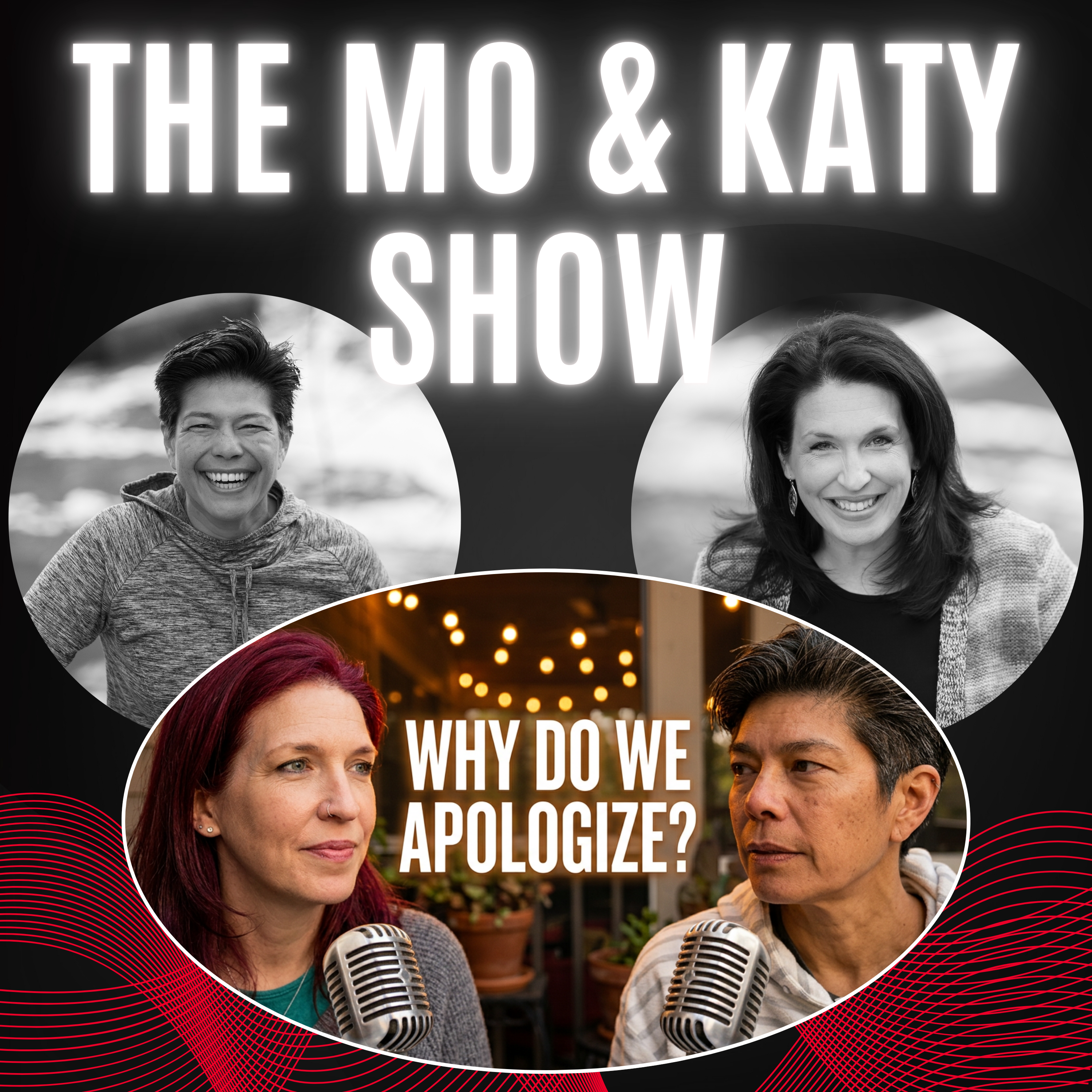
The Mo and Katy Show · Katy Stevens and Mo Barrett
Mo and Katy - unlikely best friends finding common ground in a world obsessed with differences - talk about how knowing your purpose changes the way you make decisions, ask for help and show up with confidence. In this episode, they get candid about apologizing less, owning what you are and aren’t good at and honoring the people who make a lasting impact. Along the way, they question unspoken expectations, share some shower-thought-worthy examples and find the humor in what they’re still figuring out. Sometimes it’s heartfelt, sometimes it’s funny and sometimes it goes somewhere unexpected. That’s the point: life is messy, people are fascinating and connection can show up in surprising places.
Speaker 2: Hey everybody, and I'm Katy and Speaker 1: I'm Mo. Speaker 2: we are The Mo and Katy Show. We are unlikely best friends finding common ground in a world obsessed with differences. Speaker 1: We are well into our second act and officially done editing ourselves. Blooper reel notwithstanding. We've got plenty of experience, even more opinions, and absolutely no intention of quietly fading into the back. Speaker 2: That's not happening. No. Sometimes we're hilarious. Sometimes we think we're more hilarious than everyone else does. Sometimes we're heartfelt. And sometimes we have no idea where this is going. Speaker 1: Going most times. Because life is messy, people are fascinating, and connection happens in unexpected places. Speaker 2: Like your deck. Here we are. It's weird in here, so let's talk about it. Speaker 1: Wow, that was brutal. That that twenty second open took us three minutes and four seconds. Speaker 2: So today we're gonna talk about decision making. What what did you call it earlier? I really liked it. The what the Speaker 1: Listen, when I say brilliant things, I'm gonna need you to pay attention because once it comes out of my mouth The what Speaker 2: The why the how. Speaker 1: yeah. When you know the why, how you do the what changes. Speaker 2: So good. See? I knew it was in there. When you know the why, how you do the what changes. Speaker 1: Chatters. Chatters matters. Chatters is a portmanteau of Matters. Speaker 2: Changes would matter. Speaker 1: Anyway, yes. So what we do. Yeah. So no, yeah, we we were talking about this, we're talking about multiple a bunch of different things and talking about being able to stand in your power and ask for something, but I think before you can do that, some of that power comes from the confidence of knowing why you're asking. So someone asked me to to help with a project and I was more than willing to help with the project, but I said in order to do the project properly, the what, in order to do it well, how, I needed to know what was the end use. I wanted to know why why we were doing this project. And they couldn't answer that question. I'm like, okay, well, until I know the why, I don't know what to do. I don't know how to do the what. Speaker 2: And I think this is something that speaks to us especially again in this middle age season that we're in. I Speaker 1: Yeah. Speaker 2: I exactly. I don't think I th I think we have had enough time in our lives of just saying yes to say yes and really being selective about how we spend our energy and our time and realizing that those are resources that like time is a resource that's not renewable. Energy is, but it's something you have to fight for. And just the the thought of just saying yes to everything because either that's what people expect or it's easier than the hard conversation is I think those days are behind us. I don't think we're doing that anymore. Okay. Speaker 1: Well, I'm gonna white way in and say I would like to think those days are behind us, but I still find myself saying yes to things that I don't really wanna say yes to and I think and that comes with time and I'm I I'm definitely at least saying yes with some reservation now. But there's definitely things that I'm saying no to that I'm like, you know, in in the past it would have been like, Well yes, 'cause because you asked I have to do. We're like, well, no, you don't, because again, your time is a precious, valuable, finite. Yeah. Speaker 2: I wanna talk about something and I'm trying to decide which category this fits in. It's either please tell me it's not just me or we we thought this was normal. And this is something you and I have been talking about a lot, and that is how much women I think in particular, but how we apologize for things that we don't need to apologize for. And I remember the first time this came up that it's really stuck in my mind. We have a friend that we know through women's barbershop and her name is Lori Joe White House. And we got on a call with Lori Joe once because she had brought us on to do an event for her chorus. And I think we started off the conversation apologizing or something for being I I was apologizing. Sorry, I hit my microphone. apol I was apologizing because I was just a few minutes late for the Zoom meeting. And I started off with, hi, I'm so sorry. She goes, you know what? Women apologize too much. Like she just said that, like full stop, women apologize too much. And I was like, you know what, I think you're right. And recently Speaker 1: And I'm sorry for not realizing that. Speaker 2: But we've been talking about instead of apologizing and oftentimes it's for something that doesn't merit an apology that either was beyond our control or w something that we feel bad about that we don't even deserve to feel bad about. Right. But instead Speaker 1: Somehow we take the blame for it. Speaker 2: Instead thanking people for like I responded to a text message the other day and it took me a little while to get back to it as it does on weeks that I'm working a lot. And instead of saying, I'm sorry I didn't get back to your text, I said, Thank you for your patience. Speaker 1: Yep. And that's something traveling something like that. And that's something I learned from Polo Polo's book. Polo REO Tate said Shout to Polo. But i instead of saying, I'm sorry for being late, rephrase it and every time you you feel yourself getting ready to apologize for something that really it now there are times. I I I hit your car. thank you for for breaking my fall, right? So but but I think in any Speaker 2: Thank you for your patience in me smashing up your bumper. Speaker 1: If you can train yourself to like when you're getting ready to say I'm sorry, instead go thank you for whatever the positive is thank you for your patience. Thank you for you know, y your patience I think is a is a good one. Especially if you're a doctor. You can go to another doctor and say thank you for your patience. Speaker 2: Every single one of them. Yeah. Thank you for your patience, patience. The patience of your patience. Speaker 1: Okay, there's too many apostrophes, let's move on. Speaker 2: I'm sorry. But Speaker 1: I'm not Speaker 2: just but I I would I would think too if we take out the apologies that don't have merit, the apologies that really are appropriate would maybe land a little better too. Speaker 1: I agree. And I wanna say something too is a lot of times it's not just the words I'm sorry. I'm also talking about unapologetic tones. I just did a webinar and talking about was it it was for delivering a pitch, but I think a pitch can be a hard conversation, it can be asking for a raise, it can be getting funding for your product. And we were working with a phrase of, you know, asking somebody to introduce me and the way it came across was, Hey, i if you don't mind, I would love it. if you could help me expand my network. And so never do the words I'm sorry come across. Like I'm sorry for this ass. But Speaker 2: Mm-hmm. Speaker 1: all the superfluous words and even the the tone of voice. Yeah. And and honestly there was a posture in the delivery that was very shrinking. And so what we worked together to come up with is, you know, name. I would like you to introduce me to who the introduction was. Very straight and to the point. And then we worked on the delivery stuff to take away that unapologetic because it was the same as saying, I'm sorry to bother you, but could you reach into your network and connect me with somebody? Like, no, you deserve to be connected, so it's standing your power. And again, once you know the why, the why is because I want to expand my network and I'm asking this person because they have an expansive network. Once you know the why, then how you do the what. changes how you deliver and how you ask for unapologetically because you deserve to have a seat at that table, to have that contact in your network. So it's like, dear so and so, I would like you to introduce me to person X. Speaker 2: And you know you do because you st that's the other thing is that's another thing about reaching this age that I actually have really grown to love is that I know what I do well and I've become much more unapologetic about it. People are like, hey you you run a music studio and I'll say, yeah, and I'm really good at what I do because I am and I don't know that I would have said that five years ago, even five years ago, ten years ago. Speaker 1: So you're saying unsolicited just offering people how good you you know, 'cause I'm good at my bangs. Yeah, there's Speaker 2: are they're on point. Speaker 1: little scoop. Speaker 2: What I didn't know they made that noise. Speaker 1: I know. That's that's why we're mic'd up. Speaker 2: But I also am very unapologetic about what I am not good at. I can't keep plants alive. I try. But if they come in my house or hang outside my studio, it's gonna be a long, slow death. So I have some jeweled plants on my like plants made of jewels on my piano because Speaker 1: So I think I I think what we're I if I can if I can repeat back to you what I'm hearing. Plants who are in hospice. Katie's place is is a good place for them to have their last few stamen alive. stay in a lab. Speaker 2: Well you can tell by the way I lose my leaves. I'm a dying plant. Speaker 1: No time to please. no, the dogs have been awoken. It's always the same. Speaker 2: But yes, so I will I will tell like, hey, do you want this plant? And sometimes I think, okay, this time it'll be different. No, it never is. I kill plants. but I and and I don't pretend to like gardening. I don't like gardening. I don't like, the feel of the soil in your hands. I'm like, mm-mm, nope, not my thing. Speaker 1: Do you not like gardening? I don't. Because you don't like the f the f Speaker 2: feel of It just Speaker 1: Well you can get dirt under your nails then you can get the dirt out of your nails. well then we're gonna Speaker 2: Also, if you're going through a hard time and I'm sorry if you're going through a hard time, please don't ask me to bring your family a meal. Just not my strength. I'll order you a pizza. But so those are things that like meal train. I'm like, nope. Papa John. Hello. Those are just Pop Johns. I'll order them. Speaker 1: I'm like, what does that even mean? I'll open the toilet for you. Come on, I'll pop a john for you. Speaker 2: I don't think that's even a thing. Much like Austria. Speaker 1: A Papa John is a thing. Is it? Speaker 2: Yes. Anyway, I know what I'm not good at and I know what I'm good at and I'm a little more unapologetic about them. Like what are you what are you Speaker 1: I think that's cra you not good at Speaker 2: unapologetically bad at? Nothing. She's good at everything. Speaker 1: Well, everything is a good segue into my problem is I will st I have grand ideas and I can see them all the way to fruition. So for example, we're working on this songbook, a sing-along songbook. I can already picture the finished product. I can picture us going on a book singing tour, not signing tour. Yeah, and this is for the Women Air Force Service pilots. We actually have started it. We've got a demo book. But I'm really, really struggling with the next phase of it, which is the full-size book, Spiral Bounks. I'm looking for a printer, I'm, you know, working with the graphics designer. but I can already see it in its final state and I can see us going on a book singing tour. My what I'm unapologetically working on for the rest of my life is finishing things. I tend to start a lot of things. I was convinced that I would be in the Air Force for nineteen and a half years, just six months shy of of retirement and and And you did it. Yeah I did. You did. I struggle with that every single day. I Speaker 2: I have seen I know you've said that. Which you don't since I've known you, but no I do too. Listen. What? but I've seen you follow through on a lot of things. So I because but you've done it. Speaker 1: But it's an easy. I wouldn't easy. Well the bake oven is. Speaker 2: Everything's not eas. You've finished you've crocheted entire blanket. You've finished that. You're working on another one. Speaker 1: It's not done yet, but it will be Speaker 2: 'Cause I made her buy all the yarn the last time we went to the craft store. She's like, I'm just gonna buy one. I'm like, but you know what you need, just buy it all. So I made her buy Plus it was on sale. You're welcome. Speaker 1: anyway. Speaker 2: There's gotta be something that you're like you've tried it and you're bad at it though. I can't think of what that thing would be. So I think you're hiding it from me. Speaker 1: Maybe hide and seek is what I'm bad at. Let's circle back to that. I don't know. I mean, I you know the well, here's well, I don't know. I people so in the Air Force peop a lot of people golf 'cause a lot of work gets done on the golf course and my whole goal was to make it to major without golfing, which w I did. Speaker 2: Congratulations. Speaker 1: But part of the reason I didn't want to take up golf is I heard that with golf it's one of these things where it's an addictive thing and it's a huge time investment to get good at it. I don't wanna do something that I may be bad at when I start and have to invest a lot of time just to get better. Speaker 2: That's interesting. Huh. Do you like to stick with things that you're what? Speaker 1: That I know like also well here's the thing. I would take up golf because it's a sport technically. I don't know whatever, but I mean ESPN carries it on the ESPN twelve right after the Microsoft Excel worksheet competition. On the Ocho. Speaker 2: I was just gonna say that would be that'd be your sweet on the ocho. Speaker 1: But sometimes I will try something just because everyone says, you know, peer pressure, you know, like drugs and whatnot. And then and then if it's something I d I have a really obsessive personality. So if it's something and I'm not good at it right off the bat, I will try and that's why like when you taught me how to crochet two years ago, I would watch YouTube videos and I would try I like I have a different grip than the way you taught me. And Speaker 2: And yeah, we're still friends. Well struggle Speaker 1: I mean you know that a mine is Speaker 2: is that our crochet grip is different. Speaker 1: Yeah. I'm like a match grip. She's a wee fork and knife. But But the whole thing is Speaker 2: We persevere. Speaker 1: is that when I first started crocheting, I was not good and I did not like that. It is I do not like being bad at something. And so I would practice there was times when I well I didn't tell you, but like my hands would cramp up and stuff like that, but I was watching on YouTube so I can get better at tension and all that. Speaker 2: Next thing, magic circle. Speaker 1: No, I will never do magic circle. The magic circle drives me nuts. And I this is the only time I wish that yarn was heavier is when I'm doing a magic circle. I just want to chuck the entire spool at someone or s it just I get so frustrated. Magic circles are terri terrible. No. What are we talking Speaker 2: It's just a matter of time. I'm just kind of Speaker 1: about today? Speaker 2: apparently a lot of things 'cause that's what we Speaker 1: Here's the thing. I don't necessarily the only reason I have to make a magic circle in crochet is so I can make some kind of wobble thing. And I I don't want to make a wobble. I just want to go back. I don't want to follow a pattern. I don't want to have to count. I just I just want to go back and forth and make a blanket. So for me, the why of learning how to do a magic circle, which is maddening, is Speaker 2: It is a little it's taking me so it's taken me some time. I'm good at it now. Speaker 1: I don't even care if I'm never good at it. I'm done making magic circles. I just want to go back and forth. I just want to make blankets. That's Speaker 2: If I make your magic circle for you and then Speaker 1: not the same. Okay. That's very Henry Ford assembly line. I don't make assembly line blankets. I am handmade in the USA, probably using Chinese yarn, but probably made in the USA. Homespun. I got sheep. I'm gonna go shear the sheep, make my own wool. Speaker 2: Lot of times I text, what are you doing? What are you up to? Football and yarn. Football and yarn. Yep. That's how I like to watch football. Speaker 1: Last night was baseball and yards. Baseball and football. Speaker 2: That's right. It's October. So we have all the sports right now. So anyway. Anyway, what are we talking about? That you're bad at. Speaker 1: Why? Yeah. answering questions. Speaker 2: Well and and also of course I liken everything to singing 'cause that's what I do all day is teach people to sing. But that's why I do a pretty thorough intake with someone when they come into the studio because If they if their goal is to get a recording contract and sing pop music and I decide they need to learn classical, there may be a reason and a caveat for that. But like I I need to really know what their why is, especially the older they are, like if they're an adult. There's no use in me there's no use in us as spending time on things that are not going to serve the why. So I think that's super important. Speaker 1: Well, I think another thing to to flip it, you you're talking about your students. I'm saying you as a as an instructor It's also important for your students to know your why. Yes, I know you want to get a c recording contract, but we're gonna focus on classical. It's only gonna be for a little bit, but here's why. And I think a lot of times w we talk about this in the military a lot, it's called commander's intent. Right? So if we know what the end goal is, then there is there's always gonna be more than one way to get there. And it's i it it's figuring out like if I know the end goal, the commander's intent, the why of what we're doing, then it can change the how of what we're doing. I love that. You what I mean? So like the same thing as when you teach, you have all these different techniques for how to anchor and the the jet pack and you know shooting jets out of your feet. Like you have all these things, but you always explain the why. You always explain we're doing this because you're engaging the bigger muscles, like okay, I don't necessarily need to know physiologically what's happening, but now I understand why that works and that helps again and it it's something I can read because you're really good at that is giving multiple different ways to get the same thing done, but you always Speaker 2: I told you that's why I wasn't a good math teacher. I taught school for one year. I wasn't a good math teacher because in my mind there is one way that I do math and one way only. And if I would explain that to the students and they didn't get it, I'd be like, okay, I don't know what to tell you. Speaker 1: Maybe this is how you do it. Is there some math where two plus Speaker 2: I think there's like people think of things in different like you know, like some people when they add they think in groups of ten. Some people do it, you know, do it other ways. But like I would explain my way and if they didn't get it, I'd be like, okay, sorry about your luck. Watch. Speaker 1: Yeah. I didn't know math had a way. Speaker 2: There's a way there's a way. There's a way. It's like tying your shoes. Everyone's got a different way to tie your shoes. I tie my shoes differently because of this one right here. Speaker 1: Yeah, well I'm glad you graduated from little kids velcro shoes that light up at night, Pink Pony. Speaker 2: Is not what I'm talking about. Speaker 1: No, you double knot your Speaker 2: I double knot my shoes differently because of you. Thank you. I just I love seeing a random dog walk across the deck. I'm wondering if if dozer snores are coming through because Anyway. They're always loud. Speaker 1: Yeah. Anyway, when you know the why, it changes the how you do the what. Speaker 2: That's true. Sorry, there's more dog there's no more dog motion and apparently I'm very distracted by it because they're sitting in the side. Is there any time you've ever had a why and the what was the what or how was unclear? Like there was something that you had to deliver on and it needed to be done, but you just weren't sure how to get there. Speaker 1: I can't think of an example but I'm sure there was. But again, the why is the most important part of that. Yeah, I agree. So if I know the why, then the how will make itself available and you know, what you need to do to get to the why will make itself available, which and the why will inform how you do that what. I I mean I can't think of an example, can you? What Speaker 2: I think that's I think any time we work with we we work with a client, so if we have an event and someone says, Okay, we want you to come do our event, I think the first thing we want to find out is what is what is the end result, what is the why? What do you want your people to feel? What things do we need to get accomplished? And then I don't know that it's i I don't know that it's always clear for us from the very beginning and I think it's probably good that it's not, because we need to really listen to their why in order 'cause our why and their why might be slightly disaligned disaligned, misaligned. Sure. Making up words today. And it's important that the way that we deliver it is the way that they want it delivered and we're hitting these little like we're hitting these little stops along the way to make sure that they are getting what they what they want out of it. Speaker 1: That's a good example too, because we have met with clients and they they'll say, they they want a certain thing. So they tell us the what, which we're fine to do, but when we ask them why they want that particular what and they want it done a certain way, how they want it done, when we ask the why, like why do you want it done that way? Well, that's the way we did it last year. Okay, was it successful last year? Well no, but Okay. But but I think having those conversations and I think it always goes back to why. That's the whole Simon Sinek thing. People don't buy what you what you sell, they buy why you sell it, or I mean that's pretty spot on, I think. But but I think also to that point, we have had people say, they tell us what they want, but through the conversation of why do you want these certain elements, we have changed the run of show, we have changed the script. And we have done from an energy mapping standpoint, when they want this shtick, but at some point like three quarters of the way through, they want to honor someone Speaker 2: Yeah, just a minute. Speaker 1: the chuckle hut before we step into the funeral home. But again, it's a good quote. But it's but it's the why. Because when you know why we're doing this segment of this run of show is to celebrate somebody who recently passed. Yeah. It changes how we get into that segment and it also changes how we get out because that's caring for the audience. Yeah. Like that's I mean we look at our why and how quite a bit because our what is just chaos and randomness. Speaker 2: I think it's worth mentioning too that there is there are elements that we want to w there may be elements we want to include, but we want to include them because we want to include them and it might not serve our client well. So there are things we've gotta let like, okay, this is not happening this time. Killing your darlings or something. Speaker 1: What do they say? Let go of your darlings or something. That got violent. But it's getting rid of them. It's disposing of the bodies of your darlings. It's called now it's a Speaker 2: It's still not making it worse. Speaker 1: true crime podcast. a future crime podcast. It's Get a Pig, Shave the Heads my You're the one who started with the whole murder avenue. Anyway, well yeah, that's a great point. Again, a lot of times we get so focused on our how or our what Speaker 2: Yeah. Speaker 1: that we ignore the why. Like why are we doing this? Why are they asking us to do this? So I think it always comes back to that. So yes. When you know the why, it changes how you do the what. Absolutely. Print. Speaker 2: Control save. There it is. I want to, before we sign off today, I just want to take a moment and kind of dedicate today's show to a friend of ours who we just lost, our friend Greg Smith. Greg was part of the Master Circle group that we are in. And Mo, you've probably known Greg Speaker 1: Twenty nineteen. Speaker 2: Well was gonna say you're yeah, close to I met I met Greg at twenty at Moe's TEDx talk in twenty nineteen and he had a kind of a double fight with cancer. He had two different kinds of cancer and just his his his battle ended this this past week. So Greg was a big supporter and advocate of what we do. He he at one particular occasion we were practicing for an actual music improv show that we were doing and Greg was part of the group that was our test audience. And from that point on he has just it's like we we found that connection and he got us and from that point on he is was a fierce advocate for getting us on stages. and giving us work and giving us plenty of free reign with our shenanigans. Maybe too much. Maybe too much. he he asked us to do our joint TED X talk in twenty twenty four and then subsequently hired us to do the MC work for TEDx twenty twenty five and twenty twenty six. And he's just a really great guy. He was a force, he was creative, he was passionate, he was generous. Speaker 1: lifelong learner and was a connector. Like he yeah, he connected people. Speaker 2: Yeah, ru wrote books. He was passionate about vocal health, so he and I geeked out about that a lot. And so we we are gonna miss Greg. We've you know, are grateful for the team of people we've met because of him. So we just want to dedicate today's he was definitely somebody who had who who really had a big why and got a lot of things done because of that. So Speaker 1: And and one more thing too, we had the opportunity, I think we d I'm trying not what to I think Speaker 2: Okay. I'm sorry. Speaker 1: Well can you just finish my What the sentence.... Speaker 2: Sure. yeah, so we saw Greg in August, when the TEDx the last TEDx event happened. And what a what a great privilege it was to get to tell Mo was able to tell Greg that the opportunities that he gave her literally changed her life. And how often do you get to tell somebody that when should be more Speaker 1: The answer is it should be more often. Like we shouldn't again, if your why is to love people well Speaker 2: Yeah. So we were able to look Greg in the eye, say, We love you. We appreciate all that you've done for us. I wouldn't be where I am with my stuff either if Greg hadn't done what he did for Mo first. And so we are really grateful the way he he was a huge part of how we've navigate navigated our second act. Yep. And we're really, really grateful for that. And just he was a wonderful human being. And what a wonderful thing to be in his universe and be part of his his people. So so if you've got somebody like that, if you can trace back to a pivotal moment where they give you an opportunity or they believed in you or they Speaker 1: It doesn't have to be a pivotal moment. Speaker 2: said something that that changed your trajectory or had an impact on your life, please tell them, text them, call them, write them a note. So Speaker 1: a carrier pigeon. Speaker 2: edible arrangement. Speaker 1: Edible underwear. Too far? Too far. Speaker 2: Whatever. Whatever it is, but please Speaker 1: Clearly not whatever. Speaker 2: Well, I mean, whatever. But please reach out. Speaker 1: Yeah. Speaker 2: How do you even know that? Never mind. I don't think anyone Speaker 1: You smell that banana? That's gross I should have used another fruit. those watermelon flavored you know what? That's when Yankee Candles partnered with Hanes and then Hey, scratch my end word. Just smell Okay. Get us out of this, please, quickly. Quickly. Speaker 2: one thing that Greg always did was he wore crazy socks. So if you have if you're able this week, put on a pair of crazy socks one day this week and help us honor Greg by just his spirit and everything. But yes, please, if there's somebody in your life that deserves a thank you, please go out of your way today. Do it today and and thank them. Do it yesterday. Right. Right. Speaker 1: And if you're watching this tomorrow, do it then. Do it. Correct. Speaker 2: Okay. Speaker 1: Good. Speaker 2: Well, so go out there and go out there and swack somebody, make them feel seen, heard, understood, appreciated, and connected. Don't forget to live your life by full stops and send us some things you want us to talk about. Speaker 1: 'Cause you know, we stay on topic. Rarely. Speaker 2: Sure. We s I don't know. There was edible undies mentioned today, so who knows. Speaker 1: They're called fundies. All right. Have a good one. Speaker 2: See you next time. Bye-bye. Bye.