
The MILCOM Founders Podcast · Rod Loges
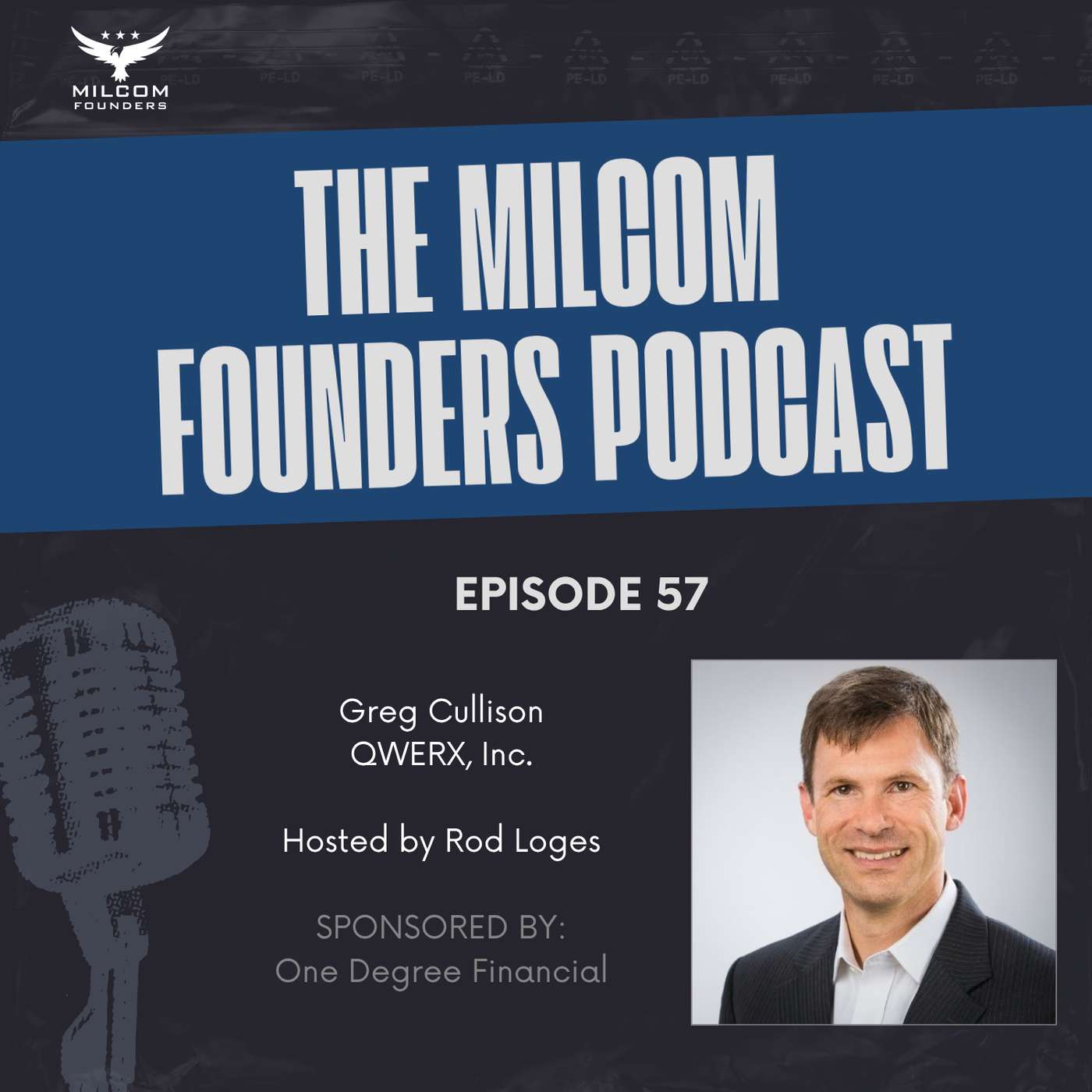
MilCom Founders Podcast, Episode 57: Defending the Network from the Inside Out with Greg Cullison Join host Rod Loges and guest Greg Cullison as they trace a career path from the U.S. Foreign Service through Navy Reserve intelligence, a deployment to Iraq, and into the founding of QWERX, Inc., a cybersecurity software company that authenticates every device on a network every three seconds using one-time encryption keys derived from randomness in nature rather than mathematical algorithms. In this episode: Greg's career started in the Foreign Service, where he had his first overseas posting at 23. The predictability pushed him toward graduate school in public policy, then into government consulting, and eventually a direct commission into the Navy Reserve Intelligence program in 2002. During his deployment to Iraq with the 18th Airborne Corps, a colonel gave Greg six weeks of top cover while he built trust with Iraqi counterparts on a sensitive capacity-building program. Despite zero visible progress early on, that quiet backing made the mission possible, and Greg earned a Bronze Star for the work. The origin of QWERX was a letter in Greg's mailbox informing him that his SF-86 data was among the 22 million records stolen in the Office of Personnel Management breach. The root cause, static credentials manually rotated twice a year, was still not being fixed. QWERX authenticates every device on a network every three seconds, issues a one-time encryption key, discards it, and repeats. A stolen credential becomes useless before an attacker can act on it. Greg explains the threat quantum computing poses to current encryption, including the "harvest now, decrypt later" strategy nation-state adversaries are already using, and why QWERX's approach is quantum-resistant without relying on any algorithm. Greg learned QWERX was a finalist at the RSA Conference Launchpad competition the same day he found out payroll could not be made. For veteran founders, Greg recommends using AI for research and marketing, reading actual books instead of listicles, and staying honest about whether the idea is actually working. The question Greg wished Rod had asked: how do you shut it off? He credits learning drums and coaching youth soccer as the practices that force genuine presence and keep him from running in reactive mode all day. Key takeaways: Leadership of self comes before leadership of others. If your own mindset and conduct are unstable, what you reflect to your team will be too. The difference between failure and giving up matters. A wrong turn you can course-correct from is not the same as walking away because it got hard. Early adopters and mainstream customers are not the same people. Spending energy trying to convince skeptics before you have proof points is usually the wrong focus. Static credentials are still how most attackers get in. The cybersecurity industry has added complexity around a problem it has not fixed at the root. Time is the one resource...
0:00Greg Cullison is the co-founder and CEO of QWERX, a cybersecurity company built
0:04on a direct challenge to the industry.
0:06Static device credentials are not a security problem to be managed.
0:10They are a design flaw to be eliminated.
0:12QWERX replaces static credentials with dynamic keys that rotate every
0:16few seconds and vanish after use.
0:18There is no credential to steal, harvest, or exploit.
0:21Even if an attacker could capture a key, it already no longer exists.
0:25The company's patented infrastructure has been validated at the RSA
0:28Conference, demonstrated live over Starlink, and analyzed by a US
0:32government lab to be quantum-proof.
0:34Before QWERX, Greg served as a US Foreign Service Officer, earned a
0:38graduate degree in public policy, and worked in government consulting
0:41before receiving a direct commission into the Navy Reserve Intelligence
0:45Program in two thousand and two.