
The Media Beat · Maureen Kerr and Claire Tavernier
The ways we consume news and opinion continue to evolve rapidly. In this Deep Dive Double Header, Claire and Maureen take us through how this has happened and what is means for consumer, creator and those hoping to make a buck. News covers the opening of the new Murdoch chequebook, Ofcom spreading its influence in the UK and AI scraps. You will be pleased to see a noticeable uptick in Podmoji apparatus as we go through good news for Neon, UMG and SNL UK.
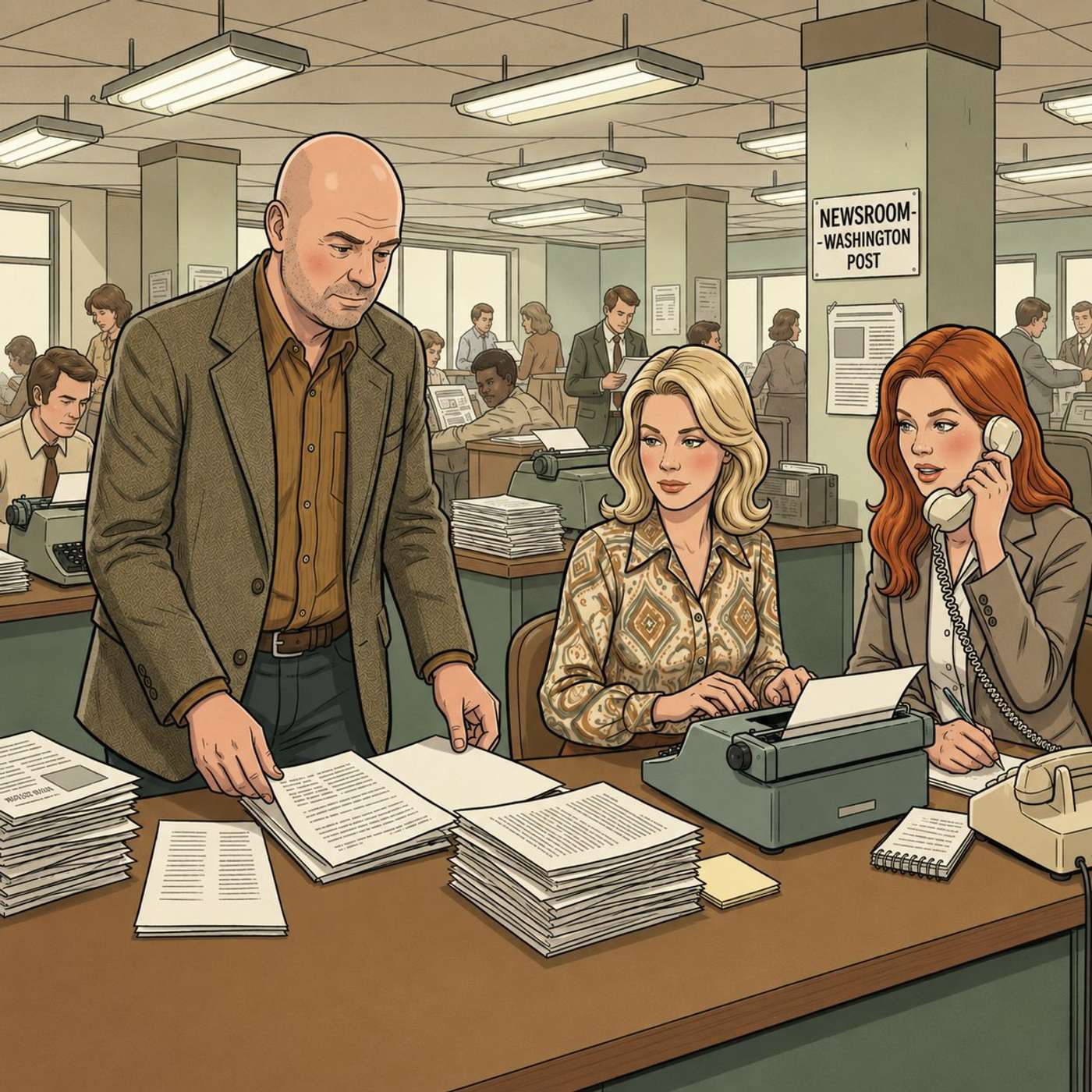
THE MEDIA BEAT — Episode 97 Hosts: Oliver Turnbull, Claire, Maureen ───────────────────────────────────────────────────────────────── OLIVER: Good day, good morning, good evening, good afternoon — wherever and whenever you consume your podcasts, or this one in particular. We hope you're well, our wonderful audience. It is us, The Media Beat with Maureen and Claire, episode 97, with a packed show. The Deep Dive is about the consumption of news, which is not entirely coincidental — there's quite a bit of preparation behind it. We've also got stuff about Ofcom tightening the rules for certain content providers, James Murdoch has had his chequebook out, OpenAI and Gemini, Pogmojis, Palme d'Or, UMG, and SNL UK. But we start, as always, with the Deep Dive — and it's one of the more legendary double-header deep dives that have become so popular in the media sphere. CLAIRE: Thank you. OLIVER: We're going to hear from Claire and Maureen on news and commentary — our evolving consumption habits, and how it's all changed from a man in a dinner suit reading to us about Her Majesty and the government, to the much more sophisticated ways we're now delivered and receive news. But enough of that. Claire, maybe you'd like to explain with a bit more professionalism and knowledge what we're actually talking about here. CLAIRE: Yes — and I'm going to gently chuckle at your pronunciation of "Palme d'Or," because you do make fun of the way I pronounce certain words, so I'm giving myself permission. OLIVER: You may. Palm Door. CLAIRE: Palme d'Or. OLIVER: Oh — it's not a door, it's of gold? CLAIRE: Dor. Palme d'Or. OLIVER: Got it. CLAIRE: Anyway, this is the one area where I have some genuine expertise — pronouncing French award names. So, let me tell you a little about what's happening in the world of news, and then Maureen will do a deep dive on one of the major new players that has arrived. The way I'd like to frame this — because we all like a good title — is: From Newsroom to Newsletter. We've used this quote before on the podcast. It's attributed to Jim Barksdale, former CEO of Netscape: there are only two ways to make money in business — bundling and unbundling. We talk a lot about bundling in TV and streaming. We've had a lot of unbundling there — everyone left their overpriced cable packages — and now we're back into bundling and rebundling. We've discussed all of that. But in news and commentary, we're in a completely different phase of that cycle. It's unbundling rapidly. And that's what we're going to talk about today. Traditionally, if you think about the printed press — commentary around news and current affairs was bundled into newspapers, magazines, and to some extent TV shows. That's still true, and there are still some very big brands like the Financial Times and the Economist, which remain powerful symbols of bundled quality. But what we're seeing more and more, and what I find very interesting, is commentators unbundling themselves. One of the most famous examples is probably Alastair Campbell and Rory Stewart, unbundling into The Rest Is Politics rather than becoming columnists in a national newspaper. Paul Krugman is another one who became really well known on Substack. These people are building what we call creator brands, monetising directly, and cutting out the institution in the middle — the newspaper, the magazine, whatever it was. This is because, very much like television, there has been a structural shift that has completely changed the economics of the industry. For most of the history of the press, the barrier to entry for publishing was enormous. You needed printing presses, a distribution network, an advertising sales team, and capital for all of it. That really kept the bundle intact — if you were a writer, you generally had to work with institutions that owned the infrastructure. The internet started to dismantle that in the early days, but it was really the smartphone, the apps, and the newsletter that finished the job. The marginal cost of distributing your thoughts has fallen to essentially zero. And so the unbundling of commentary is happening very fast — much faster than, say, local television, which still requires boots on the ground. But technology is not the only driver. There's also something happening in the industry that makes it almost impossible today to make a living the old way if you're a journalist. US newspaper employment has fallen by 30,000 people between 2008 and today. In the wider media industry, we lost 17,000 jobs just in 2025, and 2026 looks like it will be worse — we've already seen the Washington Post, Fox, and the Wall Street Journal making cuts in the first two months of the year. And of course AI is arriving. What AI is doing is not replacing the big names, but it is filling in for the structured, mundane tasks you would normally give a trainee journalist. The bottom rungs of the ladder are disappearing faster than the rest. The unbundling is also being accelerated because newspapers under enormous financial pressure are increasingly reluctant to invest in long, expensive journalism — which tends to be less popular with readers and less popular with advertisers than clickbait. So why would they do it under such financial strain? Some newspapers are fighting back by forming alliances. A good example is the ICIJ — the International Consortium of Investigative Journalism — which has about 30 outlets across 55 countries. It won a Pulitzer Prize for the Panama Papers investigation in 2016, and three world leaders resigned following that story. That's the kind of institutional journalism that still has real impact — but I would say it's the exception, not the rule. So what's happening is journalists are going it alone. And the platform that's emerging as the winner in this world is Substack. Maureen will go into much more detail, but let me give you some numbers. Writers collectively earned $450 million through Substack in 2025. There are about 100,000 publications now earning money on the platform, and around 50 creators are earning more than a million dollars a year through paid subscriptions alone. And remember — no staff, no sales team, no editor. Just a writer and a direct relationship with readers. There are other platforms — Patreon, Ghost, Beehiiv — but Substack has become the brand name for this kind of publication. Now, as we know from talking about television, the catch in unbundling is always discovery. I mentioned 100,000 people on Substack monetising — but there are over 2 million publications on the platform. You have a handful of large accounts at the top, people who often made their names in traditional journalism, and then a very, very long tail behind them. These new worlds force writers to become like YouTubers and TikTokers — a one-person media company. And not all of them are enjoying it. Not all of them are good at it. I'll hand over to Maureen in a moment, but I want to raise one more thing — another catch in the system. I want to bring back one of my favourite films of all time, All the President's Men. 1976, Robert Redford, Dustin Hoffman playing Woodward and Bernstein. But I want to talk about Jason Robards, who plays the executive editor of the Washington Post, Ben Bradlee. The whole drama of the film isn't just the reporting — it's Ben Bradlee saying, "I want a second source. I'm not running this story unless it's watertight. I need to take institutional responsibility for this." On Substack, there isn't that. The writer is the editor, the publisher, and the brand. Nobody is asking, "are we sure about this?" So I'll end here by saying I'm genuinely happy that long-form journalism is not only surviving but in some ways thriving on new platforms. But I am mourning the decline of the curator and executive editor role — though that's possibly just me being old and cranky. Maureen, over to you. ───────────────────────────────────────────────────────────────── MAUREEN: Old and cranky — I doubt that, I really do, Claire. So I've approached this slightly differently, building on a lot of the opinions and statistics you've laid out. I think people have been framing this as newspapers on one side and Substack on the other — big institutions versus the individual writer. You've got the big mastheads of newspapers, and then you've got all the journalists who've been fired or let go, walking out of the building — but taking their readers with them to some extent. So who is winning? You may ask. But I don't think that's quite the right framing. A format is never really the only point — and I think you've picked up on this, Claire, when you talk about the audience. A newspaper, a newsletter, a podcast, a YouTube channel — they're all just ways to reach people. The valuable thing is the relationship with the audience, the trust built up over many years between the journalist, the writer, the newspaper, and its readership. Do people come back? Do they pay? The numbers you've thrown out are incredible — a top tier of 50 creators earning over a million dollars. So yes, they do pay. Can you reach them directly? Absolutely — a genuine one-to-one conversation. Are they dependent on an algorithm to send them your way? No, not anymore. For a long time, newspapers did own that relationship. You subscribed, the paper landed on your mat — or in your inbox, mostly — and you read it every morning. That was the habit. And I think the internet broke that habit. The front page moved to the feed; readers came through Facebook, Google, Twitter, Apple News — wherever the traffic was coming from that day. And that made media companies, I think, much weaker than they actually looked. They could have millions of visitors, but as soon as that algorithm changed, they disappeared. And that is where I think Substack is somewhat misunderstood. It's doing something extraordinarily clever. We usually talk about Substack as a place where individual writers go to be independent — and that's true — but I think it misses a bigger point. Substack gets the writers, and it also gets the small media companies that come with them. The direct relationship with the audience is the critical thing that makes Substack special. It has email addresses, payments, podcasts, comments, and a community. People who come back to a Substack do so without asking permission from Facebook or Google. And that's why Scott Galloway and the Prof G team have come to Substack recently. Galloway didn't come to Substack to find an audience — he already had one. He had the podcasts, the books, the video presence, the business. He took the whole Prof G machine to Substack. That move matters considerably more than it might appear, because what Substack is building is a home not just for solo writers, but for media brands that want a closer connection to their audiences — which is exactly what newspapers used to do. The problem for newspapers was that they were losing the direct relationship with readers because of the intermediaries — Facebook, Apple News, Google, and the algorithms. On Substack, the same person might read the newsletter, listen to the podcast, watch the clip, come to the live show. Prof G is touring across the US and coming to the UK as well. One audience moves across different formats. The masthead we talked about in print terms is much simpler now — individuals and businesses coexisting within the Substack ecosystem. That's where they're making money. Not just individuals, but businesses being created and recreated within that environment. That's where I rest my case on newspapers versus Substack. It's all about direct relationships with readers, across different formats — which is effectively what we used to call distribution. But I was staggered by some of those numbers, Claire. $450 million. Wow. CLAIRE: Yes. The top writer on Substack — I believe it's Heather Cox Richardson, who publishes Letters from an American — has 2.5 million subscribers. Some estimates put her revenue above a million dollars a month. I think you should keep going with your Substack, Maureen — because that's what you're going for. MAUREEN: I need to build a business around myself. CLAIRE: It's all there to play for. OLIVER: It gets plopped into my inbox. Do you do it regularly? MAUREEN: I do a couple of pieces a week, and I also write for Forbes. I have exclusivity for a period of time with Forbes, and then the pieces drop into Substack. CLAIRE: So you span both traditional press and Substack. MAUREEN: I've got the podcast, Forbes Digital, and Substack. I'm building. OLIVER: Good Lord. MAUREEN: Scott Galloway, Heather — watch your backs. CLAIRE: Your media empire is shaping up nicely. OLIVER: You're going to drag us along with you, I hope. CLAIRE: Exactly — we want to ride the coattails. OLIVER: Claire has a fabulous presence as well, of course. Me, not so much — but I'm happy in my humility. That was great, thank you. It's so complicated now — where do you get your news? Where do you get your commentary? Can you believe it? People today really have to be on top of what's real and what isn't. But the richness and the tailorability is probably worth it. Something recently dropped into my feed: a gentleman reading a poem, which I've never really understood — but it was really helpful to have him explain why the poem was interesting, the story behind it. I'm getting myself educated. Thank you so much. And do subscribe — Maureen is far too shy to ask you, but please subscribe — it's as eloquent as you might imagine if you're used to her from this podcast. And that was the Deep Dive. Classic. We now move on, somewhat ironically, to The News. ───────────────────────────────────────────────────────────────── OLIVER: We start with — and there's a hand up and waving — the Murdoch story. CLAIRE: That's Maureen. MAUREEN: That's me, yes. OLIVER: What did I say? CLAIRE: You said Claire. We do have video now. OLIVER: Good Lord. Yes. I could have sworn I said Maureen, but I am on quite strong medication. Maureen, of course. MAUREEN: Have you still not recovered? Are you okay? OLIVER: No, I'm fine, genuinely fine. Thank you for all the floods of enquiries on LinkedIn as to whether I was okay. I think they numbered zero — but I'm fine. Sorry, Maureen. It is you and you are there. And it's a Murdoch story. James Murdoch has bought New York — and I thought it said he'd bought New York, but it's a magazine. New York Magazine, as opposed to The New Yorker. And Vox as well. Tell us all about it, Maureen. MAUREEN: It's really helpful that you've clarified that for our audience. All right. The Murdoch deal. James Murdoch has his own holding company called Lupa Systems. He has agreed to buy New York Magazine — the publication, not the city or the state — as well as Vox.com and the Vox Media Podcast Network. What he leaves behind are The Verge, Eater, SB Nation, and a few others, which stay in a separate company. Now, the family drama angle — the son who broke from his father's empire, or the son buying a magazine his father once owned — that's what everyone jumps to as soon as they hear the name James Murdoch. We're not doing that, because frankly it's not the interesting bit. The interesting bit is what he actually bought. Not just a magazine, not just a website — he bought audiences. New York Magazine brings more than 400,000 paying subscribers and is a serious culture and service journalism brand. Vox brings a YouTube channel with nearly 13 million subscribers and an audience that comes for plain-English takes on politics, technology, and the news. The podcast network brings nearly 50 shows with real host power — including Pivot, of course, with Kara Swisher and Scott Galloway. And Pivot is exactly the kind of asset this whole conversation is about: a loyal audience built around personalities, moving across podcasting, newsletters, live events, video, and subscriptions. Put that next to what Lupa Systems already has — Tribeca Film Festival and Art Basel — and the pattern becomes quite clear. Murdoch is buying brands that gather people around culture, ideas, and live experience. He's buying in a soft market. The one valuation we can point to is BuzzFeed, which just sold a majority stake to Byron Allen's company for only $120 million — a fraction of what it was once worth. Murdoch isn't just buying digital media assets at a discount; he's buying media brands with audiences who choose to come back time and again. I think this is one of the smartest deals I've seen in digital media in a long time. CLAIRE: It's very interesting, because I think what James Murdoch is saying is: we've reached the bottom of the unbundling well, and now it's time to start bundling again. It's a very neat follow-through to everything we've just been talking about — we're in the full throes of unbundling, it will eventually go too far as it always does, and Murdoch is saying: with valuations where they are, now is the time to start bundling again. He may well be right. He's certainly picked very interesting brands. I'm personally a fan of Vulture, so I'm glad it's found a home. You're always relieved when your favourite places find a home. And yes, it was a soft valuation — not dramatically so, but not great. He's making the bet that some of these brands and creators are stronger together, and it'll be fascinating to see whether he can make that work. OLIVER: Do you think he'll be as active as his father? MAUREEN: Yes. CLAIRE: I think he'll have a different angle. He's picking slightly different assets. But he's going to want to be a player — and both he and the other siblings who aren't Lachlan received a pretty substantial cheque, so they have money to play with. OLIVER: Let's keep an eye on it. Thank you so much for that. And we move on to Ofcom. Claire, this is a definite Claire story. ───────────────────────────────────────────────────────────────── CLAIRE: Yes, it's a boring regulator story — I'm joking. Ofcom is the UK regulator for television and communications. They've published something I find quite interesting: a draft code of practice for what they call Tier 1 streaming services — meaning any platform with more than 500,000 UK users. That effectively means Netflix, Amazon Prime, and Disney Plus. The point is that right now there are no regulatory standards for streamers, not in the way there are for broadcasters. If you see something on TV you don't like, you can complain to Ofcom — and Ofcom has indeed received complaints about various BBC episodes. But you can't do that if you dislike something on Netflix. There's currently no one in the UK you can complain to. Ofcom has decided this is a loophole that needs filling, and I agree. The draft code will cover protection of under-18s, harm and offence, impartiality and accuracy in news — which is interesting — and protection against unfair treatment and privacy. There are also accessibility requirements, including subtitling, audio description, and British Sign Language, with some quotas. BBC iPlayer will stay under its existing BBC code, though the accessibility requirements will apply to it as well. I think it levels the playing field for UK broadcasters, which is fair enough. I also want to mention France briefly — France has been regulating streamers from the beginning and went very far, requiring platforms to reinvest 20 to 25% of their domestic revenues back into French production, with sub-quotas for independent production, feature films, and the French windowing system. France has long championed TV quotas to protect local production, and in this case it's been quite a successful move — something UK independent producers are watching with interest. Ofcom isn't going there at the moment, but it may at some point want to consider whether those kinds of quotas are justified. Although the US streamers are already producing quite a lot in the UK, so it may not be necessary. Maureen, what do you think? MAUREEN: I agree with you on the level playing field. I'm all for rules around harm, accuracy, and impartiality of news. Where I'd draw the line is around content rules themselves, because most of these organisations are domiciled outside the UK — they're clearly serving a UK audience, but I don't think Disney Plus is a Channel 4, and I don't think Netflix is an ITV. A drama box set is not the same as the 6 o'clock news. Ofcom needs to be realistic about the limits of enforcement. We don't want the UK to be uncompetitive. Ofcom can set the rules, investigate, and fine — but how much teeth does it really have in practice? If the guidelines are clear and practical, and they address harm, impartiality, and accuracy, I'm completely for that. I just wonder whether they'll overreach on content itself — I don't think they'll have the enforcement power to do much there. CLAIRE: I should clarify — it's a consultation at this stage, so everyone can send their views, and I'd fully expect Amazon, Netflix, the BBC, Channel 4, and others to respond. The final code probably won't arrive until the end of the year. But I agree with you — protection is needed, and the question is exactly how enforceable some of it will be. OLIVER: Great story, great summary. Keep an eye on it. And finally — that was boring regulation. Now: interesting, sexy AI. ───────────────────────────────────────────────────────────────── CLAIRE: The sexy? Sorry. OLIVER: Maureen gets the sexy story. And our focus on France is perfectly reasonable — we have 4.2% of our listenership from France, our fifth-highest listening nation. So absolutely, many French listeners. But yes, Maureen — AI. There's a scrap. We always like a scrap between OpenAI and Gemini. What's going on? MAUREEN: I wouldn't necessarily call it a scrap — but before I get into the stories, can I just go back to Ofcom for a second? Claire talking about regulation and somehow making it fascinating — and always bringing in something about France — the bar is set high. CLAIRE: I'm putting that on my LinkedIn profile. "She makes regulation sexy." MAUREEN: Please. Right. So there are a couple of stories here, and we'll end on Tribeca Film Festival. First: Apple is bringing Google's Gemini into Siri. That's a really big deal. Siri is no longer a side product — it sits on the iPhone, it's in people's pockets. If Apple gets this right, Gemini becomes the voice assistant for a huge number of everyday users. It also tells us something about OpenAI — ChatGPT was clearly the exciting name Apple brought into the iPhone story early on, but now they've gone full Gemini. That said, OpenAI isn't out — it can still be used elsewhere and isn't the only game in town. The second move: Microsoft — a significant investor in OpenAI — is loosening their partnership. They're still billions and billions deep into OpenAI, but they're simplifying the relationship. That grip between the two is definitely loosening. OpenAI is now free to work with other cloud companies, including Amazon and Google. Microsoft still has a very strong relationship as an investor, but it no longer has the same lock on OpenAI. Plain English version: the AI companies want to be everywhere, and the big platforms — Apple, Microsoft, Amazon, Google — do not want to be stuck with only one AI partner. Everyone is being flirtatious and fickle, working with every AI model, because I don't think anyone really knows where they want to land. Claire and I, and maybe Oliver, use at least four or five different AI models ourselves — I think enterprises are doing something similar. Now, something close to our hearts: film — and Tribeca Film Festival. We've been following Tribeca for a number of years, especially when they opened up a deal with Sora and let some of their directors experiment with it, and subsequently worked with Runway. So it is no surprise — though the market generally is surprised — that Jane Rosenthal, Tribeca's co-founder and CEO, has announced that on June 10th she will showcase an AI feature film. A drama. Fully AI-generated. It dramatises the Iran war and deaths in Iran. It was made by just two brothers in a room — no crew, fully AI-generated. It has shaken parts of the industry to its core, even as — as we know, fresh back from Cannes — Demi Moore and others have said we simply have to face up to the fact that AI tools are going to be part of filmmaking from here on. It will be featured on June 10th as the first fully AI-generated live-action feature film at 75 minutes. Claire, did your jaw drop, or were you expecting this? CLAIRE: I think we were all expecting it, and we'll have to see. My biggest fear, honestly, is that it's good. MAUREEN: I've seen the trailer. It is good. CLAIRE: I was kind of hoping it wouldn't quite work, because that goes against everything I value. But we'll see. I think there's no doubt there's a place for AI in filmmaking — this is actually a good example of it, where you couldn't send crews to the ground and it makes sense to recreate something. It's clearly more economically feasible to do it with AI, and film financing is very difficult. I completely get the logic, and I think you can tell wonderful stories with AI. But it makes me a little bit sad. That's my honest reaction. Going back to AI and Google briefly — one thing worth flagging: that deal Apple did with Google is worth about a billion dollars a year, so there's real cash changing hands. But Google is now everywhere in terms of smartphones — it powers AI on iOS, on Android, on Samsung Galaxy AI. There's a kind of monopoly of thought forming, which is never healthy. So just putting that out there. ChatGPT will still be available on Apple and isn't going away completely, but Google's dominance in AI — despite being a relatively late entrant to this world — is something worth keeping a close eye on. OLIVER: Will AI be good, but not that good — artists must be. We're watching that very closely. Thank you — excellent stuff. ───────────────────────────────────────────────────────────────── OLIVER: That was The News, done The Media Beat way in our unique-ish style. We move on now to Pogmojis. And I'm hoping for some props this week because YouTube viewership is going up and people are saying we need more relevant props going on — you speak, we listen. So let's start with Neon, who have won their seventh Palme d'Or. Claire, what's your take? CLAIRE: Yes. Neon is an independent film distributor and they have won seven Palmes d'Or back-to-back — which my mother-in-law has decided is a completely illogical expression that she refuses to use, though I don't quite know why. Anyway. Their run started in 2019 with Parasite, then Titane in 2021 — there was no Cannes in 2020 — Triangle of Sadness in 2022, Anatomy of a Fall in 2023, Anora in 2024, and then there was a gap in 2025 and Pure this year in 2026. That's a pretty remarkable run for a small independent studio. What's interesting is that it's very much the anti-algorithm success story. They go very niche, they back people on instinct, on belief in creators — they don't look for stories they think will work commercially. And indeed, not all of these films have been huge box office successes. Some have crossed over — Parasite did very well, Anora did okay — but most have remained quite small. And there's a question about whether the Palme d'Or and Cannes generally is becoming increasingly detached from what people actually watch. It's also interesting that legacy Hollywood studios, who used to win the Palme d'Or, have been nowhere to be seen for seven years. And several of these winners weren't originally in English — which speaks to our increasing comfort with subtitles. When I say "our," I mean yours — those of us from non-English-speaking countries were already there. I'm genuinely not sure how I feel about it, because I think cinema is at its best when it crosses over between art and popular culture. These are very arty films, and I'm not sure that's always good for Cannes. So I'm going with the Gallic shrug. MAUREEN: My reaction is that I love every single one of those films — personally, anecdotally. I can't wait to watch the latest one. I would love to be in the room with the other distributors, who walk out slightly more annoyed and slightly more impressed every single year. How do they do it? I think it's wonderful. Lucky number seven — I wonder if they'll hit eight. I hope they don't turn this off. There's something really special about that award. ───────────────────────────────────────────────────────────────── OLIVER: Right. UMG — they've rejected a bid. Maureen, start with you. MAUREEN: This is one to gloat about, for Claire and me. If you listened to our earlier episode where Bill Ackman put forward a takeover bid via Pershing Square Capital, we said at the time: there's no way this is going to be accepted. There isn't a buyer here because there isn't a seller here. UMG is not up for sale — you can throw out as many blank cheques as you like. And guess what? The board has rejected the bid. CLAIRE: A classic moment. So yes, it's interesting — Cyril Bolloré, son of Vincent Bolloré and a board member, said he was strongly against it, told the board not to do it, and the board followed his lead. Nobody really wanted to sell. We were right, says the Persian cat — who, for the record, is not happy about the bid either. OLIVER: Was that in our predictions episode? MAUREEN: No, it was a reaction to a news event. OLIVER: It still counts. Absolute win for The Media Beat. MAUREEN: We've got one in the bag already. ───────────────────────────────────────────────────────────────── OLIVER: And finally — SNL UK renewed for a second season. Claire, start with you. CLAIRE: Yes, and I think it's genuinely good news — it's a good programme that's done really well for Sky. The numbers, when you dig in, are a little nuanced. The series premiere drew 226,000 viewers — that's enormous for that slot on Sky, four times the typical audience, and it beat Channel 4, which is not very frequent for Sky One. And obviously with catch-up it rose to half a million viewers over seven days consolidated. But it did decline quite steeply after that, going down to 86,000 later in the run. What it did do, though, was generate 86 million views across social. I think for Sky, they viewed SNL UK primarily as a marketing vehicle to engage a new, younger audience. By that measure, the social numbers will have made them very happy. So they've decided to renew it for 12 episodes — it'll be interesting to see whether it can pick up the ratings in season two. MAUREEN: One number I keep hearing about — Claire, can you corroborate this — is that each episode reportedly costs around £2 million. If true, that's a very expensive unscripted show for Sky by any measure. I saw it somewhere, but I'm not sure I believe it. CLAIRE: I was shocked by it too, but it is the estimated figure. As a comparison, the US show costs around $4 million per episode. The reason it's so expensive is the scale: an eleven-member main cast, a writers' room of twenty people, a live crew, a full house band, and a senior producer team — all turning content around in 24 hours because the show is highly topical. MAUREEN: It's the highest Sky has ever paid per episode for anything. And plenty of people said they didn't think this format would travel. But if you listen to Lorne Michaels, he says it keeps getting better every week. The renewal speaks for itself, and the doubters are now quietly staying home. CLAIRE: And if you count it as a marketing expense to attract younger viewers to Sky's streaming services, channels, and advertisers — it's a big bet, but you can see the logic. OLIVER: I think it's good. The format really does travel. Brings us to the end of Episode 97. We've squeezed it all in. SNL UK is getting better — it has the energy and zeitgeist of the American version, which is quite an achievement. But who cares what I think? Until next time — goodbye, Claire. CLAIRE: Goodbye, Oliver. Goodbye, Maureen. Goodbye, everyone. OLIVER: And Maureen — goodbye to you. MAUREEN: Goodbye to you, Oliver, Claire, and everyone else. Goodbye. OLIVER: Until the next time. Bye-bye.