
The Media Beat · Maureen Kerr and Claire Tavernier
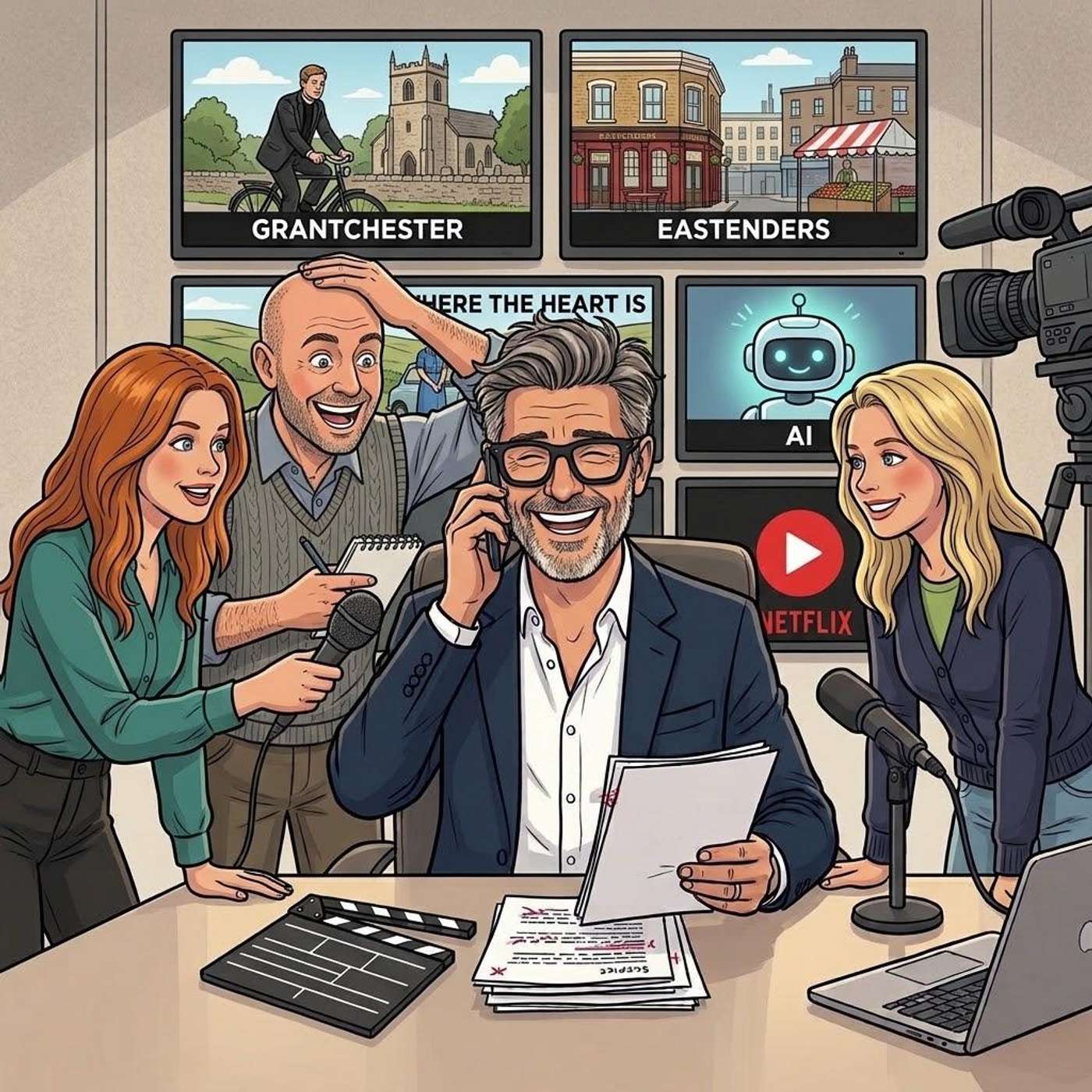
In this special episode we are honoured to welcome Diederick Santer, whose career in TV is a fabulous example of the joys and challenges of making TV. From being the boss of Eastenders to running his own production company, he's seen it all! Join us as he tells his story through the gentle quizzing of Maureen and Claire.
THE MEDIA BEAT: EPISODE 105 Transcript Special guest: Diederick Santer --- INTRO Oliver Turnbull: Hello everybody and welcome to The Media Beat. We are at episode 105, and every now and again we have a special one. This is one of those special ones, because, if you are watching on YouTube, you can see we have a special guest with us. He has a career in TV as long as your arm, but I won't reveal too much, because that will come through the questions of Maureen and Claire, who are chomping at the bit to get to know a little bit about the man, the legend, that is Mr Diederick Santer. At the moment he is working at Sky, but we'll hear more about that later. Claire, maybe you would like to start the interrogation, sorry, the interview, with a little bit of who this man is. --- DEEP DIVE: IN CONVERSATION WITH DIEDERICK SANTER Getting into television Claire: The man, the legend. I'm really delighted to have you on the show, Diederick. Diederick Santer: Well, thanks for having me. It's really exciting to join you. Claire: We can't wait to dig into what you've done, what you're doing at the moment and, perhaps more importantly, where you see this whole industry going from where you sit. To give a very quick summary: you've had decades of experience in television. You were at the helm of EastEnders for quite a long chunk of time, and we're going to talk about that because, as Maureen and Oliver know, I'm pretty obsessed with soaps and how they're made. You ran Kudos for a while, a major independent production company. One of your shows there was Grantchester, which is still running years and years later. You worked for Netflix, and you're currently working for Sky. You've been commissioner, producer, independent producer and producer within larger organisations. So there's a lot to talk about. But to start us off, how did you get into television? Diederick Santer: This is the mid-90s, three decades ago. I was an actor, and I was spectacularly unsuccessful. I couldn't really get it together. A couple of things I noticed. One was that the bit of the rehearsal process I enjoyed most was the first day, when everyone sat around and talked about the script and the characters. I was particularly good at that. I was maybe less good, less assured, less interesting when it was stood up and the acting was actually happening. I got to 25, 26 and I could see it just wasn't going to happen for me. I wasn't getting the breaks or the auditions. Then, you know how it goes, a friend of a friend was working for a theatre company and they needed someone to read some scripts for a festival. So I read a pile of scripts, I really enjoyed it, and I had to give an opinion on each one. Then I started doing that for another friend of a friend who worked at a TV company. And what I found was that within a few months, all the noes I'd been hearing as an actor were suddenly turning into yeses. Someone would say, "I've got a meeting with this author tomorrow but I haven't read their book. Can you read it and break it down into chapters by ten o'clock tomorrow?" Yes, I could do that. So it was suddenly a positive time, and I stopped feeling terrible about myself. If you're failing as an actor, it's "What is it about me? My voice, my face, my everything?" It was quite depressing. So I had this break as a script reader, which bounced into assistant script editing, and there were a few long-forgotten shows on ITV in the mid to late 90s where I got my break going from script reading to script editing. A bit of right place, right time, and a bit of early signs: as a kid I was always drawn to film, TV and theatre, and I mistook that for acting, but actually it was storytelling in a wider sense. Claire: I'd like to know about the transition from script editor to producer, but first, can you describe the role of a script editor for listeners who may not be familiar with it? Diederick Santer: It's changed a bit, but in those days I worked on a show called Where the Heart Is, a much-loved, very successful ITV show about district nurses in West Yorkshire. The lead writer was a brilliant writer, Ashley Pharoah, who is still super busy and in demand 30 years on. He co-created Life on Mars, for example. He'd done his time on EastEnders and Casualty, and this was his first sole commission. On the first series, and in those days it was "series", not "season", I was a sort of number two. On the second series the other script editor went AWOL, so suddenly it was me. It was a 12-part series, a bigger order for series two. How many was Ashley going to write? What other writers would we get? What would the shape of the series be? My role was to sit with Ashley and the producer and work out the major character arcs, the A to Z for Pam Ferris's character and Sarah Lancashire's character, and then how that breaks down into each episode. Then work with Ashley and the other writers: you're doing episode four, that's the one where they go to Scarborough for a conference. I'm freestyling now. So it was my job to help peg the series out, and then to do the air traffic control on the scripts. The first draft of episode one comes in. It's good, I've got some thoughts, our advisors have got some thoughts, the producer, the exec producers, the director and the channel have all got thoughts. So you're managing consensus to a degree, finding the best version, because the last thing you want is to say to the writer, "I thought it should be darker and they thought it should be lighter." Sometimes you need to expose them a bit to that conversation, but you want to be clear what the direction of travel is. It's also your job to find the continuity across the series. Hang on, we're telling the same story in episode five that we are in episode seven. Join the dots, have the overview, and marshal the different drafts through to production. When the thing's shooting, you work with the production office and the directors to make sure the scripts are working. You can be the lightning rod if the actors are unhappy or think a particular script is rubbish. Sometimes you take that back to the writers, sometimes you deal with it yourself. It was a brilliant job for me in my late 20s, because I liked actors and understood actors, I liked stories, and I loved working with different writers. And that thing of planning a series and thinking: how do we make sure every episode is the same but different? On a big commercial ITV series, you want the audience to get something of what they expect every week, but also a different flavour, a different story, a different energy, a different resolution. As someone who spent their childhood watching endless TV, I felt as a script editor that I'd come home. This was the job that was built for me. That was a long answer to a short question. Claire: No, it was amazing. I didn't realise script editing was such a wide role. It's essentially a producer role in many ways, without the title. Diederick Santer: It's changed a bit now. It's more compartmentalised into script producers and story producers. But in those days, maybe the stakes were lower, there were fewer people working on things and the teams were smaller. At one point I was script editing two different series at once, which is crazy when you think about it. But it was a fun job and a good rehearsal for being a producer. From Jane Eyre to EastEnders Maureen: Can I ask a quick question? I've always been fascinated by whether people stay in their lanes, and you clearly don't. Working on a show like EastEnders must have been an extraordinary training ground for storytelling, with a relentless production rhythm. Then you move into high-end drama, which I imagine is a completely different vibe and a different team. What did you learn from your EastEnders days, and what have you ported across into other areas? Diederick Santer: I think often where you end up in TV for the next 10, 20, 30 years is where you got your first break. Happily, I got mine in scripted, in returning drama series made for ITV. I sometimes meet people whose first job was as a runner on The X Factor, and twelve years into shiny floor shows they say, "What I really wanted to do was drama or comedy. How do I get into drama?" They all feed into each other. There's a certain snobbery around soaps, but it's essentially the same skills, whether you're working very quickly in volume or much more slowly on a high-end piece. I went from producing what was the 2006 version of high end, an adaptation of Jane Eyre for the BBC with Ruth Wilson and Toby Stephens in the leads... Claire: Which I loved. I thought it was Ruth Wilson's big break. Diederick Santer: Thank you. It was her first job, and she was phenomenal. So we spent a year making four hours of that, and then I stepped into EastEnders, where we would spend a week making four episodes. But it was the same skills, and you have to take the same approach: we have to make this the best it can be within the resources, financial or temporal, available. Not settle for good enough, but ask what's the best it can be within the constraints. Obviously that pegs differently for a premium prime-time period drama shot on film and something that's pretty much daily, but you still have to find your points of quality and your non-negotiables. Claire: What did you think when you got the call, or the tap on the shoulder? Did you think, "I'd rather keep making Jane Eyre"? What was your feeling? Diederick Santer: Well, forgive me, but I kind of shat myself. Claire: That'll be the clip, Diederick. You know that, right? Maureen: It's got to be. Diederick Santer: It was a show I'd watched. I was a London teen, a posh one, but a London teen nonetheless, of 15 when EastEnders began. I watched it with my mum, and as a young person in London it spoke to me, so I'd watched its first four or five years very closely and I was still a viewer. I got summoned to see Jane Tranter, who was head of drama at the BBC, and the late Alan Yentob, who was head of drama, entertainment and children's. We were shooting Jane Eyre in Derbyshire. It was early or mid 2006. I didn't know what it was for. I walked into the office and they said, "Diederick, we want you to do EastEnders." I basically accepted in the room, then said I needed to go and talk to my partner. I was really, really excited, because it was a show I loved, followed and had views on. But I was also terrified, because I knew it was four episodes a week, 200-plus a year, a regular cast of 40-plus, some of whom were a handful, a regular writing team of a dozen or more, a huge production and a really important show for the BBC. And I knew that of the last four producers, two had thrived and two really had not. It was a bit like going to be a football manager, knowing there's a 50-50 chance this will end in failure and everyone being a bit cross with you. Claire: High risk, high reward. Diederick Santer: Exactly that, Claire. The first few days were terrifying. I'd had a mini dress rehearsal a few years before with Cutting It, the hairdresser drama with Amanda Holden and Sarah Parish, which ran for four series on the BBC. I produced the first three. That had been a show in the tabloid eye, with a brilliant but colourful cast. But it wasn't in the volume. I remember my new assistant putting all the routines into my Outlook diary, and watching it live, thinking, "What the hell?" Seeing my life disappear. There's some flexibility in how you do that job, but every Thursday you watch two episodes, every Friday you watch two episodes, every Friday night you sign off four cuts, every Monday you get four first drafts, every Tuesday you get four second drafts. Every three months there's a story conference. And in the first weeks I had to have one-to-ones with the cast. It was like being in a wind tunnel. A hairdryer is too small. I think what's really hard in a job like that, and maybe this is my definition of producing, is that there's so much going on and so many people with views. With EastEnders then, there were newspaper views, discussion sites and forums, people at the BBC, friends, family. I had a young kid at that point, so the mums at the school gate had a view. The cast had a view: "I don't like the storyline", "Can't I have more to do?" How do you find your own voice, your own vision, your own way through all that noise? That was really interesting and really enjoyable. It was stressful at the time, but it's nice to be needed, isn't it? When you go into a workplace and everyone's got a question for you, it's flattering on some level. If you're a bit mad, you mistake that interest for personal qualities in yourself. I realised a lot of the time it was just because I was the figurehead. It was the role that had to have an opinion. But it was a really live time, and I really enjoyed it. Claire: And it's nice to work on something that's part of the national conversation. Diederick Santer: I enjoyed that part of it, I must say. It was good for my ego. There were some big spikes in the show, and it was fun. Claire: You brought in new families, you axed a few families, and you had some really big Christmas Day episodes. One of them went up to 14 million viewers. Even football games don't get that these days. Same with the 25th anniversary. Looking back, what are you most proud of? And is there anything you wouldn't do again? Diederick Santer: That's a good question. I'll try to keep it concise. Funnily enough, I was looking at the dates this week, and I started at EastEnders 20 years ago tomorrow. My first, very disorientating day was just shy of 20 years ago. I'm really proud of Christmas 2007. Some people will remember it was the reveal to Bradley and Tanya that Max and Stacey were having an affair. It was huge, because Simon Ashdown, who was the head writer, had come up with this affair story that we'd slow-geared, so it had a crunching inevitability. Glacial storytelling. But by Christmas, the glacier was extremely powerful and unstoppable. That was a great moment. We brought in some good characters. Samantha Womack and Rita Simons as the Mitchell sisters, Roxy and Ronnie, who freshened the show up. They were fantastic. We brought in the Masoods, Nina Wadia and Nitin Ganatra. Up to that point EastEnders had had some good Asian characters, but they hadn't quite flown, and it was weird for a show set in East London not to have an Asian family. So we put that right. The departures were difficult, because as you bring people in, some people have to go. There are a couple of characters, and I'm not going to go into this, where you regret it. Maybe you didn't quite see the potential. But the fun thing with a show like EastEnders is that it goes on so long that some of my successors have put those mistakes right. Fans will note that a couple of people who left while I was there are now back in the show, and good thing too. Maybe they were the wrong characters for that time but the right characters for now. The live episode, again, was an overnight audience of 16 million, which is just nuts to think about. It was the 25th anniversary live episode, the climax of a whodunit, and that was great fun. There were low moments as well. You look at a week's episodes and think, "I thought we had good storylines, good scripts and a good director, but this is boring. How can I put it right?" I can cut it a bit quicker, but you can't reshoot a week or rewrite a week. Make it as good as you can in the time and move on. That was never comfortable, but it was the reality of doing 200 shows a year. It was a privilege to work with some of that cast, to get to know Barbara Windsor and June Brown, who played Dot. Extraordinary people. Barbara was always a dream: exacting, but a dream. June was a handful. I remember having to tell her off. She was in her 80s, and she'd screamed across the car park at a member of the story team. I won't say exactly what she said, but she attributed two four-letter words to his storylines. He was in tears in my office, and I had to call her in and say, "You can't speak to him like that." It was quite curious telling off someone of her status in her 80s, but it was unacceptable behaviour. So some of those talent relationships were joyful and interesting. You can tell I remember it fondly. Kudos and the drama financing puzzle Claire: And then you left the BBC and went independent, to Kudos. Diederick Santer: I'd been in the very privileged position of being an in-house producer at the BBC from 2000 to 2010, pretty much, and I thought it was time to strike out under my own flag. I'd never been an independent producer. I got into a conversation with the brilliant producer Jane Featherstone, who was running Kudos at the time. I was seeking her advice and said I wanted to set up my own company. She said, "Don't do that. You don't know what you're doing. Set up your own label within Kudos. We'll set you up." It worked really well, because I had my own team, my own letterhead and my own flag to fly under, but I had all her expertise and that of Dan Isaacs, who was working with her. I had their business affairs, their production, their back office and their building. So it was the best of both. Creatively I was doing my thing, but I was checking in with Jane, with Dan, and with Alison Barnett, who's still their brilliant head of production. They were underwriting it as well, so the risk was managed and I got to learn how it worked. That was a really joyful time. That led to Grantchester, which I think got greenlit in 2013. They shot season 11 last year. It ran for dozens of episodes: James Norton and Robson Green fighting crime in a 1950s village. He was the vicar, Robson was the detective. Claire: It was the original cosy crime, really. Diederick Santer: It was a good one. James moved on after a while and we changed the lead, but it sold all around the world, and along with Happy Valley it really established James, who is a global star now. In scripted, some shows have really long tails. What I mean is that they endure in sales terms. A show like Grantchester, and a few of those Kudos titles I had nothing to do with, like Hustle and Spooks, still sell and sell. Those long tails make them quite profitable over time. Not every show works like that. But if you can keep selling another window of your title to France or Belgium or the US, sell seasons seven to eleven, then each sale is pretty small but over time they accumulate into big sales. So it proved a very profitable show, and a joyful one for the audience and for the people who made it. Claire: And you ended up running Kudos. Diederick Santer: I did. I had my label, and then Jane moved on, initially for a bit of a break before she set up Sister, and I took it on. I inherited some fantastic programmes. Kudos was making Broadchurch and Humans. We won a few things. We had Tin Star with Tim Roth, which was huge on Sky, and The Tunnel. Maureen: Tin Star. Love. Claire: The Tunnel was formatted, which was quite new at the time. Diederick Santer: It was the Anglo-French version of The Bridge. And we had Will Sharpe's first comedy for Channel 4, Flowers. So we had some great shows. If I'm honest, I didn't entirely love running a big indie. I thought I'd enjoy it more. It was a really solid company making really good shows with really good people. We were owned by the Shine Group, which then merged with Endemol, so it was a strange corporate time, and I slightly fell out of love with it, and maybe with producing. But it was a magnificent company to run, and I look back proudly at the people, the talent relationships and the programmes. They're still making great shows: House of Guinness for Netflix, a lot of the Steven Knight shows, the SAS series he does for the BBC. Still a fantastic company. Maureen: Was that also when the market was changing, and maybe a stepping stone to your life at Netflix and in streaming? Before, you had the broadcaster and distribution, and independent production companies didn't take on as much risk as they do today, certainly over the last ten years. Was there something going on in the industry that made you think, "We've turned a corner, the Netflixes and Amazons are coming in and changing the economics"? Diederick Santer: I think that's right. That bunch of shows Kudos had in the late noughties and early 2010s, Spooks, Hustle, Life on Mars going into Ashes to Ashes, Law & Order: UK, were all made and financed a bit like Grantchester. A UK broadcaster, ITV or the BBC, paid the lion's share of the budget. There was a distribution advance, an advance on future sales from a financier, and in those days there were some DVD sales as well, imagine that. They were quite hard to make, but they weren't so hard to finance. The financials were pretty clear, and you'd bring them back pretty much every 12 months. Claire: And you only had to get a yes from one person. Diederick Santer: That's a good way of putting it. You could pop the champagne cork when someone at the BBC, ITV or Channel 4 said yes. What changed in the 2010s was that other players came in, budgets went higher and production got more complex. It became harder to bring a show back every 12 months. There are really only a couple of shows in the UK that still do that: Call the Midwife, and the one in the Caribbean where they solve crimes. Claire: Death in Paradise. Diederick Santer: Death in Paradise. And Silent Witness as well. They're now ordered in bulk, two or three years at a time, rather than picked up annually. Netflix was also coming in and doing something really interesting: they would finance the entire show and keep all rights for maybe ten years. They'd give you more than the show cost to make, a kind of cost-plus model. So all production companies, including Kudos, were having to pivot to a more mixed economy, moving away from reliance on terrestrial broadcasters nearly fully financing their shows, and working out how to patchwork the finance. Humans is a good example. It's not one I greenlit or worked on, but it was a co-production between Channel 4 in the UK and AMC in the States, plus a big distribution advance. It worked for each broadcaster because neither was paying a full-fat commission. You could say it was split three ways between each broadcaster and the distributor. More shows are made like that now, with two, three or more players. Someone's coming in for the French rights, someone for the American rights. Or there's a distributor taking the risk and backing it until you get your big sales. Or there's a big streamer saying, "Don't worry, we're Apple, we're Disney, we'll pay for the lot and take it for all our territories for a number of years." So a production company now needs a mixed economy. It's fantastic for Kudos to have titles with long tails like Grantchester, where there's still a payout, but also great to have a show like House of Guinness, with a big budget and guaranteed finance before you've even started. What I used to say in my later years at Kudos is that the green light is the start of your problems. You'll get your BBC or ITV saying yes, but it's not enough. Now how are we going to find the American partner? Maybe you're getting a sense of what I didn't necessarily love about my later years at Kudos. I never wanted to be an independent film financier, and that's a bit how it felt, trying to patchwork these things together. But I had a great team. Amanda Levin, who's now running drama for Netflix, was on the team. Ollie Madden was at Film4 for a good while and is now at Netflix doing film. Karen Wilson, who still runs Kudos now, was there. We had an incredible team of people. Commissioning: BBC, BritBox, Netflix and Sky Claire: And then you went across to the commissioning side. You decided you were going to be the one greenlighting. Diederick Santer: I had a moment where I didn't really know what I wanted to do. I was just turning 50, I'd said goodbye to Kudos, and then Covid hit and it was getting very quiet. I thought, "Have I accidentally retired at 50?" Then I got a call from Piers Wenger, who was director of drama at the BBC. It was July 2020, the first Covid summer. He was trying to run BBC Drama in Covid, certain shows were working out protocols and coming back to life, but one of his team was ill with what we'd now call long Covid. She had a dozen shows at various points of green light, and the other commissioning editors had their hands full. So he said, "Can you come in on Zoom for eight weeks and stand these shows up until she's better?" It sounded great. I knew some of the shows and some of the talent. I spent a week reading the scripts and then two months on Zooms, but two months turned into nine or ten, given the nature of the cover and the complexity of the productions. I was looking after some extraordinary programmes. Jimmy McGovern's series Time, the first series with Sean Bean and Stephen Graham. They've just done a third now, with David Tennant. I was on Zooms with Jimmy McGovern, whom I'd not met before but obviously knew of. They had to film that in a prison during Covid. Pretty hairy stuff. Another was The Pursuit of Love, which Emily Mortimer was writing and directing, from the Nancy Mitford book, with an extraordinary cast including Dominic West and Andrew Scott, filming all over the UK in Covid. There was a Jack Thorne show, a docudrama, and the sequel to A Very English Scandal. A few really, really good shows. In a sense the shows were my problem, because I was the buyer, the person at the BBC doing the quality control and being the sounding board. But I wasn't having to do the deals or be there at breakfast and wrap. And I liked hovering between shows. A year to make Jane Eyre, three years making EastEnders: one show, all day, every day. This was fun. I was moving between eight, nine, ten different shows across a day or a week. Some were completely to my taste and some not. Some were with talent I'd always wanted to work with, and some with talent I was a bit sniffy about. Working with different production companies, some new, some very experienced, and thinking: what do they need from me? What does this show need? I got a taste for it. That was my switch into commissioning. That came to an end, but I had some good relationships, and from there I got the job at BritBox International, which was an interesting role. BritBox International is still going, and it's hugely profitable, particularly in America, Canada and Australia. At that point it was expanding into the Nordics and South Africa. It was co-owned by BBC Studios and ITV and was basically a best-of-British, targeted streaming offer. So I was like a kid in a toy shop, going round UK producers asking, "What have you got coming through? What have you got with problematic green lights at the BBC, ITV or Channel 4 that we could come in on, as a co-pro partner or an acquisition, to help close your finance and then take you into America, Australia, Canada and our other territories?" It was interesting working out the strategy too. Cosy crime works well for that niche international audience that loves British things, but is that a growth audience? Do you keep doubling down on cosy crime so the service gets repetitive? Or what do you need to do to disrupt, to get people talking, to have big talent you can leverage to talk about the service? That question of shows which retain an existing bunch of subscribers versus shows which acquire new subscribers gave me an understanding of how a streamer works. Maureen: That's fascinating, because we'd all love to be in the room when you're making those decisions and running the slide rule over the financial viability of shows. So, drawing on all your experience, what does a commercially attractive drama look like today? Are people thinking about the talent, the underlying IP, the genre, or something completely different? What's happening in that room? Diederick Santer: It's different for different broadcasters. BritBox is a good one to talk about, because the proposition was very simple. The service wasn't required to be all things to all people. It was a UK scripted, and to some degree unscripted, specialist in anglophile territories. You'd look at what everyone was watching and see what was efficient in terms of cost per view. That was a great metric: certain shows that weren't budgeted that high, or that we weren't paying a fortune for, could yield extraordinarily low costs per view. But those wouldn't necessarily get you new subscriptions. So another really interesting metric, and I know other streamers do this as well, is the first show viewed when you start a subscription or a free trial. Why have you come to the service? Often it was not the warmer crime things. Sometimes it would be a new series of Line of Duty, which had talkability: people would take out a BritBox subscription to see it. Or we had a story about Cary Grant called Archie, with Jason Isaacs in the lead, written by Jeff Pope. It was on ITV in the UK and we came in as co-pro partners. It played really well in America, and Jason was very marketable; we had him on chat shows. That was a great acquisition driver. The other thing all broadcasters look at now is completion rate. We've got eight new episodes of Vera: who started them and who finished? We did a co-pro with ITV on a Lenny Henry series, Three Little Birds, a semi-autobiographical series loosely based on his mum. Who came to it, who got to the end of episode one, who stayed to the end? Shows with staying power are really important. So it's a blend of things: what is efficient in terms of cost per view, and what is turning heads and bringing people to your service. I saw that most clearly at BritBox, but all broadcasters, BBC iPlayer, ITV, are thinking about what the retention pieces are and what the acquisition pieces are. Maureen: And for Netflix and Sky, a similar conversation or a different set of metrics? Diederick Santer: At Netflix I was only there for six months. I came in as holiday cover again. I was the supply teacher at Netflix. Some people were on sabbatical and I was covering their shows, so I didn't get so near the strategy. I was looking after shows that were going through, which included Baby Reindeer. That was interesting. There was a massive Harlan Coben called Fool Me Once, and Scoop, the Newsnight Prince Andrew film. But it's similar questions at Netflix: what keeps subscribers and what drives new ones. That's the question at Sky as well. It's a hugely successful platform that does lots of different things, sports and news, and with our dramas we're always thinking: what can we do that those other bits can't? What audiences can we reach? What itch can we scratch that sport, news and all the brilliant acquisitions on Sky can't? With our original dramas, it's retaining existing audiences with a much-loved show like Gangs of London coming back, or hopefully reaching a new audience with something like Sweetpea or War. Some of our acquisitions, like Heated Rivalry and Euphoria, are great acquisition drivers for younger audiences, and Saturday Night Live has done great things for young audiences, drawing new subscribers to Sky and to NOW, our streaming platform. So it's the same questions: what tickles your existing audience, and what attracts a new one? AI and the empathy box Claire: We could keep going, but we're running out of time and our revered producer is making all the signs. I want to ask briefly about AI. Does it influence the production side, the cost side, the selling side, the talent side? Or is it not really something that comes up in your role today? Diederick Santer: We're thinking a lot about AI, and there are a million different uses. I was asked recently, "What are your most time-consuming workflows, and how can AI help with them?" Well, AI can't help me read scripts. If it did, I wouldn't be doing my job properly. And AI can't tell me in any meaningful way what audiences want to watch in three, four, five years' time. What it can help me do, like it helps lots of people, is organise thoughts. And when we're asking "Has there been a show about X before?", it's almost an enhanced Google search. In programming, there was a brilliant thing our factual people did a couple of months ago called The Wargame. It was a kind of role-play game, terrifying actually, where they took ex-politicians like Michael Gove, Nicola Sturgeon and Penny Mordaunt and put them in charge when the Russians were attacking. What they used AI for, brilliantly, was footage they couldn't get, like a Royal Navy frigate getting blown up or Westminster Bridge on fire. There's no way to source that from archive, and it would have been impossible to CGI it all. So it was really useful. They played those things into the scenes, the military guys saying, "Look, one of our frigates has been blown up," and showing it to the politicians, so it felt very real. So there are all kinds of applications, and we're learning about it. What I can say really clearly is that in drama, humans are at the heart of it. We're not selling out scripting to AI, and we're not interested in AI performers. There may be some workflows, to use the corporate phrase, that we can simplify, but the one we're not outsourcing is creativity. Whether it's Adolescence or War or Sweetpea or Baby Reindeer or EastEnders, it's the human condition, and you don't want a robot telling you what that is. You want a human saying, "I've seen this thing, I felt this thing, and I want you to feel it and see it too." That's what drama does. Jack Thorne, who wrote Adolescence and other amazing dramas, says TV is the empathy box. You watch TV and you think and feel what someone else is thinking and feeling. You can't outsource that. So we've got some quite clear guardrails about where we can think about using AI and where we would never use it. That's my AI speech. Maureen: I personally love that, and I'll probably use it as well. Career advice Maureen: Can I ask maybe the penultimate question, because I'm sure Claire will get in with the last one? Our audience is quite broad, from C-suite to students and very early-career media folks. What was the great piece of advice you received, starting out or during your career, that you still find yourself thinking about today? Diederick Santer: There are a few. I don't know whether you use bleeps on this, but my first boss in TV said, "A fight or a fuck in the first five minutes." Oliver Turnbull: It's too late now, you said it. Diederick Santer: The fight can be a verbal fight. It doesn't have to be physical; it's about high stakes. And the other F-word could be some romantic or sexual intrigue. Maureen: It could be subtle. Claire: We don't bleep, by the way. Diederick Santer: The other thing an early boss said to me was, "Make a decision." What he meant was that sometimes there's no right decision, only the least bad one. You can spend too much time taking soundings or iterating. The crew need a decision. The show needs a decision. Maybe it'll be the wrong one and you'll have to unpick it and row back, but today you must make a decision. I sometimes find myself saying that to colleagues, or to myself. Stop hovering. Let's get on with it. Claire: Somebody once told me a no is better than a maybe. Diederick Santer: Or a no is better than a slow maybe. Producers say that to us all the time. Sometimes they thank us for our no: "Thank you for your no, it only took four weeks." They'd rather that than the nine-month maybe. Maureen: Mine was: don't come home to London until the deal is signed. Diederick Santer: That's a good one. Again, it's get it done. Close the deal. What Diederick is watching Claire: OK, we're going to finish, but Diederick, what are you watching these days, on any screen? Diederick Santer: I try to watch everything. I love factual entertainment: The Traitors, and I'm excited that Race Across the World is coming back. To my shame, I don't think I've ever missed an episode of The Apprentice. I like Hunted. And I like a lot of comedy. Smoggie Queens on BBC is one of my favourites, and Ellie & Natasia is back, a BBC sketch show. In drama, I love Rivals. That show is run by my old story producer from EastEnders, Dominic Treadwell-Collins. If you cut Dominic open, you'd see Rivals. He was pitching Jilly Cooper to me 19 years ago, and it's been his dream to make it. Yes, the performances, the look and the stories, but the triumph of that show is the tone. Landing that consistent tone is magnificent. Another show with brilliant tone is Widow's Bay on Apple, with Matthew Rhys, a sort of comedy horror. On Disney I watched Furious, a police procedural led by Emmy Rossum from the US Shameless. Claire: With a female serial killer. Diederick Santer: That's it. What was really interesting was that it was very watchable and very funny, and yet when you get into it, it's about the darkest subject: child sexual abuse, a kind of Epstein story. A very clever piece of sleight of hand. The Pitt on HBO Max was insane. I loved that. It reset the medical drama. And on Sky, of course I'm watching Saturday Night Live. I'm going to see the season finale live on Saturday, with Cynthia Erivo, which is going to be a treat. I'm watching War, I loved The Wargame, and I'm looking forward to Sweetpea returning in a couple of months. I try to watch everything. I watch a lot of telly. Claire: I hope everybody's been taking notes, because those are some pretty good recommendations. I agree, Rivals is a fun show, and I think we need fun shows. And I love factual entertainment too. Diederick Santer: TV does different things at different times. Sometimes you want to be challenged. Sometimes you want a warm bath. Sometimes you want to go to a nice place. Sometimes you want to understand the world better. Different shows for different mood states. Maureen: And the casting of The Wargame was extraordinary, to have those folks in the room. Diederick Santer: The casting is incredible. I'll pass it on. --- OUTRO Oliver Turnbull: That was amazing. I've known you for over 35 years and I didn't know half of that. I feel terrible. I really should have asked at some point. Diederick Santer: Don't. You know me in different ways and different places. Ollie and I have known each other since I was in my late teens. You've seen a different me. Oliver Turnbull: Another amazing side of you. I love the way it goes: "I turned up for two weeks," and then five years later they're saying "You're so sticky." Obviously he's like that with everybody. You meet Diederick and you want some more. The opposite of my career. Diederick Santer: I know that's not true. Oliver Turnbull: That was brilliant. A nice arc, as well: we ended with AI and what you're watching. Right, we have to close. Diederick, thank you very much and farewell for now. Diederick Santer: Farewell. Thanks for having me, folks. Maureen: Thanks, Diederick. Wonderful. A great pleasure. Claire: Thank you, Diederick. I really enjoyed that and I learned a lot. Thank you for your time. Diederick Santer: Thanks for your questions. A pleasure to be with you. Oliver Turnbull: See you on the next one. Bye-bye. --- END OF TRANSCRIPT