
The Media Beat · Maureen Kerr and Claire Tavernier
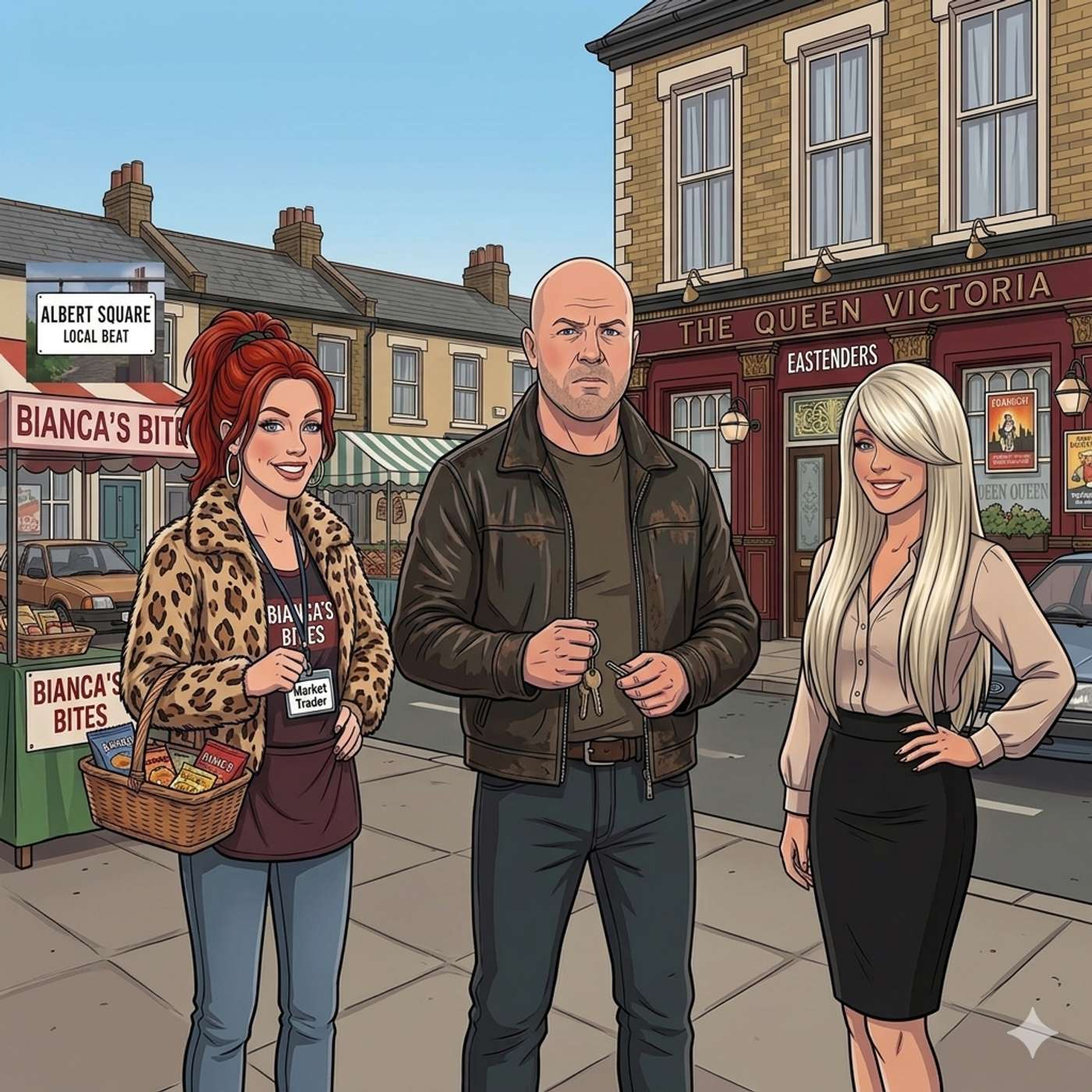
A gripping, heart-stopping, fingernail biting Deep Dive this time on.... Soaps!: from their origins, business models, ridiculous plots and superstar launchpads - Claire has it all. We also look at Disney's super app, comings and goings in the music industry and playground scraps featuring Mr Musk! Podmojis look at "podslop", getting fit with Spotify and who bought the drinks at the Met Gala!
THE MEDIA BEAT — EPISODE 95 Clean Transcript Hosts: Oliver Turnbull, Maureen Kerr, Claire Tavernier --- INTRO OLIVER: Well, hello, everyone — listeners all around the globe. And we are a global podcast by definition, really; that is the digital world. But we do have listeners all over the place, and it's lovely to have you. Hola, bonjour, and so on. It's The Media Beat, episode 95, with Maureen and Claire as ever. Every time a new deep dive is proposed, we tend to go: oh, why didn't we think of that before? We've had so many of them now and yet brilliant ideas keep coming — and here is no exception. It's a Claire one. A subject very close to her heart: soap operas. She's going to explain what they are, what they do, some of the more extraordinary plots she's encountered along the way — to the point that it's really a love letter from Claire to the world of soap. I won't spend any more time talking about it. Claire, please take us through soaps — what they are, what they do, how they affect us. --- DEEP DIVE: THE HISTORY AND LEGACY OF SOAP OPERAS CLAIRE: Yes — it is a love letter. An ode to soaps. And to everything they've done to the way we tell stories now. I think they need a bit of a love letter, because soaps are very often dismissed as lesser television. Partly that's because they're associated with female audiences and daytime viewing. Partly it's because sometimes they look a bit cheap — let's be honest. And partly it's because they're so volume-heavy that people assume they can't possibly be proper culture. And yet, even if you're not a soap person, you're still being shaped by soap. If you're watching Grey's Anatomy, The Secret Lives of Mormon Wives, The Traitors, Love Island, or even Line of Duty — all those shows borrow, in different ways, from soap storytelling. And many of our favourite actors were trained on soaps. Idris Elba started in Family Affairs on Channel 5. Margot Robbie and Guy Pearce started in Neighbours. Julianne Moore started in As the World Turns. Demi Moore started in General Hospital. Chris Hemsworth started in Home and Away. And Leonardo DiCaprio played a young Mason Capwell in Santa Barbara, which some of our older listeners might remember. So let's go back to the history. Soap operas — technically called long-running serial dramas — began on radio in the 1930s in the US. They were serialised domestic dramas for daytime audiences, sponsored by consumer brands. The big early backers were soap manufacturers like Procter & Gamble — which is, I'm sorry Oliver, where the term "soap opera" actually comes from. Not soapboxes in Hyde Park. OLIVER: I remember now. Yes. CLAIRE: By the time television arrived, the format was already basically formed. Soap scholars define the genre by four things: open-ended narrative, multiple concurrent storylines, recurring characters, and cliffhangers. And what that means in practice is very simple — the story never ends. The earliest television soap was As the World Turns in 1956. Then General Hospital in 1963. Coronation Street started in 1960, actually — before that. Days of Our Lives, 1965. EastEnders and Neighbours both in 1985, and so on. Some soaps became formats. Possibly the most widely distributed was Sons and Daughters, originally an Australian format from Fremantle — the story of twins separated at birth who meet again at twenty and fall in love. That format was adapted in Germany, Sweden, Greece, Italy, Croatia, Bulgaria, and Indonesia. The reason so many soaps were launched, and so many adapted, is that if you were launching a new TV channel — and people did launch new TV channels back in those days — you would ask yourself: do I need a soap? And the answer was almost always yes. It was the central structure of daytime and early evening programming. It was the thing that gave a channel a personality. Yes, they had evil twins, implausible amnesia storylines, characters coming back from the dead, and plots that completely ignored physics and occasionally basic human psychology. But they are also possibly the best example we have of continuous, emotionally coherent world-building at scale — always-on content, and crucially, a world that keeps going whether you're watching or not. You can drop in almost at any point and still feel like you belong. Characters have moved on, things have happened, but it still feels deeply familiar. And because of this familiarity, this habitual quality, soaps have had a massive social impact. In 1973, Erica Kane on All My Children had a legal abortion on television in the US — one month after Roe v. Wade. In the 80s and 90s, General Hospital, All My Children, and The Young and the Restless were already exploring stories of abuse, manipulation, and controlling relationships — what we now call coercive control. HIV was something nobody in mainstream television would touch — but Mark Fowler in EastEnders did it. Gay relationships were brought into living rooms long before anyone else would do it. Coronation Street introduced the first trans character in a British soap with Hayley Cropper in 1998. How early was that? MAUREEN: Remarkable. CLAIRE: And this is what soaps did. They brought things into the living room in a way that made people think: oh, well, maybe it's not such a big deal if it's on Coronation Street. They made things feel normal. And a lot of what feels normal now, soaps got there first. That's not trivial — that is mass culture doing actual work. The other fascinating dimension is production. A typical long-running serial drama produces around 200 to 250 half-hour episodes a year, with 15 to 25 core characters plus recurring and legacy cast. Each episode typically carries three storylines — A, B, and C — so if you don't like one, another's just around the corner. Storylines are mapped months ahead in a writers' room. If a character needs to exit, the process takes six months from first discussion to the character leaving. And in production terms, you have multiple filming units, permanent and temporary sets, an extraordinarily tightly controlled schedule. It's built for volume. It's an engine. It's possibly the most efficient production machine ever made. When I was at Fremantle overseeing soaps, in Germany we had six daily dramas running in parallel. One of the key decisions in one of those years was switching all the lighting across all six soaps to LED — and that saved a significant portion of the budget. These aren't high-art decisions, but they are very important. We also did cost benchmarking against Neighbours in Australia, because essentially a soap is a soap is a soap; the economics are similar everywhere. And here's a little dirty secret of television: after the first couple of years, once you've amortised your initial costs, soaps make a lot of money. A half-hour episode in Western Europe costs roughly £100,000 to £150,000 to produce. In Eastern or Southern Europe, it can come down to €30,000 to €50,000. Compare that with high-end drama — anywhere between one and thirty million an hour — and you see the difference. For a TV channel, that machine is invaluable. But soaps today feel like something of a legacy format. Audiences have declined significantly. Coronation Street and EastEnders in the UK used to attract 12 to 16 million viewers — up to 30 million for a big event episode. Now we're talking three to five million, much of it on catch-up. The same is true in the US, where daytime soaps have lost more than half their audience since the late 1990s. Soaps were absolutely built for a world of fixed schedules. There's actually a great phenomenon called the TV Pickup — the National Grid tracks the end of soap episodes, because the surge in kettle use is so predictable. The whole country briefly united by a cliffhanger and a cup of tea. With streaming, we lose that schedule. We lose the shared rhythm that made soaps so culturally dominant. They haven't disappeared, though. They've evolved. Days of Our Lives successfully moved from NBC to Peacock in 2022. And even the shows still on television are finding second lives in streaming — the Cat Slater storyline from EastEnders has been very big on YouTube, for instance. Before I get to the extraordinary plotlines — and I did promise those — I want to leave you with this. Soaps helped establish the storytelling grammar we live with now. The cliffhanger. The easy re-entry after you've been away. The endless open narrative. Even the sense that the story keeps going whether you're there or not. That's soap logic, and you can find it everywhere in streaming, reality television, shows like The Traitors — all borrowing from it in different ways. Right. The Hall of Fame of completely unhinged storylines. Dirty Den in EastEnders: thrown into a canal in 1989, reappearing in 2003 as if nothing had happened. Iconic. Days of Our Lives had an entire storyline where a serial killer was killing everyone in the town — some of them with poisoned doughnuts — but it was later revealed they weren't dead at all; they'd been abducted and were living on a tropical island. General Hospital in the 90s had an alien abduction storyline. Neighbours was famous for its amnesia arcs, including Susan Kennedy, who lost her memory and thought she was sixteen again — and Harold Bishop, who disappeared for five years and came back thinking his name was Ted. But my absolute favourite is from a Finnish soap called Salatut Elämät, which we produced at Fremantle. It featured one of many evil twin storylines. The twins were called Aaro and Eero — Finnish names. I can't remember which one was the bad one. But the evil twin was pretending to be the good twin, and was kissing the good twin's wife. And in a moment of passion, she grabbed his ponytail — and it was a fake ponytail. It came off. You can look it up on YouTube. It is extraordinary. So yes — it's absurd, it's repetitive, it's emotionally excessive. But you try producing 250 episodes a year for 50 years without running out of storylines. This is my love letter to soaps. To everyone who's ever worked on one — and I know some of you are listening — we love you. You're brilliant. Thank you. MAUREEN: That is absolutely incredible. Your love letter to soaps. And I think the clever thing — as you said right at the top — is that it's not just a format. It's the rhythm. Soaps always gave you a reason to check back in again, and it doesn't matter if you've missed a hundred episodes; you go back and you feel comfortable. That's spectacular writing. And it feels really relevant now, because so many media businesses are trying to recreate that sense of habit and continuity — through reality shows, creator-led content, vertical drama, live sport franchises. The soap playbook has fuelled so much of what we see today, without anyone ever really calling it out. I loved it. CLAIRE: A note on George Clooney — I did mention he started on ER, which has soapy elements, but ER is really a long-running drama rather than a soap proper. And actually, before ER, Clooney was in a CBS sitcom, a semi-regular on Roseanne, and also appeared in The Golden Girls. So more sitcoms than soaps, it seems. OLIVER: Which means we should absolutely do a sitcoms deep dive one day. CLAIRE: I love sitcoms almost as much as I love soaps. Let's put it on the list. OLIVER: What a great summary. Some extraordinary plots. I love the ponytail one particularly. Right — we move on at the pace of a Coronation Street plotline to In the News. --- NEWS ROUNDUP OLIVER: Maureen, you have the Disney story. They've announced something being called a super app. Tell us all about it. MAUREEN: Disney is moving forward with what they're calling a super app — bringing Disney+, Hulu, and ESPN together into one unified experience. Now, it looks like a bundle and sounds like a bundle, but I think Disney is trying to do something quite different. They're trying to build a true media environment — not just a catalogue you dip into, but a space that feels like your default home for entertainment. That's really important in streaming because the big platforms have, over time, trained audiences to be very transactional: subscribe, binge, cancel, move on, subscribe again. Disney is pushing hard against that by putting scripted entertainment, general entertainment, live sport, and potentially commerce all inside the same interface. Personalization, advertising, and that direct deep relationship with the customer layered on top. The prize, as with soaps, is continuity and habit — enough reasons to keep coming back and stay within the Disney ecosystem. CLAIRE: They want to include Disneyland Resort, Disney Cruise, all their other apps — everything in one place. That allows them to track habits and nudge people towards commerce and experiences. And remember, the new CEO comes from an experiences background — he really believes their differentiator is the entire wheel of value: streaming, commerce, travel, cruises, theme parks. It becomes a closed ecosystem. The upside is convenience and cross-selling, particularly for superfans. The downside is complexity. Streaming apps have spent years moving away from complexity, and this adds a lot of it back. Disney also has a somewhat checkered history with app integrations. At the moment, I think this is more of an idea they're floating to gauge reaction. If they do launch it, it would almost certainly start in the US, where all the infrastructure exists. But strategically — what's our differentiator, what do we have that nobody else has, and how do we build on it? That's a very sound question to be asking. OLIVER: No cynicism from the Media Beat on this one. It looks like something real. --- MUSIC NEWS OLIVER: A couple of music stories. Over to you, Claire. CLAIRE: Two stories to combine here. First, Universal Music Group. You'll remember we discussed Bill Ackman's takeover bid from Pershing Square, with the central argument being that the stock is massively undervalued. UMG hasn't formally responded to the bid, but they are actively repositioning — specifically addressing some of what the bid pointed to. They are selling 50% of their equity stake in Spotify — not all of it, as Ackman had suggested, but half. That will bring in $1.4 billion, which they intend to use to fund an expanded share buyback programme. And some of those proceeds will be shared directly with artists, which is clearly designed to keep them on board. There's a shareholder meeting coming up, so we'll see whether they say anything more definitive about Ackman's proposal then. But they are not standing still. The second story: Bertelsmann has announced it's merging its BMG music subsidiary with Concord. Concord is a Nashville-based company with a rather remarkable catalogue — they own the rights to Rodgers and Hammerstein and Andrew Lloyd Webber, hold the scripts for thousands of plays, and are also significant in country music. Together, they're still considerably smaller than Warner — projected revenues of $2.2 billion against Warner's $6.7 billion and Universal's over $12 billion. But their market identity is the super-independent: high efficiency, much higher margins — they're targeting 33% EBITDA margins, about 10 points above the big labels — very lean, very rights-focused, and a more artist-friendly service model. They're trying to build a new kind of music publishing business, and they're relocating headquarters to Nashville. MAUREEN: The contrast between the two stories is really striking. On one side, UMG is taking money out of Spotify — which reads either as a response to shareholder pressure to show management is doing something, or as a fairly sensible move given that Spotify is now a mature asset. Share buybacks are slightly controversial — the question is always whether there isn't something better you could do with the money. But if you're getting cash in from a mature asset, fair enough. What's more interesting to me is the contrast with Bertelsmann going deeper into rights. Rights, catalogue, and the ability to exploit underlying IP in multiple ways — remixes, sampling, synchronisation — that's where the durable value in music sits. Distribution and platforms change; if you own the catalogue, you own something that can be monetised in many different ways. Not unlike Disney's wheel of value, actually. The strategic intentions of the two companies could not be more different, and I think that's a very clear sign of an industry in flux. --- MUSK v. ALTMAN OLIVER: And Maureen, Sam Altman and Elon Musk are at it again. The trial. Tell us more. MAUREEN: So there is a trial underway — a few weeks in now. Elon Musk is claiming that OpenAI abandoned its original non-profit mission and became a commercial business to serve Sam Altman, Microsoft, and other investors. The coverage has, understandably, focused mostly on the drama — the personal texts that have surfaced, the interpersonal tension. It is, as Claire noted, basically a soap opera. But what I think isn't being discussed enough is: what actually happens if Musk wins? The damages being sought are around $134 billion — a lot of money. But the real nuclear option is that he wants to force OpenAI back to its original non-profit structure. And that is a fundamental problem for OpenAI, because their entire financial model depends on being able to raise capital to fund the infrastructure — data centres and everything that underlies the AI stack. They need to be a commercial company and eventually give investors a path to returns. That IPO path is what they're currently working towards. If that's taken off the table, the whole financial infrastructure becomes very fragile. So I don't think this is really about a personality clash between Musk and Altman — though there is certainly that. It's a much bigger governance question: can a not-for-profit entity originally built around benefiting humanity at large be converted into a private commercial enterprise once the technology becomes commercially viable? It's a lose-lose situation, honestly. If Musk wins, OpenAI is severely weakened — which happens to benefit his own AI venture, xAI. If Musk loses, that sends a powerful signal that public-interest AI labs can become commercial giants at any point, regardless of what their founding documents say. And that has implications far beyond this case. CLAIRE: I'll add: this has elements of genuine legal principle buried underneath the interpersonal drama. There are legitimate ways for a charity to become a commercial entity. What Musk is arguing is that the specific way OpenAI did it contravenes their founding documents. That's a serious legal argument. But it is somewhat muddied by the fact that he's also asking for $134 billion in damages for himself, and for Sam Altman to be fired. And let's not forget: Sam Altman was fired from OpenAI in 2023 — for about five days — and navigated his way back. He's played poker before and won. Doesn't mean this is the same game. The prediction markets, incidentally, have Musk losing. That may or may not be an indicator of anything. But it's worth noting. OLIVER: Elon, were you perhaps bullied at school? A watching brief, I think. Let's keep an eye on that one. --- THE PODMOJIS OLIVER: Podmoji time. First: podslop. Claire, you were, I believe, the first person on this show to coin the term. CLAIRE: Podslop: low-quality AI-generated podcasts — nothing at all like this one — which are flooding platforms like Spotify and Apple Podcasts. To give you a sense of the scale: in a nine-day period, 11,000 new podcast feeds launched. 4,000 of those were AI-generated. On a single peak day, 39% of new feeds were AI-generated. We are headed towards being replaced by AI avatars. I have no words. My Podmoji is the Scream. MAUREEN: Mine is a synthetic macaroni — a piece of resin art from Australia that looks uncannily like a giant macaroni. As synthetic as the pod slop itself. OLIVER: I'll allow that. Clever. --- OLIVER: Second: Spotify moving into fitness content. Maureen. MAUREEN: Honestly, I wasn't that excited by this one. It's the super app move — same logic as Disney, essentially. They want to own everything you do with your headphones on. You wake up, do Pilates with Spotify, listen to the news, read a book, go to bed. Keep you inside the ecosystem. It makes sense. My Podmoji is a sleepy face — or possibly a hedgehog. It's slow, it's deliberate, it'll get there eventually. CLAIRE: I'm a bit more enthusiastic, actually. I think it's a very logical brand extension. They know their users — a significant proportion are already using Spotify for running playlists and workout sessions. Owning audio across all the moments when you've got your headphones in is a clear and coherent strategy. Thumbs up from me. I've always had a soft spot for Spotify; I think they're a good company doing sensible things. OLIVER: Fair point. Their interface could be a touch less clunky, but smart strategic move. --- OLIVER: Third and finally: Jeff Bezos sponsors the Met Gala. Claire. CLAIRE: Quite a lot of controversy about this. My take: fundraising is genuinely very hard right now for cultural institutions. The Met Gala is a major fundraiser for the Costume Institute, and they will have made a significant sum from Bezos's sponsorship. The reputational cost is real — cultural authority is one of the key currencies a prestigious institution has, and attaching it to a tech billionaire always sparks debate. But they clearly weighed that up and decided it was worth it. And the event remained a cultural moment: everyone was still talking about the dresses, the red carpet, who was wearing what. That didn't go away because Jeff Bezos was involved. My Podmoji: the flamenco dancer in the red dress. You'll have to picture it, I'm afraid. MAUREEN: I'm with you, Claire. A lovely cultural institution getting funding when funding is hard to come by — I'm glad it happened. And my Podmoji has to be the lobster. Red on red. It's my Met Gala look. CLAIRE: You know, a lobster-shaped dress with your red hair would be genuinely incredible on that red carpet. MAUREEN: I'm available. The phone call can come at any time. OLIVER: And on that note — 2026 points each, a very deserved draw. Surreal podmojis for a surreal episode. --- OUTRO OLIVER: What a great one. The soaps deep dive lived up to all expectations — particularly the Finnish twins and the fake ponytail. Claire, please do put that YouTube link on LinkedIn when you post the newsletter. CLAIRE: I absolutely will. People have to see it. The look on the wife's face when the ponytail comes off is simply a moment. OLIVER: Genius. It only remains for me to say goodbye and thank you to Maureen. MAUREEN: Goodbye, Oliver. Goodbye, Claire. Thank you. OLIVER: And goodbye and thank you, Claire. CLAIRE: Goodbye, Oliver. Goodbye, Maureen. Goodbye, everyone, and thank you. OLIVER: And goodbye to the Media Beat-o-sphere. We are not AI — and damn it, we never will be. Until the next time. Bye-bye. --- END OF EPISODE 95