
The Media Beat · Maureen Kerr and Claire Tavernier
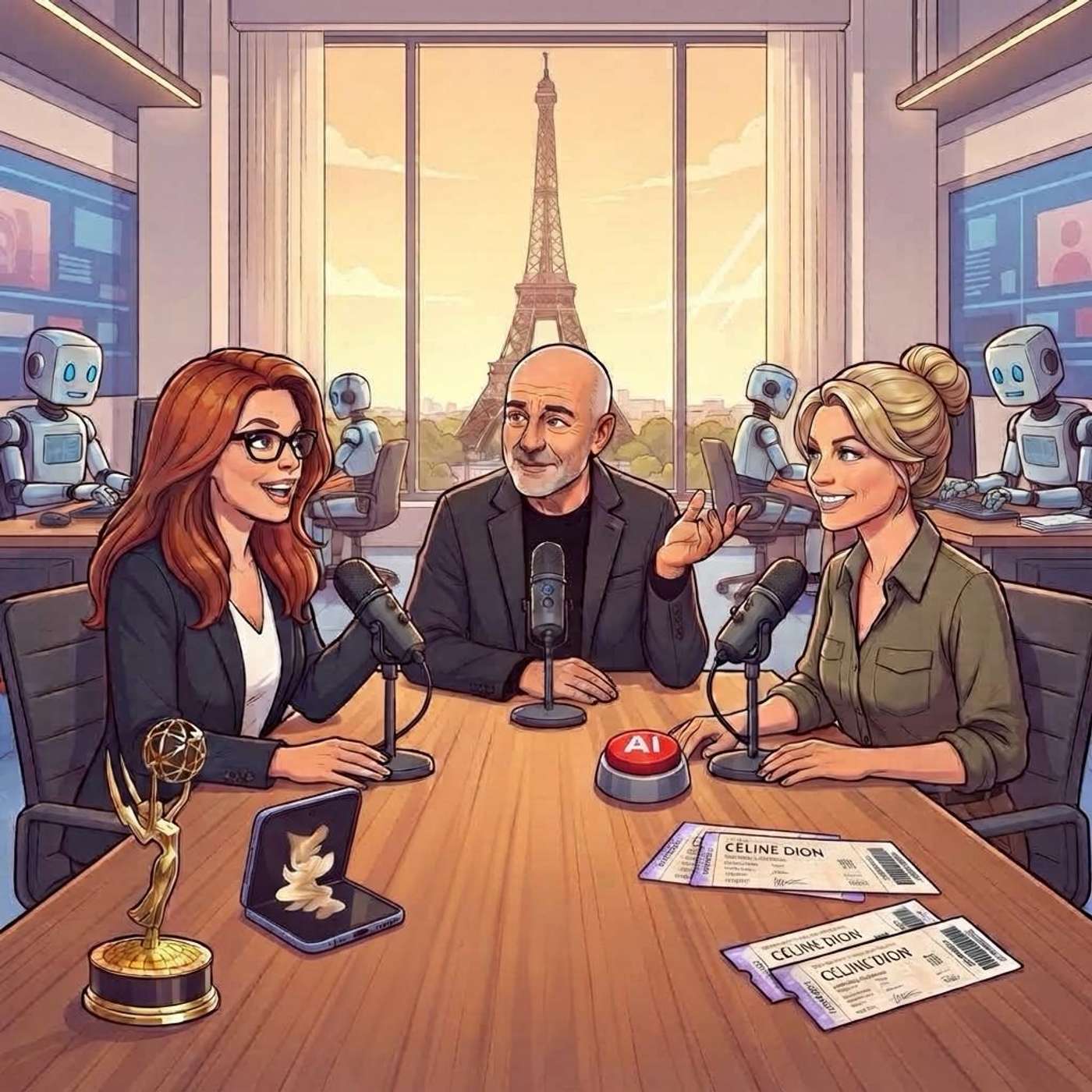
AI now lets companies create real time, current context, ads which is cool! But is it good business? Maureen investigates in the Deep Dive. Amazon, more AI and the gaps between TV seasons make the news and both contestants pull out little men in Podmojis whilst discussing the new foldable iPhone, The Emmy's and the return of Québec's greatest ever singer.
The Media Beat – Episode 103 Hosts: Oliver Turnbull, Maureen Kerr, Claire Tavernier --- OLIVER: Hello, one and all, and welcome to The Media Beat with Maureen and Claire. It's episode 103 and we are pumped. Even though Maureen is a little bit tired today, she looks like a spring chicken and ready to go and start into the deep dive. We're going to be talking about Amazon fraud — question mark. We're going to be talking about an AI pause — question mark. And we're going to be talking about those annoying gaps between series when you're really getting into a piece of drama and there's a massive gap before you can see the next blooming episode. Foldable iPhones will feature, the Emmys will feature, and of course, as usual, friend of the show Céline Dion will feature — as well as, stay tuned, possibly the most exciting thing that anyone has ever done, which Claire is doing in a few days' time. Can you guess what that is? I bet you can't. Anyway, let's crack on. The deep dive — I'm looking forward to it, I always do, but this is going to be great. We're mixing two things up that sometimes don't get talked about together, but should. It's AI and journalism and trust and what is truth and are we in a post-truth world and what can we believe, et cetera, and what our children have to learn to be more discriminating about when it comes to their news sources. So we're talking about AI and journalism in the deep dive today. I believe, Maureen, you've been doing other bits of media on this in Paris. I think you're going to start off and tell us what happened there and what your thoughts are on this crucial subject. Maureen, over to you. DEEP DIVE: AI AND JOURNALISM --- MAUREEN: Yes, and before I talk about Paris, the reason I'm a little on the exhausted side is because I also did a round trip through Amsterdam. I was in Amsterdam and I want to just talk about Amsterdam first, with respect to our content, production and TV folks that listen to us. I'm going to touch on that, but there is a connection between Amsterdam and Paris — and that's not just a very short train journey. So at IBC, I moderated a session at the IBC conference and I was very strict. I gave my panellists one rule, and one rule only. I said: no demos, no roadmaps. I got three organisations and I said I want real, true cases of the application of AI — projects already in production. So these people actually know what they're talking about. Before they started, I put one question to the conference room: listen to these case studies, but think about it in this context — is AI changing the assets, or is AI changing the work? That is, the workflow. Is it changing the products, or is it changing the workflow? So the first case was ITN, accompanied by Reuters Imager. ITN has a 70-year news archive licensed to documentary filmmakers around the world. Tim Forrest of ITN stood up on stage and said: our first attempts to fit AI into the existing in-house system didn't work. To be very frank about it, it just didn't work. So they started again, and they started cheap. They got transcription, translation and scene detection alongside Reuters Imager and they started to work. I put the question to David at Reuters: why did you start this way? He said: if you run expensive models across an entire archive, you spend heavily and learn little. But if you run the cheap pass first, you discover which footage actually deserves the expensive pass. Very practical. The commercial change is simple: a producer used to need to search by date, place, and name to find a speech. Now all they have to do is search the words that were spoken — and the footage that can be found is footage that can be licensed and paid for. The second case — I had the co-founder of Respeecher come up on stage. Respeecher is the Ukrainian synthetic voice company whose work includes The Mandalorian and The Brutalist. We remember the Hungarian voiceover, and Emilia Pérez as well. So Alex Serdiuk, the co-founder, showed us Endurance, a co-production with Nat Geo — a documentary where Shackleton's diaries are read in a voice reconstructed from recordings more than 100 years old. These are real recordings. But what stayed with me was not the engineering aspect — it was the business decision underneath it. Respeecher has never released a consumer voice cloning tool. Permission is the first question on every project. And that's why Respeecher's voice adaptation is now being used by the big studios: the studios let this type of tool in because of that principle. The third case was our old company — Bertelsmann and RTL. Claire and I used to work over in that house. So RTL and Lidl did a piece of work and showcased it. Lidl wanted World Cup advertising but had no rights to the tournament. It wanted every spot connected to that day's offer — which was extraordinary. RTL came up with a solution. Germany, as we all know, went out to Paraguay on penalties, and the final whistle came at around 1 AM German time. So at 2:15 that afternoon, a 30-second spot was on air on RTL — an animated avatar in a fictional news studio, reacting to the defeat and selling Lidl's same-day deals. The person presenting this said: I'm going to walk you through how we did it. It was months and months of preparation. The studio had been shot in advance. The avatars had been built in advance. And three separate workflows were connected by people — people did this. On the day itself, the AI work took about one hour with around three iterations, and the voices were speech-to-speech, not text-to-speech. A colleague still had to perform every line because the read had to land on exactly 30 seconds. So here's my pattern from those three cases: generation was the visible part. The value had to be built much earlier — in the transcription, in the templates, in the permissions and the preparation. Very little of that was visible on the exhibition floor. If I ran that session again, I would ask one important question and dig a little deeper. I did get them to talk about the reasons for these projects, and none of them said this was a cost-saving exercise. All three said nobody in their organisation was replaced. Every individual who participated said this was more about potentially opening up new revenue lines. For ITN and Reuters, that was the clearest case — it made more of their archive discoverable, and if it's discoverable, it can be licensed. For Lidl and RTL, the commercial case is quite different. The person on stage said the immediate value is not necessarily tangible — it's quite intangible, because it was quite innovative. It didn't provoke a backlash either. They're waiting on the consumer results and the conversion of Lidl's products. But the broader opportunity is clear: you can produce timely, contextual advertising quite quickly, and that becomes a new product you can sell in the market. Alex Serdiuk, the co-founder of Respeecher, made a really interesting observation. He said the tools optimise one task that's interchangeable — and prices are clearly heading down — but the whole job involves the organisation and a lot more people. He's seeing that the hyperscalers are definitely producing more tools with more features and more functionality to get these types of innovative products out there. I put the question to a couple of the panellists about what I'm seeing with respect to agentic AI — Grant Thornton has data suggesting around 70% of media and entertainment organisations are now using agentic tools. David from Reuters Imager said he thought about 17% of those organisations were probably overstating it — people are still using tools tool by tool. But anyway: the response was that AI is definitely changing the work. The open question I had was: who really owns the workflow? Very interesting session at IBC. And then I ran to the train station and off to Paris. There I moderated three sessions over two days, organised by Juan Ifrah. The forum was held at the offices of Les Echos — a wonderful building. The question there was a little different, but the common denominator was AI. The question I posed to the audiences was: if AI changes how audiences discover information, how does a publisher get paid when the audience arrives through a machine — like ChatGPT or Google Overviews? Five things stayed with me. Firstly, publishers have stopped assuming they will be the destination. The stats shared were that this year, the probability of a publisher remaining the destination is around 20% — which is extremely low. Second, the licensing arithmetic looks absolutely challenging. We worked through an example: if you open up your content for data grounding, you can charge something like $15 per thousand requests. The platform — say, OpenAI — keeps half of that. A well-placed publisher might appear in only a fraction of the answers, and has to share each one with several other sources. The mathematics comes out to something like $3.75 for every one million queries. I'll leave you with that. And we know that scraping, rather than licensing, is now an industry in itself — worth over a billion dollars. No one's calling it illegal yet, but there are intermediaries out there scraping data, and people are paying for it. Third, archives came up again — but with a different conclusion than at IBC. At IBC, ITN and Reuters were making archive material easier to find and license. In Paris, I could see more convincing products emerging. In particular, Les Echos has put together an AI assistant that it offers to premium subscribers. The commercial team was able to offer this product to professional journalists, commercial individuals, lawyers, accountants and researchers who use the Les Echos premium app for retrieving information over the past five to ten years. Since June, when they launched, they've had 50,000 requests and 25% of their premium subscribers had used it — against a target of 20%. The commercial team were very pleased and it helped justify a premium subscription price increase. My fourth point: people are now building their own products inside news organisations, and it's becoming cheap enough to do so. The harder discipline now is knowing when to stop — because everyone wants to build. Le Parisien built the back office for a World Cup subscriber product with one developer in under two weeks. Hearst publicly mentioned their paywall monitoring tool took only one engineer and a couple of months. But Hearst also spoke about stepping back sometimes — The Economist stopped AI summaries and video translation after testing them. People are testing and then turning it off. My fifth and final point: search may be weakening, but it's still the biggest door opener. The SEO director at The Telegraph cited a 33% fall in Google search referrals to publishers this year. But at the same time, Google was still sending around 1.6 trillion clicks a year to the open web — so it's not actually disappearing, but attribution is getting harder. And before asking what an AI company should pay for your journalism, there's a more basic question: what is it that you have inside your organisation that readers actually want? That was, in turn, the conclusion of the forum. I'm going to hand off to Claire, because that was a long time speaking — and Claire, I know you have loads of observations on those two trips. CLAIRE: They sound very productive and incredibly busy. Fantastic content — really, really interesting. And I'm sure we can watch those somewhere online, Maureen? MAUREEN: Should be able to, yes. I'll get those links — for IBC as well as Paris — though it might take another week. But I will get them and we can add them to the website. CLAIRE: Fantastic. I think you've said it — there's a dual storyline running through this concept of AI and journalism. The first, the positive one, is that AI can handle a lot of the commodity content, but that allows the journalist to focus on the interesting judgement, relationship and analysis work. But there's a counter-argument: AI is accelerating a race to the bottom, especially in terms of accuracy and trust. I wanted to briefly talk about the Reuters Institute Digital News Report, which came out in June 2026. Trust in news globally is at a record low — 37%, the lowest since we started measuring it in 2015. In the US, it's even lower: 25%. Among right-leaning Americans, it's 15%. 42% of people avoid news sometimes or often. And for the first time, social media overtook news websites as the top online source: 54% use social and video platforms for news versus 51% for news websites, and 30% say social media is their main source — up from 22% a few years ago. AI chatbots — the ChatGPTs, the Geminis — are starting to make a real impact: 10% weekly use, up from 7% last year, and 16% among under-35s. But the interesting thing is that trust in AI chatbots is very low: only 20% globally, just 6% in the UK. So people are using AI chatbots and they don't actually believe in them. There's a real dichotomy in the way people are handling news right now — they don't know where to go, they don't know who to trust. That is absolutely the crisis of confidence that journalists and news sources have to fight against. I also want to make a final point on journalism and AI that doesn't get mentioned very often. As chair of the Film and TV Charity, it's something we see a lot: there is an enormous new burden now placed upon journalists and moderators. They are now required to watch very harmful video content to decide whether it's true or not. That's part of their job now, and it never was before. Is this AI-generated? It's a new thing that didn't exist, obviously, and it has a mental health impact on journalists in the newsroom who have to watch these videos with the "is this real or not?" hat on constantly. They also have to develop technical skills they haven't necessarily been trained on — and the quality of AI-generated footage is developing faster than training can keep up. A new, probably unintended, consequence of AI in news is the mental health burden on those journalists still in the newsroom trying to deliver quality journalism. Those were the two points I wanted to add — but there's not much else to add to your masterclass. Very interesting case studies and I look forward to hearing more. MAUREEN: And to add to that — there were some representations from Scandinavia, in particular Polaris Media, a Norwegian group of local newspapers and local broadcasters. You can really see the value there — they might just be reporting that the bus station timetable has changed, or the swimming times, and they are really well trusted. The CEO of Polaris Media told me that because of their innovative use of AI — especially around the World Cup and around these local pieces of information shared across the community — they're attracting young people from colleges back into journalism. Because you've got that combination of relevance and innovation. News organisations are now being seen as a destination for one's career. The common denominator was trust — and innovation. But yes, to be a journalist trawling through that slop is unforgiving. OLIVER: That must be horrible. I like that you're giving a note of optimism, though, in the future of journalism and young people taking it up, despite the 6% trust. I love the fact that we have less trust than the Americans — the cynicism of the British, or maybe even the Europeans, shining through. Thank you, that was great. I like the way the RTL/Lidl case ends with: "anyway, we still need to know whether we actually sell more products" — brilliant. Very innovative. And always good to have a story that mentions Germans losing at football. That was the deep dive this week — AI in journalism, an absolute winner. We have to move on very briskly to In the News. IN THE NEWS --- OLIVER: Here's a very tempting headline. Claire has this story. The teaser: is Amazon defrauding its advertising clients? CLAIRE: On 31 August 2026, the FTC in America filed a federal lawsuit against Amazon, joined by 22 states. The allegation is that Amazon was running a secret ad surcharge scheme. As you may know, Amazon — like Google, like Meta — runs advertising auctions. Brands bid to appear in their search results, in those sponsored placements you see when you're looking for something on Amazon. The allegation is that Amazon secretly adds a surcharge on top of the clearing price. The winning bidder pays what it bid, plus a little extra — an undisclosed margin. The calculation is that this could have been to the scale of about $20 billion across the time it ran. Amazon is obviously the third-largest digital advertising platform in the US, behind Google and Meta. This will go on and on — Amazon will contest it vigorously. We're talking years in the courts before we know anything. But the fact that they've filed means they must be pretty sure they have something solid. If it's successful, Google and Meta must be watching very carefully, because if Amazon's doing it, chances are others have similar practices. It's also going to be interesting to see what large brands do — whether they start auditing more closely. I think what we're seeing is that those digital auction platforms have grown so fast and been so successful that brands haven't been interrogating the numbers very closely, because it kind of worked. That possibly led to some interesting practices. There's also a political context: the FTC in the Trump era is not the FTC of previous eras — open question whether it will push this as far as it might have done before. But a very interesting case that people will follow carefully. What did you think, Maureen? MAUREEN: The headline was a bit clickbait. I would not say that Amazon has defrauded advertisers — this still has to be proved, as you've set out. But I'd also say the more interesting question is going to be: when a platform is also the auctioneer, who audits the auctioneer? I think we have to find a solution to that. OLIVER: Couldn't possibly be defrauding people, surely not. Let's keep an eye on that story. Now, Maureen, you've been whizzing around Europe hosting panels and absorbing what's going on — but you're home now, and hopefully in some comfort. The AI pause: are we heading towards it? MAUREEN: Something has definitely changed in the AI debate. The call to slow down is no longer coming only from people outside the big AI companies. Anthropic — Dario Amodei — has called for pacing the development of frontier models, the models we're all familiar with: GPT, Claude and the like. Sam Altman and other industry leaders have backed stronger brakes and independent evaluation. NVIDIA says companies can basically pace themselves. But almost at the same moment, Anthropic says Claude now collaborates on more than 90% of its AI research and development work. So the company asking for slower progress is also reporting faster progress — put that in context and decide for yourself what it all means. I don't think we're heading towards somebody pressing a big red pause button — competition makes that quite difficult. But I think what we could get is a pause by another name: slower frontier releases, more independent testing, deployment gates, and a bigger gap between "we trained it" and "we released it." The burden of proof is changing. It used to be: why should we not release this? Increasingly, I think the question should be: why should we release it now? I think people are going to keep going — but with a more cautious approach. CLAIRE: It's interesting. We're still talking about around one trillion dollars in global AI investment this year, and nobody is asking for the money to stop. And the people thoughtfully asking for a slowdown are those at the leading edge — essentially saying maybe everybody else should slow down a little bit. I think there's something going on that has to do with consumer backlash, with people feeling more and more uncomfortable with the pace of AI. It reminds me of when genetically modified crops started emerging everywhere — there was a real pushback from consumers saying, even if it's better for crops and everything, we don't want that. We're not there with AI — a lot of people use it and use it increasingly — but there is growing consumer backlash on certain uses. Going back to journalism: some US news channels decided to interview the AI actress Tilly Norwood, and that created a massive negative backlash from the audience. There are pockets of people starting to feel very uncomfortable about it, especially younger generations. I also think it's in these companies' interest to make noise about self-regulation rather than wait for actual regulation. Any perceived movement towards slowing down and thinking about consequences could, as a consequence, reduce global regulation — and we know the EU, the UK, even the US are looking at regulations around this. There is a space for more responsible growth of AI, and it probably requires collaboration between governments, large tech companies and the people financing them. There's no clear route to that moment right now, which is a pity, because that's what we need. So we'll probably see a lot of lip service. Like you, I don't see this leading to much actual slowdown. OLIVER: That makes sense — when there's money to be made, it's hard to slow the machine down. I remember saying that about the internet. Or computers — that's what my dad said when I graduated: "Computers, they're going to be important. Get a job in there, son." And he was right. Super interesting story. Now, the next one is something we mentioned at the top of the show: that irritating gap between series when you're really into something. There must be some reason they do it. Maybe because they've got to make the next season. There's a report that's just come out — the Luminate report. Claire, you've read it, absorbed it, analysed it. What are your thoughts? CLAIRE: The thoughts are very clear in the Luminate report: the increasingly long gaps between series are killing audiences. Wednesday, season two on Netflix — nearly a three-year gap between seasons one and two — lost 60% of its viewership. Rings of Power on Amazon, a two-year gap, lost 57% of its audience. And even Stranger Things, which only lost a quarter of its audience when season five came out, still lost a quarter — and that was after a three-and-a-half-year gap. Remember the campaign they did when that came out, and it still lost about a quarter of its audience. This is interesting because when streaming arrived, it was going to free production from broadcast calendars — no more seasons, we could have all the content we want whenever we wanted. And there's another finding in the Luminate report showing that binge-watching is alive and well, and season drops where you get all the episodes at once are still the favourite way for streamers to deliver content. But as you pointed out, Oliver, you still need to make it. When you drop a whole season in one weekend, you have to wait longer for the next season — that's just the maths. When you're producing as you're showing — which is what happens with weekly releases on TV, like Matlock, the CSIs, the Chicago shows — they're producing episodes as the series goes out. So when they get started on the new season, they can be back within just a few months. We're used to the season ending at the end of May and the new season starting in September. You can do that with weekly releases. You cannot do it when you're dropping a whole season in one go, and you can't do it with shorter seasons either. There's a real decision to be made between the binge-watch season drop — which gets a lot of viewers very quickly through word of mouth — and the longer gap between series that follows. It's also because financing is harder, series are more expensive, you need A-list talent, and A-list talent have complicated diaries. The Luminate report actually uses The Pitt as an example — a quasi-broadcast show, even though it's made for streaming, which has a weekly release structure and sustains visibility. You don't lose as many viewers because the gaps between seasons are shorter. As the streaming industry matures, we're starting to see the issues appearing and going back to thinking: actually, that broadcast model had some good things in it that maybe we've lost along the way. Maureen, what did you think? MAUREEN: You're absolutely right. If you disappear for three years, you haven't retained an audience — you're going to have to pay again to acquire it. And it's borne out in the Emmys, actually. The Pitt is an exception because it drops and manages its audience very well — it appears each year, just under a year's gap, stays relevant, and therefore wins the Emmy Awards again. Whereas the others that missed that cycle left room for new shows to come in and occupy the minds of viewers — like Widow's Bay, which won while others were in their long gaps. You've got that proper TV schedule zeitgeist coming back. CLAIRE: Exactly. The counter-example to that is The Bear, which does season drops rather than weekly drops, and has missed out on Emmys because people forget that they happened. And on another topic — all six episodes of Ludwig have just dropped on iPlayer, I've already watched them all, and now I have to wait a couple of years for the next season. I really feel that pain. OLIVER: Oh, wasn't it so easy in the old days! Everything's so complicated now. What channel is the football on? Have we paid for Apple TV? It's a nightmare. But there are advantages — loads of great stuff to watch, 24/7, in any language. CLAIRE: Definitely. OLIVER: Three hundred channels. That was great, Claire — definitely well worth picking that one apart. And that is the end of In the News. PODMOJIS --- OLIVER: Which means it's time for Podmojis. Let's start with Maureen, because this is potentially sexy tech — and I'm on the fence on this one. The foldable iPhone. MAUREEN: The new foldable iPhone is fascinating to me, probably less as a piece of hardware than as a market signal. Samsung has been folding phones since 2019 — Apple has not invented this category. But Apple, as we know, has a habit of arriving late and making everybody else take a category seriously. The iPhone Duo opens to a 7.6-inch screen, starts at £1,999 and goes on sale next month. So this is not the new mass-market iPhone — it is Apple planting a flag. And the thing I would watch for is not the hinge, it's the apps. If opening the phone gives you a bigger version of the same app, you have spent £2,000 on an expensive hinge. But if developers start designing different experiences around that second form factor, then I think Apple may have done what it often does — arrived late, removed enough friction, and made everybody behave as though the market has just begun. My Podmoji is: intrigue. CLAIRE: I have a rule of never buying first-generation Apple anything, because even though they're... I wouldn't spend that money. I'm not sure how serious they are about the category — it's true they're planting a flag, but they're also looking at it and trying to figure out if it's worth pursuing, as they've done with categories they've ended up not pushing. For me, the main issue is the camera, which isn't as good as on the high-end iPhones. A lot of people use their phone as their main camera, and that would be a barrier for me — the hinge doesn't replace that. So my Podmoji is: wait. OLIVER: Not going to spend two grand on a worse camera. Good. I've learned something today. Now, the next one — I'll start with Claire. One of your specialist subjects: the Emmys. CLAIRE: The Emmys came out on Monday night. The ceremony was widely considered terrible — weirdly paced, they kept trying to shoo winners off stage, and then they ran short at the end and didn't have enough to fill the time. The best article I read said it was terrible TV about truly great shows. The winners, though, were very worthy. The Pitt did very, very well — best drama series, best actor in drama. Best actress in comedy went to Jean Smart for Hacks, though this was the final season. The big one everyone's talking about is Matthew Rhys. For the first time ever in Emmy history, he had a double lead actor win — one for a comedy, Widow's Bay, and also lead actor in a limited series for The Beast in Me. Yay for Wales and yay for Matthew — everybody seems genuinely thrilled for him, and that was the highlight of the night. My Podmoji is: yay. MAUREEN: I can't add much to Claire's fantastic summary. Except that there are rumours now — because the ceremony was such a televisual disaster and most shows are now made for streaming — that the Emmys ceremony may actually move to Amazon Prime Video. We're waiting to hear that confirmed by the Television Academy. Apparently they're in advanced talks. My Podmoji is a little Italian figure — because the Best Actor winner for The Pitt is Italian. OLIVER: Can the Emmys win an Emmy, by the way? Or is that not possible? CLAIRE: They could, actually — but it's a different category. There are two Emmy ceremonies: this one, which is for the main categories, and another one for, let's say, the more technical and daytime categories. That's where the ceremony itself could theoretically win. It's sort of like the technical BAFTAs. The people who probably deserve awards but are slightly less telegenic. OLIVER: It wasn't a stupid question. Excellent. And finally — Céline Dion. Maureen, you're going to explain. MAUREEN: This is important. This is serious. And actually, Paris was relevant because I'd just come back from Paris. Céline Dion was there — and this matters, because she has returned to full-length live performance after six years away from the concert stage. You might think, well, what's the importance of that? It's important because in this day and age, if you're away for six minutes, you're forgotten. She was away from the concert stage for six years — and the relationship with her audience did not disappear. If anything, her return became an event because she had been away. I think we sometimes confuse engagement with attachment. What she has is attachment — people still caring deeply about someone six years later. That's a different kind of value. And she's not just going out and replaying the hits as a catalogue artist: part of the audience is paying to experience the return itself. My Podmoji is a heart. CLAIRE: That's a lovely Podmoji. But I need to give you some stats, because my French family have been slightly obsessed with this. There was a lottery to get tickets. Nine million fans trying to get tickets. Some of my extended family had four computers open at the same time trying to get them. They originally had 16 dates, and had to extend by another 16 because of demand — all at the 30,000-seat La Défense Arena. The excitement in Paris about this is very unique. It shows that some things are still important to see in person — those live, shared experiences retain enormous value. And obviously there's been the documentary about her illness — she has stiff person syndrome — and she sang at the Olympics ceremony in Paris in 2024, which reminded everybody she was there. I remember watching and everyone saying: "When is she coming in? That's what everybody was expecting." OLIVER: Rather like Oasis, Claire. In terms of the live experience. CLAIRE: Like Oasis, but better. MAUREEN: That's the line of the podcast. OLIVER: We love you, Céline. I'm quite glad she's better. How many siblings does Céline Dion have, according to Wikipedia? CLAIRE: 14 kids in the family — so 13 siblings. OLIVER: Correct! And we've adopted her in France? CLAIRE: More than half the songs in her set are French songs. And she is I think she's bigger in France culturally than anywhere else, except probably Quebec. OLIVER: She's French-Canadian, after all. And, very important question, Maureen: do you think Céline Dion is more famous than Johnny Hallyday? CLAIRE: But Johnny Hallyday is dead, so it's harder to get tickets for him. MAUREEN: I appreciate that, yes. CLAIRE: He was touring right up until the end — you never had to wait in line to get tickets because there were always tickets, but he was still enormously popular and would easily have filled that stadium before his death. With Céline, there's the rarity element — so many people trying to get tickets just because there are fewer tickets available. But that level of fame, yes. OLIVER: The popularity of Johnny Hallyday — one of the great mysteries of the 20th century. CLAIRE: I don't know what you're talking about. OLIVER: Sorry. Very rude. OK, we are now out of time. CLOSING --- OLIVER: We've packed and loaded. Claire, have a wonderful time. You are a perfect ambassador to welcome our next King and Queen to the Royal Film Performance. Have fun, and goodbye for now, Claire. CLAIRE: Goodbye — goodbye to all of you. OLIVER: And goodbye Maureen for now. MAUREEN: Likewise — goodbye, everyone. Goodbye to Oliver and Claire. OLIVER: But before we go — Claire, maybe you're too shy to say, but I believe next Tuesday you might be doing something in the evening that might be of some interest to our listeners? CLAIRE: It's going to be very exciting. And there are still a few tickets to be had! Next Tuesday is the Royal Film Performance — the annual premiere that the Film and TV Charity, which I chair, puts on. It's a fundraising event, which is why I'm hawking the tickets. The Prince and Princess of Wales will be there, and I'll be hosting alongside Marcus Ryder, the CEO of the charity. And Tom Cruise will be there too. I've got my dress ready, my lineup notes ready — I hope to have some pictures to share. And I should say, I'm also very excited about the film itself. It's the new film by Alejandro Iñárritu, which I've learned how to pronounce. I think it's going to be pretty amazing. MAUREEN: I've seen some behind-the-scenes footage — it looks wonderful. OLIVER: Good. A great ambassador for the podcast as well. If His Royal Highness is interested in the media, he can always tune into The Media Beat. Goodbye for now, everyone! --- End of Episode 103