
The Lich's Tale: A Faerûn Lorecast · The Lich's Tale
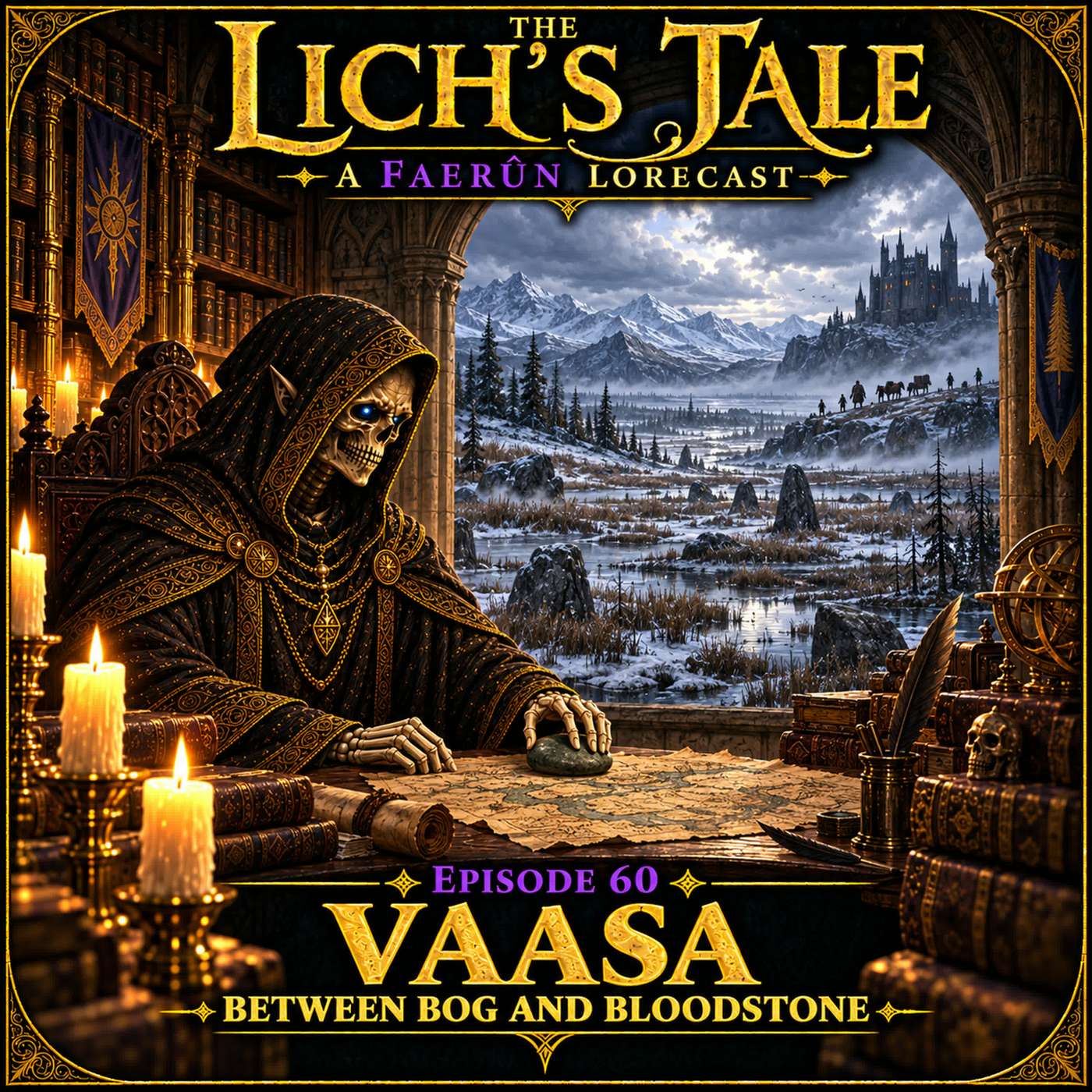
Listener Joe Biggs asked for the cold tundra bogs of his campaign. Erilian takes a water-stained map north: through difficult crossings and workable ground, past the shadow of Castle Perilous, and into the lives of people facing the Warlock Knights' demands. We visit the Bottomless Bogs, Moortown, Palischuk and Fugue, asking how season, trade, power and local knowledge shape a journey. The telling distinguishes the 1359 DR frame of *The Bloodstone Lands* from the 1480 DR Vaasa article in *Dungeon* #177. Imagined households and adventure ideas are identified as original illustrations. Thank you, Joe. Send places, people and mysteries from your own campaigns to [email protected]. Next: Sardior, the Ruby Dragon. Sources and access limits: Sources.md. No claim is made about an unverified later official status. Runtime: 1:33:08. Measured chapter times accompany the local delivery in Chapter-times.txt. The Lich's Tale: A Faerûn Lorecast · taleofthelich.com Supported by Dharma Web Solutions · dharmawebsolutions.com An unofficial fan exploration of the Forgotten Realms. Setting and characters belong to their respective creators and rights holders. Chapters 00:00:00 Joe's map 00:06:03 Between ice and mountains 00:12:21 The thaw 00:18:36 The Bottomless Bogs 00:25:02 Workable ground 00:31:07 Before the Witch-King 00:36:38 Castle Perilous 00:42:11 Bloodstone's aftermath 00:48:27 Another claimant 00:53:48 A ring of ironfell 00:59:53 Under the lord's eye 01:06:07 Towns at the edge 01:13:14 The unruled country 01:20:10 What a campaign can choose 01:26:25 The map after the thaw
The water has reached the mountains. On the map, I mean. Put the basin down, apprentice. We have suffered no continental emergency this evening, merely an incautiously placed cup. The stain has crossed three ranges, drowned an annotation, and improved the appearance of one disputed frontier. I expect a diplomatic complaint before breakfast. Here, a stone will hold the corner flat. Smooth, grey, quite ordinary. I have chosen it for this evening's illustration. Neither stone nor map is a recovered treasure of some lost Vaasan king. The archive possesses enough uncertain objects without my manufacturing a pedigree for the paperweights. Welcome to The Lich's Tale: A Faerûn Lorecast. I am Erilian Kantonine, baelnorn and lorewarden beneath Waterdeep. Tonight a listener has brought us a place, and with it a rather better beginning than a list of rulers. Joe Biggs wrote that he would love to hear about the land of his campaign: the cold, tundra bogs of Vaasa. Thank you, Joe. We shall go north. And we shall take the bogs seriously. It would be easy to hurry past them. Vaasa offers a Witch-King, Castle Perilous, Warlock Knights, an uncanny source of power beneath a capital, and enough dangerous names to keep a herald occupied until the fire goes out. A telling might leap from one impressive person to another and leave the land between them as an indistinct grey patch. Then a traveler tries to cross that patch, loses a boot, and discovers the defect in the history. The ground matters. The season matters. The difference between a dark pool and a surface that only appears to be solid can matter more immediately than the difference between two claims to sovereignty. A ruler may order a caravan to arrive. The caravan must still find somewhere to put its wheels. We are visiting Vaasa in Faerûn, the northern land associated with Damara and the Bloodstone region. Nova Vaasa, despite the familiar name, belongs to another setting and another shelf. The apprentice has brought down the correct volume. This is an encouraging development. Our journey will move between two dated views. The first is the thirteen-fifty-nine account in The Bloodstone Lands, written by R. A. Salvatore. It assumes the aftermath of the Bloodstone adventures and the defeat of Zhengyi. The second is the fourteen-eighty account in Brian R. James's Realmslore treatment of Vaasa, published in Dungeon. There are more than a hundred years between those views. We will turn the calendar when we cross that distance. I shall not pretend that the later description is a report from the present day of every campaign. A table may live in an earlier year, a later year, or a history altered by its own adventures. Tonight's dates are the dates of the records we can actually examine. Joe has invited us to understand a country, not to tell his companions that their last six months of decisions failed to obtain a librarian's approval. Our question is simple enough to carry in a pocket. How does one make a life in a place where winter can close a route, thaw can undo the ground beneath it, and a lord can mistake possession of a map for possession of the people living there? There will be particular places: the Bottomless Bogs, the Galena Mountains, Bloodstone Pass, Moortown, Palischuk, and the unhappy border settlement called Fugue. There will be particular kinds of power. A threat from a distant fortress feels different from an order delivered to one's own workroom. And there will be people whose lives begin before either threat arrives and continue, if they are fortunate, after it has passed. For those ordinary choices I will sometimes ask you to imagine a household or a journey. Those scenes are ours, made here at the table. They are ways of thinking through the landscape, never secret quotations from a sourcebook or claims about what happened in Joe's campaign. When a named institution comes from the published setting, I shall give it its proper place. When we invent a traveler, we will leave room for the traveler to belong to your table. The stain on our map has now stopped spreading. It has found the edge of the parchment, a limitation seldom encountered by ambitious kings. Let us begin with the shape of the country, before anyone attempts to rule it. Find the Bloodstone Lands first. Put the Great Glacier above them and Impiltur to their south. Vaasa and Damara are the two names around which this regional story gathers. Beyond the western mountains lie other countries and other roads; eastward the wider map leads toward Narfell and the Great Dale. This is the northeastern country of our telling, far from Waterdeep's harbor and its reassuring conviction that all interesting business eventually visits the coast. The older account places Vaasa within a rough triangle bounded by the Great Glacier, the Earthspurs, and the Galenas. Damara is its essential neighbor, and Bloodstone Pass makes the mountain boundary a political question as well as a geographical one. The later account gives us a landscape shaped by the retreat of ice. These are dated views of a changing region. They should not be pressed onto one another until every line looks identical. Do not imagine the mountains as a decorative border on a piece of heraldry. A mountain range interrupts movement. It concentrates passage where passage is possible, stretches a short distance on the map into a long day on the ground, and can place two nearby communities on very different routes to a market. A person who controls a useful passage acquires influence over journeys they never make themselves. That is one reason Bloodstone Pass belongs near the beginning of the story. The connection between Vaasa and Damara helps explain why the two lands repeatedly appear in the same histories. Armies, merchants, refugees, and messengers each encounter that connection differently. A fortification built to obstruct an enemy can also obstruct a family trying to escape its own ruler. We shall return to the difference. First, look northward. Ice is both a boundary and an influence. Cold air does not stop at the line a cartographer has chosen for the glacier. In the old regional description, winds descending from the ice and winding through the heights lengthen already severe winters. Summer offers little time in which to put matters right. The conditions distinguish Vaasa from more hospitable Damaran land without making Damara a soft southern garden. It is tempting to divide countries into comfortable and uncomfortable ones. Most people require finer distinctions. A sheltered patch with workable soil can be valuable in an otherwise harsh district. A place with a dependable approach may be preferable to a richer place whose approach regularly becomes impassable. A settlement's position on a slope can mean that runoff passes beneath it or through its doorway. None of these decisions requires a continent-wide catastrophe. They require someone to observe the last difficult season and remember it. Imagine, for the moment, that you must choose where to establish a small storehouse. This is our own practical exercise, not a recovered Vaasan building ordinance. You have timber enough for one structure, a few helpers, and supplies that will spoil if kept wet. The point nearest your destination is not necessarily the best point. You need ground that will bear the building, a route for bringing the materials, and some prospect of reaching the door after the weather changes. Now add the fear of theft. Now add a lord who expects his due. Now add a neighboring community whose assistance may determine whether the roof is raised before the next storm. Geography has become social before you have laid the first beam. That is how I would like us to read the map. The blank spaces conceal choices. A thin line joining two towns tells us that a connection exists in the cartographer's account; it does not tell us that the connection is equally useful in every month, for every load, or to every traveler. A person on foot can sometimes choose a way that a loaded wagon cannot. A party carrying an injured companion faces a different country from the party that arrived boasting of its speed. The mountains also contain wealth. That is the other half of the apparent contradiction. If Vaasa is difficult, why remain? Why return? Why would merchants risk goods there or rulers spend effort claiming it? Part of the answer lies beneath the stone rather than above it. We will examine the mines shortly. For now, keep the two conditions together: movement is difficult, and some things are worth moving. Those conditions make guides valuable, routes contentious, and local knowledge a form of power. They also make errors expensive. A visitor who thinks a northern map is merely a southern map with more white on it is likely to acquire an education with remarkable speed. Our first lesson arrives when the white begins to disappear. The thaw looks like a reprieve to someone who has spent a winter longing for warmth. That person has my sympathy. It may still be a poor moment to move a heavy cart. The Vaasan descriptions insist on a seasonal transformation: frozen ground gives way to saturated moor, and the brief summer can make crossing the country harder in ways that a visitor does not expect. Cold is plainly dangerous. Mud is less theatrical. It can be equally effective at stopping an expedition. We should avoid turning that observation into the absurd claim that winter travel is safe. Winter brings its own exposure, snow, poor visibility, uncertain ice, and demands on shelter. The useful comparison is between different obstacles. A route one can negotiate under one set of conditions may fail under another. A local guide has learned to ask about the ground as it is now, not merely to remember where the road was last season. Consider an invented journey. Three households have combined their goods for a trip to market. They are not a documented Vaasan caravan, and I will give them no false date. They carry a modest load, too valuable to abandon without consequence, too small to hire a private army. One traveler knows the outward route. Another knows how to repair the cart. A third is keeping count of the food. Already their survival depends on more than the person with the longest sword. They find standing water across the way they intended to use. The ground beyond it looks firmer. There is no dragon above it, no ghost pointing toward it, no inscription forbidding passage. A companion walks ahead to test the approach. The others wait. There is adventure in that wait if the journey has consequences. Each hour uses food. Each detour changes the chance of reaching shelter. Returning means facing the people who needed the proceeds. Continuing means placing everyone's goods behind a judgment that cannot be made from the seat of the cart. Courage helps a person make a difficult decision. It does not make the decision correct. For a campaign, such a scene need not become an afternoon of arithmetic. One concrete choice can communicate more than a list of penalties. Does the party divide the load? Pay for a guide? Wait for someone to return with better information? Leave a guarded cache and go ahead for help? These are choices about trust and obligation as well as travel. Their consequences belong to the table that makes them. The same seasonal pressures reach into a household. An imagined family preparing for a difficult period must decide what to keep dry, what to repair while materials are available, and how much it can afford to trade away. If a journey takes longer than expected, an apparently small loss of time can become a shortage at home. The person waiting there has not been idle. They have been planning around an arrival that the land has delayed. This matters when we later speak of taxation, service, and military demands. A command imposed without regard for the season does not become reasonable because it has a seal. If a worker is removed during a narrow period of necessary work, the household loses more than that worker's hours. It may lose the opportunity to do the work at all. An authoritarian regime can use that vulnerability. A competent ruler ought to understand it. Those are my judgments about the conditions, not a transcript of a Vaasan council meeting. And a community can answer the same vulnerability through cooperation. Someone remembers which approach failed. Someone notices that a neighbor's store has become wet. Someone lends an animal, shares a load, or agrees to take a message. We should not sentimentalize such arrangements into universal kindness. People can bargain hard when resources are limited. But neither should a bleak landscape persuade us that all who inhabit it have forgotten how to help one another. Joe asked for tundra bogs, and here is one reason those words are such a strong invitation. They describe a place whose condition changes the terms of ordinary action. The ground does not merely slow the heroes until they reach the interesting room. It changes which promises can be kept, which expertise is respected, and which risks a household can bear. On our table, the damp parchment has curled upward at one corner. The apprentice has attempted to flatten it by placing a second book on top. A practical measure, though the book is a treatise on levitation, and the irony is becoming difficult to ignore. Beyond these general wet moors is a named region whose reputation has made the cartographer particularly generous with warning marks. The Bottomless Bogs. The Bottomless Bogs occupy the northwestern part of the later Vaasan account. We are not looking at a single puddle large enough to deserve a dramatic name. This is wetland country, with lakes, difficult ground, and pits whose danger has become part of the region's reputation. The older overview also describes hazardous bogs elsewhere in Vaasa. A named region does not contain every example of the thing for which it is named. That distinction matters to the traveler who announces that a route will be safe because it avoids the words printed in large letters. The wet ground has not read the label. The account leaves room for competent passage under suitable conditions. A veteran guide can make a difference. It also singles out the summer as particularly treacherous. We should hold both points. If the bogs are always absolutely impassable, nobody can know them; if they are merely inconvenient, their character disappears. A country can be crossed without being forgiving. The word bottomless does its work in the imagination. It need not persuade us that every dark opening descends into an infinite metaphysical void. A depth you cannot escape is sufficiently deep for the person who falls into it. In a campaign, the exact cause of a particular hazard belongs to that place and that adventure. It might be ordinary treacherous ground, something altered by magic, or an opening into a story the party has yet to understand. The regional name alone settles none of those possibilities. There is also a rumor of enchanted hot springs. A rumor, apprentice. Leave the blue pencil capped. We have not verified their location, properties, or even the truth of the report. The source offers a reason people might venture into the bogs, and a warning that such ventures have gone badly. It does not hand us a reliable spa directory. What a tempting rumor it is, though. In a cold land, warmth has a force that a distant listener may underestimate. Add the possibility of enchantment and the same rumor can mean relief to one person, profit to another, a discovery to a third. We may examine those motives without deciding that the rumored springs exist. Imagine a party hired to investigate the report. Their employer wants a map. Their guide wants them to survive long enough to pay the balance. One companion has a relative who hopes the water might help an old injury, although no one has established that it heals anything. Another sees the chance to found a profitable stopping place. Every person is walking toward the same uncertainty with a different reward in mind. A useful story could turn on the report's origin. Was the supposed witness actually there? Did they see warm water, hear about it, or repeat a boast from a drinking companion? Does the route describe a winter approach that has become useless in the thaw? Has a landmark shifted in someone's memory? These questions create investigation before anyone adds a hidden villain. And if the party finds something, the next decision may be harder. A fragile refuge can be ruined by too many arrivals. A discovery kept secret can exclude people who need it. A claim staked by an outsider can ignore those who already know the place. These are proposed consequences for a campaign, not additional facts smuggled into the published account. They follow from taking an expedition seriously enough to ask what happens after the treasure has been counted. There is another way to bring the bogs to life. Let a guide have a competence that the adventurers lack. A quiet refusal to take a shortcut can carry more authority than a speech about danger. Let the guide explain the one sign that changes the decision. Let a character's patience help. And let mistakes alter the journey in specific ways: a damaged container, an abandoned load, a detour that puts the party somewhere unexpected. Endless identical mishaps make a landscape tedious. A changing set of choices makes it memorable. Beauty belongs here as well. The later Vaasa description recognizes it amid the harshness. We may imagine light on still water, dark stones rising from a pale surface, distances that seem to open when a cloud moves. These are invitations to picture the country, not descriptions of a precisely documented dawn. A place does not have to be comfortable to be loved. That may be something Joe and his companions already understand. A campaign's home is often the place where the map stops being abstract. They know a crossing because someone nearly lost a pack there. They remember an inn because a companion returned to it. They associate a stretch of dark water with a decision that did not look important until afterward. The bog becomes a country through such knowledge. Now let us see what brings people back to its edges, even when they have every reason to remember the mud. Bloodstone is a mineral name before it is a promise of violence. The old regional overview describes green stone marked with red. Wealth from the Bloodstone Lands traveled outward, and goods, attention, and political interest traveled back toward it. The mountains were difficult to cross, but they contained reasons to make the attempt. It is a useful correction to the phrase poor country. A land can contain valuable resources while many of its people remain poor. The treasure beneath a mountain and the food available in a worker's home are connected by a chain of ownership, labor, transport, and exchange. One cannot infer the second merely by admiring the first. In the thirteen-fifty-nine view, Vaasa has scattered places where farming is possible, yet little contiguous arable land on the scale that would easily support a large community. In the fourteen-eighty account, workable ground and mines help explain the importance of the east. These descriptions give settlement a material basis. People need more than the promise of a fortune. They need ways to continue living while they pursue it. Let us build an imagined mining household with no claim that it is a published Vaasan family. One adult works below ground. Another tends the tasks that keep their lodging and supplies usable. A younger relative helps carry and sort. The household's earnings depend on output, but its ability to work depends on tools, health, food, and the route by which necessities arrive. A delay outside the mine can be felt inside it. A damaged tool can interrupt the income on which the next tool depends. Now suppose the household receives its due fairly. There are still risks, but it can plan. Suppose instead that someone with authority can change the demand after the work is done. Planning becomes harder. Savings become something to conceal. A successful season may attract attention as readily as it provides security. When we reach the Fellthanes, this distinction will cease to be theoretical. The transport problem also gives commerce a particular shape. A load must be worth the effort and risk of moving it. Guarding it has a cost. Waiting has a cost. Traveling with others can make sense even when their pace is slower. A merchant who complains about paying a guide may discover that the alternative is paying someone to recover half a wagon from a place the guide advised against entering. Such arithmetic should not turn every Vaasan into a calculating machine. People remain because their families are there, because they know the work, because departure is difficult, because they have obligations, because they have found a measure of belonging. Profit is one motive. It is seldom an adequate biography. Nor does remoteness mean isolation from larger events. A route serving a market beyond Vaasa can make a distant demand matter locally. If buyers want more, a lord may want more production. If a route becomes unsafe, the same lord may still demand the old return. The worker experiences the consequences without ever meeting the people whose decisions helped produce them. That is a reasonable way to think about a resource economy; we need not invent a specific price crisis and enter it into the Realms' calendar. What does a town contribute to that chain? A place to exchange goods, find assistance, gather news, hire expertise, and discover whether the person who owes you money has left by the other road. Different settlements can perform different parts of the work. We will meet a trading center, a bog-edge settlement, and a border camp. They are all inhabited places, but it would be a mistake to treat them as interchangeable points where travelers replenish supplies. There is also the work that the grand economic account rarely counts. Repairing a strap. Keeping a document dry. Watching a neighbor's child. Carrying a message to someone who cannot leave their task. Such work does not become canon merely because I mention it; it belongs to the ordinary implications of imagining people living in a place. It prevents us from reducing an entire society to the ore that outsiders want from it. At the archive table, the river stone looks disappointingly unprofitable. The apprentice has asked whether it might nevertheless be a bloodstone concealed by dirt. It is a river stone concealed by wishful thinking. A widespread mineral, that second one. The wealth of the region helps explain why a conqueror would want its routes and labor. Before the conqueror arrives, however, we should give the earlier inhabitants their own place in the telling. The old account describes Vaasan hunters, trappers, and farmers living in scattered communities before the Witch-King made the country a major concern for its neighbors. That is a small amount of description carrying a large implication. People were there before the story acquired a famous villain. The language of older travel and setting accounts can be dismissive. A place may be called unclaimed or uninteresting because a distant observer sees no court worth visiting, no ruler whose marriage alters the regional balance, no market large enough to justify a lengthy entry. The people who live there possess a different measure of importance. An unclaimed country can contain homes. A wilderness can contain well-known routes. A settlement omitted from a grand political account can still have disputes, obligations, knowledge, and memories. We should not invent a comprehensive lost constitution to compensate for thin evidence. We can simply refrain from mistaking the evidence's brevity for the inhabitants' absence. Imagine a traveler arriving at one of those small communities with a map and a confident expression. The traveler asks who rules the surrounding ground. A resident asks where the traveler intends to go. They appear to be discussing different subjects, but the resident's question may be the more immediately useful one. If the visitor wants a place to stay, someone must decide whether to offer it. If they want a guide, someone must know the way and be willing to leave other work. If they want to claim land, the people using it may have an opinion that does not appear in the visitor's papers. Our invented encounter gives no particular Vaasan group a law the sources have not supplied. It reminds us that authority exists in practical relationships as well as in titles. The relationship with Damara sharpened the contrast in the old overview. Damara had a more visible political history, trade, and noble institutions. Vaasa appeared to outsiders as scattered and difficult. That difference could encourage a dangerous assumption: that a country without a familiar central authority could not become the base of a coordinated threat. A dispersed population is not the same thing as a military impossibility. It does mean that someone who wishes to command across the country must solve problems of distance, supply, loyalty, and communication. A ruler can attempt persuasion, alliance, coercion, supernatural force, or some combination. The methods matter because they determine what kind of political structure is being built. When Zhengyi enters the story, we should ask those questions rather than allowing the title Witch-King to answer all of them. A powerful individual can frighten people. To project force beyond a stronghold, that individual needs others to act. To sustain the threat, the actions must recur. The story of a conquest is therefore also a story of how scattered capacities become organized under a common purpose. We must take care with the older texts' treatment of peoples. An army containing orcs or giants does not establish that every orc or giant in Vaasa shares its aims. Later accounts themselves give us different communities and different arrangements. Palischuk will be especially useful in keeping us honest. An ancestry is not an enlistment record. The same care applies to humans and dwarves. We cannot make every human a lord or every dwarf a miner merely because those associations occur in a regional description. A good setting account gives patterns; a humane telling remembers that a pattern contains individuals. Campaigns become interesting at precisely the point where an individual has a reason to act that exceeds the label assigned to them. So let us leave this earlier country populated. There are scattered communities in difficult ground, people working and traveling, and relationships with the richer and more organized neighbor beyond the mountains. The land has a history before its most notorious fortress. We do not know every part of that history, and need not pretend otherwise. Now a new claimant arrives with a far more terrible answer to the question of who rules. Castle Perilous is an excellent name for a place one should approach with reservations. The reservations tend to multiply when its master is a lich called Zhengyi. The older Bloodstone account places the fortress at the center of his rise. From it the Witch-King organized force in Vaasa and directed war toward Damara. The later regional history also remembers him as the power whose defeat required Gareth Dragonsbane and his companions. Those points form the firm outline we need. The detailed adventure sequence belongs to the Bloodstone saga, and we are not going to turn a brief overview into a claim that we have inspected every encounter in it. For our journey, the first fixed point is thirteen fifty-nine, looking back upon the Witch-King's defeat. Keep that position in mind. The frightened communities of his rising power and the survivors examining what he left behind inhabit different moments, even when they look toward the same fortress. What distinguishes this threat from a particularly dangerous beast in the mountains is organization. A beast may make a route perilous. A ruler can make the route part of a strategy. Zhengyi's conquest turns Vaasa into a source of coordinated pressure upon its neighbor. The fortress gives that pressure a center, a place to which fear and reports alike can be directed. A remote stronghold has uses beyond defense. Its very distance can make the ruler seem less reachable than the people enforcing his demands. Those who live near a route may encounter an armed subordinate many times while never seeing the person whose name authorizes the encounter. For the conqueror, that is efficient. For everyone else, it complicates the question of resistance. The villain in the tower is only one part of the problem when the man at the crossing can stop your journey. Let us imagine a Vaasan settlement receiving news of a new demand. We will not pretend this is a lost scene from Zhengyi's reign. The residents hear that a force is coming and that compliance will be expected. Some want to leave immediately. Some think the report exaggerated. Someone has an animal too weak to travel far. Someone has a store of supplies they cannot move. Someone believes a bargain might be possible because a neighboring place appears to have survived one. No choice is made easier by our knowing, from the safety of an archive, which side deserves condemnation. People under threat often have less information and fewer options than the historian who judges them. Cooperation can be coerced. Delay can be understandable and disastrous. Flight can save a household while exposing another to danger. A compelling campaign can make room for these distinctions without softening the responsibility of the power creating the threat. The presence of a lich does not eliminate those questions. It can intensify them. A supernatural ruler may possess resources that ordinary communities cannot match. That makes coordination among opponents more valuable, while fear makes coordination harder. A rumor that one settlement has been punished can influence several others before any soldier arrives there. Terror also has limits. A frightened population may comply for a time while withholding loyalty. Subordinates may pursue private advantage. A structure built around one overwhelming figure can become vulnerable when that figure falls. These are ways of interpreting conquest, not guarantees that every tyrant's realm collapses in the same manner. The Bloodstone account gives us a particular defeat and aftermath; we should allow it to remain particular. And we should resist the urge to make Castle Perilous explain every unpleasant thing in the country. Vaasa had cold, difficult ground, rival interests, and dangerous places before Zhengyi. The Witch-King exploited a land; he did not invent all its conditions. Once defeated, he would leave a landscape whose ordinary problems still required work. The apprentice has suggested drawing a very large skull over the fortress on our illustrative map. I have permitted a small one. We must leave room for the roads. That is the proper proportion for tonight. Zhengyi matters enormously, but the people who survived his ambitions must also fit on the page. Gareth Dragonsbane belongs to the story of resistance and victory. The thirteen-fifty-nine sourcebook looks back on the defeat of the Witch-King and treats the resulting circumstances as the basis for further adventures. It is explicit that the Bloodstone adventure series could be played differently. Its regional present assumes a particular conclusion. That is a generous admission, and a useful one. A campaign guide must offer a world in which the next story can begin. Players then do what players have always done: make choices. Sometimes they follow the expected road. Sometimes they rescue someone the outline expected to die, overthrow someone the outline expected to appoint, or spend an extraordinary amount of time negotiating with a character who had been allotted one sentence. The book's premise gives us a historical view to discuss. It does not revoke those choices at another table. For this view, Zhengyi has been defeated, and Vaasa has returned to a condition the old source describes as unclaimed wilderness. We have already established why the word unclaimed requires care. It tells us something about overarching political control. It does not tell us that every inhabitant has vanished or that every obligation has ceased to exist. A defeated conqueror leaves questions behind. Who can safely return? Which routes remain dangerous? What has been damaged? Which people are missing? What claims will the victors recognize? If a family has occupied a shelter abandoned during the war, what happens when its former occupants come back? Those are examples of possible aftermath, not a list of documented Vaasan cases. They help explain why victory can begin another kind of labor. Consider a small imagined scene after a great defeat. A messenger arrives with the news. The household receiving it is relieved, then uncertain. One person wants to reopen a route at once. Another asks who has actually traveled it. A third begins counting what can be carried if the family leaves. Their response need not diminish the victory. It shows what the victory must now make possible. Heroic action and ordinary repair have different rhythms. A decisive confrontation may take an evening. Rebuilding trust can take years. A leader can order a road reopened, but the road must be examined and the people who use it persuaded that the order corresponds to conditions. A crown can promise protection. The promise gains weight when someone answers a plea from a small place whose name the court scarcely knows. Gareth's importance in the sourcebook's assumed outcome should therefore lead us toward the region, not away from it. The victory changes the possibilities facing people in the Bloodstone Lands. It offers an opening through which communities, rulers, and adventurers can act. What they do with that opening belongs to the next part of the story. This is also why a campaign set in thirteen fifty-nine has a different character from one set in fourteen eighty. In the earlier frame, the removal of a great threat leaves unsettled opportunities. In the later frame, a new ruling order has already established powerful institutions. The same village site, pass, or ruin can mean different things under those conditions. Imagine placing two adventure invitations side by side. In one, a community seeks help making a recently usable route dependable. In the other, people need help evading the authority that controls a route. The terrain may be similar. The moral and practical questions are different. One story concerns rebuilding after a collapse. The other concerns living under an organized coercive order. Neither needs to begin with a prophecy. Both can begin with a person who requires assistance and has a reason to be cautious about strangers offering it. The history gives that caution a setting. The campaign gives it a face. We should pause here before turning the page. There is a temptation in long regional histories to treat the century between two accounts as a corridor one may fill with whatever seems plausible. A dynasty must have done this. A village must have become that. A new institution must surely descend from an older one with a similar reputation. Plausibility is useful when inventing a campaign. It is insufficient when claiming to report the published world. We have a documented later account and a documented earlier one. Where the later account supplies a bridge, we can use it. Where it does not, we can leave a space. Set the date of thirteen fifty-nine beside the old map. Keep Gareth's victory and the unsettled aftermath there. Now we shall open another record, and let the new date be heard clearly. Fourteen eighty, Dalereckoning. In the fourteen-eighty account, Vaasa is ruled, where its rulers can impose themselves, by the Warlock Knights. Their authority centers on Telos and the Ironfell Council. This is the later political landscape we shall examine for the next part of the journey. The account supplies a bridge from the Bloodstone kingdom's fortunes to this order. Queen Brianne Dragonsbane was assassinated in fourteen fifty-nine. The historical summary places war in the following year and says the capital fell to the Warlock Knights. The unified kingdom then broke apart, and the Knights claimed Vaasa. There is a wrinkle in the record. Elsewhere, the same article describes the seizure of the capital as a decade earlier, although its own stated present is fourteen eighty. That does not agree with the earlier passage's sequence. We can identify the discrepancy. We cannot repair it by inventing a second conquest and quietly calling the matter settled. For our purposes, the direction of change is clear: the later account presents a region transformed by the collapse of the earlier political order and the rise of the Knights. When a precise year matters to your campaign, that inconsistency is a decision to make openly. Tonight I will not ask an uncertain date to carry more weight than it can bear. The Knights' power also rests on something stranger than an ordinary claim of descent. Telos is a primordial whose presence underlies their order. The fourteen-eighty account connects him to the special pact of the Bound Ones. A supernatural relationship thus supports an institution that makes very practical demands upon the country. We will meet those practitioners shortly. The order gives its membership a material sign: the ironfell ring. It can be displayed, recognized, and incorporated into the practices by which rank becomes visible. A person seeing it encounters an institution's claim as well as a piece of jewelry. We should distinguish that social power from any particular enchantment; the effect of a symbol upon a frightened observer requires no spell at all. The name Warlock Knights deserves equal care. We are dealing with a ruling and military order in a particular edition's account. The name does not require us to make every member an identical modern character build. A campaign can translate an institution into its chosen rules while retaining the relationships that make the institution recognizable. Those relationships are what concern us. Who commands whom? Who controls land? Who can demand service? Who is allowed to practice magic? Who bears the cost when the order prepares for war? These questions bring the ominous name within reach of the people living under it. There is a common mistake in describing an oppressive regime: making it so uniformly chaotic that one cannot understand how it persists. An order capable of maintaining hierarchy and extracting labor must accomplish some practical tasks. It can organize and protect things while treating people cruelly. Its capacity is part of the danger. Competence placed in the service of domination remains competence; it does not become benevolence. Equally, internal rivalry does not automatically give subjects freedom. Ambitious subordinates may compete by extracting more, obeying faster, or demonstrating ruthlessness. A person who hopes that two lords' mutual dislike will keep them harmless may discover that the competition is being conducted at everyone else's expense. These are the pressures we can explore through the later Vaasan structure. We need not assume that every official behaves identically or that every plan succeeds. Indeed, the account explicitly leaves large parts of the land beyond effective control. The Knights have a powerful apparatus. They do not possess the whole country as completely as their claims imply. For the moment, come closer to a place where their authority is effective. There is a household at work, a demand arriving, and a dark ring on the hand that presents it. The Fellthane holds land. Above him stand further authorities within the Knights' hierarchy, leading toward the Ironfell Council. Beneath him are people whose work makes the holding useful. The structure is legible enough on paper. Its consequences become clearer at a door. Imagine a worker told that service is required. We are creating this household as an illustration of the institutions, not reporting a named incident. The worker asks when. The answer is soon. The household asks for how long. The answer is less satisfactory. Someone points out that necessary work at home will go unfinished. The demand remains. In the fourteen-eighty account, the Council can conscript a lord's vassals. That means a family's obligations can change because of a decision made well beyond its own settlement. The immediate lord is part of the chain, but not the end of it. A local arrangement that seemed manageable can be overtaken by a larger military requirement. What does the household lose? Labor, certainly. Also skill, presence, and the ability to divide tasks. One person may be the best at a repair that cannot wait. Another may be caring for someone who cannot manage alone. The cost of taking a worker is not evenly distributed across the calendar or across families. A formal demand can be identical while its effect is sharply unequal. Now consider the conscript. The source suggests that service may appear preferable to the hard conditions of serfdom. We should hear that with care. A choice made among harsh alternatives can still be a choice a person understands. The prospect of better treatment within an army does not make forced conscription harmless. It tells us something about the life from which the recruit is being taken. An imagined young person might see service as an escape, while an older relative sees the loss that will fall upon those left behind. Both responses can be sincere. A campaign that permits only one of them loses part of the institution's hold. Coercive orders endure partly because they can offer selective advancement within the circumstances they help maintain. Landholding also gives the Knights a reason to care about production. A fief must supply the things that sustain its lord's position. That does not guarantee sensible management. A lord's immediate ambition can consume the resources on which future strength depends. But it does explain why an oppressive authority may intervene in movement, work, and settlement. The people are being treated as part of the holding's value. There is another binding relationship in the later account. Arcane practitioners are required to swear lifelong allegiance to the Knights. The Bound Ones belong to that arrangement, with Telos central to their power. Magic becomes a field in which the ruling order demands loyalty as a condition of permitted practice. Picture a gifted person confronted by such a requirement. Again, this is an invented situation for considering the institution. The possibilities might include submission, concealment, flight, resistance, or an attempt to find protection through a powerful patron. Each has a cost. Concealment can endanger those who know the secret. Flight requires a route and a destination. Service can offer resources while drawing the practitioner into acts they would not freely choose. We should not decide their moral life before meeting them. Some will embrace the order. Some will rationalize. Some will endure. Some will resist. What the institution does is narrow the space in which those decisions are made and attach consequences to refusal. The ring is therefore a useful object for thinking, but we need not invent one for our archive and then pretend it arrived from Telos. Draw its outline on a scrap of paper instead. A circle can mark membership. Membership can bring power. Power can bring obligations to those above and demands upon those below. The form is simple; the relationships are not. If your characters meet a low-ranking representative of the order, there is room for a scene more interesting than an immediate duel. What can that person actually authorize? What are they afraid of failing to deliver? Which superior will judge them? What do they know about the land they are crossing? The answers can make them dangerous, vulnerable, or both. A threat gains weight when it has a mechanism. The Warlock Knights possess one: land, hierarchy, military service, and control over sanctioned magic. To understand its cost, we should now visit people whose daily work continues beneath those demands. The later Vaasan account places serfs at the foundation of society. The word describes a condition of subordination; it should not swallow the person living in it. A worker can know a craft, love a child, quarrel with a neighbor, observe the land intelligently, and make a difficult judgment while possessing very little formal power. The mines and limited workable land are part of that setting. The Knights' demands arrive upon lives that already require effort. Harsh weather and harsh government can compound one another. We do not need to claim that every bad harvest is the ruler's fault to recognize that a ruler can make a difficult season more dangerous. Return to our invented mining household. A repair has been postponed because someone was taken for service. A delivery is late because the route has deteriorated. The family has enough to manage for a little while, provided nothing else goes wrong. This is where a seemingly small demand becomes serious. The visitor at the door may see only one payment. The household sees the margin disappearing. The difference in knowledge matters. An official may not know the family's circumstances. He may know them and be indifferent. He may be under pressure himself. Those explanations produce different characters, but they do not remove the burden from the household. A story can understand a mechanism without excusing its results. The later source also records the suppression of open worship of Ilmater while devotion remains among the people. That is a specific and revealing pressure. Religious life has not simply vanished because public expression has become dangerous. Faith, care, and resistance can persist in forms a ruler finds harder to count. We should avoid inventing a universal secret sign or clandestine ceremony and presenting it as Vaasan canon. But we can imagine the practical meaning of helping someone when visible association brings risk. A healer may need a place to work. A patient may need to arrive unnoticed. Someone must decide whether to shelter a visitor, carry a message, or remain silent when asked a question. Such acts need not appear grand to the person performing them. A bowl of food, a dry space, an honest warning. In a campaign, they can establish why a community trusts the characters long before anyone asks them to challenge a lord. Trust begins with something done and remembered. It rarely begins because strangers announce that they are the heroes. Resistance also has a distribution of risk. Adventurers may be able to leave after a confrontation. Residents may have to remain. Before encouraging an open refusal, a considerate party should ask who will face the response. That question can lead to better adventures: preparing shelter, arranging an escape, obtaining evidence, protecting a witness, or making a victory durable enough that the people helped are not abandoned afterward. These are possible campaign actions, not a claim that a named rebellion unfolded in precisely this fashion. They arise from the relation between an oppressive order and communities with limited freedom of movement. Vaasa gives such choices a particular terrain. An escape is affected by the pass, the season, the bogs, and the places where the Knights' control weakens. The ancestry labels in older sources require attention here too. We have accounts of humans, dwarves, orcs, half-orcs, and other peoples in different positions. We must not convert a regional description into a verdict on every individual. The fact that an order exploits people does not make those people indistinguishable. The fact that some members of a group hold authority does not make everyone sharing that ancestry responsible for the regime. That is especially necessary when we move from a mine or a fief to a town. Towns contain relationships that resist a single adjective. People can benefit from trade while disliking the power trade supports. They can seek safety in a place whose rulers they fear. They can make compromises without agreeing about their meaning. A humane account does not require us to make everyone admirable. It requires us to notice what they want, what they know, and what choices they actually have. Cruelty becomes more intelligible when we understand its setting. Kindness becomes more substantial when we understand its cost. The apprentice has written the word endurance in the margin. I have asked him to leave room beside it for skill. People surviving a difficult country are doing more than absorbing hardship. They are learning, adapting, remembering, and working. Let us carry that thought into the settlements, where those efforts take different forms. Moortown, Palischuk, and Fugue offer three very different ways to look at inhabited Vaasa in the later account. One stands in relation to the wetland's danger and promise. One is a substantial center of commerce. One gathers people whose desired journey has been stopped. Start with Moortown. Its place in the account is bound to the bogs and to the persistence of settlement despite repeated danger. People return. That is the fact that interests me most. An outsider can call a return foolish and feel the explanation complete. The returning person may have reasons: opportunity, familiarity, limited alternatives, or a hope that this attempt will succeed. The source does not give us every returner's biography. We should not pretend to recover them. But we can let a campaign ask the question. Imagine someone rebuilding a modest business there. They know more than the new arrivals, yet they may also be invested in believing that the next season will be better. Expertise and hope can sit uneasily together in the same person. A party arriving at such a settlement might need more than a list of supplies. It might need to distinguish useful local warning from exaggeration, rumor from witnessed event, and confidence from desperation. A person selling equipment can be knowledgeable and still have an interest in the expedition leaving. A guide can dislike a plan without wishing harm upon the people who propose it. That makes Moortown a strong place to begin a bog adventure. The landscape's uncertainty is already present in conversations, work, and expectations. The campaign can carry those relationships outward into the journey and bring their consequences back when the party returns. Now turn to Palischuk. The fourteen-eighty view presents a major trading center, with orcs and half-orcs prominent in its population. This is an immediate answer to any telling that has reduced Vaasan orcs to troops appearing whenever a villain needs an army. Here is an urban and commercial setting. People live, bargain, organize, and pursue interests within it. Commerce also links Palischuk to the ruling order's strength. A town can prosper within a system whose coercion reaches far beyond its market. That does not tell us the private views of every trader. It gives us a setting in which individual decisions have larger connections. Imagine a craftsperson accepting a lucrative order. The work may provide security for a household. The customer may serve a power the craftsperson distrusts. Refusal may be possible, dangerous, or economically ruinous depending on the circumstances your table establishes. The point is not to dictate a moral solution. It is to allow the town's role to produce a specific human question. Palischuk also offers a useful correction to an adventure habit: treating a place as culturally simple because the party is passing through it. A visitor may understand very little on the first day. Who has influence? Which promises are dependable? Which rivalries matter? A market can reveal relationships through who waits, who is greeted, who receives credit, and who is refused. Those observations can introduce a city without turning its inhabitants into an exposition service. And then there is Fugue, the border settlement in the later account. People gather there because the route into Damara has been closed to them. The border is no longer an abstract division of realms. It is a barrier between the place where a person stands and the place they hope to reach. A camp formed around an interrupted journey is different from a town founded around a mine. Many inhabitants may wish above all to leave. Yet while waiting, they must still obtain food, shelter, information, and some way to protect one another. Temporary arrangements can become prolonged conditions. The word temporary, when spoken by someone with a permanent roof, can be a remarkably careless word. We should not turn these people into an anonymous mass placed beside the gate merely to demonstrate a villain's cruelty. A campaign can begin with one request. Find a missing relative. Verify a rumor about passage. Carry a message to someone beyond the barrier. Recover papers lost during a journey. Help someone decide whether an offered route is a rescue or a trap. Each possibility should be treated as an original adventure proposal. The published settlement supplies the situation, not the outcome of those imagined stories. And the people involved should possess aims beyond gratitude to the characters. One may disagree with a plan. Another may know something the party does not. A third may refuse to leave without someone else. The gate also makes the earlier geography newly visible. The mountains that once made the pass strategically useful help give the closure force. A border order depends partly on the difficulty of alternatives. The land and the regime are acting upon the same journey, for different reasons. Moortown asks what draws people back into danger. Palischuk asks how a busy community lives within a coercive economy. Fugue asks what happens when the right to move is withheld. These are distinct places, and they deserve distinct adventures. But even together they do not represent all Vaasa. Beyond the better-controlled settlements, another country continues. The Warlock Knights claim a great deal. The fourteen-eighty account is equally clear that their effective control has limits. Much of Vaasa remains beyond their influence. A map bearing one ruler's color can therefore conceal several different kinds of authority, and substantial spaces where that ruler's commands carry little immediate force. Kultaakarr makes the distinction concrete. The Knights claim the country associated with it, but the source says they have not directly challenged its giants. That is a remarkably useful sentence. It tells us to distinguish an assertion from an accomplished conquest. Imagine a lord's messenger arriving with a demand in a place whose inhabitants do not recognize the lord. The messenger may possess an impressive seal. The recipients may possess the ground, the local knowledge, and sufficient strength to disagree. A campaign can make that encounter comic, frightening, diplomatic, or all three. What it cannot sensibly do is assume that the seal settles the question merely because the lord's map looks tidy. Giants in this region should likewise be more than a measurement of how difficult a battle might become. The later account associates Kultaakarr with a renewed giant presence and territorial ambition. For tonight's purpose, that gives us another claimant with interests of its own. We do not need to recount every ancient giant history to understand the practical consequence: the Knights face a power they cannot simply treat as obedient subjects. Northern hunters offer another perspective. A community whose life depends on knowledge of the tundra may understand routes, seasons, and dangers differently from an official based in a fortified settlement. The later Vaasan material gives these northern peoples a place in the region. We should allow that place to be more than a colorful interruption between cities. We must also be careful about older source language that turns a people's customs into a single personality. A group can share practices without every member responding identically to strangers. At a table, a particular hunter can be curious, suspicious, patient, ambitious, or tired of visitors who assume they have discovered the north. A particular encounter should be earned through circumstances, not settled by an ancestry label or a broad cultural shorthand. The land itself varies. The wet northwest is not the whole map. The later description includes rocky northeastern country and the cold steppes of the south, along with mountain settlements and river routes. That variety matters because it changes what expertise is useful. A person who knows one district well may sensibly seek assistance in another. The best guide is often the one who knows where their knowledge ends. There are dragons as well, and their presence can make the scale of an ordinary journey suddenly uncertain. But a dragon need not occupy the same narrative role as a patrol. A patrol represents an institution; a dragon may pursue an individual purpose that crosses several human borders. For a campaign, the interesting question is what it wants here and how that desire intersects with the people already using the country. A dragon's rumored presence might divert a caravan. Its actual presence might threaten a settlement, deter another threat, or make a route politically complicated. Those are possibilities to develop, not a set of events I am assigning to a named Vaasan dragon. We have enough genuine place names tonight without pinning invented deeds to them. The same restraint helps with Castle Perilous in the later era. The source presents renewed ominous activity around the fortress, giving the old name a continuing role in adventure. That does not entitle us to declare every question about its master settled. An evocative report can remain an invitation to investigate. Notice how different this wider Vaasa is from a country explained entirely by its capital. There are places where the Knights' demands structure daily life, places drawn into their economy, places from which people seek escape, and places where competing powers or difficult ground limit them. The connections among those places create opportunities for both oppression and resistance. A route beyond effective control may offer refuge. It may also lack the assistance a traveler needs. Leaving the reach of a cruel lord is not the same as arriving somewhere safe. A campaign can honor both truths. The person who knows the way becomes important because freedom must be traveled toward through an actual landscape. That returns us to Joe's bogs. Terrain can frustrate conquest as readily as it frustrates escape. The same uncertainty can shelter one group and endanger another. We should ask whose journey we are following before deciding what the country means. The apprentice has finally understood why I declined to color the whole map with a single ink. He has now proposed fourteen inks. We shall begin with two, and a pencil for uncertainty. That is usually sufficient to improve an empire's map considerably. If you are choosing a Vaasan campaign, begin by choosing its date. The decision changes which authorities are present, which memories are recent, and which questions the landscape brings to the foreground. The thirteen-fifty-nine frame offers the aftermath assumed by The Bloodstone Lands. Zhengyi has fallen. Gareth Dragonsbane's part in that outcome matters. Vaasa's political condition is unsettled, and the source invites further adventures. A campaign may explore rebuilding, the consequences of war, dangerous remnants, competing claims, and the effort required to make a promise of peace useful to ordinary people. The fourteen-eighty frame gives you the Warlock Knights and their institutions. Land, service, magic, and movement are shaped by an established coercive order. The frontier of that order remains uneven. A campaign can ask how people survive within it, resist it, serve it, escape it, or act in the spaces it has failed to control. A later campaign requires its own decisions. We have not verified a comprehensive later official Vaasan status in this research. It would be careless to take every sentence from the fourteen-eighty account, change the date at the top, and announce that nothing has altered. Equally, the absence of a newer passage in our accessible sources does not prove that nothing newer has ever been written. You can use an older account as the basis for your own later world. Just know when you are making that choice. A campaign's invention is a strength. Confusing it with a source citation is an avoidable clerical mishap, and I say that as someone who has survived a considerable number of clerks. Once the date is chosen, select a scale. A household's journey can reveal Vaasa as effectively as a war council. A story about a crossing can involve the season, local knowledge, trust, and the reach of authority. A story about a town can involve trade and competing obligations. A story about overthrowing a ruler can eventually require all of those things. Here is an original campaign premise, offered as such. A small community needs a shipment before worsening conditions make the route impractical. The ordinary carrier has not arrived. Someone offers a shortcut through ground they claim to know. The community cannot afford to send everyone, and those who go must decide what to carry, whom to trust, and what to do if the missing carrier is found with people who also need help. In the earlier era, the problem might be the uncertain aftermath of conflict. In the later era, a demand from the Knights might complicate the same journey. The core task remains material and understandable: people need something delivered. The era changes the surrounding pressures. You can build outward from there without beginning with the fate of the world. Here is another possibility. A map marks a route that an experienced resident says should no longer be used. The person paying for the expedition insists that the map is authoritative. The party can investigate, choose whom to believe, or discover why the disagreement exists. Perhaps the map is simply old. Perhaps its maker never walked the ground. Perhaps the route is usable only under conditions that the buyer has ignored. None of those possibilities needs a conspiracy to produce a consequential choice. If you do choose a larger political story, keep the ground involved. A victorious force must reach places, supply itself, distinguish enemies from people under coercion, and decide what will replace the authority it removes. The moment after a banner falls is an excellent moment to ask who will ensure the next delivery arrives. Let people remember what the characters do. A guide who was listened to may return. A family helped without being patronized may become an ally. A promise made lightly can become a complication when the party learns what fulfilling it requires. Such continuities make a campaign's country feel inhabited. And let the country change without losing its character. A repaired crossing, a safer route, a settlement with a little more room to hope: these can be meaningful achievements in Vaasa. A bleak setting need not punish every act of care until the players conclude that effort is pointless. Difficulty gives success weight. It does not require success to be forbidden. Joe, your table will already have its own names for some of these questions. A place where someone waited. A route someone insisted upon. A person who turned out to know more than the map. Those memories are part of what makes a campaign's land worth visiting. Let us return to the archive with room for them. The parchment is nearly dry. The mountains remain slightly blurred where the water reached them, and the apprentice is concerned that the map has lost some of its authority. I suspect it has acquired a useful qualification. Anyone consulting it must now ask a question before trusting every line. We began with a country that might have disappeared between the names of its rulers. We have found reasons to keep looking at the ground: the short season, the wet moor, the workable patch, the route that changes, the mountain passage whose closure can turn a journey into a long wait. We also kept the dates on their own pages. Thirteen fifty-nine gave us the aftermath assumed by the old Bloodstone account. Fourteen eighty gave us the Warlock Knights' Vaasa, with its hierarchy, controlled communities, and uneven reach. The distance between those records remained visible. Where one account disagreed with itself, we left the disagreement visible too. That may seem a modest courtesy to the listener. It is a substantial one to the people who build their own stories in these places. A sourcebook's present belongs to a particular telling. Your campaign's present belongs to the choices made around your table, informed by whichever version of the world you have agreed to explore. The river stone has done its work. It held the map still while we considered a country that resists being held still. I will put it back beside the basin. No enchanted lineage, no royal inscription, no ominous pulse. The apprentice looks disappointed. Give him time. An ordinary object becomes interesting when one knows why somebody needed it. Thank you again, Joe Biggs, for asking us to visit Vaasa, and especially for directing our attention to its cold tundra bogs. A request for a place can be an invitation to notice the lives that grand histories hurry past. I hope this visit gives your campaign a few useful questions, a clearer sense of its different eras, and perhaps renewed respect for whoever has been warning the party about the ground. If there is a place, a person, or a mystery from your own campaign that you would like us to bring into the lamplight, write to [email protected]. Tell me what caught your interest. A name on a map will do. So will a question your companions have been arguing about for three sessions. The archive has room for both, though I reserve the right to sympathize with the person keeping the notes. Our next requested shelf holds Sardior, the Ruby Dragon: his court, the questions surrounding the obsidian dragons, and the traditions of the First World. We shall keep those accounts in their own light, particularly where one age tells the story differently from another. There is a red reflection waiting there, and a place in the story where a simple answer would be premature. The Lich's Tale is made possible with the support of Dharma Web Solutions. You can find them at dharmawebsolutions.com. Our own archive is at taleofthelich.com, where you can return to earlier journeys and find your way through the shelves. If this telling has been good company, a rating or a review helps another listener discover the door. Thank you for spending this time here, and for the questions that continue to arrive from your tables. This is an unofficial, fan-made exploration of the Forgotten Realms. The setting and its characters belong to their respective creators and rights holders. Erilian, his apprentice, and this evening's illustrative archive scenes belong to our telling; the source notes distinguish them from the published lore. I am Erilian Kantonine, lorewarden beneath Waterdeep. Keep your maps dry when you can, and listen carefully to the person who knows the crossing. The lamp will be here when you return.