
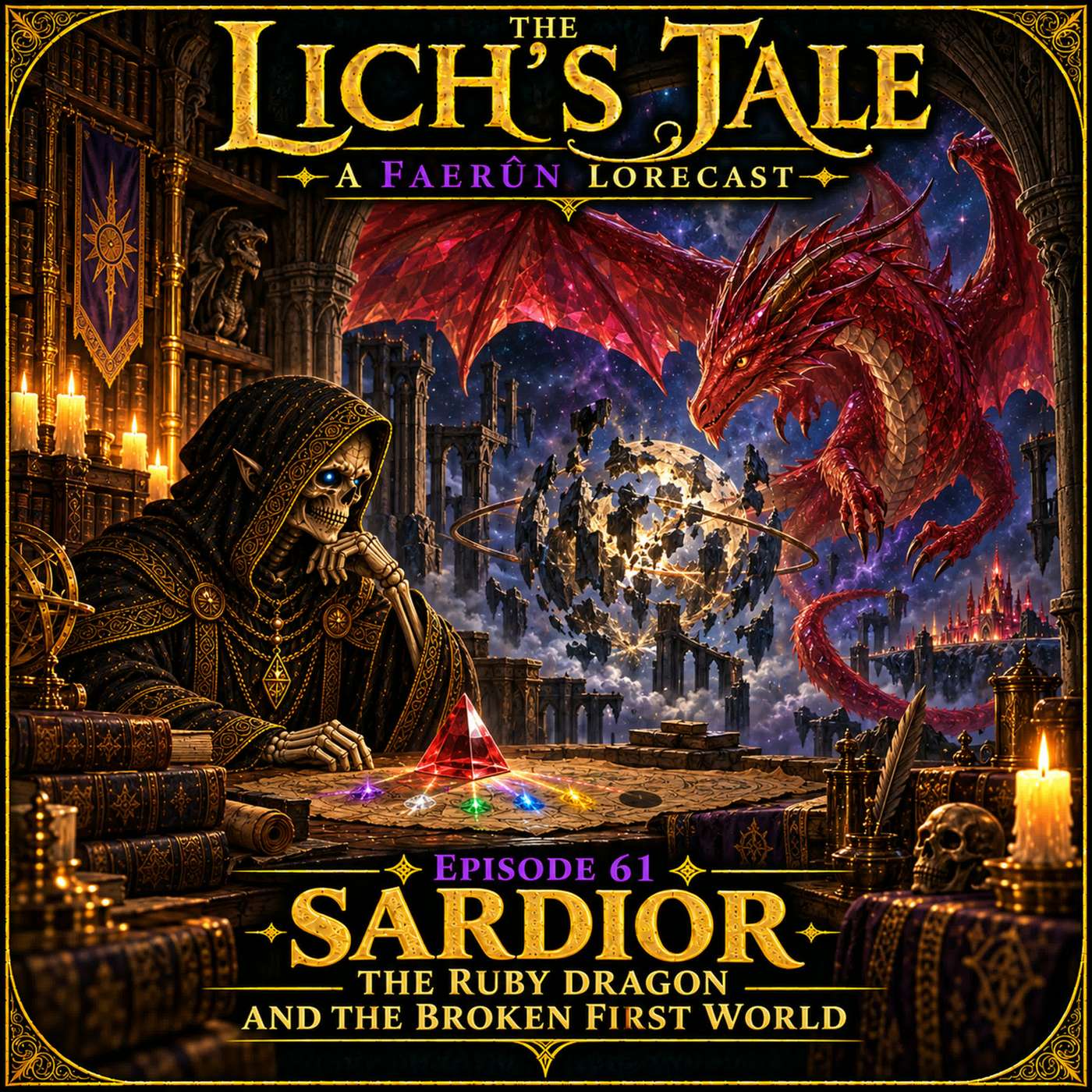
The Lich's Tale: A Faerûn Lorecast · The Lich's Tale
Why does one tradition preserve a living Ruby Dragon and another connect his fate to a shattered beginning? At a listener's request, Erilian visits Sardior's court, the five Thanes, Seradess and Blithen, obsidian dragons, scholarly servants, and the aleithian dwarves before comparing later First World beliefs with older dragon creation stories. The episode separates edition-specific lore, attributed belief, original interpretation, and invented illustrative scenes. The Blithen companion provides a partial explanation of Seradess's fall; her corruption's method remains unknown. Original magazine scans and the full Fizban book were not obtained; detailed reading limits and linked sources are in Sources.md. Hosted by Erilian Kantonine. The Lich's Tale: A Faerûn Lorecast. Supported by Dharma Web Solutions. Visit the archive. Questions and corrections: [email protected]. Unofficial fan-made exploration. Forgotten Realms and related Dungeons & Dragons settings and characters belong to their respective creators and rights holders. Archive characters and illustrative scenes are original show fiction. Chapters 00:00:00 The listener's ruby 00:04:12 A third dragon family 00:08:46 A castle in the night 00:13:12 Five kinds of attention 00:18:02 The five Thanes 00:22:27 Seradess and the empty place 00:26:46 Blithen's jealousy 00:31:07 Obsidian 00:35:49 Echoes and theories 00:40:28 The scholar's door 00:45:14 The aleithian bargain 00:50:25 The First World 00:54:49 Firstborn and heirs 00:59:32 Io and other beginnings 01:04:15 What dragons keep 01:09:05 The sixth reflection
There are six places on the velvet, and only five are shining. No, apprentice, we have not misplaced a dragon. I should hope to notice. We have a red piece of glass, a lamp, and an arrangement of polished stones which I have made expressly for tonight. The glass has no divine ancestry. I bought it because it caught the light, which is also how I acquired several regrettable waistcoats while I still had a waist. Welcome to The Lich's Tale: A Faerûn Lorecast. I am Erilian Kantonine, baelnorn and lorewarden in the hidden stacks beneath Waterdeep. Tonight we open a listener's request for Sardior, the Ruby Dragon, his Thanes, the obsidian dragons, and the traditions of the First World. The listener's name did not accompany the request. Your question did, and it is a fine thing to have brought through the door. Thank you. Last time, we put a stone on a map of Vaasa and considered what happens when the ground refuses a ruler's intentions. Tonight the stone has moved off the map. We must follow it into stories dragons tell about their beginnings, and ask what those stories leave for everyone obliged to live afterward. One account offers a living sovereign, a marvelous conversationalist with a court in the night sky. Another tradition connects his absence with the breaking of a primordial world. At the edge of the older court stands a sixth Thane, destroyed, with her lineage estranged. And behind her, in a companion account too easily overlooked, waits an adviser whose envy has made other lives into instruments. We shall give those people and traditions room. This is not a journey through one uninterrupted royal chronicle. Some of our books describe older versions of the wider Dungeons and Dragons cosmos. Some speak through myth. Their relevance to Faerûn is real, but relevance does not stamp a date upon an event or put a castle above a particular Waterdhavian roof. I have arranged the stones here to help us remember the question. If a community understands itself through a brilliant ancestor, what does it inherit when the ancestor is absent? Power, perhaps. A responsibility. A wound. Possibly a very inconvenient family argument. And if the family has left someone outside the circle, who gets to tell us why? Keep that last question nearby. We shall hear an accusation and a punishment, then find that another page complicates both. The complication deserves more than a conspiratorial whisper. It deserves names, a careful look at what each telling actually says, and the courtesy of leaving its remaining silence alone. The apprentice has offered to draw connecting lines between every stone. Admirable enthusiasm. Put down the ink for a moment. Once we have drawn a line, we become remarkably reluctant to admit that the things at its ends may never have touched. Let us begin with a third kind of dragon, and a writer who thought a familiar encounter ought still to be capable of surprising us. Imagine a company preparing to enter a cavern. For this little exercise, the company is ours to invent. Their scholar carries a book of dragon lore, their scout has found a scale, and their loudest member has announced that everything is now perfectly straightforward. This is usually when I advise checking one's exits. The scale resembles a jewel. The scholar turns pages. The confident member suggests that a jewel must mean a valuable dragon. The scout, who had hoped for useful information about surviving, begins to regret bringing either of them. The gem dragons make a third family beside the familiar chromatic and metallic traditions. Their names give us amethyst, crystal, emerald, sapphire, and topaz. Thinking of those names as merely five additional colors misses their most interesting invitation. A dragon can challenge a visitor through perception, curiosity, argument, secrecy, or the directed power of a mind. The publication trail takes us to Arthur Collins's proposal in Dragon magazine, number thirty-seven, in May of nineteen eighty. His neutral dragons offered new challenges for players who already knew what to expect. This began as a magazine contribution, not a dated discovery in Faerûn, and not a declaration that every rule in the proposal had entered the game's official core. Its design welcomed rare, intelligent, psionic dragons into the space between familiar expectations. That distinction gives the beginning its proper scale. We are watching an idea enter print. We are not watching a Waterdhavian expedition report the first sighting of a species. The two kinds of history have different calendars, and a surprisingly large number of avoidable arguments begin by putting them on the same one. Consider what our imaginary adventurers must now do. The scale has supplied a clue, but the clue cannot answer whether its owner wants conversation. Nor can it tell them whether the owner has noticed the scholar's fear, the scout's patience, or the loud one's readiness to speak for everybody else. Knowledge changes the encounter by giving the company better questions. It does not remove the need to ask them. Neutrality, too, requires more thought than a blank space between good and evil. A person may decline a quarrel because its terms are foolish, because the cost is unbearable, because neither claimant deserves support, or because disengagement is convenient. Those decisions differ morally. Calling the decision neutral does not make the distinctions disappear. I would be wary of any dragon who explained indifference as superior wisdom while someone smaller paid for it. I would be equally wary of demanding that every private creature enlist in our preferred cause before we acknowledge its right to exist. The interesting work occurs between those judgments, where circumstances make us inspect what we are asking. Our imaginary scout eventually puts the scale down and proposes a better plan. They will announce themselves from a safe distance. They will state their purpose. They will avoid pretending that a memorized category amounts to an introduction. This is an excellent beginning for meeting a dragon. It is also serviceable advice for visiting a library. Among Collins's new dragons stood one exceptional individual. Ruby described him, rather than a population of interchangeable ruby beasts. His name was Sardior, and the tale already gave him company worthy of a royal sky. The early Sardior has a roaming castle, kept in the world's shadow. To an observer below, its unfamiliar red appearance can invite an astronomical mistake. His court contains five ancient Thanes, one from each gem kind, and his followers honor him without receiving instructions for every ordinary decision. Above all, he is remembered for extraordinary conversation. That is a wonderfully specific gift to give a dragon prince. A great deal of fantasy describes what a ruler can do to a room. I am more interested, here, in what this ruler might allow a room to do to him. Conversation requires the possibility of hearing something one did not bring. Without that possibility, one has an audience. Many sovereigns confuse the two, particularly when the chairs are arranged to encourage the confusion. Let us invent a visitor for the sake of the thought. She is a mapmaker. Her patrons want an exact route to the castle, and she has already understood the difficulty with selling reliable directions to a destination that moves. She has brought a different offering: three observations of a red light, each recorded by a witness who disagrees with the others. One saw it above a ridge. Another saw it reflected in water. The third insists it stood still, because he had been standing still and considers his own experience an adequate measure of the heavens. The mapmaker has not resolved their accounts into a neat line. She has marked the uncertainty. Suppose she reaches the imagined court and lays her work before its host. The obvious reward would be a secret route. The more interesting reward would be a question. What did each witness believe they were looking for? Was the water moving? Had the third observer watched long enough? A map can preserve the history of an error as usefully as it preserves the path beyond it. That scene belongs to our speculation. The published image gives us a moving palace and a gifted conversationalist; it does not record my mapmaker's audience. I offer her because she helps us feel the difference between collecting answers and cultivating attention. A stationary capital gathers roads around itself. A moving court alters the relationship between center and edge. For an imagined petitioner, the difficulty begins before the audience: finding the place, interpreting the signs, deciding whether this is an opportunity worth the pursuit. An invitation can be generous while access remains demanding. For someone looking upward from Faerûn, the image also produces a particular humility. The night contains things our local arrangements do not govern. The city can appoint officials for its streets. It cannot insist that every light overhead submit an itinerary to the Watch. I suspect the paperwork would be formidable, and several constellations would refuse on principle. We should resist turning the palace into a guaranteed sightseeing stop. No source we are using gives tonight's departure time above Waterdeep. Its narrative work is larger than that. It lets the royal center remain elusive, and it makes curiosity part of approaching it. Yet a court is more than a splendid location. It contains different minds. To understand the Thanes as anything beyond a jewelry display, we must first give the five gem families their different ways of attending to a world. The official overview published before Fizban's Treasury of Dragons drew on earlier gem-dragon lore. Its five portraits are useful, provided we hear them as that overview's descriptions rather than universal instructions for every individual. Amethysts lean toward mediation and secluded depths; crystals toward sociability and cold heights. Emeralds combine historical curiosity with guarded suspicion. Sapphires care for strategy and defended underground territory. Topazes favor coastal solitude and can be difficult company. The overview's older material also associates gem kinds with different elemental environments. It is a mixed historical introduction, not a substitute for every final rule in the later book. Those few strokes already suggest five different beginnings for an encounter. We can test them without inventing an official adventure. Place one disputed bridge in our imagination. Two communities need it. Neither trusts the other's engineers. Someone proposes asking a dragon for judgment, because apparently the dispute did not yet feel complicated enough. A mediator might begin by making each side explain what the bridge is for. A friendly host might first discover which travelers have actually used it. A suspicious historian might want the old toll records. A strategist might ask who can hold the far bank. A solitary observer might wonder why the petitioners assume that their urgency creates an obligation for someone else. These are possibilities I am giving our invented dragons, not prescribed responses attached to scale color. Their value lies in the different evidence they bring into view. The bridge acquires a past, a social use, a military consequence, and a question of consent. Any judgment which ignores all but one of those things will be convenient chiefly for the person who selected it. At a table, this gives the person portraying a dragon something more useful than a temperament to imitate. Decide what the dragon notices first. Then decide what it habitually overlooks. A brilliant historian can fail to notice that the person answering questions has not eaten. A considerate host can encourage dangerous confidence by making everyone comfortable. A strategist can understand every approach to a fortress and still misunderstand why its inhabitants want to leave. Wisdom is not the absence of a blind spot. It is partly the willingness to ask who has been standing inside it. Nor should psionic power flatten these differences. An extraordinary mind still needs a purpose. It can preserve a boundary, reach toward another being, or make a private desire frighteningly effective. The presence of mental power tells us the medium through which something may happen. We must still examine the act. Return to our bridge for a moment. Suppose the petitioners receive a solution which is structurally perfect and socially disastrous. The span will stand for centuries, but the toll makes it useless to the poorer bank. Has the dragon answered the question? Technically, perhaps. The petitioners would have done better to describe the need, including the people affected, before asking for a feat of engineering. This is why the Thanes should enter our story as interlocutors. We can recite five jewels in a breath. We cannot conduct five genuinely different conversations so quickly. Their distinctness matters because a court that hears several approaches may recognize a problem its ruler would otherwise reduce to a single shape. The apprentice has now laid five pencils beside the stones. Good. Keep all five. We are about to need more than one color of ink. Aleithilithos, the amethyst. Hrodel, the crystal. Smargad, the emerald. The sapphire Thane, whose name appears as Charsima in the early transcription and Charisma in the two thousand three account. Tithonnas, the topaz. I shall use the latter account's spelling when following its court. Copyists do not always arrange their difficulties where a reader would find them convenient. In that later account, by Scott Brocius and Mark Jindra, a Thane is more than an appointed adviser. The transformation is irreversible, carries inherited memories and personality, and makes the Thane a facet of Sardior. The bond allows continuing mental contact unless something blocks it. A title here involves changes to the person who bears it. We should pause over that. In an ordinary court, the office and the officeholder can be separated, even when everyone involved makes a dreadful fuss about it. A minister can resign, keep a private opinion, or leave notes warning a successor about the lock on the third drawer. What does office mean when its memories enter you? The source's mechanism invites the question; it does not answer every ethical difficulty I might attach to it. We are considering its implications. Imagine a new guardian learning a predecessor's memories of a gate. Those memories might spare a village a disastrous mistake. They might also transmit an old prejudice with the force of personal experience. The guardian remembers being betrayed, though the body standing at the gate has never met the betrayer. What would it take to distinguish useful inheritance from a borrowed grievance? A fact can be checked against another witness. A feeling arrives already intimate. The person experiencing it may need exceptional discipline to remember that intimacy is not the same thing as authority. For a court composed of facets, difference becomes especially interesting. Does each member offer an independent correction, or articulate something already within the sovereign? Those possibilities need not produce identical councils. A ruler who hears several parts of himself may understand his own conflict more clearly while still failing to hear anyone outside it. This is my question for the image of the Thanes, not an additional rule concerning their minds. It helps explain why I want ordinary visitors in our imagined audience chamber. The mapmaker, the messenger, the keeper of a small shrine: each can bring a fact that royal self-knowledge will not generate. Powerful councils often admire themselves for their range. Five distinguished opinions sit beneath five banners, and everyone congratulates the room upon its variety. Then someone asks who cleans the stairs. An entire practical world comes into focus, and the discussion must begin again. The names also keep the court from dissolving into a chart. Hrodel is not simply the crystal column. Smargad is not the green token one moves when the story requires suspicion. They belong to a particular telling, with relationships that cannot be replaced by another set of five suitably colored strangers without changing what we are describing. And that particular telling remembers a place which is no longer occupied. At its edge, the neat arrangement fails. Six becomes five. The reason matters, and the first source leaves its own clergy arguing about it. Her name is Seradess. The two thousand three Legend of Sardior identifies her as the obsidian Thane, says Sardior destroyed her, and describes the obsidian dragons' banishment. It also leaves the reason disputed among his clergy. That is the extent of this account's explanation. We should feel its severity before trying to improve its completeness. A place in a court can vanish more quietly than the person who held it. The council continues. The remaining names grow familiar. Visitors learn the arrangement as it now stands, and eventually the earlier number becomes a difficulty in a footnote. An empty chair is visible only while someone preserves it. Remove the chair, and a stranger may never know there was an absence to ask about. On our table I have kept the sixth patch of velvet. It is a theatrical choice of mine. The published court is not documented as maintaining this little memorial, and I will not lend my furniture to its history. We need the empty space because we are trying to understand how a beautiful order can contain a history of exclusion. There are several temptations here. One is to make the victim of a terrible punishment wholly innocent because the punishment frightens us. Another is to assume guilt must be complete because a god imposed it. Both reach a verdict before hearing the rest of the evidence. Sympathy and reverence are powerful guides to attention. They are poor substitutes for inquiry. There is also the temptation to transfer judgment from one named being to an entire lineage. Whatever a tale says of Seradess, its consequences extend beyond her. That raises a different question: what connects an individual's act to the fate of a population? A story may describe such a connection without persuading us that it is just. Imagine an invented embassy arriving many generations afterward. Its members know they are unwelcome. The guards know a prohibition. Neither side possesses a full account of the original offense. The encounter could collapse into rehearsed hostility, with each participant speaking words inherited from someone else. Or the ambassador could ask what would count as a reason to change the rule. Not demand that the past be forgotten. Ask for a condition under which the present can become different. A court unable to answer has made its policy indefinite. That, too, is a choice, though it may prefer to call the choice tradition. I would not tell that imagined embassy to trust merely because a host has a gracious reputation. Courtesy does not undo coercion. Nor would I tell its members that the only meaningful action is vengeance. A grievance can be real while leaving more than one possible future. These are the human-sized questions an immense draconic punishment places before us. The clerk at the gate, the person seeking entry, the scholar asked to explain the prohibition: none may have created the problem, yet each participates in what happens next. Now bring down the companion volume, apprentice. The first account has left a blank, but a blank on one page is not proof that every other page is silent. Someone else stands behind Seradess in the wider series, and his desire is unpleasantly recognizable. Blithen of Many Names is another account by Brocius and Jindra. It describes a former adviser to Sardior, a strange gem dragon with crystal, emerald, and obsidian heads. When Sardior sought the counsel of several Thanes, Blithen resented losing his privileged place. He corrupted Seradess, hoping the failure of the new arrangement would restore his importance. The method is left unknown. Sardior destroyed Seradess, later discovered Blithen's deception, and exiled him. This companion also says the obsidian dragons withdrew, while history recorded their departure as banishment. Those are substantial additions. They do not give us a transcript of Seradess's choices, nor an exact account of the corruption. They do give us an instigator, a motive, and a disagreement about how a whole lineage left. Saying that every cause is wholly unknown would overlook the companion article. Saying that Seradess independently devised a rebellion would add a story it has not supplied. Blithen's motive interests me because it makes catastrophe grow from a demand to be indispensable. He wants the ruler to need him in the old way. Other minds become rivals. Their failure becomes useful. Someone else's destruction can be imagined as a route back to favor. This is a familiar pattern at a much smaller scale. Let us invent a workshop whose senior craftsperson resents a new apprentice. He withholds a measurement, then points to the apprentice's failed work as evidence that nobody else can be trusted. The error appears to demonstrate his importance because he has quietly arranged the conditions under which it occurs. A sensible master would investigate the process, not simply praise whoever predicted the failure. Who had access to the measurements? Who supplied the tools? Who benefits when the newcomer is dismissed? Competence includes the ability to help someone else become competent. A person who must continually break the ladder beneath colleagues is defending a position, whatever they call it. Scale that desire upward, give it a dragon's power, and the cost becomes immense. The old adviser does not merely resent a replacement. He uses another person to argue his case. Seradess's place in the story is therefore more disturbing than a convenient illustration of disloyalty. We have been told she was corrupted, but not given enough to reconstruct how much she knew, chose, resisted, or understood. The distinction between withdrawal and banishment deserves equal care. One emphasizes the agency of those departing; the other emphasizes the power that excludes them. In practice both pressures can be present, but the source has not instructed us to merge the versions into a newly certain event. We can preserve the tension and ask whose description became the public one. A community that leaves under intolerable conditions may remember choosing to go. The institution it leaves may announce that it ordered the departure. Each account can serve a later claim about dignity or control. My comparison explains why the words matter; it does not establish the missing details of this draconic departure. Blithen supplies a partial answer and leaves a deeper wound. The court's failure cannot be understood merely by locating the excluded member. We must also examine the person who wanted everyone else to fail. What, then, are the obsidian dragons of this older material? The reproduced web bestiary presents intelligent, dangerous creatures associated with volcanic regions, coal-bearing mountains, and the Plane of Fire. Rough gray scales in youth become a smoother black covering. Sharp edges lend the body a cutting appearance. Fire and psionic abilities both belong to the profile; older examples can make demiplanes. Its tactics include assessing opposition, retreating, and returning from advantage. This is an older monster account, not a promise that every later edition includes an identical sixth gem family. That combination matters. Obsidian here should not be treated as a palette change applied to an ordinary black dragon. The material, habitat, and powers belong to a specific design. And intelligence makes its danger more interesting than simple persistence. A foe capable of withdrawing can learn from the encounter. Survival does not prove the encounter has ended. For a story set in Faerûn, a keeper of the table could choose to bring this older conception forward. That is a deliberate campaign choice. It should not arrive disguised as a missing page from whichever modern rules the group happens to use. Imagine such a campaign near a mountain mine. This mine and its people are our invention. Workers have found smooth black fragments in a warm seam, and a foreman would like the party to declare them harmless so that production can resume. The party's first useful act may be refusing the terms of that request. A declaration is not an investigation, and an employer's deadline is not evidence. The mountain gives the inquiry practical stakes. Which shafts carry heat? Where can people leave quickly? Who has been keeping records of tremors, missing tools, or unfamiliar marks? A dragon may be the eventual answer, but the workers' knowledge is valuable before anyone has named the danger. An adventurer who ignores them because the assignment sounds mythic deserves to spend the afternoon carrying their equipment. Suppose the party discovers a thinking creature defending a route through the rock. Negotiation might be possible, or it might not. The creature's intelligence does not guarantee kindness. The workers' fear does not make every proposed response wise. Evacuation, observation, barriers, and carefully bounded contact may all matter before a heroic confrontation does. This is where I would separate understanding from excuse. Learning why a dangerous being acts can help protect those it threatens. It does not oblige the threatened to accept injury as an educational experience. Equally, an old account's hostile general description need not prevent a storyteller from giving a particular individual motives that can be examined. The exile tradition adds another layer if the table chooses to use it. An emissary might care about an ancient grievance while a miner cares about tomorrow's shift. They do not have equal information, equal power, or the same immediate problem. A useful adventure lets both concerns remain visible. We need not make every obsidian encounter a trial of Sardior's court. The older lineage has its own physical and mental presence. It can occupy a landscape, make decisions, and disturb ordinary life without serving only as a dark footnote to someone else's glory. And the wider psionic writings place other, stranger echoes around that absent sixth Thane. Some are explicitly theories, which is a good reason to inspect the words introducing them. The Draconum Psionicus series proposes that mind drakes may have arisen from the psychic aftermath of Seradess's destruction. It attributes that explanation to sages rather than declaring it settled fact. The same introduction describes Sardorian golems guarding temples and the Ruby Dragon's castle, with their construction kept secret, and ectoplasmic dragons associated with an unusual demiplane and the Astral. These are different creatures with different roles. Their presence does not turn every psionic dragon into a surviving fragment of Seradess. An origin theory can be valuable without being conclusive. It tells us what a scholar believes needs explanation and what events they consider capable of supplying it. But an attractive connection should still survive questions. What observation would distinguish this origin from another? Are there earlier examples? Does the proposed cause explain a feature of the creature, or merely happen to be dramatic? If I tell an apprentice that every unexplained noise in the archive comes from an offended king, I have produced a theory of considerable grandeur. I have also delayed repairing a shutter. We do try to reserve supernatural explanations for cases where they earn their keep. Let us imagine a collector arriving with a small cage. This is an invented visitor, and the creature she thinks she has caught need not be what she claims. She wants a certificate naming it an echo of the lost Thane. The certificate would make it valuable. She has evidence that it behaves strangely, evidence that she found it in a dangerous place, and a theory she very much hopes is true. What should the scholar do? Begin with the immediate facts: the animal's condition, the security of the cage, the safety of everyone in the room. Then separate observation from interpretation. Where was it found? Who witnessed the capture? What changed in its behavior before the collector chose the name? Only after that can an origin be discussed usefully. Otherwise the desired label starts instructing the observer what to notice. Every ordinary movement becomes an omen. Every failure of the theory becomes evidence that the creature is cunning enough to conceal its nature. That kind of argument can survive anything because it has stopped risking contact with the world. A campaign can make uncertainty productive by giving inquiry consequences. The creature may need care while the experts disagree. A merchant may offer money for the very label the investigators have not established. A frightened community may need sensible precautions without waiting for a final theological answer. Those pressures allow the table to pursue truth without pretending that everyone can put their lives aside until scholars agree. Responsible uncertainty still acts. It chooses measures suited to what is known, keeps records, and avoids treating an unproved possibility as permission for unlimited harm. The golems suggest another question: what knowledge should remain restricted? A method for making a powerful guardian can also become a method for imposing power. Secrecy may protect a community, preserve a monopoly, or do both at once. The answer depends on who controls access and how they are accountable for it. That brings us to Sardior's mortal servants. A god associated with knowledge and secrets requires people who make decisions about both. Their daily work gives us a quieter entrance into his tradition than a palace crossing the stars. In the older Legend, Sardior's clergy are few, socially engaged, and valued for knowledge. Their temples favor clear views of the night sky near communities; a ruby on a pedestal can serve as a shrine. The companion account of his devotees gives chosen psions particular duties and distinguishes them from defenders and the rarer ruby disciples. Religious service can involve scholarship, consultation, and protection. A question brought through the door may become someone's day's work. I find that modest scale useful. A faith need not fill a city with monumental architecture to affect the way people live. Someone must answer the inquiry, preserve the document, receive the visitor, and decide whether a private confidence can be repeated. These acts give knowledge a social form. Let us place an invented consultant above a noisy street. The window is open to the night, the lamp is nearly out, and three visitors are waiting. A caravan master wants a route checked. A parent wants an old inscription read. A wealthy collector wants the location of an object whose current owner would prefer to keep it. The consultant has one evening. Fees may keep the room open, but the largest fee is not necessarily attached to the best use of the knowledge. Nor does refusing all payment feed the people maintaining the archive. The problem is practical as well as moral: how can a useful service remain available without allowing wealth to determine every answer? One solution in our imagined room might be a published scale of fees and a protected share of time for those unable to pay. Another might be community support in return for open access to ordinary records. Either arrangement has costs. The important thing is to make the arrangement visible enough that people can contest it. Now consider the collector's request. The information may be accurate and the payment lawful, yet releasing it could expose someone to danger. Scholarship does not cease to have consequences because its product is a sentence. The consultant must ask what is being requested, whose confidence is involved, and whether the visitor's stated purpose withstands scrutiny. An archive which keeps everything secret makes itself powerful by making everyone else dependent. An archive which releases everything may betray the very people whose testimony it preserves. Between those extremes lies the difficult daily work of custody. I have no formula which saves a lorewarden from judgment. I do recommend writing down the reason for a decision before congratulating oneself upon it. The parent with the inscription complicates the queue in a different way. Suppose the carving is a name on a damaged family object. Its interpretation changes no empire. It may nevertheless matter more to that visitor than the consultant's most impressive discoveries. Knowledge deserves attention at that scale, too. We should be able to imagine the evening ending with something smaller than revelation. The caravan receives a warning about an uncertain ford. The parent receives a careful reading with one letter unresolved. The collector leaves dissatisfied because the scholar has asked an unwelcome question. None of those events is official Sardior lore; they are a working day I have built around the institution the sources suggest. They help us move from the words knowledge and secrets to the choices those words require. There is, however, a published community whose relationship with Sardior is considerably more specific. To find it, we must go beneath the surface and consider a bargain involving dwarves, divine knowledge, and a very long period of service. The account of the aleithian dwarves, again by Brocius and Jindra, begins with miners from Rokehold finding a temporary lair of Aleithilithos. Sardior arranges a bargain with Moradin through Dumathoin: knowledge concerning enemies in exchange for dwarven caretakers. A community enters a demiplane of ectoplasm, where mining, crystal work, and guarding against intruders become its duties. Long residence changes its people, whose description includes purple-gray skin and psionic abilities. Much later, Aleithilithos closes the portal and tells them to prepare for a future need involving the world above. The article uses relative time, including roughly two centuries before its own narrative present. It gives us no sound basis for assigning that interval a precise Dalereckoning date or placing Rokehold beneath a particular Faerûnian city. We can explore the tradition without adding a geographical certainty it has not supplied. Here a divine agreement acquires households. The participants in the first bargain may have understood the service one way. Children born into the resulting community inherit its conditions before they can evaluate them. A task accepted by ancestors becomes the shape of everyday life. That does not by itself make the bargain fraudulent. Communities can find purpose, skill, solidarity, and opportunity in a continuing vocation. But consent is more complicated across generations than it is at the moment two envoys shake hands. The later inhabitants deserve questions of their own. Imagine a young craftsperson in a community inspired by this account. Our character is fictional. She knows how to work the crystals available to her, knows the sounds that make the guardians look up, and knows the stories explaining why her family is there. She does not remember choosing the arrangement, because she did not. When someone announces that the community must prepare for the surface, her first concern may be neither rebellion nor revelation. What will her trade be worth there? Will her parents be safe? Which tools can she take? Does preparation mean departure, defense, contact, or waiting for instructions that may not arrive within her lifetime? A command can be momentous while remaining terribly incomplete for the person expected to act on it. Good leadership must translate purpose into preparation: supplies, training, information, opportunities to ask questions, and a way to report difficulties without being accused of disloyalty. The tale's changed bodies make the question of return more intimate. A homeland described by ancestors may no longer be a place where descendants move unnoticed. They carry the history of service in themselves. A community can be faithful to an inherited promise and still become unfamiliar to those who first requested its help. For a Faerûn campaign borrowing this older tradition, that is a more promising beginning than presenting the aleithians as another unusual face in a tavern. An embassy might arrive with practical needs and an incomplete commission. A surface settlement might welcome their craft while misunderstanding their obligations. The adventure could turn on translation, trust, and the material work of making room. I would let those dwarves speak about the bargain in more than one voice. Some might take pride in it. Others might want it renegotiated. An elder could hold both feelings without contradiction. Communities do not acquire a single opinion merely because an outside scholar gives them a single name. At the table, the ruby still catches the lamp. We have followed its light into service, inheritance, and change. Now the next tradition asks us to imagine an inheritance vastly larger: not a remembered workplace or an empty office, but a world whose breaking may have left descendants everywhere. The First World belongs to later draconic creation mythology. Official discussion surrounding Fizban's Treasury of Dragons presents a primordial unity associated with Bahamut and Tiamat, and the possibility that the many worlds descend from a shattered beginning. This is a cosmological telling. It is not a securely dated event on a map of Toril, and the familiar word first does not make every earlier plane called a first world the same place. The distinction matters because a myth works at more than one scale. It offers an account of origins. It can also tell its hearers what they owe one another now. If strangers belong to the remains of a shared beginning, distance becomes something to interpret rather than a sufficient reason for indifference. That is my reading of the image, not an additional historical fact. A broken vessel can suggest kinship among its pieces. It can also encourage someone to believe that every piece must be forced back into a single shape. The moral consequence depends on what the believer does with the image. Let us try an invented conversation. An elder dragon tells a traveler that her world is one shard among many. The traveler asks whether that makes it incomplete. The dragon says it makes it precious. Neither answer settles the cosmology, but the second leaves more room for the lives already being lived upon the shard. Now give the same premise to an impatient conqueror. He calls differences damage. He calls resistance a symptom of forgetting. Every particular language, city, loyalty, and landscape becomes an obstacle to the unity he intends to restore. The myth has not changed. The use to which he puts it has. When I hear someone promise to mend the world, I listen closely for what they propose doing to its inhabitants. A repair which requires everyone to stop being themselves deserves inspection before the ceremonial hammer is raised. There is another danger in treating a broken beginning as the only valuable one. It can make the present seem like an inferior remainder, a place whose beauty is merely the residue of an earlier perfection. But people make things after catastrophe. They raise children, learn skills, form friendships, preserve jokes, and build institutions their ancestors could not have anticipated. The new need not apologize for failing to be the old. Even if a creation myth describes a loss, the lives that follow can possess their own worth. For a listener whose adventures take place in Faerûn, that gives the cosmic story a useful boundary. Toril need not become a waiting room for the restoration of somewhere else. Our task is not to prove this creation account from the desk tonight. It is to understand the claim and the possibilities it gives a story. Some characters may believe it passionately. Others may regard it as a metaphor, a rival theology, or an intriguing hypothesis. Their responses can reveal what they fear losing and what they hope might yet be possible. Sardior stands at the heart of the listener's question because later language connects him to this beginning. We must attend to the wording, including the difference between a playtest and the published discussion which followed it. A small change in how a claim is presented can make a large difference to how confidently a narrator ought to repeat it. In the twenty twenty-one Unearthed Arcana playtest, Draconic Options, gem dragonborn trace a heritage through gem dragons to Sardior, described there as the first creation of Bahamut and Tiamat in the First World's early days. That is explicit playtest language. It belongs in the history of the idea, with its playtest status attached. The official article accompanying the published dragonborn options says gem dragons claim Sardior's inheritance and reports a belief that he was destroyed with the First World, with gem dragons arising from that loss. Claim and belief remain important words. The public excerpt supports that tradition of inheritance. It does not settle every question about Sardior's fate. An heir need not be a simple copy. Even in an ordinary family, inheritance can include things one must choose how to carry: property, a name, an obligation, a story, or a reputation whose burdens were created before one's birth. The descendant's life is not exhausted by the ancestor's. If a gem dragon understands itself as an heir of Sardior, that belief might encourage preservation. It might encourage investigation. It might produce a demand to recover something lost. Each is a possible response rather than an automatic instruction written into a jewel. And the later player-facing material brings this heritage into the lives of gem dragonborn. Its elemental associations differ: force for amethyst, radiant energy for crystal, psychic power for emerald, thunder for sapphire, and necrotic power for topaz. Telepathic speech and temporary spectral wings give the inheritance visible and intimate forms. Telepathic speech in the described option does not grant unrestricted access to another person's thoughts, nor automatically let the recipient answer in the same way. That last boundary matters in a scene. Imagine a gem dragonborn courier sending a silent warning across a crowded room. Our courier is invented. The recipient hears the message and looks toward the door. If the courier expects an answer which the ability does not provide, a plan can fail through a very small misunderstanding. A gift becomes useful through practice, communication, and knowledge of its limits. It does not exempt its bearer from explaining those limits to companions. I have known enough accomplished scholars to assure you that extraordinary mental capacity and the ability to give clear instructions are separate accomplishments. Now give our courier a family tradition about Sardior. Perhaps she treasures it. Perhaps she has never had occasion to decide whether she believes it literally. A stranger's demand that she settle the nature of the First World before breakfast would be unreasonable. People can inherit a cosmic story and still have a parcel to deliver. This is one reason I like bringing the discussion down from the immense dragon to the person walking a street. Heritage becomes something lived among other obligations. It can inform an identity without consuming it, and its bearer can ask questions about it without ceasing to belong. A faith in a lost ancestor may connect distant lives. It should not erase the individual who carries it. Whatever a myth says about the beginning of creation, the person before us deserves more than being treated as evidence for somebody else's theory. There are other dragon traditions with their own beginnings, their own great loss, and their own ways of explaining divine opposition. To hear one of them properly, we must change shelves and announce that we have done so. The fourth-edition Draconomicon: Chromatic Dragons, published in two thousand eight, offers an account of Io and the divine conflict surrounding the world's formation. In its origin traditions, Io makes mortal dragons and is slain by the primordial King of Terror. One version has Bahamut and Tiamat emerge from the divided god. Another treats them as his eldest children, inheriting his divine power. The book itself supplies alternatives. Their coexistence is part of the evidence. We have now moved to a different edition's cosmological frame. This is not a missing middle chapter which we can insert between the two thousand three court and the later First World telling. Nor should a catastrophe in one account be assigned the date or name of a Forgotten Realms Sundering merely because both involve a great division. The comparison remains rewarding. One image locates opposed powers within the breaking of an earlier whole. Another lets descendants inherit after a parent's death. Those images direct attention differently: toward division within an origin, or toward succession after loss. We can notice that difference without choosing a secret mechanism that makes both literally identical. Think of what an ordinary family story does when it describes a quarrel. If the quarrel began because an estate was divided unfairly, the remedy may concern property. If it began because siblings wanted different lives, forcing the property back together may solve nothing. The account of the beginning influences what later people believe can heal the trouble. With gods, the stakes and imagery grow vast, but that relation between explanation and remedy remains useful. A creation story can make conflict seem temporary, necessary, tragic, or reparable. A believer may then use that understanding to justify patience, struggle, reconciliation, or domination. My task as your lorewarden is to keep those uses visible. I do not improve a source by stripping away its alternatives until it sounds certain. Nor do I improve your campaign by announcing that all inherited contradictions must be settled before anyone can play. A table can choose one account as literally true in its world. It can also allow several traditions to coexist, with the uncertainty itself shaping institutions and character. Those are different creative arrangements, and the participants should know which kind of story they are entering. For example, consider an invented dispute between two dragon scholars. One wants to recover a relic because she believes a divided divine nature can be reunited. The other fears the attempt because he sees independent descendants whose lives would be overridden. The same object means a possible cure to one and a threat to the other. The adventure becomes richer if both must explain what evidence could change their minds. Otherwise they are merely rival speeches guarding opposite doors. Give them witnesses, imperfect tests, reasons for doubt, and people who would bear the cost of a mistake. Their theories will then have something to do besides sound magnificent. A listener asked for dragon mythology, and this is where mythology becomes an active part of a world. It enters decisions. It tells someone whether a fragment should be guarded, reunited, buried, or handed to a person who has been excluded from its story. The next object on our table need not be a fragment of creation at all. It may be a cup, a coin, or a damaged tablet. Dragons keep things, and the meaning of keeping can bring cosmic questions within reach of a single pair of hands. The publisher's description of Fizban's Treasury connects dragons, their lairs, and their hoards with the magic of the Material Plane. That premise invites us to look at a treasure room as a place with consequences, rather than merely an inventory waiting to be divided. What does a dragon preserve by keeping an object? Value is one answer, but value can mean more than exchange. A possession may recall a victory, embody a promise, record an encounter, or bear witness to a life its owner otherwise scarcely remembers. Let us build one last substantial scene of our own. A dragon has a small cup among remarkable treasures. It is badly repaired. No merchant would rank it highly. An adventuring company has come to recover it because an old letter identifies it as the work of a family whose surviving descendants live nearby. The dragon remembers receiving it. The family remembers losing it. The letter is incomplete. The party has enough information to establish that the object matters to more than one person, but not enough to assume that either account contains the whole transaction. A familiar adventure might make this a simple theft in one direction or the other. A more patient one asks what the object can tell us. Who repaired it? Does the inscription record a gift, a debt, or a name? Was the person who offered it entitled to do so? Has anyone asked the descendants what recovery would mean? They might want possession. They might want the maker's name restored to the record. They might want to see it once. Those wishes have different possible solutions, and the party does the family a disservice by choosing an answer before asking. The dragon may also be capable of generosity without immediately agreeing. A possession kept for centuries can become part of a private history. Surrendering it may feel like losing the last material connection to an encounter no one else remembers. That feeling does not settle ownership, but recognizing it can improve the negotiation. Suppose the parties arrange a copy, a visit, and a public account of the maker, while continuing to investigate the original transfer. The ending lacks a slain monster. It does contain work: careful craft, travel, testimony, and the willingness to acknowledge that one's possession has a history beyond oneself. Now replace the cup with a supposed fragment of a primordial world. The uncertainties become greater, and the claims acquire religious force. The same habits remain valuable. Identify the object honestly. Ask how it came into someone's hands. Learn what each claimant proposes to do with it. Consider those who will be affected but have no seat in the negotiation. An artifact does not become everybody's property merely because everybody has an opinion about its cosmic importance. Nor does a long period of possession erase every earlier claim. The story should allow its characters to examine both propositions. Here the court, the excluded lineage, the inherited memories, and the First World tradition can meet without being forced into one chronology. They give us different questions to ask about what a dragon keeps and what a dragon owes. A campaign can select the account it needs, then let its consequences reach the people handling the object. I prefer that to a cabinet in which every treasure turns out to be the secret key to everything. A world feels larger when some objects have one particular history, and the people inside that history are allowed to matter. Put the cup back carefully, apprentice. Even an imagined heirloom deserves better treatment than your elbows have offered it. The lamp has burned lower. Five stones still catch it, and the sixth place remains dark. The glass at the center has not become a sacred relic in the time we have spent discussing it. I mention this because the apprentice has begun drafting a label, and I recognize the dangerous handwriting of enthusiasm. We can leave with several things more clearly distinguished. The early Ruby Dragon belongs to a particular history of invention and a memorable image of a court above the night. The two thousand three writings expand that court into offices, servants, communities, and a terrible rupture. Their companion account makes Blithen essential to understanding Seradess's fall, while leaving the means of her corruption unrecovered. The First World tradition asks a different kind of question about origin and inheritance. Its claims need not be flattened into the earlier court's daily itinerary. And the Io traditions remind us that a book can preserve more than one beginning without inviting a narrator to erase the difference. For your own table, choose what is true before the answer becomes necessary to resolve an adventure. You can keep that truth secret from the characters while being fair about the kind of uncertainty the players are exploring. A mystery should have something to discover. An unresolved theology can remain unresolved. Confusing the two risks making careful investigation feel pointless. If you use Seradess, allow the distinction between her acts and the claims made about her to matter. If you use Blithen, remember the lives damaged by his desire to be needed. If you use a living court, let someone outside its familiar circle bring a question it cannot answer from its own memories. And if you use the broken First World, give the worlds that followed it their own worth. Let restoration be a question with consequences, not an impressive word which settles every moral difficulty in advance. I find myself returning to the imagined mapmaker who marked her uncertainty instead of concealing it. She brought the court something valuable: an account of where her knowledge ended. That made it possible for another person to contribute. The opening left by an honest question is quite different from the emptiness left by exclusion. Thank you to the listener who asked for Sardior, his Thanes, the obsidian dragons, and these wider traditions. Your request led us beyond the familiar red reflection to a difficult court and some surprisingly practical lives beneath its stories. If a name, a place, or an unresolved question from your own campaign has been troubling the margins, send it to [email protected]. Tell me what you want to understand. You need not supply a grand theory. Sometimes the best beginning is the detail everybody else has hurried past. The Lich's Tale is supported by Dharma Web Solutions, at dharmawebsolutions.com. Our own archive is at taleofthelich.com. If this telling has been good company, a rating or review helps another listener find the door. This is an unofficial, fan-made exploration of the Forgotten Realms and related Dungeons and Dragons traditions. Their settings and characters belong to their respective creators and rights holders. Erilian, his apprentice, and the illustrative scenes we built tonight belong to this telling; the source notes distinguish those inventions from the published material. Our next shelf will wait for its question. For now, I am Erilian Kantonine, lorewarden beneath Waterdeep. Keep a place for the witness who has not yet been heard, and ask what a beautiful account has left outside its frame. The lamp will be here when you return.