
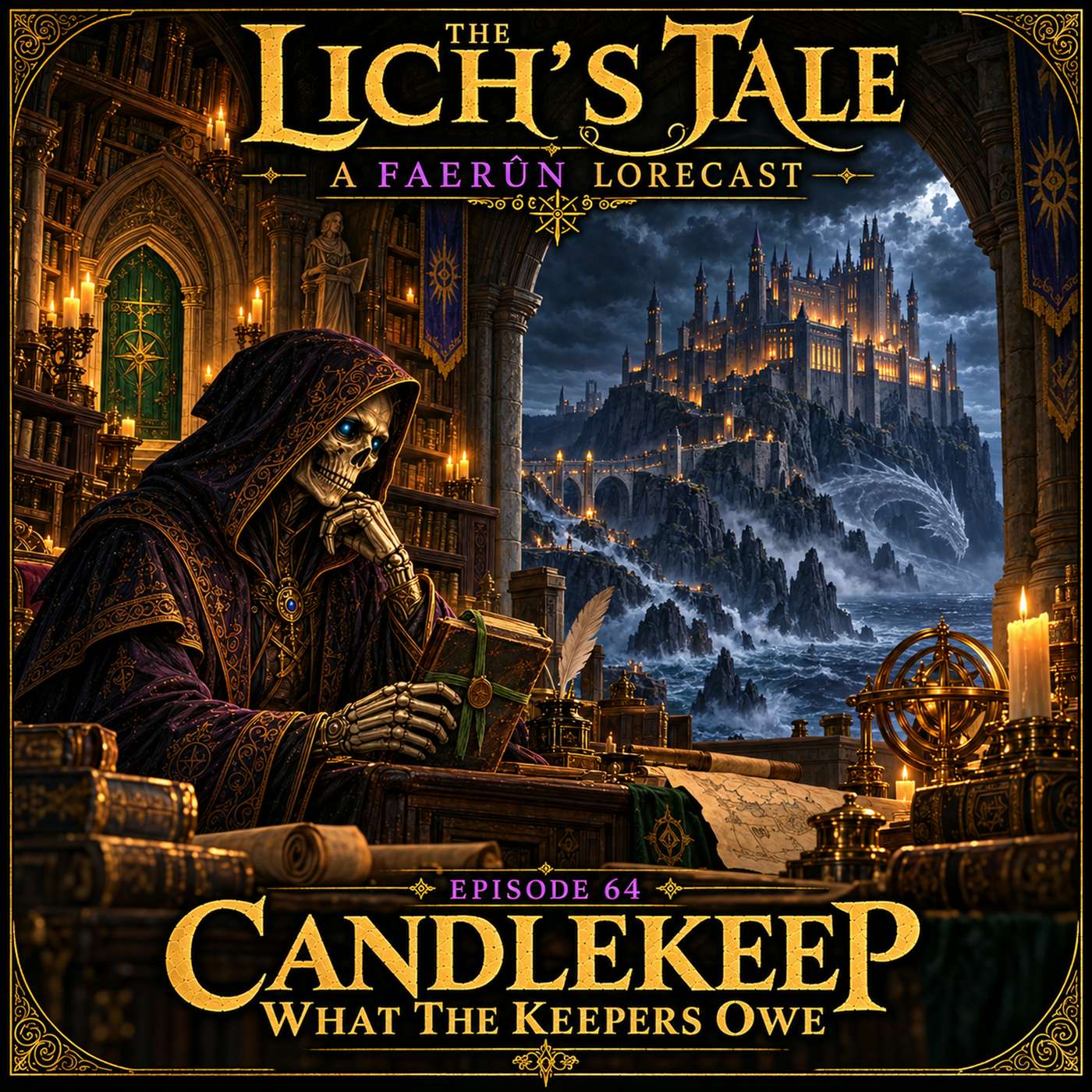
The Lich's Tale: A Faerûn Lorecast · The Lich's Tale
The Lich's Tale: A Faerûn Lorecast — Episode 64 A plain book tied with green cord leads Erilian Kantonine toward Candlekeep and a difficult question: what do the keepers of knowledge owe the people who need it? From the gift at the gate to the Avowed, the Endless Chant, Miirym's long guardianship and a djinni imprisoned in a book, Erilian considers the difference between protecting a collection and fulfilling its purpose. The journey reaches Tashluta before returning to the reader waiting outside a guarded door. This is a reflective exploration of custodianship, consent, access and evidence. The village well book and illustrative scenes are original show fiction. Companion research notes distinguish source material, older accounts and interpretation; adventure outcomes are not invented as history. Archive: https://taleofthelich.com Questions and corrections: [email protected] Supported by Dharma Web Solutions: https://dharmawebsolutions.com Unofficial fan-made Forgotten Realms lore and storytelling. See Sources.md for attribution and access limits. Chapters 00:00:00 The book with an empty margin 00:06:53 The road to knowledge 00:13:32 The gift at the gate 00:20:24 The people who keep 00:27:08 A second copy 00:34:02 The voice carried forward 00:40:42 What a fortress protects 00:46:50 Miirym and the cost of keeping 00:53:34 A person inside a book 01:00:39 The journey beyond the shelves 01:07:24 The work of neutrality 01:14:14 What the record cannot say 01:20:59 What the keepers owe
Do not untie it yet. The cord is older than it looks, and the book has become accustomed to being held together. I know the feeling. There. Set it beside the lamp. No jeweled clasp, no dragon stamped into the leather, no warning that the careless reader will be devoured before reaching the index. A disappointing object, if one judges knowledge by the expense of its threats. Its cover is plain brown. One corner has been repaired with cloth of a slightly different shade. Someone cared enough to mend it, but not enough to make the repair invisible. I rather approve. Welcome back to the hidden stacks beneath Waterdeep. I am Erilian Kantonine, and tonight I have brought you a book with an empty margin. That does not sound remarkable. Most books possess several. This particular margin, however, is going to trouble us. Imagine that the writing beside it records the depth of a well through thirty winters, the names of the families who drew from it, and the year when the water first began to taste of iron. Nothing an archmage would kill for. Nothing a king would display beside his throne. Yet if your child had begun to sicken, and you suspected the water, you might regard those measurements as the most valuable writing in Faerûn. Now imagine that the only surviving copy lies behind a guarded door. The keeper says it is safe. You believe him. He says it is precious. You agree. He says there are rules about who may see it. And suddenly the two of you are discussing very different meanings of preservation. Last time, we followed a wizard who made preparations to outlast his own death. Manshoon gave us a particularly unpleasant education in the difference between continuing to exist and deserving to continue in command. Tonight we leave the private chamber, with its carefully maintained preparations for one man's return, and approach a place built around something larger than one man's survival. We travel to Candlekeep. The library fortress rises above the Sea of Swords, a mass of walls and towers whose windows promise more books than any visitor could read in a mortal lifetime. Its size is part of its wonder. So is the thought that, while kingdoms have changed their names and rulers have improved their ancestors in retrospect, people there have continued the patient business of keeping words available to a future they would never see. I love that undertaking. I should like you to remember this before I begin finding fault with it. Criticism from a person who despises libraries is a simple thing. He generally wishes to build a larger dining room where the shelves stand. Criticism from a lorewarden is more troublesome. I want the books to survive. I want the guardians to succeed. I also want to know what happens when the person whose life depends upon a sentence cannot reach the room in which that sentence is kept. Candlekeep offers us a way to examine that question without pretending it is easy. A library in Faerûn cannot fling open every door and hope that goodwill will discourage fire. The reader who arrives with a polite request may be a scholar, a thief, an agent, a victim, or several of these before the afternoon is over. A book may contain an error. It may contain a spell. It may contain someone who would very much like to be let out. Nor is every refusal cruel. If a traveler asks for instructions that would destroy a town, the librarian's duty cannot be exhausted by pointing out that the handwriting is exceptionally clear. Knowledge gives people choices. Some of those choices have victims who never entered the library and were never consulted about its principles. We shall therefore make our way slowly. First the road, then the gift at the gate. We shall consider the people who keep the collection, the difference between a surviving page and a trustworthy account, and the prophecy carried from one voice to another. We shall descend far enough to meet a guardian whose service should make any comfortable institution uneasy. And we shall look at the occasions when a book becomes an obligation to leave the shelves behind. No single key opens all those doors. I have met scholars who claimed otherwise. They usually sold the key. Our little brown volume will accompany us as an imagined test. It belongs to this evening's conversation, and its village exists wherever you choose to put it. We shall ask what a careful keeper ought to do with it, and what a desperate visitor ought reasonably to expect. That will help us distinguish a grand promise from the daily labor required to honor it. Keep your cloak close. The coast is windy, and the road to a library is still a road. There are puddles, sore feet, and people carrying books they have been assured will impress the monks. Somewhere among them is a person who has spent too much on the binding and too little on the contents. We should be kind to him. He is about to receive an education. The first mistake is to imagine that knowledge begins at the gate. By the time a seeker reaches Candlekeep, a great deal has already happened to determine whether that person could make the journey at all. There is a road to follow: the Way of the Lion, approaching from the Coast Way. That road matters almost as much to our question as the towers at its end. A fortress library may welcome many sorts of visitor in principle. In practice, every visitor has to arrive with enough food, enough time, and some expectation of returning home. Consider two travelers. This is an exercise, not a pair of names I have smuggled out of a chronicle. One has a horse, a servant, a purse, and a letter explaining that his research is of considerable importance to a noble household. The other walks. Her neighbors have contributed to the cost of her journey because the writing she hopes to consult concerns their fields. If he is delayed, his household sends more money. If she is delayed, somebody must decide whether to sell another animal. They may receive the same courteous greeting. They have not arrived under equal circumstances. The difference is easy to overlook from inside a room where the fire is lit and the next meal is assured. I have overlooked it myself. The phrase, return next month, is much easier to utter when next month does not threaten to eat the roof of your house. This is one reason the setting of Candlekeep is so striking. The Sea of Swords gives it distance and grandeur. The high stone speaks of continuity. Yet the surrounding coast also reminds us that a great archive is part of a world of weather and movement. Sailors, merchants, pilgrims, hired guards, and the people who repair their equipment all help determine which writings travel and which remain in a chest until the chest rots. A scholar might name a manuscript after its author. I sometimes wonder whether there should also be a line for the woman who kept it dry on a leaking cart. Do not take that as a proposal to make every title page longer. They are quite bad enough already. It is a proposal to notice that preservation rarely belongs to one heroic act. Someone writes. Someone carries. Someone pays. Someone knows the road. Someone recognizes that the apparently worthless bundle should not be burned for warmth. By the time a librarian receives it, the book has already depended upon people whose names may appear nowhere in the record. The fortress gathers those journeys into a single visible place. That is one of its great achievements. Scattered knowledge becomes easier to compare. A traveler who could never visit every temple, manor, ruined school, or distant town may discover their surviving testimony within reach of one institution. The walls make a promise of concentration: come here, and perhaps the pieces of your question can finally meet. But concentration has a shadow. If too many answers are available only in one place, the road to that place becomes a narrow passage through which need must travel. A damaged bridge, a war, or a purse grown empty can close it as effectively as a locked gate. Think again of our imagined well book. Perhaps the person who wrote it never considered herself a scholar. She was simply the person who could make the marks and persuade the others to tell her what they remembered. If the volume reaches a great library, its chance of surviving may improve wonderfully. If nobody at home retains a usable copy, the village may have exchanged immediate access for distant security. That exchange is sometimes necessary. A settlement threatened by fire or conquest may be relieved to know that anything will survive elsewhere. I would never tell people fleeing destruction to wait until they have arranged a perfect system of copies. Save what you can carry. Live to argue about the rest. Yet when danger passes, the question returns. Can the people who supplied the knowledge still use it? Does the archive remember the path by which the book arrived, or merely the name of the generous donor who purchased it at the last moment? This is where a map becomes more than geography. A line from Waterdeep to Candlekeep represents one sort of journey. A line from a small holding to the market, from the market to a collector, and from the collector to the library represents another. Both may end at the same shelf. Only one is likely to be celebrated. I would have a good keeper remember both. Now the towers are larger. The road narrows in our attention. The people ahead are checking their wrappings, smoothing their letters, arranging their faces into expressions suitable for being taken seriously. The scholar with the horse has begun rehearsing his introduction. The woman on foot is making certain that the book has not become damp. Soon an Avowed will ask what they have brought. It sounds like a question about an object. It is also a question about what the institution recognizes as worth keeping. Candlekeep's famous entrance gift is a written work that adds something of value to its collection. That principle is more interesting than the vulgar version often repeated by people who enjoy making learning sound expensive: bring a sufficiently costly book, and the door will open. Cost and usefulness can coincide. They can also part company with astonishing speed. A lavish copy of something already well represented may contribute less than a humble work that preserves unfamiliar knowledge. The library has reason to ask what is inside the binding, rather than simply how loudly the binding announces the donor's wealth. There is generosity in that idea. A person's observations may matter even when the person has no title. A record can enrich a collection through its particularity. It need not explain the movement of the heavens. Sometimes it is enough to say what happened in one place, carefully, where nobody else thought to write it down. There is difficulty in it too. Somebody must judge the offering. Imagine our well book placed on the table before a gatekeeper. The writing is uneven. The first entries use the names of seasons; later entries use a local reckoning that the visitor has to explain. One writer calls a household by its family name, another by the name of the grandmother who once lived there. A leaf has come loose. Two measurements appear to contradict each other. A careless reader sees a mess. A better reader sees questions. Were the depths measured from the same point? Did the rope stretch? Did the well lining change? Was the family name a change of occupants or merely a different habit of speech? The book may be imperfect and still preserve knowledge nobody can replace. Its flaws need to be described, not used as an excuse to stop looking. This is a demanding standard for anyone working at a gate. The person judging a new arrival cannot spend a season investigating every muddy bundle. Other visitors are waiting. Security must be maintained. There may be deception in the next packet, and the packet after that may contain something dangerous. The institution has to make decisions with limited time. That is why a rule about accepting valuable knowledge requires more than admiration. It needs people with broad learning, and people willing to admit when a work lies outside their competence. A gatekeeper who has never studied fishing might miss the importance of a fisher's observations. A scholar of royal genealogies might recognize a missing succession while overlooking a missing harvest. The answer cannot simply be to declare every object equally valuable. A library would soon drown in deliberate repetition, vanity, and rubbish. Even a vast collection has limits of attention. Shelves can be enlarged more readily than the number of hours available to understand what stands upon them. I would ask instead whether a doubtful offering receives a useful refusal. Is the seeker told what would make it intelligible? Is a fragment dismissed because it is incomplete, or examined for the possibility that its missing companions are already inside? Can someone explain that the local names need a key, the dates need clarification, or the account needs a statement of who witnessed what? Those are questions about good stewardship. I am not reciting a hidden list of Candlekeep's procedures. I am asking what follows if the entrance gift is to honor knowledge rather than merely reward people already trained to present it attractively. Our traveler could help. She might supply a short explanation of the different hands. She might distinguish what she saw from what her grandfather told her. She might write down the old name of the village and the new name used by the tax collector. These additions would not make the original measurements more accurate. They would make their meaning easier to assess. Notice how much has happened before anyone consults a rare spell. We have already entered the difficult business of evidence. There is another concern, one the word gift can politely conceal. Who has the right to give the book away? If it belongs to a household, did everyone who depends upon it agree? If the traveler bought it from a dealer, what does she know of its earlier ownership? If it records a community's practices, does placing it in a distant collection serve those people, expose them, or both? An object may be offered honestly by someone who has inherited a dishonest chain of possession. A careful institution cannot solve every injury that brought a manuscript to its door. It can at least resist the convenient belief that acceptance washes the past clean. For our imagined traveler, I would hope for a simple outcome: the book is understood, its origin recorded, and a way is found for the people at home to retain the useful knowledge it contains. That outcome would take more work than merely stamping a name in a register. Most worthwhile outcomes do. The gift has now become a relationship. The visitor has contributed something. The keepers have accepted responsibility for it. What they owe in return cannot be measured only by the thickness of the walls. And we have still not reached the shelves. The people of Candlekeep call themselves the Avowed. Remember that word. A vow describes a continuing obligation, not a decorative interest in old paper. Their order has ranks and offices: the Keeper of Tomes, the First Reader, the Great Readers, the Master Readers, and the people whose work sustains the whole. The Chanter tends the prophetic recitation. The Gatewarden attends to security. Guides assist seekers. The titles tell us that keeping a library involves several kinds of judgment, which cannot safely be collapsed into one talent. The person best able to interpret a difficult passage may be a dreadful judge of whether the visitor beside him has concealed a knife. The person who notices the knife may have no useful opinion about a disputed line in an ancient inscription. Both are needed. Neither should pretend to be the other merely because the same institution feeds them. A large archive is often imagined as a still place. I find this amusing. A library that appears still is generally being kept that way by a considerable number of people moving somewhere else. Books must be carried. Rooms must be maintained. A request must be understood before it can be answered. A damaged work must be handled carefully enough that inspection does not become destruction. Someone must know whether the item being sought is absent, misplaced, described under an unexpected title, or waiting on a desk in front of a scholar who has entirely forgotten that other people exist. That last category has defeated more systems than fire. Let us imagine a morning's work for one of the less celebrated keepers. A visitor asks for everything concerning a vanished settlement. That sounds clear until the keeper asks which settlement, in which century, and under which name. The visitor knows the modern ruin. The older record uses the name of an estate that once included it. Another text refers only to a shrine nearby. A third may be relevant, but the keeper has not yet compared the geography. The useful answer begins with uncertainty. I have three possibilities, she says. We must establish which concerns your place. This is less impressive than producing a large volume and declaring the matter settled. It is also much more helpful. The keeper has not merely found writing. She has made the limits of the finding visible. Institutional rank can support this work by creating access to experience. A junior scholar can ask someone who knows the older language. A specialist can recognize an error that otherwise would be copied for another century. Authority becomes useful when it brings a difficult question to the person best equipped to examine it. Authority becomes dangerous when it makes the answer immune to examination. I do not mean that every visitor should be allowed to interrupt every expert forever. A person can spend an entire lifetime explaining why a clearly false claim is false, while the claimant experiences the exchange as a delightful hobby. The librarian is entitled to close the conversation. But there must be some difference between refusing endless repetition and refusing evidence that the institution has made a mistake. Suppose our well book contradicts a respected survey already held in the collection. Perhaps the survey says there was no permanent settlement in that valley during the years the book records births, marriages, and water levels. The little volume might be forged. The survey might be careless. The valley might have been named differently. These possibilities require comparison. If the larger book wins because it is larger, no learning has occurred. If the obscure book wins merely because it flatters our affection for neglected people, no learning has occurred either. Sympathy is a reason to listen carefully, not a substitute for checking the dates. This is where I most admire the vocation of a Reader. At its best, it demands a difficult combination: enough confidence to make a judgment, enough humility to revise it, and enough patience to explain why the revision matters. Those qualities are less easily displayed than a staff of power. They are also harder to borrow for an afternoon. A vow to preserve knowledge should therefore include a willingness to preserve the history of one's own mistakes. If an account has been corrected, the earlier error may still matter. People may have acted upon it. A later researcher may need to understand why a route was abandoned or a claim was accepted. Quietly replacing the page can erase the very sequence that makes the truth comprehensible. There is no shame in a correction plainly marked. The shame lies in arranging matters so that only one's successes survive. Manshoon would have understood the temptation to curate his own continuity. An institution can yield to the same temptation without a single clone being involved. It can preserve the flattering portrait of itself and mislay the inconvenient petition. Which brings us to the humblest and most formidable weapon in a library: a second copy, made carefully enough that someone else can notice what has changed. A copy is an act of faith in a stranger. You make it because someone else may need the words when you are absent, distracted, or dead. You check it because faith in strangers should not require them to inherit your errors. Accounts of Candlekeep describe an institution that sends writing outward as well as receiving it: copies and compilations, scholarship made available beyond its own rooms. This is essential to understanding the place. A library that only acquires can grow magnificent while leaving the surrounding world little wiser. The movement outward is where preservation becomes useful at a distance. A person in Waterdeep need not travel to the coast merely to discover that someone else has already asked a question. A teacher can compare an account. A healer can consider a description. A traveler can learn that the route recommended by a grandfather has acquired a rather inconvenient swamp. Yet the copy creates its own obligations. The reader cannot inspect the original through the copyist's eyes. He depends upon choices he may never see. Imagine a page that reads, the water was sweet until the second frost. There is damage near the last word. One copyist writes frost. Another, uncertain, leaves a gap. A third decides that harvest makes better sense and supplies it without explanation. All three pages may look equally confident when they reach a reader a hundred leagues away. The first may be right. The second has preserved uncertainty. The third has manufactured a fact. Good intentions do not rescue the third copy. He wished to give the reader a complete sentence. Unfortunately, the world had not provided one. That is an inconvenience to be recorded, not a vacancy for the copyist to fill with his own good taste. It is a small matter until somebody calculates when a sickness began. Then a single confident word can move the explanation by months. This is why I distrust the claim that a book has been improved whenever its difficulties have disappeared. Some difficulties belong to the subject. A damaged word should remain visibly damaged in the account of it. An uncertain date should not become certain merely because the new binding is handsome. Translation makes the problem larger. A word may describe a kind of obligation for which another language has no exact equivalent. It may name a relationship between a family and a place, or between a community and a shrine. Render it as ownership, and you may give a lord more authority than the original writer intended. Render it as permission, and you may make a permanent right sound revocable. I am not suggesting that translation is impossible. Without it, much of our world would remain divided into small islands of mutual incomprehension. I am suggesting that a responsible translator sometimes needs a longer sentence. Elegance is welcome. Accuracy has the prior appointment. There is pleasure in this work too. We speak so often of error that we forget discovery. Two incomplete copies may preserve different missing pieces. An annotation may identify the person concealed behind a title. A later writer may have quoted a passage from a work otherwise lost. Patient comparison can recover something that no single volume still contains. No spell need flash. Nobody has to defeat a creature with an inconvenient number of heads. A reader notices that the same unusual phrase occurs in two places, follows the connection, and gives the past a little more room to speak. I have seen more excitement over such a discovery than over certain coronations. Admittedly, some coronations are very long. There is a practical question underneath the delight. Who pays for the time? Copying consumes labor, materials, training, and attention. The person doing it must eat. The room must remain usable. A fee is not automatically an act of greed, and a patron who pays for a careful copy can support work that otherwise would never be done. But a price can also decide which questions receive answers. A rich collector may purchase an elegant curiosity while a poorer community waits for a passage of immediate use. The keeper need not despise the collector to recognize the imbalance. A useful institution can think about how some of its prosperous work helps sustain less prosperous needs. That is my proposal, not a claim that every such arrangement already exists behind Candlekeep's doors. Admiring an institution should make us precise about the difference between what it does and what we hope it might do. For our well book, a copy would give the village something back. Better still, it would return with the uncertain measurements marked, the different hands identified, and a note explaining why one comparison with another account might matter. The gift at the gate would then have begun a conversation rather than ended one. The original could remain safe. The knowledge could travel. Those aims can support each other, if someone makes the effort. And there is another way words travel at Candlekeep, one older and stranger than the copyist's journey from line to line. They pass from mouth to mouth, through the air, carrying a future that has not yet finished arriving. Alaundo is inseparable from Candlekeep's fame. His prophecies became a living tradition of recitation, the Endless Chant, led through the keep by the Chanter. There are also the Echoes: preserved fragments of his voice, held in gems under restricted custody. One tradition makes prophecy audible in daily life. The other preserves the speaker's actual utterance more closely, and less publicly. That contrast deserves attention. We have a voice repeated by living people, and a voice kept as an object. Neither arrangement removes the difficulty of understanding what was said. A prophecy can be true and still be difficult to use. That is a sentence which disappoints many visitors. They arrive hoping the future will behave like a well-kept appointment book. Instead, they find language, and language has a regrettable habit of requiring judgment. Suppose, for the sake of our conversation, that a seer warns of a crown beneath dark water. I have invented that warning, so do not sell your fishing boat on its authority. It might concern a drowned ruler. It might concern a city whose emblem is a crown. It might concern an actual crown lying at the bottom of a pool, waiting for someone to make the worst discovery of his life. Before the event, several meanings compete. After the event, one may appear obvious. The danger is that people confuse the clarity of hindsight with the usefulness of the warning when a decision had to be made. This is not an argument against prophecy. In Faerûn, dismissing prophecy altogether would be a rather willful refusal to notice the world. It is an argument for humility in its interpretation. A person can believe that a warning matters without claiming to know exactly which gate to close tomorrow morning. There is also the question of response. If the warning concerns a disaster, does speaking it help prevent the disaster, help cause it, or prepare people to endure something they cannot prevent? Those possibilities place different duties upon the keeper. Silence might protect the public from panic. It might also deprive them of the chance to act. Imagine a ruler who hears an uncertain warning and demands that everyone named in his preferred interpretation be arrested. The keeper has preserved the words accurately. He may even have explained that the meaning is disputed. Has his duty ended when the ruler leaves the room? I would be reluctant to say so. The keeper did not cause the ruler's cruelty, but knowledge of a likely misuse can create a reason to do more than shrug. He might record the warning he gave, seek another interpretation, or make clear that the arrests have no certain warrant in the prophecy. Each response carries danger. None is made unnecessary by the beauty of the original recitation. Now imagine the opposite failure. A keeper withholds a warning because he fears embarrassment if his interpretation proves mistaken. The motive sounds prudent. It may be mostly concern for reputation. People outside the walls cannot tell the difference unless the institution has some way to examine its own decisions. Prophecy therefore tests more than belief. It tests how a community handles uncertainty when the consequences are large. The Endless Chant also raises a quieter question: what does repetition do to attention? Words heard every day can become part of the room. Their rhythm is familiar. Their meaning may receive less scrutiny precisely because their sound is so well known. A listener who has heard a passage a thousand times can miss the moment when a new event makes it urgent. And yet repetition preserves. Voices keep a tradition active through lives that end. A chant can carry memory when a page is inaccessible. It gives people a shared act, a task that does not depend upon one extraordinarily long-lived individual remembering to perform it. There is a lesson there for someone such as myself. I can be tempted to keep too much in my own custody simply because I expect to remain available. That expectation is not a substitute for teaching someone else where things are. A lorewarden who makes himself indispensable may have confused devotion with poor preparation. Alaundo's tradition makes the distinction visible. The seer is gone. The labor continues. People who did not hear him in life still undertake to carry something forward. But carrying a voice forward must not mean claiming the voice for every purpose the present finds convenient. A prophecy is not a blank endorsement of whoever currently holds the key to its cabinet. The more revered the speaker becomes, the more carefully later authority should distinguish his words from its own conclusions. I would like that distinction written in letters large enough for princes to read. They might then have to invent a more original excuse for ignoring it. We have heard the voices above. Now we should look at what protects the rooms in which they endure. For no institution can speak honestly about its duties while treating the means of its protection as somebody else's concern. The word fortress is not a flourish added to make Candlekeep sound impressive. It belongs to the nature of the place. A concentration of rare knowledge attracts people who would steal it, people who would destroy it, and people who would insist that they were entitled to do both. Stone, watchfulness, and magic are therefore part of the library's life. But it would be a mistake to imagine that a ward can make judgment unnecessary. A ward can enforce a boundary. Someone still has to decide what the boundary means. A rule against fire protects a book from a straightforward danger. A rule against damaging writing seems equally clear, until we begin asking about intention, accident, and proportion. A frightened child overturns ink. A careless visitor rests a wet cloak on an open page. An agent deliberately erases testimony. All may leave damage. They are not the same act. Older accounts of Candlekeep's discipline can be severe, extending well beyond a courteous request to leave. I would not turn those accounts into a claim that every punishment described in the past is the practice of every later keeper. I would also not dismiss their moral difficulty because the institution's purpose is admirable. Protecting a precious thing can become an excuse to treat a person as less than a thing. The danger is especially strong when the precious object will outlast the person, and the keeper is trained to think in centuries. A moment of human suffering may begin to look small beside the imagined life of a manuscript. It is not small to the person who suffers it. You may say that a deliberate destroyer of knowledge deserves little sympathy. I agree that intention matters. Someone who burns the only record of a people's history has attacked more than parchment. He has tried to injure the future's ability to know those people. A library has every reason to stop him. The question is what follows after he is stopped. Does punishment protect others? Can the harm be repaired? Is the sentence measured against the act, or against the keeper's fury at being defied? These are questions a just institution must remain able to ask even when the injured party is itself. I speak with some feeling. A guardian can become very certain of his anger. He has spent years repairing what careless hands damage in moments. He knows the labor represented by every shelf. At last someone acts with deliberate malice, and the guardian feels that all his accumulated restraint has acquired permission to disappear. That is exactly when restraint is most necessary. Nor does leniency require helplessness. Doors can remain locked. Dangerous objects can be isolated. Access can be limited. A visitor can be removed. The keeper can call upon capable defenders. Mercy does not oblige the archive to provide an arsonist with a second lamp. What it requires is that the institution remember why it wanted the books to survive. If the answer has become only, because they are ours, then something has gone wrong before the first flame is lit. There is a different hazard in excessive confidence. The more powerful the defense, the easier it becomes to treat the protected space as morally and intellectually secure. We have wards, people say, as though wards prevented vanity, deception, or an error copied in good faith. They may prevent some intrusions. They do not establish the truth of everything already inside. A false account can enter by an ordinary door, wrapped in sincere gratitude. A dangerous idea can arrive in the mind of a respected scholar. A patient enemy can behave impeccably while learning which person is tired, lonely, or eager to be admired. These possibilities do not prove that trust is foolish. They explain why trust needs more than impressive architecture around it. Imagine a keeper who finds an unfamiliar mark in the margin of our well book. One colleague suspects a spell. Another thinks it is a notation used by a previous owner. The sensible response is neither to read it aloud at once nor to destroy the page in a panic. It is to contain the uncertainty while somebody competent examines it. That small pause preserves both safety and the possibility of learning. A good defense should create room for judgment, not abolish it. And the people who provide that room deserve examination too. A wall has no opinion about being a wall. A living guard does. A bound spirit may have opinions that have gone unheard for far too long. Below Candlekeep's books and towers, the question of protection takes a shape large enough to fill a cavern. Her name is Miirym. Miirym is the spectral dragon associated with the caverns beneath Candlekeep. The account of her guardianship begins with aggression: she sought the library's riches for her own hoard, was defeated, and was bound to defend what she had tried to seize. Her body did not endure. Her service did. That is enough to disturb an evening, if one permits each part of it to mean what it says. An attacker can owe restitution. A community can require protection against someone who has harmed it. Those propositions are not difficult to defend. The difficult part is the distance between a sentence imposed upon a living creature and an obligation that continues after the creature's body has vanished. We should resist the temptation to make Miirym merely picturesque. A ghostly dragon below the library is a splendid image. I can almost hear the enthusiastic traveler asking where he should stand to see her most dramatically. I should prefer that he first ask whether she wishes to be regarded as a sight. There is a person in the history, however formidable her shape. She acted. She was defeated. Others imposed terms. Time changed almost everything around those terms except the continuing fact of her service. That should sound familiar after our recent conversations. We have considered chosen guardianship, and the work of those who remain because they have bound themselves to an obligation. Miirym makes us examine the other side. An enduring guardian is not necessarily a willing one. The usefulness of the guardian's labor cannot settle the question. I do not pretend to possess a simple remedy. Unmaking an ancient binding can be difficult. A keeper may inherit a situation he did not create and lack the power to alter it. Releasing a dangerous being may expose others to harm. Any serious judgment must take those possibilities into account. But inability to repair an injustice immediately is different from deciding that it no longer needs to be repaired. The first can be an honest limit. The second is an accommodation with convenience. Imagine inheriting a house whose safety depends upon a servant who cannot leave. You did not write the bargain. You may treat the servant gently. You may even speak with sincere gratitude about how much the household owes him. If each year you postpone asking whether the bargain can end because the household runs so smoothly, gratitude has begun to conceal a theft of time. The imagined house is smaller than Candlekeep. The question is not. Nor should we solve it by making Miirym innocent of everything that preceded her binding. That would make the argument easier and less honest. A wrongdoer can still be wronged. A just response to an attack can become unjust through its duration, its conditions, or its refusal to recognize any possibility of change. The past does not disappear. It also does not confer unlimited permission upon everyone who comes afterward. There is a special danger for institutions that outlive their members. Responsibility can become so widely distributed through time that no one feels it belongs to them. The present keeper says his predecessor inherited the arrangement. The predecessor's writings say much the same. Eventually a thousand years of benefit have passed through the institution, while responsibility is always located just beyond the reach of the person currently holding office. Someone must be willing to say: whatever its origin, this is now among the conditions under which we do our work. We must understand it. We must ask what it costs. We must not describe every cost as though it were willingly paid. That statement would not dissolve a spell. It would change the honesty of the conversation. For a lorewarden, honesty begins with the description of the guardian. We should not quietly replace bound with devoted because devoted looks better in the account. We should not use faithful as though continued service proves consent. A creature prevented from leaving cannot demonstrate a free choice to stay merely by remaining where she has been confined. This does not mean there can be no affection, pride, or attachment within a long service. Beings are more complicated than their circumstances. Someone may care about what she protects while also wishing her obligation had an end. That possibility makes the question more human, if you will forgive the word in a conversation involving both a dragon and myself. A library preserves difficult distinctions on the page. It ought to be able to preserve them when they concern its own survival. We will leave Miirym her dignity, and the unanswered parts of her story their proper weight. I will not invent a release, a private conversation, or a reconciliation merely because an ending would make us more comfortable. The account remains uncomfortable. That discomfort is useful. It reminds us that a collection may contain obligations which cannot be fulfilled by keeping its contents intact. Sometimes the right care of a thing requires changing the condition in which it is held. And sometimes what looks like a thing is waiting for someone to recognize a person. Consider the book associated with Zikran, a tome with a djinni imprisoned within it. The captive seeks help in obtaining freedom. The account offers more than the familiar promise of treasure: liberation can be answered with a wish, or with the continuing aid of a grateful ally. I will not give that possibility a completed history that I cannot establish. The important fact for us is the request. A book asks for something. Up to this point, we have imagined the keeper asking questions of a book. What does it contain? Is it authentic? Is it dangerous? How should it be stored? The imprisoned djinni changes the direction of the inquiry. What are you going to do about me? There are few questions more capable of upsetting a tidy arrangement of shelves. The ordinary language of collections becomes inadequate. Acquisition, custody, transfer, preservation: useful words for objects, uneasy words when the object is also the place of a person's confinement. A keeper who says the volume is in excellent condition has answered a question. He has not answered the captive's question. We must be cautious. A voice from a magical book may deceive. A promise of reward may be a trap. The fact that something speaks politely does not oblige a scholar to release it without inquiry. Anyone who tells you otherwise is either very inexperienced or hoping you will open something on his behalf. Yet caution ought to lead toward investigation, not provide a permanent excuse for ignoring the voice. There is a difference between saying, I must understand what you are, and saying, your claim is inconvenient, so I shall classify it as danger and cease thinking about it. The first protects everyone involved. The second protects the comfort of the keeper. Zikran's captive gives us another question: would the duty change if there were no reward? A wish is a magnificent inducement. It could make a difficult expedition seem suddenly worthwhile. But if we believe the imprisonment is unjust, the moral reason to help cannot depend entirely upon the captive's capacity to pay. This is easy to say from a chair. Rescuers risk their lives. They need food, equipment, allies, and some account of what they are attempting. I would not casually spend someone else's courage in the name of principle. A keeper asking others to undertake danger owes them candor about the risk. Still, we should notice when generosity is being praised for an act whose real attraction is the compensation. There is nothing shameful about accepting thanks. There is something troubling about recognizing a captive as a person only after discovering that he can grant a wish. The alternative of friendship is equally revealing. If help is offered freely after release, it may become the beginning of a valuable relationship. If freedom is exchanged for compulsory service, we should examine how much has actually changed. The bars may have vanished while the habit of ownership remains. I would ask a would-be liberator to practice one sentence before beginning: you may say no. Not every request can be honored. Not every alliance will last. A being who has been freed may leave, disagree, or choose a life that contributes nothing further to the rescuer's plans. If those possibilities are intolerable, perhaps the rescuer has been imagining an improved possession rather than a friend. You see why a library of magic cannot limit its ethics to protecting bindings. An ordinary book can preserve testimony about suffering. An enchanted book may sustain the suffering itself. The keeper must distinguish between preserving the record of a wrong and preserving the machinery by which the wrong continues. This distinction reaches beyond djinn. A magical object might hold a consciousness, contain a place, or maintain a condition that affects living beings. I am speaking of possibilities now, not declaring that every curious volume in Candlekeep conceals such a secret. The point is that the outward form does not settle the inward obligation. Even the phrase, remove nothing from the collection, can become difficult. A page might be worth preserving while the enchantment attached to it deserves to end. A book's historical interest might survive the release of the being trapped within it. We should not assume that scholarship requires every cruelty to remain operational. Someone will object that alteration destroys evidence. Sometimes it does. That is a real cost, and it should be recorded honestly. But evidence is not the only good in the world. A keeper may have to document what can be documented, accept that something will be lost, and choose the freedom or safety of a person over the perfect preservation of an instrument. Such a decision is weightier than an empty declaration that knowledge is always sacred. It requires knowing what is being sacrificed and why. Manshoon taught us to be suspicious of arrangements that make other people serve one individual's continuity. Miirym asked us to look beneath the institution's protection. The captive in Zikran's tome asks us to look within the object itself. Each time, the keeper's vocabulary has had to grow. Safe is not enough. Intact is not enough. Even useful is not enough. A good library must sometimes be the place where a person is finally heard. A book can also be the reason to leave. One mystery beginning at Candlekeep points toward Tashalar and its city of Tashluta, far from the familiar routes of the northern Sword Coast. The trail associated with the Canopic Being leads into a southern setting where vineyards, trade, volcanic geography, and hidden depths replace the first view of the library towers. Tashluta stands in a great caldera. The place being sought is not a northern scholar's room reproduced under warmer sunlight. That change of setting is part of the lesson. A vast library can gather accounts of many lands. It cannot make those lands interchangeable. We have spoken before about the danger of viewing Faerûn from a single comfortable center. Waterdeep is particularly gifted at imagining itself the natural location from which everyone else's significance should be measured. I live beneath it. I can assure you that the habit penetrates several layers of stone. A reader who learns of a distant place through a book must remember that the book is an introduction, not ownership. The local people are not footnotes awaiting confirmation by a visitor. They have their own names for things, their own disagreements, and their own reasons for distrusting strangers who arrive with very definite ideas formed several hundred leagues away. Imagine a researcher reaching a southern town with an old description of a shrine. He knows the shrine's earlier dedication. He knows the shape of an inscription. He does not know that the people now caring for it use the building for a purpose the writer never encountered. If he treats his older knowledge as permission to ignore them, he has confused chronology with authority. The older account may still be valuable. It may explain the inscription better than anyone locally can. The visitor and the residents may each possess something the other needs. Scholarship becomes useful when it allows those forms of knowledge to meet without requiring one side to disappear. The same applies to language. A name written by a traveler may be a misunderstanding, a nickname, or a term used only by outsiders. Repeating it with greater confidence does not make it more local. The sensible question is often, what do you call this? It is remarkable how many learned people can spend years avoiding that sentence. The journey south also reminds us that bodies encounter knowledge differently. A route described as straightforward may be impossible for a traveler whose legs cannot manage it. A staircase that the writer barely noticed can become the central fact of the place for someone else. In the account of the Canopic Being's hidden spaces, ramps and lifts offer another arrangement of movement. Difficulty need not always take the form of denying passage to a particular body. This deserves more than a congratulatory nod. Every building makes decisions about who can move through it. Some decisions are deliberate. Others are inherited so unthinkingly that they appear to be properties of the world rather than choices made by builders. A library that welcomes a seeker should consider whether the seeker can reach the desk, read the writing, hear the explanation, or endure the journey between rooms. Magic may help. So may a sensible piece of carpentry. We ought not demand an archmage for a problem that a ramp could solve. I am not giving you a certified inventory of Candlekeep's accommodations. I am asking what welcome means once it leaves the mouth of the person at the gate. The word has to survive contact with the visitor's actual circumstances. The lesson returns to the traveling scholar. When he comes home, what does he write? Does he describe the help he received? Does he distinguish what he observed from what he was told? Does he acknowledge that some questions remained unanswered because the people concerned chose not to answer them? A local refusal is not automatically evidence of ignorance. People may have reasons to withhold a route, a rite, a burial place, or a dangerous practice from a stranger. The collector's desire to complete his account does not erase every other claim upon the knowledge. This can frustrate a library. I understand. Completeness is a powerful temptation. The empty space in a record can feel almost like an accusation. Yet an institution capable of preserving the world's voices must also learn to record the limits of its own permission. There is a useful difference between, nobody knows, and, nobody told me. The second sentence may be less flattering to the writer. It is often the more accurate one. The book that sends a seeker to Tashluta therefore opens more than a route across Faerûn. It opens the possibility that the collection will be corrected by the world. A reader leaves with a question. If he returns well, he brings back observations, new uncertainties, and a greater respect for the people who knew things before he arrived. That is a fine result for a library. It has helped produce a better reader, including a better reader of itself. Candlekeep's reputation for neutrality is one of its strengths, and one of the claims we should examine most carefully. A place of learning can serve people who would not safely meet under the banner of a rival ruler. It can preserve an account without endorsing the writer. It can keep testimony that the victors would prefer to erase. All of that is worth defending. Neutrality can also be used to avoid a question whose answer would be inconvenient. We are only the custodians, someone says. What people do with the knowledge afterward is their affair. Sometimes that is a necessary limit. A library cannot supervise every reader for the remainder of his life. It cannot know every consequence of a passage once the passage leaves its walls. To pretend otherwise would create an impossible obligation and invite a very disagreeable kind of rule over other people's thought. But inability to know everything does not mean inability to know anything. A keeper may have good reason to believe that a particular request will be used to harm particular people. He must then decide whether his general rule of service still fits the case. Suppose a petitioner asks for the location of an old burial ground. His explanation is scholarly. Later he lets slip that he intends to remove its contents for sale. Or suppose someone requests a list of families who concealed refugees during a persecution. The list may be historically valuable. In the wrong hands, its surviving names may become a guide to retaliation. These are imagined requests, but their difficulty is ordinary enough. The same record can serve remembrance, restitution, theft, or punishment. A keeper cannot infer the purpose from the neatness of the handwriting on the request. Nor can he solve the problem by providing knowledge only to people he likes. That would make the collection an instrument of personal preference. A scholar who questions the institution must still be able to learn. A disliked faith may possess truths worth preserving. A political enemy may be asking an honest question. The useful distinction is between disapproval and credible danger. It should be made with reasons that another careful person can examine. I do not trust a keeper who regards every criticism of his judgment as proof that the critic should not be allowed near books. There is a further complication. The people most able to present themselves respectably may be the people whose purposes deserve the closest scrutiny. Wealth buys introductions. Rank lends confidence. A powerful visitor can make a demand sound like an honor bestowed upon the library. A frightened person may sound evasive because she has learned that explaining herself is dangerous. If the institution confuses composure with honesty, it will serve manipulation beautifully. A neutral archive also has to think about the collection it has already inherited. Shelves do not fill themselves evenly. Powerful households commission records. Officials preserve the papers that justify their authority. People who cannot write depend upon others to notice their experience. A collection can be maintained without deliberate prejudice and still contain the uneven results of a very unequal world. That observation does not make the surviving records worthless. It tells us how to read them. Ask who had the means to write, who had the means to preserve, and whose words were treated as worth carrying to safety. The answer may explain a silence without allowing us to fill that silence with whatever story we prefer. Imagine a dispute over our village well. A noble estate has an orderly account claiming responsibility for its maintenance. The villagers' book records years in which local families supplied the labor. Both may be partly true. The estate may have paid for stone while the families performed repairs. Or one account may be concealing a failure. The keeper should compare the claims, not choose the prettier script. And he should remember that the village's ability to make its case may depend upon access to the very book now preserved in his collection. This is where neutrality becomes active work. The keeper has to make evidence available fairly, describe uncertainty accurately, and resist pressure to treat one side's confidence as the measure of truth. He may need to protect a vulnerable source. He may need to disappoint an influential patron. None of those tasks is accomplished by remaining emotionally distant from everyone. A cold room is not an impartial room. It is merely cold. I would defend Candlekeep's independence because learning needs places that cannot be casually commanded by the nearest throne. I would also ask how that independence is used. Does it protect inquiry? Does it preserve inconvenient testimony? Can a person without an important name discover something that an important person would rather keep obscure? Those questions make neutrality worth more than a slogan. They give it consequences. The keeper need not become the ruler of the world outside. He does need to remember that the world outside contains the people for whose sake knowledge might matter. There is one answer a great library must remain willing to give, even after it has built enough towers to impress every ship passing the coast. We do not know. The words should not be spoken lazily. Sometimes they mean that no one has yet looked carefully enough. Sometimes they conceal a reluctance to search an inconvenient room. But when the work has been done and the evidence still fails, they are among the most useful words a scholar can offer. They prevent a guess from entering the next book disguised as an inheritance. Consider what can disappear before a page reaches Candlekeep. A household burns. A traveler dies. A letter is discarded because the person keeping it cannot read the language. A practical instruction remains in people's memories and is never written at all. A community changes its speech over generations until an old name no longer sounds like the name under which a later researcher searches. Some losses are violent. Others occur through neglect, accident, or the perfectly ordinary fact that people are busy surviving. We should not demand that everyone prepare a complete account of their lives for the convenience of future scholars. The result is a past with gaps. A vast library reduces those gaps. It does not abolish them. This matters when a person comes seeking vindication. He may hope the archive will prove that his family once held a right, that an ancestor was innocent, or that a story passed down at home was true. The keeper's sympathy can be real. The missing evidence may still be missing. A humane answer does not invent a document to comfort him. It explains what was searched, what was found, and what other avenues might remain. Perhaps a local record uses another name. Perhaps a temple preserves a related account. Perhaps testimony from living people can clarify a custom that never appeared in a formal grant. Or perhaps no answer can be recovered. That is painful. It is also different from proving that the family's story was false. Absence needs careful handling. If a list was meant to include every household and the household is absent, the omission may be evidence. If the list records only those who paid a particular fee, absence tells us something narrower. A scholar who forgets the purpose of the list can make the missing name carry far more weight than it should. Our well book has an empty margin. We have finally reached the reason I asked you to notice it. Imagine that one winter has no entries. The measurements stop, then resume in another hand. We can see the interruption. We cannot see its cause. Illness, departure, a lost leaf, a quarrel, a change in who held the book: several explanations would fit. A storyteller may choose one. A keeper must label the choice if he makes it. We can say that the record is incomplete. We can compare the surrounding entries. We can look for other evidence. What we cannot honestly do is turn the silence into a detailed scene and later cite that scene as though the book had supplied it. You may think this is an oddly stern warning from someone who has spent the evening inviting you to imagine travelers, copyists, and a village well. It is precisely why I have invited you to imagine them. An example can help us think without pretending to be a recovered event. The trouble begins when the invitation is forgotten and the invented person acquires the authority of a witness. A good tale can be true to a difficulty without being an account of something that happened. A good archive knows the difference. There is hope in incomplete records as well. A gap can become a question that sends someone back into the world. A fragment can be recognized years later beside another fragment. A name dismissed as insignificant can turn out to connect two accounts that had seemed unrelated. The keeper's patience makes those discoveries possible. He does not have to know every future use of a record before deciding that it deserves to survive. That is one of the great moral strengths of a library: it can preserve possibilities beyond the imagination of its current readers. But patience should not become postponement without end when someone needs help now. The archive has two times to consider. There is the long future in which a fragment may become intelligible. There is also the afternoon in which a living visitor waits for an answer that will determine what she does next. Neither time can simply swallow the other. If we spend everything on the immediate demand, we may leave the future empty. If we preserve everything for an unspecified future, we may fail the people who gave preservation its purpose. The art lies in making room for both: securing the original, sharing what can be shared, explaining what remains uncertain, and keeping enough of the path visible that another person can continue the work. That is less dramatic than a prophecy fulfilled beneath a darkened sky. It may be how a great deal of the world is saved from being misunderstood. Now let us return the little book to the table. We have asked a good many things of it. We should see whether our idea of keeping has changed. At the beginning of our evening, the book looked modest. It still does. The cloth repair has not become a jeweled clasp. The green cord has not revealed itself as an ancient serpent. I apologize if you were expecting either. Some objects must be allowed to remain themselves. What has changed is the number of people we can see around it. There is the person who made the measurements. The person who kept the pages dry. The traveler who carried the volume to the coast. The keeper who had to decide whether it added something worth preserving. The reader who compared it with another account. The copyist who refused to make an uncertain word look certain. And the people at home, who still need to know whether they can drink the water. None of them can be removed from the question merely because the book has reached a safe shelf. Candlekeep is remarkable because it makes so many such encounters possible. Its towers gather journeys that might otherwise never meet. Its traditions carry knowledge across lives and generations. Its keepers undertake work whose value cannot always be known when the work begins. That deserves more than suspicion. It deserves gratitude. Gratitude should be exact enough to notice what the undertaking requires. The gift at the gate asks the institution to recognize value beyond display. The ranks of the Avowed ask it to join authority with competence, and competence with the ability to be corrected. The copyist asks it to transmit uncertainty honestly. Alaundo's remembered voice asks it to distinguish preservation from interpretation, and interpretation from command. Miirym asks a harder question. Who pays for the institution's endurance, and did they choose to pay? The captive in Zikran's book asks whether a keeper can recognize a person inside an object he has been trained to protect. A journey to Tashluta asks whether the library can learn from people beyond the range of its own habitual assumptions. Those questions do not all have the same answer. They should not. A single formula would be pleasantly easy to engrave above the entrance and dangerously easy to misuse. What they share is a demand for attention. Look at the particular person. Examine the particular claim. Understand the particular danger. Do not allow the grandness of the institution's purpose to make its daily choices invisible. If you someday stand before Candlekeep's gates, bring a worthy gift if you can. Bring also a clear question, and enough humility to discover that the question needs to change. The first answer may be a request for a date, a name, or a distinction you thought unimportant. That is not necessarily obstruction. It may be the beginning of being helped properly. If you are turned away, I hope the refusal leaves you knowing more than you did when you arrived. If you are admitted, I hope you remember the people who helped you get there. And if you find what you sought, I hope you consider who else might need it, and what you owe them in the telling. For the keepers, I would wish a similar discipline. Let the wall be strong, the catalogue useful, the copied page accurate, and the uncertainty plainly marked. Let the dangerous work be handled with care. Let the humble work receive a fair hearing. Let no title become so impressive that the person holding it can no longer say, I was mistaken. Above all, let preservation remain connected to a world in which people are still trying to live. This is a wish I must apply to my own shelves. I have the advantage of speaking from a room where I can arrange the conversation and choose the book on the table. That is a considerable power. It would be indecent to use it only to inspect other keepers' failures. So when you come again, you may ask me what I have overlooked. You may ask who supplied an account, what I have not checked, or why a door remains closed. I may have good reasons. I may have an old habit that has become very skilled at impersonating a reason. Your question might help me discover which. I reserve the right to grumble while making the discovery. A vow of guardianship should leave one or two harmless pleasures intact. There. The cord can rest beside the volume for a moment. We need not bind it closed merely because our conversation has ended. Leave a slip of clean paper at the uncertain passage. Write that it is uncertain. Write where the next reader might begin. That is a small act, and a fitting one. We have not filled the empty margin with a story it cannot support. We have made it possible for someone else to ask a better question. On our next shelf wait the Nether Scrolls: knowledge whose promise has drawn ambition far beyond the ordinary limits of a library. We shall ask what happens when the hope of learning becomes the hunger to possess the very foundations of magic. Tonight, let the humbler book keep its place. I am Erilian Kantonine. Thank you for sharing the lamp. May what you carry be worth keeping, and may what you keep remain capable of helping someone beyond yourself. Until we meet again, travel carefully, listen closely, and leave the next reader a truthful margin. You have been listening to The Lich's Tale: A Faerûn Lorecast, episode sixty-four, Candlekeep: What the Keepers Owe. If this journey has given you something to think about, a rating or review helps other listeners find the archive. You can explore more of the show at taleofthelich dot com, and send questions, corrections, or suggestions to taleofthelich at gmail dot com. Our thanks to Dharma Web Solutions for supporting the show. Visit dharmawebsolutions dot com. The Lich's Tale is an unofficial, fan-made exploration of the Forgotten Realms. Research notes accompany this episode, and Erilian's archive remains our own storytelling frame. Thank you for listening.