
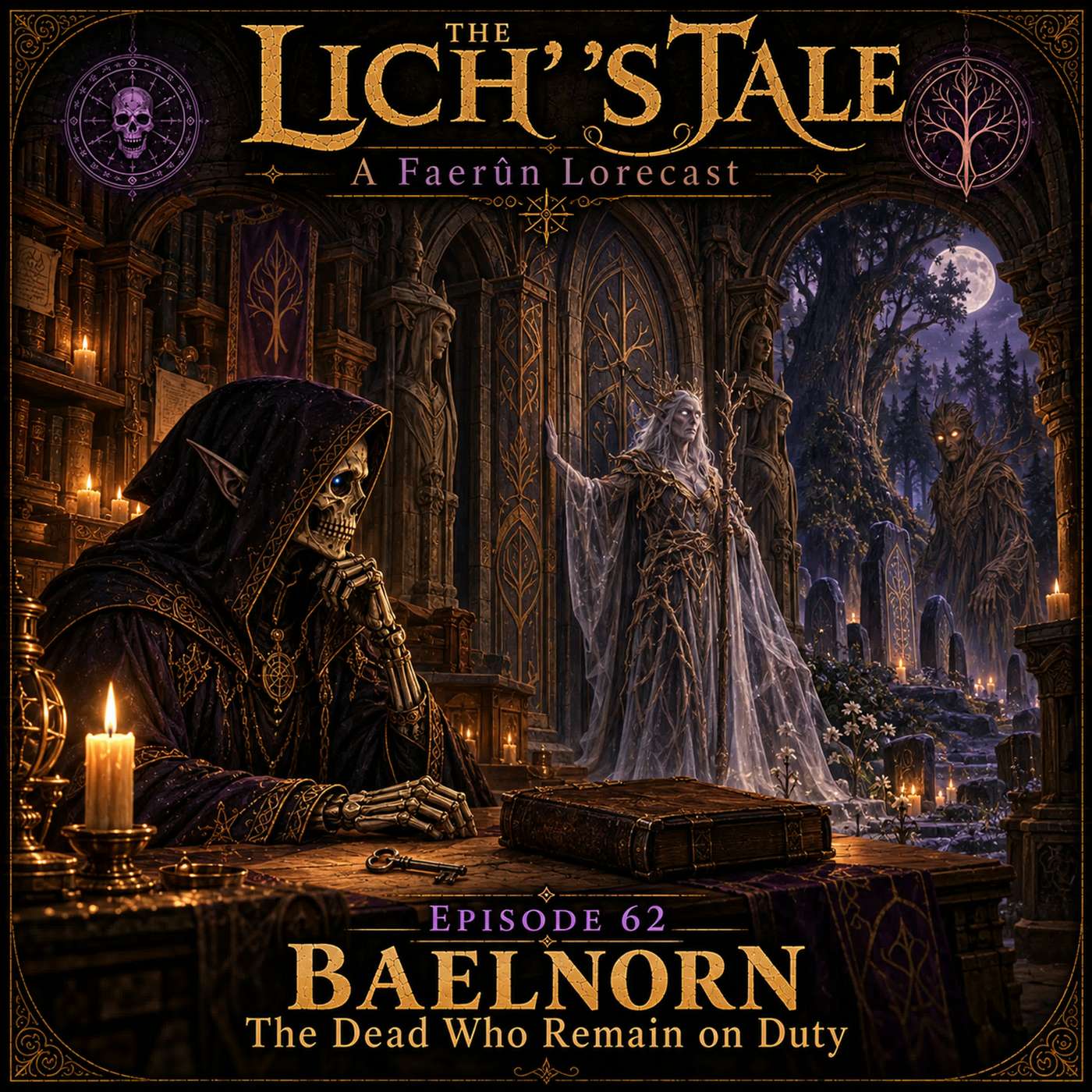
The Lich's Tale: A Faerûn Lorecast · The Lich's Tale
What does it mean to remain when a lifetime of service should be over? In the hidden stacks beneath Waterdeep, Erilian considers the elven guardians who accept a duty beyond death. Through Cormanthyr's watchers, teachers, and wardens, he follows the lives of Synnorha Durothil, the Guardian Paramours, Braerinda, and the Srinshee. In the Vale of Lost Voices, the story of the Audark survivors reveals a more severe form of devotion: silent guardians who cannot leave the sacred forest they protect. An exploration of memory, grief, inheritance, and what the living owe those who keep watch for them. Next: Manshoon and the problem of surviving yourself. Historical lore is distinguished from Erilian's reflections and explicitly imagined scenes. Research editions, access limits, and sources are recorded in the companion Sources.md. This episode does not assert that every historical guardian remains active today. Archive: https://taleofthelich.com Questions and corrections: [email protected] Sponsor: Dharma Web Solutions — https://dharmawebsolutions.com The Lich's Tale is an unofficial, fan-made production, unaffiliated with the owners of Dungeons & Dragons and Forgotten Realms. Chapters 00:00:00 The key and the duty 00:06:33 The life an elf gives up 00:13:29 The choice to remain 00:20:22 Watchers, teachers, and wardens 00:27:17 The altered body 00:34:39 An ancestor in the household 00:41:48 The Guardian Paramours 00:48:50 The Lady of Moonlight 00:55:42 The Srinshee 01:03:26 Venom and the broken clan 01:11:33 Guardians of the vale 01:18:47 The forest as a record 01:25:57 The watch after the fall 01:33:08 A question at the threshold 01:40:27 What the living owe 01:47:46 The lamp for the next visitor
Come in. The lamp is already lit, and the chair by the table is quite safe. I mention that because you have been looking at the other chair, the one beneath the arch, with the expression of a person deciding whether furniture can be haunted. It can, of course. In this instance, however, the chair merely has a weak leg. There are dangers in an archive against which even a thorough knowledge of necromancy is inadequate. I am Erilian Kantonine, keeper of these hidden stacks beneath Waterdeep, and tonight I should like you to consider a small, rather inconvenient question. When someone has spent a lifetime protecting a family, a place, or a body of knowledge, what happens when that lifetime ends? For most people, the answer is that someone else must take over. A daughter receives the keys. An apprentice inherits a desk. A soldier is buried, and another soldier stands at the gate. Sometimes the arrangement succeeds. Sometimes the keys disappear, the apprentice sells the desk, and the replacement soldier has been given three contradictory instructions and no supper. Continuity is a fine word. It becomes a much more interesting thing when somebody must actually provide it. Among the elves of Faerûn, there have been those who offered an extraordinary answer. They would remain. They would give up the ordinary course of their lives and accept a different existence so that a duty need not fail with the body that had undertaken it. We call such guardians baelnorn. Yes. The word has caught your attention. You have been visiting a baelnorn for some time, and I have been reasonably patient about your curiosity. Reasonably. You may ask questions. I reserve the right to object if you begin with how often I need dusting. Our subject tonight reaches well beyond the person sitting across this table. I cannot speak for every guardian who ever watched an elven gate, any more than a single captain can explain every shipwreck. We shall go into Cormanthyr's remembered streets, into the households that kept their dead advisers close, and into a forest where grief changed the form of the people who carried it. We shall meet a teacher whose duty outlasted death, and guardians who could no longer speak at all. Before we go, imagine a modest household key laid upon the table between us. No ancient relic, no celebrated treasure. Merely a key such as a steward might carry. Its iron has been polished by use, and the teeth are uneven because the lock was repaired more economically than wisely. Let it stand for a responsibility: somebody must see that the door opens for the right people and stays closed against the wrong ones. Now imagine that the person given the key survives every person who remembers why the lock was made. The family changes its name. The house above it burns. A road appears where there was once a garden. Strangers arrive with a plausible claim and a pressing need. The guardian is still there. The key still turns. What, precisely, is being protected? That question is the heart of our evening. A baelnorn's existence may begin with a vow, but history does not obligingly stop while the vow is fulfilled. Children become elders. Borders move. A hidden library may cease to be a refuge and become the only surviving store of knowledge that a devastated country needs. An ancestral sword may be a sacred trust to one person and the means of saving a village to another. Even a faithful guardian must understand what faithfulness demands when circumstances change. There is beauty here, certainly. An elder willing to remain so that the young may grow without fear is a moving thing. There is danger as well. The dead can be devoted, powerful, and wrong. Affection does not make judgment unnecessary. Nor does a long memory guarantee that its owner has interpreted the memory correctly. I keep records partly because I know how persuasive a recollection becomes after its owner has repeated it for several centuries. We shall therefore grant the baelnorn neither automatic sainthood nor the condemnation that many frightened travelers attach to any face marked by undeath. We shall look at their work. Who asked them to stay? What did they surrender? What authority did they retain? Whom did they teach? What happened when grief and guardianship grew around the same root? Keep the imagined key near your hand. We will return to it. For now, let the streets above us recede, with their carts and their tavern arguments and their perfectly living people finding new reasons to be unreasonable. We are going east, into the long memory of the elves, to understand why someone might choose to remain at a door after death had already opened another. To understand the sacrifice, we must begin with the life that precedes it. An elf's years do not merely provide more room for the same experiences a human might have. They alter the distance between an act and its consequences. A young elf may know someone who remembers the planting of a grove now treated as ancient. A family dispute can retain witnesses long after the dispute itself has acquired the dignity of tradition. A teacher can meet the grandchildren of an apprentice and find, with some disappointment, that the same errors remain fashionable. This long view can encourage patience. It can also encourage a very durable form of stubbornness. An error does not become wisdom because it has occupied a handsome house for five hundred years. The people of Cormanthyr were no single temperament. Gold elves, moon elves, and green elves lived within a shared realm without agreeing about every part of it. Their habits, political interests, and relationships with the forest differed. Some prized the ordered life of great houses and courts. Some moved more readily among other peoples. Some watched the ambitions of the city from woodland communities that had good reasons to distrust decisions made far from their homes. These differences matter because baelnorn emerged from particular communities and particular needs. An elf did not cease to have a history upon accepting an enduring duty. A former court mage carried the habits of court. A warrior carried the memory of comrades. A member of an old house might know a genealogy with extraordinary precision and understand the neighboring family's grievances rather less generously. To say that a guardian was elven tells us something. It does not tell us enough. Nor should we confuse every elven departure with death. The expression passing west has carried more than one meaning. It can concern a voyage toward Evermeet, a withdrawal from troubled lands into an elven refuge. It can also evoke the greater departure beyond mortal life. A ship sailing west is still a ship, and a passenger aboard it has not thereby become a spirit. Poets may enjoy allowing these meanings to mingle. Historians must occasionally separate them, with apologies to the poets. Arvandor belongs to the sacred hopes and understandings of elven existence. The Seldarine are not an ornamental addition to this story. The prospect of communion beyond a mortal span gives the decision to remain a depth that the simple phrase longer life fails to convey. A baelnorn is not merely someone who has obtained additional time to finish a particularly ambitious piece of embroidery. Something has been set aside. A path that called to the living elf is relinquished in favor of a duty among those who remain on Toril. That does not mean that every detail of elven death is public knowledge. Elves have never felt obliged to explain every sacred matter to the first traveler who mistakes curiosity for entitlement. There are disagreements, guarded rites, and experiences that those outside a tradition describe poorly. We should resist the temptation to fill every silence with a confident answer. A silence can be respected without turning it into a secret conspiracy. In Cormanthyr's old practices, those who died in battle might be carried to the Vale of Lost Voices. Other dead were remembered within the arrangements of their clans. Tombs, forest burials, and the wishes of the deceased all had their place. We shall look more closely at the vale before long. For the moment, notice that the dead already belonged to a living geography. Their memory had places, paths, obligations, and people responsible for its care. A baelnorn made one part of that relationship startlingly immediate. The ancestor could answer. Imagine the effect upon a child who has been told that a particular great elder was brave, wise, and rather severe. In most households, the child must accept the portrait. In a household advised by a baelnorn, there is at least the possibility of meeting the subject and discovering that the portrait has omitted a sense of humor, a dislike of flattery, and a detailed recollection of the child's father's own youthful foolishness. An enduring witness complicates family legend. There is comfort in that. There can also be discomfort. Families select their memories. They polish certain deeds and put others in drawers. A guardian who remembers the contents of the drawers may be valuable for reasons quite different from the strength of a spell. Yet long life is still life, with its changes and its ordinary freedoms. An elf can leave a city, begin a new study, form a new household, or abandon an ambition that has become foolish. The commitment of a baelnorn can narrow those possibilities around a chosen task. Even where a guardian is capable of movement and action, the purpose of remaining is an obligation, not an invitation to an endless holiday. Hold those two things together: the richness of an elven life and the call beyond it. Otherwise the transformation becomes a bargain measured only in additional years. The true question is what those years are for, and what the person accepting them has agreed to forego. In the traditions of Cormanthyr's High Magic, a rite known as the Tribute of One's Duty to the People expressed this commitment with remarkable clarity. An elf could sacrifice an ordinary existence in order to serve a clan or community in another form. The rite was concerned with the relationship between the person and the people for whom the sacrifice was made. It was not a convenient answer to being late with one's research. Baelnorn were one possible result within a wider understanding of transformed service. Other paths concerned spirit warriors or guardians bound to the natural world. We must keep those distinctions. A treant, a spirit warrior, and a baelnorn are not interchangeable names for an elf who has declined to depart. Different forms bear different powers and obligations. The particular path before us is the enduring, magically sustained elven guardian who remains among the concerns of the living. The rite's account speaks of the Call to Arvandor being severed, with duty taking its place. Those are weighty words. I would not reduce them to the image of a door slammed in someone's face. They describe a profound reorientation of existence. The new form and its task sustain the one who has accepted them. The guardian remains because there is something to guard, someone to teach, some responsibility that has been made the center of this altered life. In the Cormanthyr of the old accounts, an earnest desire alone did not ordinarily settle the matter. The Coronal, the High Mages, and the elders of the clan were to agree that the sacrifice should be permitted. Such transformations were exceptional. The community was expected to have a need beyond the ordinary provision of defenders. Consider why that consultation matters. A person may sincerely offer a great sacrifice while understanding only part of what it will require. A family may urgently desire a powerful protector while giving too little thought to the protector's future. A ruler may see strategic advantage where a mage sees spiritual consequence. Agreement among several kinds of authority could check the enthusiasm of any one of them. Could. I choose that word deliberately. A council is made of people, and people can lend one another confidence more readily than wisdom. We should not imagine that a solemn room becomes incapable of error merely because everyone within it has lived a long time. The traditions also allow for transformations brought about by the will of the Seldarine, beyond the arrangements publicly known to the realm. That possibility prevents us from treating one court's procedure as an inventory of every guardian who ever existed. There may be duties and defenders that no clerk recorded. It does not give us leave to invent a divine explanation whenever a story has a gap. Unknown remains unknown, even when it wears a sacred name. Now suppose a household faced the loss of its oldest protector. The borders are troubled. Two young children are heirs to responsibilities they scarcely understand. There is knowledge in the house that would be dangerous in careless hands. The elder offers to remain. It is easy to see the appeal. The children would have counsel. The wards would have a keeper. A threatened community would retain someone who knew both its strengths and its enemies. But listen to the questions that should follow. Who will teach the children to become capable in their own right? Will the elder accept their eventual authority? Does the duty concern a family, a building, a particular object, or the welfare that these things once served? What happens if those concerns pull apart? An oath that sounds magnificent at a ceremony can become very difficult in a corridor full of frightened people. I am not reciting a preserved discussion from an elven council. I am asking you to imagine the responsibilities such a decision places upon everyone involved. A sacrifice is not made less real because others benefit from it. The beneficiaries nevertheless acquire obligations of their own. They owe the guardian honesty about the need, respect for the choice, and some effort to ensure that the life offered in service is not merely consumed by their convenience. There is a difference between accepting help and arranging the world so that a helper can never stop helping. A clan that calls an ancestor noble while refusing to train a successor has found an elegant language for neglect. Nor should admiration become pressure. The existence of a revered path does not make every elf who chooses another path selfish. One may serve a people through a full mortal life and then depart. One may teach while living, leave work in good hands, and accept the call beyond. If only endless service counts as love, then love has become a demand without a boundary. The highest honor attached to the baelnorn's choice should remind us how exceptional it was intended to be. It was a gift of the self, not a tax payable by every capable elder. To understand a baelnorn properly, we must preserve that freedom at the beginning of the story. Otherwise we have praised the guardian while quietly taking away the choice that made the guardianship meaningful. What does such a guardian actually do? This is where the grand language becomes usefully practical. Cormanthyr knew different names for different kinds of service: watchnorns, lorenorns, and those called guardnorns or wardnorns. The distinctions described work and purpose. They help us see the variety concealed by the single word baelnorn. A watchnorn might observe and protect family lands or a public place. Think of the grounds of a castle, where danger need not arrive as an army. A messenger takes the wrong path. A visitor lingers beside an entrance that should not interest him. A person admitted on one errand attempts to accomplish another. Watching means recognizing the difference between an unfamiliar face and a threatening intention, and that requires knowledge of ordinary life as well as magic. The less spectacular part of vigilance is knowing what belongs. Which doors are normally open? Who has reason to be there after sunset? Which child habitually hides in the garden when lessons become difficult? A defender who cannot distinguish an assassin from an embarrassed apprentice will produce many incidents and very little security. I speak with feeling about the apprentice. A lorenorn's work could include teaching, keeping a library, or continuing the study of the Art beyond the years ordinarily available. Here the essential resource is not merely the spell that repels an intruder. It is understanding that can be transmitted. A living library is valuable because someone can ask it a question the original cataloguer did not anticipate. Suppose a young wizard has copied a difficult working correctly and still cannot make it succeed. A written description may preserve the sequence but not the mistake the student is making in practice. A teacher can notice hesitation, misplaced attention, an assumption smuggled into the attempt. Long experience gives a lorenorn a store of such corrections. It also gives the student the uncomfortable knowledge that the excuse being prepared has probably been heard before. Yet teaching demands more than repeating the way a thing was once done. The pupil has a particular mind. The surrounding world may have changed. The purpose of the lesson is to create someone capable of judgment, not an echo that happens to breathe. A guardian of knowledge has failed in a subtle way if the knowledge can never safely leave the guardian's hands. A wardnorn's responsibility might center upon a crypt, a secret place, or an object whose power demanded exceptional protection. Here the threshold has sharp consequences. A curious trespasser and a deliberate thief may both be capable of releasing a danger. A protected object may deserve its protection because it is precious, because it is perilous, or because the rights attached to it remain valid even after the surrounding walls have fallen. These tasks could overlap. The Srinshee, whom we shall meet properly in a little while, served as guardian of the Vault of Ages and as a teacher to the armathors and court mages. Guarding and teaching belonged to the same long life of service. The titles should not be mistaken for cages into which every baelnorn fits neatly and forever. Nor were all baelnorn simply statues waiting beside a particular chest. They could possess the capacity for action and movement that they had enjoyed in life, though their commitments and the unease of others often narrowed their public activity. There are exceptional guardians whose restrictions were much more literal. The baelnorn of the Vale of Lost Voices will show us why it is unwise to turn one example into a rule for all. Social unease deserves a moment of its own. A community can honor a sacrifice and still find the daily presence of its consequences difficult. The ancestor is revered, but the family does not necessarily want every visitor to encounter an undead elder at breakfast. The protector is trusted, but younger officials may feel diminished by a figure who remembers their predecessors' predecessors. These responses do not all arise from hatred. Some come from fear, grief, embarrassment, or the ordinary desire to have room to become oneself. Imagine a library whose keeper has outlived the architects, the donors, and several changes in the language of its catalogues. Such a keeper can tell you why the eastern alcove must remain dry, which shelf was moved after a flood, and why an apparently worthless bundle of correspondence should never be discarded. That is practical memory. Lose it, and you may spend a century rediscovering what a single conversation could have taught you. But the keeper must also listen when the roof begins to fail in a way it has never failed before. The past can explain the building. It cannot replace looking up. That is the daily discipline behind these names. The watchnorn notices. The lorenorn teaches and studies. The wardnorn protects a trust. Each can be magnificent. Each can fail by mistaking the familiar method for the purpose it was meant to serve. When we speak of the dead remaining on duty, these are the duties we should picture: attention, instruction, and the difficult judgment at a threshold. You have waited politely to ask about the body. We may as well discuss it before curiosity distracts you from everything else. A baelnorn is an enduring person in an altered condition, sustained by magic. The resemblance to a lich can be strong enough that an unprepared stranger sees only the resemblance and reaches for a weapon. That reaction is understandable. It is not always intelligent. Descriptions of the baelnorn of Cormanthyr speak of elven forms whose skin has shriveled and become increasingly translucent. Age can make the structure beneath it plainly visible. Other accounts emphasize pale, luminous eyes. Individual appearance is not uniform. Magic, the circumstances of transformation, and the guardian's own practices can produce differences substantial enough to defeat a traveler's confident little checklist. A baelnorn need not project the supernatural terror associated with a predatory lich. That distinction does not guarantee that an encounter feels comfortable. Fear also comes from the observer. A traveler who has seen a village devastated by undead may tremble before a harmless funerary carving. Another may remain composed before a genuine danger because it has excellent manners. Neither response tells us everything about the being encountered. The traditions that distinguish baelnorn from ordinary liches also do not make the familiar soul vessel an essential feature of their existence. Some accounts allow particular guardians to make use of cloning magic, but that is not grounds for assuming that every baelnorn has a hidden jar waiting to be smashed. A habit of identifying a creature, announcing a universal weakness, and charging forward has furnished many tombs with additional occupants. Still less should we imagine that every form of undeath is maintained by the same appetite. The guardians before us are sustained through the magic of their condition and its purpose. We have no reason to attach the soul-consuming practices of other undead to them merely because the living find both appearances unsettling. Accusing an individual of a dreadful act requires more than a resemblance. The same care applies to their powers. Many baelnorn had been formidable spellcasters and retained their minds and command of magic. That alone made them exceptional defenders. Their value was not exhausted by an ability to endure a blow. They could remember a ward's construction, recognize an enemy's method, and consider a problem for longer than most adversaries could afford to wait. A particularly revealing ability was the sending image: an extension of the guardian's presence through which communication, and in some accounts spellcasting, could take place. The figure encountered in a corridor might therefore be a projection while the guardian's body remained elsewhere. Such an image was not simply a second solid person. It could not necessarily grasp an object or perform the physical work that a hand could accomplish. This distinction changes an encounter. Suppose a warning figure appears before a party approaching a sealed door. The frightened travelers may think they have found the guardian and begin planning how to get around it. They may instead have met the first means by which a guardian has chosen to speak to them. The warning is an opportunity for information to pass in both directions. Who are they? Why have they come? What do they know about the place they are entering? A projection can also allow a guardian to remain socially present without bringing an altered body into every room. Consider the gentleness that might permit. A child need not be startled awake by a shadowed figure at the bed. A teacher can speak across a protected threshold. A defender can warn before approaching with overwhelming force. None of those uses proves that every guardian is gentle, but the ability makes more choices possible than simple violence. There is a practical lesson here about appearances. An image can reassure, intimidate, instruct, or deceive. A beautiful figure may be an illusion. An alarming one may be an honest presentation. The proper question is what the speaker does with the advantage that magic provides. Does it clarify the situation? Does it offer a chance to withdraw? Does it make a demand that can be understood? Do not hear this as a promise of safe passage through an elven vault. A guardian may judge you an immediate threat, and the judgment may be correct. The protected place may contain things that cannot tolerate an experiment in conversational goodwill. Prudence is still a virtue, even when the person practicing it has a touching confidence in their own intentions. What I ask is that we distinguish capacity from character. A baelnorn may be magically formidable, physically strange, and entirely committed to protecting someone. Those facts can coexist. Conversely, venerable appearance and a declared duty do not place every decision beyond examination. Power makes a promise enforceable. It does not tell us whether the promise was wise. We have looked at the altered body and the ways it can act. Now we must look at the people around it. For a guardian's power matters most in the relationships it creates: the living relative who asks advice, the heir who wants independence, and the community that must decide how much authority to leave in hands that will not grow old in the usual way. A family with a baelnorn has an unusual inheritance problem. The ancestor may be dead, but the ancestor's opinions remain available. Anyone who has endured an energetic discussion over a modest estate can appreciate how much more complicated the discussion becomes when its oldest participant has no intention of leaving the room for the next several centuries. Cormanthyr offers a particularly instructive example in the Durothil family. Lady Synnorha Durothil was a baelnorn whose age would otherwise have made her a natural claimant to the standing of clan elder. Yet the family's recorded arrangements preserved a distinction between the dead and the living: the undead were barred by tradition from claiming official clan rank among those still alive. Synnorha could advise. She did not simply occupy the living family's highest place because she had survived longest. Her great-granddaughter Uschymna held the position of clan elder and quietly relied upon Synnorha's counsel. There, in a small piece of household history, we find something more valuable than a grand declaration about the wisdom of ancestors. We find a boundary. Experience could be consulted without becoming an automatic title to rule. The arrangement did not make influence disappear. Advice from a powerful ancestor can weigh heavily even when it carries no formal command. A living elder might feel reassured, indebted, challenged, or all three at once. The distinction nevertheless gave the living a recognized place from which to act. The family could possess continuity without requiring the same person to hold every office forever. Why should that matter? Because families continue by producing new people, not simply by preserving an old set of instructions. A child must eventually become someone whose judgment can be trusted. A ruler must decide matters for which there is no exact precedent. A marriage, a migration, a new alliance, or a change of livelihood may be necessary even when it disappoints an ancestor's expectations. If the guardian's purpose is the welfare of the family, then the family's capacity to govern itself is part of what must be protected. Keeping every descendant permanently dependent would preserve the guardian's importance at the expense of the guardian's charge. It would be a very elaborate way to misunderstand the task. Imagine, then, a younger relative approaching an ancestral adviser with an intention to leave. The family has occupied the same lands for generations. The young person wants to study elsewhere, marry into another community, or pursue work that the household does not understand. The elder sees risks with painful clarity. Perhaps the elder remembers a war on the proposed road, a betrayal by the proposed allies, a disaster that began with similar confidence. The young person may be naive. The elder may also be treating an old event as though it were the only future available. A useful conversation must allow both possibilities. Long memory should give a decision more evidence. It should not make new evidence inadmissible. This imagined disagreement is ordinary enough to occur among the living. Undeath changes its scale. Most families eventually lose the people whose judgments shaped their beginnings. With a baelnorn, a foundational judgment can remain embodied and persuasive for an extraordinary span. That can prevent a harmful mistake from being repeated. It can also allow an old grievance to retain a voice long after everyone else would have been ready to put it down. Consider inheritance in its wider sense. There are possessions, certainly: jewels, spellbooks, tools, land, and weapons. There are also obligations to tenants, neighbors, dependants, and allies. A guardian who protects the silver while forgetting those relationships has preserved the easiest part of the inheritance. A household's honor cannot be stored entirely in a locked chest. Nor is family lore always flattering. A baelnorn may remember that an admired founder was helped by someone later omitted from the family account. The name of a rescuer may belong to another people, another faith, or a rival house. A useful guardian can keep that inconvenient debt visible. Without such reminders, ancestry can become a ceremony in which each generation congratulates itself upon a past it has edited for comfort. There is room for humor in this. Imagine a proud descendant beginning an account of the family's unbroken dignity while an elder nearby remembers the founder falling into a pond during an attempt to impress a prospective spouse. The correction need not destroy affection. It may save the family from becoming unbearable. But there is grief as well. Every new generation brings the possibility of attachment and the certainty of change. The guardian may watch faces echo older faces, hear familiar turns of phrase return in new mouths, and then lose those people too. We should not assume that repetition makes bereavement trivial. Memory can deepen affection rather than wear it away. Synnorha's example therefore gives us a useful starting measure for good guardianship. Remain available. Preserve what is needed. Let the living have their names and offices. The ancestor's task is not to occupy the future so completely that there is no room left for descendants. It is to help make a future in which descendants can stand. The household was not the only possible object of loyalty. Some guardians served a larger community, and one of Cormanthyr's oldest stories makes that shift through an unexpectedly intimate beginning. The Guardian Paramours were lovers whose families forbade their union. They sought the Coronal's aid. Their deaths were staged, and they were transformed together, becoming baelnorn sworn to the Coronal and Cormanthor rather than to a particular house. There is a great deal packed into that account, and a storyteller should resist the temptation to decorate every empty space. We do not need invented conversations beneath invented balconies to see the choice before them. Family authority had denied the relationship they wanted. The Coronal offered a path that placed their continuing existence in the service of something wider than the families that had kept them apart. They became defenders of the grounds of Castle Cormanthor. Love and public duty were joined in an enduring arrangement. It is a striking origin for guardians who might otherwise be reduced to figures on a list of magical protections. Notice the precision of the claim. They were remembered as the first baelnorn sworn to that royal and civic service rather than to a particular house. That is not the same as saying they were the first baelnorn ever to exist. History suffers when a useful distinction is trimmed away to make a sentence sound more impressive. I would rather keep the distinction and lose the flourish. The tale also refuses to remain entirely comfortable. We can rejoice that the lovers found a way to remain together and still ask what sort of society made so extraordinary a transformation necessary. The solution was astonishing. The original cruelty was smaller and more familiar: families deciding that their authority mattered more than the wishes of those whose lives they governed. I do not know all the motives of those families. The preserved account does not authorize me to distribute invented sins among them. What we can see is the result of the prohibition and the path taken in response. It is enough to make us cautious when a household calls its every demand a duty. Some duties protect people. Others protect the household's power over them. Service to the Coronal offered another alignment of loyalties. A baelnorn bound to a family might be expected to care first for that family's holdings. A guardian sworn to the realm's ruler and the grounds of the castle served a place where many families' interests met. Such a shift mattered in a civilization whose houses could be both pillars of strength and obstacles to common action. Cormanthor's later opening to other peoples brought those tensions into sharper view. Eltargrim's vision of a more inclusive city did not dissolve inherited prejudices by decree. The transformation into Myth Drannor involved institutions, protection, teaching, and difficult coexistence. A city can announce a welcome in a single day. Its residents must practice the welcome repeatedly, often when doing so is inconvenient. For an enduring guardian, such a change could require more than learning new faces. The meaning of authorized presence could broaden. People once regarded as outsiders might become neighbors, students, colleagues, or persons entitled to the city's protection. The guardian's memory of an older arrangement would remain accurate as history while becoming insufficient as a guide to present conduct. Think how concrete that is at a gate. The person approaching is a dwarf or a human. An older generation would have treated the approach with suspicion. The ruler's new arrangements permit entry. The guardian must understand which instruction governs. If an oath to defend the city is interpreted as an oath to prevent the city from changing, the defense can become a rebellion against the people who actually live there. This is an interpretation of the problem, not a claim that the Guardian Paramours themselves refused a lawful visitor. We should not burden them with misconduct merely to make a lesson convenient. Their remembered faithfulness is the point from which the question arises: faithful to what, and through which changes? A realm is more than the ruler's body. It includes the people, institutions, agreements, and places that make life together possible. Yet the ruler may be the person to whom an oath is formally addressed. The relationship between those two facts can become difficult when rulers die, policies change, or a court's interests drift away from the welfare it is supposed to serve. Baelnorn make such difficulties visible because they can outlast the original participants. The promise remains embodied while the surrounding arrangement moves on. There is dignity in the possibility that someone can carry an obligation across those changes. There is peril if the obligation is treated as an excuse never to think again. Remember the lovers at the beginning of this passage. Their story began with a choice about whom they could love and ended with a role in the protection of a community. They were people before they were guardians. The fact that their duty became famous should not erase the humanly understandable desire that led them to it, even though the people in question were elves and would doubtless object to my adjective. Another guardian of Castle Cormanthor brings us closer to the private cost of remaining. Braerinda, remembered as the Lady of Moonlight, was a moon elf baelnorn associated with the castle's gardens. Her actual dwelling lay deep beneath the keep's cellars. She preferred to communicate and watch through a sending, and she surrounded her appearance with an unusual beauty of magic. The descriptions are luminous: a form gleaming with a bluish white radiance, eyes like dark spaces scattered with silver points. Her appearance was not merely a frightened witness's attempt to explain a pale figure in the dusk. She used spells and effects to shape the way she was seen. The result could be magnificent without making her ordinary living flesh again. We should pause over that choice. It is easy to imagine that an undead guardian must have ceased caring about beauty. Why should that follow? An elf who valued grace, light, and the expression of the Art need not lose every such inclination because the body's condition has changed. Appearance can be an act of taste, a form of courtesy, a means of privacy, or simply something the person enjoys. Braerinda was the last surviving member of House Calauth, a moon elven house of Arcorar. That fact changes the light around the whole account. She preserved the memory of a house associated with bards, but those who might once have shared that memory were gone. A name can remain in an archive after the conversations that gave it warmth have ended. What does last mean in that circumstance? It does not mean that the world has stopped containing people. The garden may be full of them. It means that certain things can no longer be recalled together. There is no one nearby who remembers the same voice from the same room, who can interrupt a story to restore the detail that affection has misplaced, who knew a familiar person before that person became a solemn entry in a genealogy. A survivor can preserve facts alone. Shared memory requires someone else. The old account tells us that Braerinda longed for conversation and remembrance, and that she found a friend in Elminster during his early days in Cormanthor. I shall not invent the words they exchanged. The friendship is significant without a fabricated speech. A figure whom a hurried account might describe only as a magical defender was also someone who wanted company. Think of what a patient listener can offer in that situation. They cannot become the lost family. They cannot remember what they never experienced. They can nevertheless allow a memory to become part of a new relationship. A story passes from solitary recollection into another mind. The listener asks a question, and the speaker discovers that the vanished house can still matter to someone who never stood beneath its roof. That is one reason I am glad you came down the stairs tonight. An archive is not complete when everything has been placed upon a shelf. It must also be possible for something on the shelf to reach a living person with enough context to be understood. Otherwise preservation becomes a very careful arrangement of loneliness. Braerinda's example also warns us against measuring a guardian only by the task performed for others. A court might value her watchfulness. Visitors might admire her radiance. An intruder might fear the power behind the sending. None of those responses necessarily asks what she herself needs. Service can make a person useful enough that everyone forgets to consider the person separately from the usefulness. This is not an accusation against every person who knew her. Elminster's friendship is evidence of the contrary possibility. It is a reminder that ordinary companionship can matter within a life whose circumstances seem extraordinary. There need not be a world-threatening crisis to make a conversation worthwhile. Suppose you were admitted to such a garden. You might prepare questions about the castle's defenses, the history of a ward, or the safest path through an ancient danger. Those could be proper questions. You might also ask about the songs of the house she remembered, and then have the courtesy to listen to the answer without looking over her shoulder for the next important person. I am offering an imagined visit, not promising that you can make it now. The Braerinda we are discussing belongs to the old history of Cormanthor. A record of where someone once kept watch does not certify that they stand there today. Too much has happened to that city for us to treat every remembered address as a present invitation. Yet the historical encounter remains valuable. It shows us a baelnorn whose guardianship included beauty and whose endurance included loss. It shows that the dead who remain can still have preferences, friendships, and needs that duty alone does not meet. Most of all, it gives us a counterweight to the image of the solitary sentinel who supposedly wants nothing except an undisturbed door. Sometimes the sentinel would like somebody to sit down and ask a sincere question. That is a smaller undertaking than saving a kingdom. It may also be the undertaking available to you. The Srinshee's name carries a different weight. Even among the long-lived and magically accomplished, she stands as a figure whose history is difficult to contain. Lady Oluevaera Estelda, known through the settlement of Srinshinnar and the people she led, became a guardian, a teacher, a counselor to Coronals, and one of the great masters of elven magic. Her story is much larger than her time as a baelnorn. That is precisely why we should not let that time disappear inside the larger fame. The old chronology places her transformation centuries before the opening of Myth Drannor, and her return to living elven form in the year two hundred and sixty-one of Dalereckoning. Between those points lay nearly a thousand years of existence as a baelnorn. The figures are useful chiefly because they give proportion. We are considering an enduring chapter of a life, not a brief interruption between two more interesting adventures. Her earliest history is not entirely clear. There were stories about the places she had known and the length of her life, and not every story can be given the same confidence. We can say that she survived the destruction of communities and led survivors toward safety. The account of Srinshinnar places her amid the losses of the Shadow Wars, with her own clan gone and a remnant of people brought to Cormanthor. That history of survival gives her later work a context. Protecting a vault and teaching a court are not merely two prestigious appointments. They are ways in which a civilization retains the means to continue after loss. The vault holds things that must not vanish or fall into dangerous hands. The classroom produces people capable of using knowledge with care. One safeguards an inheritance; the other gives the inheritance a future. As Wardnorn of the Vault of Ages, the Srinshee guarded treasures of the Coronal. As a teacher, she instructed the armathors and court mages. Those roles required judgment about access. A guardian cannot simply refuse everyone forever if the protected knowledge is meant to sustain a living realm. A teacher cannot simply release everything to every student if some workings demand experience and restraint. Her service therefore stood at a demanding intersection. She had to know what should remain closed, what could be taught, and who was prepared to receive it. Such decisions are easy to criticize from a distance, especially by people who have never had to account for the consequences of a mistaken admission. They are also decisions that can be abused. The power to say that someone is not ready can become the power to keep them unready indefinitely. The Srinshee's long relationship with Eltargrim gives us a more personal view of this work. She watched him grow as a warrior and guided his development as a High Mage. Her affection for him is remembered in the manner of a proud elder toward a pupil who had listened carefully. That is a remarkably domestic image to place beside the scale of their power, and I find it helpful. Great projects often depend upon somebody once having taught somebody else to pay attention. A ruler trained by an enduring guardian can inherit more than techniques. He can be challenged by someone who knew him before he possessed a title. The rest of the court may rearrange its language around the ruler's authority. A teacher can remember the person beneath it. That memory can become a restraint against vanity, provided the ruler still permits correction and the teacher still understands the person he has become. The Srinshee was restored to life and youth before the opening that would transform Cormanthor's civic future. Mystra's involvement was rumored, but the circumstances should remain uncertain where the account leaves them uncertain. A great event does not become clearer because a storyteller assigns a god to every unexplained part. We can honor the wonder without pretending to know the whole mechanism. Her later participation among the makers of Myth Drannor's mythal belongs to that restored life. Keep the sequence clear. A woman who had spent centuries as a baelnorn could act again in living form. Her knowledge, relationships, and responsibilities did not become irrelevant because her condition changed. Nor does the exceptional restoration prove that every baelnorn can expect the same future. A singular event is a possibility within history, not a promise to everyone who makes a sacrifice. What does her example teach us about the meaning of service? First, that the guardian is larger than a single office. The Srinshee had been a survivor and leader; she became a keeper and teacher; she continued into further deeds. Second, that preservation and renewal need not be enemies. The person who remembers what was lost may also help create something that has never existed before. That second point deserves emphasis. We often picture the ancient as defenders of an unchanging order. Here is an ancient figure whose teaching helped prepare a ruler for a new undertaking. Memory could furnish courage as well as caution. Knowing how often narrowness had led to disaster could support an effort to build a broader community. We need not tell the whole history of Myth Drannor again to feel the importance of that. The city did not emerge from a blank forest. It inherited wounds, loyalties, rivalries, and accumulated knowledge. Among the people who carried those inheritances was a former baelnorn who had refused to let death end her usefulness, and who did not let usefulness end with the preservation of old things. There is a demanding hope in that life: to remain long enough to teach, and to teach well enough that something new becomes possible. Now we leave the court and go into a part of the forest where the word duty acquired a harsher texture. Before it was remembered as the Tangled Vale, this woodland had known another name and another kind of life. The arrival of the green dragon Venominhandar, called Venom, changed both. Trees and paths were distorted by the dragon's magic, communities were attacked, and a beautiful country became a place arranged around a predator's advantage. A dragon's influence is not confined to the ground upon which its body rests. Fear changes journeys. Families leave fields or gathering places unused. Warriors spend their strength protecting a boundary instead of tending the life within it. Allies and lesser creatures gather around power. Venom's followers included wyverns and other draconic threats, multiplying the reach of the danger. The forest itself became difficult to traverse, its twisted growth serving the ruler who had imposed it. For the green elves whose homes lay there, this was no distant problem to be discussed when other business permitted. It was the destruction of the world in which their daily lives made sense. The larger realm attempted campaigns against the dragon, but failed assaults and competing threats left the people of the vale with reasons for bitterness. Some believed that their suffering received less attention because it lay beyond the places most valued by powerful gold and moon elven interests. We should distinguish the grievance from an effortless verdict upon every decision of the realm. Cormanthyr faced dangers on more than one border. Armies could be required elsewhere. But an explanation of scarcity does not erase what scarcity feels like to the people left exposed. A village does not become less burned because the council had a difficult choice. General Halflar Audark became central to the struggle. Green elven warriors gathered around him, and members of his own clan committed themselves to the effort against Venom. Their resistance extended through a long contest of raids, smaller victories, and repeated danger. The great confrontation was not the first thing they tried. By the time it came, the conflict had already consumed an immense portion of the country's attention and lives. In the year remembered as the Year of Silver Wings, two hundred and forty-nine years before the beginning of Dalereckoning, a force of nearly three hundred elves attacked the dragon's lair. Their losses were terrible, but they killed a great green wyrm. The surviving warriors began their return with the dragon's head borne before them. Imagine the relief they must have thought they were carrying home: proof that the terror had finally been ended. We cannot know every thought in that procession. We can understand the mistake upon which its hope depended. Venom had not been a solitary dragon. There was a mated pair. A second great green wyrm attacked the returning survivors, and its poisonous breath killed them before they could mount a successful defense. Halflar died with his warriors. The victory in the lair had been real, and the conclusion drawn from it had been fatal. The place of that slaughter became the Vale of Lost Voices. The name preserved the terrible silence of the army's destruction. It was thereafter a place where fallen elven warriors could be buried and remembered. The landscape held both the evidence of resistance and the warning against mistaking partial knowledge for complete understanding. There is no need to manufacture a secret betrayal to make this tragedy meaningful. The known facts are dreadful enough. A people fought a genuine threat with courage and suffered because the threat was larger than they understood. Bravery cannot correct information that never reaches the brave. The survivors' families were left with a victory that had not brought their loved ones home and an enemy that still existed. Only a dozen members of the Audark clan survived the catastrophe described in the account: four women and eight men, among them Mistale Audark, Halflar's wife. We should not hurry past her name in our eagerness to reach the transformation. Before she was associated with a proposal for enduring guardianship, she was someone living after an enormous loss. The shape of her family had been broken. The place where the dead lay had become a center of memory that could not simply be abandoned. The surviving dragon continued for years. Its territory diminished, but containment was not the same as safety. Eventually, in the Year of Elfsorrows, two hundred and six years before Dalereckoning, the moon elf Jassin Aunglor confronted the remaining wyrm with a moonblade. The struggle ended in the collapse of the lair, and neither Jassin, the dragon, nor the blade emerged from the fallen stone. The account treats this as the end of Venom's rule, while leaving the buried scene beyond ordinary recovery. After the dragon's final downfall, Mistale went to Cormanthor with a request. She and the other surviving Audarks wished to become baelnorn, guardians of the vale where their people lay. The proposal sought to turn the lives left after catastrophe into an enduring protection for the dead and the sacred ground around them. This was an exceptional request within the knowledge of the High Mages. Baelnorn had commonly been spellcasters, while these green elven survivors belonged to a different tradition of skill and life. The outcome of such a transformation was uncertain enough to cause controversy. Eventually the request was granted. The account gives us that decision. It does not give us every word spoken, every doubt felt, or the private measure of consent within each surviving heart. We should not invent certainty about those things. We can see that grief, devotion, and the need for guardianship converged in a choice that changed the Audarks forever. To understand the guardians they became, we must carry the history of the forest with us. They did not arise in an empty sacred grove. They arose from a country that had learned, at terrible cost, how much could be lost when protection failed. The Audark guardians differed markedly from the wizardly baelnorn most familiar in the courts and vaults of Cormanthyr. Their altered flesh was described in the dark greens and browns of the forest, hard as petrified wood. Their hair resembled moss. Their eyes shone amber. If you had expected a pale court scholar, the vale would have corrected your expectation immediately. They were warriors of extraordinary ability. Their command of the forest included concealment, swift magical movement within it, and awareness conveyed through the creatures that lived there. The woods were not merely a wall around their post. They were part of the means by which the guardians knew the post was threatened. Most poignant of all, these baelnorn could not speak. The guardians of the Vale of Lost Voices carried its name into their own condition. They communicated through action and through their relationship with the forest. They could also send apparitions to warn intruders. Their silence should not be confused with the absence of thought, feeling, or intention. A person can have much to say without possessing the means by which another expects to hear it. Their duty was also tied to the place in a particularly direct way: they could not leave the vale. Recall our earlier caution about universal claims. Some baelnorn could move and act broadly. These guardians could not simply decide to visit the capital or follow a thief across the whole of Faerûn. The boundary of their charge was a boundary of their existence in the world. There is strength in such concentration. A defender who knows a place intimately and remains there through the generations can notice changes that a passing patrol would miss. There is also a cost. The guardian's future is bound to the place's future. Every funeral, every desecration, every act of remembrance arrives within the same enduring duty. The world beyond can change while the watch continues beneath familiar branches. Funeral processions were among those the guardians recognized and protected. A baelnorn might lead the procession of a particularly valiant warrior, an honor that made guardianship visible as welcome rather than threat. Picture the difference between an apparition barring a path and a silent figure taking the lead along it. The power may be the same. Its meaning changes with the purpose of the visitors. The guardians also watched those who came to pay respects. Elven visitors could announce why they had entered, and a warning apparition might demand that an intruder explain or withdraw. Outsiders faced more severe scrutiny. A declared purpose did not by itself confer a right of passage. The vale was sacred ground, and the guardians' understanding of that ground included the right to refuse entry. This could be frightening even to a respectful traveler. A person may mean no harm and still misunderstand the customs of a place. Ignorance can be dangerous without being malicious. We need not pretend otherwise in order to recognize the legitimacy of protecting graves. The tension belongs to the history: the guardians protected a trust, and their methods could be lethal. Grave robbers made that tension worse. Some sought the valuables buried with the honored dead. Magic could allow thieves to enter and escape quickly, and even a small number of successful thefts could encourage many more attempts. A boast carried beyond the forest might become a map in the mind of the next fool. The cost of one intrusion therefore extended beyond what was taken on that occasion. By the year three hundred and twenty-one of Dalereckoning, the old account describes fewer warnings and more intruders killed on sight. That is a grim development. Repeated violations hardened the guardians' response. It would be comforting to imagine that righteous purpose always produces patient methods. History gives us less comfort and more responsibility. We can understand why the guardians became harsher without declaring every possible consequence just. The dead they protected could not recover a stolen gift. The forest had already suffered predation. Yet the reduction of warning also narrowed the chance for an ignorant or mistaken visitor to correct a course. A defensive measure can answer a real danger while creating dangers of its own. I will not invent an innocent victim to sharpen the point. The recorded change in conduct is sufficient to raise it. Nor will I pretend to know how each silent guardian weighed these matters. The absence of speech in the account is not an invitation to place convenient speeches in their minds. What we can say is that their story complicates the easy image of the good undead guardian. Good purpose does not make an encounter gentle. Devotion can coexist with severity. Trauma can leave a community deeply protective of boundaries that a stranger scarcely notices. To approach such a place responsibly would require more than confidence in one's own virtue. It would require knowledge, restraint, and a willingness to accept that the place is not waiting to become part of one's adventure. The Audarks remained on duty. Their endurance preserved a sacred landscape and the memory of those for whom they had sacrificed. Their story also leaves us with a hard question about every long watch: how does a guardian keep responding to actual danger without allowing the history of danger to become the only thing the guardian can see? Let us walk more slowly through the place they protected. A sacred forest can look empty to someone who has been taught to recognize importance only when it is carved upon a large stone. The Vale of Lost Voices held different ways of burying and remembering, and those differences made the guardians' knowledge especially important. Among the gold elven customs described for the vale were stone mausoleums, sometimes protected by magical wards. In later circumstances, some were placed underground to make them less accessible to thieves. The honored dead could be laid out in their warrior's finery. Powerful weapons might pass to living members of the clan rather than be sealed away, while relatives placed other offerings with the deceased. There is a practical and emotional balance in that arrangement. A weapon needed by the living can continue to serve them. A personal gift can accompany the dead. The distinction shows that burial was not simply the indiscriminate removal of useful things from the world. Families made choices about continuity, remembrance, and need. Moon elven burials could be placed in glens and clearings, beneath an open view of the night sky. Fine robes, jewelry, and gems accompanied some of the dead. Magic restored the disturbed vegetation, concealing the precise location. A family might know where someone rested while a stranger saw an unbroken patch of woodland. To the person seeking a visible monument, that concealment could look like an absence of commemoration. It was a different form of commemoration, one whose meaning depended upon relationship and knowledge. A place can be known intimately without being announced to every passerby. Privacy is not the enemy of memory. The green elves had practices more closely entwined with the trees themselves. A renowned warrior might be buried with an enchanted acorn upon the chest, which would grow into a sapling. Other remains could be joined with trees through druidic magic, with particular distinctions concerning oaks and the druids of Rillifane. The forest's living growth became part of the way the dead were held. These are customs of the people and period we are discussing. They should not be turned into a rule that every elf across Faerûn has always followed. Even within a shared tradition, families and individuals can have particular wishes. The richness of the account lies in its differences, not in our ability to flatten them into one tidy ceremony. Now consider what guardianship means in such a landscape. A defender must know that the unmarked clearing is not unoccupied land, that the old tree is not simply convenient timber, that a path through the understory may cross the resting place of a family. An outsider's ignorance does not remove those relationships. The guardian's memory gives the place a legibility that the outsider lacks. This is one of the most concrete services a baelnorn can provide. Stone erodes. Markers fall. Oral instructions may become uncertain when generations are displaced. A surviving witness can preserve the connection between a name and a place. The witness can also prevent the practical violence that follows when someone treats what they cannot identify as something without an owner or a history. Imagine a descendant returning after many years away. The path remembered from childhood is overgrown. A storm has brought down a recognizable tree. The person carrying the family story is unsure which clearing was the right one. A guardian who remembers can turn a bewildering forest back into a place of relation. The help offered is not a spectacular spell. It is the ability to say, by whatever means are available, that the person sought is here. Now imagine the opposite approach: a stranger enters with a spade and an argument about the usefulness of buried wealth. There may be practical needs outside the forest. There are always practical needs somewhere. That fact does not give every stranger an unrestricted claim upon another community's dead. The language of usefulness can become a very convenient disguise for appetite. The difference between those imagined visitors cannot be determined solely by their equipment. A mourner may carry tools to tend a site. A thief may arrive with flowers and an excellent speech. The guardian must attend to behavior, knowledge, and purpose. The task is difficult because appearances can be borrowed while relationships cannot simply be claimed into existence. Funeral processions made those relationships public. The deeds of a fallen warrior could be recited as the mourners moved through the forest, bringing the life into the place where the body would rest. A guardian's presence could affirm that the community received the dead. The silence of the Audark baelnorn did not make their participation meaningless. Taking the lead along a path could be an act of recognition more eloquent than a formal address. We often speak of guarding treasure as though treasure were a stable category. The vale asks us to broaden the word. There were valuables, certainly. There were also names, obligations, distinctions among burial places, and the assurance that a person would not be treated as abandoned because the living had gone elsewhere. The guardians protected those things together. Their forest was a record that happened to grow leaves, and they knew how to read it. A guardian's task becomes more difficult when the society around the task collapses. The fall of Myth Drannor left more than broken architecture. It disrupted the ordinary relationships by which a protected place explains itself. A door that once stood inside a household might later open from a rubble-filled street. A vault whose custodian answered to a living institution might remain after the institution had ceased to function. The guardian could survive the destruction of the arrangements that made the guardianship intelligible. Accounts of baelnorn among Myth Drannor's ruins describe them continuing to protect deep repositories of spellbooks and magical objects. That persistence is easy to admire from a distance. It is also worth examining closely. Keeping something safe through catastrophe is not the same problem as keeping it safe in a functioning city. The latter can rely upon recognized authority, messengers, neighbors, supplies, and people who understand the rules. The former may have almost none of those advantages. A living visitor might see an abandoned ruin. The guardian might see an occupied trust whose beneficiaries have been scattered. Both are looking at the same stones, but only one has knowledge of the continuing obligation. That difference can be the beginning of a conversation or the beginning of a fatal misunderstanding. The word abandoned does a great deal of work in the mouths of treasure seekers. Sometimes it is accurate. Sometimes it means only that nobody answered when the seeker called from a safe distance. The absence of visible occupants does not settle the ownership of a place, the danger within it, or the rights of people displaced from it. Ruins are often treated as though history has conveniently cleared their title. History is seldom so obliging. Imagine a family driven from a city during a disaster. They leave behind records of kinship, a dangerous working that cannot be transported safely, and the tools by which a future return might be made possible. An elder remains to guard them. Years pass. The family's descendants know only fragments of what was left. Other people arrive with an entirely different understanding: a ruin, a locked room, something valuable inside. The imagined guardian must distinguish heirs from claimants, necessity from appetite, and a sincere mistake from a practiced deception. A family name may have changed. A sign of recognition may have been lost. A person with the right ancestry may have the wrong intention. A person without that ancestry may be the only one capable of preventing a catastrophe. The original oath may provide a clear purpose without providing a simple answer to each case. This is why intelligence matters as much as durability. A ward can react to a condition. A person can ask whether the condition still expresses the purpose for which the ward was made. The baelnorn's continuing judgment is part of the value of leaving a person on duty rather than relying entirely upon an automatic defense. It is also where the guardian can err. A long watch may narrow experience. If every recent visitor has been a thief, the next visitor will be viewed through that history. If the people entitled to enter have been absent for centuries, their return may seem less plausible than an imposture. The guardian's evidence can be extensive and still incomplete. We should not turn this difficulty into a general accusation that old guardians inevitably become mad. That is a dramatic shortcut, and an ungenerous one. The transformation was understood as a sustained condition of purposeful service. Individuals can retain great clarity. The challenge is not that age automatically destroys reason. It is that reason still needs information from a changing world. What would help? In an imagined restoration, the living would need to do more than arrive demanding entry. They could gather the surviving records, establish relationships, explain what has changed, and offer a way for the guarded purpose to continue. A claim becomes more credible when it includes responsibility for the consequences. The person who wants only the treasure has a simpler speech than the person prepared to care for the whole inheritance. This is also where teaching and guarding meet again. A surviving baelnorn could help returning descendants understand what they have recovered. A spellbook without the knowledge needed to interpret its hazards may be more dangerous than useful. A collection of names without their relationships may lead to mistaken claims. The guardian can restore context as well as open a door. The ruins therefore give us a severe test of preservation. Has the knowledge merely survived physically, or can it still be returned to responsible use? Has the guardian protected a possibility of renewal, or become trapped in the belief that nothing should ever leave the room? The answer will vary with the person and the trust. We should not decide it before the encounter. There is something deeply moving in the thought of a light still burning beneath a ruined city. But the light is not the whole achievement. Its purpose is to make something visible. If descendants eventually return, the most faithful outcome may be the one in which the guardian can finally show them what was kept, explain why it mattered, and help them carry it into a life the ruined streets no longer contain. Let us test that thought with an imagined encounter. We will keep it modest. No prophecy requires the visitors to succeed. No hidden bloodline makes the answer convenient. There is a sealed chamber beneath the remains of an elven house, a baelnorn responsible for it, and three living people who believe that something within may help a threatened settlement. One is a descendant of the house. One is a scholar who has studied the danger. The third is a local healer who will have to care for the people if the attempt fails. Each brings a different claim to attention. The descendant has a relationship to the inheritance. The scholar has knowledge. The healer has responsibility for those who may suffer. None of these things alone settles the matter. The guardian's image appears before they reach the final door. The visitors explain their purpose. At once, several questions become possible. What exactly is the threat? Why do they believe the chamber contains a remedy? How was the information obtained? What will happen if they are wrong? What are they prepared to leave untouched? Notice how much better these questions are than simply asking whether the visitors are good people. A sincere person can be disastrously mistaken. A frightened person can omit an inconvenient fact because the omission seems necessary to obtain help. A scholar can become attached to a theory. Good intentions are relevant, but they are not a substitute for understanding. Suppose the descendant demands entry on the strength of ancestry. The guardian might recognize the relationship and still refuse the demand. Inheritance can confer rights without making every proposed use wise. A household's dangerous possessions do not become harmless when held by the correct hand. If the guardian's charge included preventing misuse, a descendant's recklessness could be exactly the danger anticipated. Now suppose the scholar dismisses the guardian's caution as obsolete. The world has changed, the scholar says, and old restrictions cannot be allowed to obstruct an urgent need. That argument may contain truth. It may also conceal impatience with information the scholar does not possess. The guardian may know why an apparent remedy failed before, or what secondary effect was omitted from the surviving description. The healer asks a different question. If the object cannot safely be taken, can the knowledge needed to help the settlement be taught? Is there another working? Can a limited part of the collection be consulted? Can the guardian explain the danger well enough that the living can choose another course? This is where a story about access becomes a story about cooperation. The only possible outcomes need not be surrendering the entire trust or killing everyone who approaches it. A guardian with judgment may have ways to assist without abandoning the responsibility that justified remaining. The visitors may have ways to accept help without insisting that their first proposal was the only reasonable one. We should not guarantee a happy resolution. The chamber might genuinely contain nothing that can help. The danger might be too great. The visitors might have arrived too late. A story does not become more humane by promising that every painful constraint will dissolve after one eloquent conversation. Sometimes honesty consists of refusing an answer that would comfort everyone briefly and harm them afterward. Yet even a refusal can be performed well or badly. An explanation can preserve dignity, clarify a hazard, and offer what limited help is possible. A contemptuous dismissal can turn uncertainty into anger and make the next encounter worse. The guardian may owe no stranger unrestricted entry, but power does not make courtesy meaningless. The living have duties too. If they are warned that a particular action will endanger others, they cannot erase the warning from their account merely because it obstructs their plans. If they receive help under conditions, they must understand and honor those conditions. If they learn that the object belongs to a displaced family or serves another community's protection, their own need does not automatically extinguish every other claim. At the same time, a guardian should be capable of hearing that the world outside has acquired new needs. If the protected knowledge was meant to serve life, evidence of a grave threat to life is relevant. The oath's words deserve careful attention, and so does the reason those words were chosen. Literal obedience that defeats the trust's purpose may look disciplined while being deeply unfaithful. Our imagined encounter ends without opening the chamber for you. That is deliberate. The point is the work that would have to precede a responsible opening. Questions, evidence, patience, alternatives, and an honest account of consequences. These are less spectacular than a contest of spells. They are also the things that allow power to become service rather than merely control. Return now to the real guardians we have met. Synnorha advising the living without taking their formal rank. The Srinshee guarding and teaching. The Audarks protecting a place where repeated theft narrowed the space for warning. Their circumstances differ, but the imagined chamber helps us see the same difficult responsibility in each. A guardian must preserve a trust while continuing to recognize the people whose lives give the trust meaning. There remains a question that admiration often avoids. If a guardian has agreed to remain, can the duty ever be finished? We must be careful here. There is no single answer that I can honestly give for every baelnorn, every transformation, and every oath. Particular conditions matter. The Srinshee's restoration to living form shows that an extraordinary change of condition occurred in at least one great history. It does not provide a simple procedure that anyone else can claim on demand. The Audark guardians' inability to leave their vale shows a different kind of constraint. We should allow those differences to remain. But even where we cannot pronounce upon the final mysteries of a guardian's existence, we can ask what the living should try to accomplish. If a baelnorn remains because a community lacks another protector, then the community ought to work toward having protectors. If an elder remains because essential knowledge would otherwise disappear, then students should learn it. If a vault requires a custodian, the conditions of custody should be understood by more than the one person who has already surrendered an ordinary future. An endless emergency is a convenient arrangement for everyone except the person expected to endure it. Consider a lorenorn whose teaching succeeds. The students become capable. They copy, test, preserve, and transmit what they have learned. They acquire judgment rather than merely formulas. Has the teacher been made less valuable by no longer being indispensable? I would say the opposite. The teacher has achieved something that mere possession could never achieve: knowledge now has several responsible futures instead of one vulnerable keeper. The same is true of memory. A family that relies entirely upon its baelnorn to remember the dead has confused access with care. The living can learn the names, tend the places, and pass the stories onward. They can ask questions while answers remain available. It is astonishing how many people postpone a conversation with an elder on the assumption that there will always be another opportunity. Even in Faerûn, that assumption is a poor foundation for an archive. What about a guardian whose original beneficiaries no longer exist? Braerinda's loneliness as the last of House Calauth brings the question close. A duty may continue to have meaning beyond the people who first established it. A garden can remain a place worth protecting. Knowledge can matter to new listeners. Friendship can create a living relationship where a family relationship has ended. These possibilities do not erase the loss. They prevent us from assuming that loss leaves nothing but an empty routine. Here the guardian's own capacity to choose and understand becomes important again. A person should not be treated as a mechanism that has been left running after the people who built the arrangement have gone. If the community can converse with the guardian, it should listen. What does the guardian believe the task now requires? What help would be welcome? What burdens have others ceased even to notice? It may sound strange to speak of helping someone so powerful. Yet power is not the same as sufficiency. The Audark guardians could defend their vale but could not leave it. Braerinda could appear in extraordinary beauty and still want companionship. A learned elder can know a thousand old facts and need a visitor to explain a new circumstance. Each condition creates needs that raw magical strength does not answer. Nor should every difficulty be solved by giving the guardian more authority. Sometimes the kinder and wiser act is to take responsibility oneself. A descendant can settle an ordinary dispute without asking the ancestor to judge it. A student can do the work of preserving a text rather than assuming the teacher will remember it forever. A community can maintain its own defenses instead of allowing gratitude to become an excuse for dependence. The living also owe the dead a form of intellectual honesty. They should not enlist an ancestor's name in arguments the ancestor never made. They should not pretend a guardian endorsed a policy merely because the guardian protects the place where the policy is announced. And they should not turn a person's sacrifice into proof that every demand made by the community must have been just. An honored story can become a weapon if it is told carelessly. The tale of someone who freely remained can be used to shame those who wish to depart. The memory of a defender can be used to silence criticism of the authorities the defender once served. The proper response is to keep the person and the choice visible. What was offered? To whom? Under what circumstances? What can the story actually support? I have no wish to diminish the grandeur of the baelnorn. I wish to place the grandeur where it belongs. It lies in sustained attention to something beyond the self, in the willingness to teach, protect, remember, and sometimes reconsider. It lies in a promise made meaningful through action. That promise deserves more than admiration from a safe distance. It deserves a living community willing to do its share of the work. If the dead remain on duty, the living should not take that as permission to go off duty themselves. The best tribute to a guardian may be a generation capable enough, careful enough, and kind enough to make the burden lighter. The lamp has burned lower while we have been away. Above us, Waterdeep continues with the cheerful conviction that tonight's business is entirely new. Someone is bargaining, someone is lying about the quality of a horse, and someone has just discovered that a locked door remains locked despite an impressive explanation of why it ought not to be. The city provides an inexhaustible supply of practical examples. Look again at the key we imagined upon this table. At the beginning of our evening, it stood for the simple duty of opening a door for the right people and keeping the wrong people out. We have since made both categories much less comfortable. The rightful heir may be unwise. The stranger may bring a genuine need. The person keeping the door may possess irreplaceable knowledge and still require new information. The lock has not become simpler. Our understanding of the responsibility has become more honest. We began with the life an elf gives up and the call beyond that life. We saw that the choice to remain was exceptional, carrying honor because it required a sacrifice. We followed different kinds of work: the watcher who notices, the teacher who passes understanding onward, the guardian who protects a dangerous or precious trust. None of those tasks can be reduced entirely to the possession of a powerful spell. Then the names gave the duties faces. Synnorha Durothil showed us counsel separated from formal rule. The Guardian Paramours carried a private love into public service. Braerinda's radiance could not remove the loneliness of being the last of her house, but friendship could reach her within it. The Srinshee's long guardianship helped preserve and teach a civilization's knowledge, and her story continued beyond the condition of undeath. In the Vale of Lost Voices, the cost became sharper. The Audark survivors had known a devastation that altered a whole country. Their choice gave the sacred forest enduring defenders, silent and formidable, bound to the place they protected. The mourners they guided and the thieves they confronted were part of the same history. Their example asks us to hold devotion and severity together without pretending that either word explains everything. If you leave with one image, let it be a threshold at which somebody still pays attention. That attention might be stern. It might be patient. It might have acquired habits that deserve to be questioned. But at its best, it prevents a person, a place, or a body of knowledge from being treated as though nobody remains responsible for it. I know something of the attraction of such a task. These stacks contain more than the victories their owners wished remembered. There are failures, unfinished attempts, names that would otherwise be reduced to a footnote in somebody else's triumph. Keeping them is worthwhile. Making them available to a living mind is worthwhile too. You have helped with the second part tonight, whether you intended to or not. You need not become an undying guardian to practice the same kind of care. Learn a name before it is lost. Ask an elder a question that allows a real answer. Return something borrowed. Record the obligation attached to a gift. Teach what you know carefully enough that the next person can do more than repeat you. These are small acts beside High Magic, but a civilization that neglects them will eventually ask its greatest magic to repair very ordinary failures. And if you encounter someone whose service has lasted longer than anyone expected, remember to ask after the person as well as the task. The guardian may need help with a danger. The guardian may need news. The guardian may simply appreciate company that does not arrive demanding access to a restricted shelf. Our next conversation will turn toward a very different answer to the desire to continue. Manshoon offers us power, identity, and the disturbing problem of surviving oneself. Where tonight's guardians asked what they could preserve for others, we shall consider what happens when a wizard's determination to preserve his own command meets the existence of other selves with very similar intentions. There are situations in which being one's own worst enemy becomes regrettably literal. For now, the stairs are clear. Take the lamp as far as the upper landing and leave it where the next visitor can find it. The chair beneath the arch will be repaired. Eventually. Even a lorewarden must choose which threats to civilization deserve immediate attention. Good night, my friend. May those who keep watch for you be remembered, and may you give them something worth watching over. You have been listening to The Lich's Tale: A Faerûn Lorecast. If this visit to the archive meant something to you, a rating or review helps other listeners find their way here. You can explore the archive at tale of the lich dot com, and send questions, corrections, or subjects you would like Erilian to explore to tale of the lich at gmail dot com. The Lich's Tale is an unofficial, fan-made production, unaffiliated with the owners of Dungeons and Dragons and the Forgotten Realms. Thank you to our sponsor, Dharma Web Solutions, at dharma web solutions dot com. And thank you for listening.