
The Leadership Window · Dr. Patrick Jinks
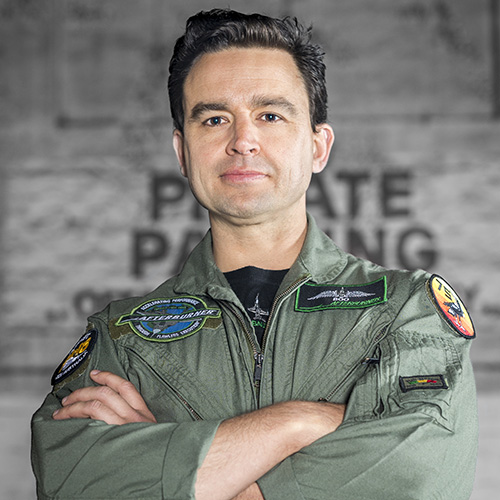
What does it mean to have a fighter pilot mentality? Patrick asks an accomplished fighter pilot. Christian "Boo" Boucousis is a former fighter pilot turned entrepreneur, keynote speaker, and leadership expert.
0:06Speaker AWelcome to the Leadership window podcast with Dr. Patrick Jenks. Each week through a social sector lens, Patrick interviews leaders and experts and puts us in touch with trends and tips for leading effectively. Patrick is a board certified executive coach, a member of the Forbes Coaches Council, a best selling author, award winning photographer and a professional speaker. And now, here's Dr. Patrick Jenks.
0:31Speaker BWelcome to episode 153 everyone. Hope everyone is doing fine. It is early June and I'm in Columbia, South Carolina, which one of its famous to claim is its heat and they call it famously hot. Columbia, South Carolina and I woke up to 54 degrees this morning. Actually I had to turn on my porch heater for just a few minutes. So I'm enjoying that. Warm days, cool mornings. I don't know how long it's going to last, but I'm going to try to take advantage of it. For those of you who think you've had a tough day and you think you have a hard job, I'm going to start this show with a snippet from the book written by today's guests. So here we go. It it's hard enough to hang on to a jet at 1000 mph with static electricity arcing through the cockpit while threading thunderstorms with 4,000 pounds of explosives strapped to your wings or going blind on our leader while pulling nine GS to maneuver into a position of advantage in an air combat mission, simultaneously trying to get eyes on the bandit and the lead. And in a three dimensional virtual fishbowl, it's hard enough to fly in a disciplined formation while working the radar, managing a data link, listening to radio calls and monitoring the stream of data on the display that come at us both in the aircraft and the helmet. It's harder still in combat when you're tracking multiple targets, coordinating with other air assets, or dodging through an integrated air defense system bristling with surface to air missiles and you're avoiding getting shot down. Now I ask you, how was your day? What does your world look like? How would you describe in your leadership world that same kind of dimension of what makes it difficult for you? People talk about the hardest job in the world, rocket science or brain surgery or fighter piloting. Maybe it's, maybe it's leading an organization, trying to create social change in the community. Maybe that's the hardest job in the world. Whatever it is, we all have our things that want to distract us, our things that challenge us. And we're talking today with Christian Boo Boucouses. He is a former fighter pilot turned entrepreneur, keynote speaker and leadership expert. Boo, as his friends call him, and I'm sure that was on, on the side of his airplane as well. Boo served as an FA18 Hornet pilot in the Royal Australian Air Force and he has translated his experience in high stakes aviation to successful ventures in the business world. He's the CEO of Afterburner Incorporated, and that's a company that has helped thousands of organizations implement what he calls the flawless execution model, or flex, to achieve their goals. Boo's leadership has guided Afterburner in transforming businesses worldwide, including NFL teams like the New York Giants, who his team really kind of helped win the super bowl back in the day. We won't say too much about that because they happen to beat the Patriots to do it, which doesn't matter to me, but it matters to my son. So I don't know if I want him to listen to this episode. In any case, Boo, as his friends call him, is our guest today and man, I just can't, I can't be more excited about this. Just talking about how, how someone who, in that really high stakes environment views some of the stuff we talk about on a daily basis. So, Boo, let me say thank you for carving out time for us and sharing coming in and sharing some insights with us on the show. Welcome.
4:45Speaker AIt's a pleasure. And you've got a little bit of fighter pilot in you there, Patrick as well, because Jinx is actually a, a maneuver that autopilots perform. It's the last ditch. Just before you're about to die, you try and jink the airplane out of the, out of the gun sight of the bad guy.
5:01Speaker BThat sounds about right. The last maneuver right before you die. Wow, there's a name.
5:07Speaker AYou do it well, you're not going to die. You're going to be a hero.
5:09Speaker BSo. Okay.
5:09Speaker AIf you do it right, it's, it's high stake stuff.
5:12Speaker BThat's cool. That's cool. Yeah, man. I just want to start with this. What are you. So first of all, how long, how long ago was it when you were flying? It's been a little while now.
5:26Speaker ADecade, Two decades ago?
5:28Speaker BIt's been a little bit.
5:29Speaker AYeah. Throughout my 20s.
5:30Speaker BYeah. Well, one of the things I enjoy about the book is when you're talking about, you know, the generation of planes, you know, 4th gen, 5th gen, we talk about that in terms of other technological things and you know, AI, 4th gen, 5th gen, all that. But one of the things that caught my attention that we'll talk about a little bit later actually is the keeping up to speed and keeping up to date with the generations of technologies, wisdom, experiences, you know, infrastructure, all of that. Just thought that was a, that was a fascinating piece to me to hear you talk about that. Let me ask, let me start by asking you this. Boo. What did I miss in my introduction? What is it people really need to know about you right now? That I, that I didn't cover?
6:24Speaker AThat I care and I really want to try and course correct where the world's going and that honor and challenge is bestowed upon leaders. Yeah. Yes, we can change the world just one person at a time. But if you want to create a world that is a good place where people thrive and do good things and everyone feels that they're part of something, it's. It's a leadership job. And one of the challenges as we get busier in life is that the time to develop and grow is being stolen away from us with technology. You talk about the generations of airplanes. You know, the fourth generation airplanes that I flew, that was, they were the first human machine kind of interface. It's where engineers built a machine to work underneath. A pilot's FingerTips was called HOTAS, Hands on Throttle and stick. Because what you realize as a fighter pilot is seconds count. So the second it takes to come away from the throttle and push a button to do something is one second where you're not controlling your speed and one second where a bit of turbulence can slow you down even more. And what you learn very quickly is that you have to understand technology. You have to understand it implicitly in terms of its strengths and weaknesses. And also that technology can lead you astray. It's engineered to be helpful, and it's engineered to be simple to use. But at the same time, it can be deceiving. It can tell you, it can tell you something that it thinks is good. But the reality is, hang on a minute, that's. That's a false hit. That's something that isn't real there. I need to go one level down and find out whether the information supporting that piece of insight is, is actually accurate. So really, for me, it's. How do we help people navigate the human centricity that is fundamental to leadership and the way in which we use technology as a tool or as we like to say, how do we fly the technology rather than the technology fly us? We don't want to be a slave to it. And that's an important, it's an important mental model for a fighter pilot. It's, don't let the airplane fly you you're the pilot, you fly it, and you use the systems to. And its capabilities in a way that serves. You don't believe everything you see.
8:44Speaker BSo would you say that's what you're on a mission to do? I mean, what is after Burner or. Or. Or Boo. On a mission to do?
8:53Speaker AWhat do you. What are the same.