
The Innovation Attorney Podcast · The Innovation Attorney
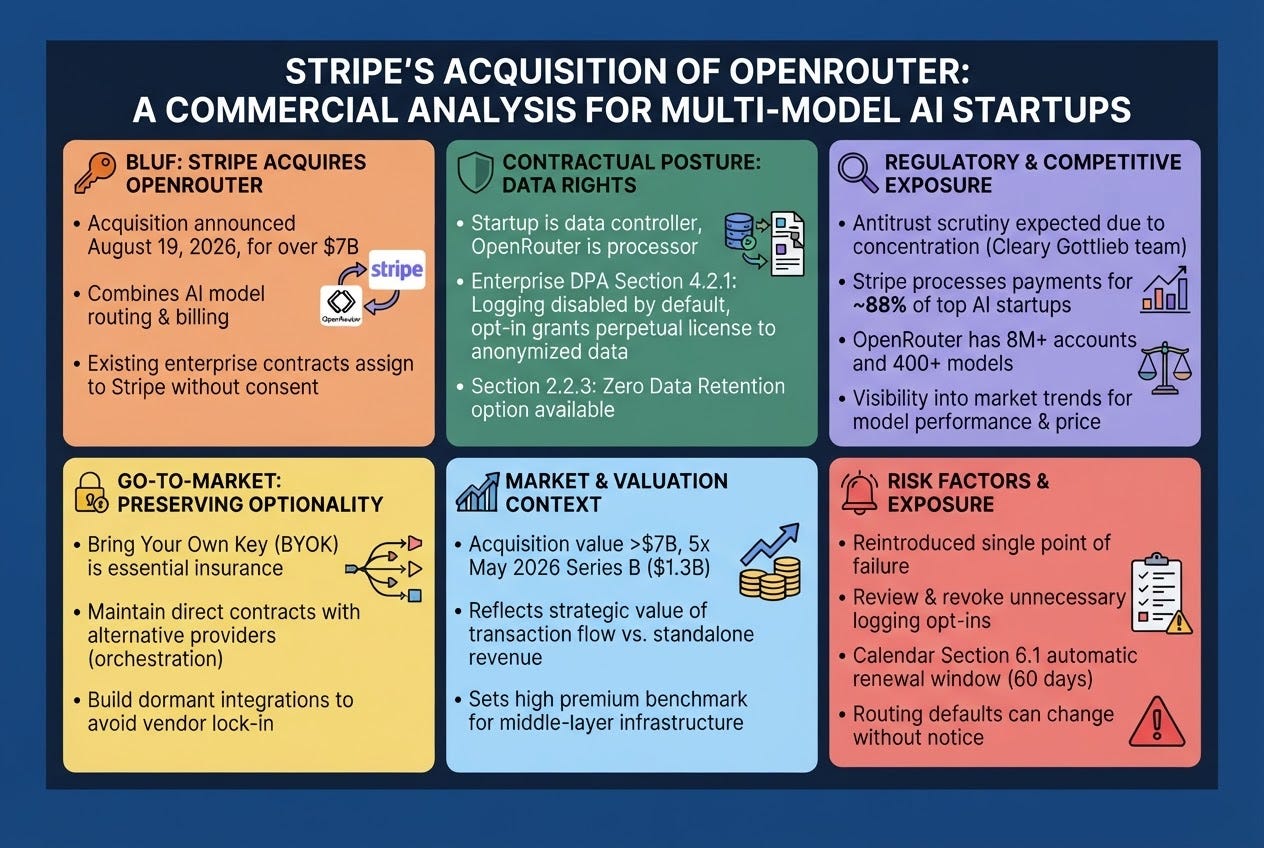
Stripe’s agreement to acquire OpenRouter for more than $7 billion, announced on August 19, 2026, places the metering, billing, and routing layer that many startups use to reach competing AI models inside the commercial structure of a single payments company. The acquisition does not rewrite OpenRouter’s published enterprise contract today, but it does activate an assignment clause that lets the existing agreement transfer to Stripe without the customer’s separate consent. Any founder or general counsel whose product depends on OpenRouter’s routing across more than 400 models now has a narrow window to read that contract, confirm its data handling terms, and decide whether multi-model independence survives a single-owner routing layer. A. Executive Summary Stripe’s agreement to acquire OpenRouter for more than $7 billion, announced on August 19, 2026, requires every startup routing AI traffic through the platform to audit its data processing agreement. OpenRouter connects customer applications to more than 400 AI models from more than 80 providers, and the enterprise version of that service already contains an assignment clause, at section 11.8 of its terms, that permits a merger or an asset sale to transfer the contract without the customer’s individual consent. Stripe’s own August 19 announcement names NVIDIA, Zoom, and Lovable as existing customers of the combined offering, and OpenRouter’s chief executive stated publicly that the company would keep its current name, product, and roadmap. The assignment clause already resolves whether the contract survives the deal. The routing defaults, the fee structure, and the data handling commitments that made OpenRouter useful in the first place now have to survive contact with a payments company that already processed OpenRouter’s own billing before the acquisition and that counts a large share of the current generation of well funded AI companies among its payment customers. This report sets out the established facts of the transaction, the specific contract terms a multi-model customer should review before the deal closes, the antitrust and data privacy exposure that the transaction’s own counsel staffing indicates, and the go to market choices available to a company that wants to preserve optionality across model providers regardless of who owns the routing layer. OpenRouter’s prior financing, a $113 million Series B round in May 2026 that valued the company at $1.3 billion, makes the acquisition price more than five times that mark roughly three months later, a valuation jump that carries its own commercial information about what Stripe believes the routing layer is worth once it sits beside a billing system Stripe already owns. B. Detailed Findings Intellectual Property, Data Rights, and Contractual Posture The document that controls a multi-model startup’s position after this acquisition is not the acquisition agreement itself: it is the enterprise Data Processing Agreement OpenRouter already...
0:00SPEAKER_00Stripe's acquisition of Open Router.
0:02SPEAKER_00A commercial analysis
0:03SPEAKER_00for multi-model AI startups bottom line up Frontstripe's agreement
0:06SPEAKER_00to acquire Open Router for more than $7 billion,
0:09SPEAKER_00announced on August 19, 2026,
0:12SPEAKER_00places the metering,
0:13SPEAKER_00billing,
0:14SPEAKER_00and routing layer that many startups use to reach competing AI models inside
0:18SPEAKER_00the commercial structure of a single.
0:20SPEAKER_00Payments Company.
0:21SPEAKER_00The acquisition does not rewrite Open Router's published enterprise contract today,
0:26SPEAKER_00But it does activate an assignment clause that lets the existing agreement transfer
0:30SPEAKER_00to Stripe without the customer's separate consent.
0:33SPEAKER_00Any founder or general counsel whose product depends on open routers routing
0:37SPEAKER_00across more than 400 models now has a narrow window to read that contract,