
The Innovation Attorney Podcast · The Innovation Attorney
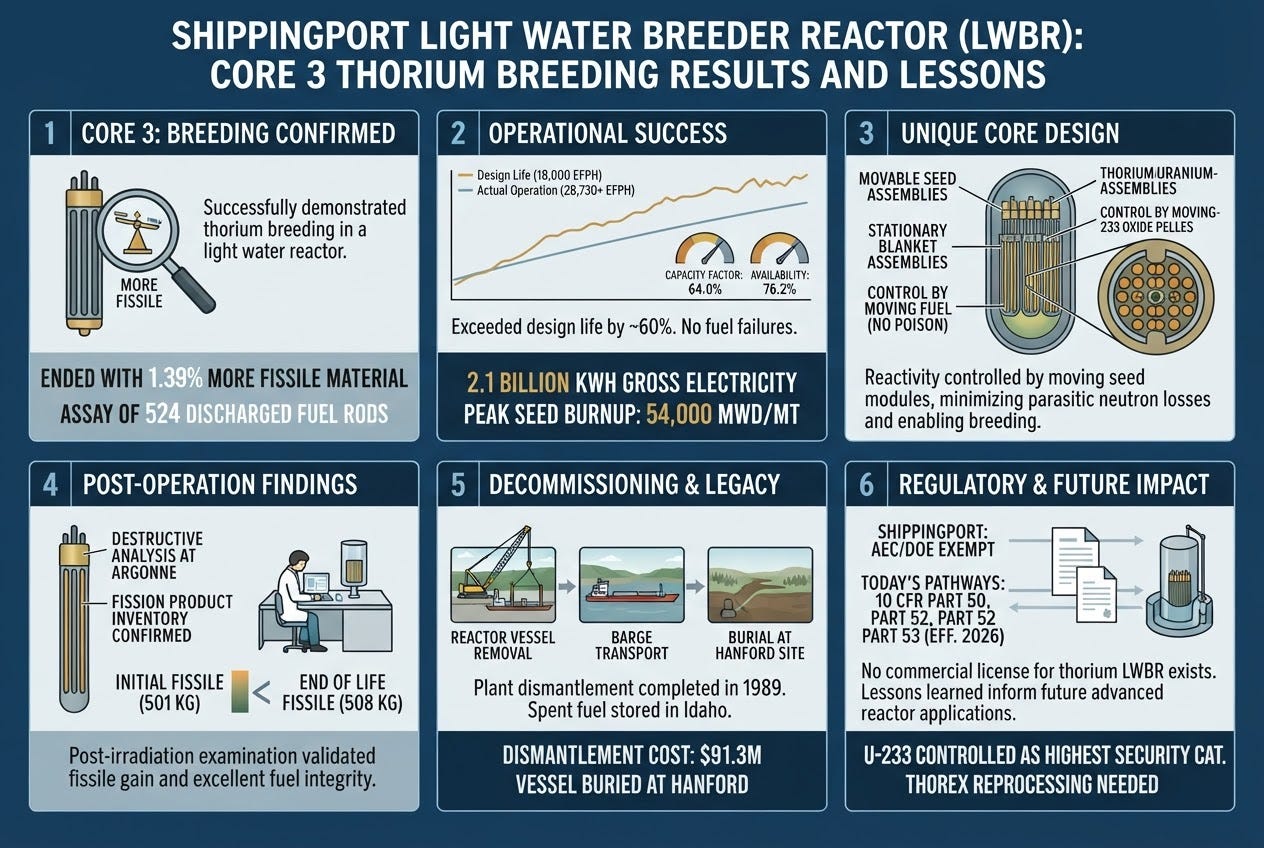
The Shippingport Light Water Breeder Reactor, which ran from 1977 to 1982, demonstrated that a thorium and uranium 233 core can breed fuel, ending with 1.39 percent more fissile material. Core 3 at the Shippingport Atomic Power Station in Pennsylvania produced about 2.1 billion kilowatt hours of gross electricity over roughly 29,000 effective full power hours, and assay of 524 discharged fuel rods confirmed the gain in fissile inventory. Examiners found no fuel element defects. Power operation stopped on October 1, 1982, and the Department of Energy completed dismantlement in 1989 for $91.3 million. Shippingport was the first full scale American reactor built only to make civilian electricity. Its third core used pellets of thorium oxide and uranium 233 oxide in Zircaloy 4 tubes, and it controlled reactivity by moving fuel in place of neutron absorbing control rods. That choice removed a source of parasitic neutron loss, and the loss was the margin that made breeding possible in light water. For energy investors, utilities, and policy professionals, the record carries a plain commercial message. The physics worked in 1982. The fuel cycle around it needs recycled uranium 233, shielded fabrication, and reprocessing that has never operated at industrial scale, and those requirements kept the concept off the market. The federal outlay for the Shippingport pressurized water and breeder programs was estimated at $622.2 million in 1975, and the breeder core never entered commercial service. Shippingport was exempt from licensing by the Nuclear Regulatory Commission, so no licensing record exists for a thorium fed light water reactor. A developer today would proceed under 10 CFR Part 50, Part 52, or the optional Part 53 that took effect on April 29, 2026, and uranium 233 is controlled as special nuclear material of the highest security category. The sections below trace the history, the engineering, the cost, the back end of the fuel cycle, three documented precedents, the strongest case against thorium breeding, and the decisions that follow for each audience. Background and History How Did Shippingport Become the First Full Scale Civilian Reactor in America? Shippingport became the first full scale civilian power reactor in America because a cancelled aircraft carrier reactor was redirected to Pennsylvania in 1953. In April 1953 the Atomic Energy Commission proposed canceling the carrier propulsion reactor under development at the Westinghouse Bettis laboratory and moving its funds to a civilian power plant. On December 8, 1953 the President of the United States proposed the Atoms for Peace program before the United Nations General Assembly, and the Commission sought a utility partner to build the plant. Duquesne Light Company won the partnership. Its bid supplied the land, the turbine generator, and $5.0 million toward light water reactor research, and the contract was signed in March 1954. Ground was broken on September 6, 1954 before about 1,400...
0:00SPEAKER_00Shippingport Light Water Breeder Reactor.
0:02SPEAKER_00Core 3 Thorium Breeding Results and Lesson's Executive Summary,
0:05SPEAKER_00the Shippingport Light Water Breeder Reactor,
0:07SPEAKER_00which ran from 1977 to 1982,
0:08SPEAKER_00demonstrated that a thorium and uranium-233 core can breed fuel,
0:10SPEAKER_00ending with 1.39% more fissile material.
0:18SPEAKER_00Core 3 at the Shippingport Atomic Power Station in Pennsylvania produced
0:22SPEAKER_00about 2.1 billion kilowatt hours of gross electricity
0:26SPEAKER_00over roughly 29,000 effective full power hours,
0:29SPEAKER_00and a say of 524 discharged fuel rods confirmed the gain in fissile inventory.
0:35SPEAKER_00Examiners found no fuel element defects.
0:38SPEAKER_00The plant stopped power operation on October 1, 1982,
0:41SPEAKER_00and the Department of Energy completed dismantlement in 1989 for $91.3 million.
0:47SPEAKER_00Shipping port was the first full-scale American reactor built only
0:51SPEAKER_00to make civilian electricity,