
The Innovation Attorney Podcast · The Innovation Attorney
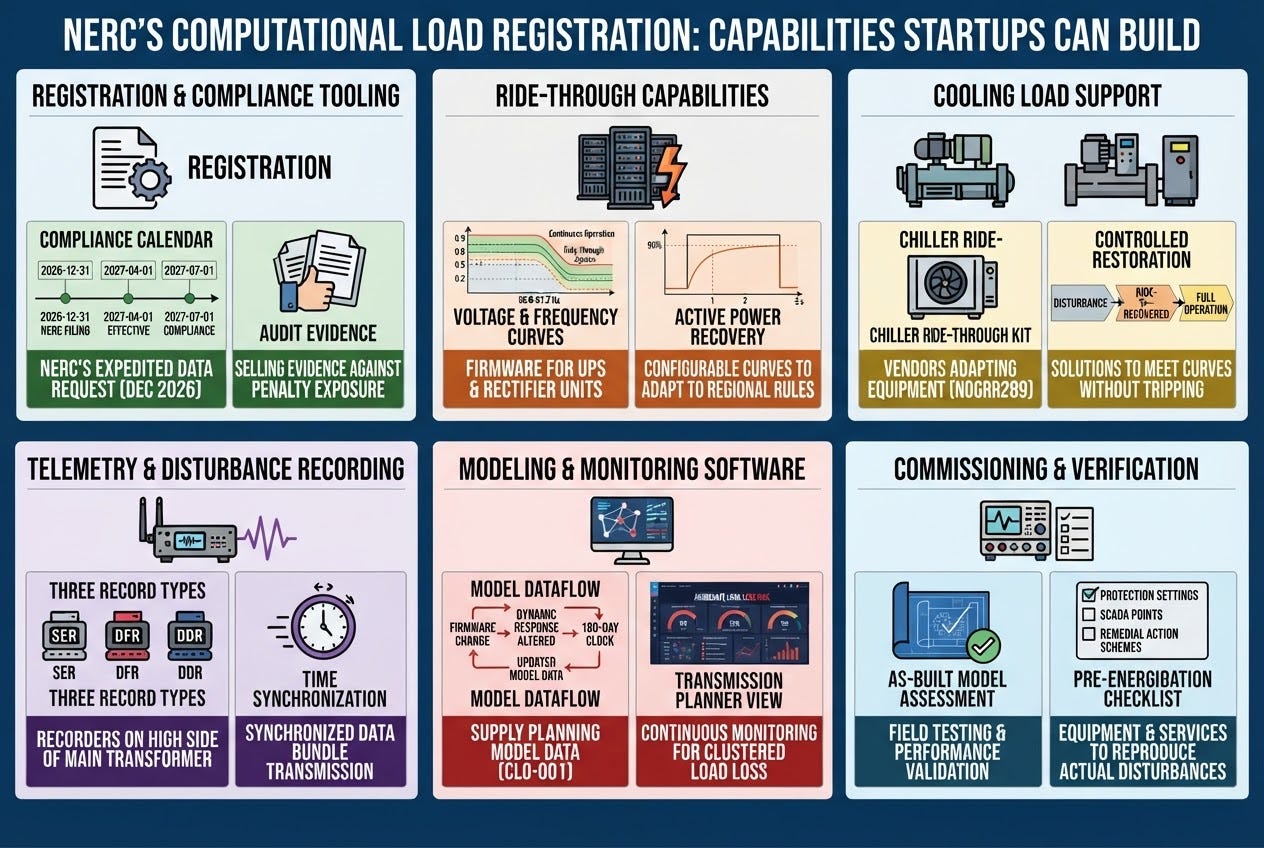
NERC’s computational load registration at 50 MW and 100 kV creates demand for ride through, disturbance recording, and operational data capabilities that grid software and power electronics startups can build. Three Dominion zone events frame the market. About 1,500 MW of data center load tripped on July 10, 2024. About 500 MW stayed off the grid after the April 18, 2026 fault. About 3,800 MW disconnected on July 22, 2026, after a normally cleared fault on a 230 kV line (Sources 5, 9). FERC ordered NERC on July 16, 2026, to file Reliability Standards and registration criteria for computational loads by December 31, 2026 (Source 1). The draft standards passed their final industry ballot on October 15, 2026, with affirmative votes from 77.93 to 95.45 percent against a 66.67 percent passing threshold (Source 6). The registration criteria cover sites of at least 50 MW connected at 100 kV or higher, raised from the 20 MW and 60 kV draft of April 2026 (Source 23). The standards in the first filing require three capability groups. Owners must supply planning model data that includes tripping and ride through behavior. Owners and operators must follow operating instructions and keep communications open with grid operators. Owners must install sequence of events, fault, and dynamic disturbance recorders on the high side of the main transformer (Source 6). Minimum voltage and frequency ride through requirements are not in the first filing. They sit in a separate project that NERC’s Standards Committee approved on October 21, 2026 (Source 25). Texas already applies a ride through curve to large electronic loads of 75 MW or more under NOGRR 282, effective August 1, 2026 (Source 16). The strongest product opportunities sit where the first filing creates a dated compliance duty and where the later ride through rules will need verified equipment. For investors and policymakers, the registered site count that NERC’s expedited data request will produce in December 2026 is the figure that sizes the market. Background and History How Did Computational Loads Become a Registered Reliability Risk? Computational load became a registered reliability risk because a protective disconnection by one data center campus is harmless, while the same disconnection by dozens of campuses on one fault removes gigawatts of demand in seconds. NERC’s July 10, 2024 incident review documented the first event of that size. A failed lightning arrester on a 230 kV line in the Eastern Interconnection caused a permanent fault. Reclosing produced six faults in 82 seconds, each cleared in 42 to 66 milliseconds. Voltage in the affected area fell to between 0.25 and 0.40 per unit. About 1.5 GW of load, all of it data center type load, left the grid on customer side protection. None of it was disconnected by utility equipment (Source 22). NERC found that about 1.26 GW dropped on the third voltage depression and stayed off for hours. The cause was a customer side counting scheme that trips...
0:00SPEAKER_00What ride-through, telemetry,
0:01SPEAKER_00and monitoring capabilities do computational loads need under NERC 50MW
0:07SPEAKER_00and 100KV registration rule?
0:09SPEAKER_00Executive summary NERC computational load registration at 50MW
0:13SPEAKER_00and 100KV creates demand for ride-through, disturbance recording,
0:17SPEAKER_00and operational data capabilities that grid software
0:20SPEAKER_00and power electronics startups can build.
0:22SPEAKER_00Three Dominion Zone events frame the market.
0:25SPEAKER_00About 1,500mw of data center load tripped on July 10, 2024.
0:31SPEAKER_00About 500mw stayed off the grid after the April 18, 2026 fault.
0:36SPEAKER_00About 3,800 MW disconnected on July 22, 2026,
0:42SPEAKER_00after a normally cleared fault on a 230 KV line .
0:46SPEAKER_00FERC ordered NERC on July 16, 2026,
0:50SPEAKER_00to file reliability standards and registration criteria for computational loads
0:55SPEAKER_00by December 31, The draft standards passed their final industry ballot