
The Innovation Attorney Podcast · The Innovation Attorney
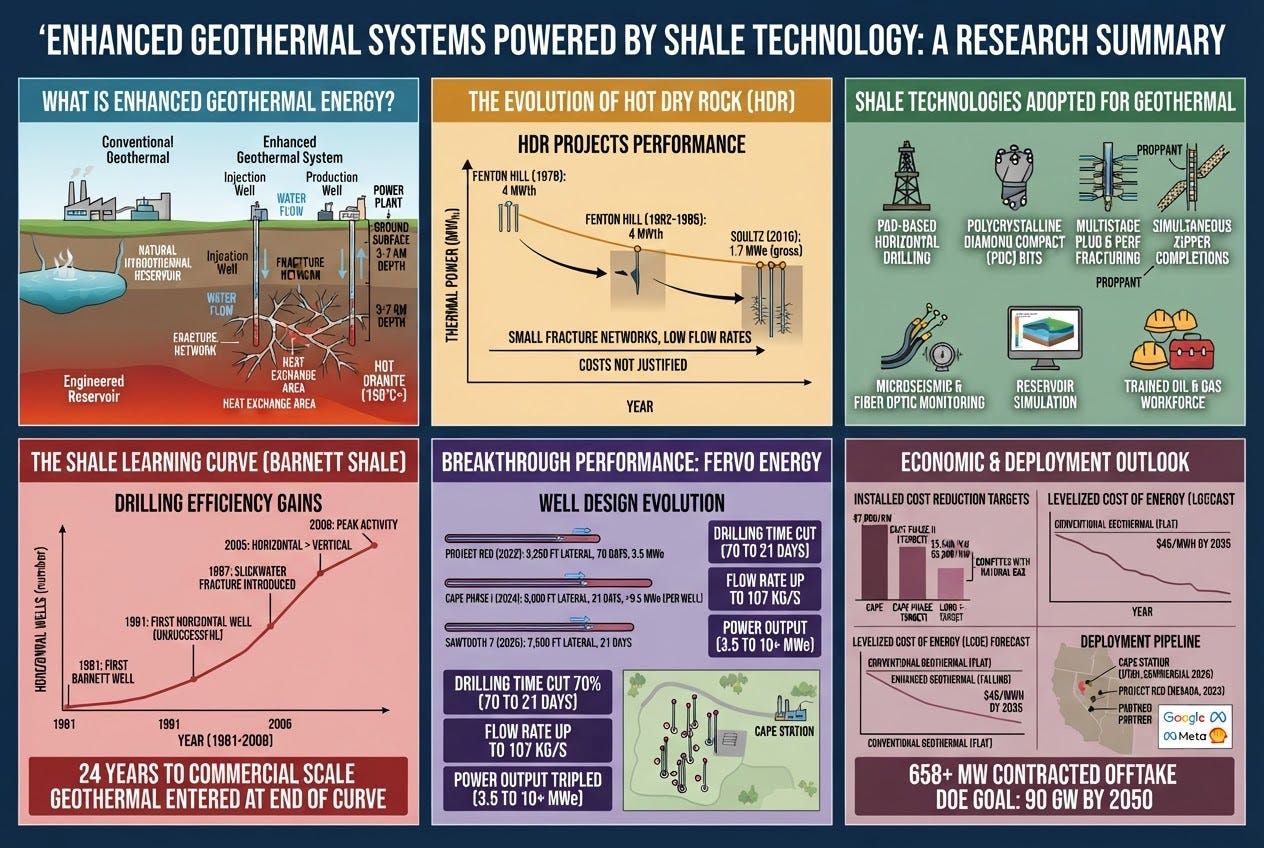
Fracking technology from shale drilling cut Fervo Energy’s geothermal well time from 70 days in 2022 to 21 days in 2024, and the 2026 Cape Station plant runs on it. Geothermal energy needs three things underground: heat, water, and a path for the water to travel through hot rock. Heat exists nearly everywhere below the surface. The path was missing in most places until oil field crews applied horizontal drilling and multistage fracturing with diamond cutter bits to granite. Fervo announced first power from Cape Station in Utah on September 24, 2026. Why Is Geothermal Energy a Small Share of U.S. Power Today? The common explanation is geography. The National Laboratory of the Rockies counts 3,969 MWe of installed U.S. geothermal capacity across 99 plants, and 72 percent of it sits in California, where natural hot water reaches shallow depths. Geothermal looks like a resource for a few lucky places. That explanation skips a fact from 1974. Los Alamos drilled into granite at Fenton Hill, New Mexico, to 2.929 kilometers and found 197 degrees Celsius. The laboratory fractured the rock, connected two wells, and ran a closed loop that produced about 4 MW thermal through 1995. Heat was available at depth. Published reviews conclude that the wells cost more than the flow could repay, and single stage stimulations of that era sent water through a few dominant paths instead of across a large rock surface. What Changed Between Fenton Hill and Cape Station? The shale industry spent 24 years teaching itself to do the same job in different rock. Mitchell Energy drilled its first Barnett well in 1981. A slickwater fracture design adopted in 1997 cut completion costs by roughly $75,000 to $100,000 per well. In 2005 new horizontal wells in the Barnett outnumbered vertical wells for the first time. Geothermal developers walked in at the end of that curve and took the tools. Fervo applied them to granite in Nevada in 2023. Project Red flowed 63 liters per second at 191 degrees Celsius and produced 3.5 MW. In 2024 a single Cape production well flowed 107 kilograms per second, and Fervo reports more than 10 MW from it. Drilling cost across the first four horizontal Cape wells fell from $9.4 million to $4.8 million. The company’s third generation well, announced July 8, 2026, reached 19,448 feet and 460 degrees Fahrenheit in 21 days. On a submarine reactor plant I learned that a heat source is worth only the surface area of the exchanger that couples it to the working fluid. A fractured granite reservoir is an exchanger, and each fracturing stage adds area to it. Fervo completed 80 stages in its Cape test area, and 95 percent placed the designed proppant volume. Shale completion crews had spent two decades learning to place proppant stage after stage. The Fenton Hill team worked without that experience. What Does the Cost Curve Mean for Capital Allocation? Installed cost tells investors where the risk sits. Fervo reports about $7,000 per kilowatt for the first 100...
0:00SPEAKER_00Geothermal energy and fracking technology.
0:02SPEAKER_00Energy research report executive summary fracking technology from
0:06SPEAKER_00the shale industry made enhanced geothermal energy commercial
0:10SPEAKER_00when Fervo Energy announced first power from Cape Station in Utah on September 24,
0:15SPEAKER_002026.
0:17SPEAKER_00Enhanced geothermal systems drill horizontal wells into hot granite,
0:21SPEAKER_00fracture the rock in stages with propint,
0:24SPEAKER_00and circulate water between wells to build an underground heat exchanger.
0:28SPEAKER_00Each of those steps came from oil and gas fields.
0:31SPEAKER_00Fervo Energy cut the drilling time for a horizontal geothermal well from 70 days
0:36SPEAKER_00in 2022 to 21 days in 2024,
0:39SPEAKER_00and the company reports that one production well at Cape Station delivered more
0:42SPEAKER_00than 10 MW of electric output during a 30-day test in 2024.
0:47SPEAKER_00The Department of Energy estimates that next-generation geothermal can supply 90 GW of U.S.
0:53SPEAKER_00Capacity by 2050,