
The Human Potential Running Series Podcast · Human Potential LLC
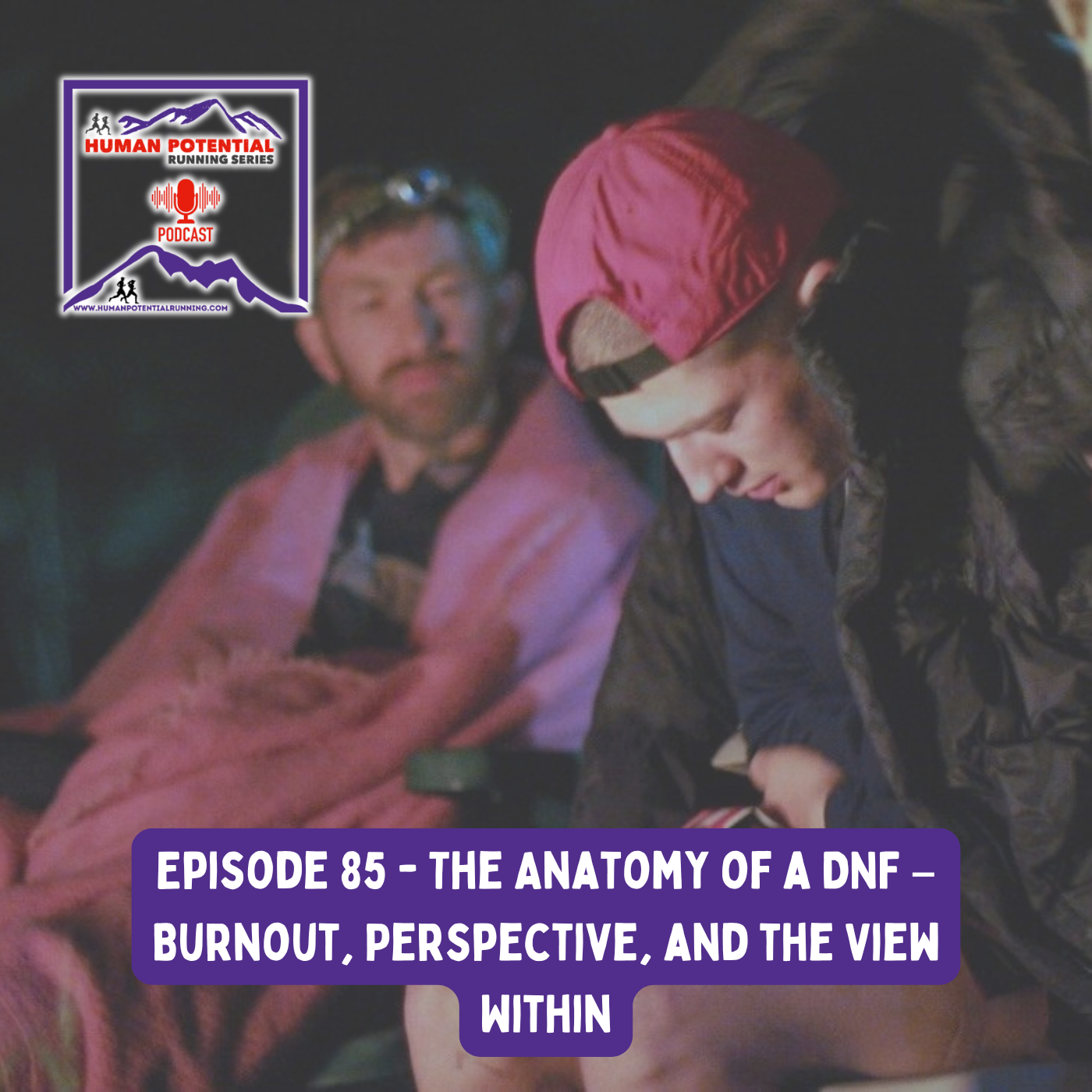
What happens when a runner who has finished 16 consecutive 100-milers finally has to walk up to an aid station tent and utter the words: “I quit”? Take a run with the Human Potential Running Series podcast. In Episode 85, host and HPRS race director John Lacroix is joined by ultrarunner and coach Stefan Schuster to break down Schuster’s first career DNF at the Crazy Mountain 100. Moving far beyond race splits, the two dive into the complex web of physical and psychological factors that lead to dropping out—from chronic injuries like plantar fasciitis and hamstring strains to physiological burnout, life stress, and overtraining. John challenges the modern obsession with high mileage streaks and social media pedestals, sharing lessons from his own DNF history and urging runners to look beyond external validation. Together, they explore the difficult internal work of rediscovering your "why," knowing when to step back from rigid training plans, reframing failure as a tool for personal growth, and remembering to appreciate not just the scenic mountain views, but the "view within." They close out the episode with a lighthearted deep dive into old-school ultrarunning swag etiquette—including whether you have the right to wear a race shirt if you didn't cross the finish line.
John Lacroix: welcome back. Stefan Shystee McShyster Schuster. What about all right, I Stefan: Good to be back. Thanks, John. John Lacroix: I so we're gonna we're gonna be out on a curveball here to start. Dude, I I'm so pissed off that the Sixers team turned into what they are here in the NBA in the offseason. I I don't like I think Jalen Brown is an amazing basketball player, but I don't I don't tend to like his attitude and that makes sense because I think there's s something going on there. but for them to also get LeBron and then they've got shit sniffer still, you know, just Stefan: Yeah. John Lacroix: man, it just really they look awesome. I I that's really like what it could Stefan: On paper, they look great. You know, I I don't follow Jalen Brown as much as you probably do as an ex Celtics fan, but I was really surprised that LeBron went to Philly because Embiid is always injured and like without him they're not gonna win anything. So I just think it was a waste of a wasted opportunity on LeBron's end. John Lacroix: So we've we've covered that you and I tend to have very different takes. Stefan: Ha ha ha John Lacroix: I think the Sixers are better without him beat. I think they're better with him hurt. Like, absolutely. Like I think he's exactly Stefan: Really? He's always hurt though. John Lacroix: and they're doing just fine. but hey, our our our main content when we get to it later in this episode is DNF. The DNF. Stefan: Uh-huh. John Lacroix: And I think you're right. I think that Even though they look good on paper, the Sixers will once again DNF. That is my prediction. They are not they're not. But hey, trust the process. Stefan: Yeah, I don't think that they're gonna win anything, that's for sure. If you had to pick a team to win the chip this coming season, who would you who would you choose? I know like I mean it's weird John Lacroix: Dude, I I rode Stefan: the NBA's weird because like the championship was two months ago or whatever and the season starts in, you know, another month or two or whatever. John Lacroix: I rode with the Knicks all last season. They were they were here in Denver pretty early on in the season last year. And that Stefan: Mm-hmm. John Lacroix: was that was one of our games. Emily and I are season ticket holders. We have half a season. That was one of our games. And man, sitting there watching first of all, I hate their fans. we Stefan: Dude, I live with one fucking. I live my roommate is Dave, and Dave is the most annoying sports fan in the entire world. John Lacroix: Dave is a Knicks fan. Stefan: he's a he's also from New Jersey. and he also is a Michigan fan, which I didn't know until we became roommates. And as an Ohio State alumni, John Lacroix: well that makes sense. Stefan: he annoys the shit out of me during football season. Sorry, Dave. John Lacroix: So, dude, like they so their Knicks fans tend to be rambunctious. They're not as bad as the Lakers fans. They're worse than the Celtic fans. The Celtic fans are also bad, but man, those Knicks fans are something. And when they were in town last year, we went to that game and we were maybe in the third quarter, and I said to the guy who was really obnoxious in like two rows in front of us, he turned around and looked at me and I was like, dude, this yes. Be obnoxious. You can have it. Like stand up, cheer. This is the team. They're they're Stefan: You John Lacroix: totally gonna do this. Stefan: you want to know a great story, actually, sports story that's like somewhat related, somewhat unrelated. When I was in third grade, I learned how to curse actually because I was at a devil's game and the people in front of me were cheering, fuck the flyers, and that's how I learned what the the F bomb was. John Lacroix: That is a great sports story. of course I mean I I grew up near Boston, so I got to go to Red Sox games, sit in the bleachers. And the first Red Sox game I ever went to was against the Yankees. And I was in the seventh grade. Stefan: Mm-hmm. John Lacroix: And my seats were front row right behind the Yankee bullpen. And I remember just unleashing every F bomb, every creative way to launch an F bomb, which is pretty it's pretty broad. There's a lot of ways in Boston to release an F bomb. But at David Cohn, who was warming up Stefan: Mm. I'm sure. John Lacroix: in the bullpen and just yeah, it's one of my first sports memories ever was being like yelling at a Yankee telling him how much they fucking suck and Ugh. Stefan: Dude, when I was a kid, I was like a diehard Yankees fan. And I kid you not, the first 15 games I went to, it was like some insane statistic, be especially considering how good the teams were back then. They lost every single game I went to live. It was the most disappointing John Lacroix: my god. Stefan: thing in the world. I remember being like even at some Yankees Red Sox games, and I was like at the game where Hideki Matsui like broke his wrist diving for a ball on like the outfield. It was Just my luck at games was absurdly bad. John Lacroix: well it's five we're five minutes in, Steph and we should probably switch to talking about running. All right, let's do it. Stefan: Okay. Some ultra running. So I have a few intro topics for you. the first was that over the weekend I so I'm sponsored by Buff now and I was hosting a tent for them at Dirt Circus in Boulder here and I was just walking around seeing some of the other folks who were there. you did, yeah. I met John Lacroix: I saw your photo. I saw your f I saw your photo. Stefan: I met Marshall Ulrich, Ulrich, and I thought it that was super cool because I remember reading about him when man, back when I was in like high school. some of the crazy feats he's done like running across Death Valley like four times in a row, like doing it without a crew carrying like water John Lacroix: Mm. Stefan: in like a wagon. so I thought it would be a good s introduction for this episode because I'm like I bet John knows him and maybe has a story or two that you could share. John Lacroix: Marshall's also run across country. And I believe his quad what you're talking about in Death Valley was a quad badwater. Like he did Stefan: Something like that, yeah. John Lacroix: he did Badwater, but then kept going. And yeah, he towed he towed like a tiny trailer he made behind him. It was like attached to his waist. I don't think he pushed it. I think he like had it dragging Stefan: Mm. John Lacroix: behind him. Marshall has run a few times with us at HPRS. And the only really good story I have is a selfish one. Stefan: Yeah. John Lacroix: it's within the last eight months. S I I don't remember why or what he was commenting on, but on Facebook he left a comment. And the comment was that I am the greatest ultra running race director of all time. Stefan: Ha ha. John Lacroix: That that's what he wrote. Like John's d that was his like that was his comment. Stefan: That's high praise from like a I would say a I don't know how well known he is by like the youngins today, but like I mean I would call him I would call him John Lacroix: Not very Stefan: like a legendary ultra runner. So that's somebody to, you know, take good vite John Lacroix: Ye yeah, for f for my generation of Ultrarunner to have someone like Marshall Ulrich say that is that was instant tears. I took a picture on my phone like a like I snapshotted it. It's saved. That is one of those little bits of motivation that I keep handy if if Times are tough or my motivation's low or my energy's zapped. Why the fuck am I doing this type of stuff? I Stefan: Mm-hmm. John Lacroix: I go back to my Marshall Ulrich telling everybody that I'm the greatest ultra running race director of all time. I I don't Stefan: Mm-hmm. John Lacroix: know if that's true. I'd like to believe that it is, but if Marshall thinks so, I'll take it. I also Stefan: Yeah, it's good, that's pretty cool. I bought his book, so I'm excited to read it now. John Lacroix: I also interviewed him for Ultra R Ultra Stories podcast, my previous show. Stefan: yeah. John Lacroix: and it was right after he wrote his his book, yeah. And he was we talked a lot about that on that episode, which you can't find anymore. Running on empty, yeah. He's a good Stefan: Had it here just in case. Yeah, running on empty. Cool stuff. John Lacroix: dude. He's a very good dude. Stefan: Yeah, I I had to I'm trying to get a picture with everyone who like I looked up to when I was younger and one one day I'll like put a wall together or something. I think the only picture I have of you and us, John, is this really like terrible lighting photo of you and I at the beginning of Silver Heels. It's it's just the worst photo of all time. But we'll have to get another one. John Lacroix: we'll get a new photo at some point. Stefan: wait, no, I also have John Lacroix: You Stefan: a picture of you giving me my first belt buckle. John Lacroix: You know, you are shorter than me, so you do look up to me. Just a a tiny bit. What else did you have on your pre your preload list? You said you had a few. Stefan: There's that. I'm shorter than most people, sadly. all right. Yeah, my preload list. I am wearing my crazy mountain hat despite my DNF. when I was a younger ultra runner, I used to say, Why would people wear stuff around when they didn't finish the race? And here I am. and I just it's funny. I got my first DNF what was it almost three weeks ago now? And I'm excited to dive into that with you. I surprisingly just I don't actually care that much. and I'm gonna proudly wear my swag around. I know that's a I feel like that's a debate in the ultra running world though. Do you wear it or do you do you wait until you go back and you finish? and yeah, is what it is. Okay. John Lacroix: We'll we'll talk about that in this in this episode. 'Cause I have I have some old school rules. Yeah, that I yeah. Stefan: Old school rules. All right. I'm excited to hear it. the last one I have for you is that actually the reason I asked you if we could move this podcast back by an hour. And the reason is because I've been feeling f pretty fatigued at some of my races lately. So I actually had a blood test done at nine AM this morning. So I'm excited to see if there's anything concrete that maybe I can make adjustments to going forward. John Lacroix: Okay. So you're just like like a general malaise or are you just like are you exhausted or are you over it? Stefan: Mm, I think it's mostly what I feel is fatigue like during events. it started do you want me to just kinda like launch into all the details or do you wanna build this up? John Lacroix: before we before we do, I think I think this'll help us actually in our episode. But Stefan: Okay. John Lacroix: before we do that, the one thing I wanted to say was thank you for the the last episode we did where we were talking about Sage. I I there are seldom times that I've talked about that topic in particular, which is doping and Stefan: Mm. John Lacroix: front runner bullshit, and and wish the conversation had gone on longer. We c we just kinda ran out of time that day. It's fine. But man am I chomping at the bit to get after that one more with somebody. But it's it's okay that we don't. But okay, Stefan: Yeah, we definitely can. John Lacroix: so this conversation that that let me front load this. So recently recently, friends, Stefan had his first DNF. and it was at Crazy Mountain Hundred in Wyoming. Stefan: Montana. John Lacroix: pardon me, Montana. Same place. Stefan: Pretty much. John Lacroix: you know, in the the West the great expanse of the American West that no that people seldom think about. Stefan: Yeah. John Lacroix: and he called me. Stefan: I have a pr sorry have a friend who asked if I was driving through Kansas to get there and I was like what the fuck is wrong with you? I know John Lacroix: boy. Okay, well that's a different my god, people. Man, we're so fucked as a nation. so on on his way home from running Crazy Mountain, from DNFing Crazy Mountain, Stefan called me to talk about his DNF. And I don't know about a you know, we we had been discussing the possibility of of recording a few episodes together for a couple months now. And so I just when I finally got around to responding to Stefan's request to record together, I I put in the the notes in the email. We should probably do a a episode on DNFing. And so that's what this is about. We're gonna talk about DNFing. So Stefan You're you're saying that you're tired. You're yeah, tell us more about it. I think this is a great segue into the comments. Stefan: Okay, so for those who don't know me, maybe I should give a little background, I guess. John Lacroix: Please do. Stefan: my name is Stefan Schuster. I'm a 31-year-old ultra runner. I have run I don't really know what the count on ultras is over the last like eight years. I think it's like 35-ish, give or take official ultra marathons with 16 100 mile finishes. I had never DNF'd until about three weeks ago now. and Yeah, so to give context is so important for any discussion. last year I ran Western States in Leadville. as someone who discovered ultra running at 14 years old, I read Ultra Marathon Men when I was in high school. I immediately like had a dream of I'm going to do this one day. And legendary races like Western States and Leadville, both of which were completed last year, were kind of like the pinnacle of success for me. And so I feel like ever since those two events last year, I have felt like really mentally and also physically like drained since then. specifically like when I show up to like longer distance ultras. so there's a lot of reasons why maybe I like DNF'd a few weeks ago and it all kind of compiles at at once. But I do want to kind of build up to what happened a few weeks ago. So the first thing was last year after running Western in Leadville, I showed up at Sangray, as you might remember. And my mindset when I showed up there was essentially I'd love to do another hundred miler for fun this year instead of focusing on like time performance like I did at the first two races of the season. I just wanted to go and like enjoy myself and went there with the mindset of I'm gonna do do my best to go a hundred miles, and if I don't, then I'll drop down to like the hundred K or something and just off the bat. Terrible mindset. If you're going 100 mile or you have to show up with like absolute conviction that you're gonna finish. just pro tip for anyone, regardless of circumstance. But yeah, you know, unsurprisingly ended up not really enjoying myself. Just wasn't I don't know, I just didn't feel I just wasn't enjoying myself. So I decided to drop down. you probably remember that. It was like It felt kind of like a DNF, even though John, you guys are nice enough. Emily was race directing that day, but you guys listed me as a hundred K finisher, which was nice of you guys. ended up finishing with swiggles. and yeah, in like 15 hours or something like that. anyways, if you fast forward a little bit though, had I don't really get injured too often, but I had an IT band injury in October that lasted like four to six weeks or so. And then pretty much since December, I've been dealing with some like chronic plantar fasciitis. I did do, you know, a decent amount of like miles during burrito league in January. I ran the jackpot hundred in February in like nineteen and a half hours, which was like, keep in mind it's like super flat. It's the only flat race I've ever done. I would say I got pretty bored and like didn't enjoy that experience like a ton. Definitely not trying to go back to loop races, but that's just a personal choice. to each their own. yeah, and then I really like where things have started to be concerning, in my opinion, is when I ran like Scout Mountain at the beginning of June. I found myself in a similar scenario to like sangre, where I just wasn't really just wasn't enjoying myself off the bat. having chronic plantar fasciitis this year has not made things easy. It's really hard to enjoy the experience when every footstep like actually hurts. but overall I would just say I didn't really feel engaged. I didn't feel like I was enjoying the the process as much as I usually do. That typically comes really easy to me. And I think to a lot of people, like it's just a lot of fun to go somewhere new, be outside, explore, challenge yourself, meet new people, all the amazing aspects of our our sport. And I kind of just like forced a finish that day. And it was a pretty brutal experience to just like not enjoy the vast majority of the race. I think I can speak for not only myself, but most ultra runners when I say that like finishing, I think for most of us is is not enough. Like you want to actually look back and like feel like you enjoyed the the experience, the journey from like going from mile zero to a hundred. There's Something magical about that that I just felt like I didn't appreciate at Scat Mountain and not a reflection on the race. Very well run. Amazing course, amazing community. I definitely want to go back and give it the respect it deserves, but just had a tough time out there. you know, after Scout ended up probably overtraining a little bit because it's the summer and I wanted to go out with my friends, ended up straining my hamstring a little bit, pretty much didn't run leading up to Crazy Mountain. And so now I'm at Crazy Mountain and you know I have this evidence from like Sangra, I have this evidence from Scout, and even Jackpot, where I just I wasn't really engaged or having fun at three events now. and now I also now have the evidence of I T-band injury in October, plantar fasciitis ongoing, hamstring strain. That's three different injuries within a year. and then I go to Crazy Mountain and You know, there's all those factors on top of the fact that like I didn't sleep the night before the race. I slept like two, two and a half hours because a storm came in while we were camping. Wonderful. and then I actually got sick mid-race. So when you and I were talking on the way back from that that DNF the next day, John, I yeah, I ended up like getting pretty sick like in those few days after the race. And I'm actually really happy I dropped. I felt so terrible. I have zero regrets from dropping, but I mean, it was the first time I ever had to go to a tent and say I quit. And of course, to make to make that even worse, I was trying to do because I'm sponsored by Buff now, I thought it would be fun to do a little ultra running film with them. They were looking for cool stories, journeys that they could document. And I thought, you know, Rocky Mountain Salem is not something a lot of people know about. Like, why not show the joys of mountain running? And this year has been anything but joyful so far. And now now that you have I think all or most of the context that I wanted to give for this discussion, I'm trying to figure out what to make of this drop and what to do next. I am technically signed up for Leadville, which is in like a week of this recording, and I have not yet deferred if I'm going to defer. So I people in real time are gonna get to hear like what problem solving and yeah what this what this problem solving looks like. And based off of a lot of the things, John, that you told me on the way back from Crazy Mountain, I think people will learn a lot from from this discussion. I hope so at least. John Lacroix: Have you h by the way, has Leadville offered you the option to defer yet? Stefan: I emailed them and they said I can defer up until like the day before. And they have not for reference, I don't even know what the course is as of like this moment. You do? I'm John Lacroix: I do. You're gonna hate it. Yeah. Stefan: gonna hate it. John Lacroix: yeah, everybody's gonna hate it. from from what I have heard from someone involved in actually approving the new course, it is going to be the single easiest quotations there. This Stefan: Ha ha. John Lacroix: the single easiest Leadville 100 of all time. Stefan: I was actually I kinda figured and I think for a bounce back race I was kind of excited by that prospect. I mean compared to John Lacroix: Yeah, I Stefan: Scout Mountain and Crazy Mountain, like Leadville is not a difficult race. John Lacroix: Yeah, I'm I'm gonna let it play out, but based on what I've heard they they didn't tell me the exact route, but from what I've heard it sounds like hope passes out. Stefan: No way. John Lacroix: Yeah. And by the time that this airs, I believe the race will have come and gone. So yeah. Stefan: So that's true. I heard from Buff that Hope Pass and Twin Lakes will will be a part of it because they have their tent set up by the river crossing over there. John Lacroix: Hmm. Yeah, I've heard so many things from so many people as well. So it's Stefan: Right. John Lacroix: like everything's rumor and conjecture at this point. But Stefan: Hmm. John Lacroix: I did hear it's gonna be the easiest Leadville of all time. So my guess is Stefan: gosh. John Lacroix: as expected, if you get to Twin Lakes, you're gonna hug the road. Not necessarily being on the pavement, but I know power power line's out for sure. Stefan: Mm-hmm. Yeah, that has to be out. John Lacroix: and I believe that probably the Colorado Trail is out, south of Al Stefan: Most likely. John Lacroix: east of Albert and massive there. So yeah, I think that just leaves a lot of fire road, exposed fire road out in the blazing hot freaking sun, that runs parallel west of the highway that goes down through there. I and you probably end up on the road quite a few times. Stefan: People underestimate the heat of Leadville. They just are so focused on the elevation and people forget about how John Lacroix: It Yeah. Stefan: hot it gets when you're at like ten thousand plus feet. Not just Leadville, even like Silver Heels or Sangre. John Lacroix: Yeah. Stefan: Sangre you're in the trees a lot, which is nice though. John Lacroix: So when you when you called me, Stefan, you were man, you were a down and dejected man. What you know, Stefan: Yes. John Lacroix: f I wanna go back to that. Why did you call me? Stefan: I called you because I wanted advice in the moment on I wanted advice from somebody with a lot of experience in this sport who could talk to me as somebody who like knows what it's like to drop, but also who knows I don't know who ha who like actually understands where I'm coming from. like the eight station I dropped at at Crazy Mountain, I I literally asked them like who's your most experienced volunteer? Who can I talk to? Like who can who maybe understands how I'm like feeling, which is burned out at the moment. and I mean, I I feel like from what you've told me about like your ultra running experience, it sounds like you like I remember you telling me a story once, maybe even on the podcast where you ran like eight, one hundred milers in a year. and you were just left feeling completely like exhausted after that experience. And I thought like that's the John is the only person who has maybe experienced like what I feel right now. It did not help that like I mean I was totally sick and just getting worse like as that day went on. but yeah, I mean still I even without the sickness, like I have so much evidence from the last year of just like not performing the way I want to or feeling the way I want to and appreciating the sport the way I want to. that like even without the sickness, like there's still some problems that are ongoing. John Lacroix: Okay. One of the questions I asked you was, how many hundreds have you finished so far? Stefan: yeah, sixteen. John Lacroix: And when did you run your first hundred? Stefan: My first hundred was sangre in twenty nineteen. John Lacroix: So you've run that's seven was shy of seven years. We'll call it yeah, we'll call it seven years. Stefan: Mm-hmm. John Lacroix: So you've run a little over two one hundred milers per year, every year on average. That's what the average comes out. That's probably not realistic, like really what's happened, but we'll call it two two and a quarter hundred milers a year for seven years. Stefan: Mm. It's it's Yeah, it's been like one to three per year. John Lacroix: Okay. And the next thing I said to you was, Stefan, the the person like people who have run a 100 mile race, what is the average number of total 100s that they run? That they finish. Stefan: Most yeah, most people do like one, I think, total. John Lacroix: You gave me your answer was one point six. That was very that was like yeah, you were like, Stefan: Is that what I said? I don't even remember that. John Lacroix: it's like one point six. And I was like, man, that is very data driven Stefan: Mm. John Lacroix: approach. I don't know if it's one point six, but I know it's not two. Stefan: Ha ha. John Lacroix: so like the average person who runs a 100 miler is essentially one and done. Stefan: Mm-hmm. John Lacroix: And I've also pontificated many times on this podcast and the one prior Ultra Stories that the average lifespan of an ultrarunner is three to five years. And what I mean by that is of of folks who come into ultra running, on average, they're here with us anywhere from three to five years before they get bored and move on. Or they just move on to something else, or they run go back to running shorter distances or it's it's just a grind, right? Stefan: Mm-hmm. John Lacroix: So so my my point that I was trying to make to you was one, you've been running hundreds regularly for seven years. Stefan: Mm-hmm. John Lacroix: And in that time you have far surpassed the what is what is known as quote unquote normal. And and even of the folks who run multiple hundreds, I I would say that that average is probably three to five. Because if the average lifespan of an ultrarunner is three to five years, they're gonna w run, you know, three to five 100 milers within the three to five years, because most folks only have time to Stefan: Mm-hmm. John Lacroix: train and participate in just one. That's all that life affords them. So I I wanted you to hear how much of an anomaly. How much of how mu how much of an anomaly that you are, but almost how much a gift that it has been to you that you've been able to perform at the level that you're performing at, doing what you do for as long as you have. And Stefan: Mm-hmm. John Lacroix: so out of the gate for me it was, why the fuck are you hanging your head, dude? Stefan: Well, because I I've long said this before this year. the no matter how much running, no matter how many ultras, no matter how many hundreds I do over the course of my life, is never gonna be enough. Like that's just how much I love this. It it'll never be enough. one day when I'm like ninety eight years old, if I make it that far, I'm gonna be like, if only like th there's one more mile I could have done somewhere and like could have enjoyed and you know. Just that's just my mindset. John Lacroix: So you I mean you're living life to the fullest. And that's Stefan: yeah, like through the sport I would say definitely. John Lacroix: Now let me ask you a question. Another question. This is a new one. How many races do you run in a year that are not Stefan: Mm-hmm. John Lacroix: in ultra distance? Stefan: That are not an ultra distance. that are not an ultra distance zero. John Lacroix: Okay. Stefan: Yeah, typically it's like zero. I think I ran in the last three years I ran I ran one marathon in January of twenty twenty three. And that was the last non ultra. John Lacroix: When you when do you figure out your ultra calendar for next year? Stefan: I'm thinking about like two years ahead right now. That's how I've always been thinking. Yeah. John Lacroix: Okay. And when you do that, when you do that, what is your like when you're looking at the calendar, is it Stefan: Mm. John Lacroix: like what's going on inside of you, inside your heart, Stefan: Mm-hmm. John Lacroix: inside your brain, when you're looking at the possibilities? Are you, like I just, and then I could do this. And they're just like, I have Stefan: Yeah. John Lacroix: to I is there, is there anywhere in there, is there an I have to? Stefan: no, there's no way have to's. like it are you asking me about twenty twenty seven in particular? John Lacroix: No, I'm just wondering your thought process while you're setting up your calendar. Like do you have I'm tr what I'm trying to get to is Stefan: yeah. John Lacroix: do you ever have FOMO? Is it is does fear of missing out ever pop into the equation when you're trying to figure out what races you're gonna run? Stefan: I think I know where you're going with this and I've heard you talk about this a lot over the years and I did I've never put myself in the category of like f FOMO in the sense that I'm signing up out of like fear of missing out. I honestly like there's if if I had like FOMO, I'd be signing up for way more races than I'm already doing right now. John Lacroix: That's fair, that's fair. Stefan: so I feel like I guess you could say I have FOMO, but it's controlled. to me, controlled means like two or three hundreds a year, spaced like six to eight weeks apart minimum, is usually like what I've done. and that has worked really well for me. This year I said to myself, I want to try and do a little more up the ante. I'm out of grad school. I am able to do a little bit more at the moment. So I tried doing like jackpot in February, and then I was trying to do four summer mountain one hundreds when typically I've done like three over the course of like a June to September time span. And then in the winter, I don't usually do anything super l like I don't do any races. Maybe like a rim to rim to rim in like a March, for example, but no like hundred mile races typically in the winter season. If that helps. But like when I look at when I think about next year, I I basically just say to myself, what is exciting? But also like what can I realistically do that's not gonna get me like burned out. You know, I say to myself, there's these three races that I want to do in July. which one do I want to pick for next year? And then which am I going to think about for twenty twenty eight? That's how I look at it. 'Cause I do wanna do everything. you know, it's like Pokemon, you gotta catch all, but like John Lacroix: Is is there a what about a fear of running out of time? Stefan: Yes, I I'm not gonna lie, I have in the back of my mind the goal of being like a hundred, hundred miler. I always thought like that would just be an amazing lifetime accomplishment, but I'm also not in a rush. I'm not trying to get that done in like five years. I'm trying to get that done in like thirty, forty years. That's fine with me. John Lacroix: I notice one thing in particular amongst the most recent of folks who are joining the one hundred one hundred club. And I don't think Stefan: Okay. What's that? John Lacroix: and I don't think you have that. You're not that person. Stefan: Hmm. What do you mean? John Lacroix: this is one of those moments where I piss people off, Stefan. They are obsessed with the gram. Stefan: Okay. John Lacroix: Like I I've asked this question before many places in the past. And the question is: if you couldn't post about it on social media, would you still do it? Stefan: Mm-hmm. John Lacroix: If there was no opportunity for you to celebrate yourself publicly, if there was no opportunity for you to I I don't think promote is the right word, but it's the same kind of thing Stefan: huh. John Lacroix: to, you know, place yourself upon a pedestal Stefan: Mm-hmm. John Lacroix: that it's almost like if you went to the Capitol in Washington and you walked into the Hall of Statues. Stefan: Mm-hmm. John Lacroix: And and you walk in there, and let's just say for argument's sake, you walk into the hall of statues, and every single statue in there is is of somebody who has previously run 100-100s. And Stefan: Mm-hmm. John Lacroix: now you've got it. I need to be in this hall of statues. And you go out Stefan: Mm-hmm. John Lacroix: and you run 100 hundreds and you just have to let everybody know before David Crock Davy Crockett, whatever his name, I think it's Davy Crockett, before Davy, Stefan: Yeah, I think that's right. John Lacroix: before Davy ever does. You have to be the first to announce that you have arrived at the Hall of Statues. Stefan: Mm-hmm. John Lacroix: And I I do not dismiss at all the tremendous feat that that is, running a hundred hundreds. That is tremendous. That's an enormous body of work. And we've seen a handful of folks like the Jester and Walter Hanloser, who Stefan: Mm-hmm. John Lacroix: like they've they've fucked they've done that in a year. Right? Like they've like Stefan: Yeah, it's true. That's insane. John Lacroix: next level, but what if they couldn't post about it? Stefan: Mm-hmm. John Lacroix: What if nobody ever knew? Stefan: feel like a lot of them would still do it. John Lacroix: I think a lot of them would, yeah. But I don't think all of them Stefan: I mean I'm John Lacroix: would. Stefan: maybe not all of them. I mean I'm thinking of like the Jester and like Pam Reed and like Kotra Corbett. I feel like those are three that would John Lacroix: You're you're Stefan: would have done it anyway. John Lacroix: you're picking the right yes, absolute a hundred percent. You're picking the right names there. Stefan: And yeah, even Marshall, who we were just talking about. I'm John Lacroix: Yep. Stefan: pretty sure he has a h over a hundred hundreds. John Lacroix: And I want you to know that all of the folks whose names you just mentioned started running hundreds at a time when social media didn't even exist. Stefan: Mm-hmm. John Lacroix: Which it's been a while that it's been around. But, you know, when I started running ultras, God help my soul here, 21 years Stefan: Ha ha ha. John Lacroix: ago, there was no Facebook. Well, there there was, but you still Stefan: Mm-hmm. Well John Lacroix: you still needed a college email address to be on it, right? But there Stefan: Yeah. John Lacroix: was no, there was no like There was no social media as we know it today. There was no Strava. There was no Stefan: Mm-hmm. John Lacroix: there was no Garmin, whatever their thing is. Like it you were just running. And Stefan: Mm-hmm. John Lacroix: like, you know, even when when FKTs came about. And I can speak from experience and it's hard for me. When Stefan: Mm-hmm. John Lacroix: I when I came into the sport of ultra marathon running, it was solely because I wanted to be somebody. I wanted to be remembered. I didn't want to just leave this earth not being remembered. And the way that I was going to be remembered was, well, I'm gonna break this f this speed record for hiking New Hampshire's four thousand footers the fastest. And when I and after I do that, nobody will forget me. And and Stefan: Mm-hmm. John Lacroix: and that is entirely egotistical and a little bit narcissistic for sure. And just not the right motivation to in my like and it took me many years to to like understand that and see that. And to be fair, I was also in my twenties. And go go ahead. Stefan: Yeah, I think a lot of people say you need like this really strong why, but like to your point, like I think there are a lot of people who accomplish a lot for like really ego-centric reasons. I you know, an Instagram John Lacroix: I I think this is Stefan: post can get people a hundred mile finish if they really care about it. John Lacroix: Now forgive me because th this is an important part of this conversation, believe it or believe it or not. Like Stefan: Mm-hmm. Okay. John Lacroix: and and it's kind of why I'm bringing up. And I really like deep down, I don't think you're that guy. However, and this is how I know you're not that guy. Stefan: Ha boy. John Lacroix: let me digress for a second. I was in my twenties with no direction in life. Just got an associate's degree in TV production, made a documentary film, Stefan: Mm-hmm. John Lacroix: was going on like a film tour to show my shitty little documentary that I made with the hopes of, you know, just kind of I don't know, raising money for diabetes research. But I I just I was tired of being overlooked and ignored in a nobody. And and I was seeking out a way to be seen. Stefan: Mm-hmm. John Lacroix: In the world to actually be perceived in the world. And I know that the way that I didn't realize it then, it took me many years to figure it out. That the way I was going about it was very immature. And essentially I was trying to become an influencer before influencing was a thing. you said to me. And man, I hope this doesn't get you in trouble. Stefan: Yeah. John Lacroix: And you can you can sidestep this if you want, but Stefan: Okay. John Lacroix: something about I wish I had never been involved with making this film. Stefan: Yeah. it's like very uncomfortable. So just for some more context again, I feel very uncomfortable on camera and I don't really like posting about myself on social media other than like, you know, sometimes I I try my best to be honest and like forthright about like race reports and stuff. I've yet to post post about Crazy Mountain mostly because I just don't really know what To say. I think the answers are slowly coming to me, but I digress. yeah. I had a friend like two years ago ask if I would do an ultrarunning film with him. I pretty much shut it down because I feel uncomfortable like being the center of something like that. and then this year another friend asked if I would do something, since he knew I was running Leadville. And I was like, Well, there's a million Leadville films. Like, what if we did something on the Rocky Mountain Slam? more unique, more opportunities to film, tell a different story. And then Buff around the same time, like two weeks later, said, Hey, does anyone have any storytelling ideas? And so that's I was like, wow, this seems like I have two friends who two different friends who are videographers, and a company who supports like me and like what I'm trying to do. Maybe we can make a film about just like having fun ultra running. and yeah, you know, like there is a part of me that wishes that like I didn't become involved because I mean a big reason I finished Scout Mountain was was honestly because I was like, man, this is the first one of the series. I'm not having fun. This isn't like how I typically feel during hundreds. I've done enough now to know the difference between like you're having a tough race and like something's not right. And I kind of forced that finish just because I wanted to like keep the prospect of like, okay, people are depending on me alive. but you know, when I was at Crazy Mountain, it got to the point where I was like, okay, I can't that mindset's not gonna get me to three more 100 mile finishes. And I don't want to run the most miserable slam of all time just for like a film. I'm hopeful that like we're still gonna make something inspiring for people, but it definitely has brought like its own set of like challenges to my life. It cause now that's involved with like my decisions in terms of like what do I do or what do I not do? whether I like it or not. you might hear my cat in the background. She's trying to be on the podcast. Yeah. John Lacroix: All good, I have a crazy cat too. We got a new kitten and he's a fucking terror. Stefan: And you're not getting me in trouble, but by bringing that up. Buff has been wonderful. I talked to them after crazy and they were like, We can shut it all down now if like you want to, but yeah. John Lacroix: dude, there's so much learning there that needs to be out in the world. Like how Stefan: Yeah. John Lacroix: how few videos are there about DNFs or Stefan: Mm-hmm. John Lacroix: or the courage to dare greatly? Stefan: Mm-hmm. There is there is a part of John Lacroix: I think Go ahead. Stefan: me though that like that as we record this a week from Leadville, I'm like, man, how cool would it be to like have a really bad race at Scout, DNF Crazy Mountain, like have a good race at Leadville and DNS the bear. Like, that's just the life of an ultra runner. And part of me like wants wants that to come true. But also I realize like you can't just like force a finish at any of these events. And like I don't want to go to Leadville and again be like miserable. but I definitely have some reflecting over oof, is the next eight days to figure out like, okay, are we a hundred percent doing this? And if we are, like, what's gonna change? Because like there's there's definitely some things that need to change and I hope that we have a few minutes during this episode to talk about like that. John Lacroix: I'm making a note. Stefan: Mm-hmm. John Lacroix: By the way, The only films out there about race directors are about a man who has stolen the story and won't tell the actual history, a con man, a preacher, and a racist. And you motherfuckers would be nothing without the race directors. I'm just saying. All these all these mo Stefan: I always thought I always thought if I was involved with a film I would be the one like behind the camera, like doing it of someone else. I thought that would be and I still believe like that would be way more fun than what I'm doing right now. but like I do think there are kind of like what you said, there's powerful lessons that people can learn from like a DNF and even though this is not the story I had set out to tell with like Buff and that that my f friends who are videographers, I think that like there is a powerful lesson that a lot of runners, not just ultra runners, need to learn about. Like you are not you're not like a data point. Like you're not the time that you finish in or the place that you finish in, or the place in your age group that you finish in. And I think that like that is going to be hopefully a a powerful part of what we end up being able to create. I Because I've been running for I mean, John, this is now my twentieth year of running. So I'm 31. So I started running so 19 complete years in my 20th year. I started running at twelve years old. And I learned in high school when success is like so easily easily measured by your time and place, especially in those shorter distances, half mile, mile, two mile. Did you make it to like past the state sectional round of like your your your league and whatnot? I learned very early on, like after getting depressed and like struggling with identity issues in high school, that like, I'm judging myself by myself by like the ticks of a stopwatch or like my place or or whatnot. And I learned very early in my running career that that's not a sustainable place to be. so I think one of the reasons that like this DNF doesn't really bother me as much as I thought it would, is because I learned that lesson so long ago now. That like I know I'm not a reflection of one one failure. but I hope that like more people can hear that and, you know, pontificate about that in like their life and in their like relationship with running. John Lacroix: I I that's the point I was trying to get to with you, Stefan. I'm glad you said all that 'cause you know, it's like it's like I've say like I've seen you on TikTok. You're you're making TikToks, you're making reels, but you're you're doing that to try to get your business moving, right? Your your coaching and your Stefan: Some of it's for fun. I'm a pretty bad marketer. Like that stuff doesn't come easy to me. I don't like being on camera. I don't I don't know. Yeah, it's not like fun. John Lacroix: Nobody does. No. We all we all we are all our worst critics, man. Like we hate our we hate our voice. We hate how we look. We hate how it sound like all the things. Like we we fucking hate it. Like I just I put up Stefan: Mm-hmm. Yeah, that's the a tough part of a coaching business and is like you can't like you have to market yourself. It's not like you're selling a t-shirt and you can just like be out of the frame. John Lacroix: Yeah. And like I I put out a trail work video on our socials right before trail work weekend. And remembering that and I I spent an hour and a half with the first part of that video because it took me twenty five takes before I was happy with any of them enough to be like, I'll use that one. but Stefan: Mm-hmm. I've done that too. John Lacroix: You know, so I mean like I see you on socials and I and I know it's awkward for you. You can see the discomfort, but but then the pressure of there being a film make Stefan: Mm-hmm. John Lacroix: makes me wonder like how much did that actually add to this to this DNF, to you, like the pressure of an audience. Stefan: Mm. John Lacroix: How much does that factor into the DNF? Stefan: it's really hard to say. Yeah, I mean it's like it's so hard to say because John Lacroix: You don't have to have an answer for that either. Yeah, but yeah. Stefan: I'm just like I can't tell if that played a part. You know, maybe I'm just putting more pressure on myself than I realize to be like you have to finish these events like for this film. Part of it might be like, hey, you finished two races you dreamed of running for 15 years last year. Like maybe it's time to start like coming up with new reasons why you're doing this. I think that's like certainly something I need to think more about. you know, when I lined up for my first hundred at Sangray in 2019, my why was like, I'm trying to make the 14 year old version of me who said to himself, like I have a dream of finishing a 100 mile race, like I wanted to make that version of me proud 12 years later or something. Yeah, it was like 10 years later or something like that. I think I was 24. That's a really powerful why to line up for a race with compared to like where I'm at now. That I just I feel like I've already accomplished the goal of like I am now living that life I had set out to live of like being an ultrarunner and like this is my life. So my why is pretty much just like this is what I do. This is my life. I had a really powerful moment at powerful sleep deprived moment a few years ago at Moab 240 where I was like in the middle of is this like a flat section where you have like the dome of stars around you at night. Probably had like three or four hours of sleep going into night three or whatever. And the conclusion I had like it come to I felt like I was like talking to the universe. It was very weird. I'm not like a religious person, but it kind of just felt like this is your purpose. Like your purpose is to move, to run. to inspire people through running to like become better people and better people and enjoy their lives like through the pursuit of like what they love. You know, and I say it that way because like to me my vector to enjoy life and to be, I think, a better human being is through running. But I don't expect everybody to use running as their vector. It could be like art or music or like academics or something like something else. But like that was a really powerful moment and that's carried me to this point. But I think like the reason I'm doing this needs to continue to evolve even further and I'm not really sure what exactly that answer is. John Lacroix: Well, you n you're a coach, Stefan, so you need to have this answer. And and I think that Stefan: I know. It's really bad that John Lacroix: what's something that I hope you take away from this is Stefan: Mm-hmm. John Lacroix: as a coach, you need to know what a DNF feels like. And Stefan: Mm-hmm. John Lacroix: you need to know what the other side of it too. Stefan: Mm-hmm. John Lacroix: Because you can't coach you I don't feel Stefan: The questions it leaves you with. John Lacroix: you can't adequately coach folks a DNF if you don't know what it's like. Stefan: Mm-hmm. John Lacroix: I personally. All right. I'm gonna I'm gonna throw some stuff at you here. Stefan: Okay. John Lacroix: and it's it's kind of something I brought up. I've kind of tickled it in this conversation and I brought it up on our phone call when we talked last. And Stefan, I I started running in November of two thousand four. And then in two thousand five, in July, I ran my first ultra. Stefan: Mm. John Lacroix: and between when I started and my first DNF was five and a half years I ran. And Stefan: Mm-hmm. John Lacroix: in and in that five and a half years, I ran 66 different official races and countless fat asses that were of ultra distance or greater, but I ran 24 official ultra marathons. I think I'm I'm mentioning this because it sounds like our numbers in terms of ultra, they met they kind of line up, right? Stefan: You did sixty six races though. I did not I've not done sixty six races in the last seven years. John Lacroix: Well, but that ca that includes five K's and fourteen milers and ten and half marathons and marathons, like so that's what I Stefan: Okay. John Lacroix: mean. Like in the first five and a half years. And and that's why I asked you that question, by the way, was how many races are you running that are non-Ultra? And you're none. I was like, shit, Stefan: Ha ha John Lacroix: bro, like you gotta like sprinkle some other shit in there. May maybe. So anyway, yeah, five and a half years I ran 66 races, but only 24 of them were ultra marathons. And in March of 2010, I arrived at my first DNF, which was the Barkley Marathons. Stefan: Ha ha ha. John Lacroix: I completed one loop at the Barkley Stefan: Mm. John Lacroix: and then refused to continue. And if as that was way back in 2010, and if folks are listening and they didn't know that fun fact. I have a photo credit in the Netflix film Barkley, the race that eats its young. they used quite a few of my pictures from my year on that course. and then the next race was a month and a half later. It was called McNaughton in Vermont. It was a 100-miler, and I DNF'd that at 30 miles. Stefan: Mm-hmm. John Lacroix: Now, what's interesting is that these two events were me heading into the grand slam of ultra running. And so that June, June fifth, I ran a fifty mile and then I went and ran Western States and finished thirty-one minutes before the cutoff. I ran Vermont again. I think it was my one. It was my fourth Vermont 100. It was the first time I did not finish sub 24 hours there. And then I went to Leadville and DNF'd at 61, which is Twin Lakes 2. And they call that the Grand Slam graveyard because most folks who are running in the Grand Slam, that is where they DNF the Grand Slam. And then I decided not to go to Wasatch later, a month later, because I was burned out. however, I did go to the Vermont 50. I I DNF'd two races, two ultras in 2011. I DNF'd Run Rabbit Run as the only 50 mile I've ever DNF'd. I DNF'd the Slick Rock 100. That's an entirely different story. in 2012, I DNF'd the Bighorn 100. And so I think that I'm trying to paint this picture that there was a three year stretch where, first of all, I had my first DNF, which I didn't Stefan: Mm-hmm. John Lacroix: really count. But then shortly thereafter, I had my next DNF. And I realized in that moment that, man, it it actually is really easy to DNF now. Like it's it's easy to walk away. And Stefan: Yep. John Lacroix: then I I DNF'd, you know, every year. I DNF'd a hundred mile or every year for three years. And I can also see in that time frame that I went from running 66 races on my way to that Barkley. And in this next three span, I ran, including the Barkley, I ran a total of 16. And so the number of races that I was running in greatly Stefan: Mm-hmm. John Lacroix: diminished. The number of ultras I was running in diminished. The number of non ultra distance races that I was participating in, non existent. There's a five K in here and a and one marathon. that was a relay. But then I found my groove again. and my groove in included being a lot more strategic on what races am I gonna run every year? And how many ultras am I gonna participate in in a given year? And I you know, after this it's pretty robotic that I've got five races a year, and they're Stefan: Mm-hmm. John Lacroix: and they're all in the summer. and I got in the habit of taking occ you know, no October, November, and most of December off. And by Stefan: Mm-hmm. John Lacroix: by off I mean off. Zero Stefan: Ha ha John Lacroix: miles. Rest Stefan: You're not gonna I don't know if you're gonna love this. in I'm trying to remember when did I start this? It would have been twenty twenty maybe it was twenty twenty three. I got the idea that like I wanted to be a more consistent ultra runner. So I set a monthly goal of two hundred miles a month minimum. to me it was running, walking, hiking, whatever. but I I kept that streak alive for forty two months until last month. And now let it die. So I have not taken any any no time off John Lacroix: Well good for you. Stefan: until yeah, pretty much now. John Lacroix: Now, Stefan, you also mentioned the year that I ran eight one hundred milers. So that year, go ahead. Stefan: Yeah. I do sorry, one thing I just want to add in is like I'm now that that streak is over, it does feel like a wave of pressure is off to like have to run a certain amount of miles a week. And I think going forward, I need to consider like do I really want to do something like that again or is it more beneficial to like, you know, a month a year to to lower things. John Lacroix: What a great thought. And so very important. And you're you're kind of getting to what I'm getting at with this. So I started this year on August 27th, 2016. I ran the Cascade Crest 100. Then I ran Big Cedar 100. I love that race, by the way. I ran Big Cedar, I ran Rocky Raccoon in 20 hours, 13 minutes. That is my PR for 100 miles. 20 hours. Holy shit. I'll never do that again. Stefan: Fast. John Lacroix: I ran Miwok 100K. Then I DNF'd my first 50K at North Fork. I went to Western States and ran the 100 there with the same time to the minute as I ran it seven years prior. I ran Vermont 100 and for the second time did not finish in sub 24 hours. I also found out that year that I've been banned for life from Leadville for telling the truth about Leadville. And so instead ran Habanero 100 down in Texas and DNF'd at 63. And then I went to Wasatch 100 and DNF'd at 63. And then I ran 202 miles across Colorado for shits and giggles. And that was it. For my my hundred. So I started eight one hundred milers. I finished five. And of those wait, one, two, three, four, five, six, seven, eight. Yeah, I I finished six. And the two that I didn't were Habanero and Wasatch, and I I DNF'd those at one hundred K and also ran Mi Walk hundred K and I And then since then I told you, Stefan, how many hundred milers have I finished since then? Stefan: you finished silver heels. John Lacroix: In 2022, one. So from that run to rise above, it was five years before I finished a 100 miler again. And four years after that, I still haven't. And I'm trying. I'm looking for it. I have DNF'd three 100 milers and finished one since then. And I'm fucking tired and my body is I I really do believe that the year that year that I ran those eight hundreds, Stefan: Mm-hmm. John Lacroix: what you're describing about yourself is exactly where I was and Stefan: Mm-hmm. John Lacroix: and how I felt. And it's and I asked you some important questions. Do you still love ultra running? Stefan: Well yeah. John Lacroix: Are you over it? Are you bored with it? Stefan: No. John Lacroix: So your love of it is not the problem. Stefan: Right. John Lacroix: The problem is your body. Stefan: Yeah, it's hard to stay excited in the moment when, you know, in my case I haven't for me, I've never had plantar fasciitis before. So when you have like a five out of ten pain for like every step after mile ten, that's been it's hard to really like love what you're doing in the moment, when it starts so early in like an event. So there's that. John Lacroix: What do you what are you doing to help your plantar fasciitis? Stefan: man, at the moment not a lot. I'm just kinda like tired of yeah, I know. Yeah, I deserve that. John Lacroix: well then fuck you. You know. Stefan: I tried like really hard in like eight March and April to get it to go away and I got it to be like better, but not perfect. And then I started doing more I I'm I have like multiple PT routines just from like all the hundreds I've done. I kinda know like what I need to t focus on before events. Everybody's body looks symmetrical, but it's not. John Lacroix: Mm-hmm. Stefan: so I start started to be a bit more versatile, I guess, in like May before Scout. And then, you know, I had my hamstring thing in July. So I was really focused on that instead of like the feet. And now I'm just not even sure what to focus on. 'cause it's just like I I don't even know where to go from here. John Lacroix: So you had the chronic plantar fasciitis and a hamstring issue. And from watching NBA basketball, we know that the hamstring injury is the hardest to heal. It takes the takes the longest too, usually. shit. It was just a strain. Stefan: I got that one fixed in like two and a half weeks. It was not it was like not a factor. Yeah, it was probably like the most minor strain you could get, but I mean I couldn't even like do a Mount Sinitas lap like three weeks before before Crazy Mountain. And I was able to do forty-four miles, 10k vert without John Lacroix: shit. But here you Stefan: a problem there. Sorry. Timeout. John Lacroix: Timeout. You couldn't you couldn't do a Mount Sinitas loop three weeks before Crazy Mountain. Stefan: No. John Lacroix: And then you go out to Crazy Mountain and DNF. Stefan: Well, the hamstring did not hurt there. No, I was just gonna say the the hamstring did not hurt there. But no, I mean John Lacroix: go ahead, feed go ahead, feed me a big bowl of bullshit. Go ahead. Stefan: I really like wasn't I was running I took a full week off after that and then I ran every other day for a week and then it was taper week. So yeah. John Lacroix: Man, that week off was was a whole lot of rest, Stefan. And I say that sarcastically. Like, Stefan: I know you do. John Lacroix: good God, man. Like, are you hearing yourself? Stefan: I know myself well enough to know like what works and what doesn't. John Lacroix: But it doesn't work. You Stefan: Well, it has worked up until this year though. John Lacroix: Okay. Stefan: That's a lot of years of a a lot of years of like things working. John Lacroix: I love challenging people in this way, by the Stefan: Yeah. John Lacroix: way. It's not you. It's just Stefan: I know. Yeah. John Lacroix: are those the only injuries, the plantar fasciitis and the hamstring? Stefan: Back in October there was the IT stuff. John Lacroix: Okay. Stefan: A T Ban. But still John Lacroix: What? Stefan: within like that's within like what is that? Like a within eleven months, that's three different issues when I typically have like zero to one. John Lacroix: what is the system in your body that Controls pain signals. Stefan: What is it? John Lacroix: I mean it's your nervous system, but right? Stefan: Okay. John Lacroix: Didn't you take A and P. Stefan: I mean, it's been a minute. I thought you were sorry, I thought you were trying to take this conversation the endocrine route and and I John Lacroix: I'm getting there. Yeah, I am. Stefan: was like I don't think the answer is endocrine, but so I that's why I was a bit like thrown off. John Lacroix: Well, tell me about the Enderkin system. Stefan: your hormones. John Lacroix: Yeah, it uses chemical messengers called hormones to control growth, mood, and energy. I am. Actually, it's AI telling me. Stefan: You're definitely on Wikipedia. John Lacroix: it includes your thyroid, your adrenal glands, and your pancreas. Stefan: Mm-hmm. John Lacroix: And it controls energy use, sleep, and full fluid balance, and it is connected to your lymphatic system. And that is primarily your spleen tonsils, which I don't have, and your lymph nodes. And it drains extra fluid from tissues and returns it to the blood. It traps germs and makes white blood cells to fight sickness. And where I think that this matters is that you got sick at Crazy Mountain. You were sick after Crazy Mountain. Stefan: Mm-hmm. John Lacroix: So there's a reason there's they call it practicing medicine, by the way. And I'm I'm not a doctor. But Stefan: Mm-hmm. John Lacroix: in in knowing just like what I what little I know about the lymphatic and and endocrine system and how they work together, it sounds Stefan: Mm-hmm. John Lacroix: it sounds like I was trying to express to you on the phone, and I'll do here that it just sounds Stefan: Mm. John Lacroix: like burnout, but not mental burnout. You're not mentally burned out. You still love ultrarunning. You still want Stefan: Mm-hmm. John Lacroix: to run ultras. You still want to be an ultrarunner. Your body is burned out. Your lymphatic system and your endocrine system is burned out. And And I asked you, like, hey, how many ultras has Nick Clark run recently? Or Jeff Rose? Anton, Timmy Olson. Stefan: Mm-hmm. John Lacroix: And and these are all ultra runners who undoubtedly competed at a very high level, Stefan: Mm-hmm. John Lacroix: but they all also ultimately admitted to having chronic fatigue syndrome. Stefan: Mm-hmm. John Lacroix: Which is what we as ultrarunners, especially those of us who run ultras frequently, that's like the boogeyman, right? Like you're trying to Stefan: Mm-hmm. John Lacroix: hide from and stave off the boogeyman. We don't want the the grim reaper, which is chronic fatigue Stefan: Right. John Lacroix: syndrome, to catch us because if he catches us, we're done. Like we're not coming back, right? Stefan: I think a lot of people know it as what you're calling chronic fatigue syndrome. A lot of people know as OTS overtraining syndrome. Same thing. John Lacroix: Okay. And you admitted in your talk here today that you were overtrained at Scout Mountain. Stefan: I yeah, I felt like fatigued for about three weeks leading in and I wasn't sure why. yeah. John Lacroix: So, okay, you don't know you you're not sure why. And that's fine. We don't need to know why. We just need to know it was there. And Stefan: Right. John Lacroix: and to me it sounds like there's some kind of stress on your lymphatic system that's that's Stefan: Yeah. John Lacroix: that's going on. And that is, again, the system that moves fluid and fights germs and cleans your blood and Stefan: Mm-hmm. John Lacroix: And when when we talk about rhabdomyolysis, so runners, their kidneys are strained and they're pissing blood, Stefan: Mm-hmm. John Lacroix: you know, which is fun. I've done it. that that the lymphatic system is a part of that, right? Stefan: Mm-hmm. John Lacroix: so I guess I'm like I'm just trying to throw out there. And I'm not a doctor, to be fair. I'm I'm not a doctor. But if I'm Stefan: Mm-hmm. John Lacroix: if I'm trying to connect dots, I I can see that there's some kind of strain on your lymphatic system and your endocrine system. And it doesn't it doesn't sound Stefan: Mm-hmm. John Lacroix: like it's at the level of OTS or Stefan: Mm-hmm. John Lacroix: CFS. Like it doesn't sound like you are there yet, but Stefan: Mm-hmm. John Lacroix: But the advice that I was trying to give you on the phone was, hey bro, Stefan: Yeah. John Lacroix: hey bro, like all of the like, let's say you're in a, you're in a you're in Apollo 13 and all of a sudden the space capsule, all the fucking lights and dingers are going off, and you're like, fuck, right? Like that's Stefan: Mm-hmm. John Lacroix: that's the moment that you're in, I feel like, is like there's a lot of lights and buzzers going off. Stefan: Mm-hmm. John Lacroix: And you're trying to just turn them all off. But then the next part. in that movie was how d what happened and how do we get them home? Stefan: Mm-hmm. John Lacroix: And so in this moment, what I was trying to say to you is like, hey dude, all the lights and buzzers are going off and the and they're telling you to fucking sit down. Stefan: Mm-hmm. John Lacroix: And and I also said to you the same thing I just pointed out, which is like I had this epic summer and Stefan: Mm-hmm. John Lacroix: I called it my summer of slam and I was putting it out there into the world and I was trying to inspire people and influence again and and man, I'm gonna soldier through it no matter no matter how uncomfortable it is to put yourself out there. And Stefan: Mm-hmm. John Lacroix: at the end of the day, I got fucking tired, but and I didn't want to listen and I kept going and I kept pushing through it. And I had two two DNFs and then ran 200 miles. Stefan: Mm-hmm. John Lacroix: And then I haven't I've run one 100 since. And so for me, I was trying to say to you, like the choice is either you sit down and take a rest. Or you're gonna end up like all like all these other guys, including myself, where you're a DNF factory and you're gonna start wondering if you ever will run a hundred mile again. Stefan: Mm. John Lacroix: And I've been through this before. I told you about a time years ago where I had I DNF something every year for three years, and then I got my mojo back. Stefan: Mm-hmm. John Lacroix: And how I got my mojo back was rethinking. Ultra running and rethinking my calendar and trying to take an approach that was more responsible to myself, to my body, to these systems that I don't know enough about to be completely accurate with. And Stefan: Mm-hmm. John Lacroix: I and I did that, and it allowed me to perform at a high level again and finish a lot of hundreds again until I got to another year where I decided I'm gonna go for it again. And, Stefan: Mm-hmm. John Lacroix: you know, so. We we often try to come up with it's not that, it's not that well it's not it's not that, but I don't actually know Stefan: Mm-hmm. John Lacroix: if it's that or not. I'm saying it's not that because I don't want it to be that. Stefan: Mm-hmm. Yeah, I don't know like what exactly it is. It feels like there's so many factors. I think, you know, one one factor is, I mean, that's part of the why I, you know, we I asked to bump this by an hour is to get like blood work done, see what's is there anything possibly like or obviously wrong with like TSH or cortisol or even like testosterone after talking to you about that stuff. just to like make sure there's nothing Crazy. Also vitamin D and iron, making sure those are making sure those are at adequate levels. But what was I gonna add in? yeah, I mean I also talked to you on that phone call about just the last five years of my life and just the importance of recognizing that like the endocrine system is not just stressed by by ultrarunning and running your exercise in general. It's yeah, it's affected by life stress. And John Lacroix: Mm. Stefan: over the last five years, I quit my job in corporate America, went to grad school, worked at a running store, drove Uber, went to did a dietetic internship, which is like a residency program that was unpaid. do did that like 30, 40 hours a week on top of working, on top of running ultras this whole time. and then am now trying to like get a a full time coaching business off the ground. It's been lot of stress. I think stress is the one word I would use to define the last five years. And so a big takeaway that I actually had during like Crazy Mountain was I need less stress in my life. So that is if anything comes out of this, it will be reducing the amount of like stressors in my life. That is something that needs to change. You know, when you say all the lights are blinking in the spaceship that are going off, I'm like, okay. Yeah, like one thing that needs to decrease is like the amount of general stress and anxiety. So I don't know where that leaves us, but I just wanted to add that in there. It's not just running John Lacroix: I no, you're you're Stefan: stuff. John Lacroix: yeah, you're b you're you're bagging what I'm mowing. it's the lymphatic and the endocrine systems are connected. And Stefan: Mm-hmm. John Lacroix: and it's not just exercise. It's what else is going on. Stefan: Mm. John Lacroix: And and I was even saying to you, like, God, it wasn't long ago you and I had lunch at the schoolhouse here in Arvada. Stefan: Five years ago. John Lacroix: And and yeah, you're talking about changing your life and going and get a a master's, right? You got a fucking master's, Stefan. You got a master's degree in nutri in nutrition. Stefan: Yeah. That was hard. The internship was like exponentially harder. Yeah, both were hard John Lacroix: You're goddamn right it's hard. Fuck yeah, it's hard. Stefan: combined, but John Lacroix: And you did that while living in Boulder, fucking Colorado. So what? It's expensive here. It's stressful. You're Stefan: Well, I was in Denver. Yeah. Mm-hmm. John Lacroix: you're you're you know, you're in apartments living with other folks. Sometimes up to Stefan: Mm-hmm. John Lacroix: three others, four. Stefan: I had one roommate the for two years and then I lived alone for one year and then I've had roommates again one roommate eat here in Boulder the last two years. John Lacroix: Yeah. Okay. And it's it's expensive to live here and so you're working one, two jobs Stefan: Mm. John Lacroix: to try to make ends meet while obtaining your masters and also running sixteen one hundred mile races. Stefan: Yeah, most have been in the last five years. John Lacroix: Do you ever like, do you ever talk to yourself in the mirror like you're a stranger and listen to the person talking to you and hear and just hear how ridiculous that is? Stefan: I have never done that. Yeah. No, I've never done that in exercise in particular. Yeah. John Lacroix: Did you hear it just now? Did you hear it? Stefan: Yeah. I mean that's a lot of stress to go under in five years. John Lacroix: Well, the New Englander would in me would go down the negative path, but I'm gonna say, Stefan, not not only is it lot of stress, but that's an incredible body of work for any human being. Like what what you have accomplished as a as for yourself, as a person, not like and again, Stefan, you you pursued and obtained a master's degree. while living alone and sometimes with roommates in a part of the country with the highest cost of living, working one to maybe two jobs at a time, trying to make ends meet, while also performing at a high level as an ultra-marathon runner, running multiple 100-mile races, more than most people do on average, and you've won a handful of them outright. You you sir have to take a moment, and this is what I mean by fucking stop. Like you don't need to run Leadville. It proves Stefan: Mm-hmm. John Lacroix: it proves nothing. Because if if you st I know if I if you stop for a moment and just appreciate what you've already done Stefan: Mm-hmm. John Lacroix: and realize that you are so much more than an ultra runner. Stefan: I'm a cat dad. John Lacroix: That's great. me too. I love it. Stefan: Sorry. John Lacroix: There's a lot to celebrate, Stefan. And it doesn't sound like you've taken a moment to celebrate it. Stefan: No, I'm pretty bad at that. John Lacroix: We all are. That's why we're ultra runners. Stefan: Yeah, and especially like you know, that feeling you get after you finish your first hundred is so John Lacroix: Never forget it. Stefan: powerful. my god, dude, if anyone's listening to this and you have yet to run your first hundred, like do not like do not take that for granted. like I don't feel that I don't feel like pretty much any dopamine hit after finishing like an ultra anymore. It's just like cool, that was like a good experience or like that was fun, but there's no there's no flooding of the system. John Lacroix: but you're hitting it s you're hitting it, Stefan. Stefan: with endorphins at all. John Lacroix: since you finished your first 100, you've been searching for that feeling again. Stefan: I've gotten it. I got it again, you know, the second hundred, the third, not as strong. It was probably the strongest after my first Moab two forty in twenty twenty one. That was been my fourth like hundred plus event. and after that, like really it has like gone off a cliff. John Lacroix: I got it at Western States both times. I got it at I get it every time at Vermont. I get it. I've had it at Cas Cascade. There's some that I haven't gotten it. But when you don't get Stefan: Mm-hmm. John Lacroix: it, like, yeah, your brain immediately is like, but wait, I didn't but wait, I didn't get the fucking drug. I didn't get that fucking Stefan: Yeah. John Lacroix: thing I was looking for, which is that Stefan: Mm-hmm. John Lacroix: it's that feeling. Man, like anything to capture It'll never feel like it did the first time, but man, if you could capture capture even a little bit in a bottle, right? Like Stefan: Right. it's so good. That's the best drug. John Lacroix: So that's why this DNF stings the most, I think, though, Stefan, is not even close to capturing that feeling. You're far from that feeling. Stefan: Mm. Mm-hmm. John Lacroix: And it scares the shit out of you that you might not ever get that feeling again. Stefan: I'm o I'm actually okay not getting that feeling again. but I do wanna like John Lacroix: that'll change. That'll change. Stefan: like I didn't really get it after Western States last year, but I did I would say I had the most joy, like right now. I look at that stretch of training from the time I got into the finish line of the event, and like I have never been so proud of like an eight month period of like dedication to to something. John Lacroix: there you go. That's good stuff. Stefan: that is that's a very different feeling though than like the dopamine hit you get after you finish a long ultra John Lacroix: The other part of our body that we haven't mentioned is our parasympathetic nervous system. Stefan: Okay. John Lacroix: And that's the part of our nervous system that controls calm, resting, and daily body tasks. People call it the rest and digest system because it helps slow your heart rate, run digestion, and save energy when you feel safe. And I and I bring it up because. Stefan, as a race director, I fear DNFing as a race director. Isn't that an interesting concept? Stefan: DN what do you mean? John Lacroix: What if I don't make it to the end of the fucking race Stefan: Ha. John Lacroix: as a race director, right? Like, no, you laugh. But dude, in the last month, I've directed Silver Heels, Sheep Mountain, and held a th three-day trail work weekend. And for half of that, my kids were here. I had to say goodbye to them, put them on a plane and send them home to Florida. And the World Cup ended. but I realized in in getting prepared for Sheep Mountain. That my brain was not working at the same speed and pace Stefan: Mm. John Lacroix: that it normally does. And I would normally leave for Sheep Mountain on Thursday night at 6 PM. I'd be on the road heading for fair play. And and it was 10 30 and I just finished fucking loading my truck. Like I wasn't even close. And then I I realized that, my God, like I haven't recovered from Silver Heels yet. And I'm putting on sheep. And that was a Stefan: Mm-hmm. John Lacroix: very trying weekend. that I'm really glad I made it to the finish line of. But there were some parts of getting ready for sheep that I was just like, I don't know if I could fucking do this. Like, I need to call somebody. I'm gonna Stefan: Mm-hmm. John Lacroix: have to call somebody to do this for me because I'm exhausted. and then trail, you know, doing trail work this past weekend, same thing. Like I I fucking wrecked myself. Stefan: Mm-hmm. John Lacroix: and so I finally had an appointment with my doctor that prescribes me medication for for my ADHD and other other issues. And and I saw my chiropractor and I got a massage, a hot stone massage, like trying to do some self care. And the entirety of the conversation that I've had with all three of those individuals revolves around my parasympathetic nervous system. Stefan: Mm-hmm. John Lacroix: And the f and the fact that I'm not doing enough self-care. I'm not resting enough. I'm not I'm not allowing my body to recover. And twenty years ago when I first started running ultras, that looked very different than it does now. Like my Stefan: Mm-hmm. John Lacroix: my ability to bounce back at forty four is not what it was at twenty-four, right? I we Stefan: Mm-hmm. John Lacroix: just know that's a fact of life. so I I bring it up because it's it's I I always remind folks of you you have to rest. And in some of those years, like when I was running the Grand Slam, you know, you look at all of the different opinions out there on how to do that. How do you train for the Grand Slam? And it's well, you run Stefan: Mm-hmm. John Lacroix: Western states and then take a week off after it and then you la runly you run lightly in advance. You're not training for Vermont. Yeah, you're just maintaining r running. Stefan: Yeah, your your races are your training. Yeah. That's funny. Somebody asked me how I was training for Leadville this year and I was like by running hundreds. John Lacroix: And it's fucking crazy though. Like you don't think about it in the moment. Like that is what you're doing, and you're committed to it. And your brain is locked in. And and that's the plan. And that's what I'm doing. And I'm going through these motions. And then and you have blocked out all of that other noise that's telling you to stop. And are you fucking crazy? What's wrong with you? I don't even like to drive that far. All of that shit. Like you block it all the fuck out, right? Stefan: I address all that in my book, don't worry. It's all don't listen to those people. John Lacroix: because you have to. Right. and Gary V would tell us to fuck them, right? You don't Stefan: Yeah. John Lacroix: don't listen to them. They're planting seeds you don't wanna water. And Stefan: Uh-huh. John Lacroix: but at the end of the day, like it's not that they were right. but there's something to it that we gotta rest. Like you've gotta you've gotta give your Stefan: Mm-hmm. John Lacroix: body a chance. Stefan: Everything is nuanced. John Lacroix: So are you gonna Leadville? Sounds like you are. Stefan: Assuming all the blood work stuff comes back normal, I'm leaning towards yes. And if I do go like like I alluded to earlier, like with sangre, it's gonna be like you you like you're in it to to like do it. and you know, one thing that I haven't done this year, and I do think this has been a factor also, is like doing a series like a slam as opposed to like individual events doing more in one year I think has maybe been a detrimental factor to like going to these events. because John Lacroix: How so? Stefan: I feel like I'm not as like locked in in terms of what I'm doing and like dedicated to it. I feel like I'm more lackadaisically there just trying to finish. And I'm like if I go to Leadville maybe It maybe in a weird way, like trying to go harder is actually what I need. It 'cause I just don't really feel like at the other events I've gone to, I'm like, okay, I'm here to like race. It's like, okay, I'm just like I just gotta keep like eating and like moving and all that. Yeah, I'm John Lacroix: You gotta hang on. You gotta hang on. Stefan: like more trust trying to hang on to the series and now that like I DNA I'm not gonna finish a slam this year. it's just not gonna happen. now I'm like, well, maybe I can like maybe the Weird solution for me is like, hey, let's try and be more competitive and see if like that makes me enjoy this more. I really enjoyed like working hard and being competitive at Western and Leadville last year. But I don't know. Am I pushing too hard in the wrong direction if I do that? Or am I like trying something that I haven't really tried this year? And maybe that will end up being what works for me? It's like, ugh, just like so many questions. I have no idea what the right actual answer is. John Lacroix: I I hate to be this guy 'cause it's the last thing I would want to ask, Stefan: Yeah. John Lacroix: but what what if you DNF Leadville? Stefan: then I think that then I will s no matter what, like I'll I think I will be not running another hundred until like June or July of next year. Yeah, I mean that would be like worst case scenario. I think that would really fuck with me mentally. It's already starting to fuck with me, just that like I've gone to multiple events in a row where I haven't like enjoyed myself. And part of the reason I want to do it is because like that's not a comfortable feeling to sit with. like I wanna know that like hey, you still can enjoy this, and go into next year with some some confidence and like just confidence in the fact that like hey, you you like really do love this even in the moment. John Lacroix: Where do you find joy in events, Stefan? Is it what are all the places you find joy in these events when you're there? Like what is it that brings you joy while you're running? Stefan: I think the the best the best joy that for me I get is like when you can do something that you love at like a really high level. So like that moment where like you're talking yourself, talking yourself positively and overcoming like challenges while you're climbing up, you know, a Leadville would be like Hope Pass. You know, to me, like those are the moments that like make it worth it. Or like when you're dropping what feels like the fastest mile. The fastest 10 minute mile ever at mile like 85, right? You know, you're like deep in a race, it's really hard, and you're doing what you love at like a high level. That to me is like the best moment of of an event. and this year when things get hard, I just don't really feel like I've talked to myself the way I I usually have. and I think there's just some like internal I think there's like internal work I need to do. Like I I was thinking. John Lacroix: Are you being s are you being like self deprecating? Are you being mean to yourself? Stefan: It's more just like, yeah, why are you doing this? I haven't had like a great answer to fall back on. And I'm just like not enjoying it. And I'm just, you know, I end up ruminating on like, well, what are you doing? Like you should just quit. Like, you know, Crazy Mountain, I was that was by the way, that course was fucking spectacular. anybody who's looking for visually an incredible race should go there. But you know, I was in like the one of the most beautiful places I'd ever been and said to myself, like, I was too focused on how shitty I was feeling to to be like enjoying it. When in the past, you know, I'd climb up the same mountain pass and be like, wow, this is awesome. I'm struggling. Like, let's, you know, overcome this. so just there's big mindset shift right now that I haven't had to work through in the past. John Lacroix: Okay, I'm gonna I wanna do an exercise here with my DNF, Stefan: Okay. John Lacroix: with my DNF list. Stefan: Mm-hmm. John Lacroix: I'm not gonna tell you the race, I'm just gonna tell you the reason that I DNF'd. Stefan: Yeah. Okay. John Lacroix: And I want you to listen for the the trend. Stefan: Okay. John Lacroix: Okay. first, one loop is enough. Stefan: That that's true of Barclay, I think. John Lacroix: Second, I promised myself that if I wasn't having any fun that I would not do it and I'm not having any fun. It's fucking raining. It's been raining the whole time. I'm good. Stefan: Mm-hmm. John Lacroix: Three, I'm really fucking tired. Fuck this race. I could go home now. Four, severely hypothermic, if I continue in these conditions I will die. Five. This is now the third time that they've told me where the course is going because this epic rainstorm has closed so many sections that they want us to go. At this point this race will probably be like 120 miles long. I'm fucking done. They have no idea where we're going. six. I just don't want to go anymore. seven. And this is a 50k. I actually had a mental health crisis and broke down and just couldn't stop sobbing. The next one, the sun's coming up. It's still a hundred fucking degrees. I can't imagine doing another 37 miles in this fucking heat. Eight. I can't fathom doing another eighteen thousand feet of climb in the last thirty-eight miles. There's no fucking way. Stefan: That's gotta be Wasatch. John Lacroix: It is. the next one. I was supposed to be doing this with her and she's not here, so I don't care. the next one. I'm bored. I'm just not having any fun. the next one, the time doesn't math. The math doesn't math. I'll never make it. and I've been here so many times that I've already seen it. I don't need to see it anymore. So I'm done. And that's it. Do you hear any like big trend in all of those reasons? Of course there's some that are medical and there's some that are l Stefan: Right. John Lacroix: like bullshit logistical race stuff, but the majority of those are are all the same thing. Stefan: Not having fun. John Lacroix: Correct. Either I'm not having fun or my brain's not there. Stefan: Mm-hmm. John Lacroix: And so all the times that, you know, you too, we you coach runners. Stefan: Mm-hmm. John Lacroix: you convinced a runner to run her first fifty K at Sheet Mountain. Stefan: Mm-hmm. John Lacroix: And she did a fantastic job, by the way. And she had a blast. And you and I both, I'm sure, both of us, tell runners the same shit that your body can do this. Stefan: Mm-hmm. John Lacroix: All you need, all you need is the nutrition, like the the blueprint, the puzzle that is nutrition figured out, Stefan: Mm-hmm. John Lacroix: well enough to keep your brain in the game Stefan: Mm-hmm. John Lacroix: and to fuel your body to do it. It's right, it's not just fueling your body to do it. It's also Stefan: Yeah. John Lacroix: keeping your brain in the game. Stefan: Mm-hmm. John Lacroix: So when it comes Stefan: I also fucked that up at Crazy Mountain. Dieticians mess up too. John Lacroix: You tell you tell me more. Tell me more. What happen like what happened? Stefan: so the best way I can put it is so I've met Andy Glaze a few times. I'm sure you know him, the guy with the hundred mile a week streak for like six years. I yeah, John Lacroix: yeah. Hilarious. I think he's hilarious, by the way. Yeah. Stefan: he's one he's a great person. I've met him like a few t quite a few times now, but I saw him at Leadville maybe two years ago, and he was like, You really need to do Crazy Mountain. you would love it. And he was like, It runs like the UTMB of America. But like How could I really understand his words when like I haven't run UTMB? I thought he was just saying like it's beautiful. I did not realize how long some of those mountain passes were really gonna take to traverse and how technical the course was. I used my same fueling strategy that I've used at like Western States, Leadville, you know, going into this year, which is a lot of like higher carb. Yeah, I have my like electrolytes dialed in pretty well now, but basically just the sections took way longer than I expected, and I was not prepared for that. I ended up definitely very underfueled and under hydrated over the course of like the day. I'm sure that that did not help me as I was climbing up a mountain past a mile like 37, thinking to myself, this is not fun. Why do I why am I feeling so lethargic? I'm sure that that played like a part, even if it was a small part. The sections there for reference are every at least up until mile forty four, like every section is like eleven to thirteen miles between eight stations. I mean, that's almost like more like two hundred mile territory. John Lacroix: that's fucking heavy. That's heaven for me. when Stefan: Ha ha John Lacroix: you say perform at a high level, Stefan: Mm-hmm. John Lacroix: what does that mean to you? Like what do you mean? Stefan: I think there's not a timer associated with it. I think it's more of a feeling. It's like the feeling you get when like you're pushing like your John Lacroix: Okay. Stefan: hardest like in in the moment. John Lacroix: So when you're at a race like When you're at a race like Crazy Mountain and it's a lot slower than you thought it would be. Stefan: Mm-hmm. John Lacroix: Right. Cause that's that's what I'm hearing you say is like the terrain and traversing that terrain ended up taking it was just a lot slower. And not Stefan: Yeah. John Lacroix: not n and and that's not necessarily just a time thing either. It's a mental thing. Like it's Stefan: It's a mental thing. Like I you know, I put all my I put my main night gear that I was planning to use, like my bright ass waist belt. I wouldn't have hit it until sunrise. Is how badly I messed up. for reference. John Lacroix: So When you say at a high level, you just weren't performing at a high level and and it doesn't mean you weren't going as fast as you wanted to, or you weren't like leading the race, or it wasn't like a it's not like a like a a place or a time or like I'm I'm trying to be top ten type of thing. Like and Stefan: Right. John Lacroix: and I'm hearing you say that like performing at a high level has nothing to do with that. But Stefan: No, no. John Lacroix: But what you view of as a high level, you weren't you weren't there at Crazy Mountain because the the situation wasn't what you thought you were gonna be. It was a lot slower than you thought it was gonna be. Stefan: I mean, there's a lot of things that go into that. Poor fueling, poor hydrating, sleeping two hours the night before the race. You know, all these other factors are starting to I can't lie, like fuck with me mentally. Is there something wrong with me? Am I burned out? Like, you know, and you you combine and also like getting sick. My throat hurt a little during the race. I thought, you know, just like trail racing, you know, sometimes there's dust on the trail that does that. John Lacroix: of course, yeah. Stefan: so you know, you combined like all these factors and It makes sense why I dropped. so I don't regret anything, but like yeah, that was that was a lot to to think about in in the moment there. Ha yeah. John Lacroix: No r no regrets. I I but I guess like just like in my DNFs, like what if what if your decision to DNF at Crazy Mountain, and it sounds like it was. Stefan: Mm-hmm. John Lacroix: Just you weren't having fun. It was just it was a choice. Stefan: Yeah, I mean, at the end of the day, yeah. I mean, I knew what it was gonna take to finish the race. Physically, I felt like I could have, if I'm being honest. I was still like, I think two plus hours ahead of cutoffs. But I had already done I knew what I had to do so vividly because I did that at Scout Mountain a month prior. I forced to finish there when I was like not having fun and not feeling good. And with that seven weeks fresh in my mind, I was like, I don't want to relive this again. it's time to call it and go home and try and figure some things out. John Lacroix: So Stefan: Yeah, I mean you could sum it up as like not having fun. I there's l like so many factors we've just talked about in an hour and forty minutes now that go into that, but like yeah, you could sum it up John Lacroix: of course, yeah. Stefan: as not having fun. John Lacroix: Are you glad you went? Stefan: Yeah, totally. John Lacroix: Was it was was it beautiful? Stefan: Dude, it was as bad of a job as I did of like really appreciating it, the way it deserved to be appreciated. It was pretty insane. It was like it was John Lacroix: there's there's something. There's something there too, Stefan. Stefan: it was next to the Grand Canyon. Grand Canyon's always number one seeing that for the first time. John Lacroix: Yeah. Stefan: but like, yeah, next to that, I felt like it was probably the second most beautiful place I've been and, you know, just looking at it being like, damn. I mean The wildflowers, the mountain passes, like the high alpine lakes. holy shit. I mean, it's John Lacroix: man, listen to you. Stefan: pretty cool. John Lacroix: Why can't that all be enough? Stefan: W what do you mean? Why can't that be enough for like the experience? John Lacroix: Go ahead. I'll I'll I I to leave there with your head held high. Yeah. And just be like, man, like I finally DNF'd. Like, man, but that was fucking Stefan: Yeah we John Lacroix: awesome. That was beautiful. I can't wait Stefan: Mm-hmm. John Lacroix: to go back. Try again. I got now I have a white whale. Now you've got some you've got Stefan: Yeah. John Lacroix: a you've got a a a fucking whale to catch. Stefan: yeah, I can't wait. like I I'm definitely gonna go back as soon as I possibly can to like give that course what it deserves. The the effort, John Lacroix: Of course you are. Gotta slay the beast. Stefan: the yeah, the effort and the appreciation that it deserves. but why can't that be enough? That's I have not thought about that question yet. John Lacroix: Yeah. I'm so glad I asked it though, 'cause here is here's I I've said this a few times lately. You know, we go to Stefan: Mm-hmm. John Lacroix: the woods and we we go to the mountains so Stefan: Mm-hmm. John Lacroix: that we can appreciate the view therein. And that view that is magnificent. And as you just described, second only to the Grand Canyon, beautiful wildflowers, jagged peaks, deep valleys, a a beauty that not too long ago in our nation's history would be near impossible to even get to. Stefan: Mm. John Lacroix: And you're there and you're taking that in. And what what we sometimes forget is that there's also a view within. Stefan: Mm. John Lacroix: And those two are related. And so for you to even have the chance to be in such a beautiful place to see whatever you saw and Did you for did you forget what that did in here? And are you forgetting to to turn that lens around to look inside? And not not just in the You know, the conversation we've been having around like, you know, like, does it like I don't know what happened and it it hurts and it it sucks and I I gotta Stefan: Mm-hmm. John Lacroix: figure out what's going on with me so I can keep running ultras and I wanna perform at a high level Stefan: Yeah. John Lacroix: and it's like, hey dude and and I even said it when I was telling you, Hey Stefan, have you stopped? Have you stopped at all to fucking take take in the view of what you've accomplished in the last five years? Stefan: Ha, not really. John Lacroix: And I even said it to you on the phone, like, man, like to get to that point, what a gift Stefan: Mm-hmm. John Lacroix: that a DNF is. That is, that is, I think, this is my take. Step Stefan: Another go on, sorry. John Lacroix: what a gift that a DNF is. The amount that it can and will teach you, the information that you are going to gather to make yourself not just a better ultrarunner, but a better human. To have created a fabricated adversity that is still out there for you in a white whale that you get to go back and try to catch the fish and slay the beast. Like you now have something else to work towards. You've been given a gift, but the gift that you're not appreciating the most is the one that we seldom look at. And that is how has it affected the view within yourself? Stefan: Right. What I'm hearing is a few different there's a few ways this can be interpreted. One one is have you taken a look at like what you've done to get to this point? So like all the hundreds, all the life stuff. The other rendition I'm hearing is like, does this affect your identity? which we've touched a little bit on. Those are like the two big ways I'm I'm hearing that question. John Lacroix: What if you what if you never got your masters? What if you failed at that? Stefan: I'm too stubborn to fail at the end of the day. No, but if John Lacroix: If you DNF race Stefan: I DNF'd it, like what would I have done? I don't know. I kind of like put myself in a position for grad school where there there was like there was no turning back. But John Lacroix: But in ultra running, there is a turning back. The whole the whole reason we do it, Stefan, is because it's hard. Stefan: Mm-hmm. John Lacroix: The whole reason we keep going back is because it's hard. And we're Stefan: Yeah. John Lacroix: always looking for harder. And harder isn't necessarily a bigger mountain. It could be just Stefan: Mm-hmm. John Lacroix: a bigger challenge or a different goal. Stefan: Right. John Lacroix: That's that's the whole reason why we do it. And the possibility Stefan: Mm-hmm. John Lacroix: of not completing the goal. Notice I notice how I didn't say failing Stefan: Mm-hmm. John Lacroix: or failure. It's the whole idea that I'm that you may not reach the goal, that that fear is Stefan: Mm-hmm. John Lacroix: why you even dare to step to the starting line to begin with. Stefan: Mm-hmm. John Lacroix: If that wasn't there, there'd be no reason to do it. Why the fuck else would I try to Stefan: Right. John Lacroix: run try to run a hundred miles? Stefan: Might as well go do a five K. John Lacroix: Right. But Stefan: Five K Ultra John Lacroix: The qu the the the question always comes to and I wrote it down. Like, so you so you didn't finish the goal that Stefan: Mm-hmm. John Lacroix: day. That is not a failure. And it's not a failure because it's brought you to a very important question. And that question is not just in in ultrarunning, Stefan. It's in life. What needs to change? Stefan: Mm-hmm. John Lacroix: That's the gift is, and this is why I I always say like DNF is not did not finish. Stefan: Mm-hmm. John Lacroix: Because life's still going on. You're not finished. Stefan: Mm-hmm. John Lacroix: Your life as an ultrarunner is not finished. Your life as a human being doing what you do in the world is not finished. Being a friend. I don't know. If you have siblings, you might you you might be an uncle or Whatever whatever, man. Like someday you'll find a a lady or a handsome dude, whatever it is. you know, like it's not finished. Nothing is finished. You just did nothing fatal. You're still Stefan: Mm-hmm. John Lacroix: alive. There's still more work to be done. The real question is, what needs to change? In other words, how do you grow? That is a fuck that Stefan: Yeah, I'm trying trying to figure that out in real time is hard. I'd love to give the podcast listeners like a an answer here. John Lacroix: What do you got? You you gotta have some things. What do you got? Stefan: What needs to change? I don't have any answers right now. I have no idea. I know I need to do some internal work. I know I need John Lacroix: What's that what does that mean? Stefan: I John Lacroix: You gotta go to therapy? Stefan: I already do that. John Lacroix: well I do I do too. Good for you. Stefan: yeah, I mean, I need to I think for the first time in a lot of years since starting to run ultras like sit down with myself and understand like why are you like doing this, like still doing this. Because like the why changes over time, sometimes organically and sometimes not so organically. Like right now it doesn't feel organic. it feels like I'm searching and trying to find it. I think that's a big one. I think as somebody I was talking to at the aid station that I dropped at, he was talking a lot about how like he's here for the hard moments. And I feel like I have fallen out of love with that. I I'm not gonna lie, like the whole like mental toughness, David Goggins kind of like thing doesn't resonate with me much anymore. And I don't think it needs to for me to like be in this sport. But I do think like there's a big difference b in terms of how I walk myself through a hard moment now versus how I used to. So I think I need to re-examine like that process and go over what I'm gonna tell myself before a race starts. because I used to do those exercises and I I don't anymore or I haven't. I guess maybe I got I don't think arrogance the right word, but I mean experience can Experience and a good fueling plan can carry you a long way. so there's that. I think I've learned that like I have a lot of work to do. John Lacroix: I heard you need to re explore what is your why. Stefan: Mm-hmm. John Lacroix: I heard that you need to rethink adversity, what it is, Stefan: Mm-hmm. John Lacroix: and how do you push through it? Stefan: Yes. I think those are two big questions I need to think about. John Lacroix: And I also hear that you need to work on your attitude towards it. Stefan: I need to be more grateful. John Lacroix: Yeah. Okay. Now, let's say your therapist is in the room. Stefan: Okay. John Lacroix: and let's say one of your clients is in the room. Stefan: Okay. John Lacroix: And those are two very different conversations. Stefan: Yeah. John Lacroix: One is if you said to your therapist, I figured out that these are my things, like I really need to explore what is my why. I need to rethink adversity, what it is, how do I push through Stefan: Mm-hmm. John Lacroix: it, my relationship to it, and I need to work on my attitude. I need to be more grateful. What would your therapist say to you? Stefan: she What would she say to me? John Lacroix: What do you think? Stefan: She knows that I'm like super hard on myself. So she would probably come at it from an angle of like more. She's she usually plays the more supportive role because she knows that I like am yeah, typical ultra runner. Super hard on myself. what would she say to me? She'd probably say. John Lacroix: That comes from somewhere, by the way. That comes from somewhere, by the way. Stefan: I'm sure it does. John Lacroix: Yeah. Stefan: Yeah, maybe she would say we need to talk talk about that. yeah. John Lacroix: she would. Stefan: she would say, like, you know what she'd probably say? She'd I I would hope she would tell me, like, hey, like, we've I've given you a lot of exercises over the last few years, and like you some of them I've done and some of them, most of them I've not done super well, but like I think what she would say to me or should say to me is like you should like if this really matters to you the way you say it does, you need to prioritize taking the time to like answer these questions. John Lacroix: Okay. Stefan: It that will actually require work. John Lacroix: Now you have a student, a client Stefan: Mm-hmm. John Lacroix: in your in your in the office. And if they said these things about themselves to you, what would you say to them? I'll I'll be your client. Stefan: Mm-hmm. John Lacroix: and I just sat down and you and I are talking about I just DNFed a Stefan: Mm-hmm. John Lacroix: race and I and I sat down here and and we're trying to come up with a plan with what's next. Where do we go from here? Stefan: Mm-hmm. John Lacroix: What do I train for next? What are my next goals? And I said to you, you know, Stefan, I really I think I need to really re explore my why. I need to get get deeper into what my why is today, knowing that it's different than it was seven years ago. Stefan: Mm-hmm. John Lacroix: I just need to re-explore that and I really need to rethink adversity. Like what is my relationship to it? What am I willing to take on? What am I willing to push Stefan: Mm-hmm. John Lacroix: through? What does that look and feel like? And I gotta work on my attitude. I'm not grateful enough. I feel like I've become complacent because of all that I've accomplished. I don't I don't respect the mountain like I used to. Stefan: Mm-hmm. John Lacroix: yeah, I think that's where I'm at. What would you say to them? Stefan: You've done a good picture painting j a good job painting the picture of me saying, it sounds like you should take a little break. and and John Lacroix: Is that is that what you would say to your client? Stefan: that's the first thing I'm hearing is like you should you should these these things sound like they're gonna take some time to resolve themselves is my first thought. But also I think that you know the first thing I would tell a client is like You are not like the reflection of one failure. I think that's super important for anyone to know. John Lacroix: good stuff, Stephen. Yeah. Stefan: the most important thing I've done as an ultra runner this year was volunteer at Quadrock. And I think I told you this story. There was a guy there who dropped at the aid station I was at, and we had already taken the tent down and everything. And basically I drove him back to the finish line and made sure he had like food, water, stuff like whatever he needed. And he was struggling with like the same thing, first DNF. the most important thing I've done this year as an ultrarunner is like help get that guy out of like a funk and say, to the point where he was like, you know what, like I'm excited for Never Summer now. he sent this whole long email to Brad who forwarded it to me, and it was like the most meaningful thing I've probably ever gotten, like as an ultrarunner. so I I think that like that's the first thing I would make sure my client also knows. The second is like, well, we have tangible questions. We have action items. you can like nothing is stopping this this client from sitting down for like an entire day or weekend or whatnot to like, you know, really like reflect and think about these things. I think this person needs time. Maybe it's a maybe it's four hours, maybe it's a weekend, maybe it's like a month or like multiple months. I don't know. These are like hard questions to answer, but I would say, like, hey, you have tangible questions that you've been able to come to. now it's just a matter of like solving them and not just like bullshitting your responses to them, but actually like finding something that resonates with you. If that person was also signed up for Leadville next week, I would say, like, if you can find those answers before, like, great. And if not, like, I don't know. There's a lot of people I've coached where I view my role as a coach as like I'm here to s to support you and your goals. and like do the best job that I possibly can with that. So even if someone says like I wanna like do this, even if they know I think it's not like the best idea, I'm gonna like set them up for success for it. And I think the best person that person thing that person could do is like is put in the actual time and effort to like try and answer some of these questions. John Lacroix: One of the things that I prescribed to you on the phone was whether you run Leadville or not, I Stefan: Mm-hmm. John Lacroix: think what you need to do is just not follow a training plan for a little bit and just Stefan: Yeah, I stop. you'll like this. My mileage has not been outside of the crazy mountain week because I did forty-four miles of the race. I have not run over thirty-two miles, I think, since the beginning of July. For me, that's like pretty crazy. John Lacroix: And but just go and run and hike for the joy Stefan: Yeah. John Lacroix: of running and hiking. Just being outside. Go to your favorite places, do your favorite routes. And and the Stefan: Mm-hmm. John Lacroix: pr the prescription I gave you was to go find you still love it. You still love running. You still love ultra running. Cool. For now, just go run for the love of it. Don't have a goal. Don't have Stefan: Mm-hmm. John Lacroix: the pressure of a film or a sponsor or Like just Stefan: Right. John Lacroix: just go enjoy being outside and spend time outside and don't push it and don't don't you know and I've I see you doing that. So Stefan: Mm-hmm. John Lacroix: so so my question and and you're you're just celebrating it with me. So how does it feel to do that? Stefan: To yeah, to reduce everything. John Lacroix: Like you're doing that. Yeah. Stefan: it feels It feels like I'm doing the right thing. I don't know how else to put it. Like I wanna be running more right now. I mean, my baseline for most of the last few years has been like sixty, seventy plus miles a week, especially like leading into an event or events. and this year is like or especially the last like most of the last six weeks has been, hey, like it's time to take the foot off the gas pedal. First it was cause the hamster eight now. It's cause like, hey, mentally and physically, like I just need to take I don't know, I just need to listen to myself and like let my body rest and my mind rest. And like that's felt I think good. I don't like it, but sometimes like you don't have to like like what the right thing is. John Lacroix: No, Mac you don't like it 'cause you still want to put that feeling in a bottle. That one I well, Stefan: Haha I don't know if it's that. Yeah. John Lacroix: it's cause it you feel f I feel like Stefan: I don't need the afterwards feeling. I want the during feeling of like, you know, loving John Lacroix: I I got that Stefan: that loving it climbing up the mountain. John Lacroix: I I got that. Yeah. But like where like just running for for kicks is like so far from that. Like like you Stefan: Right. Yeah. John Lacroix: know in order to get that feeling, like you gotta be training for it. You gotta be pushing for it. Stefan: Yeah, you do. John Lacroix: yeah, but but like no, but dude, you gotta rest a little and remember why you love it and get to remind yourself of all the places you go with a view. Every picture you take, Stefan, go back and look through the pictures you take while you're running. Stefan: Mm. John Lacroix: I looked at your Instagram yesterday. And Stefan: huh. John Lacroix: every picture that you take is of you smiling with a friend or a be a beautiful viewpoint. Stefan: Mm-hmm. John Lacroix: And it's it's I think that's also an important exercise too, is like stopping enough to like reflect. Like you gotta reflect on Stefan: Mm-hmm. John Lacroix: just where you've been and what you've done and All these cool you the cool place you dude, we take living here for granted. Like a kid from a kid from New Jersey and a kid from New England moved to Colorado. That's you and me. Stefan: Mm. John Lacroix: And we've lived here long enough now that come on, bro. You you take for granted where we live every day. Like you forget. And and Stefan: Right now, maybe, yeah. John Lacroix: and and every now and then, like when there's no smoke and you actually get the view and you're driving somewhere and you're just like, fuck. Fucking live here. Like I get to I of it's awesome, right? But Stefan: I mean, I love it every day when I'm driving and I see it. Yeah. I mean it's John Lacroix: but how often do you like really pause and just be like, I fucking get to live here? Like Stefan: Mm-hmm. John Lacroix: this is fucking awesome. I get to live here. I get to be here. This is cool. Like, Stefan: Mm-hmm. John Lacroix: and and I ca I guess that's been my message through the this whole episode is like we can't we can't forget as humans, never mind as athletes. You can't forget as Stefan: Mm-hmm. John Lacroix: a person where you started. I even said to you on the phone too, like, hey, yeah, you remember that pudgy little fucker that showed up with the Giants hoodie Stefan: Yeah, the song gray. John Lacroix: at Sangre and and you finished and you look you look like a little hobbit coming in with your fucking hoodie Stefan: Ha ha John Lacroix: on. Like like that kid. I want you to think about that kid. Stefan: Mm. John Lacroix: That kid. And seven years later, the man that you are today and everything that you've gone through. not just to run 16 100 mile races, but to survive Stefan: Mm-hmm. John Lacroix: the grind of life and Stefan: Mm-hmm. John Lacroix: and what have you accompl what you have accomplished, accomplished in totality, this this DNF. And and I the last time I did an episode on DNF, it was a it was called Daring Greatly. And it was all about just having courage and being out Stefan: Mm-hmm. John Lacroix: there and and even starting and and Now I've it's it's changed a lot because I've seen a lot of people DNF and and boy Stefan, I I see the gambit of people from from the I should fucking hang myself later today, bad self deprecation, all the way to Stefan: That's that's intense. John Lacroix: I'll see you next time, John. You know, like And it's hard as a like as a purist. I want to have hard cutoffs. Stefan: Mm-hmm. John Lacroix: I want to push you. But then there's the other side of me that says, but wait a minute. There's an awful lot of folks there that even if they could just show up and walk for 24 hours and make it 50 miles in that time. I Stefan: Mm-hmm. John Lacroix: I need to give them an opportunity to do that because Stefan: Right. John Lacroix: that's an incredible thing for them too. Who who says they have to run? Like Stefan: Mm-hmm. John Lacroix: what if I'm just giving them the arena to be in, to feel something bigger than they normally feel in their everyday, right? Stefan: Yeah. John Lacroix: The other the other thing I notice in this conversation is not once have we compared ourselves to someone else. Stefan: You want us to? Yeah. John Lacroix: No. No, I fucking hate that. Like the n the number one reason I fell out of love with Ultra Sign Up is the ranking system. Stefan: Yeah. Do I'm gonna DNF this episode 'cause the coffee I'm drinking. Do you mind if I come back and we touch on this in a second? Sorry. I need John Lacroix: Sure, yeah. Go ahead. Stefan: to take take two minutes. John Lacroix: Okay. I'm gonna talk about you while you're gone. All right. Stefan Stefan literally just got up to go piss, I assume. He said two minutes. So while he's not here, I'm gonna save that thought for when he comes back. But I I I really do think that it's important if you're out there and you're listening to this episode. You know, a as a race director, there's so many people over the years who, for whatever reason, they decided they're not they're not gonna come to the race. They're gonna, they're gonna DNS, did not start. And I've gotten so many emails in the past where people would say, hey John, I'm not coming to the race this weekend. Can you please remove me from the roster so it doesn't show up on ultra sign up as a DNS? And in my world, I was like, who the fuck cares if it shows up as DNS on your ultra sign up record, quote unquote. And it I I to this day I don't understand why that matters, but I I had a few runners try to under like describe it to me. And it was, I I I I just don't want people to think that I'm lazy or that I'm I'm chicken or that I was scared or or something like that. And and for me it was I've been I'm talking about Stefan's back. You're okay. Stefan: Sorry about that. Right. John Lacroix: so I I'm I'm back in history. I'll I'll tie back in here in a second. so I was talking about the number of runners who would email me to ask me to remove them from the roster so that they don't show up as a DNS. Stefan: yeah, I've heard you talk about this. John Lacroix: Yeah. And it's just like they didn't want people to view them as being lazy or a bitch Stefan: Mm. John Lacroix: or scared or whatever. And at Stefan: Mm-hmm. John Lacroix: the end of the day, like I loved being the guy that say you you actually think anybody gives a fuck enough about you to go to your ultra sign up and take stock of how many races you didn't start. Like Stefan: Mm-hmm. John Lacroix: nobody fucking cares. But Stefan: Mm-hmm. John Lacroix: I know that that DNF is different. Like, There like for a while, like I would go to Anton's, you know, like going going to Anton's ultra sign up after he finally DNF'd a race and like you start counting them. and you Stefan: Mm-hmm. John Lacroix: could kind of see what was going on with him. But but the yeah, there's some people out there that they have like a like a million fucking DNFs is what it looks like. Well like and there are people that are like, you see Stefan: Yeah. John Lacroix: this guy? He like he like DNFs everything that he starts. So he's not gonna do it. Like Yeah, there Stefan: Mm-hmm. John Lacroix: is some of that out there. And it's the very reason why here at HPRS, we don't even post DNF Stefan: Mm-hmm. John Lacroix: information. So if if you don't show up, or if you show up and don't finish, it's like you were never there because who the fuck cares? Like I don't think that should be a metric by which we are measuring a man, so to speak, or or measuring a Stefan: Mm-hmm. John Lacroix: woman either. Like I should add that, or a non yeah, yeah, Stefan: Measuring a person. John Lacroix: pardon me. I I don't think it matters enough that that should be a like a a fucking measure in the world. Stefan: I mean, I think that patterns patterns are important to recognize. you know, if you've if you DNF every single race, I think the question of the question should be asked of like, well, what do we need to change? there's a different, you know, set of questions and changes that should be maybe made for that person. I don't want them to like judge themselves by by, you know, putting themselves into these First of all, it says a lot about anyone who lines up. To have a DNF means you had courage to start kind of like what you were talking about earlier. John Lacroix: Mm-hmm. Stefan: That says something. But also maybe it says like, hey, like we have some work to do on like our mental game, or like maybe we're not preparing enough physically. I don't know. There's like things that you can do to remedy the situation. On just like on the flip side, like I've like finished everything that I've done until now. And now the question is like, well. Is it just like a hiccup in the road, or is there like major changes that need to be made? John Lacroix: You know, I I used to tell people when I first moved to Colorado, most of the ultras here were in the plains, like down here in the flat front front range. Stefan: Mm-hmm. John Lacroix: And and I started building my fat asses and my races, and they're they're hard. Stefan: Mm-hmm. John Lacroix: Every single one of them is hard. And there's the psychological opponent the proponent component, pardon me, the psychological component. For me, like if you're gonna go to a race and you're gonna say, I'm gonna run fifty K and you Stefan: Mm-hmm. John Lacroix: show up at and you show up at the race and you're out there and everything goes perfect according to plan, maybe even better to plan, and you finish and you say, There, I ran fifty K. What did you learn? Stefan: Mm-hmm. Yes. John Lacroix: But if you go to a race and you say, I'm gonna run 50K, and you go to the race and and and you don't, and all of a sudden there's a part in the race where you're like, no, like I I actually don't fucking know if I'm running 50k today. Stefan: Mm-hmm. John Lacroix: And and now this is where as a race director, I use adversity as a tool for personal growth. And I've injected that purposefully in my race flow or in how the race is designed because I want you to doubt. Or If if you have no doubt, I at least need you to fucking struggle and push through that. And then you finish. And then when you get to the finish line, then you can say, man, I'm so glad I finished this. Suddenly you have a lot to think about. What did I learn Stefan: Mm-hmm. John Lacroix: today? So so that's where growth comes in. And and I believe that that that is also why DNF is a gift, because there's no greater gift. You all right. You well, you showed up thinking you were gonna do something. You had all you had Stefan: Mm-hmm. John Lacroix: enough confidence, you got to the start line, you got in there, and for whatever reason, whether it was by choice, and and by the way, if if you're somebody and you're listening to this and you're like, My nutrition was off, well, that's a choice. Right? Stefan: Yeah, I think a lot of people are un or misinformed about nutrition, but I guess you could say that's like somewhat of a choice. John Lacroix: I didn't train enough. I didn't Stefan: Mm. That's a choice. John Lacroix: I overtrained. it started Stefan: Yeah. John Lacroix: to rain and I didn't have the right gear. By the way, it's not the weather got bad. The weather's always gonna weather. Like one of my Stefan: Yeah. John Lacroix: one of my favorite people is there's no such thing as bad weather, just bad preparation. So Stefan: Mm-hmm. John Lacroix: you didn't have the right gear for the weather. You didn't have a change of socks and shoes where you where you really could have needed it. Stefan: Mm-hmm. John Lacroix: I chose the wrong crew. I I just didn't go fast enough on the parts where I really could have made up some time. Stefan: Mm-hmm. John Lacroix: and and and again, I would say like my nutrition fell apart. or I didn't have the right tr like nutrition. I I would say every single one of those things in some way is a choice. Like you made a choice at some point. You you made the choice to either not bring the right food, to not figure out your nutrition, or you've got it figured Stefan: Mm-hmm. John Lacroix: out and you just didn't follow the plan. Like they're Stefan: Right. John Lacroix: they're all choices. So I I Stefan: Mm-hmm. John Lacroix: really do believe that every DNF, every DNF is a choice. Stefan: You know, yeah. John Lacroix: So that s so then it becomes so then and we they teach us this in school, Stefan. Stefan: boy. John Lacroix: How do I learn from the poor choices that I made? Stefan: Right. John Lacroix: but we were before you went potty, we were talking about we weren't comparing ourselves to anybody else. Stefan: Look at this French press, dude. It's all it's all gone. Just in this last two hours. John Lacroix: That thing is massive. my god. You're fucking gonna be wired for the day. I've still never had a sip of coffee, so I have no idea what that's like. Stefan: Actually I still have a lot of that coffee still in this last eight ounce mug. John Lacroix: all I have here next to me is a bag of bugles. And by the way, when you were a kid they fit on your fingers. As an adult, not so much. And like everybody's Stefan: Yeah. John Lacroix: they used to be able to put these on your fingers. I'm like, and you also used to be a booger miner. okay, so we're we're not comparing Stefan: Booger miner. As as you wear your like nuggets mining shirt. John Lacroix: That's actually a Mrs. Doubtfire quote. That's a little Robin Williams action there. Stefan: actually haven't seen that one. John Lacroix: Shame on you. Stefan: I know. John Lacroix: yeah, we're not we're not comparing ourselves to anybody else. Like I'm giving you an example of I guess maybe I was. I I guess I'm kind of saying like, hey, what you're going through, Stefan: Yeah, that is John Lacroix: Stefan, like parallels a lot to like what I was going through back in the day. Stefan: Mm-hmm. John Lacroix: and for me I was more like, yeah, I know how this movie plays out and I don't want you to be in that in that extended cut. I'd rather you figure figure this out. Stefan: Yeah. John Lacroix: but but besides that, it's not like like there was a time in ultra running when when the race meant a lot more and folks were really comparing themselves thanks to the new ultra sign up ranking. Like Stefan: Mm-hmm. John Lacroix: comparing themselves to each other, comparing themselves to the efforts of the elite. And and I really felt like it was a problem, Stefan: Mm-hmm. John Lacroix: problem for our sport. I think it led to a lot a lot of burnout, and we see a lot less burnout these days. I think people are being a lot Stefan: Mm. John Lacroix: smarter because of lessons learned. Stefan: I I also think on the elite side of things, they are working so hard at some of these races now that they can't d race like ten ultras a year the way that people John Lacroix: it's like three goal races. Stefan: used to. Yeah. John Lacroix: You know? And it's great. Yeah. Like fuck when Anton was in his in his prime, man, he was everywhere, right? He was everywhere. Carl was everywhere. Yeah, like eight Stefan: Yeah. I thought Carl was also one of those who was everywhere. Yeah. John Lacroix: ultras in a year. Like yeah, like Carl was everywhere. Anton was everywhere. Killian was everywhere. Stefan: Mm-hmm. John Lacroix: yeah, like we've really learned a lot and smartened up, but Yeah, you you weren't ever you're not ever comparing yourself to anybody else, other Stefan: Mm-hmm. John Lacroix: other than to say what what we've learned over time are the norms. Stefan: Mm-hmm. There's a lot of people doing a lot right now though. It's hard to not John Lacroix: And what Stefan: see that and say like, like if they're doing so much more, like, you know, my three hundreds a year shouldn't re like, why is it burning me out? John Lacroix: The folks that Stefan: I can't help but think of that sometimes or or recently at least. John Lacroix: Stefan, the folks that you see that are doing a lot are all doing it for the gram. Stefan: Do I just need to do it for the gram? Is that what you're saying? John Lacroix: No, no, I'm saying what about the countless folks who are not doing a lot that are gonna be here for a long time? Stefan: Yeah, and that's like funny enough, that's why I was like, I should do this film with Buff, is because in my mind, there's like there's too many people who are not who are who you are describing, who are not being seen, who deserve to be seen. I don't know. I don't feel like I'm a typical running influencer. I just like to talk about running on podcasts with you. but John Lacroix: What all right. Stefan: I think there's like a lot of value that Like those folks who are not making YouTube videos, not posting on Instagram, like that they could be giving and they're not because they prefer to remain anonymous. And that's just a personal choice. But I don't know. I I wish more of those people would be out there 'cause they're the ones who deserve to be seen. John Lacroix: Killian Korth Stefan: Mm-hmm. John Lacroix: thirty one year old male. Stefan: Okay. John Lacroix: Started running ultras in the year of our Lord 2018. Stefan: Mm-hmm. John Lacroix: so we're at year eight. Stefan: So him and I are John Lacroix: Eighth season. Stefan: both thirty one. I ran my first fifty mile in twenty eighteen. John Lacroix: Twenty eighteen he finished Silver Rush fifty miler, cactus rose one hundred miler. Stefan: Okay. John Lacroix: twenty nineteen, he did Salt Flats one hundred, Silver Rush fifty, Leadville one hundred, and Hitchcock one hundred in Iowa. He took COVID off. 2021, Silverton Alpine 50K, Ure 100 mile, Cactus Rose 150 mile. He was first overall, less than 10 finishers. He did DCP, and that was 2021. Stefan: Mm-hmm. John Lacroix: So all of a sudden he went from okay, Silver Rush, Cactus Rose, Salt Flats, Silver Rush, Leadville, Hitchcock, a gear off, and then All right, boy, we're doing Silverton Alpine Ura DC Peaks 50 is one of the toughest 50s in the fucking country. That's what's that cactus rose 150 mile. he did DC Peaks 50. That's the only race in 2022. And then in 2023, he did Coca Dona 250, Bigfoot 200. 2024, Mogeon Monster 100, Rand C Red Canyon, sorry, Red Rock Canyon 100K, and DNF'd Coca-Dona 250, Tahoe 200, DC Peaks 50 mile, and Triple Clown Triple Crown of 200s. He DNF'd all of that in 24. Stefan: Mm-hmm. John Lacroix: So he did Mogeon 100, Red Rock Canyon 100K. And DNF'd Kokodona 250, Tahoe 200, DC Peaks 50 Mile, and didn't even show up for Bigfoot or Moab. Stefan: Mm-hmm. John Lacroix: 2025, he did Coca-Dona Flagstaff Crest, Tahoe 200, the Triple Crown of 200s, which I believe he set the record for, right? Or was that Mike? Stefan: he set the triple crown last year for that. John Lacroix: Okay. Silver Rush fifty mile, Bigfoot two hundred, Moab two forty. And then this year he's injecting a wada band substance into his foot so he could run Coca-Dona two fifty. Stefan: He did do that, even though Aripa told him it was okay. John Lacroix: Which is bullshit. Stefan: Yeah, that was bad on really both ends. John Lacroix: Correct. And that's why I wish we had more time to talk about that last but okay, so hear me out. We said that he's on year eight of running ultras. Stefan: Mm. John Lacroix: So in his seventh year. Like like your seventh year. Stefan: Ha ha John Lacroix: You know, bro really pushed it hard last year. Stefan: I guess we both had our best year on year seven. John Lacroix: Yeah. And he's but he's now he's he's in year eight making some really Stefan: Or wait, no, mine would have been my year seven would be, yeah, nineteen twenty, twenty one, twenty two, three. Well, twenty five would have been year seven. This would be year John Lacroix: Right now, you're still pushing it hard, but I mean he in his sixth and s Stefan: eight. John Lacroix: for you. Yeah. Stefan: Twenty twenty five. Yeah. So John Lacroix: So And it's not like I'm not trying to compare you to Killian in the sense of your levels of performance, right? Or there is there Stefan: Yeah, he's way better. John Lacroix: is no like I've gotta be like Killian or I wanna be like Killian. But I heard you say like there's people doing way more. Stefan: Mm-hmm. John Lacroix: And they're right, they're influencers. Killian is an influencer. He is he's he's got the gram, man. Like Stefan: He's a professional runner, though. John Lacroix: He is. And so he's earned he's earned it, right? Stefan: Yeah. John Lacroix: But bro's still fucking blowing up, falling apart, and now injecting wada band substances into his fucking body. So I I want you to s I guess what I'm trying to say is like when you make the statement of there's other people doing more. Stefan: Mm-hmm. John Lacroix: Pull back the onion though, dude. Take the fucking covers off Stefan: Mm-hmm. John Lacroix: of the bed and look at the sheets. Like, what's Stefan: Mm. John Lacroix: but what's going on under the sheets? Like, it's not all fucking roses either. Stefan: Mm-hmm. John Lacroix: And so I really want to like, I'm I'm trying to stress to you and others that our body can indeed do incredible things. Stefan: Mm-hmm. John Lacroix: But there are there are indeed limits to that. And Stefan: Mm-hmm. John Lacroix: and we what we would like to believe that that we are limitless and that it's all in your head. It is in your head. Just like the fucking Stefan: It's so John Lacroix: dumbass decisions you make are in your head, like signing up for too many fucking races. Like also a decision. Stefan: Yeah. Hey, it's so easy to feel like Superman one day in this sport and then not the next. John Lacroix: I I I think that's a great episode, Stefanette. Two hours and twenty minutes. It's one of my longer ones. Stefan: Yeah, same. John Lacroix: I'm gonna put it at I'm gonna leave it as one episode too. Is there anything that we missed that that you would wanna cover or say or or did you have any questions that you didn't ask? Or are you good? Stefan: Oof. I don't know. I think John Lacroix: I I assume this isn't the way you thought it was gonna go. Stefan: Yeah, I don't know. I wish I could leave like the audience with more concrete answers to some of the things that we talked about, but I think The honest truth is just that like it's a messy sport and that answers are not always so easy to come by. John Lacroix: Yeah, and for me it's good. Stefan: And like I'm yeah. I yeah, I I don't know, maybe I'll just leave it there. John Lacroix: And and for me, I'm taking one out of Gary V's book, friend. Stefan: Mm-hmm. John Lacroix: Lead with gratitude. Be thankful of everything you've already accomplished. Be thankful that you're even able to be there. And and don't forget to enjoy the view. Not just Stefan: Mm-hmm. John Lacroix: the view out, but the ju the view within. And we're all we're all out. I used to tell runners at the finish line at HPRS I hope you did good work on yourself today. Stefan: Mm-hmm. John Lacroix: And and I've said it to DNF people too. Like, Stefan: Mm-hmm. John Lacroix: and I mean that. I I really hope that you'd you do good work on yourself, Stefan. I hope when you listen back, I know you'll listen to this episode after when it Stefan: Yeah. John Lacroix: comes out. Like I I hope you hear some of the things that we talked about again in a few weeks and that you can continue to it continues to help. I like that's my goal is to Stefan: Mm-hmm. John Lacroix: help to help you and help everybody else, like reframe the DNF as a gift. Stefan: It's definitely John Lacroix: It is. Stefan: led to a lot of questions that I wouldn't have asked. John Lacroix: Now, before we go, we have to go back to the etiquette of the hat and the t-shirt. Okay. Stefan: Okay. John Lacroix: This is from ultrarunner.com, U-L-T-R-U-N-R dot com. This is an old school site from Kevin Sayers, who was a great ultrarunner for a long time, turned race director, now not sure what he's doing, but basically he posted out onto the ultralist, which was an emailing list back in the day. What the what the rules are. And Stefan: Mm-hmm. John Lacroix: it says here that in the ultrarunning community, the wearing of race t-shirts has become a sign of accomplishment and fashion. Stefan: Mm-hmm. John Lacroix: Choosing just the right t-shirt for that special occasion can be daunting and difficult. The final, the following guidelines have been compiled in fun to help the responsible t-shirt wearer and hat wearer avoid potential Stefan: Yeah. John Lacroix: embarrassment and/or elevate their status. So A shirt cannot be worn unless the wearer has participated in the event. As a participant, crew, significant other, volunteer, they can they can all wear the shirt. Stefan: Mm-hmm. John Lacroix: but it says here. I love it. Never wear a race shirt from the race you are about to run. Stefan: What if it's from a previous year? John Lacroix: It it displays a lack of running integrity and might put the mojo on you. So never wear a Stefan: Yeah. John Lacroix: race shirt from the race you are about to run. When returning to a race in which you previously finished, then wear the shirt from the first year you completed Stefan: Mm-hmm. John Lacroix: a race. Don't shortchange yourself by wearing the shirt from the year before. It doesn't adequately display the feat of accomplishment or the consummate veteran status that you are due. But it says here, a d a DNFer may wear a sh race shirt if the letters DNF are boldly written on the shirt in question. So Stefan: Ha ha John Lacroix: I think you need to write DNF on that hat. Stefan: man, you're not wrong. John Lacroix: Yeah that's a patch. There's a leather patch on there. You just take a fucking Sharpie and write Stefan: Yeah, there's a leather patch. John Lacroix: it on that motherfucker. What Stefan: Ha ha. John Lacroix: what mile was it? 43? I'd put that shit on there too. Yeah, I would put that. Stefan: forty four. Don't don't shortchange me. John Lacroix: Might as well make it 45. Round up. DNF Stefan: my watch said forty five at aid station. John Lacroix: DNF at 44. That's what I would write on that hat. Stefan: Ha. John Lacroix: And then go get yourself a new one next year. Stefan: A new hat, yeah. John Lacroix: Yeah. That's what it says. Those are the rules. Stefan: That's hilarious. Fair enough. The only time I've worn a race shirt from the same year was when the bear gave out green shirts and I was running as Mario and Luigi and I was Luigi that year, so I ran in the green shirt they gave out. But John Lacroix: Did you finish that? Stefan: I did finish it. John Lacroix: Bro, Stefan: I know. John Lacroix: add that to your list of shit. Like you finished one of those sixteen hundred mile finishes you ran dressed as fucking Luigi. Like Stefan: As Luigi. Yeah. John Lacroix: it's a me. Stefan: Dude, the mile fifty two aid station was pizzeria themed. It was fucking hilarious when me and my friend John Lacroix: Ha ha ha. Stefan: rolled in and these little kids looked up at us and they were like, Is that really Mario and Luigi? I'll never forget the look on their face. Good times. John Lacroix: Well, I hope folks learned something from the episode. I hope that above all else, Stefan, I really hope that what we talked about here today continues to help you as you process your first DNF and look ahead to what's next in ultra running. And I I'll remind Stefan: Mm-hmm. John Lacroix: you as an old timer that good luck at Leadville, buddy. I hope that you get it done. I hope Stefan: Yeah. John Lacroix: that you either way you will rest on the other side. It's just a Stefan: Yeah. John Lacroix: it's a blip, it's temporary. You Stefan: Mm-hmm. John Lacroix: You pick yourself up, you dust yourself off, and you move in that one direction we all know. Stefan: Forward. John Lacroix: Sir. Stefan: Thank you so much for your time today. and for having me on. John Lacroix: Always great. I have you back any time, Stefan. Stefan: Appreciate it, John.