
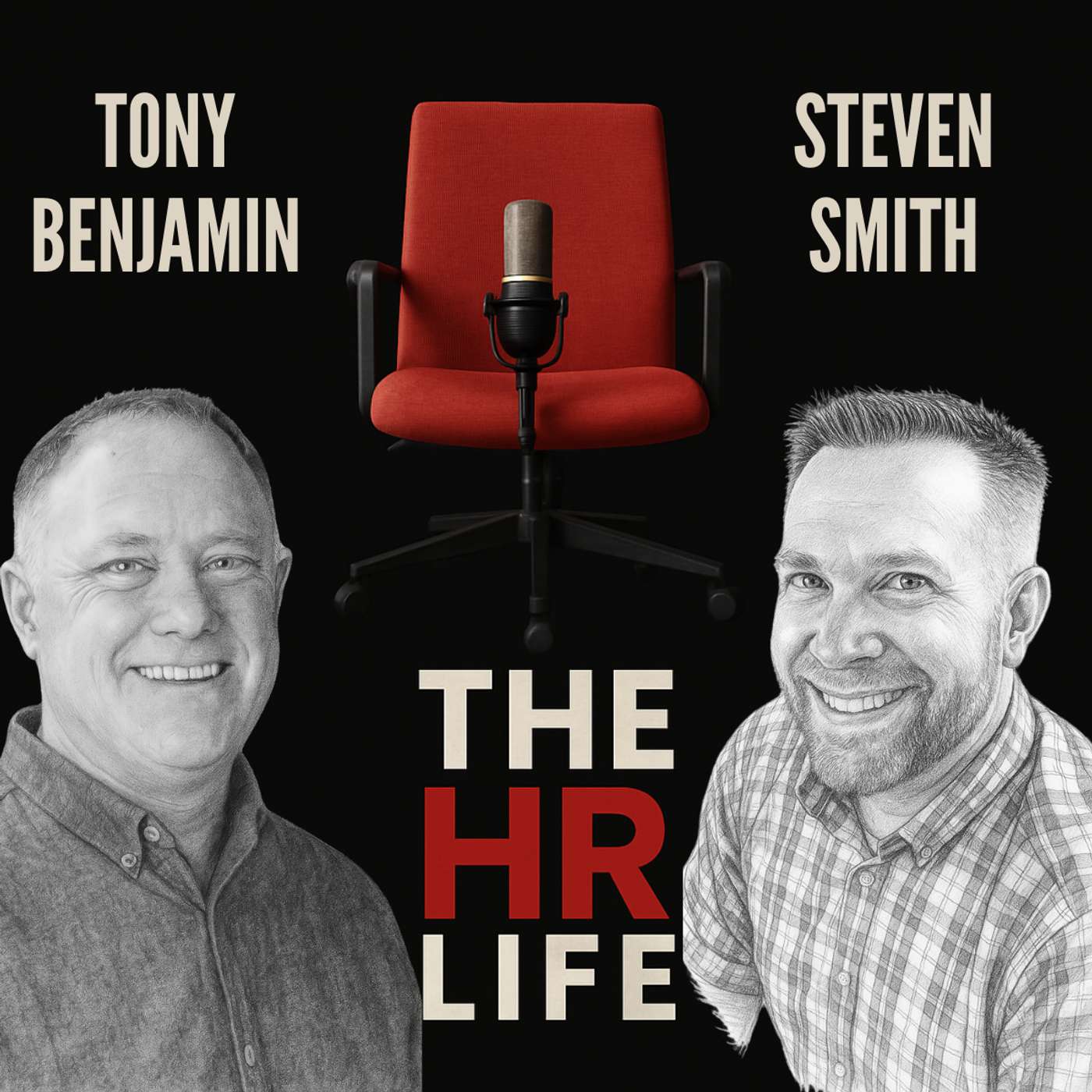
The HR Life Podcast · Tony Benjamin
The Red Seat is empty again, so Steve opens with the story of waiting twelve hours in line at Wrigley Field during the 2016 World Series and somehow landing ten rows behind home plate, right next to Javy Baez's family, while his wife and Javy's mom chatted like old friends. Tony counters with a Steelers stadium tour where the only rule anyone enforced was don't touch the grass. Then the guys roll up their sleeves for an episode on how to properly give employee discipline. This episode is a crash course in doing discipline right: why the best verbal warning never uses the words "verbal warning," why every manager needs a notebook (Tony could not remember what to call it, and Steve could not stop helping), and how an AI bot might spot a pattern before a lawyer does. Tony shares a game called Bet Your Life that could end with the manager getting written up instead of the employee. Steve lists the five offenses that can justify skipping straight to termination. Why does half of Reddit think a PIP means you are already halfway out the door, and are they right? Does an employee's signature mean they agree with the write-up? And is "we're an at-will state" the legal force field so many managers think it is? Stick around to the very end, too. Tony shared the secret to life, and Steve missed the whole thing. Download a sample Disciplinary form at: https://drive.google.com/drive/folders/1F99mk1JfoKScGea7wMlFhmboNlr-oLVh?usp=sharing Learn more about Fantastic Tony Benjamin at: https://www.thegrangellc.com/ Learn more about Steven "Big Deal" Smith at: https://thehiringtreebook.com/ Learn more about the Books mentioned on the podcast at: https://thehiringtreebook.com/hr-life-podcast Learn more about Dyno Outfitters at: https://www.utahviaferrata.com/ Learn more about MegastarHR at: https://www.megastarhr.com/ Learn more about Pucks for Autism at: https://www.pucksforautism.com/ Learn more about Thrive Life Project at: https://www.thrivelifeproject.org/
Tony Benjamin (00:14.566) Welcome to the HR Life Podcast, a podcast about the work-life experience of those of us in human resources and business leadership. Your hosts are fantastic Tony Benjamin, owner and founder of the Grange Strategic HR Consulting, and Steven Big Deal Smith, who is so important that Javier Baez invites him to family gatherings. Hey Steve! Steven Smith (00:38.571) Well that's a good one. Tony Benjamin (00:44.09) I've I've been told though that his close friends call him JV. Steven Smith (00:47.627) Yeah, so wow. This goes back to the World Series in twenty sixteen. That's where this story comes from. Tony Benjamin (00:55.376) Really? Okay. Now and I can't remember which episode it is in, but we talked about that before. Like we've talked about you and at the World Series before. Yep. Yep. Yep. Telemundo and all that. Steven Smith (01:03.049) The World Series. Yeah, how we how we stood in line for all those hours. So so the crazy part about it is after we stood in line, the lady at the front desk, so so when we finally got up there and we got to get our tickets, the lady at the front desk says, Okay, where do you want your tickets? And and we were like, you know what, we've been waiting in line for eight hours. We don't even care. You can put us in the nosebleed section for all we care. We are just ecstatic and excited to actually be here. Thank you. Right. We're just so appreciative. And she's like, okay, I have two tickets. Cause and plus, we were probably one of the few that only wanted two tickets because there was two of us. There was a lot of people that were like, Well, give me four, and then they had scalpers literally right there in the line, and they'd sell the other two to the scalpers right away. And so I th I think this lady kind of seeing this scenario thought, Well, okay, these guys are one, they're serious, they're they're real fans, two, they're not gonna go scalping, and three, they are just so appreciative of being here. Tony Benjamin (01:47.73) Right, right. Yeah. Steven Smith (02:01.224) Here to begin with, let I'm gonna treat them nice. And that's exactly what she did. So she gave us two tickets. We had no idea where they were, gave us two tickets, said, Go ahead. Tony Benjamin (02:02.588) Yeah. Steven Smith (02:10.025) We walk in and we get up to the front and we we the first thing we do is go to the bathroom and get food because we we haven't eaten all day, we haven't gone to the bathroom all day. So the first things that we do. The cool part is the concessions that so the first inning had already started. So we're we already missed the first inning because we were just in line. And the concession people are like, well, here's some free stuff. So they actually gave us some free food because we had been waiting so long. They were so nice. They were so nice. Like it, like I said, it was unbelievably nice of everybody. So so we get to the front, we say there's a lady obviously helping people. Tony Benjamin (02:25.41) Yeah, yeah. Tony Benjamin (02:31.238) Wow, really? That's cool. That's really cool. Steven Smith (02:39.949) People sit and say, Hey, we just got these tickets. We finally got in. Can you show us where these are? And she's sure. So we go up this little thing and then we start going down. And then we skip a section. We go down more. And then we go we're just like, What is going on? And we finally are ten rows behind home plate and there are no seats and and there's a family sitting there. And then there's two blank spots where a handicapped spot usually is. So I'm assuming that the handicapped person didn't show up or or there was no need. And so she said, Hold on a minute. And she they went and got those really cushioned, branded Chicago Cubs cushy seats, the fold chairs, you know, set them there for us next to this family, sat us down and said, These are your seats. And so we sit down. Tony Benjamin (03:21.706) wow, yeah, yeah, yeah. Steven Smith (03:31.251) And sure enough, to the left of us, this entire family is Javi Baez's family. And so it was the Hobby Baez at the time. Yeah, Javi Baez so Javi yeah Tony Benjamin (03:36.554) wow. So okay, so Javi Baez, that's how they okay, I I got it wrong. Yeah, Javi. To his friends. To his friends. Steven Smith (03:45.705) Yeah. So Javi is was the second baseman. He was I mean, just phenomenal. He's he's no longer with the Cubs, but at the time, I mean, just powerhouse. And I'll tell you what, the first time I ever heard over a hundred mile an hour fastball by Heraldus Chapman, and you hear that hit the glove, that is something to hear. I I you can't explain it. Like in person and and literally again, we're ten rows away from home plate. Like it just unbelievable. So Tony Benjamin (04:05.2) Bet that's cool. Yeah. Steven Smith (04:14.386) So yeah, so we got to sit with Javi Baez's family, talked with them, like obviously at Lisa got along really well because Javi Baez's mom was right there. And so two moms like just jib jabbing and talking and going on. It was a lot of fun. So so anyway, that that was a treat. That that was probably one of my so memorable that we created a shadow box. So when you come visit our home, we have a shadow box on our wall that has our tickets. Tony Benjamin (04:20.818) that's awesome. That's that's really cool. Steven Smith (04:41.724) It has the the little fl flag thing that we got. It has my little pin. It ha yeah, it has all kinds of stuff from the game and a few pictures of us from that day. And it's in this little shadow box that that j just is a reminder of of what a cool day that was. So Tony Benjamin (04:45.65) Dependent. Yeah, yeah, yeah, okay. Tony Benjamin (04:59.484) That that's awesome. That that's really cool, Steve. That's the the only NFL game I've ever been to. We were sitting on like six or eight rows up, something like that. And I loved being that close. Like being that close, you get a real flavor for the game. You get to Yeah, yeah, you get to experience it. And that's that's when I looked out there and I saw that T J Watt is just he's a man among boys. Steven Smith (05:10.505) Yeah. This is different. Tony Benjamin (05:24.442) It's just the guy's huge. He's huge. And it just anyways, yeah. No. Well that's cool. That's cool. So Steven Smith (05:24.478) Yeah. Yeah. So cool. Yeah, and and I and we were in Wrigley Field, so that was already nostalgic. It's one of the oldest ballparks that still exists today. And I just such a such a memory. And and like I said, the Cubs, the the workers that were there, and obviously this relates from an HR perspective, they were so kind to us. This couple from Utah randomly showed up, you know Tony Benjamin (05:34.929) Yeah. Steven Smith (05:54.688) didn't have tickets to begin with. th they just they went above and beyond as as workers and and w just showed a real good example of of what it means to really, you know, own up to the organization that you work for and treat people with respect and such. It it it was just it was fantastic. So overall. Tony Benjamin (06:12.37) No, shout out to all those people 'cause there are people for those professional sports organizations that they get it. Like they really understand. When my son and I, when we toured what was then Heinz Stadium, which is now Accresher Stadium, when we toured it and we're walking through the Hall of Fame their stuff that they have for the Steelers and everything, and like Steven Smith (06:15.295) Mm-hmm. Steven Smith (06:19.561) Yeah. Tony Benjamin (06:35.708) There were some questions from the group and all that, and everyone's like, I don't know. And you know, kinda I I I just the guy handled it all with patience. Like he got it. Like you're a fan, you're a fan. And and like everything is important to you, no matter how dumb it seems to him, right? He was cool. He was so cool about it. And the only thing they were strict with us on is touching the grass when we went out on the field. Steven Smith (06:45.769) Yeah. So cool. Steven Smith (06:53.097) Mm-hmm. Tony Benjamin (07:01.212) But other than that, they were just yeah, and to your point, man, they they get it. They just know who you are. Even so they take us on the tour and then they dump us into the pro shop, right? And you go into the pro shop and those people are like at the cash register. They're helping Tons of people who've just gone on this tour and all that and you get a discount because you went on the tour and you go in there and they're like, Where are you from? Is this your first game? it is. Wow, that's really cool. And they like, hey, we'll we'll throw in a couple of these extra little things, their little cards and stuff that you know, and they have for today's or tomorrow's game, and here you go. And like they're they're cool. They're just they're awesome. and you got this jersey and that. Steven Smith (07:20.843) Mm-hmm. Tony Benjamin (07:40.496) Tomorrow if you're gonna bring that to the to the game though, you gotta have a clear bag. So let's get her I'm you know, they're telling you what to do 'cause you can't take not a clear bag into the game. It just cool stuff. Like Steven Smith (07:51.156) And think about that. That that is going above and beyond, but that's also a coworker who who truly understands their role in the organization. They understand their role, they understand the part they play, and they also understand the rules that that need to be played, right? And they're helping others follow those rules without making it confrontational or anything of that nature. So it just yeah. Tony Benjamin (08:01.148) That's right. Yes. Steven Smith (08:17.449) Just an incredible that's cool. So we've both had really cool experiences in that regard just with sports teams. Tony Benjamin (08:17.733) Yeah. Yeah, yeah. Yeah, yeah. Well, yours is a bigger deal than mine 'cause it was the s world series, but I'll take it. One of these days when I'm rich and famous, I'll go to the Super Bowl and the Steelers will be playing. So it might be a while. So all right, now everybody. Go ahead. That's right. And that's yeah. Right, right. Right. all right, now our guest today is Javier Baez. No, I'm just Steven Smith (08:32.809) Nice. Well, what you need to do is you just show up, Tony, and wait in line for like twelve hours and get tickets at face value instead of ten thousand dollars for, you know, a half a seat. Steven Smith (08:50.219) Yes. Wait, I thought it was Dek. I thought it was Dek from Ba from Badlands. We'll get to that later. Tony Benjamin (08:52.057) No, anyways, no. Yeah. That's that's right. Yeah, we'll we'll talk about that later. anyways, no, we're doing an empty red seat today. We hope everyone's had a great time. Hope you enjoyed the conference episode that we did. That one just dropped. Steven Smith (09:11.349) That's fun. Yeah. Tony Benjamin (09:13.013) this week and hope everyone enjoyed that. That was a lot of fun. And I love the I love the conference. And we're getting we're getting slightly better with sound at the conference, so that's good. exactly. Steven Smith (09:16.949) Who wise? Steven Smith (09:23.291) Slightly better. I thought this was way better. personally I mean not you know, not trying to doggy or anything, but man, it was it was pretty good, I thought. So Tony Benjamin (09:33.445) Yeah, yeah. Last year was pretty rough. But this this year is good. So anyways, and we weren't crowded around a mic. Last year all three of us, whoever we interviewed, was all talking into one mic. And yeah. that's a magic. Shh. but anyways, it w that worked out pretty well. I enjoyed that. Steven Smith (09:41.291) It's very true. Steven Smith (09:45.449) Yeah, you had to be careful not to kiss Tony accidentally. It was r it was that close. Ha ha ha. Tony Benjamin (09:59.376) It was a lot of fun, great conference. It was it was just really good. And and we we wanna note that Steve's post about the episode, Sherm commented on it. So National Sherm is taking interest in the podcast. Yeah. Steven Smith (10:09.343) They did. They did. Thank you to Sherm, yeah. Well, and not only are they taking interest, I I had a conversation with somebody from Sherm the other day. And and what we're trying to do is get in touch with their marketing team so that one of their team members might be a potential guest later on. So we can get some real good details and answer some of those questions, you know, without making it confrontational or awkward or anything. Just get answers, right? Just here's here's what people are saying. So I I shared an email with them what a lot of our listeners and and our live studio audience had said so that their team could be well aware of, hey, here's the questions people have, here's what's going on. Tony Benjamin (10:27.558) Yeah. Steven Smith (10:42.829) and so yeah, so so that was a lot of fun to to kind of have that conversation and share that feedback with Sherm directly. And yeah, so we'll see where that goes. So there no, that was cool. That was cool. Yeah. Tony Benjamin (10:52.411) Yeah, no, that was cool. That was cool. We're we're the the podcast is growing and we thank everybody for referring to people to us and all that. And hopefully all the women we didn't bore with the sports talk. And not that the Star Wars talk already hasn't done that for you sometime. But Steven Smith (11:03.579) Ha. Steven Smith (11:09.279) I know, right? There's certain things that we probably bore people anyway, but that's all right. They can they can just hit, you know, ahead thirty seconds or whatever and then they can get to what they want. So Tony Benjamin (11:13.595) Yeah, yeah. Tony Benjamin (11:17.327) That's right. That's right. They can they can skip past it. And someday I'll learn how to do chapters and we'll we'll do chapters. So so all right. well anyway, we're we're kind of already in this today. Today we want to talk about employee discipline and specifically we have an empty red seat today. We're gonna talk specifically about employee discipline for for small business. I I think the principles we're gonna talk about will will go across the board. Steven Smith (11:22.783) Ha ha there you go. Tony Benjamin (11:47.794) in many ways, no matter what size of of company you have. but we want to get into that. We want to talk about employee discipline. You know, Carissa Staley gave this awesome presentation at at the conference about investigations. And then I I we were so enamored with that that I asked her to speak at Basin HR as well. And the whole group, and a lot of those people are pretty senior and but some of them aren't Steven Smith (12:04.266) Yeah. Tony Benjamin (12:16.197) And it just reminded me that perhaps, just perhaps, we need every once in a while to talk about here on some podcasts that are some more early career stuff, right? Early career things. So Steven Smith (12:28.691) Yeah. Well, it would probably be what be what some people would consider basic. But but sometimes those basics, if we look back at the roots, sometimes learn you know, going through those basics again reminds us, we're not even doing that or I didn't even think about that. So Tony Benjamin (12:41.945) Right, right. No, and and I think I think the important part about this too is that you're getting the basics from an advanced practitioner's point of view. Meaning meaning when you first do it, you get a little nervous, right? Like the first time you do an investigation or something, you're nervous and not sure if you're doing everything right and all that sort of stuff. but after you've done it twenty times, there's some nuances that you get into, right? you're not thrown off as as much and all that sort of stuff. So I think Steven Smith (13:07.754) Yeah. Tony Benjamin (13:12.111) I think looking about this maybe as as someone as the two of us more senior looking back on some of these things is a good way to is a good way to approach it. But we wanted to touch on something, so go ahead. Steven Smith (13:21.759) Well, and I yeah, and I found too that sometimes when you've done it twenty times in a row, or you know, however many times you've done it, sometimes you forget stuff in the next investigation. Not on purpose. It's just based on how things are going, you just skip a step or skip a a a point, and sometimes that comes back and bites you a little bit, or you're like, man, I we should have done that. Darn it, you know. So so anyway, so those that's that's why I think reviewing something like this can be really helpful. Tony Benjamin (13:34.639) Right. Tony Benjamin (13:46.117) Yeah, yeah. Yeah, no and Tony Benjamin (13:51.728) And when I sat through Carissa's thing, there were a couple of things that she said that I went, yeah, I I I didn't think about that as a formal step. So it was all good. All right. So we're gonna talk. Right, right. So now we're gonna talk about employee discipline. But before we do that, let's do a read. Looking for a team building experience your employees will actually talk about, Dino Outfitters in Vernal, Utah offers guided trips on the epic new Ashley Gorge Via Ferrada. Steven Smith (13:59.926) Yep. Yep. That that's the beauty of it, right? So Tony Benjamin (14:21.135) Help your team build trust, confidence, and real connection all while hanging out on the side of a cliff. Reach out to build a custom experience at UtahViaferada.com. Shout out to Amber and her team and the wonderful things they're doing. And if you haven't booked this year in the already for her, you might be too late. So give a start start looking at the early spring stuff, because anyways, cool stuff, really cool stuff. Steven Smith (14:43.497) Yeah, right. And Amber's so great. If for those of you that decide to go on this, you're gonna absolutely love it. She's a she's an incredible host in that sense or guide. And yeah, such a great conversation, just very well prepared and Tony Benjamin (14:57.617) Yeah. Tony Benjamin (15:04.121) Yeah, yeah. She has a great team there to support and everything else. And they're awesome and they're very patient. You know, she hikes up that mountain to start it. Probably, you know what, she said like ten times, eight times a week. Yeah, something like that. It was a lot. It was a lot, whatever it was. Steven Smith (15:13.587) Probably three times. I was gonna I was gonna say three times a day, but there you go. Tony Benjamin (15:19.505) Yeah. But she she hikes up the mountain and those of us who are puffing like halfway up, you know, she's really patient about stopping and waiting. So yeah. It was it was good. You know, her, she's barely breaking a sweat and you're s you know grasping for gasping for air. No. Yeah, yeah, yeah. It's because she does it so much. Right. Okay, so let's let's talk about employee discipline a little bit. Steven Smith (15:25.769) Yeah, she's she's she is patient, it's so true. Steven Smith (15:34.397) I know, right? I don't even think she did break a sweat. She just kinda walked up there and yeah. That glow was not sweat. It was just she's just really good at what she does. So there you go. Tony Benjamin (15:48.954) And I I wanna start I wanna start before the discipline and I wanna talk about about the purpose of discipline and we'll let's start there. so when you hear about discipline or you're disciplining somebody, we often think of punishment, right? your child does something wrong, so you spank or put in timeout or whatever it is that you do or my aunt used to make us hold a penny up against the wall with her nose, stuff like that, you know. but Steven Smith (16:16.274) Wow. Tony Benjamin (16:19.186) it was i the the point just being is that that's what we think of when we think of discipline. That's not what discipline is. The word discipline actually means self control or control. Steven Smith (16:29.822) Well And think about it. If you look at the you know etymology of it, discipline comes from dust disciple. And a disciple is a dedicated student, learner, follower, somebody who commits to the teachings, lifestyle, and philosophy of a certain master. So in this scenario, you have to you almost have to think of your employee as the disciple of your organization. And they're committing to your organization. And so when we go to discipline, what does that actually look like at that point? And that's part of what we're gonna discuss today. So and and maybe that delves into To some religious dogma a little bit, but but again, we'd have to look at the the core of the term there and just think of it in employee relationship. So Tony Benjamin (17:09.733) They are somebody who is bought in and is following the way, as the Mandalorian would say. And and and so you're going along and you're you're you're part of the team already. You're already bought in, right? And what you're doing is you're keeping them on the path or th the way. you're keeping them on that path and you're creating boundaries around which to go from. Now, I would say that it's a lot harder to have Steven Smith (17:13.3) Correct. That's right. Steven Smith (17:21.386) Mm-hmm. Tony Benjamin (17:37.35) discipline or whatever if they don't have a job description or they don't know what their job is. I just want to point this out. A lot of people who call me for legal advice, I this is no joke, people. I'm telling you straight out, I'll ask them, who do you report to? I'm not sure. I talk to this person a lot, but this other person is it really is who I report to on the org chart, but I never talk to them. Wow. Okay. And who who gives you your performance review? Steven Smith (17:41.929) Yeah. Steven Smith (17:53.128) And they don't even know. Yep. Tony Benjamin (18:07.239) this person I never talked to ever. they right. I mean, it just it just shocks me, right? They don't know who they report to, or what was your job description? They never gave us one. Well, what do you do? Okay, what were the key aspects of your job? What was the focus? They don't know. And so here's the here's the indication that I would say to people: go up to your employee, and we've talked about this before, perhaps, but I would say, go up to your employee and say, How do you know you're doing a good job? Steven Smith (18:13.029) Mm-hmm. Tony Benjamin (18:36.847) And if the answer is I try really hard, or there's some sort of version or of that, like I work really hard every day, right, right. Then then then you know you have a problem. So and and I would say I would say 50% of the time, as I as a consultant work with managers and in that or even the legal stuff I do, 50% of the time it's the manager who has not done their job, not the employer. Steven Smith (18:42.642) Yeah, where they can't be specific or yeah. Steven Smith (19:07.22) Yeah. Tony Benjamin (19:07.771) fifty percent of the time. And you you can't send you can't sit somebody down in in ninety percent of the cases, you can't sit somebody down and say, All right, develop a marketing plan or I need you to process these papers, go. And th they you have to train them, you have to all that sort of stuff. So I I want to start there and then there's two reasons in gen two broad reasons in which you give discipline or the reasons you give discipline. Number one is that they're not performing at the level you want them to. Okay, so that's number one. The second is that they violated some sort of company policy. and that that could be from sexual harassment down to they're late every day. I just they but they violate a company policy. Steven Smith (19:45.374) Yeah. Steven Smith (19:51.806) Yeah, something's but and can can I can I just put a gicture in here really really briefly? One of the things that discipline is not is it's not a sequence of warnings before some type of termination. It is not documentation. Yeah yeah. Well I Tony Benjamin (19:54.768) Yeah, yeah. Tony Benjamin (20:04.036) It is not documentation. It works that way later, but it's not. That's not what it's for. Steven Smith (20:07.953) Yeah, you you still wanna it has to be fair and and you still do want to document it, but you need to have a consistent process for addressing issues in the workplace. So so so what you need to do is actually think ahead of time what kind of issues might we encounter in the organization. You know, if I'm a business owner Tony Benjamin (20:16.357) Yes. Steven Smith (20:25.491) This is part of what I have to think about. What kind of issues might I potentially run into? And do I have a consistent documented process to address any one of those situations? And sometimes it builds over time. But but again, it's not just a sequence of warnings that that okay, this is how I get you determination. It's not a pip, is what I'm trying to say. Disciplinary action is not a pip, which, you know, for those of you who don't know what a pip is, it's like a proof. So anyway. Tony Benjamin (20:43.963) Yes, yes, yes. Tony Benjamin (20:50.833) Personal im improvement plan. Steven Smith (20:55.068) I usually called it a performance issue plan, but you know, any one of those definitions works, right? Any one of those works. So so so anyway. Tony Benjamin (20:58.491) Yeah, okay. Performance improvement plan or personal improvement plan or yeah. Steven Smith (21:04.447) Yeah. Yeah. Yeah. I just I wanted to clarify that because discipline is not that and and and that's a a unique distinction. And so as we go through this we're gonna we're gonna kind of address that. So Tony Benjamin (21:13.361) Right, right. And we'll yeah, yeah, we're gonna get into the whole PIP problem. there's a national pip problem. but no, no. So okay, so you you have and and generally speaking, this is this is so on my website there is an article that refers to this too. And the the first portion of discipline that I point out to people, is that the first level of discipline is not anything in writing and it they're not quote unquote in trouble. The first thing how you discipline people is ask what's wrong. So that that is the f and we call that a verbal warning. But but if you go up to somebody and say, I'm giving you a verbal warning today, all they're going to do is get defensive. Okay. The verbal warning isn't a label that you hang on a conversation. The verbal warning is Tony was late today, 10 minutes. Steven Smith (21:53.865) Mm-hmm. Steven Smith (21:58.217) Mm-hmm. Tony Benjamin (22:07.653) And that set us back. So I go up to him and I say, Hey Tony, you okay, man? You're never late. Why were you late today? Is everything okay? And maybe he says, Hey, my car broke down, I had to hitchhike to work. Or, and then you're like, Wow, and only 10 minutes late. Just whatever it is, right? You go to them, you express interest, you tell them you noticed, you noticed, and that's the important thing, you noticed, and that you're concerned for them. Okay. Steven Smith (22:18.174) Yeah. Tony Benjamin (22:34.063) Now, what that does for the employee to discipline them once again is to get them back on the right path. And they want they see if you don't go up and talk to Tony after he's been late one time, and you don't have to badger him and all that sort of stuff, but if you don't go up to him, what he takes out of that is, well, Tony doesn't even know if I come in on time. Or my my manager doesn't even know if I come in on time, right? Steven Smith (22:51.626) I can get away with it. Steven Smith (22:58.011) that's a good point. That's a different angle there, yeah. Yeah. Tony Benjamin (23:00.869) Look, I've had managers where I've where they're like, We gotta write up so and so he or she's been doing really bad. And I'm like, Okay. Well, why don't okay, we we go through all the paperwork and everything, they say, Okay, go get and bring up here. And it's eleven thirty in the you know in the morning or whatever. And they're like, they called in sick today. Like, how did you not know that? Right. And you wonder why they have a problem being late because you don't even know if they're there or not. So so Steven Smith (23:23.225) Ha ha ha. Steven Smith (23:27.636) Yeah, yeah. Not even paying attention. Tony Benjamin (23:30.723) Right, right. So what I would say is do that. When a mistake happens you know in performance level, we don't jump in and jump on an employee and say, Hey, you screwed up this one time. What you do though is you go to and you say, and you don't do it for a typo, for example, but you jump in and if there's a mistake made, you jump in and you say, Hey, I saw you made this mistake. Is everything okay? Is there something going on? No, no, no, I know it. I get it. I I won't do that again. Okay, great. Steven Smith (24:00.554) Perfect. Yeah. Tony Benjamin (24:00.688) And you let it go, but you're showing concern for the employee, okay? And again, that does two things. Number one, it lets them know it was noticed. And I can't do that forever. Number two, you showed concern for them and they feel reinforced like you care, not that you that you're punishing them or whatever. So that's your first, that's how you do a verbal warning. That's how you do it. And by the way, go ahead, go ahead. Steven Smith (24:26.942) Well well, I was gonna say what what you've brought up here is the thing that I always tell employers. There there are three things employees need to know at all times. They need to know the job standards. What are your standards? What what are the e expectations, like you said? Number two, they need to know the attendance rules because this is a common place where things get violated, right? And then the last thing is they need to understand and know the workplace policies. And I'm sorry, giving them a document that just outlines it all is not sufficient enough. You should have some type of training either during orientation or ongoing. every you know six months or so where you talk about these things. Here's the standard expectation in this particular role. You know, those will be more individual, but like attendance rules and workplace policies can be very generalized, right? So so so that those expectations have to be clear and and too often managers assume that the expectations are known. And and that's where oftentimes the problem lies, or at least where it begins. Tony Benjamin (25:27.963) Yeah, you know how you know how many times I've been in a meeting where they want to write somebody up and I'm like, Okay, what what did you tell them their standards are? he knows what the standards. Steven Smith (25:39.054) Exactly. And then you're like, are you sure? How about you tell me the standards? 'Cause sometimes they can't even define it. Tony Benjamin (25:41.52) Are you sure? What if I have him write them down? And if you're how yeah, well that's well, yeah. So but I don't know. This is this is a bet your life. This is a game I used to play with my kids too. It's called Bet Your Life. And I say to I I've said to some managers, okay, why don't you write down the expectations of what the job expectations are? I will have the employee write them down blind to what you've written down. If they don't match, how about we write you up? Instead of them. Tony Benjamin (26:14.799) Are you sure they know? Well, they might not. They might not. Okay. Good, good. Yeah. So go ahead. Steven Smith (26:19.838) Exactly. And and Tony, the the point here is, you know, when we have conversations like this from a consulting perspective with a manager, the the point of this is not to call you out or throw you under the bus or or be cruel and mean about this. What we're trying to do is help you understand what the standard should be and how to help establish it if it's not fully established, right? That's the whole point of this. So yeah. Yeah. Tony Benjamin (26:32.505) Right, exactly. Tony Benjamin (26:43.899) That's right. Yeah, yeah, yeah. And and because if you can if you can improve the performance of your employees just by setting standards, that's what you do. That that's an easy, low-hanging fruit to do. okay, so anyways, that's that though those are the important first steps in that. do they know the standards? They know what's expected of them. And then you're gonna then the next question to that manager is okay, how did they violate those? What aren't they living up to? And if Steven Smith (26:54.366) Yeah. Yeah. Steven Smith (27:11.636) Yeah, let's gather the facts. Tony Benjamin (27:14.521) Right, right. And l and and here again, th in theory you train your managers to this over time. Okay. They they they do it over time. And sometimes at the beginning they roll their eyes and, you know, gripe at at you about how they can't just, you know, work with their employees. They gotta run through red tape. But you start to train them. No, look, I'm trying to help you be a better manager and it's not about red tape. look, everybody Steven Smith (27:22.408) Mm-hmm. Tony Benjamin (27:41.421) Okay, if you if you're a manager and you don't have a little notepad or or one of those what do they call those those little booklets of of paper you can write in the the well, no, it anyways. Everybody knows I'm talking the little black and white ones that are bound, right? And Steven Smith (27:51.87) The legal Steven Smith (27:58.314) Yeah, it's called a legal notebook or a legal like the the term legal is usually what's used there. Tony Benjamin (28:01.22) No, no, not legal. Anyways, it's something about writing. Anyways, but anyways, the point is you as a manager need to have one of those. Gosh. Okay, Napoleon. Yeah. But anyways, so if you don't write right, there you go. If you don't have a notebook as a manager in which you just jot down notes, Tony was late on Tuesday. I talked to him about it and put the date next to it. Steven Smith (28:05.13) Why don't you believe me, Tony? Go. Steven Smith (28:13.13) I mean golly. Steven Smith (28:27.21) I just call it a journal, but you know, whatever you wanna Tony Benjamin (28:29.209) Right, right, right. But you you just you just write those things down and you you write them down and you just kinda keep notes. And then what you're you know, you're into it three months, you're like, wait a minute, how many times has Tony been late? It seems like he's been late a lot lately. And you're looking back and you're thinking, six times. Or maybe it's only twice, but it feels like six times. Okay, so that's all possible too. Yeah, yeah. Steven Smith (28:53.704) Can I offer a better solution here? With the onslaught of AI, which is a great thing, why don't you create a bot that is just about history and you just open up your phone and speak to your bot real quick? Hey, I just want to record. Tony was late today. You know, today is whatever day, time, et cetera. And now you have you have something that not only records it because you're supposed to document anyway, but two, you could easily run a report on that. very quickly to get the answer that Tony just described without having to flip through notes and see, okay, how many times did I write this down. Right. That's the beauty of technology today is is it it makes it so much easier to do these things. And so I I have a bot that's my journal bot and I just record stuff. So Tony Benjamin (29:40.657) That's cool. That's cool. And and I I want to put a cautionary note there that a notepad, that process has gone through court and it's just you know, you it's supportable. I don't know about AI. Yeah, yeah, yeah. Steven Smith (29:49.671) Mm-hmm. Yeah, still be careful what you say in it. You know, be be direct and, you know, subjective, right? Or not subjective, objective. And yeah, and and so yeah, keep that in mind. Tony Benjamin (29:59.597) Objective, yeah. Yeah, yeah. But but i in terms of the documentation, I don't know what the courts are gonna say about that, but I do I think that's a great way to do it. But the point is you're jotting those things down so that so that you know. Right, right. So then when you come to HR, the manager and HR people train your managers this way. When the manager c then comes to HR, they say, Hey, on this day and this day, Tony was late. And then I've noticed over the last two weeks that he's not getting all of his work done. Steven Smith (30:12.818) Yeah. There's a history. Tony Benjamin (30:31.707) Well, what's the standard of getting his work done? Well, he processes 32 files a day. I don't know, whatever it is. He processes 32 files a day. That's kind of our standard. And he's only been doing 10 a day. So we really need him to step up. He's he's gotta get at least above 20, somewhere there to be, you know. You're like, okay. Like those are direct standards. Now, the standards of your managers may not be that clear, right? Because not everyone's quote unquote production or admin. I understand that, but whatever the standards for it are, how do I know they're a good employee versus a bad employee? then then those are the standards. So they come with you, come to you and they say, here it is. Or maybe, hey, he he's violated some sort of policy. he's not clocking out when he leaves for lunch or and he did it on this day and this day. What what whatever those things happen to be. but the manager should outline those for you. Steven Smith (31:03.657) Yeah. Steven Smith (31:19.762) Yeah. Tony Benjamin (31:24.227) Now, this is where when you, as an HR person, need to start looking and watching each of your managers and start training them on this. So let's say you got Bob, and Bob has five Hispanic employees and five white employees, for lack of better phrases. And he comes to you and he wants to write up Javier. So you write up Javier. And then the next day, and I'm just grabbing names, people. Please don't get mad if I just grab cliche names. Steven Smith (31:46.782) Hmm. Steven Smith (31:52.138) Ha ha. Tony Benjamin (31:54.0) And then Jose is next, right? And so and so, okay. Then then, you know, three weeks later once write up Jesus and then Javier again. Okay, well do you see what's going on here? Like hopefully you do. Steven Smith (32:08.414) Yeah, that's four in a row. There were all the Latinos instead of the white folks. Well, think about this. Tony Benjamin (32:11.721) All the Latinos are getting written up, none of the white guys. Now, it may be that the Latinos are late. I I wanna make sure we understand this. But you can only have evidence of that if they've kept their notebook or their record about when they talk to them about it. But you need to you as HR need to be that filter to keep an eye on it just in case. Go ahead. Steven Smith (32:17.801) Yeah. Steven Smith (32:32.116) Yeah. And and you know, we learned this from the Scherm case recently, right? The one in December. You if you're first of all, you need to hold everybody to the same standard. You can't just make up a standard and say, well, this is the standard that we're going to put in place. But if you haven't educated all of the people that are in that role to the same standard, that's a big problem. That was one of the biggest problems Sherm had in in their particular case that they just lost in December. Tony Benjamin (32:37.751) Ta, yes. Steven Smith (32:58.97) Is is they they created a standard because they wanted to create this pip and all that stuff, but that standard was not known to the other employees, which means they probably made it up on the fly simply to to say, well, this should, you know, you know, because this is the way managers think sometimes. When I talk to managers like, well, this should be the standard, okay, should be the standard is not the same as this is the standard. And and that's where you have to sit down and say, okay, does does everybody in this role understand that standard? If we were Tony Benjamin (32:59.214) And Tony Benjamin (33:08.273) Mm-hmm. Steven Smith (33:28.884) It's like your little test, Tony. If I were to go and interview all of your employees right now and ask them what's the standard, would all of them answer the same way? There's your litmus test. Period. Tony Benjamin (33:36.111) Yes. Yep. Yep. No. That you're you're exactly right, Steve. That that's exactly right. And but anyways, you as HR are the initial filter for that stuff. You're you're the filter for it. And that doesn't mean Steven Smith (33:48.04) Mm-hmm. But again, if we're in a small business with no HR, where does this lie, right? The owner. Tony Benjamin (33:55.824) Right, right, okay, and that's exactly right. Right. So now here's what I would yes, no sa this is perfect. For small business owners, you still need to have an org chart. Okay. Unless you're so small that everybody reports to you, the owner. That's fine too, but they need to make sure they know that. Okay. You got five team members and supposedly all of them report to you, but Jimmy never talks to you. Okay. They don't all report to you. Steven Smith (33:57.898) Because the owner's wearing the hat, right? Steven Smith (34:16.244) Yep. Yep. Tony Benjamin (34:25.563) Jimmy reports to whoever he's getting his information from. And if it's not you, it's not you. So, no, you're exactly right. So, but for for small business owners, here's the thing you need to understand. All the protected classes, right? Race, sex, religion, national origin, age, disability, status, sexual identity, that sort of stuff. Uh-huh. Steven Smith (34:47.412) You have to name all now, Tony. This is your test. Tony Benjamin (34:49.989) No, I'm I'm really bad at it. There used there used to only be like five and now, you know, and pregnant status is one and military veteran status is another and yeah. Anyways, there you go. I'm not that's not that bad actually. 'cause normally I just read those off to people. I I bet you they're for the state of Utah. For the state of Utah. Steven Smith (35:05.012) I'm gonna have AI check this later and make sure you got them all. Steven Smith (35:12.653) Ha. Tony Benjamin (35:13.987) Anyways, but so but for those of you so what you want to make sure is that you are not treating people differently based upon one of those protected classes. So in our example of the manager who's giving all of them to the Hispanic guys, the answer to that is maybe he maybe they really are all late. Maybe that's really going on. But you better double check that and have your ducks in a row if you're gonna write up four of them and none of the white guys on the team. Okay. So just The that's the first that's the first thread. Ninety percent of the time you're gonna pass that, you know, that filter and it's all gonna go well. the next the the next thing then that you want to do is you want to write down all the instances that you've got in your little book in order. On January seventh, Tony was late. On February fifteenth, Tony was late. On February eighteenth, Tony was late, on February twenty ninth, because that happens. Tony was late. And then and then you're gonna you're gonna record the dates, right? So you record all those dates. Now you then you also say if it's something else, here's what I would say. If let's say Tony's only been late twice, and and but you say on January 5th, Tony was late, and January seventh, Tony was late, and then you say on March first or February first, it depends on how long out you want to keep track of those, but on February first, Tony Steven Smith (36:12.138) Wow. Tony Benjamin (36:39.973) you know, he misapplied a payment in the accounting system to a wrong thing and it was a a ten thousand dollar mistake. Okay. The two are not related, but we're gonna put those in the disciplinary action because it forms a bit a better picture of what's going on. So here's the standard in this section. You want a lay person who has knows nothing about your employee. You want them to be able to look at the document and understand why you wrote them up. Steven Smith (37:08.298) And understand it. Tony Benjamin (37:10.349) Right. And the the best way to do that is with a timeline, because it's very evident. Look, very few of us get upset with somebody or or disappointed in somebody who makes a mistake, right? Or makes two mistakes. But if over time they're making mistakes, but they're not all the same kind of mistakes or whatever, or violating the same policy, it it all goes into your mind about why you're gonna write them up or not. Right. So include everything, just because it's not all related. maybe they haven't Steven Smith (37:35.06) Yeah. Tony Benjamin (37:40.294) Maybe you're allowed three, which is a stupid policy, but maybe you're allowed three lates in a quarter, right? So once a month you can be late. and by the way, all your employees are gonna be late once a month if you do that. But so, but but let's say you can you can be late three times, but that's not why they're getting in trouble. They've only been late twice, okay? But they're getting in trouble for this other thing. They installed something wrong or did something wrong in their performance, whatever it is. that you put those two lates in there as well because what you you're you're now looking at a pattern. They're starting to be late and their performance is suffering. There are things going on. Now if you've been talking to them and asking them what's wrong and going on in their life, you're gonna know if they're having some sort of other issues. And that's FMLA and a bunch of other stuff we'll talk about at a different time. But for right now, you want to create that timeline of what's going on. You want to include it all so we have a good picture and dates are important. When you write it up, we use the name of the employee. So the first time I refer to them, I use their whole name. And after that I just refer to their first name. We do not mention any other names in the document, in the disciplinary action. If you say i if if their manager went and talked to them on, you know, Bob the manager went and talked to Tony on on, you know, this day right here, you don't say, you know, Bob the manager, you say, Tony's manager spoke to him on this day about it. And that's all you gotta put. That's all you have to put. Tony his manager spoke to him about it on that day about being late. Okay. Steven Smith (39:19.902) Did you know I I have a eight-step guide for what is known as useful documentation? And you've you've addressed most of them. So yeah, so you record the dates, you specify the facts, you specify the expectation that was, you know, not met, the you gather the employee's response, especially if some type of conversation happened with the employee, what support was offered, what change was required. Tony Benjamin (39:28.287) cool. Steven Smith (39:49.064) And then obviously the timeline and then follow up. W follow up is where I see a lot of people make mistakes as well. and so those are the eight things. Yeah. Tony Benjamin (39:55.43) Yeah, yeah, yeah. So let's let's right right. So here here's what I would say. If you're going to write somebody up and you don't know what they're going to tell you about that, then it's probably not time to write them up yet. It means that the gr laying the groundwork. So when Steve says get their their their input, you don't go to him and say, Hey, you screwed up in this in this journal entry you made yesterday to the tune of ten thousand dollars. Why did you do that? Steven Smith (40:10.09) Correct. Tony Benjamin (40:24.367) I'm probably gonna have to write you up about that, but I wanna ask why you did it. that's not a that's not the right way to do it. When Steven Smith (40:31.038) Yeah, as part of the fact finding you have to you have to let the employee respond before you make any type of decision, period. But Tony Benjamin (40:37.605) Well, what you want to do is you want to you y what you should say is, hey, he made this small journal entry error and I talked to him about it on January second. on on March fifteenth they made the same error again and again in July. And now it's August and they just made this ten thousand or say a hundred thousand dollar error or whatever it is. Now it's significant, right? But if you have jotted down all those things and then you know what they're gonna say because you've talked to them. Steven Smith (41:07.486) Yeah. And they're not gonna be surprised. Tony Benjamin (41:08.375) And and right now you don't have to put you do not have to put in the disciplinary action that first section. The first section is what happened. You don't have to put in there Bob's or Tony's manager talked to him about this, and Tony said it was because his babysitter was a doofus. You know, you don't have to write that stuff down. All you have to say is that Tony did it. But you the the manager should know because they've been talking to that person again, that first step that we talked about, that verbal warning process. So anyways, so you write all those things down and you put them in order. And yes, to the other point that you raise there is you want to say in that first section why it is against company policy or what the performance standard is. Tony knows that he has to produce thirty he has to, you know, do 32 widgets or files a day. He is he's only getting that's the expectation, he's only getting twelve. and so it's very clear listed in there what is Steven Smith (41:58.334) Yeah. Because that's the expectation. Tony Benjamin (42:07.141) What is the issue? Now what I want to say to people, and especially you small business owners, because I can probably hear it from here, you're going, Holy crap, that's a lot of work. No, it's actually pretty fast. it's it's really quick. if you're using AI, actually it's a two minute conversation. Right, right. But with with that said, this sort of stuff, you don't do it all at once, all the documenting. Steven Smith (42:23.538) It's way quicker, yeah. Tony Benjamin (42:34.705) The only thing that takes time then to do is to is to look at it and go, hey, am I writing up all the Hispanic guys? And number two, writing it down. Like that's all your time investment is because you did you did little things here and there. It's like look, it's no different than cleaning up the kitchen. When you get done eating, you put the food away or you put the dishes in the sink or in the dishwasher. And that doesn't take you all night, right? But if you let the dishes pile up for six days like I tend to do, then it takes a while. But anyways. Steven Smith (42:55.442) Yeah. Tony Benjamin (43:04.697) You get the idea. Steven Smith (43:04.948) Well here You know what another cool part about this is, and and I sorry I keep bringing this up. I'm just in the throes of creating this for companies right now. You could create a bot that as you're recording those incidences and putting those in there, the bot could tr trigger a flag and say, Well, based on your rules, it looks like you you have had this talk recently with four of the Latinos on your team of ten and none of the white guys. This could be a disparate impact. There could be mistreatment here or something like that, some form of discrimination. And and so you could even have it flag it. For you and at least bring it to your attention so that you can sit back and say, wait a minute, am I doing this? Because by default, most business owners, small business owners or or HR, even the manager, they don't think about that. They just see the issue and they would just want to go jump right to the issue and and take care of it right away. Correct. Exactly. Yep. Tony Benjamin (43:52.83) And again, that doesn't mean you don't address it. It just means you're aware of it and you've got something written written down saying, hey, I looked at this this day on you know on on whatever date it was and that's I I'm aware of it and I know about it and I'm not discriminating. Like I checked myself. It's actually happening. And and then you got great documentation. All right, let's do this. Let's break here because that's obviously really fun conversation. Let's break here and we'll do the next read. Steven Smith (44:09.481) Correct. Yeah. Tony Benjamin (44:23.185) Running a business is hard. HR shouldn't be. Megastar HR is here to save you from bad HR. With expert support in everything from hiring to handbooks, compliance to culture. Need payroll help or recruiting power? We do that too. Fractionally and flexibly, no overhead. Just results. Visit megastarHR.com and let's grow your business together. Shout out to Becca. And Becca's gonna be on the podcast again. She agreed that she's gonna be on. We just gotta figure out a date. That's right. That's right. Yeah. So Steven Smith (44:54.137) Yay. Gotta figure out a date. Gotcha. That's that's that's cool. That's cool. So so one other thing I was just thinking about as you were talking about this, you know, consistency is a big deal here when it comes and maybe you're gonna address this, but but you know, when you compare similar cases at your company and and and it are there any reasons or was there anybody treated differently in that? process right though those are things that I see like like a business owner or a designated second reviewer which could be an AI bot you know should look at those types of things and just make sure that are we being consistent across the board when it comes to some of these disciplinary actions or are we treating some people differently? Again, this is a great way to to just kind of flag that kind of stuff for review on your side to say okay are we doing this the right way you know so consistency is pretty critical. So 'cause you wanna treat everybody fairly and correctly, right? Tony Benjamin (45:51.794) No, no, you're you're right. And it works the exact same way that the the the Supreme Court works. They set precedent. And once they and what that means is once they've come to a decision that the law means something, then then they don't have to decide that same question over and over and over again. Steven Smith (45:58.043) Yep, exactly. Yeah. Steven Smith (46:06.014) Mm-hmm. Steven Smith (46:09.61) Correct. They can just compare it to a case that comes in and says, Well, this is how it was treated, therefore Yeah. Yep. Tony Benjamin (46:14.959) Right, right. Therefore it's always this answer. Right. And and what I w Steve's exactly right. When you discipline people, it's your disciplining. You need to set precedent and follow your precedent. So if a ten thousand dollar mess up on the general ledger gets Susie in trouble, well then every time somebody messes up at ten thousand dollars or more, they get in trouble. Right? And and that's that's just now there's ext Steven Smith (46:40.674) Exactly. And that has to be consistent. Tony Benjamin (46:44.547) Right, right. Now there's extenuating circumstances to that, right? Maybe Susie has been late twenty times over the last two weeks, which would be remarkable. it's more more late than days, but you get the idea. She's been late a whole bunch versus Debbie, who has has been late once in five years, right? Like they're they're those things. But you're gonna you want to make sure that your precedent is broad enough that it's taking those things into account. Steven Smith (47:12.426) Yeah, and I really want to emphasize the follow through. You need to set a review date. You need to confirm whether the improvement actually occurred. you know, one of Yeah, if we if we wanna go there, that I see that a lot is is, you know, you get you get really good at the discipline side of it and telling them where they've made the mistake. Tony Benjamin (47:21.539) Okay, yeah, yeah. So let's th let let's talk about this. Yeah, yeah, yeah. Steven Smith (47:32.51) But you don't follow through with the actual corrective action to see if it actually changed. If if if Tony comes in late today and then three weeks from now and ten weeks from now and four months from now, was there any follow through from before? Like there has to be follow through in that because you have to allow for improvement, right? And you have to record or can at least confirm that improvement is happening. So Tony Benjamin (47:57.296) Yes. And and I would say that a lot of the complaints I get are of managers setting a standard, the employee meeting it, and then the manager not recognizing that they've met. Steven Smith (48:09.354) Corre and that's why I say the follow through is so important. So important. Tony Benjamin (48:11.353) Yeah, yeah. Yeah. Now now let's let's this is probably g okay, so I wanna make sure that you all understand that's the first section of any disciplinary action that we've talked about up to this point. Now what we're talking about is the second, and I think this is probably a good time to talk about pips. Okay. This is a good time to they're not the same. So a verb Steven Smith (48:28.606) Yeah. And now they're not the same. They usually result from disciplinary issues, right? Like they can result from that and maybe be part of the plan, but they are different things. Yeah. Tony Benjamin (48:36.579) Right, right, right. Tony Benjamin (48:40.933) That's right. So that's right. That's right. So a written warning is this is a warning, you've done something wrong. Okay. And and we're telling you, and the reason it's a warning is because you're warning them that if they keep doing those actions, they're gonna get fired. That that's that's literally what we're talking about. So that that's number one. A performance improvement plan or a pip is something completely different. And I want to say this right now. All of you people, especially bigger companies. Steven Smith (48:57.908) Mm-hmm. Tony Benjamin (49:11.067) But for all of you who think that because you put them on a pip that that's your documentation to get them fired, don't do that. That's the wrong use for a pip. And I would tell you, yes, and I will tell you that 80% of companies, this is how they use pips. They use pips as a document documentation process to get rid of somebody. So guess what? You go into a meeting and you say to them, I'm putting you on a pip and Steven Smith (49:18.894) I hate that. It is the absolute wrong use. Steven Smith (49:28.415) Yeah. Tony Benjamin (49:40.165) What are they thinking? They're thinking you're gonna fire me. You're documenting, right? You're building a documentation to to terminate me legally. That's what and by the way, eighty percent of you are doing it. So ta da. Steven Smith (49:55.753) Yeah, and so there's a reason why employees think this now. If you go on Reddit, like like I've been on Reddit and you know, some of these forums, Facebook, all that stuff. That's exactly what the majority of employees think pips are now, is they just simply think, okay, well, now they want to get rid of me. Now what do I do? Right. There's a reason they think that, and it's because there's way too many employers doing this incorrectly. Way too many. Mm-hmm. I know. That's that's what I'm getting at. Tony Benjamin (50:11.291) Yes. And Tony Benjamin (50:18.083) Yes, b it's because it's true. I don't know what else to say it's true. Yeah. Steven Smith (50:23.294) Yeah, it is true. And and and what we're s what Tony and I are trying to say is that a pip is not that. If if that's what you're using a pip for, you are grossly mistaken. Period. Absolutely grossly. Like just Wow, you really love that word now. Tony Benjamin (50:35.035) Grossly, grossly gross. It's gross. It's gross. Yeah, it's just gross. No, you Yeah, yeah, I do. I do. Yeah, no, it's it's yes, it's it's it's off. And and the reason is is because most of you have made the decision to terminate the person and that's why you're putting them on a pip. You're not putting them on a pip to see if you're gonna terminate them. You've already made up your mind. And if you don't think your employees know that, you're missing out. So, okay. Here's here's when I was at Dish Network, this was this was kind of the defining difference between a pip and warning. Okay. A warning is just that. A warning is, hey, you've made this mistake. Here's what you need to do to improve. Go do it. The onus is on the employee. Okay? Steven Smith (51:05.13) Yep. Tony Benjamin (51:29.519) The onus is on the employee to follow through and do what they need to do. A performance improvement plan, the onus is on the manager or the leader. Okay? Now that doesn't mean that the person still can't get fired, because they can, but it means that the onus is on exactly what you said, Steve. You have regular check-ins, there's a training process. Steven Smith (51:55.624) Yeah. Tony Benjamin (51:57.03) There's there's I'm going to help you improve process. Here's and it works just the same. You build in the performance improvement plan all the history of what's gone wrong. But instead in the next action, the next section, instead of the Yeah, it's pretty good. It's I I I don't know. I'm hungry. Let's blame it on that. anyways, in that next section, instead of saying, here's what you need to do to improve, you say. Steven Smith (52:11.656) Wow, that was fun. Tony Benjamin (52:26.169) Here are the things that you need to do to improve to meet these, and here's the steps how you get there. You do this, you do that, you do this. And they are all time bound, and there's a reporting structure to the supervisor, and there is a requirement on the supervisor on action they will take. If you do not want to do that, because you just want to get rid of the employee, don't do a pip. Give them a Steven Smith (52:33.916) It has to be well defined. Mm-hmm. Tony Benjamin (52:55.811) A warning and that's the difference. Okay. Now to your point, go ahead. Steven Smith (52:57.63) Yeah. Yeah. Well, and this this brings up a common question that I get. You know, when as a small business owner, when when is coaching appropriate or a pip appropriate or a written warning appropriate or a media escalation appropriate? Like those are common questions that we get. So yeah, let's talk about that really brief or actually you've talked about a little bit already. But yeah Tony Benjamin (53:17.581) Okay. So so the the the straight answer is significance of the problem. Okay. So if in your business it doesn't really matter what time they show up, they can show up anytime within a half an hour time frame and it's okay, then you're not gonna write people up for for being late. You're just not, right? 'Cause it d the severity of it doesn't affect your business. If however being one minute late affects your assembly line, Steven Smith (53:23.944) Yep, exactly. Tony Benjamin (53:46.159) and causes everyone to wait or whatever, then obviously you're gonna write them up for that one minute late if they're there three times or two times or whatever your standard happens to be. So Steven Smith (53:54.632) Yeah. Again, those better be written out and understood by everybody though. So Tony Benjamin (53:58.96) Well, well, okay, here's what I would say is that you say that the standard is you're not to be late. You can check in up to five minutes early, but you can't be late. Okay. That's the standard. They violate it once, and just because you violate it doesn't mean you go slap on the wrist with written right. You're on a pit for one time being late. I've seen word weirder things done. Anyways, Yeah, yeah, I know. anyways, so Steven Smith (54:09.514) Mm-hmm. Steven Smith (54:14.76) It does mean they're on a pip. Ha ha ha. Steven Smith (54:23.922) So have I. That's why I joke about it. Tony Benjamin (54:28.793) And we're laughing at the HR people, not the employees. That's the best part about that. anyway. Yeah, yeah, yeah. But but it's the severity of it, right? So the first time so-and-so is late on that one minute thing, you're gonna go and talk to them. You gave a verbal warning. That's what that is. Now, I don't tell employees you can be late three times in a quarter before I write you up. Okay. Steven Smith (54:32.808) Well, and I am laughing a little bit at the managers who think that they're the ones that that are right, you know. Steven Smith (54:42.388) Yeah. Tony Benjamin (54:57.115) But I have some sort of back end standard that we precedent that we set within the company as to this is when we feel that it gets severe. Okay. And and I because if you tell an employee, you the standard for the employee is never be late. You can be lenient with that standard before they get written documentation. So there you go. That's the answer to that is when it becomes severe enough that it's doing your stuff. Steven Smith (55:20.17) Mm-hmm. Tony Benjamin (55:25.755) But by the time it becomes severe enough that it that it deserves a written documentation or a written warning, you should have talked to them at least once. At least one time verbally warning them. So and that's why my disciplinary pro policies that I include always has discipl verbal warning. But it always says in there, just because a conversation is not labeled a verbal warning doesn't mean it isn't. That's what I tell people. So I I think that's the Steven Smith (55:43.306) Mm-hmm. Tony Benjamin (55:55.514) So right, the the answer to your question, and again, for you small business owners, the reason to do written documentation or a written warning is not to punish people or to have a record that you can turn around if they sue you. That's not the point. The point is we sat down in a meeting and we put in writing what we were talking about. It's kind of like a contract sort of thing, but we put it in writing so that no one can di can misremember what we talked about. Steven Smith (56:24.692) Yeah. Tony Benjamin (56:24.815) That's why you're doing it. So it's clear. There's no whatever. Okay. So yes, yes. Steven Smith (56:30.196) Yep. Yeah, it's it's almost like acknowledging receipt, if you will. And again, it's not necessarily agreement, it's just simply acknowledging that this was discussed. And and you know, okay, so then this brings up the question, because I had a manager ask me this the other day. Well, what if the employee declines? Okay, well then if that's the case, document the refusal. But but you know, do not treat a signature, if you will, as proof that the account is true, right? Tony Benjamin (56:54.777) Right, right. So on Steven Smith (56:55.016) Just just because they sign it or acknowledge it doesn't always necessarily mean that it's absolutely true. They're just acknowledging that, okay, you've discussed this with me. Does that make sense? Tony Benjamin (57:03.503) Yes. Matter of fact, so on my form, above their signature line it says, By signing below, I acknowledge that I have received this disciplinary action. My signature doesn't necessarily signify that I agree with the contents of this notification. Steven Smith (57:13.578) Mm-hmm. Steven Smith (57:18.51) Exactly. And that's important because managers miss this a lot. They assume, I got to sign it. Yes, I win, you know, type thing. And no, that's not the case. It's just not. So Yep. Tony Benjamin (57:28.773) And if they don't want to sign it, it's no big deal. usually you should have two people in a disciplinary meeting. and then you both right, right, you both write down at the bottom of it, employee you sign your the employee refused to sign, you sign your name and date it, and you're good. That's all it is, right? So and I've never been in any sort of administrative law hearing, unemployment or anything else, where I hand the them a document with two people having written it down and Steven Smith (57:34.074) always have a witness. Yeah. Steven Smith (57:44.938) There you go. Tony Benjamin (57:57.628) Where they s where the judge says, no, I don't believe this. It's never that's never been the case. And frankly, most employees aren't smart enough to say, I never received that. I don't know what that is. They just made that up. Look if you're an unethical employee and you just want the best legal action, the best legal stance, that's it. but they never think of that. Steven Smith (58:07.998) Huh. Steven Smith (58:17.202) Okay, so so now that you talk about legal stuff, there are four legal policy cautions that that I want to bring up. yeah, and and let let's see. So f the first one that I get all the time that drives me crazy is at will language. I have managers that will come to me all the time, well, we're in at will state, let's just get rid of Tony Benjamin (58:20.571) Mm-hmm. good. Let's see what you got. Okay, let's see what you got. Okay. Tony Benjamin (58:34.381) Yeah. Steven Smith (58:38.19) And and that it's it's like they're using the at will language as their excuse for just about everything. But but first of all, a disclaimer alone is not a legal shield. Okay. And and at will language will never override an employment law, contract, or, you know, potential handbook promises and established practices. Tony Benjamin (58:47.482) Right. Steven Smith (58:57.662) That that that's important to understand. I I get this all the time. we're at at will like it's it's like it just comes out of their mouth. Well, yeah, we're at will. we're at will. Yep, we're an at will state. Yep, we're at will. And and i even in other states, I've heard this in other states too that have at will language. So that's the first thing is don't assume that just because you have at will language that you can override just about anything, because that's not what it does. It it's it's not this disclaimer that prevents you from all the legal implications, period. Any comments on that, Tony? That's that's the first thing. Tony Benjamin (59:25.583) Yeah. Yeah, yeah, no, I I think that's exactly right. And there are times when using at will with an employee, you're terminating them, is better than making up something. So, like there's some companies around the Salt Lake area that like to fire people and they make up reasons to justify it. The real reason they're letting them go is because they've reorganized the team and it's only a team of like five people. Steven Smith (59:40.244) Correct. Steven Smith (59:47.935) Yep. Tony Benjamin (59:53.618) But they put a new manager in charge of it and they say to the manager, You can have who you want, we'll get rid of who you don't. Okay? And so they always make up some sort of performance thing. And 80% of the time it's a lie. Okay. So it's better just to say, ding, it's better to tell the truth and just say, We're letting you go because Timmy, who just took over your team, doesn't like to work with you. And I'm sorry, but it's his team and he gets to pick who's on his team. Steven Smith (01:00:05.438) Yeah. Yep. It's better to use that will in that case. Yeah. Tony Benjamin (01:00:23.067) We're gonna let you go. And and that is a much better answer than making something up because I the reason I know this happens is because they call attorneys and they say they told me it was because of this, this, and this, but that's a load of crap, and I have proof that that's not the truth. They just gave me an award last month for being the best employee on the team, and now they're firing me for performance reasons. And which by the way, is I've seen that. But right, so Steven Smith (01:00:28.583) Making something up. Steven Smith (01:00:50.088) Wow. Just fascinating. Yeah. Tony Benjamin (01:00:52.515) So stop making stuff up and just say at will. Okay. Steven Smith (01:00:55.486) Yep, there you go. No, that's great. Okay, so so second thing. Before you discipline or terminate somebody, you need to make sure that you check for any potential links to accommodation requests, protected leave, discrimination or harassment complaints, wage concerns, whistleblowing, you know, protected concerned activities, you know, things like that. because You know, they they don't they don't automatically excuse the misconduct, but you you just want to make sure that you're not that that that one of those things is not suddenly there and it catches you by surprise. Like, crap. So so just that that's number two. So when you think about the legal and policy cautions, that that's one to that I always say, Hey, make sure you check it. Just check it. Tony Benjamin (01:01:33.179) Yep, yep. Tony Benjamin (01:01:40.752) Right, right, right. So so here's a great example of this. I worked for a company, a team lead came to me and says, We need to let one person go as a riff off from our off from our team. And I said, Okay. And they gave me the name of the person and he was the oldest person to work there. In the entire company, he was the oldest person. He's like ten years older than anybody else on his team, oldest person yeah on the in the entire company, and you're gonna let that one guy go. By the way, he had he had an impeccable performance record. Steven Smith (01:01:56.19) Mm-hmm. Mm. Steven Smith (01:02:10.268) Yeah, it's like You gotta check. Tony Benjamin (01:02:10.617) Right. And so you're like, okay, guys. Right, right. So so be aware of that. Now for small business owners, what Steve just said it can sound frightening. Here's the easy, straight in answer for you about this. Those protected classes, race, sex, religion, national origin, age, disability, veteran status, sexual orientation, those things right there and pregnant status, under the Steven Smith (01:02:40.298) Again, we're gonna test later on whether you got all. Tony Benjamin (01:02:40.961) WFA. Yeah. But anyways, but the the point is is that you want to make sure you want to all those protected classes that you're not isolating somebody because of that one because of one of those protected classes. Okay. And and what I would say is if somebody from the outside just casually looking into this and saw, for example, Steven Smith (01:02:59.72) Yeah, the protected concerted activity is the Tony Benjamin (01:03:08.549) You just fired all the Latino guys, but none of the white guys. Does that look like racism at first glance? Or or right, is it a violation 'cause you fired because of their race, which is a protected class, right? So that's all. That's all Steve is saying right there is make sure that you at least think about it. Now in the guy the guy what we did, we went back through all of their performance records and he had one tiny blemish on his performance record and no one else had any. And that Steven Smith (01:03:17.93) Yeah, it's a good litmus test. Tony Benjamin (01:03:38.267) was the determining factor why we ended up letting him. Steven Smith (01:03:44.171) Okay, so item number three, and this this just has to do with with what federal coverage thresholds right are. So Title Seven and ADA generally applied. They generally apply when you have 15 employees or more. Okay. The ADEA, which is the American disability stuff, that that generally applies at twenty employees or more. FMLA, Family Medical Leave Act, that usually starts around fifty employees. and then, you know, there are other laws. It does. Tony Benjamin (01:03:46.246) Yep. Tony Benjamin (01:03:56.497) Generally speaking. Tony Benjamin (01:04:10.161) But it has ADA implications, it has Americans with Disabilities Act implications. Those two laws are essentially the same thing now. So Steven Smith (01:04:13.907) It does. Yep. Steven Smith (01:04:17.822) Yeah. Yeah, because there like I said, and there's additional, you know, eligibility and work site rules and things like that. And then obviously there are other laws and state local rules that may apply depending on where you're located. And so so so and and the reason I bring those up is because most small business owners don't really understand those rules, what what they even mean or how they even apply. So if you're under 15 employees, you're you're really not as, you know, subject to this. If you're under the 20 employees, if you're under the 50 employees, but but it's good to know that those are the thresholds so that once you hit those numbers as a small business owner, this is where you know having somebody you can either refer to internally or a consultant or somebody that you can refer to, yeah, call us. That that will help a ton. And so just beware of those those those main thresholds, the fifteen employees, the twenty employees, the fifty employees, and then obviously a hundred employees and and so on and so forth. So and then there might be local laws, you know, to be aware of too. So Tony Benjamin (01:05:13.617) There are and and there are some laws that have no minimum. And Congress, when it's enacting laws, more and more is saying no minimum. The Pregnant Workers' Fairness Act, for example, the PWFA, which is just starting to hit the courts. so Steven Smith (01:05:19.668) Correct. Steven Smith (01:05:23.892) Correct. Tony Benjamin (01:05:33.595) Who was it that was Amazon? Amazon's getting sued under the PWFA. As soon as more information about that case comes to light, as long as it doesn't go away quickly, we will bring you information on that. That's major stuff. but anyways, for small business owners, please don't get discouraged or worried. Just just make just make sure I I would tell you that if you're under 15 Steven Smith (01:05:45.778) Yeah, yeah, it'll be huge. Steven Smith (01:05:53.66) At all. Yeah. Tony Benjamin (01:05:59.814) The biggest thing you wanna you you still need to abide by is the Fair Labor Standards Act, and that's minimum wage and other stuff like that. Everybody has to abide by that. The rest start hitting most of the rest start hitting you at fifteen. And then you said twenty and fifty. Those are that's exactly right. Okay. I wanna I wanna okay, those are the four things. Those are our legal concerns, right? So okay. Steven Smith (01:06:24.436) Well, those are the three. The fourth one is just your state specific guidelines. You know, i you have you have to look at your handbook language and actual employer practices and and you know, unemployment determinations may also you you have to consider the circumstances with that, with whatever your established procedures are. So so anyway, the again, just look at state specific ones too. That's the fourth one, which I kind of alluded to in the third, but but just be keep in mind that sometimes your state may have specific language and rules that you also need to be aware of, period. Tony Benjamin (01:06:46.693) Yeah, yeah. And we that's Steven Smith (01:06:54.066) So there you go. Tony Benjamin (01:06:54.487) And certain places in the Midwest and that even your city and California, some your city might have specific roles. Yeah, yeah, that's I say your city. Yeah, yeah. Or the county. So okay. So I okay, so with that in mind, and that sounds scary. It's really not, but but it sounds scary. But if you have questions, call us. We'll we'll fix this for ya. okay, so then Steven Smith (01:06:59.21) Correct. Or even municipal. Like mu your municipality. Yeah, it's it's so true. Yeah. Yep. Steven Smith (01:07:13.34) It's not, yeah. Yeah. Yeah. Tony Benjamin (01:07:20.269) Then the next piece of any disciplinary action is what the employee has to do to meet the standards. Okay. It's really easy. You say, Tony must hit hit his production standards of of a minimum of twenty files processed a day. Right? And that's straightforward. You be sh Tony must not be late anymore. Steven Smith (01:07:33.342) Steven Smith (01:07:42.058) That's it. Tony Benjamin (01:07:45.684) Tony must be here on time. What whatever those things in, it's a one-sentence, it's really easy to do and describe it. There are some instances where it gets a little wonky or or whatever, but then we can help with that if you get there. But but just straightforward. Now here's the other thing. Any of those sections need to say this. Tony should be aware that this is a warning, and that should these behaviors continue. They may incur additional, may incur additional disciplinary action up to and including termination of his employment. He is okay, and then you leave it there with that. That's how you do written warnings. The difference for a final written warning is that sentence says Tony should be aware that he will not receive any additional warnings. Any repeat of the of the above described behaviors will result in his immediate termination. And you wanna say will. When you when you're just giving a a a a warning, a first one, you say may. You wanna say may because you wanna be very careful if they sneak it, if you don't notice it or your manager doesn't see it or doesn't bring it to your attention or whatever right away, somehow it slips under the radar. You don't want them then to turn around and say, Will you lied to me? Steven Smith (01:08:49.278) Like a written warning. Steven Smith (01:09:07.378) Yeah. Tony Benjamin (01:09:08.945) There's not giant liability there, but there is some if your situation is complicated in other ways. So just realize that. Okay, so to recap that, the disciplinary forum, there's two sections we've talked about, what has happened and how to correct it. We quote policy and the violation of policy and what they've done wrong or whatever in the first section. In the second section, we say they have to abide by those policies or meet the standards or whatever. There's one more section on an on a disciplinary action that I recommend everybody include. And that is specifically a place for them to write their comments. Now that's not an invitation for them to write a book. I've seen that before. Don't let them write a book. But it is a place they can say. Steven Smith (01:09:51.444) Ha ha. But if they do write a book, feed it into AI so that you can summarize it. Tony Benjamin (01:09:57.586) Sunrise. but but you do want to to have a place for them to write their comments. And this goes back to the signing thing earlier. A lot of employees won't they won't sign a disciplinary action, but they'll write their comments on there to tell you it's a piece of crap. Nope, don't agree with this. That's not what happened. Okay. But the the good thing about this is, and and I've heard people say to me, Well, all you're doing is putting on the record that they deny what's going on. That's fine. They can deny it all they want. They can deny it all they want to. I'm writing you up because you've been sexually harassing Susie. And you can write in there, I did not sexually harass Susie all you want to. That's fine. All that does is is put your response in the record. That's all it does. Now, if the person writes, I did not harass Susie, and the reason I'm being blamed for that is because I'm black and they want to fire all the black people. Okay, that's a different thing. Now you've been notified of possible discrimination. You got to do some things there too. But generally speaking, you have a place on them for them to write their disagreements or their perspective of it or whatever else. It will surprise you how many people will write on there, yep, all this is true. I'll do better. Like they'll just do it, but you give them an opportunity. There's two copies of it when you go into the meeting. One gets given to them and you take one. If they write comments on it and they want a copy of their comments, then photocopy it and give it to them. Have them sign at least the the company copy and and and and hang on to. And that usually probably should have some sort of authorizing signature on it as well, some sort of executive or somebody that signed off on doing it. Because it's a show that you or the manager, whoever it is that's giving it to them, just isn't arbitrarily doing it. Steven Smith (01:11:26.75) Yeah, just give it to him. Tony Benjamin (01:11:50.448) In a really tiny company, you may not have that, right? You're the owner, so you just you sign it off and on yourself. But anyways, the point just being is those are the portions of it that you need to have. A PIP has those same portions, but the portion in what needs to be done differently is much longer and like we talked about before, has reporting periods. It's time bound. You meet on a regular basis to discuss those. And I would tell you If your meetings are farther apart than every two weeks, you might as well not do a pip. because you're you're the whole idea of I'm gonna meet with you once a month to evaluate that, there there might be some circumstances in which that works, but no, no. Cause even a salesperson, you can say if your numbers aren't up by the end of the month, you're gonna be let go, okay. Well then I wanna follow up with you once a week to see how many cold calls you're making, how many follow-ups you're making, those sorts. Steven Smith (01:12:31.944) Yeah, but usually that's not sufficient. So Steven Smith (01:12:43.976) Yep. S are are you doing the right KPIs to lead to the numbers? Yeah. Yep. Tony Benjamin (01:12:48.421) That's right. Yeah, yeah. So, anyways, there we go. Did anything else you want to touch on, Steve, or questions you got or anything? Steven Smith (01:12:53.25) One more my la my my last thing, because this actually came up in a conversation this week that I had with a manager. Do I have to discipline in every scenario? And the answer is no. And here's here's what I mean by that. There are certain workplace violations that absolutely justify immediate termination. But they better be written in your policy and they better be very clear. Now there are five that I usually run into. One is like physical violence and threats, like battery, assault, you know, things like that. The second is like threat, theft, fraud, dishonesty, embezzlement, falsifying records, bribery, kickbacks. The third is yep. The third is actual harassment and discrimination, where they're engaging in it in a severe and persistent way or very targeted or very intentionally. Okay. Tony Benjamin (01:13:30.865) Sleeping on the job. Steven Smith (01:13:43.354) substance abuse and safety breaches, especially when those the substance abuse leads to safety, gross safety violations, since Tony loves the word gross, yeah. And then the last one obviously is a severe breach of confidentiality where they're exposing trade secrets, proprietary data, client list, source code, et cetera. So, so so in your policy, make sure that as an organization or as a business owner, you decide what are my absolute Tony Benjamin (01:13:51.025) It's gross. Steven Smith (01:14:13.243) you know, standards, if you will, but also my no go. If if you do these things, it's immediate termination no matter what. There's no discipline, there's no pip, there's no conversations or whatever. These are absolute reasons for termination. And and the five that I just mentioned are are by far probably the ones that should be in your policy for sure. and And that way you don't have to go through this process. Cause some of my managers tell me, I don't want to go through this process. They literally just, you know, harassed Susie over there and they did it intentionally and it was targeted. Okay. Well, guess what? As long as that's in your policy and you have it recorded, then absolutely go ahead and terminate them. But just make sure you have those types of things within your policy. So because and they are severe, right? Severe misconduct and and breach of trust. Ha have a section that talks about those things so that you don't necessarily have to do a disciplinary action. Or pips or anything like that because those are things that are you they're just uncalled for, period. So that's my last thing. Tony Benjamin (01:15:10.683) Right. No, that's a no, no, I I that's a very good point. And in that policy though, you should say here are examples of the things that would get you terminated immediately and we r we reserve the right to say anything that you do may fall into this and then make sure it really does its equivalent to that sort of stuff Steve was describing. you know. Steven Smith (01:15:20.681) And that's my point. Yeah. Yep. Steven Smith (01:15:28.613) Yep. I'll ha I'll have to make like a I could probably make like a quick cheat sheet on here's the five things that I mentioned here. Maybe I'll put it in the show notes or something, but yeah. Tony Benjamin (01:15:39.248) Yeah, yeah. Yeah, yeah. That's that's a great idea. Or maybe we can put a link. We have a we have a Google Drive where people can download stuff from. So that might be a good thing to do. anyways, but so that that's how that that's how that goes. I was gonna say something else there. just in your policy make sure that that you have some wiggle room. what I like to say is that I your policy creates a box. Steven Smith (01:15:47.431) Yeah. Yeah. Tony Benjamin (01:16:09.017) And as long as you operate within the box, you have choices and you can determine how you want those to happen. If, however, you act if something goes outside the box, that's when your immediate terminations and stuff come in. So give yourself leeway. If you write it absolute, you don't have any leeway, right? You don't you don't have any leeway. So let's say that that Tom is Steven Smith (01:16:29.683) Yep, exactly. Tony Benjamin (01:16:36.587) sexually assaulting Lisa and Lisa defends herself, you know, with with a stick or something and beats him across the head until she gets away. if your policy says violence will not be tolerated in in any way, shape, or form, then you have to fire her 'cause she used violence. Right? Don't do that. Steven Smith (01:16:54.793) Poor Lisa, yeah. Even though she's sitting there defending herself, you know. No, that's a great point. Tony Benjamin (01:16:59.301) Right, right. Don't don't yeah. So have some sort of have some sort of little gray areas built into these things. It maybe as maybe as a closing this sort of stuff out for you small business owners, it sounds complicated. It's not. It's a daily habit of monitoring and working with people to improve their performance. And if you're doing that, these things come very naturally and easily. So just just saying they come very naturally and and and it's easy to to to make happen the right way. So anyway, just just throw it it sounds complicated, it's not you can handle this. Steven Smith (01:17:24.168) Yeah. Steven Smith (01:17:36.083) Whoo, that was such a serious way to end this conversation. I I apologize. I just it it's a question that comes up and I just want people to be aware that there are reasons to just fully k get rid of So Tony Benjamin (01:17:45.062) Yeah. Tony Benjamin (01:17:48.432) Right. And and you know what, we should we should probably talk next time about what happens if you're a c you know, we should have another discussion sometime about what happens if you're ever accused of discrimination or whatever else and how you handle those things. you don't have to immediately call a lawyer. you can you can call me or Steve, we'll walk you through, we'll advise you on how to handle some of those things. Ninety percent of if you get a demand letter from an attorney, that's Steven Smith (01:18:01.683) Yeah. Steven Smith (01:18:10.75) Yeah. Tony Benjamin (01:18:15.729) Probably a little different, but we can talk about that. we gotta cover that in another show. We have a matter of fact, that'd be a good topic to talk about sometime where we talk about demand letters and how and why they work. And we can talk about it maybe from the plaintiff point of view of how those things work. Steven Smith (01:18:29.959) Yeah. Well and and I'd say too for our listeners, if you g want to shoot us an email, if there's any other topics that you think would really be helpful, let us know. we can not only research them, but you know, we've we've got enough experience in organizations that we we probably have some really good examples that we could share. So there you go. Tony Benjamin (01:18:48.773) Yeah, and I and I just I wanna point out that even for those of you who are who are HR professionals and you've been listening to this, we've geared a lot of it towards the small business owner with fifteen people or something. even though we're gearing it that way, hopefully it's been helpful to you to kind of see some process or bigger picture things or at the very minimum some reminders. But and we'll try and tell more jokes. That's right. All right, now. Steven Smith (01:18:58.761) You know, smaller businesses, yeah. Steven Smith (01:19:10.973) Yep. Yeah. Little nuggets here and there, so Tony Benjamin (01:19:17.541) We'll get to something really important. Tony Benjamin (01:19:37.507) All right, all right. Steve, Steve and I need to work on his air guitar. I don't know. I was watching your right hand do the doing the notes. It was it was awesome. We need to put a real guitar in your hand so you can practice and then play air guitar. Steven Smith (01:19:41.319) My air guitar's getting better, huh? Steven Smith (01:19:47.069) Just say it, it's getting better. Steven Smith (01:19:53.768) Ha ha. Actually have one downstairs I could pull out. I've just never played a guitar in my life ever. Well what you know, what's funny about that is I took a class at BYU to to to learn guitar. But Tony Benjamin (01:20:02.5) I can help you with that. Steven Smith (01:20:07.783) And the only reason I took it is because I had to join one class because I had a online course that I was waiting to be graded. And and when the and when I took the exam it was right before Christmas or right before school closed and it closed and it never graded me. And so I had to literally register for the next semester in at least one class. Tony Benjamin (01:20:22.844) Steven Smith (01:20:26.971) So that I could wait for that final paper to be graded so I could graduate. That that's all I was waiting on. And BYU had just implemented for the first time online courses. It was a brand new thing way back when. This was way back in 2004. And and so I was so frustrated because I was like, okay, technically I'm done right now. I should not have to register for classes. I should not do so. I thought, okay, well, I'll just pick some random class. And so I picked a guitar class to learn guitar. But I only went to two classes for for two weeks. And then and then finally my grade came in and I graduated and I was done and I I was able to drop it. But so something tells me I should have kept it. But that first job we ended up relocating to Maryland and so I couldn't stick around. So Tony Benjamin (01:21:00.857) That's funny. Tony Benjamin (01:21:06.959) Yeah. Now before we get to the HR and life topic, I want to say so for the band, we've started playing Don't Stop Believin by Journey. And it's so much fun to play. Like that song is too short. I wish it were longer. It's just too short. It's so cool to play. All right. So today's this this is gonna bring full circle a conversation we had a long time ago. Just j yeah, and and have brought up several times. Steve has finally Steven Smith (01:21:15.229) Nice. Ha ha. Steven Smith (01:21:29.865) Weeks ago. Months ago. Tony Benjamin (01:21:36.977) Corrected a deficiency in his personal life, and he has finally watched Predator Badlands. Yay! Steven Smith (01:21:39.004) Yeah. Steven Smith (01:21:44.155) I did. I watched it on an airplane flight because there we go. Tony Benjamin (01:21:48.111) So w Yay Way to go, Steve. Way to go. Steven Smith (01:21:56.884) Yeah, I was on a I went to on a trip to California recently. In fact I met some cool people there. We'll have some some additional guests on our podcast. But while I was on the flight I went ahead and watched Predator Badlands and came to love Dek and Tia and Bud and Tony Benjamin (01:22:11.857) That's right. Tea is awesome. Yeah, yeah, yeah. Steven Smith (01:22:14.833) Jenna's a punk. But yeah, Tia Tia is pretty awesome. I what I like about Tia is, you know, for ha more than half the movie, it's only half her body because she's trying to find the other half, which is kind of funny to me. But but you know, she's an AI synthetic bot, which just makes it even Tony Benjamin (01:22:25.073) That's right. Yeah, yeah. No. Tony Benjamin (01:22:32.955) No, it was it's really cool. What what's what's what's the actress's fanning? What's her No, it's not Dakota fanning. It it's in the family though. Steven Smith (01:22:37.681) Yeah, Dakota fanning. Yeah. No? I thought it was. I don't know. Don't ask me that kind of stuff. I don't pay attention. Tony Benjamin (01:22:51.567) Gotta I gotta get it right now or else I'm gonna L fanning. That's who it is. L Fanning. Yeah, L fanning. She's awesome. She's one of my new favorites. Steven Smith (01:22:53.031) Now you gotta look it up 'cause you have to know. L Fanning, there you go. L. She did she did a great well, she did a great job because, you know, her twin, Tessa, which was the synthetic sister who was cold blooded and horrible, ended up becoming an enemy. Because, you know, the whole time Tia's talking about this great sister, and like, yeah, we're this great sister's and yeah, yeah, yeah. Anyway, so so so here's the thing. Watching this movie, what I realized is that when you have a toxic group, Tony Benjamin (01:23:07.62) Right. Tony Benjamin (01:23:13.361) Spoiler warnings. Steven Smith (01:23:24.483) Of dynamics, you have this dysfunctional team that is unable to perform well. Like it will it will not be a high performing team. And when Dek first starts out, coming from his clan, who where he's just been rejected as this runt and and can't obviously meet the honor of of his father, the assumption is okay, I have to be like my dad, and therefore I have to Have to live in this same toxic team environment, which means it's just me, and that's it. There, there's no other team. I have to earn my right into this clan, which means and I have to prove it. Therefore, I'm gonna go out here and I'm gonna prove it. And what I love about this whole process with Dek is he learns that you know what? I can build a team of people and win, and I don't have to do it alone. And and so he ends up pulling together. this psychologically safe environment for himself and and this team of people that he ends up gathering, if you will, so that they could Yeah, and and what what's what's what's really crazy about this is that not only was he able to bring them all together, but he he helped them all go toward the same goal. But that goal evolved as they received additional information. Tony Benjamin (01:24:34.907) Leading. Tony Benjamin (01:24:52.625) Yes. Steven Smith (01:24:52.657) And and and is that not like work? Sometimes we have this shared purpose and empathy. We we have these complementary strengths that we're talking about. In this case, it was obviously domination over this particular planet and a particular creature. But then all of a sudden that completely changed when it turns out there was actually a different organization that was being the dominating people. And he decided, okay, wait a minute. I need to approach this differently. And and he made the correction. You know. He was extremely selfish at the beginning and he could have stuck to that. Like he could have just continued to be that way and and probably would have lost if if that had been the case. He would have got himself killed absolutely. But instead, he he came together with his team, they changed the framework and and the goal of the team and and they had and and and the cool part about that is it made their shared purpose that much greater as a as a team. Tony Benjamin (01:25:29.305) Yes. Steven Smith (01:25:48.754) And so now that they had this shared purpose, they absolutely dominated and were able to accomplish their goal. And and not only that, but he was able to approach his father and you know, I won't Yeah, and surpass his father. And and what I love my favorite quote in the entire movie was at the end when Deck is talking with his father, and his father's like, now you're worthy to be part of the clan, and he says, You know what, Dad? Tony Benjamin (01:26:01.403) Surpass his father is what we'll say. Steven Smith (01:26:16.669) I don't want to be a part of your clan because I've already created my own clan and that's where I'm staying and that that was that was one of my favorite lines in the whole movie. Anyway, so yeah, I really loved this movie. It was a great movie. It really was. It was really, really good. Yeah. Tony Benjamin (01:26:29.509) Yay. It was good, huh? Yeah, yeah. Great, great movie. Now we should we should give a little backstory here. So when Steve came up to do the Via Ferrata, we watched we watched Prey. We watched Prey, which is another Predator movie, yeah. Steven Smith (01:26:42.685) Yeah, Prey, which is another Predator but it's a prequel because it's it's the Predator, what, in the seventeen hundreds when he when he came to Earth. Yeah. And that that was pretty good too. I actually enjoyed that one as well. It a little bit different, a little a little too gory for me. I I'm not a huge fan of huge gory movies because Predator Banlands was not really that gory. It really wasn't. So yeah, but robot pieces all over the place. That doesn't really impact me a whole bunch. Tony Benjamin (01:26:49.925) Yeah, yeah, yeah. Mm-hmm. Yeah, yeah. And and Yeah. Tony Benjamin (01:27:03.077) No, no. Little robot gore, but that was it. Tony Benjamin (01:27:10.437) Yeah, yeah. No, but yeah, that too. No, but that's yeah, yeah. So we we watched that because he he and Alicia, his wife had watched Predator, and then you watched Prey. Yeah, right, right. And then you watched Prey, which and and those two are enough to give you enough to to appreciate they gave you enough to appreciate Predator Badlands. Now I would tell you. Steven Smith (01:27:10.707) Especially when the blood's green. It's just liquid. Steven Smith (01:27:18.589) We did. Yep. On Father's Day of all days. Steven Smith (01:27:37.575) Yeah, because you understand where Dek is coming from and his particular tribe and why they send them off the way they do it. For them it's like this aboriginal journey, go and prove yourself and come back and you can be part of the Tony Benjamin (01:27:49.232) Right, right. And and I would tell you that now to understand El Fanning and and you know, the the Android, their perspective and and how they come into that and their background, you have to watch the Alien movies. But I will tell you, Ali Alien is very gory. Those movies are very gory. Some of the some of the worst movies ever made and some of the best movies ever made are in that series. So Steven Smith (01:28:07.678) Yeah. Steven Smith (01:28:12.925) Yeah, I'm just not a huge fan of gore. It's just it to me there's no I would rather keep it to the imagination. So if somebody's gonna be ripped apart, I just wanna hear it and imagine in my mind what just happened and we can just move on with life. So that's just kinda how I Tony Benjamin (01:28:25.669) Yeah, yeah, yeah. The Alien Alien Aliens the second movie and the new Romulus. Alien Romulus. Yeah, yeah, it's no I said that's way yeah. I was trying to Steven Smith (01:28:34.025) Well it's not aliens the second, it's just aliens. Isn't there a predator versus alien at at some point? Tony Benjamin (01:28:41.721) There there is, there is, but it's a it's a quote unquote non canonical movie. So yeah, yeah, yeah. That's right. Well, listen, everybody. Yeah, yeah, there's there's some of that going there, right? well anyways, we hope everybody has enjoyed themselves and and had a good time on the on this show with us and we hope that this has been helpful to you. Steven Smith (01:28:47.401) gotcha. So that's not part of the original canon. I got it. That's like Star Wars and Disney. So there we go. I get that. Tony Benjamin (01:29:09.125) So we'll put it some links in the show notes and maybe we'll put some forms in there for you. And and you can download some forms. We'd really like that. And and then also keep an eye on Steve's blog. He does a blog based on every one of the episodes, so that'll be helpful. And yeah. Steven Smith (01:29:23.815) Yeah. Yeah. Especially if you prefer reading or or, you know, if you wanna share l let's say you saw an episode you really like, the articles are really short. They're about five minute read or less and easy to share and and get it out there so people can, you know, read a quick synopsis. So if they don't like to listen. Tony Benjamin (01:29:37.199) Yep. Yeah. Yeah. And there is a there is a blog on my website as well that the twitch you can link through there, but it it talks about the basics of what we talked about today. so anyways, and if we can be of help, obviously we want to be. But thank you everybody for listening. And hey, a couple of milestones. we are well over we're almost we announced a couple of weeks ago that we would just cross five thousand downloads. We're more than fifty five hundred in now. Steven Smith (01:29:49.897) Mm-hmm. Tony Benjamin (01:30:06.918) So like that next thousand is turning by really fast. September was the biggest month in terms of listenership for the podcast in our history. And not by a little. I think we blew it out by at least a hundred listens. so thank you again to everybody for that really, really cool stuff. So Steven Smith (01:30:10.109) Yeah. Steven Smith (01:30:25.041) I hope it recorded, Tony, 'cause you you I I have no idea what you just said 'cause you completely went silent on me. Tony Benjamin (01:30:31.759) I was given the secret to life. That's what's going on. Yeah, you missed it. Steven Smith (01:30:34.346) man. So you you must have you must have muted yourself or something. Tony Benjamin (01:30:38.289) No, no, no. No. it's the internet. I think your internet's slow today. So Steven Smith (01:30:43.719) Well, I just you know, I' okay. I you know, I I thought for sure at the end of this episode I was gonna be crying a little bit, especially after the whole Predator Badlands thing, but I guess not, so here we are. I totally missed your speech and all you listeners are lucky you get to hear what I never got to hear. Tony Benjamin (01:30:48.774) You know Tony Benjamin (01:30:56.849) See and I just want to say you'll get to hear when it drops. but for all you people that said that you know, tune out early with like five minutes to go or whatever, see what you're missing. That's right. That's right. Okay, one last thing. I think I think last time did we do thr I can't remember which one we read last time. Steven Smith (01:31:07.291) Right. Steven Smith (01:31:13.481) This is what you're missing, right? That's exactly what you're missing. our shenanigans. Steven Smith (01:31:26.055) We did Thrive Life last time, but Tony Benjamin (01:31:26.557) we did Thrive Life. Okay. Thanks for helping me out with that. All right. Pucks for Autism proves that when communities rally, families win. Their hockey tournaments raise local funds that support autism, programming, inclusion, and connection for kids and adults everywhere. Join the team that plays with purpose. Visit Pucksfor Autism dot com. That's Pucksfor Autism dot com and get involved today. Steven Smith (01:31:30.269) We we can do pucks for autism, yeah. Tony Benjamin (01:31:54.557) And shout out to the woolly to the Utah Mammoth. You better get going there. And shout out to Claire for her amazing work with Pucks for Autism. I was. I was gonna say woolly mammoth. I just I don't know, it's in my head. There you go. Anyways, thanks everybody. We we really appreciate you you joining us today. And I think that we'll go out the same way we came in. Steven Smith (01:31:59.646) Were you gonna say woolly mammoth? I know you were. Steven Smith (01:32:16.377) I think so too. Tony Benjamin (01:32:19.515) Thanks for listening to today's podcast. Don't forget to to subscribe and leave a five star review on your favorite podcast app. Comments or questions for us? Email the podcast at the HRlife Podcast at gmail dot com and we'll talk again soon. Steven Smith (01:32:36.596) Was that a hiccup? You hiccup, didn't you?