
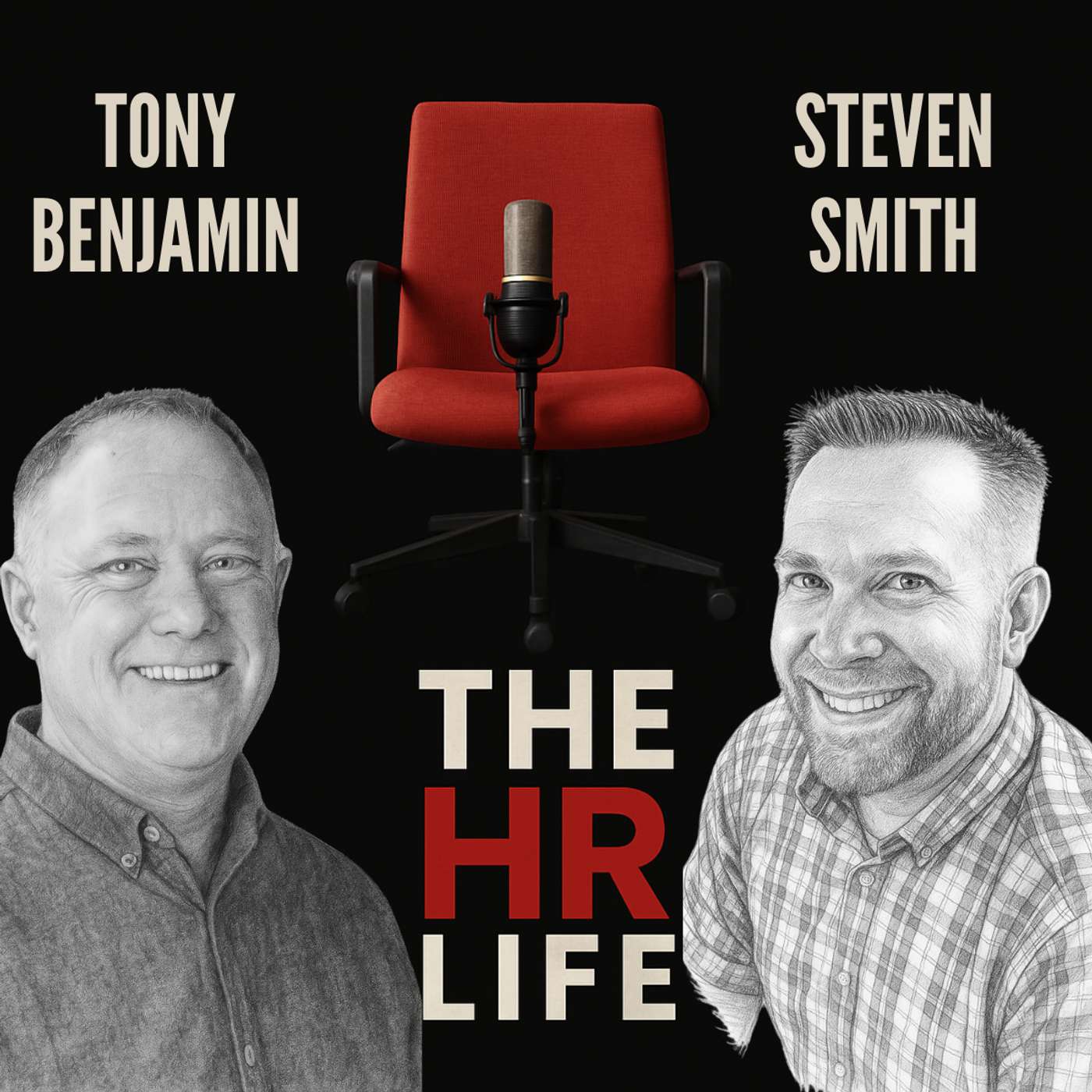
The HR Life Podcast · Tony Benjamin
The Red Seat sits empty this week, which means nobody is there to keep Tony and Steve on task, and it shows. Steve finally tells the story of the day Michael Jordan pulled up in a black Corvette and wanted to know why a couple of kids were photographing his fence. Tony counters with Donny Osmond, a fan who could be heard from seventy-five yards away, and the time J.R.R. Tolkien told an editor to stop citing the dictionary because he helped write it. Somewhere between Steve admitting his AI agent summarizes Tony's texts so he never has to read them, and Tony cheerfully shoulder-tapping a total stranger at the Utah Work Elevated Conference, the guys get around to the news. And the news is a lot. Disney is telling employees that spouses and domestic partners with access to other coverage need to go get it there, and Tony has thoughts about what that means for two-income households and the mom and pop shop down the street. The University of Utah paid consultants millions for a plan to cut staff, and HR is first in line, with plans to shrink a 900-person HR team to 300. Then the conversation turns to Gen Z. Tony brings a Simon Sinek take that might make you rethink every eye roll you've aimed at a 23-year-old, and Steve brings proof that employers have been calling the next generation lazy for centuries. Is Gen Z entitled, or did they just watch their Gen X parents get laid off and do the math? Why does Tony think HR is a Rorschach test, and what does your company see when it looks at the inkblot? A Link to the UofU story: https://www.sltrib.com/news/education/2026/09/15/university-utah-plans-lay-off/ A link to the video of Simon Sinek talking about Gen Z: https://www.facebook.com/share/r/1CEkpqG8W1/ Learn more about Fantastic Tony Benjamin at: https://www.thegrangellc.com/ Learn more about Steven "Big Deal" Smith at: https://thehiringtreebook.com/ Learn more about the Books mentioned on the podcast at: https://thehiringtreebook.com/hr-life-podcast Learn more about Dyno Outfitters at: https://www.utahviaferrata.com/ Learn more about MegastarHR at: https://www.megastarhr.com/ Learn more about Pucks for Autism at: https://www.pucksforautism.com/ Learn more about Thrive Life Project at: https://www.thrivelifeproject.org/
Tony Benjamin (00:09.955) Welcome to the HR Life Podcast, a podcast about the work-life experience of those of us in human resources and business leadership. Your hosts are fantastic Tony Benjamin, owner and founder of the Grange Strategic HR Consulting, and Steven Big Deal Smith, who is so important that Michael Jordan stops in to see him when he's in Chicago. Hey, Steve! Steven Smith (00:36.108) Yeah. We already did the ring thing, now we get to talk about this one, huh? Tony Benjamin (00:42.851) Yeah, that's well, you know, we're kind of on a roll on a theme now, you know, so although although I think I think the best one that I cut you off guard with was it recently anyways was the Steven Smith (00:46.156) I know, right? Yeah. Steven Smith (00:54.562) Yeah, that was that was incredible. And in front of a live audience too, which I think was so appropriate. So way to go. Way to go on that one. That that's how it works, right? Yeah. Yeah, no, Michael Jordan, Black Corvette. you know, when you're young, I'm like twenty years old at the time. You're young, you you when you see celebrities, we lived in Chicago, right? And so there's Tony Benjamin (00:58.681) D Right, right. Well hey, I you're what can I say? I'm your friend. I'm your friend. Yeah. Steven Smith (01:21.486) There's a lot of stuff there, like the Home Alone House. And I mean, there's just a lot of places to kind of visit, which was in my area. And so we found out where Michael Jordan lives. And when you go up to his house at the time, anyway, the house that he owned there, there's a huge basketball with the number 23 on his fence right there. And and so we pulled up because we thought, hey, let's get pictures. And so, you know, you couldn't get in. I mean, it went way. I mean, who knows where it went up in in in the enclosure at that point. So we just, you know, start taking pictures. And all of a sudden black Corvette pulls up. Pulls up. And then the window slowly comes down. Hey, what you guys doing? we're just taking pictures. We're just taking pictures, right? But as we got closer, it's actually Michael Jordan. So he's like asking, like, like he's he's basically asking, you know, what what you? Tony Benjamin (01:47.759) Right, right, right. Tony Benjamin (02:06.66) And it's him. Tony Benjamin (02:10.863) That's cool. Steven Smith (02:16.162) Doing taking pictures on and I'm sure he knew. He just said cool, you know, and Wendell rolled up and he buzzed off. But but yeah, it was kind of funny that he was such a nice guy. I mean, I have to admit it. He was really nice. So I I I can't I can't be mad or anything. And it was just kind of cool to see him because then you can tell stories afterwards, right? Not not that it's a glamorous story, but it's still kind of fun. So Tony Benjamin (02:20.077) Yeah, yeah. Tony Benjamin (02:37.069) Right, right. No, that's no, that's I think that's really cool. There there's certain people so I worked at Deseret Book and Donnie Osman came in there once and there was a lady who you of course was of the age that Donnie and her youth was a big deal. And so it was she was That's right. Steven Smith (03:01.87) For those of our listeners who don't know who Donny Osmond is, just look up Joseph and then Technicolor Dreamcoat, the original cast. There you or the or the song Let's Get Down to Business. You know, in in Mo in Mulan. Yeah, he was he was that song in Mulan. But yeah, there you go. Did you know that? Tony Benjamin (03:08.279) Yeah. A little bit country, a little bit rock and roll. Tony Benjamin (03:16.183) Or puppy love. Wow. Anyway, so she she s no, I didn't know that. That's that's funny. she she bumps into him in the hall and she fangirls. And I'll bet you I don't know, just down from where I was, I bet she was a hundred yards away, maybe seventy-five yards away, something like that. And I could hear her just like she was next to me. wow, wow, wow. She freaks It was so funny. Steven Smith (03:45.046) It's just funny that you made that into a verb, fangirl. Tony Benjamin (03:49.081) She fangirled. Haven't you ever heard that? Fangirlled. Steven Smith (03:51.795) I know. I know. It it originated with the Beatles, didn't it? Tony Benjamin (03:56.107) Yeah, probably. Probably. But anyway, she f she whatever. She she did her her deal. I did I got to meet a bunch of people while I worked there. I got to talk to and meet Orson Scott Card several times and he was really nice. Spent time on the phone with him and and I got to meet Gladys Knight once and Michael McLean and but I won't tell you what I thought of that interaction. That was it's not flattering for him. but anyways, there you go. There you go. But yeah, so they're your celebrities are bigger than my celebrities though. There's no way around. Steven Smith (04:27.118) Well then Steven Smith (04:35.63) So for those who are dying to know, the original earliest recorded use of fangirl was actually in 1934 by some guy named AP Herpert in the Oxford English Dictionary. So there you go. But they but they have subculture context that dates back as far as 1844. So I guess it predated the Beatles, but the Beatlemania obviously what what it says is that Beatlemania tra basically Tony Benjamin (04:46.318) Wow. Wow. There you go. Tony Benjamin (04:56.076) Wow. Well. Yeah, yeah, yeah. Steven Smith (05:05.186) made it trace to music stars, whereas before that it was just being a fan, a fanatic, right? And so it it predates that for other things, but but when it came to music, the Beatles obviously were one of the first ones that started that. So that makes sense. So Tony Benjamin (05:20.174) There you go. I the o that the Oxford English Dictionary is a cool thing. And for those of you who think you had one on your shelf when you were young, you did not. That big red thick thing that you had, or whatever color it was, that your mom no well, that your mom, the mom made you look up. Very few places actually have it. It's what is it, thirty volumes or forty volumes long or something like that. Yeah, and did ya? Of course you did. Steven Smith (05:32.716) No, it was at school, wasn't it? You can only access it at school. Steven Smith (05:43.842) Yeah, it's a whole set. Well, we had it. Well, my mom was a librarian and she was an English teacher. So she she had all kinds of stuff. So there's yeah, there's that. Tony Benjamin (05:50.798) there you go. Tony Benjamin (05:55.449) So here's here's my favorite story about that. So J.R. Tolkien, when he wrote The Lord of the Rings, the the editor changed how he spelt dwarfs, D-W-A-R-F-S to dwarves with a V. And yeah, and so he, being who he is, he went to them and he said, and he said, you need to change this. He said, no, that's not how you spell it. Steven Smith (06:12.652) Really? Tony Benjamin (06:25.174) And he said, and he said, What do you mean? And the guy said, Look it up in the dictionary, sir. And Tolkien looked him straight in the face and said, I wrote the dictionary. I'm telling you, it's with an F if you didn't those of you who don't know, Tolkien helped write the Oxford English Dictionary, which in that in that thing, it gives the history of words, just like you were just talking about. Steven Smith (06:41.41) Yeah. I I'm I'm thinking the sets that we ha Yeah. Yeah, I think I'm trying to think. I think the books that we had were actually encyclopedias, not the dictionary. So Tony Benjamin (06:54.112) Anyways, but there you go. That's the the Oxford English Dictionary and it's really cool thing. There's a movie out there, Something in the Madman that has Mel Gibson in it. If you wanna learn a little bit more about that, that was a really cool movie. But there you go. J. R. Tolkien. Steven Smith (07:06.604) You know, it's just like it's just like that word. It's just like that word that when I do my Ghostbuster presentation, I talk about this word desapparate. And disapparate is not a word in the dictionary. it is a word that Harry Potter, the Harry Potter series, she actually yeah, J.K. Rowling actually made that word up to fit with the series. And so that is a word desapparate. It like I said, it doesn't even exist. She created the word, and so there you go. Tony Benjamin (07:23.234) Yeah, J.K. Rowling, yeah. really? Steven Smith (07:36.216) Fun times. Tony Benjamin (07:36.802) There you go. Masters of the language create words that actually work in English. That's how you know. So all right, with all that behind us now, we'd like to introduce our guest. So hey, we're we're we're eight minutes in, but yeah, no, no red seat. Steven Smith (07:41.58) Yeah, absolutely. Yeah. Steven Smith (07:46.573) Ha ha. Steven Smith (07:53.558) It's Mickey Mouse. wait. Tony Benjamin (07:58.177) Yeah, no. Steven Smith (07:59.316) Wow. I I'm not even gonna think about how your voice went that high. Tony Benjamin (08:04.108) Yeah, I don't do a very good Mickey Mouse impersonation. I do an okay Ronald Reagan. but that's about as far as you get I do an awesome Louis Arm. Icy sky is blue, red roses blue, friends shaking hands. There you go. One of the greatest songs of all time. Steven Smith (08:25.214) Man. Look out. Hopefully everybody didn't just turn tune out right now. So Tony Benjamin (08:32.054) Right, right. okay, so we have an empty red seat and Steve, you know, Steve, we we were talking about this. It's been a while since we've had an empty red seat. Like Steven Smith (08:43.02) I know, it has it though, like it doesn't feel like it, but I guess it has. Tony Benjamin (08:46.338) Well, we did that one that we slipped in the middle, right? We did that one that we slipped in the middle, but like it's been quite a while. Like I think Johnny C the Johnny C reaction was the last one. So Steven Smith (08:49.782) Yeah, yeah. Steven Smith (08:58.158) Yeah. And that was like what, ten episodes ago, maybe? I can't even yeah, I I don't even know. Well, there you go. Tony Benjamin (09:02.026) Yeah, something like that. It's been a while. It's been a while. So and we and we're s we're still what two, three weeks out on publishing. So but anyways, there you go. Yeah. So anyway, w there's there's a number of things that happen in HR that Steve and I run across and a lot of times I'll I'll I'll grab the link and I'll shoot it to him in a text and then Steve never reads it. Steven Smith (09:11.36) Mm-hmm. This is true. This is true. Yeah. Steven Smith (09:27.372) Yep. I never read his texts. There's no point. That's right. My my agent gets to me and says, Hey, do you want do you want me to give you a summary of this? And I just say, probably not. Tony Benjamin (09:32.19) Right. He just has AI read my text and then summarize for him. You better get back to Tony sometime. But by the way, for for everybody for everybody who came to our session at the Work Elevated Conference, thank you. Like it was a great session. We had a great time. I really felt good about that until and I was Steve did the great introduction about his ideal. And and then I started talking. And of course I wasn't quite as good, but I was doing okay. and then and then Ryan Kohler walks in the back. Steven Smith (09:54.21) That was amazing. It was. Steven Smith (10:12.521) Not quite as good. Which was awesome. Tony Benjamin (10:16.332) And I was like, crap. It was like there's there's the the guy who knows more about AI than anyone else I've ever talked to ever. And he walks in the back. And he's just got this big smile on his face. It's like, crap. And I just th I hope I don't say something wrong. Steven Smith (10:30.264) it's hilarious. I what what was funny is when he walked in, you know, I just say hey Ryan and because that's what he's used to, right? And and then you could you could visibly see Tony's demeanor change. His jaw drops, he literally starts sweating from his brow and has to pull out a tissue to wipe his head. It's amazing. It's amazing. Tony Benjamin (10:35.566) Right, right. Tony Benjamin (10:47.426) Yeah. Yeah, that was it. That was it. Mm. Then I stammered a few times and yeah, no it Steven Smith (10:55.512) No, but I do want to sh I want to do a shout out to Lisa Hepworth. Lisa Hepworth was one of the speakers and and she came to our session. And it was it was fun to hear her comments. In fact, if you've I assume well, that episode comes out in like what a week or two. I don't even know. So when it comes out, when you get to listen to it, you'll gotcha. Yeah. Yeah. So you'll you'll get to hear her. She's a a speaker, a writer. I think she does consultant work as well. Tony Benjamin (11:12.896) Yeah, yeah. Two we to a week from tomorrow. Yeah. Steven Smith (11:23.84) you can follow her on Facebook if you want. But yeah, Lisa Hepworth, she she made some comments as well. It was just kind of fun to see her there. She for her, it was kind of the first time to ever see that type of of thing, I guess, would be the best way to describe it. And yeah, and and she just she thoroughly enjoyed it. she just thought it was really cool that first of all, she was she loved the topic that we had selected. And she yeah, she just she thought it was really fun. She thought it was fun. She Tony Benjamin (11:36.121) really? Steven Smith (11:51.18) She didn't know a lot about the topic. And so when we talked about it, she felt like, well, I don't have a lot of experience here. But I I felt like her comments were spot on. I I don't feel like she said anything that was off the wall. and so so anyway, she she was just excited about that. So so it was just kind of a fun thing. And there were there were obviously several students there. There were there were other several, you know, HR representatives obviously across the spectrum and and and several of them were there too. So that was fun. It was it was just fun to see people in person and and see their reaction. Tony Benjamin (12:18.284) And as far as we know, none of them were right. None of them were on the spectrum as far as we know. They were from across the spectrum, not not part on the spectrum. So Steven Smith (12:23.774) As far as we know. I guess I better be careful with my words now, huh? Tony Benjamin (12:31.598) Yeah, well, it's probably me that just got us in trouble, so you're fine. anyways, no, I thought it went well. It was a it was a fun session, and I I came out of there thinking, hey, I actually do know something about AI. And then we went and saw Ryan Kohler talk, and then I was reminded just how far behind an AI I am. So I was like, holy crap. Yeah, talk about my jaw. Just I had to pick it up off the ground. Steven Smith (12:51.342) I think everybody was reminded how far behind they are with Tony Benjamin (12:59.194) but the conference was fun. I had a lot of fun. I actually got to go to sessions. I think this is the first year I've got to gotten to go to more than one session or more than a piece of a session in four or five years now, something like that. Steven Smith (13:12.908) I'm jealous because I only saw Ryan's session. I did not get to because you know when you're when you're working the vendors and things like that, it's it's just a lot. There there was a a a session or two that I sat down to do something, but then I got the text message, hey, we got a question here or something going on there. And I got pulled away again. So yeah. It's okay. It's okay. It's I don't know if it's about to be in a big deal. It was just about putting out fires. I felt like I was in HR. Tony Benjamin (13:16.922) really? Tony Benjamin (13:27.17) Yeah. Tony Benjamin (13:31.256) Well, you know you're a big deal. That's what happens to big deals. So Tony Benjamin (13:40.207) You know, it well it was it was kinda cool. So, if if everybody we haven't even talked about the the Excellence Awards yet. at least I don't think we have. But anyways, the Excellence Awards. Yeah, maybe we mentioned it at the conference a little bit, but the Excellence Awards were incredible. I know there's a sizzle reel of some of that stuff coming out, that that'll be out. But anyways, that was that was really cool. It was a real honor for me to present Steven Smith (13:51.628) No, I don't think we have either. Tony Benjamin (14:09.516) The first Hall of Fame award to Francis Hume. And and we're gonna try and see if we can get her on the podcast. Yeah. And that the fact that when I asked her to estimate how many students that she had taught over the years, and she goes, Well, I'll I'll pick a kind of a reasonable number. I'm sure it was higher than this, but I don't want to aggrandize myself. 35,000 was the number she gave me. I was just like, What? Steven Smith (14:13.779) Well deserved. Yeah. Yeah we are. Steven Smith (14:24.599) Hate. Steven Smith (14:36.206) So crazy. And and she's probably right, that probably doesn't even touch it. Tony Benjamin (14:39.618) Like holy crap. And and you know, she hasn't as far as I understand, she hasn't been personally teaching the class for a while. It's her class and she farms it out to people that come and fill in and stuff. But when they s when they mentioned her the conference and asked people to raise their hand if they took one of Frances's co classes, there was still forty or fifty people in that room who raised their hand. Yeah. It was I don't know. It was so you you think about that, that was what Steven Smith (14:49.112) Yeah. Steven Smith (14:59.503) my word. Yeah, it was still a high number. Yep. Very true. Tony Benjamin (15:10.88) Five percent of the entire attendance of the of the conference had taken one of her classes. Anyways, cool stuff. Steven Smith (15:13.527) Yeah. Well, if it was forty to fifty, it was ten percent because we had four hundred over four hundred attendees this year. So yeah. There were there were some students mixed in there, so maybe a little less than than that. But but yeah, we had we had over four hundred people with with vendors and speakers and all that. There were over six hundred this year. That that's one of our largest conferences, I think, since like twenty sixteen, twenty seventeen. So that's exciting. Tony Benjamin (15:20.811) that that's right. Okay. So ten percent. That's right. Yeah, yeah. Tony Benjamin (15:38.487) Yeah, I was gonna we don't at least I don't have numbers from before twenty eighteen that I've seen, but I know it's the largest since then. So anyways, it good that was good stuff. But we had a lot of fun. We saw a lot of people we knew, we enjoyed doing the presentation, the recording from the podcast, which all of you have now heard because you're listening to these in order. you got to hear that. That was a little bit fun. We recorded in a new method of doing the audio, and I liked it. Steven Smith (15:47.436) Yep. Yeah, absolutely. Steven Smith (16:00.878) Yeah. Steven Smith (16:06.114) We did. I th yeah, I think it went really well. And and you know what what's cool about that is is if you're listening to this and you are in a different state and have conferences coming up, you you can always ask Tony and I to come do a live session at your conference. We would be more than happy to come out and do that. Tony Benjamin (16:07.552) I liked it. That worked out really good. Yeah. Tony Benjamin (16:24.694) If we can make it there, that'd be the way to do it. Yeah, if we can find a way to be there, we'll do it. And which we need to go to Georgia's one of this one of these times. I keep dropping challenges on We gotta Steven Smith (16:27.372) Yeah. Yeah. Steven Smith (16:33.067) I know, right? That's the one I love the most, right? I love George. I just I just miss it 'cause it's nostalgic for me 'cause I used to go to those all the time. So yeah. Tony Benjamin (16:40.99) Yeah, yeah. We we need to go out there and see Xavier too, so and and by the way we got to see Andrea Hollingsworth. She was there. she wasn't able to stay. She had to f she had to get right out of there quick, but it was so nice to see her and we took a selfie and all that sort of stuff. Andrea's one of my favorite people. Steven Smith (16:49.364) Yes, she spoke. Steven Smith (16:57.228) Well, and and I got the warmest hug from her. I was it was just, you know, it when you have genuine friends like that, hugs like that really matter, right? And so I just I I love that about her and and just that whole compassion idea. We we should have her again on the podcast here pretty soon. Yeah. Yeah. Tony Benjamin (17:07.106) Yeah, yeah. Tony Benjamin (17:14.274) We are gonna have her back. Yeah, we are gonna she and I talked about it while we were there and and we're gonna we're gonna have her back on. But anyway, she's she's fantastic. That was that was great to see her and so many of our friends and people that we knew and that we've known for a long time. Okay, one last thing about the conference, and I'll let this go. So Heather Anderson, who listens to the podcast, and those of you in Utah may know her. Anyway, she's she's awesome. Steven Smith (17:18.529) Excellent. Yeah. Tony Benjamin (17:42.359) She has she has long dark hair and she's you know she's not super tall or whatever. It's but she colors it red. She colors it red. And so I look over and there's and she often wears like a suit, a business suit, to events, the big events. So so, anyways, I see Johnny Catzianis. Jan well, Johnny was over there and he was talking to somebody, and her back was to me, and there's the dark hair that's colored red. Steven Smith (17:45.998) But it's reddish. Kind of the reddish. Yeah. Yep. Yep. Steven Smith (18:01.048) You were talking to Johnny, right? Yeah. Tony Benjamin (18:10.382) And a business suit. And so, you know, Tony hasn't seen Heather in a year. So Tony goes up and gives her a little shoulder chuck in the back. And not very hard, it was just a little bit. And I turned around and was like, hey Heather, and I got through, hey, hey, and it wasn't Heather. So bad. It was so bad. Yeah, yeah. And I apologize like for two minutes straight, but I still feel silly. I think her name was Katie or something. She was a good sport, really good sport. Steven Smith (18:26.798) So you're just like butting into people, knocking over. Steven Smith (18:38.636) I heard I heard that she expected you to grovel, but you didn't. And so that was the only disappointment with the interaction. So Yeah. Tony Benjamin (18:46.062) okay. Well, I did apologize. Literally I apologize for like two minutes straight. I felt so bad. Anyways. All right. So we we talked about that. So here are some of the stuff that we we that we've Steve and I have kind of bumped into. And this is gonna be kind of a smorgasbord of of stuff. There are still some loss lawsuits in that that Steve and I are tracking, and we're gonna come back to those. The work day cases had a couple of updates. Steven Smith (19:11.414) Yeah, we gotta have a episode we're we'll have a whole episode dedicated to that one. So yeah. Tony Benjamin (19:14.152) Yeah. Yeah. There's there's a second lawsuit that's going on with Sherm, and so we're gonna address that at some point. we'll we'll get into those sorts of things. So be advised that we're still gonna come back to those things. We're gonna we're gonna talk about those. I d hear are a few things though that have been in the news recently at the conference, and all of you have already heard the thing about HR X and that sort of stuff. Steve and I will have a full episode on that at some point. we're just gonna try and get enough information that we can help out with given more details. Steven Smith (19:44.674) Well, and I'm gonna try to have somebody from Sherm help us out with that. So hopefully we'll have some really good information. I have a lot of connections there still, so Tony Benjamin (19:48.536) Right, right. Tony Benjamin (19:53.462) Right. Okay, so first news item and this very much what Steven Smith (19:56.29) Wait, wait, wait. What about our first read? I mean, come on, Tony. Yeah, yeah, let's do it now before we jump into this because this this'll we're jumping into this, we're definitely going to be we got a lot, so let's do it. Tony Benjamin (20:00.294) you want to do the read now? yeah, we're in twenty minutes, huh? Tony Benjamin (20:08.642) Yeah, yeah. Looking for a team building experience your employees will actually talk about? Dino Outfitters in Vernal, Utah offers guided trips on the epic new Ashley Gorge Via Ferrata. Help your team build trust, confidence, and real connection. All while hanging out on the side of a cliff. Reach out to build a custom experience at UtahViaferrata.com. Shout out to Amber. Thanks, Amber, for supporting us. You're cool. Steven Smith (20:36.746) Amber is amazing. Amber's amazing. Not only is she fully prepared, she she's yeah, she just she's patient with you. She takes you up there, walks you. I it was to me, it was very it was probably one of my better guided experiences I've ever had. and I've had a lot of guides, you know, ghost tours and things like that over the years. And and unfortunately Amber didn't have any ghost stories. I'm sure Tony Benjamin (20:40.748) Yes. Steven Smith (21:02.388) She might maybe she does have some. I sh I totally should have asked her. I bet she's got some good ones of, you know, ghosts hanging off the side of a cliff too. So we'll have to ask her later, but but anyway, so Tony Benjamin (21:09.422) Yeah, yeah. And there so just so everyone knows, by the time this airs, we will have dropped some of those pictures. We'll be sharing some of those on Facebook, on LinkedIn, and that sort of stuff. And and you can check those things out. And literally there's some pictures of people hanging off the side of a cliff. It's pretty cool. So that's right. That's right. Anyway, shout out Amber. Steven Smith (21:29.48) That's how it works. And there's I mean the some gorgeous views too. And and it was slightly overcast when we went. And so it the sun was not beating down us until later. But in the morning when we left, it was it was just not only gorgeous, but it was nice and cool and yeah, beautiful views. So Tony Benjamin (21:35.418) it's amazing. Tony Benjamin (21:49.507) Now the the hike up, the climb is a climb. Like my legs I had to rest at the top. Yes. It is something. So but it anyways, great. Amber was awesome. And we'll put out some pictures of that. I've already had people asking us about next year and wanting to go and and stuff like that. So yeah. So just anyways, we'll we'll see how that goes. Now Steven Smith (21:52.778) It is definitely a climb. Be be prepared. Steven Smith (22:08.633) that's cool. Yeah. We'll plan another trip. Yeah. Tony Benjamin (22:14.582) Yeah, and also Steve and I have been thinking about other kinds of activities and stuff we can do, so stay tuned for those things. Okay, so here's the big one out of the news. First and foremost, Disney has announced that they are not going to provide benefits to spouses and dependents if those spouses and dependents have anywhere else they can get coverage. Steven Smith (22:40.824) Well, and domestic partners, which I guess those are considered dependents to you, but that's how they described it in their article as domestic partners. Tony Benjamin (22:43.714) Yes. Right. Tony Benjamin (22:49.89) Yeah. So can I just say I hate this sort of thing? Like this like think about the assumptions in that, right? Think and and and look what it means we all know a vast majority of households now are two income households. And and you're not getting rich with two incomes. You're not. You you you might be able to save a retirement better than those of us with one income, but you're not getting rich. Steven Smith (22:55.618) Ha. Steven Smith (22:59.672) Yeah. Steven Smith (23:07.854) Mm-hmm. It's very true. Yeah, yeah. Tony Benjamin (23:20.158) And it just is it is it's a it's another confirmation of how many households are two income households and and how dependent upon how dependent upon that second income people are. In addition to that, it's also confirmation that what we've been talking about with different people, that and we talked about it with Scott, that no one has an incentive anymore to control costs. Steven Smith (23:45.944) Yeah. Tony Benjamin (23:45.997) The only people that have any incentive at all to control caught medical costs at all are companies. That's it. And and and individuals. Other than that, no one else has an incentive, a financial incentive anymore to lower premium increases and that sort of stuff. And you're seeing how Disney is handling it. Steven Smith (24:06.168) Well, and you know, think about those of us who have dual income homes, and and we've had that for a while at our home too. But, you know, oftentimes when we sit down and talk about the medical costs, we try to pick the plan that's the most beneficial to us, and then we just go with that one as a family. There's no point in splitting it up in that sense. And this is going to force that split. And and you know, keep in mind, dis this is not the first. Disney is actually following or joining other Corporations like Starbucks and and Zoom who also scaled back with with various employee perks and you know, things like that. Because of these rising financial pressures and you know, the children will still remain eligible from what I understand on the coverage. the the shift is really to the spouses, right? Or domestic partners in that sense. Yeah. Tony Benjamin (24:50.924) Right, right. But but they're well, and if your if your spouse doesn't have medical insurance available to them, obviously Disney says they can be on. They can be on. It's just if you if there is something else available to them, the spouse and dependents have to yes. Steven Smith (24:57.292) It'll still count, yeah. They can still do it. Steven Smith (25:05.25) That's where they're expected to go. Well, and you know what's interesting. So they they cited an 11% increase in in one of the articles that I read. And and what's also interesting about that is there were two major things that that resulted in the uptick. And it was cancer treatments, which have skyrocketed, and weight loss medications, like GLP1s and GLP3s and G like Wagovies and all like those types of medications now, because they're so popular for people to to lose weight. Tony Benjamin (25:26.423) Yes. Steven Smith (25:35.24) And and be so because of that, and and because those weight loss medications are now available on a lot of plans, it has skyrocketed the costs associated with that. And and in my mind, I'm thinking, okay, yes, it skyrockets it, but if you lose weight, does that not help you from a I would think that would cut insurance costs after a while because you don't weigh as much. So I'm I guess I'm a little confused on that. Tony Benjamin (25:59.363) Well, this is the wellness program stuff, right? Like if if you if you put employees on a healthier trajectory, when do you get the savings? Unless you're doing something like Well Trio where you're managing i everything in the moment. But other than that Steven Smith (26:03.778) Yeah. Steven Smith (26:09.517) Yeah. Steven Smith (26:14.424) Well and the GLP O on's have only been out for what two years? So there's probably not even data on it yet. Tony Benjamin (26:18.894) I think they've been I think they have been starting to roll out for about three years and the first year that ev most diabetics who were diagnosed because they're a diabetic med medicine, most diabetics who were on it couldn't get it because it was becoming so popular so fast. So I think that's they've been popular about three years. Are you looking it up to see when they became popular? Steven Smith (26:31.598) Yeah, yeah. Steven Smith (26:44.024) Yeah, I'm looking up real quick 'cause I I I even though it's impopular for three years, I don't think that actual employer sponsored plans allowed them until what, two years ago, maybe? That's I guess that's what I'm referring to. Tony Benjamin (26:55.414) Yeah, yeah. well what they would do is they would say if you're using it for diabetes, it's allowed. If you're using it for weight loss, it's not. but anyways, no, and those drugs are expensive. They're very expensive. Most of them are not in the generic phase yet. and so good luck with that. Anyways, it's driving up costs. But anyways, it's something to watch for because I have a feeling Steven Smith (27:03.256) Diabetes. Yep. It's not, yep. They are. Yeah. Steven Smith (27:14.018) Mm-hmm. Tony Benjamin (27:24.13) that there's these really big companies that are doing this and I have a feeling it's coming to the ma and pa shop around the corner. Because of out of all these people, they can least afford they can least afford to have huge medical increases every year. So okay. Next one that we're gonna talk about. we wanna talk about the University of Utah. So the University of Utah Steven Smith (27:43.159) Yeah. Steven Smith (27:51.074) Ha ha. Tony Benjamin (27:53.832) for those of you cheer for the Utes and all that sort of silly. Steven Smith (27:58.668) I know they played this weekend, didn't they? Because I was at the farmer's market in Murray. So every Saturday I do farmers market in Murray and sell, you apple cider slushies and cider donuts and all that stuff. And I I think everybody and their mother was in Utah gear. They were all dressed up. So I'm pretty sure. And and and you know, I at first I was blaming Comic Con or not Comic Con, Fan X is what they call it here in in Salt Lake City. And there were over a hundred thousand people there. And so thought, maybe they're just dressed up for Fan X, you know, 'cause they're fans, right? But anyway. Tony Benjamin (28:07.627) yeah, yeah. Tony Benjamin (28:13.516) Yeah, yeah. Tony Benjamin (28:20.792) Yeah, yeah. Tony Benjamin (28:27.214) They dressed up as Ute fans for Fan X. I like it. Okay, so this comes from an article in the Salt Lake Tribune on September 15th by Courtney Tanner. so we're we're given some credit there. the so the first pair the lead paragraph is the University of Utah anticipates laying off as many as eight hundred and fifty-five staff members over the next nine months. news the flagship school confirmed. Steven Smith (28:29.368) That's right. That's right. For Fan X, yeah. Tony Benjamin (28:56.958) comes after the university sought guidance from two national consulting firms. Okay. First of all, that's in okay, so here's here's a summary of some of this stuff. the school is looking at in the future, several years down the line, a decrease in enrollment. And so they're laying people off now to be able to be lean and to do that. Steven Smith (29:21.74) In in my mind, first of all, I have a comment there. In my mind, if you're seeing less enrollment as a school, where is the real issue there? I don't think this has to do with I I think it has to do with the actual programs being offered and and how you're offering them, right? Because people have changed. They they no longer want the four year degrees. I in fact, I I I met with a class the other day of of high school kids and and I did a presentation. Tony Benjamin (29:34.754) Ding. Steven Smith (29:48.328) And I would say ninety percent of the high school kids in that class were not interested in a traditional four-year college degree. They they could not understand the reason of taking two years of just general credits so that I could focus on a major that I want to do. And and these younger kids, that's the demand. Like, like why am I wasting two years of my life on just general stuff when I could just be doing the two years of what I actually want to study and am interested in it. And I think they've got some there's some stuff there, right? I I know I I remember some of my classes. Yeah. Tony Benjamin (30:21.41) Well, Xavier Cunon, he was talking about this. That's why he did. He didn't go to college. He went right in. And by by the time they all graduated, he had four or five years of experience before they were even in the workforce. Steven Smith (30:31.532) No, I don't think I don't think you're thinking of Xavier. It was what was this? No, 'cause he was a military member. Tony Benjamin (30:35.704) Wasn't it Xavier? Tony Benjamin (30:39.702) that's right. It was somebody else. Okay, I know. I know who you're talking about though. That will come to my mind later. No, but anyways, yes, that's very much the case. So, anyways, so there's there's cuts to benefits coming, apparently. And and they're they're gonna make a a a bunch of cuts. okay, so twenty thirty two is when they anticipate the enrollment drop to happen. Think about that people. Twenty thirty-two. It's twenty twenty-six. And they're laying people off now. Steven Smith (31:09.762) Well Steven Smith (31:13.582) Yeah, we're still six years out. But that's also coincides with the dates when when it's gonna be the highest of baby boomers retiring, you know, and people are gonna have to work more, right? Up accordingly, but I think AI is gonna help with that. But anyway. Tony Benjamin (31:23.618) Yeah. Yeah. Okay. Here here's a couple of more pieces of this. And we're gonna get to an HR thing here in just a second. okay. let's see. This is in one of the to figure out how to best weather the predicted storm, MacArthur said the school brought in two consulting firms, McKinsey and Company and Huron Consulting Group. For outside and honest analysis. Both those companies are known for pushing staff cuts as a solution to problems. In a book about McKenzie, one journalist who has long covered the firm said, it may be the quote, the single greatest legitimizer of mass layoffs than anyone anywhere at any time in modern history. That's quite a quote. Steven Smith (32:15.672) That is quite a quote. Holy cow. Tony Benjamin (32:17.664) So the the U confirmed that they paid those two firms four point seven million dollars for their analysis. Well, wait, wait, wait. Four point seven million dollars for their analysis. And the U previously paid six million dollars to McKenzie as of January twenty twenty five. So they've paid them more than ten million dollars to tell them to cut staff. Now look, let me let me just say this. with my political leanings, anytime you cut bureaucracy in a state agency, I Steven Smith (32:39.598) Yeah. Yeah. Tony Benjamin (32:47.488) smile little bit. And and part of that staff growth. By the way, the University of Utah has forty-seven thousand employees. Think about that. So they could probably do with a little trimming. but but okay here we go. The layoffs okay that's where I'm going next. Yep, yep. So the layoffs are confirmed among a group of five thousand seven hundred operational staff members who Steven Smith (33:02.2) Yeah. What about the HR s angle here? 'Cause the the HR shocked me. Yeah. Tony Benjamin (33:16.364) Whose work do you believe can be consolidated, simplified, or eliminated? Okay. Overall, this you has. Yeah, well, well, that's that's okay. Hold hold on. Let me see if I can let me find this quote so I I get it right here. Okay. Currently the U is in the first phase of its staffing process, looking at its HR and finance units. Steven Smith (33:20.75) Yeah. Six hundred of which are Tony Benjamin (33:42.775) It wants both to become centralized as part of a shared services. In HR, for instance, the U anticipates only needing 300 staff members total for about 41,000 employees, 300 staff members. The school currently employs 900 HR workers. Okay, so they're gonna let go 600. Steven Smith (34:02.904) Yeah. So they're cutting six hundred of the HR fo and I'll tell you what, HR is getting hit really hard right now. There are a lot of HR people, especially here in Utah. I don't know about the rest of the country, but here in Utah, we are seeing a huge uptick of some major HR directors, crows. I know Tony loves that word, VPs, like Tony Benjamin (34:15.596) Yes. Tony Benjamin (34:26.606) I love that. They're dressed in black and fly around. Steven Smith (34:29.208) Like high level HR people are being let go here in Utah pretty heavily right now. Yeah. Tony Benjamin (34:33.218) Yes. Yes. And and that's the that last bit of information is why is what caught my interest about this. So those of you who are in the state of Utah and there's gonna be some HR professionals looking for work, look out for Okay. Let's try to help them out as best we can. But yeah, and and I just anyways, it's something to be aware of. Steven Smith (34:41.507) Mm-hmm. Steven Smith (34:50.658) Yeah. Yeah. Tony Benjamin (35:00.17) And it it it kind of goes back to we've had a theme for a while now about talking about layoffs and we were talking about this with Rod even a couple episodes ago about about how common that sort of stuff is becoming. and I go ahead. Steven Smith (35:15.49) Yeah. Well, and and like I said, this younger generation, they they just don't want to go to school that much anymore. Like JD, I think it JD is who we were talking about earlier, JD Robinson. Yeah. And you know, another statistic that kind of got me on this article was the 900 plus vacant beds in student housing. Now I can tell you exactly why that's happening because they charge so much for student housing. Of course, students are gonna want to live off campus. Tony Benjamin (35:25.786) that's who it was. Yeah, yeah, yeah. Steven Smith (35:44.034) There's no way they can afford some of the student housings that I've seen. I mean, even my daughter trying to she went to UVU and was looking at some housing. It was astronomical. Like two thousand a month for like a little studio apartment type thing or or shared bedrooms for like eighteen hundred a month. That it's ridiculous how expensive that's gotten. It's no wonder they have nine hundred plus vacant beds. So Tony Benjamin (36:06.988) Yeah. No, no, that very, very much. if you think about it, rent in in along the Wasatch front is now higher than a house payment. It's cheaper on a monthly basis to own a home than it is to rent an apartment. So but of course we're pushing not to build any more housing. So, you know, there we go. Anyways, I could go on for that forever. but no, this kind of leads into another subject we want to talk about. So I ran across a video and I sent it Steven Smith (36:17.762) Yeah. Tony Benjamin (36:37.002) It's by Simon Sinek to Steve the other day. Yeah, it was it was really good. It was really good. I'll try to put a link to it in the Facebook notes or whatever when we publish the thing or this episode. So maybe we'll be you'll be able to watch it. but one of the things he talks he's talking about generational differences in the workplace. And I'll talk about my personal stuff with this in just a second. But he's talking about the differences, and here's what he said that I found very interesting. Steven Smith (36:39.768) Such a great video. Steven Smith (36:59.288) Yeah. Tony Benjamin (37:06.658) He said that we're all looking at Gen Z now as the entitled, want their money up front, don't want to put in the work, they just want to get paid right now, not not gain experience before they get paid and all that. We all look at them as spoiled little brats. He said, but, and this was important, he said, he said, but think about it from their perspective. They are the children of Gen X. Steven Smith (37:35.288) Mm-hmm. Tony Benjamin (37:35.379) And they are watching their parents, they've watched their parents go through rifts and all the havoc that came with it. And so now they're saying, well, if I'm gonna take this job and there's a chance I'm gonna get laid off for nothing that I did, for an expen or for a mistake that the executive team makes, if I'm gonna take on that risk, I want to be paid up front. And his answer to that was that's the correct response. And I think he's exactly right. We in our culture of business in America right now think it's normal that we plan, what, six and a half years ahead, in the case of the U, and say, there's a downturn coming. Let's start firing now. And and we see this tech is very, very susceptible to this. Hey, look, the market is softening a little bit. We better lay off now. Steven Smith (38:06.284) I agree. Tony Benjamin (38:30.242) And then of course three months later, because you've got your V C funding and you don't want it to go waste, you're you're spending money like crazy in any way you can and hiring back. But anyways, it and there's reasons for that. But anyways, the point just being is that s Simon Sinek was saying this and I it I thought it was I thought it was profound. Any thoughts on that, Steve, before I kinda Steven Smith (38:54.36) So so I I wanna I I wrote an article about this recently. In fact it was one of my newsletter articles. It just just came out what Wednesday or something like that last week. And so I've got a whole article on this that that kind of addresses this pretty heavily, which I I felt like was kind of covered this. You know, in my Ghostbuster presentation, I there's this slide that I show. Where it talks about how every twenty years or so there are articles that come out about the previous generation is so lazy and they don't want to work anymore and all this stuff. And and and literally I've been able to track and find newspaper articles as far back as like eighteen forty-four. And then I've also even found some books in the fifteen hundreds when typeset and all that start coming out, you could actually type on a mass scale. There are books that talk about how serfs are lazy now and don't want to work the land. I mean Tony Benjamin (39:45.464) The the new generation is lazy. Steven Smith (39:46.806) Yeah, every new generation, every 20 years or so, it's the same exact story that they're lazy and entitled and whatever, right? That the it's just it's what happens every year or every 20 years or so. And so the problem is is our mindset and how we think about this and how we look at them. See, we're older and so we see them as lazy and entitled, but I can tell you when we were that age, guess what? They thought the same thing about us. It was the exact same thoughts. They thought about us, the generation before us. Tony Benjamin (40:17.87) Yeah, the the there are a few different nuances, but the general thought process was the same. Steven Smith (40:21.654) General thought pro it's it's very much the same. And so what I would challenge us to do is take that mindset and those thoughts and and the description or I don't even know what to what to call it, but but when when we in our minds when we think, okay, well, we're just gonna they're we're just gonna assume that they're lazy or what have you, as soon as we've done that, we've already let that s that argument win. without even really looking at the minds of Gen Z employees or or this newer generation that's coming into the workforce. And and you here's the here's the common things that I get. Well, they'll never pick up the phone. They want a promotion after like eight or nine months. They need feedback on everything. And they just quit with a text message. Okay, so is that their fault or is that just do you see where I'm going with this? Do Tony Benjamin (41:13.39) Well but think think about that. N Elon Musk when he laid off how many people? Like twelve thousand people? How did he do it? He did it via an email before you arrived at work. And you if you didn't see the email, you found out because the gate didn't open for you because your pass didn't work anymore. Steven Smith (41:19.128) Yeah, yeah. Steven Smith (41:29.634) Yeah. Yeah, you suddenly just couldn't get in anymore. Tony Benjamin (41:32.246) So so are should we be surprised when Gen Z quits via a text? No. Like, no way. Steven Smith (41:39.596) Yeah, no, not at all. That's how they communicate. In fact, I'm surprised they don't just go in the company Snapchat and snap it to them. I mean the why not? Tony Benjamin (41:43.202) Well not Tony Benjamin (41:47.311) But yeah. No, but but the point I know that's I know that's how they do it. But I've on on my website I've got I've got a a blog post about this as well, that everyone complains that there's no loyalty anymore. And I and I'm like, well, why should employees be loyal right now? Companies are not loyal to them. In general they're not. And so and so why should employees be loyal? Like Yeah, now you can say, Well, my company's different. Perhaps. Perhaps. But in general in our society, companies aren't loyal to their employees anymore. They're just not. So why do you why why should you expect that they they should be loyal to you? It's just and and you know what I all that stuff's just a reaction. I think Simon Sinek said that great. It it was a great he was like, if you think about it, that's the correct economic response to what companies are doing. Steven Smith (42:46.126) Correct. Yeah. It's it's the who wouldn't respond that way in in that sense. And we're just kind of blaming this younger generation. You know, it's interesting too is when I researched my article that I wrote, I did a lot of research on Gallup. And not only did Gallup support a lot what Simon Sinek talked about, and and I wonder if he maybe got some of the statistics from that. I know he talked with a lot of people too and and kind of had some of his own information, but it was crazy to me that Tony Benjamin (42:51.095) Right. Steven Smith (43:15.16) The common thing that the things that this younger generation was frustrated the most about are things that we should expect in the workplace. And for some reason we don't expect it like we used to. And suddenly they're expecting it again and we're getting angry about it or we're getting frustrated by it when in reality we needed, you know, let's look at the man in the mirror and say, okay, what are we doing? Pri one of my favorites, because cause I I was talking with this high school class again or college class. Tony Benjamin (43:43.234) Are we gonna refer to the Michael Jackson song now? I'm starting with the man in the mirror. Steven Smith (43:45.582) We are gonna Yeah, that's where you need to start. But what happened was is is when I talked to some of these young kids from it was it was actually from college, not high school. These young kids in college, one of the things that they said they were most frustrated about some of their jobs that they were receiving is they don't have a chart. They sometimes they don't know exactly what they're supposed to do. They start the job and they have these measurements that are that are undefined. and and then and then there's these unwritten rules that are never said out loud and they're never really taught it. and so so they're yeah, until they get in trouble. And and and so for them, one of their biggest frustrations is is from an HR perspective and and maybe even a as an organization as a whole, we are not making the expectations visible like we used to. We are not making them Tony Benjamin (44:20.942) Until they get in trouble. Then they find Steven Smith (44:37.462) You know, here's here's the core of what's expected. Here's what minimum standard looks like. Here's what, you know, going above and beyond. In fact, Tony, in your presentation at the conference, you alluded to this when you do performance reviews. If if you don't clearly define the levels of what the like here's below expectations, here's just meets expectations, here's exceeding expectations, like, like we're not defining those things. We're just assuming that this younger generation automatically knows what those are and they don't. We're not defining it. We're we're like this bad parent that says, Susie, don't touch the stove and we won't explain to them why. This generation wants to know why. They don't want to know, just don't do it. Tony Benjamin (45:08.046) Nope. Nope. Tony Benjamin (45:17.068) Or even worse, we don't even tell we don't even tell them not to touch the stove. We just get mad at them when they do. And they and they either get burned or we yell at them for touching the stove without ever having told them not to. Yep. Yep. Steven Smith (45:21.474) Yeah, we just kind of let it be and say, yeah. Mm-hmm. Yeah. And they still don't understand why, because we never told them in the first place. No, that's that's exactly my point. And and so I think we really need to sit back and and think about this from an organizational perspective as we talk to this this younger generation. Are we being the coach that they need or the boss like in nine to five with Dolly Parton that Nobody really respects and wants to honor. So Tony Benjamin (45:52.303) Yeah, no, you're you're exactly right. Hey, did you hear about when she died that the national the the British band or whatever that at the outside the Buckingham Palace played that song? What nine to five? I thought it was cool. Steven Smith (46:06.498) Yeah, they played the song. Yeah. Well, and I was totally on the petition for making September twenty-fifth nine to five day, Dolly Parton day, you know? Cause it's nine to five, right? I'm so for that. I I you know, my my grandmother, my grandmother, her name was Bobby, and she absolutely adored Dolly Parton. And so I grew up just listening to her because Tony Benjamin (46:15.744) Right, right, right. Tony Benjamin (46:31.025) really? Steven Smith (46:31.476) She adored her. She adored Dolly Parton. She loved the music. And I and I think the reason my grandmother so my grandmother, her husband unfortunately left her and and all these things. And and so she was a single mom. And so my mother grew up in that environment of this single mother who was taking care of the family in in every facet that you can imagine during this, you know, sixties and seventies. And so Dolly Parton comes on the scene just being the woman that she was. My my grandmother just fixated on that because she was living exactly what Dolly Parton was trying to go against and say, This is not right. This is not what should be happening in in our environment, right? In in the world. So anyway, just it's just fun. So that that was kind of the home I was brought up in was listening to Dolly Parton and Tony Benjamin (47:16.12) Yeah. But no, you're you're right. And the reason that movie when she did that was so successful is because it was a very good reflection of what business was like. Now you can you can say, Yes. How many how many of you have met women? And these women are getting about to the retirement age now. But talk to some women who were in business in the in the the late seventies and early eighties. Steven Smith (47:26.69) Yeah. And you still see some of that today. I hate to say it, but I still see some of it today. It's ridiculous. Tony Benjamin (47:44.577) And many of them will tell you that there was pornography framed and on the wall in their office when they started working. And it was a man's world and look, I don't know. I I want to be careful about how I sound on this because I don't want to sound like I'm picking on a whole bunch of stuff that doesn't need to be picked on. But but the point was is is that's what companies are like. And I think a lot of the times we look back on that with this whole work ethic thing and we think, those were the days. Those were the days. That was awesome back in the day when people worked hard and didn't expect you know I don't think we want to go back there. Yeah. All right, let's let's do our next read. Let's do our next read and then we'll then we'll finish talking about this a little bit. Running a business is hard. HR shouldn't be. Megastar HR is here to save you from bad HR. With expert support and everything from hiring to handbooks, compliance to culture, need payroll help or recruiting power? We do that too. Steven Smith (48:19.512) I don't know. It felt more like slavery back then. Anyway. Tony Benjamin (48:44.558) Fractionally inflexibly, no overhead, just results. Visit megastarhr.com and let's grow your business together. Shout out to Becca for sponsoring us. We're very appreciative. We got to see Becca the other day. Steven Smith (48:59.522) We did. It was so fun. We went to dinner with her. Tony Benjamin (49:02.51) Yeah, that's right. That's right. She was there for the board dinner. That was awesome. Steven Smith (49:05.26) Yeah, she sat right next to me. I was so privileged. I was like, wow, here she is in the flesh, next to me. Yeah. Tony Benjamin (49:10.872) Get in the flesh. And she said that she's get she she's getting to a point where she can be on the podcast again. So that's good. Steven Smith (49:16.898) that's fun. Yeah, we'll have to have her as a guest for sure. Yeah, she's so busy. She's so so good at what she does. That's the problem. Tony Benjamin (49:21.236) And and she even forgave Steve for making me laugh on a couple of those reads. So just she's that nice. She she's nice. Steven Smith (49:27.426) She did. It was an official it was an official forgiveness. And and I never issued an apology though. So just I I wanna make that very clear. That's right. Tony Benjamin (49:33.167) That's right. That's right. And let's also be clear that I make sure I ratted you out for it. So I was like, don't blame me. It's not my fault. It's not my fault. anyway, to go back to this, like this is and you and I we've talked about this before, but look, people do their best work when they feel comfortable, safe, and they can be honest. Steven Smith (50:02.136) Mm-hmm. Tony Benjamin (50:02.508) That's when they do their best work. And everyone just needs to start to realize that. And Steven Smith (50:09.934) Well, think about Maslow's hierarchy of needs. I mean, Andrea Hollings were talked about this. When when those essential needs are not being met, we go into this fight or flight, you know, mode. And when we're in that mode, we can't be our authentic selves. Period. It it's not possible. You just can't. Tony Benjamin (50:13.388) Yes. Tony Benjamin (50:29.356) No. And and that's one more reason why you should never give people pips. Just just look, anytime an employee gets a pip, their first thing in their head is I'm getting fired. And and and they go they right, they go in it owes it's whether it goes into 90% of the time because a whole bunch of HR people have got it in their heads that that's the right way to document stuff. And you wanna know what people? No, it's not. Steven Smith (50:35.032) Mm-hmm. Steven Smith (50:40.568) Yeah. Yep. Because that's usually what it leads to. Steven Smith (50:53.421) Mm-hmm. Tony Benjamin (50:56.054) Everyone knows that you're setting them up and you're creating documentation to fire them and so they stop trying. most of Most of Steven Smith (51:04.226) Yeah. You know, I I I've been I've been talking a lot offline with Eric Bostik again. I it for those of you who watched his episode where he talked about the attachment science and how the way we were attached to our parents as children determines how we react as leaders. And and and the reason I'm working with him because we're talking with another organization in in the middle of the country about doing some trainings for their managers and really honing in on this. But if you think about what he talks about in that when when when you look at Maslow's hierarchy of needs, the safety and the love and belonging area, those are the two elements there that that are some of the biggest on the the pyramid, if you will. And man, I tell you, when those are not met properly, ooh, it just creates for a very bad workplace. It just does. Tony Benjamin (51:54.166) No, Okay, this will date me just a little bit. But if any of you have listened to the police album, Synchronicity, whenever we talk about crappy bosses or what you were just talking about there, Steve, this is there's a line. I should look this up before I just quote it, but there's a there's a line from the from the song Synchronicity. and let me see if I can find it. Lyrics, synchronicity. We'll find it by the police. anyways, let's see. Steven Smith (52:33.546) Isn't isn't so so pause for while you're looking that up. My understanding of synchronicity was that it's like meaningful coincidences that happen to you. So so somebody once described it to me. It's like you're thinking of an old friend and then all of a sudden you run into them a few minutes later, or or you hear a song on a radio that you you were singing a few minutes ago and suddenly it's on the radio. something like that where you where you the serendipity or I I don't know. Tony Benjamin (52:36.397) Yeah. Tony Benjamin (53:00.374) Li harmonies, harm yes, harmony of of disconnected things that eventually leave you there. And I'm trying to I'm trying to find the lyrics here. maybe I have the wrong song, but but yeah, yes. Anyway, dang it, maybe it's it's on that album though. I thought it was synchronicity lyrics, but maybe it was a different song there. But Steven Smith (53:13.902) You know, and the skeptics might say, Well, that's just random, right? It's not Steven Smith (53:29.336) You know, I I I sat next to I was gonna say I sat next to one of our guests, Allison, way back in the day, and and she was talking about this thing going on at home. And so I shared with her the the you know the attachment theory and all that stuff. And and she said, somebody else told me about that recently. And so for her, that it was a synchronicity type moment because she she was now hearing it again and it was on her mind. Tony Benjamin (53:29.966) It it talks about go ahead. Steven Smith (53:54.26) And it randomly came up again. And so she's like, Yeah, you know, sometimes we have to listen to these things in the world trying to sh you know, tell us a message or share something with us. And and so maybe we should pay more attention in that sense. So Tony Benjamin (54:07.348) Okay, here here it is. No, no, very much. Very much. okay, let's see. no, no. This is another industrial ugly morning. The factory belch is filthed into the sky. He walks unhindered through the picket lines today. He doesn't think to wonder why. let's see. Where's the where's the exact lyric that I want? Steven Smith (54:14.254) So it's not just coincidences is is what I'm trying to say. Tony Benjamin (54:38.39) See crap. This anyways, that they he says, here it is. The the secretary's pout and preen like cheap tarts and red light street, but all he ever thinks to do is watch. And every single meeting with his so-called superior is like a humiliating kick in the crotch. And I I whenever I think, whenever I think of bosses and treating people poorly. Steven Smith (54:58.894) Wow. Tony Benjamin (55:06.818) This whole the the song Synchronicity and Synchronicity Part Two is about the futility of of modern industrial jobs. And and the whole point of of of what we're talking about here is it does not have to be that way. It doesn't have to be that way. It do you that's right, that's right. And look. Steven Smith (55:29.91) It's a choice. It it really is, yeah. Tony Benjamin (55:34.849) And and we can hate the Gen Z people or w look, and we said the same thing about you millennials at the time. So just, you know, accept that. but anyways, that we understand they want the rewards now instead of later. And why? Because they don't trust that you'll give it to them later. And they're looking at stuff and they're like, if all I get is a potential for a bonus and I don't get it every year, I get it every three years or whatever like that. It's not worth all that you're putting me through. And and and there you go. Go ahead. Yeah. Steven Smith (56:10.466) You know what's really funny too? On that album is Every Breath You Take, which to me is one of the creepiest songs ever. And people will try they try to convince me. They have tried for years to convince me. But Steve, it's a love song. It's a love song. I say, No, it's not no, it's a stalker. It's like it's like a boss that you can't stand because he's micromanaging you and and like taking over. Like that's how I see it. I'm sorry. That is how I see that song. And it drives me bonkers because I think to myself, Tony Benjamin (56:20.514) That it's romantic. Steven Smith (56:39.554) There's nothing about this song that feels romantic to me at all. Like it just doesn't. So, so Tony Benjamin (56:42.83) Yeah. Well, see that that how that started though is that that song came out back in the day when you couldn't just find the lyrics anywhere. You had to listen to it, and not everyone had listened to it, right? Yeah. But it is a love song. It's the stalker saying how much he loves the person he's stalking. So, you know, I had a c I had a legal client the other day. I'm in an interview with her, and I asked her, Who do you report to? She couldn't tell me. Steven Smith (56:53.646) And actually learn it. Tony Benjamin (57:12.492) She's worked there five and a half years and she says, Well, I think officially I report to so and so, but I never talk to her. I never retalk to her. So I I deal on a daily basis with this guy over here. And I was just like, Okay, you don't even know who you report to. Seriously. That's how is she supposed to know to do a good job on her job? Like, if she doesn't even know who is going to hold her accountable. Steven Smith (57:19.63) Yeah, but th there's no governance there, right? Tony Benjamin (57:41.848) How is she supposed to do a good job? That's it's that's ridiculous. Steven Smith (57:44.098) Here here's my thought on that. I'm trying to make some fun like marketing things to throw out there. And I I came up with one I think is pretty fun. If your HR department or if your management team feels like a DIY project, you need to contact a consultant. Because like seriously, that that's that's my thought on this because like it is it is so true. Some of the companies I talk to, I'm like, my gosh, you are literally treating your HR department like a DIY project. And it's no wonder it's failing. Tony Benjamin (57:59.215) Yeah, yeah. Steven Smith (58:13.878) It's no wonder that the pain is getting bigger and bigger because y you thought these YouTube videos were gonna cut it for you. And now that you've done the DIY, you're so deep into it, you're just like, I'm just gonna keep going. You know, you know those those moments, right? You just I'm just gonna keep going. Tony Benjamin (58:31.758) HR is a Rorschach test. Like the current attitude towards HR is a Rorschach ch test. Because those those executives who think it's crap and don't think it does anything for them except maybe keep them out of court, those people hire people that that's all they do. And they never see the higher functions. you don't know what a Rorschach test is? Okay, so Rorschach tests are those things where they do a blob of ink, okay. Steven Smith (58:48.194) What the heck is a Rorschach? I don't even know how to spell that. I've never heard of that. Steven Smith (58:58.986) huh. Okay. Tony Benjamin (58:59.318) So they take a piece of paper, they put a blob of ink, and then they fold it in half and squish it and then open it up. And then yeah, yeah, they show it to you, they show it to the patient and they say, What do you see in this? And it's supposed to be an off the top of your head quick response. I see a butterfly, I see, I see two people kissing, or I see a bazooka and it's blowing up a village, or you know, that that sort of thing. And the point is, is it's insight, it's insight. Steven Smith (59:05.646) And they describe like what they see in the symmetrical blocks or whatever. Steven Smith (59:24.61) Wow, that was random. Tony Benjamin (59:28.926) into what you're thinking. The whole point isn't what does the blob really look like. It's what do you see in it. And you yes, you're you're you're projecting on the image what you're thinking. That's why it looks like means to you. Steven Smith (59:35.896) Like your cognitive patterns and emotional Yeah. Steven Smith (59:43.916) You know, I've never had I've never taken that test. And and it's funny because when I first thought about it, I said, well, I've never had to take that test. Because when I was a kid, if you took that test, there were things that were wrong. Which is really sad to say. But so I was always proud I never had to take those types of tests, but maybe I should, just to see. Tony Benjamin (59:50.44) Yeah. That's right. Yeah, yeah. Tony Benjamin (01:00:01.816) Yeah, for those of you who've seen the the movie The Watchman Rorschach, the reason he's called that is because his mask, the dot the smudges move around on his mask, and so you see what you want to see in him instead of his face. Anyways, but yeah, that HR HR is a Rorschach test. I I'm really I'm really if you think HR is useless, it's going to become useless in your company. And you're never going to find that. One of the coolest Steven Smith (01:00:17.505) Interesting. Steven Smith (01:00:26.466) Yeah, that's a good point. Tony Benjamin (01:00:30.954) things I'd I've ever the coolest compliments I've ever been given is by one of the owners at Superior Drilling and she told me she said we didn't know this is what HR was. Like we did not understand that this was its role and its function. And I said perfect that's exactly that that's a high compliment to me because they didn't know they were missing somebody in their executive team that filled this part of it and they were trying to fill it in other ways. Steven Smith (01:01:00.066) Yeah. Well, like I said, they'll disguise it under operations or you know what have you. We've seen we've we've talked about this before, right? Tony Benjamin (01:01:04.162) Yeah. Yeah. Yeah. Yep. Yep. Yep. No, and it's anyways, it's anyway, so there you go. That's the Simon Sinic thing and Steven Smith (01:01:12.75) See and I and and here I thought this whole time that Rorschach created the test to identify thought disorders like schizophrenia. And I and you've completely proven me wrong. You've completely proven me wrong. Tony Benjamin (01:01:20.942) And this is what happens, people, when when Steve's got his AI running and it's looking up stuff for him or he's typing it in really quick. Yeah. Here's what it is. Yeah, yeah. Yeah. Well, yeah. Hey, I'm fine and so am I. but anyways, no, that's the the whole point is you see what you want to see, right? And they're testing for certain things. What do you see? What is it that's there? Steven Smith (01:01:28.43) 'Cause my agent whispers in my ear at all times and says, Hey, are you sure this is related to HR? Are you saying all HR people are schizophrenic? Like it's just like man. Way way too much fun. Yeah. Yeah. Tony Benjamin (01:01:51.233) And that and that I think is HR is becoming a Rorschach test. I I really, really believe that. anyways, there you go. I you know, those are a few quick subjects and and we talked for an hour. That's that's pretty good. I I hope like these are the sorts of things that I look, I'm just randomly on the internet. Matter of fact, how I find the a lot of these stories is I open up a new tab in Google and the and on my phone and the generic tab that comes up has several news stories and I always scroll through them because invariably it gives me an HR story or two. And that's where I find this stuff. Steven Smith (01:02:27.874) Yeah. Well and and the reality is that Tony's just admitting that he's a doom scroller and he just scrolls, scrolls, scroll, scroll, scroll. Tony Benjamin (01:02:35.438) Everybody doom scrolls. That's the truth. Steven Smith (01:02:38.252) And I I get these text messages. In fact, I I think now I start I have I receive more text messages from Tony sharing articles and things like that than my wife does sharing videos with me. So this is when I know that it's it's a problem. I I think we need to talk to your wife Rachel about this, Tony. I I I think that there's a discussion there. Tony Benjamin (01:02:47.318) Yeah. Tony Benjamin (01:02:50.68) Well Tony Benjamin (01:02:55.97) Well, yeah, yeah. Hey, Rachel's the reason you'd be getting more than usual is 'cause Rachel's been out of town for a week. So, you know Steven Smith (01:03:02.546) trust me, there is a there is a guest that from Atlanta that we were trying to get on our podcast right now. So we're gonna have a chat with him, hopefully this week. And it came from my wife because she was scrolling and found this guy. So wait till you hear that story. We won't go into details right now, but but if we get him on the podcast, it there's some interesting scenarios there. Let's just It really is a funny story, and for some people it might not be the funniest, but Tony Benjamin (01:03:12.396) Yeah, yeah, there you go. That's no no that's Tony Benjamin (01:03:23.16) Yeah, that's that was a that's a funny story. Well it'll be good to talk about that. Yeah, yeah. Well, it's a it's a great it's a great HR conundrum for people. So yeah. Steven Smith (01:03:31.276) But you know I Steven Smith (01:03:36.79) It is. It is an HR conundra. That is exactly right. And and you have the anal ones that just wanna follow the letter of the law, but then you have those that see the humor in it and can move on with themselves. And and there are examples of both in this world. And I think sometimes call, I just I feel like sometimes we just need to let a little bit of humor in there without letting it offend anybody. Tony Benjamin (01:03:55.981) Yep, relax people. Relax. If no one's offended or hurt or or ashamed or whatever by what's going on, just everyone relax. We can tell people that hey, tone it down a little bit, but yeah. But we'll get into that. We're gonna get into that. Steven Smith (01:03:58.04) Yeah, we're not Yeah. Steven Smith (01:04:08.834) Well and and o and oftentimes it's it's the intent that matters most. And I'm sure the intent yeah, anyway. Well yeah, like you said, we'll talk about that later. Tony Benjamin (01:04:13.804) Yeah, yeah. Tony Benjamin (01:04:18.462) As right, as we say, it's all fun and games until someone's offended. And then it's only games. So anyways, okay. There we go. anyways, thank you to all of our listeners. We wanna as as we kind of end this episode, I we wanna thank you again. I I just Steve, I haven't even told this to Steve, I just saw that our September was our highest downloaded month of all time. Steven Smith (01:04:24.558) Wow. Well, there you go. Steven Smith (01:04:47.554) Wow. Tony Benjamin (01:04:47.744) So, right, right. And so if you're new to listening to the podcast, thank you very much. Welcome here. Yeah. Yeah. Send us an email at the HRlife Podcast at gmail.com. Let us know you're listening. Tell us a little bit about you. We'd love to hear about that. We met so many people at the conference. Yes. Yeah, yeah. Let's let's do that stuff. But, anyways, welcome to the podcast. We hope you enjoy it. Steven Smith (01:04:52.866) Yeah, welcome. Welcome to the club, the HR Life. Steven Smith (01:05:06.027) If there's topics you want us to talk about, share the topics, yeah. Tony Benjamin (01:05:17.218) Look, if if you're bored while you're listening, tell us, because that's the cardinal rule. We want to have fun. We just and not every right, every episode, every episode has its own little unique things and not everyone's for everybody. But at the same time, we hope you're having fun. Like we just hope it's a light dive into HR and and it's entertaining. I I talked to somebody a few weeks ago and they said, Tony, I really want to get into your podcast. Steven Smith (01:05:21.718) Yeah, we cannot be boring. Tony Benjamin (01:05:45.101) The only time I have to listen to it is on my way home. And that and he says, every time I go to think about it, I'll all I think about is I don't want to, I'm on my way home. I don't want to think about HR. And and I said, Right, right. And I said, look, I understand. It's yeah, it's kind of like me at night in a computer screen, like, but having said that, I told him, I said, listen to it. And what you might find is that it's a great, funny, relaxed release. Steven Smith (01:05:55.854) Poor guy. I don't blame him. Tony Benjamin (01:06:13.89) where it's a cross between your normal life where you have fun and HR. So but Steven Smith (01:06:18.968) That that's what I was thinking. To me, it's more of a good release. I I always listen to it when I come home from farmers markets on Saturdays. And you know, you might think that's funny that we I listen to our own podcast, but but in part it reminds me of the guests because I I always appreciate what the guests say. There there's always a little nugget here and there that they they share that I'm like, you know what? That's a great point. Tony Benjamin (01:06:25.027) do ya. Yeah. Steven Smith (01:06:43.198) And and they argue it well, thank goodness. And so I I think that's what I appreciate the most about many of the guests that we speak with. So Tony Benjamin (01:06:50.666) I exactly. the guests that we talk to are thought leaders in in many, many ways. And look, there are times like with Brit's episode, I don't agree with UBI, but you know what? Getting a different perspective is really cool. and and learning and understanding. Yep. Yep. Steven Smith (01:06:56.035) Mm-hmm. Steven Smith (01:07:05.218) Yeah. Well and and and understanding why they think that way, right? Cause I think those are also important factors. In fact, you know, her episode drops tomorrow and and and so I was going through it again and writing a blog article about the ideas that were presented. And as as I'm reading through it and and going through it, for example, her comment about Johnny C. Taylor's speech right at the beginning, where we talked about the statistics and and her take on that was phenomenal. Hopefully you've listened to that episode. If you haven't, go back and listen to it. Because her take is completely different. Completely different. But it also makes sense. it makes sense why you would think that, right? Correct. Yeah. And and I and I think that's what I what I enjoy the most about the diversity, right? Because this really shows and and highlights the diversity of who we are as people. Tony Benjamin (01:07:42.636) And it was a passionate response. That's the coolest part. It was a passionate response. Steven Smith (01:07:58.214) And that it's okay. We can literally be on a podcast episode like that and and com have a conversation about stuff that we agree or don't agree with, and yet we get along just fine and we laugh at jokes and talk about Bigfoot and you know various other things, right? So there you go. And and then we meet up at a phenomicon and talk about ghosts and you know, all the other things that are out there. So there you go. So Tony Benjamin (01:08:12.322) Right. That's it's e that's exactly it. Yeah. Tony Benjamin (01:08:21.122) Yeah, no, i exactly. I i and that's that's exactly that's exactly right. It but i anyways, welcome to the podcast, everyone. Thank you for making September of twenty sixth our best month yet. You know, we we I felt like we were just saying a few episodes ago that we had crossed five thousand total downloads. And that doesn't that's not the total number of people who listen to us. So just so you know, that's a that's a segment of that. But we cross five thousand total downloads. We're already Steven Smith (01:08:33.368) Our best month ever, yep. Tony Benjamin (01:08:49.642) almo I think 5400 is where I just saw a minute ago. So like already we're we're choogling that fast. Thank you to everybody. We're really, really appreciative. and and hopefully we'll get to meet all of you. You know, being at the conference was great. getting to see lots of people there as events come up if you see us at an event come up and say hi. Let us know what your favorite episode was, what you liked, what you didn't. Steven Smith (01:09:09.998) Please do. Yeah. Tony Benjamin (01:09:13.52) I realize it's it's weird because you get to know us in many ways and in in many ways we ha we don't know you as well. So come up and talk to us and and let us get to know you. Steven Smith (01:09:21.656) So true. It's like that random guy that meets me at the airport says, What's up? Yo, Steve, you know, and all this stuff. And I, in fact, after after Ryan, he you know, he he talked about how his his AI agent, his bot or whatever is called Hey Ryan. I'm gonna call mine yo Steve because that's the most common things people say to me, Yo Steve. And my father-in-law used to say it all the time, yo Steve. When when he would leave me a voicemail whenever he wanted to talk to me, he would say yo Steve. And so that's gonna be my agent. It's gonna be yo Steve. Tony Benjamin (01:09:26.663) Yeah, yeah. Tony Benjamin (01:09:39.438) That's hilarious. Tony Benjamin (01:09:52.239) That's that's good. That that's really good. That's that's really good. okay, with that, let's do our charity read now. And I think I think we'll we'll do Pucks for Autism here. Or did we do that at the conference? No, we'll do Pucks for Autism. Pucks for Autism proves that when communities rally, families win. Their hockey tournaments raise local funds that support autism programming, inclusion, and connection for kids and adults everywhere. Steven Smith (01:09:59.81) Yeah, yeah. Steven Smith (01:10:03.97) Yep, I love it. It's all good. Tony Benjamin (01:10:20.312) Join the team that plays with purpose. Visit pucksforautism dot com. That's pucksforautism dot com and get involved today. Utah Mammoth. Here we go. Steven Smith (01:10:34.774) Gonna keep saying that. Tony Benjamin (01:10:37.154) That's right. That's right. yeah. Anything else you want to throw out at the end, Steve? Steven Smith (01:10:40.546) May may maybe the Utah Mammoth will have us come to a game one day and we can do a live episode from the game during the Pucks Up for Autism Tournament. Tony Benjamin (01:10:46.008) that'd be cool. That would be cool. That'd be, you know what? Someday they're gonna do this and and we're gonna be there and we're gonna celebrate it with everybody and we'll say, look at look what all you listeners did. So anyways, thank you. Shout out to Claire. She's awesome. I'm still upset that we didn't when she was transitioning jobs, we didn't get her in Utah. I'm still bummed about that. Steven Smith (01:10:50.35) That would be way cool. Steven Smith (01:10:56.384) Absolutely. Yep, absolutely. Steven Smith (01:11:11.83) That's all right. Tony Benjamin (01:11:12.874) Utah needs a little of that six mile attitude. So All right. Well with all that I think we'll go out the same way that we came in. Steven Smith (01:11:16.365) Absolutely. Tony Benjamin (01:11:25.506) Thank you for listening to today's podcast. Don't forget to subscribe and leave a five-star review. That's a five-star review on your favorite podcast app. Comments or questions for us? Email the podcast at the HRlife Podcast at gmail.com and we'll talk again soon.