
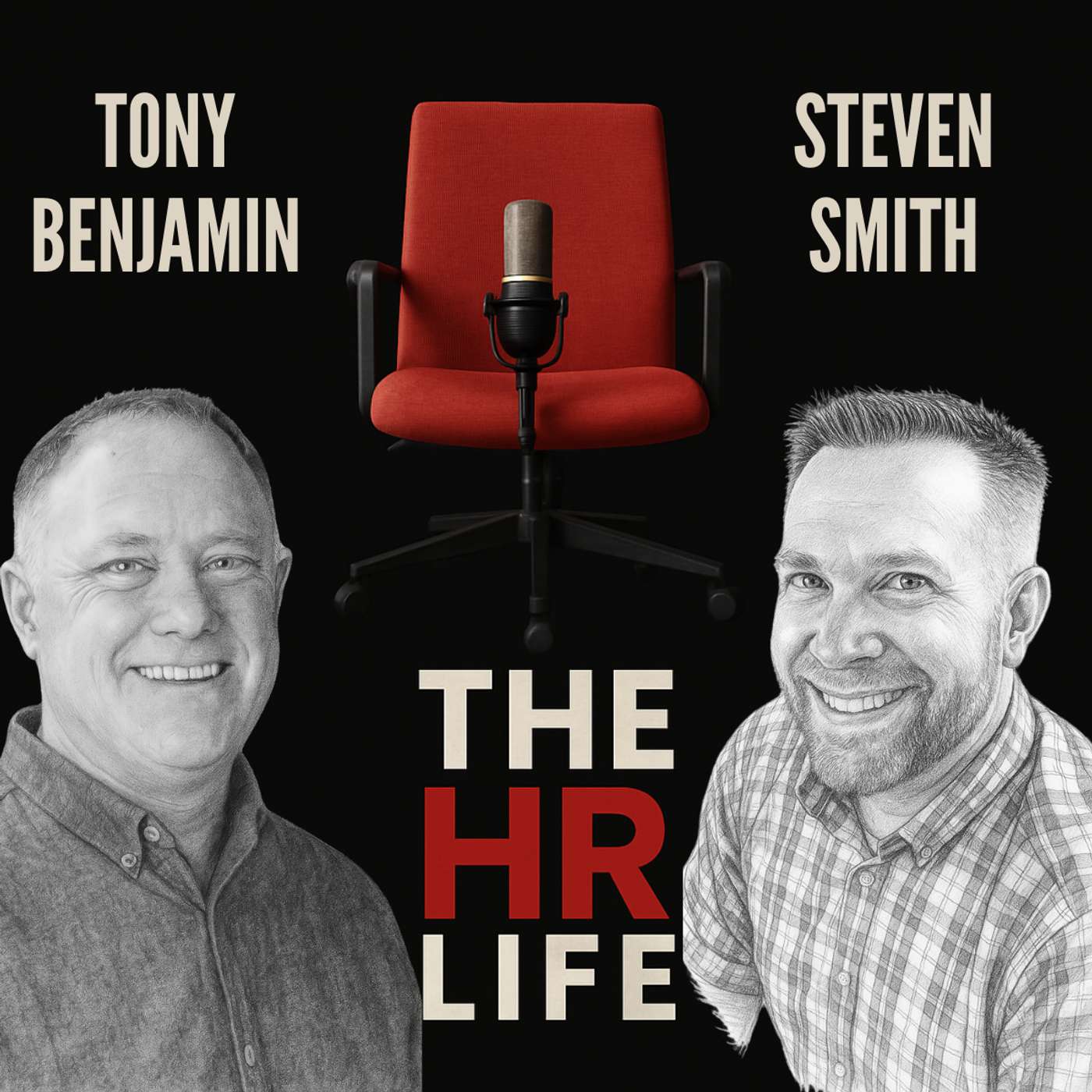
The HR Life Podcast · Tony Benjamin
Sarah Olin and Elena Arecco Bridgmon join the guys to talk about the real impact of good leadership and the business case for treating employees well. Steve tells us that he's worn the Chicago Bulls Championship rings, and Sarah marches a picture of Elena's head across the screen getting Tony to laugh out loud. The discussion includes the importance of the integration of Work and Life into "WorkLife", finding self-actualization at work, and what's required so employees can bring their whole selves to work. (And yes, that's the sound of a coin dropping.) Learn more about Lumo at: https://www.linkedin.com/company/lumoleadership/posts/?feedView=all Sign up for Lumo's Newsletter at: https://lumoleadership.com/get-started/ Learn more about Fantastic Tony Benjamin at: https://www.thegrangellc.com/ Learn more about Steven "Big Deal" Smith at: https://thehiringtreebook.com/ Learn more about the Books mentioned on the podcast at: https://thehiringtreebook.com/hr-life-podcast Learn more about Dyno Outfitters at: https://www.utahviaferrata.com/ Learn more about MegastarHR at: https://www.megastarhr.com/ Learn more about Pucks for Autism at: https://www.pucksforautism.com/ Learn more about Thrive Life Project at: https://www.thrivelifeproject.org/
Elena Arecco Bridgmon (00:08.967) No, can't say. Tony Benjamin (00:13.896) Welcome to the HR Life Podcast, a podcast about the work-life experience of those of us in human resources and business leadership. Your hosts are fantastic Tony Benjamin, owner and founder of the Grange Strategic HR Consulting, and Steven Big Deals Smith, who is so important that he wore the five championship rings from the Bulls during the Jordan era. Hey Steve! Sarah Olin (00:41.39) Wow! Elena Arecco Bridgmon (00:41.916) What? Steven Smith (00:42.035) Hey Tony. And you know where I wore them? I was sitting in Michael Jordan's locker. Yep. There there's a story. So I served yeah, we gotta introduce them, right? Yeah. Tony Benjamin (00:47.068) There we go. Wow. Elena Arecco Bridgmon (00:50.892) What there has to be a story there, Steve. Tony Benjamin (00:54.244) Okay. Wait, wait, wait, wait before before you get to that. Now we gotta do so that was a quick jump in. That was awesome. Sarah and Elena, welcome to the podcast. We're happy to hear ya. Happy to have ya. There goes the crowd. Now be be careful when somebody of your caliber gets here, they go a little crazy, so don't get too close to the velvet rope. if you'd like to try and crowd surf, that's been done a time or two, so just tell ya. Steven Smith (01:01.373) That was a very quick trip in. Elena Arecco Bridgmon (01:06.717) Alright. Steven Smith (01:22.363) That's right. That's right. Tony Benjamin (01:23.642) Hey Steve, they're starting to get out of control, dude. Hold up the sign. Hold the sign. Yeah. There we go. Okay. Whew. Okay. That's that's a crazy crowd. Yeah. That's right. Okay, Steve, go ahead now with the story. The five rings. Steven Smith (01:26.737) The sign down guys. Elena Arecco Bridgmon (01:31.409) Yes. Wow. Sarah Olin (01:32.706) It was very Bulls reminiscent right there. Elena Arecco Bridgmon (01:35.089) Yeah. Felt like it was the we're back in the eighties. Steven Smith (01:35.453) That's right. That's right. Sarah Olin (01:37.25) Yeah. Steven Smith (01:41.595) Okay, so so I was on I was serving my mission for my church out there, and there was one of the members who was basically the janitor. And he he said, I can get you guys in the back. We're gonna go in the back. I'll take you through the locker room. We'll get to go on the floor. I remember the floor too, because when we got on the basketball floor, it was the championship bowl and and all of the stuff, the fancy seats. We Got to sit in the seats and got to visit everything. He says, I got a surprise for you. And he had a little box in his hand. And so we walk into the locker room and I I literally sit down with in Michael Jordan's locker room. It has his name there and everything. And a few of us are around there. And then he hands me the box and says, Open this up. And I open it up, championship rings right there. And he let me put them on. I even got a picture of it of me holding the rings in my on my hand. Elena Arecco Bridgmon (02:30.382) What my gosh Wow Sarah Olin (02:35.436) Wow. Steven Smith (02:36.155) We were in the huge boardroom and we got to see where they do a lot of their plays. It was it was fascinating to me. It was it was cool. I'm not a huge basketball fan, but I everybody knew who Michael Jordan was. Everybody. So mm-hmm. Tony Benjamin (02:45.904) Yeah, yeah, yeah, yeah. Elena Arecco Bridgmon (02:46.525) My gosh. Everybody's a Jordan fan. Yep. Sarah Olin (02:46.658) I mean, and he owned the Hornets. He owned the Hornets. He sold his majority stake last year, right, Elena? Elena Arecco Bridgmon (02:54.575) He did. He sold it, yeah. So but he's been seen around Charlotte. You know, he's a North Carolina guy, so Steven Smith (02:55.347) really? Interesting. Yeah. Tony Benjamin (02:56.506) That's interesting. Sarah Olin (02:56.706) Yeah. I used to see him at games all the time. Getting heckled. He don't like it. He don't like being heckled. Elena Arecco Bridgmon (03:02.417) yeah. yeah. Steven Smith (03:03.175) He's a yeah, he's he's a good guy, but I mm mm. Mm mm he doesn't. Tony Benjamin (03:03.45) I s yeah, I I saw a recent video of him and someone asked him when was the time you were most nervous in your life shooting a free throw? Like what was the most pressure field? And he said, believe it or not, it happened just a couple of years ago. And the guy's like, Wait, a couple of years ago. And he said, I went over to a friend's house and his son was there. And his son said how much he loved me and admired me and all that. And they had a basketball court. And he says, Will you show me how to shoot a free throw? Sarah Olin (03:16.994) Hmm. Tony Benjamin (03:36.708) Michael Jordan says, I haven't touched the basketball in years. And he says, There I am at the free throw line trying to show this kid how to shoot. And he says, That was the most pressure I felt in my entire life. It was right there. So yeah. Yeah, that's you know, Steve, that's a great story. I I tell everybody, so those of us who were Mormon missionaries back in our in our youth and that, you'd be surprised what we get let into. Elena Arecco Bridgmon (03:36.829) Wow. Sarah Olin (03:40.312) you Elena Arecco Bridgmon (03:41.201) Wow. Elena Arecco Bridgmon (03:48.613) Wow. Steven Smith (03:52.179) Pretty cool though. Steven Smith (03:56.529) It was fun. It was fun. Sarah Olin (03:58.158) It's a good one. Steven Smith (04:04.281) Mm-hmm. All kinds of stuff. Tony Benjamin (04:04.454) People give us tours of stuff and you're nice young kids. i w I sir I served in Romania and they're the national cathedral. We went to see midnight mass one night and it just it was it was around Christmas and so they weren't actually having it that night. And so we walked in the thing's empty, and so we're just wandering around looking around, and the the head priest over the facilities came to us and said, Elena Arecco Bridgmon (04:04.531) Mm-hmm. Elena Arecco Bridgmon (04:17.505) wow. Tony Benjamin (04:28.803) you guys are Mormons. Yeah, yeah. I th you guys are awesome. We we know you love organ music. And so they took us up in the back where the giant organ was for the National Cathedral. And one of the elders who was with us, or four of us there, and he said, Do you want to play it? And so he played on the it was just people trust you. We got into crematoriums, we've da da da just they'd always give you tours anywhere you wanted to go. Just, you know, you nice young men, here you go. So Elena Arecco Bridgmon (04:38.492) Wow. Elena Arecco Bridgmon (04:49.393) Steven Smith (04:54.375) I should tell you one day some of my stories with the gang members. That will be fun. Los Reyes. That's for another day, another day, but Sarah Olin (04:59.502) Wow. Part do, part do. Elena Arecco Bridgmon (04:59.929) Whoa. Tony Benjamin (05:02.073) Yeah, yeah. Yeah, but Elena Arecco Bridgmon (05:04.578) Yeah, seriously. Now I'm you know, I need to know these stories. I love this stuff. It's great. I do, but we'll save those for part two of the of the pod. Sarah Olin (05:08.298) Alaina has a few follow up questions. Yes. Tony Benjamin (05:13.345) Okay. That's great. Well, ladies, welcome to the podcast. We're really happy to have you here. It's it's really good. We've Steve and I have been looking forward to this ever since we spoke. it's really good. you guys I know, right? It's so so here's here is something cool. I I have to tell you this, my first grandchild was born this weekend. And so it was really cool. Awesome little Hawthorn Ulysses. Sarah Olin (05:13.676) That's right. Steven Smith (05:16.551) Yes, welcome, welcome. Steven Smith (05:24.285) It feels like it's been forever. Was this like a month and a half ago or something? That was a long time ago. It's a long time ago. Sarah Olin (05:26.914) I know. It's crazy. Elena Arecco Bridgmon (05:29.606) Been a minute. Steven Smith (05:35.751) Yes, yes. Elena Arecco Bridgmon (05:38.162) Yeah. Sarah Olin (05:40.078) Tony. Tony Benjamin (05:42.945) Ulysses Benjamin was born and cute little baby. but because of that, anything that happened before Friday seems like yeah, there's the picture right there. Elena Arecco Bridgmon (05:53.114) Under understood. congratulations, look at that little nugget. Tony Benjamin (05:57.116) Yeah, and this makes it makes perfect sense now that everyone's listening to this on audio only. So enjoy people. But anyways, anything anything that happened before last Friday seems like a year ago 'cause it's been a wild weekend, so Sarah Olin (05:58.656) That baby is scrumptious, scrumptious. Elena Arecco Bridgmon (06:02.258) Mm. Steven Smith (06:05.819) Right. Yeah. They're like, Elena Arecco Bridgmon (06:07.717) Yeah. Sarah Olin (06:13.134) for sure. Steven Smith (06:13.339) It it's okay. We will post a picture in the show notes but it will be blurred. So just know that we'll Tony Benjamin (06:17.549) Hey, my daughter in law threatened me about putting his face on social media. She was like, No way. So yeah. Yeah. So Elena Arecco Bridgmon (06:18.299) Yeah, yeah. Sarah Olin (06:18.701) Understood. Steven Smith (06:23.073) really? I believe it. This younger generation there is like no holds barred. They're like, Don't you post anything on my kid anywhere? So yeah. I get it. I get it. Elena Arecco Bridgmon (06:25.425) I get it. Tony Benjamin (06:29.807) Yeah, yeah, yeah. So anyway, so anything before that seems like but we're happy you're here. This is wonderful. and and welcome to the podcast. you ladies have some cool stuff that you do and and we want to talk about some of that today. And I think some of the other topics we're looking at talking about are go are going to be profound for HR people. the more I the more I think about this right now and everything that's in the media about HR and everything right now and Steven Smith (06:43.527) Yeah. Tony Benjamin (06:55.435) And and of course fast companies the most recent why we still hate HR article and all that sort of stuff that's coming out again. I think it's really great that you're here. We're gonna talk about this 'cause we're talking about level two or strategic HR. See there. Sarah Olin (07:10.798) oooo Elena Arecco Bridgmon (07:11.296) time to drink. Steven Smith (07:13.038) That's right. Tony Benjamin (07:14.999) So anyways, but w I think what you have to talk with is about that is is right in that area. Ladies, was Sarah, maybe let's start with you. Tell us about you and how you got into what your you know, your background, how you started the company and tell us more. Sarah Olin (07:30.146) Yeah, so I started doing this work 13 years ago when my daughter was nine months old. She's 14 now, can make her own ramen going into ninth grade tomorrow. Yeah, in my background before leadership development, executive coaching was I used to teach mindfulness and meditation in big companies in New York. So. Tony Benjamin (07:40.347) Wow, there you go. It's a big time. Steven Smith (07:41.115) Nice. Nice. Yeah. Sarah Olin (07:54.831) Always very entrepreneurial, always a helper. And when I was pregnant with my daughter, I said, okay, I'm going to be a therapist, a guidance counselor, some kind of, I want to take this support conversation to the next level. And coaching was having a really big moment in New York city at that time. And, I found this really intense program in New York. moved to Charlotte. I commuted. I became an apprentice and then a mentor in the program and eventually a trainer. And it was just the most awesome thing in the world. What I got from coaching personally and then what I got to give to others. I was like, this is great. Everybody needs this stuff. Now, Elena and I met through our daughters when they were in preschool. Elena was the class mom and sent out a note that said, Hey everybody, if you want to contribute to the Teacher's birthday, I'm like, lady, if you're buying, I'll send you all the money. You're a saint on this earth. Okay, you're an angel as far as I'm concerned, because that is just not, I don't wanna do that stuff. So Elena said, who is this strangely enthusiastic woman? And we got coffee and it was, love it for a sight. But Elena, I'll let you introduce yourself. And Elena and I started Lumo together. Yeah. Elena Arecco Bridgmon (08:54.194) Yeah. Tony Benjamin (08:54.748) Ha ha ha. Steven Smith (08:55.792) Yeah. Steven Smith (09:18.471) Yeah. Elena Arecco Bridgmon (09:20.698) Yeah, so yeah, Alina Areco Bridgeman and what s I don't know that Sarah and I said this specifically, but live in Charlotte, North Carolina, and I'm here with that's me going across the screen. Tony Benjamin (09:28.988) Okay. So hold on. That is so not fair. Sarah's got a little cutout, a little head of of Elena's head. She's she it's on a stick and it's going back and forth across the screen. Sarah Olin (09:36.012) of Elena's head. Steven Smith (09:37.189) Yes. That's what good moms have when they go to their sports for their kids, right? Elena Arecco Bridgmon (09:43.612) That's true. It it's really true. And I should it isn't fair, Tony. I should have Sarah's head on the stick. I'll have to work on that, as I should. so yeah, so Sarah and I co-founded Lumo, and my background is is largely different than Sarah. I came to this work from a 20-year corporate career, first in sports marketing, where I was so interested in the Jordan conversation, and then in operations, and then 15 years at Bank of America. That is why I am in Charlotte, North Carolina. I was recruited here. Tony Benjamin (09:44.038) Sorry. Sorry, go ahead, Elena. Sarah Olin (09:50.25) As you should. Tony Benjamin (09:50.554) Yes. Elena Arecco Bridgmon (10:13.381) after graduate school. And I found myself by accident in human resources because I was in a leadership development program at a graduate school and I started asking very curious questions about how this leadership development program was run. Who runs who who's actually in charge of it? How do you train people in certain areas? How do they get their permanent placements? So I asked a lot of questions and then was invited to become a recruiter and program manager and then ultimately was promoted to lead the team. So I got accident ended up in HR and had a great rotation at Bank America before I left during the pandemic. Yeah. Tony Benjamin (10:44.828) Shocking. We never hear that we never hear about accidental HR ever. No. It's weird. Yeah. Weird, weird. Sarah Olin (10:47.502) Ha ha. Steven Smith (10:48.561) Yeah, ever. No nobody a ever accidentally joins HR, so Sarah Olin (10:52.714) Elena Arecco Bridgmon (10:53.393) It's very weird. But but the funny thing is is that my parents both had roles in HR when I was growing up and were like, do anything but be an HR and I just couldn't get away from it. I went tried to be an accountant, that was super boring, ended up in sports marketing because a really, really cute guy in my economics class was in the sports marketing. I was like, That's a reason to be a sports marketing major. And then here we are, all these years later, entrepreneur, leadership development leader and coach. Tony Benjamin (11:14.586) Ha ha ha. Sarah Olin (11:15.534) Absolutely. Tony Benjamin (11:22.372) Okay. So Sarah, whose whose faces were those that just went across the screen? That was Sarah Olin (11:26.062) Those were the guys from Heated Rivalry. That was... Steven Smith (11:28.764) But it doesn't matter. It was a it's a heart shape and that's what matters. Tony Benjamin (11:30.684) It's right. Sarah Olin (11:32.684) That's right. And cute, cute guys. It's just thematically on track. Thematic, yeah. It's high level. It's not an exact science. Elena Arecco Bridgmon (11:32.848) Yes. Tony Benjamin (11:35.621) Yeah, yeah, it's it's the theme. It's the th that's that that's well look, let me let me just say there are fewer guys, but all the all of us in HR that are in it we're we're cuter. Then let me just say that. Then the sports guys pfft pshaw. Pshaw. That's right. That's right. Come on, you sports marketing guys. Let's see it. Bring it on. We're here waiting for ya. Elena Arecco Bridgmon (11:36.571) Yeah. It goes with yeah, yeah. Elena Arecco Bridgmon (11:51.543) Wow. Steven Smith (11:52.359) Wow. Just throwing it out there. Elena Arecco Bridgmon (11:54.649) It's a bold statement, Tony. Yes. Sarah Olin (11:55.084) Go, Tony. Sarah Olin (12:01.197) Bring it on Jordan, whatever. Tony Benjamin (12:02.671) And if we lose, we'll still we'll charge you with a crime and get you incarcerated or something 'cause we know the law. So there you go. Just saying, boom. There you go. That's right. That's right. Cause you know, the sports marketing guys, there's a lot of that listen to this podcast. So I'm sure it's gonna get crazy now. Yeah. That's right. Okay, so you Elena Arecco Bridgmon (12:08.821) Steven Smith (12:09.169) Wow. Wow. He is really throwing it down. Yeah. Yeah. Elena Arecco Bridgmon (12:11.493) Gauntlet is thrown, yeah. Sarah Olin (12:19.948) But tons. Steven Smith (12:20.115) Totally. Totally. Sarah Olin (12:24.598) Ha ha! Tony Benjamin (12:26.426) You ladies you you ladies formed Lumo, right? And and talk to us about the company and and exactly what you do. I know it's I know it's a leadership development, but talk to us about that and and exactly what you do. Elena Arecco Bridgmon (12:26.779) Yeah. Sarah Olin (12:30.509) us. Sarah Olin (12:39.692) Yeah, thanks, Tony. It's funny because my mentor, our mentor, Elena and I said to us a few months ago, it doesn't mean anything to say your executive coach and do leadership training anymore. It really doesn't. And we know that. where we started LUMO and where we're at today is a little bit different. We started with a focus on supporting working parents and caregivers. And while we still do a good bit of that work, we've really expanded into a lot of manager development. We work a lot with the C-suite leaders across industries, but we're narrowing it down. We're entering our next phase of maturity, right, Elena? And we're really going deep from fashion and retail, nonprofits and government agencies, and then the final commercial real estate and finance. We do a lot in those areas. So we help. Elena Arecco Bridgmon (13:22.299) That's right. Sarah Olin (13:37.026) people, okay, so that's the shenanigans, but we help people have a good experience at work. We help them behave better. We help them be good humans so they can be good humans with the people around them, right? How to really be a mature, fully expressed professional at work. Tony Benjamin (14:00.157) Well okay, okay, hold on. I've got several questions follow up on that. But before that we do that, let's let me get to my first read here. Yeah, no, because I I've got some follow-up stuff to hit to hit up with you on that, and let's talk about that. Looking for a team building experience your employees will actually talk about? Dino Outfitters in Vernal, Utah offers guided trips on the epic new Ashley Gorge via Ferrata. Help your team build trust, confidence, and real connection. Steven Smith (14:05.363) Jump into our read, yeah. Yeah. Sarah Olin (14:08.444) good. Tony Benjamin (14:28.3) All while hanging out on the side of a cliff. Reach out to build a custom experience at Utah ViaFerrata dot com. And shout out to Amber and her team. anybody's ever met Amber, man, that lady's awesome. She's incredible. So anyway, Dino Outfitters here in Vernal. Yeah, she's great. Sarah Olin (14:43.576) Shout out Amber. Steven Smith (14:45.223) I love that Sarah laughs because Sarah really wants to hang from the side of a cliff, so Elena Arecco Bridgmon (14:49.553) A hundred percent. Sarah Olin (14:49.833) I mean... Tony Benjamin (14:51.772) We already invited you. You got this the invitation. September eleventh. So just saying if and if any guests go ahead. And if any if any listeners want to get in, they can too. Well, so do I. So go ahead. Go ahead. Okay, go. Shoot. Steven Smith (14:55.165) Right. I wanna yeah, I wanna ask I wanna ask a question, Tony. I want to ask a question before you ask yours. Yeah. So you so so one of the things you first talked about is is when you kind of started, and maybe I I missed this a little bit, but you work a lot with parents and caregivers. Now the reason I the reason I bring this up is because my father-in-law had cancer. And we had when he had cancer, he started falling, right? And it was one of those things where my wife and I said, Nope, you're you're not staying home anymore. Because he was literally, he fell in the middle of his living room and was there for over six hours before a neighbor found him. Sarah Olin (15:18.638) Hmm. Yep. Elena Arecco Bridgmon (15:25.873) Mm. Steven Smith (15:31.577) And when the neighbor found it, the neighbor called us. He lives living in Alabama, so I'm in Utah, so really huge distance. And and literally within a week, I was I flew out to Alabama. We got his house up for sale and we moved in in with us at the home because we refused to ever let him fall again without being having family be close. And and so my wife and I became caregivers for my father-in-law for the last several months of his life. We didn't realize that he only had months left at that point. Sarah Olin (15:51.139) Yep. Steven Smith (15:59.429) So so I I'm really curious about this side of this business when when you talk about parents and caregivers. So I'm just I'm curious to know what your insights have been as you've worked with caregivers. especially as the aging workforce, a lot of people that are my age are starting to take care of their parents. I have several neighbors right now that are taking care of parents. And so this is a really big Sarah Olin (15:59.671) Yep. Sarah Olin (16:17.691) yeah. Steven Smith (16:22.483) N I don't wanna say issue. Yeah, a conversation. There we go. 'Cause it's not an issue. It's just the nature of where we head in our lives as we gr go older, right? So Sarah Olin (16:22.67) It's a huge conversation. Elena Arecco Bridgmon (16:31.962) Yeah. Well, Steve, I just b I I wanna just put in that we we started the company, we'll just call it what it is, to help moms because working moms tend to have the most need for support. And in the inquiry of what that means, it expanded to parents and then to caregivers. And that was all through our work with our with the the market, with our own coaches, because what you're talking about is a salmon generation that we are all part of, right? So we had our kids Steven Smith (16:58.451) Mm-hmm. Yep. Elena Arecco Bridgmon (16:59.896) I had my kids a little bit later than my mom did. And now my I kids are in high school. My my youngest is entering high school tomorrow with Sarah's daughter. And my dad is 90. Like I'm literally like in the middle of it, right? And that's I'm not unique. That's everyone, right? But the thing is, is that many of our leaders inside of companies don't know what to do. They don't know what to ask. Not unlike the conversation you had with the great Metapa Metopause ladies, right? Managers don't want to say the wrong thing. But if they don't talk to their people and check in with them. Tony Benjamin (17:07.936) huh. Steven Smith (17:12.807) Yeah. Yeah. Elena Arecco Bridgmon (17:29.028) That's not gonna leave, you know, the the caretaker that's taking care of their sick father-in-law or their whatever in a good place, right? We've gotta help our leaders through these transition moments, whatever they are, whether it be having a child, caring for someone, getting a promotion, dealing with AI. We're we're really looking at all these moments that matter where a company can really, really, really do a great job of supporting their people. both the individual employee and their managers who probably haven't been trained to have those kind of conversations. Steven Smith (17:58.713) they definitely haven't been trained. So yeah. Anyway, that that was my question. I I appreciate that 'cause I like I said, having gone through that, it's it's it's really I have a soft spot for it. So there you go. Sarah Olin (18:02.924) Yeah. Sarah Olin (18:11.766) Yeah, Steve, and it's, you know, it's funny because I think the pandemic opened up a whole lot for people you were seeing kids running around, you were seeing all kinds of things, people being crazy on zoom. And I think one of the gifts was many people stopped pretending that they didn't have a life outside of work and their right and their stuff just became so pressing and big and it's still Steven Smith (18:33.775) Amen. Sarah Olin (18:40.204) And I think that's one of the positive consequences of COVID and that people are talking about it and they have to because otherwise they're going to be leaving. They're going to be under producing. They're not, it's not going to be a great experience. And we believe one of our core. philosophical beliefs, we believe that companies want to do right by their people. And we believe people want to do right by their companies and they don't always have the tools or language to speak to one another, just like the menopause said. So it's how do we scale up our managers so that they can be with people in these really tough moments. Tony Benjamin (19:12.112) Mm-hmm. Steven Smith (19:19.825) Yeah. No, it's so true. It's so true. Like I said, when I was going through that, I mean, obviously I'm in sales, right? That that's what I'd done for for 18 years. And and there is no question that my sales started tanking during that time because I was I mean, I I was I was having to unclothe him and bathe him, right? Because he couldn't even have the energy to do that anymore. And and doing those things for several months and and yeah, there was I wouldn't talk about it at work. I wouldn't tell people what I was going through at work. I just Sarah Olin (19:25.965) Yeah. Elena Arecco Bridgmon (19:32.346) Course. Sarah Olin (19:33.07) Of course. Sarah Olin (19:37.389) Yeah. Sarah Olin (19:43.361) It's a huge. Steven Smith (19:48.932) it it wasn't what I wanted to do or or that I felt was necessary to to even bring it up. But yet I feel like some of those conversations probably should have happened to at least help understand here's why my numbers might be lower. Here's why certain things that are happening right now that have nothing to do with just me being a poor salesperson. It was just like literally I have been added upon with this and I was up sometimes all hours of the night. Elena Arecco Bridgmon (20:02.053) Mm-hmm. Steven Smith (20:15.801) And was not sleeping at all. So there there's a lot of factors there for sure. So anyway, fa fascinating to hear that that that there's support out there because I didn't know there was support like this. And so I just I just winged it, right? I just did what was necessary and we made the best effort until he passed away and and you know it's it's still a tender thing, right? So anyway, I'll stop because I know Tony has some probably Sarah Olin (20:38.936) Totally. Elena Arecco Bridgmon (20:39.545) Yeah. Steven Smith (20:42.895) more relevant questions, but but that it was just something that was very personal to me, so Tony Benjamin (20:46.478) No, I actually I think that dovetails exactly into what I wanted to talk about. yeah, you you you were talking about this and in and and helping to helping companies to kind of see and to care and and those kinds of things. so I do a little legal work on the side and what was that, Steve? It's just Steven Smith (21:09.703) Sorry, I s I see the I see that I look like this ghost inside the video and it's because my fingerprints on my camera, so I just wiped it off. Sorry, random, I know. Tony Benjamin (21:16.448) there you go. You wiped it off. See there there you go. A little inside baseball for everybody listening. anyways, no so I do a little plaintiff work, right. So I work for a law firm and I help field and and and do some initial work there for the for the law firm for employees who are looking, you know, at their companies. And and the number one thing I think I see is that companies They they're very cold. And and and I don't wanna say professional. They're just they're just cold about the way they treat people sometimes. so there's one company here in Salt Lake. I get a call from that from an employee of theirs about once every five or six months. And my guess is that that eventually one of these people that call me are going to be in court with them. And and the reason is is because they bring on somebody new or they promote somebody to be over a team and the first thing they tell them is we want you to reorganize the team the way you want to. That's awesome. That's great. But invariably what happens is those managers come in and they start firing people on that team. And there's 20 to 30% of them, right? And the people who get let go on those teams are the people who don't necessarily think like them. Sarah Olin (22:14.113) Hmm. Sarah Olin (22:40.672) Mmm. Tony Benjamin (22:41.132) Sometimes sometimes I start looking at patterns of that and I'm like saying, Okay, you got a team of five people, there were two women on it, and only the two women got let go. Hmm. Right? Or or that the person who you let go just happened to put in their FMLA paperwork two days before you took over and it hasn't been granted yet. And I just and and so I'm keeping a list of all the people that have been there and when it comes to enough, they're all going to be together in the in the group. And it so the things you're talking about, I look at what companies do and I agree. I think generally speaking, most people want to be nice and they want to do the right thing. I think a lot of people think, this is just business. Steven Smith (22:54.728) Yep. Tony Benjamin (23:23.3) It's not personal, it's just business. Well, when you ravage my ability to pay my house payment for the next six months, it sure feels personal to me, right? And it maybe maybe we can talk to talk a little bit about that. but it it's nice to hear that you ladies are doing something that that goes a different direction than that. And as you as you advise people and you're you're coaching them, you're talking about that very thing, about about being good people at work. Sarah Olin (23:23.735) Hmm. Elena Arecco Bridgmon (23:31.407) Mm-hmm. Steven Smith (23:31.933) Okay. Tony Benjamin (23:50.938) Right? Because I think it comes out in a zillion different ways. Sarah Olin (23:51.97) We'll be. Yeah, we talk, Tony, a lot about human centric leadership and putting people at the center of organizational results. And we don't believe that one has to be sacrificed for the other. And it's not just about being nice. It's about being a human being like Steve. How are you? I can't believe you're going through that with your how can I make your life better? Right. It's it's very simple stuff. But to your point, Tony, people people are really afraid. The U.S. is a very litigious Steven Smith (24:13.107) Yeah. Sarah Olin (24:24.974) country, right? Like, I'm gonna get sued or that kind of thing. And we train people in how to build strong relationships so that we can have conversations. Because Steve, that's, to me, that breaks my heart to hear like, you're going through all this and you have to show up over here and be like, everything's great. Yeah, we're gonna get those sales back up for Q4. And it's like, you know, when we lost my mother-in-law in November, who we were, she lived 15 minutes from here, we were super close, Sunday dinner family. And Elena was just like, okay, you take all the time you need, whatever you need, we're here to support you. Let's figure everything out. And that's how it can be. And nothing skipped a beat, right? So there's always a way to be great with people. Steven Smith (25:02.067) Yeah. Sarah Olin (25:18.902) And you don't even have to give them anything necessarily, but you can listen and be empathetic and just care. Just give a shit, huh? Steven Smith (25:28.155) Well and Sarah, you make a great point. You need to give them the abilities Tony loved that. Loves sis this that's his favorite word, so his favorite word. Tony Benjamin (25:29.894) There. Sarah Olin (25:33.89) Can we swear? Sorry, Tony. Tony Benjamin (25:36.348) Well we did, so here you go. Yeah, that's yeah. Okay, okay, my wife just heard that, Steve. Thank you very much. I appreciate that. No, no, it's see no no, I'm just saying it no no my my no no, what my wife heard was Steve saying that's my favorite word. That's what she heard. It's not the word. It's Steve. Thanks, Steve. Appreciate that. She like, Tony, what are you doing when you're hanging around Steve? That's Elena Arecco Bridgmon (25:37.911) Is it okay? 'Cause I wasn't I wanted mmm mmm. no. Put it in the swear jar. Steven Smith (25:43.515) Yeah, yeah, yeah. Sarah Olin (25:43.724) Wolverine, Wolverine, son. Steven Smith (25:55.763) She'll go back and listen to it again. That's right. That's right. Yeah. Elena, you were gonna say something. I wanna hear what you were gonna say. Sarah Olin (25:56.32) okay. Elena Arecco Bridgmon (26:02.479) Ha it's a bad influence. Tony Benjamin (26:04.273) That's right. Elena Arecco Bridgmon (26:08.564) Well, gosh, I don't remember anymore. Just I think just the the idea that when we talk to our people about how they are, like we talk to a neighbor, to a friend, to the person at our church or in our community, it makes a big difference. And this idea that I think you said it earlier, like work is so separate from our life, it's not. When I walk into the office, I'm still a mom, I'm still a daughter. I'm still a member of my community. I'm still all these different dimensions, right? All these intersectionalities. And I can't turn that off. And us trying to pretend that we can just turn it all off and forget about it is impossible. It's not sustainable. And it's it's really damaging to the environment, right? And to the culture. And so the thing that like you were saying earlier, Tony, about it feeling cold. I I'll just tell a personal story. During the pandemic, I actually went out in FMLA. It was August of twenty twenty, my husband broke his back and I literally was like, I cannot take one more thing. And so, yeah, it was just it was just too you know, we're homeschooling, my parents were co living with us at the time, and it was like just too much. I'm an HR professional working in one of the largest organizations in the country doing really great things for their people. When I called to get my FLA handled, it took me three weeks of Steven Smith (27:11.619) Elena Arecco Bridgmon (27:32.984) Copious phone calls, and every single person spoke to me like they were reading off of a script. It was the most inhumane experience. And I shared that with my HR partners, and of course, it had been outsourced. So there's like this balance between having efficiencies with some of our policies and actually being great with our people. And that's where our culture is developed, right? It's between where the policies are, how our managers actually talk to our employees. Steven Smith (27:38.299) Mm. Elena Arecco Bridgmon (27:59.787) and their experience that they have. And when I remember, this is a separate story, coming back from my maternity leave the first time with my manager, of course there's a policy on how you come back from leave. But she said to me, Elena, if you need to take half days, take half days for as long as you want to. She said to me, now I'm I'm an I'm not an hourly employee, so it's a little different, right? It's an exempt employee. I understand that makes it a little bit different. But there's always a way if you work with your people and you talk to them. Hey, why don't you make your first day a Thursday? So you only have to worry about Thursday and Friday. And then that way you're not starting on Monday and having like that first week back be really hard. Just small little things. Doesn't cost anything to talk to your people. And I don't know about Sarah, but many, many times when I'm talking to my leaders, and these are high-level executives, they'll be talking about employee, and I'm like, hey, did you talk to them? They're like, no, I didn't. Steven Smith (28:35.303) Yeah. Sarah Olin (28:45.905) yeah. Tony Benjamin (28:52.312) Or or no, I didn't talk to them. I'm not allowed to talk to them, right? I I don't I can't ask about their personal lives, right? And and wait, wait, stop. Who told who in the world made it up that managers cannot talk to their employees about their personal lives? That's ridiculously stupid. what now I'm gonna miss up the name, Steve, who who who gave us the the the term work life, Sakia, Steven Smith (29:09.491) Yeah. Steven Smith (29:18.661) Sakia. Tony Benjamin (29:19.036) Remember I don't remember you know who I'm talking about. Anyways, he he'll know who he is. I just want to give him credit. But anyways, he came up with this term work life. He says it's not a work life balance, and I I I absolutely agree with this. Yeah, yeah, so but the idea that it's work life, it's not a work life balance, it's work life. And until you understand no, you'll never no, no. Steven Smith (29:31.413) I know Shema now. Yeah. Yeah. Yep. Elena Arecco Bridgmon (29:31.726) I do too. Steven Smith (29:38.163) Because you're never gonna have balance. There's never gonna be a balance. But you just have to recognize, yeah. Yep. Elena Arecco Bridgmon (29:40.064) No. We call it integration. Yeah. It's work life integration. Yeah. Sarah Olin (29:43.981) Yeah. Tony Benjamin (29:44.175) Yeah, yeah, you integrate it. And it's ac it's self-actualization to accomplish things and be creative at work and do great things at work and do great things at home. And if you're not doing great things in one or the other, and and sure there are imbalances and that sort of stuff that come along, you know, because you you got to put in extra time or or you got a family s who's sick at home or whatever, and the b the balance is never perfect all the time. But over time you're s you're self-actualizing, you feel an accomplishment in both. Steven Smith (29:55.197) Mm-hmm. Elena Arecco Bridgmon (29:55.256) That's right. Sarah Olin (29:55.448) Hmm. Elena Arecco Bridgmon (30:03.854) Yeah. Tony Benjamin (30:14.368) And and I know, and maybe you ladies can talk to this, I know that there are leaders out there and business owners who are like, stop talking all this warm huggy HR stuff. And and you know, I got a bunch of employees that if I don't write they're they're just gonna take advantage. They're just, you know, all that sort of stuff. It could can we confront that? Let talk to that mentality just for a second. What what is the business case? Yeah, yeah, but well and look, look. Elena Arecco Bridgmon (30:14.446) That's right. Steven Smith (30:35.357) Yeah, how do deal with that? 'Cause I've met employees like that. There are employees like that that exist. Yeah. Tony Benjamin (30:42.24) I've I've worked I've worked somewhere where a lady faked having cancer so she could get extra PTO. She went so far as to shave her head, right? So like like I just yeah, right. So I get it. I get it. But let's talk the business case for doing it right. Steven Smith (30:46.033) Yeah. Yep. Steven Smith (30:53.843) These are real things. Sarah Olin (30:56.351) Wow. Yeah, it's, mean, listen, one of the things that we talk about a lot is that relationships are the foundation of results. And if you want a team that produces results, you need to be in relationship with them. If you want people who are going to work for you and show up and, and not try and, you know, finagle you and, and shave their head and say, I have cancer. mean, craziness, right? If you have a real relationship, that's not happening. Tony Benjamin (31:23.248) Yeah, right. Sarah Olin (31:29.634) Right? So that would be my argument. You know, you're going to... Tony Benjamin (31:33.18) Or but you know what type of person they are very quickly after you hire them and you fix that problem. That's either one or the other, right? Elena Arecco Bridgmon (31:39.02) That's right. And that's right, Tony. And that's what I was going to say. The other thing that I think sometimes puts us in those situations is that somebody isn't performing and we aren't giving them the feedback and helping them to either we're not either coaching them to get better or or to what was that word term? One of our clients said, helping them to find their way to a new job. I don't remember her term, but it was so it was such an eloquent way of saying it. You know what I'm talking about. I love it. Steven Smith (31:50.845) Yeah. Sarah Olin (31:51.192) Right. Sarah Olin (32:04.023) I know exactly who you're talking about, helping them find their next chapter or something like that. Yeah. Elena Arecco Bridgmon (32:08.595) Their next yeah, exactly. Because because when we let those experiences fester than it does it actually is a culture killer on the rest of the team. And I am gonna assert something and I could be a hundred percent wrong on this, okay, and I'll be on the but I think that those people that the people sadly that would say cancer are the exception and not the rule. Because as Sarah said, and I really believe this, most people want to do right by their company. Tony Benjamin (32:20.38) Yes. Steven Smith (32:32.091) I agree. Elena Arecco Bridgmon (32:38.313) And most companies want to do right by their people. And when we apply the the exceptions to the the majority, it can really or manage the lowest denominator, it can really hurt the experience of everyone. Steven Smith (32:51.451) think about it, it stands out like like headlines, right? Because headlines oftentimes the the things that we see in the news and the headlines are those outliers that are so off the wall that man, we got to talk about this on the news. You know, in my book I call them the gophers. Elena Arecco Bridgmon (32:55.127) Uh-huh. Sarah Olin (32:55.566) That's right. Elena Arecco Bridgmon (32:59.629) That's right. Steven Smith (33:05.159) You when when I worked with Farmer Pie I use this tree as an analogy, the gopher will gnaw at the roots of a tree until the roots are so damaged that eventually the tree just topples over because it can't feed the nutrients to the rest of the tree. And if you think about your organization like a tree like this, when you have that gopher, you have to eradicate the gopher right away. You you you can't just let it sit there and fester and gnaw and gnaw and gnaw because that will destroy the organization. And so when you do discover it, Sarah Olin (33:05.646) Mmm. Elena Arecco Bridgmon (33:13.141) Mm. Sarah Olin (33:15.427) Hmm. Sarah Olin (33:25.613) Yep. Steven Smith (33:33.373) Where you have that anomaly, you you really have to go in there and eradicate it as as best you can. but for the most part, I agree with you. I think most people want to do the right thing. And because they want to do the right thing, as people, we have to be willing to train and listen, educate, and all of those things that are necessary to actually help people succeed, right? So Sarah Olin (33:55.384) That's right. Elena Arecco Bridgmon (33:57.42) Yep. Yep. And that god sorry. No you go. I shouldn't say it Sarah Olin (33:59.439) A client just, go ahead Elena, no you go honey. A client, a client. Tony Benjamin (34:06.658) I like this. This is polite people on a on a on a conference call. This is awesome. I love this. Steven Smith (34:08.883) So fun. Sarah Olin (34:10.782) This is is respect, man. This is respect. A client of mine just shared this beautiful story. It's really beautiful. It sounds super sad, but it's so beautiful. Really. She was she was on a plane, a cross country flight, and the person in front of her had a heart attack. And she said, everyone on the plane was so amazing. They were giving this person the chest compressions for Elena Arecco Bridgmon (34:14.891) Yeah. Okay. Sarah Olin (34:40.59) like 45 minutes until they could land. They made an emergency landing. And it was a Delta flight and people were just gently coming up and saying, hey, I'm CPR certified. I can help just not showy. She said it was the most beautiful display of humanity. And I just thought, man, people can be so great. And you're talking about hundreds of people, respectful, giving space, know, letting these people have this experience. And Elena Arecco Bridgmon (34:45.878) Ow. Sarah Olin (35:09.974) We hear so much about how bad it is and there's so much good stuff, but nobody clicks on the good stuff like that. Elena Arecco Bridgmon (35:18.305) No, that's not clickbait. I'm getting a little veloced over here, Sarah. That's a beautiful story. wow. Sarah Olin (35:21.71) Sweetie, know, I know it's so sweet. I know I cried. I cried. Steven Smith (35:24.125) Well that that's that's why Yeah, influencers frustrate me in that sense because the influencers want the salacious and the crazy outliers. And you know, it it just boggles my mind. You know, my my my wife and daughter unfortunately experienced a Charlie Kirk when he was assassinated last year. And and we're we're coming up on the anniversary, 40 feet away. Yeah. So when that happened, just everything that was happening, the the the amount of people who started trying to protect one another and help. Elena Arecco Bridgmon (35:31.989) Mm. Tony Benjamin (35:41.532) They were what forty feet from him. They were forty feet from him when it happened. Yeah. Elena Arecco Bridgmon (35:47.657) my god. Steven Smith (35:54.083) It was probably one of the more organized exits that had ever th that that I've ever even experienced. Did they talk about that in the news? No, they didn't. They didn't talk about any about the crowd because when my wife called me, I still have her voicemail on my phone. When she frantically called me. Yeah. We were on the phone together. We were were we recording or I can't remember what we were doing. Yeah, we were prepping for something. And she called me. She left a voicemail and and in her voice Sarah Olin (35:58.222) Yep. Yep. Tony Benjamin (36:09.436) 'Cause Steve and I were on the phone. We were on the phone talking. I we weren't recording, we were prepping for something, but yeah, we were all talking. Elena Arecco Bridgmon (36:17.543) my gosh. Steven Smith (36:22.789) At that point, they weren't sure if it was a mass shooting or not. And so people were trying to flee the scene because they were afraid that there was going to be additional bullet point bullets or whatever in the crowd. But but yet everybody was was calm and collected. They exited. They I just just an amazing experience, I guess, in that sense. Not amazing in regard to what happened, but as we come to the anniversary and they're preparing to do a a a ceremony and things like that there, it's it's just it's crazy what Elena Arecco Bridgmon (36:32.298) Sure. Sarah Olin (36:32.974) my. Steven Smith (36:52.751) what peop like like when people are really put into the thick of things, I do believe that most of us care about one another and we want to do the best that we can. It's not like the walking dead where everybody becomes zombies and so you just have to destroy the world in order to live and that's the only way to live. Because I'll tell you, TV makes it sound as if that the apocalypse comes, it's every man for himself, but I I think if a true apocalypse came, I think most of us would be kind to one another, I would hope. Anyway, but Sarah Olin (37:01.014) I agree. Tony Benjamin (37:20.228) Except the zombies, I'm not being kind to the zombies. Just saying. That's just saying, you know, yeah. Steven Smith (37:22.309) No, I won't be kind of the zombies either, 'cause they're kinda weird, but I don't want them eating my brains. I mean, come on. Sarah Olin (37:25.762) No. No. Tony Benjamin (37:29.176) So so so ladies, I w before we get too much farther on, 'cause no, that was a good conversation. We made Elena tear up a little bit. I liked that. That was good. What a great conversation. No, I I there goes the head on the stick again. That's that's good. Sarah Olin (37:36.991) I mean... Elena Arecco Bridgmon (37:37.974) yeah. Doesn't take a whole lot, but that was a beautiful story, yeah. And I'm really sorry that gosh, Steve, your s your wife, I can't even Steven Smith (37:43.707) You know, they still have PTSD. I will say PTSD is a very real thing. It is yeah, it is very hard now for me to take my wife to a crowd, like a a crowded area. which is really strange to me. And and and what I have had to learn is that I have to be sensitive to that because if you're not sensitive to that, you Sarah Olin (37:44.13) Yeah, you can. Sarah Olin (37:47.859) I believe it. Elena Arecco Bridgmon (37:49.12) I believe it. Sarah Olin (37:55.451) I believe it. Steven Smith (38:08.559) You just you you let it fester. It's just like at work, right? When you recognize certain things and you just let it fester and fester, you make the assumptions. I it's fascinating to me that you said that one of the leaders you talked to hadn't even talked to the person yet. And I see that way too much. Why in the world do you just make these assumptions and stories? You know, Brene Brown talks a lot about that. This sometimes we try to fill in the gaps and it's like, well, wait a minute, why don't we just go talk to the person and actually get the real story from the source? imagine that. Sarah Olin (38:22.72) yeah. Elena Arecco Bridgmon (38:31.738) yeah. Sarah Olin (38:31.879) yeah. Steven Smith (38:38.643) i it boggles my mind that sometimes we th we go down that road, you know? Tony Benjamin (38:39.792) Well but but here's and Elena and Sarah, I'd love your your comment on this. I think the fear, the reason there there's two things. We don't talk about it when we go to work because we're afraid that will be used against us. That people will say, Tony's distracted, he's got this going on in his life. I don't know if he can handle this anymore. Do we really want him on the team? That's what we're afraid of. The flip side of that is that the manager is afraid that the employee is gonna sue him or her. Sarah Olin (38:54.573) Hmm. Tony Benjamin (39:09.338) Because I asked something a little too personal and they're gonna get offended and mad at me. Like that and and it just to your point, I think most of us want to do the right thing, but we're scared. And and look, HR law has gone a long way to helping in so many different things, but one of the downsides to it is that it's created a barrier between manager and employee. Elena Arecco Bridgmon (39:21.333) Mm-hmm. Steven Smith (39:32.243) So how do you handle that? I'm curious your guys' thoughts on that. Because I imagine you deal with this, right? Elena Arecco Bridgmon (39:36.073) Well ge I I'll well yeah, yeah, and I'll take the first one about it being held against and I think this goes back to what Sarah said earlier about being in relationship and so let's just let's just give a scenario. So let's just say I'm a leader and I am being authentic with my team and I'm sharing something going on with now now there's there is such thing as oversharing. Right. We're not saying, but I'm I'm sharing what's going on with me so that I can be great with my team. And maybe somebody I'm also concerned that it would be used against me. I've got to be really clear about what I can and what I cannot do and what I need. Right. So I think that there's it's not just about the being honest and and sharing, but it's also about asking for what I need and being out loud about that and being really, really clear about capabilities. So many times Tony Benjamin (40:03.068) Mm-hmm. Elena Arecco Bridgmon (40:32.842) This is a generalization, but so many times women are counted out when they have children to do things like travel. There are many women that don't want to travel after they have children, and there are many that do, but sometimes they're just decided on what they want or don't want. So we've got to be talking to each other. And as the leader, I've got to take ownership from my from my experience and advocate for whatever it is I need, I don't need. So I have a co I have a client who had a baby, very senior, like gonna be you know, next CEO kind of thing. And when she came back, she actually decided, you know, I want to keep my trips to two days. Right. And then but that was just for a period of time. And then after six months, she's like, okay, now I'm ready to expand it. I'm like, great. Who do you have to tell? Right? Because that was what she had created an agreement around when she first came back. Now she's ready to expand her travel. And if she doesn't tell, then her people are going to continue to believe, you know, something X. So it's both and right. It's being in great relationship and it's also advocating and knowing you have agency to change what you said before too. Right. So those that's kind of like the not being Steven Smith (41:29.245) Yeah. Sarah Olin (41:36.973) Yeah. Steven Smith (41:37.959) That's such a good point. That's a great point because we evolve right over time. What once my father in law passed away, it gave me greater capacity. And I had some of the best months I've ever had at at the company at the time before they they laid me off and everything. And so so it it's important that that to realize that also that we change, right? And and your people can change, your managers can change. And if that's possible, then don't just hold that one moment in time as concrete, right? That that's it. Sarah Olin (41:42.444) We change. Sarah Olin (42:00.373) Everyone. Elena Arecco Bridgmon (42:05.121) That's right. Steven Smith (42:05.799) That's the gospel truth and that's it, you know. So yeah. Sarah Olin (42:08.578) Well, and it's also, you know, there's a big conversation and we're always hearing all the latest and greatest conversations that are happening in the world, like bring your whole self to work. And yes, I, but there's a caveat to it. That's be responsible for it. I can get on a call and, and Elena says, how are you? And I say, you know, I'm having a day and I'm good to be here right now. Thanks for asking. Tony Benjamin (42:22.178) Ha ha. Sarah Olin (42:37.27) I might jump off five minutes early because I want to make sure I have enough time to prepare for my next conversation. But, you know, I'm down a court, but I'm okay to be here. Right. So it's not derailing the meeting. It's not, you know, I'm crying and Elaine is trying to comfort me and we're trying to get this work product moved forward. It's you can say, you know, Hey, my kiddo is having a hard time and you know, I'm happy to be here with all of you and I'm gonna be signing off at four, then I'll be checking back in tonight to see if I missed anything urgent and I should be good for tomorrow, right? There's ways to be responsible for our human experience, but we're all humans and to pretend we're not, it's just the most inauthentic thing. And it does no one any favors. Steven Smith (43:23.379) Yeah. Tony Benjamin (43:25.788) When you allow people to do that, they become more and more loyal to the company and more and more relaxed, the safer they feel, the more engaged they become, the more they want to repay, the more they want to give back. And I and I think that's what you want. You want an employee who feels like they're getting more out of their work than just their pay and their benefits. So right? Sarah Olin (43:30.562) Yes. Sarah Olin (43:46.534) for sure. People and especially like if we look at it from a generational perspective, right? But everybody wants meaning. Everyone wants to feel like they're making a difference. Right. Tony Benjamin (43:55.75) Yeah. Steven Smith (43:56.605) yeah. That that is not there is no generation specific on that at all. You're I absolutely agree. Everybody wants that. Yep. Tony Benjamin (43:58.256) That's exactly right. Elena Arecco Bridgmon (44:00.863) No. No. Sarah Olin (44:01.741) That's right. Tony Benjamin (44:04.783) So so let's the we've been talking about some pretty high ideals. Now I wanna talk about your ladies view. What is the state of HR right now? Like w where is it at right now? And this can be good, bad, cynical. We're open to all answers to that sort of stuff, but what is the state of HR right now? Sarah Olin (44:04.822) Everybody wants that. Steven Smith (44:19.847) Yeah. Steven Smith (44:23.261) Do we start with Sarah? Let's go to Sarah first. Sarah Olin (44:25.198) I'll start and then Elena because Elena is the real expert on HR, but I can tell you that we are spoiled. The people that work with us really care and they're great people. They're like, you know, did you guys see the West Wing? Do remember that show? Yeah, and it was like. Tony Benjamin (44:43.642) Yeah, I remember that. Mm-hmm. It's like that. Steven Smith (44:45.585) I never started. Sarah Olin (44:47.328) it's so good. But the whole thing was like this idyllic version of Democrats and Republicans being really thoughtful, having the hard conversations. And it was just it was a great show. And that's how the HR leaders are that we get to work with. They're these very, they care deeply. They're everything you want in an HR leader. They're not perfect. They're doing their best. They get frustrated, they get overwhelmed, but they're really human centric. Tony Benjamin (44:51.58) Mm-hmm. Sarah Olin (45:14.766) heart-centric leaders looking to support their people. You the thing that I will say is what I see a lot of, and this breaks my heart, is that HR people are, you know, there was a champion who's gotten coaching, this is probably her sixth or seventh coaching engagement, we just talked this afternoon, and I was like, what about coaching for you? You've gotten coaching for all these people. She's like, I know, but I don't really, and I'm like. That's the thing about HR that drives me bonkers is that they're the ones holding the people and they're not getting the support that they need. That's my rub with HR, but our peeps are really good peeps. They're awesome. Alaina, you share. Steven Smith (45:56.019) Interesting. Tony Benjamin (45:56.688) Well. Elena Arecco Bridgmon (45:58.976) We used to say, Sarah, yeah, we used to say that it was like the cobblers kids don't have shoes, right? So we w right, like we did I say that right? Sometimes I mess up these things. But the saying, you know, like you know, so the H yes, whatever. So basically the HR people hold hold the people in the organization, right? The strategic vision for the people and the plan for the people, etc. But then the HR people don't get the training. Sarah Olin (46:05.325) The kid, yeah, yeah, yeah, yeah. Sarah Olin (46:11.82) Yeah, the emperor has no clothes, yeah. Elena Arecco Bridgmon (46:28.351) So, or they don't get the support. And that's what I think you're talking about, Sarah, right? But it's from where I sit, the state of HR, we're very lucky, as Sarah said, because our our HR partners that we work with inside of companies, our clients, they really get it. They love their people and they really know how to basically sell the investment in their people. And the way that I look at HR inside of organizations is the way that I used to think about Sarah Olin (46:32.614) yeah. Elena Arecco Bridgmon (46:55.679) what now has come to be like a s a chief of staff kind of role instead of a c instead of a an organization, right? It's very dependent on the business leader, how they relate to the function, right? So if I'm a business leader who respects HR and really values the tr strategic perspective that my HR partner brings, then it's going to feel a lot different than if I just view HR as the people that put in the leave leave requests and do the do the d the discipline. Steven Smith (47:06.163) Mm-hmm. Elena Arecco Bridgmon (47:24.041) Right. So it's I think it's how the individual and then that probably comes from the top of the organization, right? How does the the CEO, how does the founder of the organization view the HR function? How are they relating to that function? Do they have a seat at this at the C suite table? And if they do, it's gonna be a very different experience inside the whole organization. That's my perspective and how it is. And go Tony Benjamin (47:43.82) And and that lends that lends new depth, sorry to interrupt, but that lends new depth to what Johnny C. Taylor was saying at Sherm Twenty Six, that ninety percent of the Fortune five hundred companies that he was talking to, either ninety percent of them either just tolerate or don't like HR at all. And yes, I yes, I think Elena, you you hit the nail with your head as I like to say, that Steven Smith (47:50.577) Just a month ago or two months ago. Yep. Steven Smith (48:01.115) Yeah. Sarah Olin (48:06.744) you Elena Arecco Bridgmon (48:07.006) yeah. Tony Benjamin (48:07.887) That yeah, you got it right there. I think I think that's exactly it. The the function often reflects and then you have a CEO that's like, they're a bunch of pain in my side and they never do I I hate HR and then they wonder why they don't get anything strategic out of HR. Sarah Olin (48:11.907) Yeah. Sarah Olin (48:22.734) That's right. Elena Arecco Bridgmon (48:22.826) That's right. Right. Or they're being asked to put in like change excuse me, vacation requests and things like that, rather than actually, you know, helping them to plan their secession and how they're gonna develop their people and look at the gaps in the the skill sets and and why we're not performing and and whatnot, like not actually using the function in the way it's supposed to be. but the last thing I'll say about where we're at is that I think that HR can make a big difference by continuing to treat these moments and time that we're in. Steven Smith (48:25.747) Steven Smith (48:37.595) Mm-hmm. Yep. Elena Arecco Bridgmon (48:51.112) As the next challenge, right? So when we have big changes like the pandemic, HR was at they had to be. HR, it was the people that got impacted, right? So HR was part of it. They had to be, right? And now that we're in this AI conversation, which is interesting because we were talking to our other founding members, and not a lot of our clients are bringing HR individually to us. It's more like the company, yeah, AI. The the companies will bring it to us. And we've done some training around AI, leading through AI. Sarah Olin (49:00.518) yeah. Sarah Olin (49:11.605) AI. Elena Arecco Bridgmon (49:18.846) But but the individual leaders are, which I find to be so fascinating. But that said, if our HR team teams can help to be strategic and help their leaders to navigate through and train their leaders to be able to to help their people adapt, be able to drive the strategy on how we scale up the teams, we give leaders managers actually leadership skills to lead the human beings that are still there and so they know how to talk to them about all these other things we've been talking about, that's gonna be an advantage that I think HR can bring to the table. Steven Smith (49:53.619) So what what is your typical company size that you guys work with? Like how how many employees are they typically? Tony Benjamin (49:54.565) Yes. Sarah Olin (49:59.279) my gosh, it runs the gamut. We work with small businesses with a dozen employees and we work with Fortune 500. So it's really all over the map. But to Elena's point, the one thing that they share is that they really care about their people. They really want to do something and they're real champions and advocates. So it's all over the place. We've a couple of years ago, Because we live in Charlotte, we made a concerted effort. We said we wanna do more work locally because Elena and I were always getting on an airplane to go and work with clients, which we love. since then, we've started working with the city of Charlotte, CMS, the airport, the library, the CRVA, all these institutions in Charlotte, which is so meaningful for us to be supporting people in our own backyard. Elena Arecco Bridgmon (51:03.722) Yeah, Sarah, I'll just say and our sweet spot has been those organizations that are between about a hundred and five thousand. So they're they're mid sized companies, right? Because the enterprise organizations, while we still work with them and bring something unique to the to the party, they have their own it you know, big functions, right? And then, you know, smaller organizations we might come in and do some episodic stuff or tr or ex executive coaching or some kind of training. But medium sized organizations are really our sweet spot. Tony Benjamin (51:34.117) That's interesting. We we find the same thing. So Steve and I are both well, I'm still on the state Sherm board and what we find here is that larger companies don't send their people to training or anything like that. They don't participate in the community because they have all their internal stuff that they do. It's it's the small to medium sized businesses that are always there. That's that's very good. Okay, I have a few more questions that dang it, I really want to get to. But I'm gonna do our second read here and then and then we'll kinda get to those. Steven Smith (51:49.896) Yeah. Elena Arecco Bridgmon (51:52.564) Mm-hmm. Yeah. Sarah Olin (51:53.591) Yep. Sarah Olin (51:59.821) Okay. Tony Benjamin (52:02.876) Running a business is hard. HR shouldn't be. Megastar HR is here to save you from bad HR. With expert support and everything from hiring to handbooks, compliance to culture, need payroll help or recruiting power? We do that too. Fractionally and flexibly, no overhead, just results. Visit megastar HR.com and let's grow your business together. Shout out to Becca over there at Megastar. She's awesome. We appreciate her support. She's been the earliest and biggest supporter of us. Steven Smith (52:34.695) Yep. Yep. Sarah Olin (52:36.128) I love it, Tony. that was such may I say that was such a delightful and enthusiastic read. You your next career as a as a voiceover artist. I'm telling you that was good. Tony Benjamin (52:48.288) thank you. Thank you. I've been practicing that one a little while, but yeah, that's yeah. No well thank you. No I I Sarah Olin (52:50.542) That was good. I can tell it's very good. It's very good. Steven Smith (52:54.899) Almost almost seventy episodes actually over seventy episodes, I think. So there you go. Tony Benjamin (52:58.135) Yeah, we're pretty close. We're pretty close to seventy now, yeah. that we've recorded. Not that many that are out yet, but that many recorded. no, I appreciate that. I it comes from working a as in an amusement park and I did five years of competitive debate in high school and college and the combination just makes doing stuff like that fun. So thank you. I appreciate that. That's very nice. I wanna I wanna talk yeah, well, it's warm in here anyway, so I'm red anyways, but Sarah Olin (52:58.222) Wow. Elena Arecco Bridgmon (52:58.395) wow. Sarah Olin (53:19.48) Yeah, it's very good. Steven Smith (53:19.667) Did you see how he got red? That was really fun. Ha ha ha. Elena Arecco Bridgmon (53:25.666) Uh-huh, sure. Sarah Olin (53:25.826) That's right, Tony, it's the heat. It's the heat. Tony Benjamin (53:29.039) You know. it's not a hot flash. That much is for sure. Right, right. That's right. I I wanna talk I I I wanna talk about two things. what I want us to define maybe leadership and kind of what it is and why then why we need a different kind of leader now than we needed twenty years ago. And Steven Smith (53:31.837) Menaopause, menopause. Sarah Olin (53:33.836) Menopause. Sarah Olin (53:51.822) Mm. Tony Benjamin (53:53.274) And then I also want to talk about how that leads to engagement. And engagement is something those of us that work in HR or or, you know, human management or whatever, the that's the holy grail that we're all chasing. And maybe we can talk about how l good leadership leads to engagement and why that matters. So it maybe whoever whichever one of you want to start, we can go there. Elena Arecco Bridgmon (54:19.337) I'll go. I've been really thinking about and was on a another podcast talking about this actually late last week about this idea. I'm gonna get it to leadership thing, of ex executive presence and how elusive it is, and and that being different than leadership presence. And I actually like the definition of leadership presence from Halpern and Lubar. I'm gonna read it because I think it's really great. I think it sort of summarizes what one definition of leadership could be. And it's the ability to connect authentically with the thoughts and feelings of others in order to motivate and inspire them towards a desired outcome. So of all the things we've been talking about, right, it's connection, it's talking to your people like a human, it's understanding what motivates them and inspiring them by giving them the vision of where they're gonna go and they feel like their work is important. That to me is leadership. And then we we talk about this a lot inside of Lumo and having fun. Well you're doing it. There's no reason why you can't be a leader and have fun for the love of, you know, whatever. Right? Sarah Olin (55:13.247) yeah. Sarah Olin (55:18.894) Totally, I agree. think I love the question, what is leadership? It's the most personal. There's a million ways to be a great leader. And I think it's based on who you are and what your values are. My values are having fun and making a difference. So if I'm doing that with a group, if I'm doing that with my team, It's leadership. It's my style of leadership. My team knows me for that. They know that we're gonna laugh, we're gonna be playful, and we're gonna get stuff done. And that's how I am as a person, and that's my leadership. And I think the best leaders are authentic. They bring forth their greatest gifts and use that as levers. the woman that I was just talking to earlier said this, this person that they want coaching for, she's really introverted. said, great. You don't need to be the loudest voice in the room to be your, your bluster and all that. Those shenanigans has nothing to do with leadership in my opinion, right? Leadership to your point, Elena is about the ability to connect. I think it's about caring about people. I think it's about, Steven Smith (56:25.157) Mm-hmm. Yeah. Sarah Olin (56:43.82) Yeah, authenticity and empathy and also having a good time. That's my own personal brand. Why suffa, I say. Tony Benjamin (56:52.794) Yeah, you know, I I I've I say this a lot that I think leadership took a giant step backwards in American history after World War Two. And that is because all those young men went off to fight and the only way to organize the military is immediate obedience, right? And if not, there's a challenge to your face and and you step right back in line. And I think all those leaders came home from that and they raised two generations of people after them that thought that was the definition of leadership in the private world. Elena Arecco Bridgmon (57:21.289) That's fair. Tony Benjamin (57:22.146) And and I I I really think that we're just coming out of that now in a direction that I think is is better. So okay, now I want to follow up with that the second half of that question. How does how does good leadership lead to engagement? Because I there's two things I've decided that are the future, and that is authenticity, which you guys mentioned right there. Steven Smith (57:29.361) Yeah. Steven Smith (57:43.911) Yeah. Tony Benjamin (57:44.056) And also and and and also this idea of engagement. To me, those two things are the things especially engagement are the holy grail of what we're all chasing because in engaged employees outproduce unengaged employees dramatically. Steven Smith (57:54.312) Yeah. Sarah Olin (57:59.663) 100%. And, and Tony, it's an, it's a great cause and effect conversation because if people aren't authentic or fully expressed, they can't be engaged, right? They're too busy hiding their authentic selves. So it's a great cause and effect. But I think when people are connected to their values, I think when they feel safe to be who they are, when they can tell the truth at work, I think that's where we're going to see, and I think that's when we see engagement. Tony Benjamin (58:09.979) Right. Sarah Olin (58:30.721) when people feel like they matter. Elena Arecco Bridgmon (58:31.314) Yeah. Agreed. I also would add, like when they're having a great experience, which I think to your point is part of that effect part, Sarah, where they're experiencing not just their day-to-day work, but the environment, whether it be a virtual environment, a hybrid environment, the in-work environment, which we know is very important. But if that ex they're experiencing that as being one full of, you know, positive energy and being able to be heard and they can share and speak up about when they when they notice problems and and challenges and bring bring their own challenges to you know where they're getting stopped stuck to their leader and not be you know told that they can't bring problems, right? Those kind of things. I think that really helps them to have a better experience and feel connected and and you know we can't really Steven Smith (59:13.469) Mm-hmm. Elena Arecco Bridgmon (59:23.398) We can't make people come to we can make people come to work or we can invite them to come to work, but we can't make them be committed to their work. And when their experience is good, their commitment will be there. To your point, Tony, earlier about, you know, it builds loyalty when people feel like they're cared for, they feel safe, they their manager asks them how they're doing, how their father-in-law is, those type of questions, it really does build commitment and loyalty to the employer and to the the team that they're on. Tony Benjamin (59:50.192) Yeah, Steve, did you want to add something that? Steven Smith (59:52.359) I I do because this was a chapter in my book that was really important to me. And I thought one of the best ways to teach somebody to be engaging is to show them the opposite. And so I I have a Ghostbuster presentation that I do across the country. And in this presentation towards the end, I talk about the traditional focus of leadership and then an engaged focus. So as an example, nobody works for just a paycheck. Nobody does. Sarah Olin (59:57.614) you Sarah Olin (01:00:03.459) Hmm. Sarah Olin (01:00:19.533) Heh. Steven Smith (01:00:19.995) You you could think that they work for a paycheck, but at the end of the day, everybody has a purpose for that paycheck. The reason they work is because there's a purpose. And the question is, do you know what that purpose is? Because if you just look at them like you normally do, like a leader, you might say, well, they're just there for a paycheck. But if you're an engaged leader, you actually know their purpose. Same thing with like reviews. Instead of annual reviews, are you having ongoing conversations with them? Engagement is the ongoing conversations, not just doing an annual review. Boss and coach, do I have just a boss or do I see you as my coach and somebody that is trying to help me get development and grow and increase and not just my satisfaction survey? Are you satisfied? No, you actually care about my development. And it's not just about satisfaction. Weaknesses and strengths. Do you focus on my weaknesses or do you recognize my strengths and then Sarah Olin (01:00:58.36) That's right. Elena Arecco Bridgmon (01:00:58.376) Mm-hmm. Steven Smith (01:01:11.305) you help me use my strengths to overcome those weaknesses. You know, it's not just a job, it's my life. So so when you when you take those those opposites, if you will, and and try to help them see there's a difference between just a paycheck and actually a purpose, that's when you actually teach them to be engaging as opposed to just you know, being at that stage where, you know, cause it we could always tell them, hey, go be a more engaging. Yes, let's go be engaging. But to me, those are like the hoorah, hoopla type, you know, sessions that we might go to for Sherm or some conference where they're like, go out there, do it. Yay. No, I I think we have to really sit down and teach them to be engaging. Tony Benjamin (01:01:50.684) Do that again, Steve. Where did you get that pom pom? Shishkumba. Sarah Olin (01:01:52.802) Come on Wolverine. Steven Smith (01:01:55.879) Ha ha ha. Elena Arecco Bridgmon (01:01:56.679) Yeah, but Steve, the thing I noticed about all that is that's all inside of what Sarah and I've been talking about, the relationship that the employee and the employer have. And that, you know, one of the things I was working with a cli client just the other day, she says, Well, how often should I meet with my people? I'm like, Well, how often do you think you should meet with people to talk about their these type of things? Not just about the work, right? And I'm like, Well, how often do you think? And she's like, quarterly. I'm like, Well, is that enough? You know, like maybe we just kind of ask the employee too, like, Steven Smith (01:02:04.083) Correct. Mm-hmm. Sarah Olin (01:02:06.489) Yeah. Steven Smith (01:02:16.093) Correct. Yep. Elena Arecco Bridgmon (01:02:26.354) How much time? Let them define it, co-create it, you know. How how how could it support you? I mean, it's just it's unbelievable how many people do not talk to their employees. Steven Smith (01:02:26.821) Let them define it. Yeah. Sarah Olin (01:02:28.578) That's right. Steven Smith (01:02:30.883) No. Steven Smith (01:02:37.691) I love how you said that. I love how you said that. B and here's why. So so when I did this research project for for my book, again it was it was this is where some of this came from. Elena Arecco Bridgmon (01:02:45.842) Mm-hmm. Steven Smith (01:02:47.973) A lot of managers were complaining about the interview process, but so are candidates. They were actually complaining about the same thing. And so what we did is we we we had this accountability survey and we sat down with the manager and we said, okay, we're gonna hold you accountable to the interview process. So it's gonna be this long and this this length, and you're gonna have interviews by this time, you're gonna have offers on the table by this time. We had kind of this this length, that this process, if you will. And when we did that, like 83% of the managers that that actually had a process in place actually completed it and they signed off on it. Sarah Olin (01:02:53.966) Hmm. Sarah Olin (01:03:17.774) Yeah. Steven Smith (01:03:17.917) everything. But the key was they had to be involved in the making of the process. They couldn't just receive a checklist from the HR department and say, okay, you have to follow this to a T. The manager had to be involved in the making of it and then sign off on it. That's what made the difference. When the manager was not involved, and they were simply handed a checklist, and they're just expected this is what you need to do. It was completed maybe I think 17% of the time. But when the manager was Elena Arecco Bridgmon (01:03:25.021) Elena Arecco Bridgmon (01:03:33.34) Mm. Steven Smith (01:03:47.809) involved it was so much higher because the manager actually had say in it and to your point Elena you they have to have say in it because if if they don't have say in it they're certainly not going to take ownership of it and if they don't take ownership of it how can you expect them to actually follow through and complete it because it wasn't made by them it wasn't their idea or or they didn't feel like they actually had a say in it they were being forced and so it has to do with agency here. Elena Arecco Bridgmon (01:04:04.232) That's right. Steven Smith (01:04:12.891) You can't take people's agency away, but you can help them see how to use their agency for the right things, right? So wow, what was that? Sarah Olin (01:04:16.59) you Elena Arecco Bridgmon (01:04:20.027) That's right. I don't it was a do it sound like a dog. Tony Benjamin (01:04:21.88) Steve, was that the was that the amazing Rizzo? Was that the amazing Rizzo in the background? Yeah. Steven Smith (01:04:26.451) I don't know what that was. That wasn't that wasn't me. There's nobody in here with me. Sarah Olin (01:04:31.096) Well, my dogs both got up, so I don't know if it was that. Elena Arecco Bridgmon (01:04:31.504) Tony Benjamin (01:04:33.902) Yeah, that that's what it was. That's what it was. We we have a guest star that shows up on our podcast every once in a while with the name Rizzo and that's Steve's dog. So I was I I was thinking it was Rizzo. Steven Smith (01:04:34.262) maybe it maybe that's a that's hilarious. Elena Arecco Bridgmon (01:04:34.503) it was. I think it was, yeah. Sarah Olin (01:04:36.918) You heard a jingle. Steven Smith (01:04:42.899) She but she's she's struggling right now. She's got she has heart failure. And so she's yeah, it's it's kind of a sour spot for me now. Make everybody cry. Elena Arecco Bridgmon (01:04:43.087) Mm. Elena Arecco Bridgmon (01:04:46.407) no. I'm gonna cry again. I'm sorry. I'm gonna make me cry. I can't deal with the dog. I know. Sarah Olin (01:04:52.494) Steve, you're gonna make Elena cry again. Tony Benjamin (01:04:53.688) I'm sorry for bringing up a sore subject. I ladies, I I think I think what you're talking about here is i is really important. I think you know we we st I start out this by saying that the sort of stuff you're talking about is advanced HR level stuff. And and what and maybe maybe get your comments on this, but from my perspective, this is so this is the part that as we teach leadership gets the most mileage out of what HR can add to our leadership. Meaning HR can be those people that teach this to managers, right? So we get people like you to come in and we teach upper senior level management or whatever. HR then is the funnel for that to make it down all the way through that leadership organization. So that every level of the company gets this and it and it funnels down to the frontline employees and so that they they feel that way. and then you as an HR person not only have to be able to do that, everything that we've been talking about, but you also have to report the big numbers and where the bottom line is and know where the cash flow goes in addition to all those things, right? And to be to to to be tuned into that business aspect as well. They're not disconnected. Everyone thinks they're disconnected. One of my one of my pet peeves right now is almost every time I'm on LinkedIn. Sarah Olin (01:05:59.982) That's right. Yeah. Elena Arecco Bridgmon (01:06:11.655) Mm. Tony Benjamin (01:06:17.922) There are videos that say if your employer says this to you, you cannot say X, you must say Y. Or, you know, and it's usually like, Don't tell them you're having a bad time. Don't tell them this. Don't tell them that. Demand this or say this. And I just think all you people are doing is creating an adversarial role for people at work. And and let me say this to people, if you don't like where you work and the culture sucks, quit. Find another job. Like do it rest Steven Smith (01:06:41.905) Yeah. Go find something else that's more meaningful. Tony Benjamin (01:06:44.538) Yeah, yeah. Do it responsibly in a way that doesn't hurt you financially, but get out of there. And you know what? Eventually companies will start to pay the price. And we all know who they are. We all already know who they are. And and yeah, and and I and I'm just like, come on, people, get it in there. But what we're talking about here is advanced next level stuff and how you build leadership and how leadership works in your organization. Yeah. Elena Arecco Bridgmon (01:06:45.649) Agreed. Sarah Olin (01:06:48.526) Yeah. Elena Arecco Bridgmon (01:06:56.091) Yes, we do. Steven Smith (01:07:06.727) Yeah. And how critical it is for an organization to thrive. Yeah. Sarah Olin (01:07:10.038) It's the most important thing, it really is. Steven Smith (01:07:15.227) Yeah. There again, you go to my tree analogy, leadership is the roots. You have to have the right roots. If you don't have leadership established there, it's it's a failure. Period. It's a failure. So huge, huge piece. Tony Benjamin (01:07:16.411) So Elena Arecco Bridgmon (01:07:24.795) Mm-hmm. Yeah. And and I'll just I wanna say one last thing about too, it's also a practice and it doesn't need to just be practiced at one level, it's practiced throughout the entire organization. Tony Benjamin (01:07:26.234) Yeah. Those are those are Steven Smith (01:07:34.557) Yeah. Yep. Yep. Yeah, to Tony's point, right? It starts at the top and then trickles down from there or to the side where however you're set up from an organizational perspective. Tony Benjamin (01:07:34.992) Yes. Yeah, yeah. Sarah Olin (01:07:35.214) That's right. Elena Arecco Bridgmon (01:07:42.503) Mm-hmm. Tony Benjamin (01:07:43.751) Well, to use a legal term it permeates the work environment, right? That's that so if a hostile work environment right, right. If a hostile were v work environment if one of the legal definitions is that it permeates the workplace, well then all the things we've been talking about need to also that they permeate the workplace and extend. So let's I wanna I wanna back up then and and maybe we'll talk about this and then we'll go into the HR in life segment. The Elena Arecco Bridgmon (01:07:47.089) That's right. That's right. Steven Smith (01:07:47.867) Wow. That that's a good word for it though. That's a good word for it. Sarah Olin (01:07:50.349) WHAAAT Elena Arecco Bridgmon (01:07:52.016) It's a great Steven Smith (01:08:03.911) Yep. No, absolutely. Absolutely. Elena Arecco Bridgmon (01:08:04.187) Yeah. Sarah Olin (01:08:04.206) That's right. Tony Benjamin (01:08:13.196) We got coming up here, but I want to talk about you ladies have both talked about how your clients are awesome. And that for lack of a better weird word, that's sweet. Thank you. That's awesome. I want to talk about corporate, I want to talk about American corporate environment and culture in general. So let's let's let's just talk about across the board in general. What is that culture? And we can we can break it up by large and small companies or large, medium, and small companies if we want to. But what is that? What is Sarah Olin (01:08:30.392) Hmm. Elena Arecco Bridgmon (01:08:30.51) Mm. Tony Benjamin (01:08:41.948) corporate American culture. Elena Arecco Bridgmon (01:08:44.986) This is where my PTSD starts to come out. I think I'm like my neck is still hurting from those two. No, it's Tony Benjamin (01:08:47.417) Mm-hmm. Steven Smith (01:08:47.56) Yeah. You just made them uncomfortable, Tony. Tony Benjamin (01:08:52.87) Yeah, I did. I can see. Sarah Olin (01:08:53.246) I think we are the most work-sick country in the world. I think we are so backwards, upside down, inside out. You've got people leaving the workforce in droves, like brilliant human beings who are like, I'm not dealing with this, I'm gonna freelance or I'm gonna be a consultant, I'm gonna start my own thing. Steven Smith (01:09:02.171) Mm. Sarah Olin (01:09:21.388) Steve, I think you were talking about it at a certain point, there's a critical mass issue like whose butts are in these seats. And certainly with the younger generations, they're not gonna tolerate it. It's really complicated. I told Elena, a recruiter reached out to me to go work for this huge company, probably a Fortune 50, I don't even know. And I'm like, you don't want me to work there. Steven Smith (01:09:26.597) Mm-hmm. Yeah. Sarah Olin (01:09:49.625) First of all, I'm not leaving my business. They're like, do you have a resume? I'm like, excuse me? No, I work for myself. I don't have a resume. But I'm not gonna go work 10, 12 hours a day for y'all when I'm just doing what I gotta do, living my great life, getting things done. And Elena and I have the best gig on the planet. Absolutely not. It's... Tony Benjamin (01:09:54.468) Yeah. Elena Arecco Bridgmon (01:09:55.866) Sarah Olin (01:10:18.582) It's really sick and it needs, and as I mentioned earlier, I think there's a lot of great people in there, a lot of people who care deeply and it's tough, man. We have to stop working people to death or to sickness because that's what I think that we're doing in many circumstances. Elena Arecco Bridgmon (01:10:39.794) I think that the corporate culture in America needs a complete overhaul because I think that we are so worried about shareholders and Wall Street that it the consequence is there's so much fear, there's so much not telling the truth, and there's so much crazy cuckoo stuff happening at the top of the houses, relatively speaking, that that is permeating into an organization. Steven Smith (01:10:57.224) Mm-hmm. Elena Arecco Bridgmon (01:11:08.228) And when you get you might even have a like the right, excuse me, a noble cause at the top of the house, but somewhere in the messy middle, it gets lost. And frontline employees suffer and middle managers suffer. And if we could really keep understand that we can have a human-centric environment, care about our people. And that not be in, you know, in direct conflict with profitability, maybe, maybe it's two points less profitability. I don't know. Like maybe we're just not, you know, bazillions of dollars. Maybe it's just one zillion dollars. You know, maybe then we could we could have the both and of having, you know, a great economy, strong workforces, and people actually having a great experience. I I know that sounds very idealistic, but I I do believe there's a way for it to happen, which is why I want to also be working inside of inside of corporate structures because I think we can have great experiences. We've seen it in pockets. I'd love to see it happening more. And I also believe very, very, very, very, very strongly that we have to have full representation at the board table or we're never going to be able to change the the the cultures that are permeating down into organizations. So that means having women, that means having people of color, that means having underrepresented on all the dimensions, right? So neuroatypical people need to be at the table. If we only have neurotypical people, then we're gonna keep having the same problems, right? We're talking earlier about, Steve, I thought about my daughter who has ADHD and an anxiety disorder. She does hasn't even been a part of a shooting and doesn't like crowds. Like what kind of environment does she need to be in to be successful at work, right? And she's gonna be successful. It's just gonna be her manager knowing how to work with her and be with her is going to is going to be what's gonna make her and help her to be successful. So Steven Smith (01:12:25.107) Yeah. Steven Smith (01:12:30.931) Yep. Steven Smith (01:12:43.602) Yeah. Steven Smith (01:12:51.227) And a manager who's willing to work with her. Because that that's another thing that I've noticed, right? That they have to be willing to work with that and and not, yeah, I just that that irks me sometimes when they're not willing. So yeah. Anyway, sorry, sorry to interrupt. Yeah. Sarah Olin (01:12:54.092) That's right. Yep. Elena Arecco Bridgmon (01:13:04.176) Well they're not trained. They're not trained. Tony Benjamin (01:13:04.389) So I'm Sarah Olin (01:13:05.688) They're not trained and they don't have the bandwidth. They're drowning too. I mean, I've got compassion for everybody because truly they don't have the skills and it's just one more thing on their already huge plate. Steven Smith (01:13:10.653) Yeah. Yeah. Steven Smith (01:13:14.653) Yeah, so true. That's so true. Elena Arecco Bridgmon (01:13:16.826) No, they did a good Elena Arecco Bridgmon (01:13:20.688) Yeah. Yeah. Tony Benjamin (01:13:21.734) Yeah, so I don't know if you ladies are familiar with a company called Stampin' Up. Have you ever heard of that company? That back during Stampin' Up Stampin' Up? Yeah. Uh-huh. Yeah, that made the stamps for c for for scrapbooks and stuff. Yeah, that's them. Yeah, yeah. Okay. Yeah. There's Sarah Olin (01:13:27.736) No. Elena Arecco Bridgmon (01:13:28.676) Wait. Stampin' Up? Like Steven Smith (01:13:31.697) Yeah, stamping up. Elena Arecco Bridgmon (01:13:37.206) Yeah, yeah, yeah. I do. I used to do some crafting, some light crafting before children. I know. I know. Yep. Sarah Olin (01:13:41.018) Wow, Elena, we're really learning a lot today, aren't Steven Smith (01:13:42.907) Okay. Tony Benjamin (01:13:45.809) There's the bobblehead of the lady again. That's sorry, the Sarah's been doing that a whole bunch off and on throughout the whole thing, and it's awesome. But no, she said something that was really profound to me, and I don't think I understood it until about two years ago. And that is she said somebody asked her if she was gonna take her pub her company public. And she said, No way. I don't want the revenue pressure that comes with the street. And and everybody said, You you're losing millions and millions of dollars. You personally Elena Arecco Bridgmon (01:14:09.487) Yep. Yep. Sarah Olin (01:14:10.627) right? Tony Benjamin (01:14:15.174) to do this and she said, I built my company for a specific reason. I don't want to take it public because it's gonna have the same trajectory either way because we're highly successful. She said, but I don't want to do that because I don't want the street pressuring me about profits today. I'm building for a five year timeline. And I to your point, I really think and and everybody blames private equity now and blah blah blah and all that sort of stuff. My answer to all of this is is you What the problem is is people saying, I'm looking for the immediate profit and the immediate value to shareholder now, as opposed to over a longer period of time. And you you just think of all the companies that have come and gone have been this great flash point and they're incredible and they do incredible things. But then they get bought or they fall apart or whatever, eight years from now or ten years from now. And meanwhile, Coca-Cola is more than a hundred years old. And they could care less what the street thinks about their overall revenue per quarter. Like, yeah, we've done that three hundred times before over the last, you know, seventy, eighty years. I don't really care what you think, right? And yeah, and if you've watched their stock over the last two years, you're crazy if you're not invested in Coke. That's all I could say. But but the point is is yes, I think there's that immediate pressure. And yes, I do believe that trickles through everything. I've worked for publicly traded companies. Elena Arecco Bridgmon (01:15:27.417) Ha ha Tony Benjamin (01:15:37.585) Where the last week and a half of every single month the CFO is like, do not pay our bills. Okay, this vendor right here is fi forty-five days out. If you don't pay him for the next two weeks, it's gonna be sixty and he can't afford that. I don't care. We don't pay, you know, blah, blah, blah. And you're just like, okay, so that's so I can have a number on my bottom line at the end of a quarter. It's ridiculous. Right? I still have the liability there. So overall it's still the same thing, but Steven Smith (01:16:03.601) Yeah, it's a wash, right? Yep. Elena Arecco Bridgmon (01:16:04.294) That's right. So wash. Tony Benjamin (01:16:05.189) Right, right, but you you want the cash in the in the bank account and I and it just it gets ridiculous. And I agree. Steven Smith (01:16:08.423) So take care of your people first. And people include not only employees but vendors and people you do business with. So there you go. Mm-hmm. Sarah Olin (01:16:10.862) That's right. Sarah Olin (01:16:15.01) That's right. Elena Arecco Bridgmon (01:16:15.296) yeah. yeah. Tony Benjamin (01:16:15.59) Yeah, yeah, yeah. Yeah. So Steve and I could mention some companies that are burning the bridges as fast as they can. So yeah. But Steven Smith (01:16:21.051) I'd rather not. Elena Arecco Bridgmon (01:16:23.685) yeah. Sarah Olin (01:16:25.215) We've we've been to that party Tony Benjamin (01:16:27.888) Yeah, yeah. Yeah and i yes. And and Steven Smith (01:16:30.193) I wouldn't describe it as a party, but it's true. That's true. Sarah Olin (01:16:32.67) Bad party! Tony Benjamin (01:16:35.788) everyone's watching the the depressing movie. Right. okay, let's let's do this, Steve. Let's let's get into the HRN life moment here just a second. And let's see if I can actually get my here we go. Here it is. Elena Arecco Bridgmon (01:16:36.463) Horrible Yeah, yeah. Steven Smith (01:16:38.556) Yeah. Steven Smith (01:16:53.683) Woop oop. Tony Benjamin (01:16:59.969) Ladies and gentlemen, Steve Smith on Air Guitars. Tony Benjamin (01:17:12.112) There we go. All right, all right. That's right, that's right. Steven Smith (01:17:13.275) You guys got to see a live session there. Did you see that? Live live live air guitar. All right. All right. So this this HR in life comes from Reddit again. We I love getting funny stuff off Reddit because they're just they say crazy stuff on there. This will be really short today, but this person basically says, so I finally understood why my senior colleague never gets stressed, and it really annoys me. Elena Arecco Bridgmon (01:17:15.429) There you go, very nice, very nice. Woohoo Sarah Olin (01:17:16.642) That was impressive. Tony Benjamin (01:17:19.076) Mm-hmm. Sarah Olin (01:17:28.184) Reddit's the best. yeah. Steven Smith (01:17:39.387) I asked her straight up and she said, I stopped expecting the company to be fair a long time ago. So I just do my job well and I go home. And then and then she did this person describes it, that's the most zen thing I've ever heard. So so so it's interesting. And obviously there's hundreds of comments. One of my favorites was, Well, you know, once you get to the point where you realize the company doesn't care about you and you start doing just enough to fly under the radar, you can achieve this level of enlightenment too. Elena Arecco Bridgmon (01:18:07.315) wow. Sarah Olin (01:18:08.014) You Steven Smith (01:18:08.691) So, so obviously lots of stuff that's on here, but but I I'm I'm just curious your guys' thoughts on that. So if we think about HR in life, all of us have probably felt this at some point in our career where we just do the job and then go home. because we're just we're done, right? We we've quietly checked out the term quiet quitting obviously stems from these types of feelings. and so yeah. So do we just find our zen and do our job and then go home? I my wife is a nurse. Sarah Olin (01:18:28.995) Yep. Steven Smith (01:18:37.431) She feels this a lot where she gets so frustrated with the paperwork that she's like, I can't even give patient care like I want to anymore because I meet with the patient for half an hour and then I have to fill out six hours of paperwork. Sarah Olin (01:18:40.248) Wow. Elena Arecco Bridgmon (01:18:46.829) Steven Smith (01:18:52.611) What's the point of living anymore or even the point of doing something like this? So so you know, when you're looking at certain industries, I can imagine this person might be in a specific type of industry, which may stem from this. But but anyway, thoughts, comments. do you guys ever work with nurses and stuff? Because I'll tell you my wife struggles with this a lot. She really does because it's like I just want to do my job and go home because I I can't one, I don't want to bring that home with me, and two Elena Arecco Bridgmon (01:18:57.773) Mm. Sarah Olin (01:19:16.174) Yeah. Steven Smith (01:19:18.907) It's it it seems to be so much about paperwork, paperwork, paperwork, being compliant that it's no longer about the patient anymore. And I I don't know if this is in the nursing industry, but it it does remind me of this. So there, there's the HR in life. So let's have a discussion real quick. So Sarah Olin (01:19:35.298) I think a lot of people feel that way, Steve, and I'm sure in the medical field, it's multiplied by 10, right? I mean, I think people need to have, especially with a job like nursing, I think people need to have... Steven Smith (01:19:43.419) Yeah. Sarah Olin (01:19:58.613) boundaries and good support structures around them to help them process and metabolize their experience because they're dealing with something really heavy. But I think the modern leader, the modern employee is dealing with a ton of stuff all the time. think it's just, I think it's challenging. You know, listen, if you want to do great work and go home, and that's, that's what you can do. That's, I mean, I don't love the, you know, I'm going to do the bare minimum to get by. I couldn't that would be a hard life for me. But not liking my work, not liking the people I'm working with, that would be a really hard life for me. I'm spoiled. I work every day with Elena. You know, my life is a dweeb. So, you know, that's that's the truth. But I think that Tony Benjamin (01:20:47.994) Yeah. Steven Smith (01:20:48.141) Ha ha Sarah Olin (01:20:55.64) From a mental health standpoint, there are people who just have to say, this is my best, this is what I can do, and that's all I can do. So I, you know, without knowing the ins and outs, like I try to respect people's decisions and hope that they're doing it from their highest and best and for the right reasons. You know, but again, if we have everybody who's like, I'm just punching a clock, what do you got at the end of the day? Steven Smith (01:21:10.098) Yeah. Steven Smith (01:21:22.439) Yeah. Yep. Elena Arecco Bridgmon (01:21:22.54) Uh-huh. Yeah. The thing that came up came up for me when you were reading that was that you know, this sounds like this individual is getting their needs met outside of work. And when I say their needs met, like whatever it is that's fulfilling them, giving them purpose, and they're choosing, they're making a conscious choice to not allow whatever the frustrations are to bother them. So like good for them, right? To Sarah's point. I agree with the like the bare minimum is not that's that's not my standard. I couldn't live that way. That's not how that just Tony Benjamin (01:21:29.164) Yeah. Steven Smith (01:21:35.538) Mm-hmm. Steven Smith (01:21:48.093) Mm-hmm. Elena Arecco Bridgmon (01:21:54.881) in from an integrity perspective, personally not gonna happen. And, you know, not everyone, I always think about it when I used to be a swimmer. And you know, not everyone is a first place finisher, right? The team will have a first place, they give their all and they're not a first place finisher. We gotta have depth on a team, right? And if this person is doing their job and they're not, you know, creating a toxic environment, generally a you know, an enjoyable person, great. You know, Steven Smith (01:22:05.191) Yeah. Even though they give their all. Sarah Olin (01:22:08.622) That's right. Elena Arecco Bridgmon (01:22:23.32) The other thing that I was thinking about when you were sharing with that, I think Sarah, you know, you said it right with the boundaries. the thing that I always just going back to the nursing example, I lived with my best friend from growing up out of college and I worked for a startup sports marketing company and she worked as a nurse. And I always was jealous. The ugly guys in sports marketing, yep. Yep, yep, yep, yep. Yep. Tony Benjamin (01:22:41.988) You mean the ugly guys? You worked with those ugly guys? Is that those ones? Yeah, yeah, okay. Yeah, yeah, okay. Just just calling that out, make sure we got it, yeah. Sarah Olin (01:22:44.878) She works with ugly, ugly dudes, monsters. Steven Smith (01:22:45.779) Elena Arecco Bridgmon (01:22:50.412) Yeah, yep, yep, you got it. Not hunks at all, not athletes, nothing like that. Nope, nope, nope. no muscle. No, not at all. no dad bods everywhere. Absolutely. yeah, and and she would could give report and she left, like she didn't bring her work home. No, I don't know if things have changed. This is 20 years ago, 20 something years ago, right? So like things have might have changed. But I always I was always jealous because I was like, like she would call me at my office where I was Sarah Olin (01:22:54.188) No muscles to be found. No abs. Dad bods as far as the eye could see. Tony Benjamin (01:22:56.518) Right, right. Steven Smith (01:22:57.309) Dad dad bods. Elena Arecco Bridgmon (01:23:18.132) literally doing anything because you're in a startup, right? I would be networking computers. I don't even know how I did that. And she'd be like, Where are you? I cooked dinner. I'm like, I'm just I'm just working along here. Like I could work all night and still have work to do. She's like, what are you talking about? And like she couldn't get her head around it. Like that was and I'm not saying that that was the right way to work by the way, the way I was working, but she could leave it at at the office, if you will. and you know, I know things have changed in healthcare. I know there's a shortage. I know there's a lot of challenges there. So I'm just speaking generally. But yeah, the other thing is we have to tell our leaders what's not working for us in the environment and keep sharing that. You know, here's the gaps in the process. Here's what what's actually happening. Here's how my patient care is going to suffer because I've got six hours of paperwork, things like that. that's what our leader should be able to handle or at least continue to funnel up, whether it happens or not, is a whole nother story. Tony Benjamin (01:24:11.578) That that's really cool. I worked at a company where the expectation was that everybody did their job for eight, nine hours at work, you know, and then left at six and then sometime around nine thirty or ten logged back in for two hours. And and I just and I was like, No, that's not what I do. Like if I'm gonna work all and if I and look, I put in extra hours there and I worked extra time when I needed to and sometimes I left a little bit early. and that's that's the natural ebb and flow of something. But when companies start expecting you Elena Arecco Bridgmon (01:24:34.915) Sure. Sure, sure. Yep. Tony Benjamin (01:24:44.25) to do X and then you do Y. The the you know, it anyways, Steve's Steve's example here really is this is what we've been talking about. This person is watching what's going on in the company. They don't feel safe. They don't feel engaged for sure. Because they're like, I just figured out the company's never gonna do anything right and they're gone. Now, definition of right is a whole different thing and we all know employees, there are some employees that have a very distorted view of what is right. We which usually means Steven Smith (01:24:57.459) Mm-hmm. Correct. Mm-hmm. Elena Arecco Bridgmon (01:25:12.963) Mm. Tony Benjamin (01:25:14.254) Me, me, me. but not all most employees aren't that way. And when you have employees starting to find that point where like, well, they're never gonna do what's right, so I just don't care anymore. And first of all, they've they've sold their own ethics, but number two, they they're just checking out and going, right? And I think that company lost that engaged. Elena Arecco Bridgmon (01:25:16.101) huh. Tony Benjamin (01:25:35.366) Person, right? If it's real that only 33% of employees are engaged, think you CFOs out there of what more you could do if only 10% more of your workforce was engaged. Think of what your company could do because they are the people that are working extra hours and longer time when they need to to get things done. Now, if they work extra hours every week, like I've had companies where that I'm like month seven, month eight, and I'm working 60 hours a week and I'm getting burned out. That's a that's a diff that's the job description at that point. It's not I'm not going above and beyond. That's just part of the job at that point. But so that I'm not talking about that stuff. I'm saying that when they need to, they find a way to get it all done for you when they have to do it. And it's and that's what you want. Sarah Olin (01:26:08.334) Yep. Elena Arecco Bridgmon (01:26:08.599) Mm-hmm. Tony Benjamin (01:26:20.944) that higher level of production. And if it's not working that way, then it's broken and you, the manager, are responsible. But this person is checked out and they're like, I I've I'm getting a paycheck and that's all I care about. Until Laney, your point, they're finding self actualization somewhere else. They're they're finding satisfaction in their life. And it was Carl Sakia. There you go. Carl. Good old Carl. Yeah, yeah. Anyways, but him and his work life definition, he's exactly right. Steven Smith (01:26:21.096) Yep. Elena Arecco Bridgmon (01:26:21.187) Mm-hmm. Elena Arecco Bridgmon (01:26:27.011) That's right. Steven Smith (01:26:41.355) yeah, Carl Sakia, yeah. Yeah, I you know, my my only thought on this. Yeah. Yeah. My my only thought here is is for those of you who are at that stage where you stopped really caring and and you're just doing the minimum to go home, I hope you can at least go home and say, you know what, I did a quality job. I did my job. It may have been the minimum or whatever, but I it it was quality and it was worthwhile. And I can go home feeling satisfied that even though I did, you know, just the minimum, if you will, or what was expected, then I can go home. I totally agree. I totally agree that they're missing out on a ton, but at least they gave quality. And and some of them don't. Some of them have given up so much that they don't even give quality anymore. So anyway, interesting HR and life segment. So there you go. Yeah. Tony Benjamin (01:27:13.5) But you're missing out on a piece of life that brings joy. Tony Benjamin (01:27:25.722) Yeah. Very good. There you go. Thank you, Steve. That was a good one. All right, ladies, what have you guys got coming up next that you want to promote to us? Tell us what you've got going that you want to tell everybody about. Sarah Olin (01:27:39.51) Well, we have this incredible membership model for our coaching program that folks just love. It's really robust. There's a lot of support and training around it. It's really beautiful. And you're going to have to email us, reach out, LinkedIn us, whatever, however you connect to find out the beautiful deets. Elena Arecco Bridgmon (01:28:05.614) We're we are at lumo leadership dot com. L u mo leadership dot com is our website. You can find all of the ways to contact us there. We'd love to hear from you. Steven Smith (01:28:16.317) Cool. Tony Benjamin (01:28:16.464) That's awesome. We'll put we'll put that link and I'll even put email in the show notes if you want, but we'll we'll definitely put that link out there. That's good. And I've I can say your your website is beautiful. I I like it. the running my own business really kind of turns me on to appreciating good websites. So your ladies, the good website. Thank you. Well you're welcome. That is high praise for me. I'll admit that. There you go. Way to go. Steven Smith (01:28:18.643) We'll put in the show notes too. Yeah. Elena Arecco Bridgmon (01:28:21.111) Thank ya. Sarah Olin (01:28:28.696) Thank you. Elena Arecco Bridgmon (01:28:29.008) thank you. Steven Smith (01:28:34.631) Right. Elena Arecco Bridgmon (01:28:34.657) Wow. That's high praise, Tony. Thank you for that. Steven Smith (01:28:37.341) Yeah. Sarah Olin (01:28:41.783) It is. Steven Smith (01:28:43.123) It is 'cause Tony doesn't give out a lot of praise. Tony Benjamin (01:28:47.14) A lot of cynicism, but not much praise. There you go. Sarah Olin (01:28:47.576) See you. Elena Arecco Bridgmon (01:28:48.675) Wow. Wolverine is on attack tonight. Sarah Olin (01:28:51.47) Come on. Tony Benjamin (01:28:52.742) Yeah, yeah. Well Steve and I will have a a performance review later on tonight about that. Yeah. Steven Smith (01:28:54.087) Yeah, the claws are out. We will, we will. He always I I I get written up so many times it's not even funny. Tony Benjamin (01:29:00.412) Come on. Yeah, yeah. Now Elena Arecco Bridgmon (01:29:00.835) Sarah does too. Sarah does too, yeah. HR gets called a lot on Sarah. Sarah Olin (01:29:01.742) Hashtag relatable. Hashtag relatable. Yeah. Yeah. Yeah. Steven Smith (01:29:03.987) Yeah, I got I got a lot of pips in mind right now. I've I I in fact I I think I have five pips going on at the same time right now. There we go. I know. It's Elena Arecco Bridgmon (01:29:10.571) Mm. Tony Benjamin (01:29:10.652) Yeah. Yeah, yeah. Sarah Olin (01:29:10.689) Yeah. Elena Arecco Bridgmon (01:29:14.089) I didn't even know you could do that. Wow. Sarah Olin (01:29:14.166) That's incredible. That is record-breaking pip. Steven Smith (01:29:20.367) I am that good. This this this Tony Benjamin (01:29:20.504) You yeah. Well look when you when you only put fourteen improvement points in each one of the pips, then you can have five pips. So yeah. Just just saying, you know, good old Steve, he just he just does enough to get by and goes home. That's that's what you need. That's right. That's right. There you go. Okay. Well again, ladies, Sarah and Alina, thank you for being here with us today. This has been awesome. Woohoo! Sarah Olin (01:29:22.2) Yeah Steven Smith (01:29:28.187) Yeah. Sarah Olin (01:29:28.539) Wow. Elena Arecco Bridgmon (01:29:31.531) Sarah Olin (01:29:35.544) just does enough to get by. Elena Arecco Bridgmon (01:29:35.627) God, HR humor. Wow. We have really gone there. wow. Steven Smith (01:29:35.943) Yep. Yeah. Steven Smith (01:29:41.368) Ha ha ha. Tony Benjamin (01:29:50.331) Now now watch out. and just a mention for the crowd, I know you're happy to see the ladies go. There'll be a a back by the back door. You can catch them and ask for their autographs later. So we're really excited. Thank you again, ladies, for being here. This has been good. This has been really good. We're talking about the advanced level leadership here. That's great. Way to go. is all right, but I'm gonna do one more thing. I'm gonna do the I'm gonna do our charity read for today and then we'll be about done. So Steven Smith (01:29:59.495) Right. Right. Sarah Olin (01:30:11.758) Thank you all. Steven Smith (01:30:16.283) Yes, our charity. Yeah. Elena Arecco Bridgmon (01:30:17.258) Okay. Excellent. Sarah Olin (01:30:18.413) Mm-hmm. Tony Benjamin (01:30:20.986) I can't remember which one I'm on. I think I think it's I think it's pucks we did pucks last time. Okay, okay, here we go. There you go. Thank you. When a child faces a serious illness, the entire family feels the impact. Thrive Life Project steps in to lighten the load, delivering nutritious meals and engaging STEM kits directly to families homes, completely free of charge. It's more than support, it's a community of care. Learn more at thrivelifeproject.org. Steven Smith (01:30:23.719) We did pucks last time, so we should be we did, yeah. Tony Benjamin (01:30:50.32) That's ThriveLifeproject.org. And just to throw a thank you out to Brock and the amazing things that they do over there at Thrive Life Project. And if your company is looking for a charity to support this year at Christmas time, do this or Pucks for Autism. Both are fantastic things. Please step up. People would love it. Tell that the podcast sent you. All right, ladies. Well, thank you here again for being on with this. This has been great. We're really glad to have you here. Sarah Olin (01:31:19.329) my gosh, you guys are both wonderful lamb chops and wolverines. Steven Smith (01:31:19.485) Yeah. Elena Arecco Bridgmon (01:31:19.618) It's great to be here. Steven Smith (01:31:23.219) Nice. Nice. Wow, there you go. Tony Benjamin (01:31:23.676) There you go. There you go. Sarah Olin (01:31:26.39) Lamb chop Wolverines, really. Elena Arecco Bridgmon (01:31:29.654) Don't don't l wolverines eat lamb chops or lambs? Steven Smith (01:31:32.765) Probably. Tony Benjamin (01:31:34.288) That's why I run around scared I don't feel safe in the workplace. Sarah Olin (01:31:35.542) Not in this circumstance, Elena, not in this circumstance. Elena Arecco Bridgmon (01:31:37.154) They get along really well. It's like the the snake and the kitten or something hanging out. I don't know. The duck and the galligator. Yeah. Okay. It has been so fun, gentlemen. Tony Benjamin (01:31:42.17) Yeah, that's it. That's yeah, yeah. Yeah. All right, well thanks, Lisa. Good, good. Thank you. All right, I guess we're gonna head out the same way that we came in. Steven Smith (01:31:43.837) Nice. Sarah Olin (01:31:43.97) The dog and the, yeah, yeah. Sarah Olin (01:31:48.618) Appreciate y'all. Steven Smith (01:31:50.195) Yeah. Tony Benjamin (01:31:58.918) Thank you for listening to today's podcast. Don't forget to subscribe and leave a five star review on your favorite podcast app. Comments or questions for us? Email the podcast at the HRlife Podcast at gmail dot com and we'll talk again soon.