
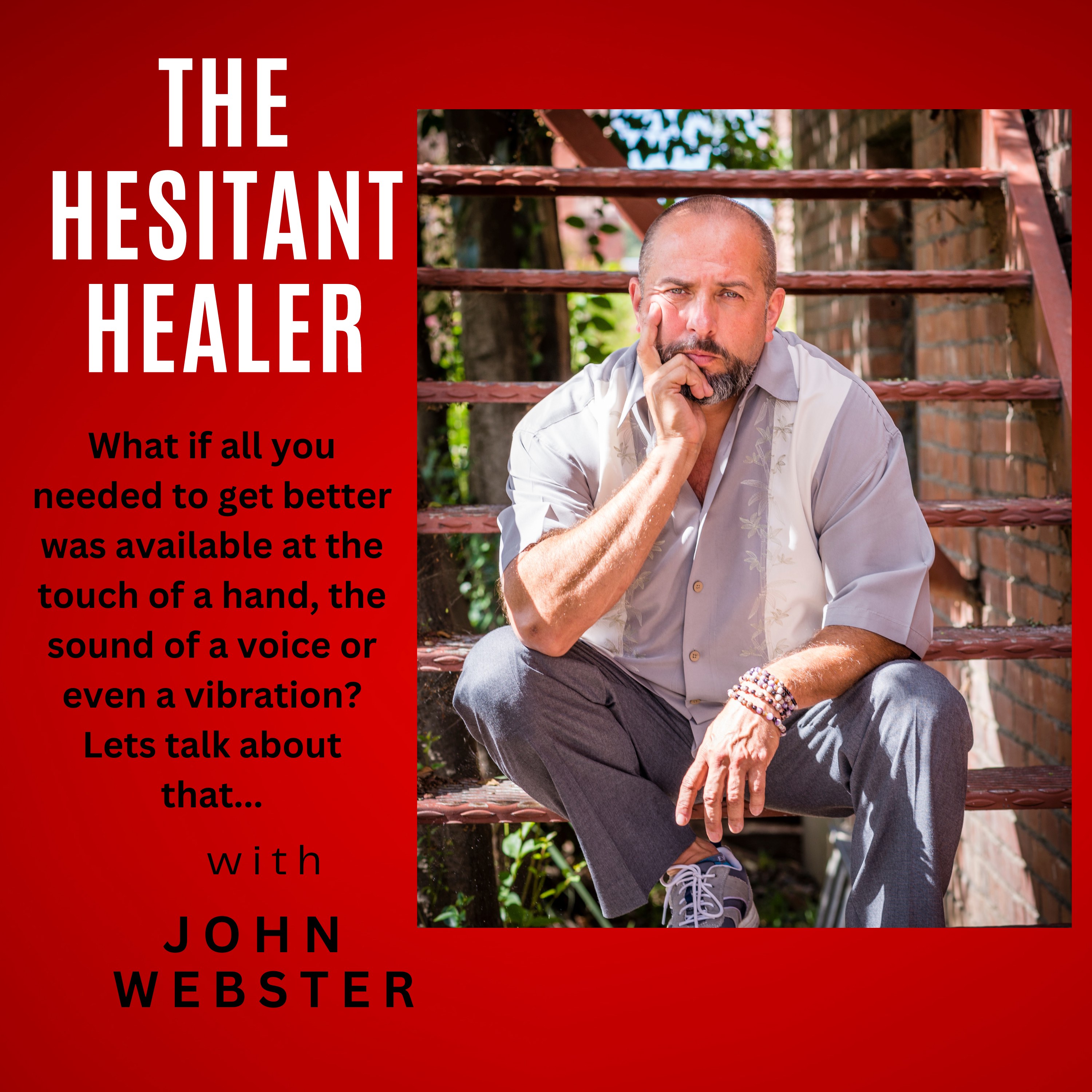
The Hesitant Healer · John Webster
In this episode we are joined by Christine Anderson all the way from Ottawa to discuss yoga, traveling together and human connection. Follow us on Instagram https://www.instagram.com/redlandsmassagetherapy Watch on Youtube https://www.youtube.com/@redlandsmassagetherapy3534 Contact Us [email protected] (909)557-4415
John: Hey Lisa. Hey John. I got a question for you. Ooh, okay. What is the capital of Canada? ⁓ Ottawa. Damn, girl, you know your stuff. What if all you needed to get better in every way was available at the touch of a hand or the sound of a voice or even a vibration? Let's talk about how that happens. Who can do it and where to find them? I'm John Webster, and this is the Hesitant Healer. Lisa Kay. Hey. Welcome to yet another episode of The Hesitant Healer. I'm your host, John Webster. And over there sitting across from me is Lisa Kay, Mike Channel. We don't use her last name very often, but she's here. And ⁓ if you're on the YouTube, you can already see that there's a third smiling face there. If you're not on the YouTube, you can hear that I'm about to introduce. ⁓ wow. I'm gonna, ⁓ my goodness. Stop. I'm such a baby. I can feel you from across the stratosphere. And the reason this emotion fuck. You know I hate doing that. ⁓ the reason this emotion is coming up is because deep breath. Talk me off the ledge, Lisa. You big breath. Ready? Because in through the nose, out through the nose. Out there. ⁓ Is because this is one of ⁓ this is so strong. The feeling of stroke right here on screen. Please don't have a this is one of my favorite people on the planet. Come on. Serious. That's you. ⁓ it's a long time in coming, too. I'm so honored that you're here. I'm gonna talk all about you and not even introduce you. ⁓ I met this person at San Francisco's lab the first time I went. I've talked about it. at length on this program about the three-week dissection club with Gil Hedley and how I was just a babe in the woods, how I'd been working for 10 years and didn't know nothing. ⁓ this is so strong. I gotta get I gotta get through this. As we talk, you'll understand why this is such a big deal. Am I gonna understand why this is a big deal? You will. I mean you'll you'll get it. ⁓ Well, let's just introduce her to everybody. This is Christine Anderson from Ottawa, Canada. All right. So when we first met, I was, I think I've described this. I walked into this, it was ⁓ a giant dental lab right in ⁓ in San Francisco, and there were 50 people from all over the world, and there were ⁓ 12 cadavers that I had yet to meet, and I'd never done this before. And most of these people that were lining the hallway, just hippies and lab coats and friends and And ⁓ I felt so out of place and everybody knew each other and and ⁓ some people had been with Gil for quite a while, some had been a couple times, but I knew nobody and I knew nothing. And ⁓ what happened then is is as he introduces us and walks us in and everybody just kind of ⁓ organically picks a table, right? You settle on this table and I think ⁓ there were four per, if I remember correctly, with the 12 cadavers that were all over. And ⁓ Christine happened to be next. table over Catacorn Caddy Corns. right beside you. Right beside me. And I don't know that we really officially met that day, but as the course takes place, you start to mingle and you start to bump into people and you have lunches and whatever. I remember one of the first things we did that that Gil did which was just ⁓ life changing for me is that he he stood up one of the cadavers, which ⁓ changes the way that you view these things, right? And it really humanizes it, makes it it's not just a dead person, it was a real person, right? And so ⁓ fuck me. That made that makes a huge difference. And then ⁓ as we started to chatter and patter, ⁓ she became one of the people that we started talking about or talking to. And then ⁓ I don't remember what day it was girl. It was probably three or four. But ⁓ we talked to Daphne a couple of weeks ago and I told the story about how when I was working on Daphne or Daphne was working on me, she stuck her finger up inside my nose so far, just ⁓ I don't know what the hell she was doing, but she's like, Can I stick my finger in your nose? I'm like, sure. ⁓ Christine stuck her finger in my mouth and she went so glad that's where that went. She went so far. I was too. She stuck it so far up into my cheek, way, way up here into the zygomatic arch. And your brain just goes, and then she she she was super calm. And she's like, wait, wait, wait. And then all of a sudden your whole face and your whole brain just like, I'm melting. And then it just kind of drops in and everything changes. Can I just say that's exactly what Gina did to me yesterday? There you go. There you go. And and Gina's one of my colleagues local. And she pulls her finger out and she goes, Pretty cool, huh? I went, What did you just do? ⁓ and so thus ⁓ our meeting began. And we had a lot of ⁓ different interactions and a lot of different bodies and a lot of stuff, but she's one of the people that ⁓ I glopped on to. that ⁓ I resonated with and ⁓ that in turn we'll talk about this a little bit later ⁓ led to me going to Costa Rica. okay. For she had done a series of of ⁓ retreats there and she's like why don't you come out be a massage therapist? I'm like, ⁓ did that and then ⁓ we've also done some other cool things. I think the reason this hits so strong, love. Ugh. is because you are a person And I've literally been to the coolest places on earth with You. So all of that is coming because I don't get to see you very often and I have emotions apparently. It might also be the time of life that I'm in right now. As my wife says, You have the biggest vagina ever. ⁓ my goodness. Okay. So the intro So the intro me, not you, me. Especially T V. All right, intro's over. Hi, Christine. Yeah. Welcome to my podcast. Goodness. What the fuck? ⁓ Like, how do you top that? I don't know. How are you? Where are you? You look like you're in a room. Where is this room? This is my living room. ⁓ I believe also in this introduction, I should mention, if I can see it correctly, one of your ⁓ Famous photographs is back there in the background, correct? Yes, that is correct. You're a you're a photographer and you are also an author. And let me tell you, you guys, this woman is one of the best writers that I personally know. And anytime she writes anything on a blog or whatever, I will sit down and and and just ingest it because it just she speaks to me through her words as well. So ⁓ and then one more of the coolest things about you that I think that I tell everybody about anytime I mention you or mention Ottawa is that ⁓ you're pretty healthy and pretty whole and do interestingly weird things like ⁓ recycle just to see how long you can recycle for. You did that thing, right? Where where you were just doing recycling anyway, ⁓ she rides her bike to work in the summer. And she skates her ass to work in the winter. ⁓ my. Down the river. And that's That's not skate to work. You don't skate to work? You just you just skate? ⁓ I thought you skated to work. You just totally ruined my entire pattern. That's okay. I will elaborate that to say that anybody who has ever lived in Ottawa has at one time probably skated to work. Okay. There you go. That's a foreign concept to me. It I have skated to work in the past, but my configuration now does not ⁓ there's not a route f ⁓ home to work that involves the canal. Got it. That's a cool but I do take the canal on my bike. Like I follow the canal path. ⁓ but I go the long way in the in biking season. So I think the California equivalent to that would be ⁓ I knew guys back in the day that would sleep in their van on the beach, they would surf in the morning, they would ⁓ have lunch and go to work, they'd get off of work, they'd go surf, then they'd go party in their van and then they'd work the night shift. And that was their whole life, right? Now such a California thing. When I was in high school, there were guys who would get up and either drive or take the bus to the beach at five in the morning, surf. get back to ⁓ where I was in Orange County and go to high school. And they would come in smelling like the ocean with blue lips and yeah, it was ⁓ the thing. They j that's how life should be. Jeff Spicoli. Yeah, they did look like Jeff Spicoli. They did. For sure. Yeah, for sure. ⁓ so tell us a little bit about you. Tell us your journey. I tell people that you're my yogi for sure. I I you you are the person I've learned the most yoga from. Yeah. And ⁓ you trusting you're also a ⁓ a certified Thai massage therapist. Yes. ⁓ I don't know that there's really any such thing as certification in Thai massage. You're just a Thai massage therapist. ⁓ I actually retired my Thai practice in September of twenty twenty-five. Okay. After twenty three years, I think. ⁓ my gosh. I know. Can you give give me a little bit about what Thai massage is for the folks who don't know? Because if you've never been twisted into a pretzel, you don't know what you're missing. You know, it's not that easy to explain. It's like explaining yoga to somebody. True. You have to experience it. it's done on floor mats, fully clothed, your body is moved, stretched, massaged. It's like a Guided moving meditation. ⁓ All right. It's pretty wonderful. And actually Go ahead. When you were going to say that I had done some crazy thing to you, I thought it was gonna be Thai massage related. You know, the funny thing is I not remember doing any TMJ work on here, which is quite funny. It was it was like nothing. But the tie the two or three times you've done Thai massage on me, ⁓ it kind of goes like this. We start, I'm like, ⁓ my, ⁓ my, what are you doing? ⁓ my. And then it's like, and then you go, okay, we're done. And I don't know what you did to me, but but when I woke up, we were done with it. I remember one specific thing ⁓ in Costa Rica. We were in the yoga studio. You were doing a treatment on me. And it had to do with ⁓ your knees or knee bending and leaning back. And I remember you saying, I came out of the fog where you said, if you don't relax, you will break my legs. ⁓ nice. And I went, Okay. Okay. Wow. Okay. Do you remember, do you remember being in that studio with me? And we started talking and we started talking and I was talking about ⁓ that one case I was on when I was at the coroner's office. And you're like, what did you just do because everything around you went yellow? Yeah, I remember that was a that was a big funny that's my the start of my favorite story, Lisa. I remember. So I'm digging out a dead hooker in Fontana, California, and that's all you guys get. I'm not allowed to talk about it 'cause it was a course case. So I don't think you were supposed to say that much by the way. I could say that much 'cause it's been adjudicated as he and he's in jail. He got what he deserved. ⁓ We didn't pre-discuss stuff. So I don't want to ask questions that you don't want to discuss. So I will just say tell us a little bit about your story and your journey about how you got to be the person you are today. ⁓ okay. I started doing yoga in 1999. ⁓ my. I was 26 years old, and it was, you know, yoga was not a thing. Most people didn't know what yoga was. I didn't know what yoga was. Right. But I had this strong sense that pushed me. To go find out about this. And so I started doing yoga. There was a studio down the street from me. It was Nashtanga studio, which is has a reputation of being very dogmatic and ⁓ Very athletic, very strict. My studio was not dogmatic or strict, but it was quite athletic. I mean, a beginner class in 1999 was, you know, it's what you would call a power yoga boot camp now. But then it was it was the beginner class, you know, so there was there was no easing in. We just, you know, I couldn't touch my toes. I was Wow, really? Mm-hmm. I was a smoker. ⁓ Nice. Okay. I was a smoker. I couldn't touch my toes. I was, I was still at that time, I was commuting on I've always been a cyclist, but as a commuter, not as a health. Right. You know, a way to get around. Just to get from A to B. So I went to the yoga studio to inquire what kind of shoes I needed. Money. Yeah. ⁓ everybody loves that story. I like that. And I literally within you know, the first I went to one class and then a second class and then I was going three days a week. And then for a couple of weeks and then I was going five days a week. Wow. And then I was going six days a week and two hour sessions. Wow. Wow. So back then it was 90-minute minimum and the teachers always went overtime. Right. So you know, now you're lucky if you get an hour. Right. ⁓ anyway, so I went to yoga and immediately something came alive in me. En but at that same time it released. A lot of emotion that I did not know was trapped in my body. So, and I had always been as a young person very emotional, which just meant angry. Maybe that's why we get along. What's that? Maybe that's why we get along. Maybe. So yeah, it just it it ignited a lot of emotion in me, and it was. Turbulent and exciting and ⁓ frightening and devastating. And but there was something in it that wouldn't let me stop. So it took a hold of my life and it changed my life. Was it a thing you were looking for or it just showed up when it was supposed to it just showed up. It like I said, I I knew I the There was just something in me that said, you you need to start doing yoga. And I was like, what the hell is yoga? ⁓ I think I read about yoga in a book or something. And so I found a studio a couple blocks from my house and it all like it changed my life. I quit smoking. I quit drinking. Not that I was a big drinker, but I was like, I was 26. Yeah. You know? I changed jobs. I like my whole life became centered around how do I get to the studio in the morning because our our morning practices were not led. They were you just go through the series on your own. That's an ashtanga thing, right? Yeah. Yeah. And those in Toronto, I was living in Toronto at the time, and those classes took place between 8 and 10 a.m., which is late. Every other city in the world, it's like between five and right and seven AM or eight AM. ⁓ but we were eight to ten. And for me, eight o'clock was really early. If somebody was getting me out of the house at eight, this was a big deal. So I switched my life so that I didn't start work before ten. So that I could get the yoga in. And ⁓ What what kind of work were you doing back then? When I started, I had been working not nothing. I went to school for graphic design. Okay. I never really worked as a graphic designer. I was working in a cafe in Toronto in the lobby of a hotel. And then I got a job. I left the cafe right around the time I started doing yoga. And I got a job ⁓ in a jewelry designer's. ⁓ workshop basically. So I was making jewelry. ⁓ wow. And it was it was fun and interesting. It allowed me to do yoga. It paid my bills. ⁓ and that's all I cared about. I was like yoga, yoga, yoga, yoga. Everything was about the yoga. And then I got interested in anatomy. Cause you know, I'm using my body. And I had this This instinct that this rising of energy had was because of the yoga. So I wanted to know what is it about the body? So that's when I started studying anatomy. How did that look? Books. Okay. Yeah. Books, videos. I mean, at that time, like er internet was early, early days. Yeah. and I So I did a teacher training. My first teacher training was two years long. And then I did a second teacher training in Boulder, Colorado. where I didn't meet Daphne. She wasn't living there yet. ⁓ so I did a sec a second training in Boulder. It was a month long with Richard Freeman. And during that month long, I got invited into the lab, which ⁓ was ⁓ what's his name? Todd Garcia. Todd Garcia, yeah. Yeah, it was his lab. Gil had been somewhat involved in that lab at that time. That's my understanding, yeah. And so I met Todd Garcia and and that year Gil was taking like a sabbatical year. And Tom Tom Myers was around there too, yeah. I think what Daphne said was Tom and Todd had started that lab. If memory I have no idea. I have no idea because I just kind of like fell into this lab because it was we were invited there for an afternoon for two hours to look. What was your first take? Holy shit. ⁓ well, one, I was horrified. Really? Okay. Yeah. I was horrified. We went in and it was very ⁓ like I could now knowing Gil, I could tell the influence that Gil had in that lab because ⁓ Todd had us all circle around the table. We were holding hands, the bodies were covered. We did this long. introduction to get acclimated to the space and to what we were about to do. And everybody was terrified. You know, nobody was there in Boulder to look at cadavers. We were there to do yoga. Okay. All right. Yeah. Yeah. But this was part of our anatomy part anyways. And they uncovered the bodies and these bodies had been in the possession of the lab already for a year. Okay. So they had been heavily dissected. And honestly, they uncovered them. And to me, it looked like ⁓ that half-eaten turkey. ⁓ yeah. On the table. It was just ⁓ bones and and meat. Yeah. ⁓ and it was horrifying. And then and then we were looking at anatomy. You know, like the shock. wore off. Some people couldn't handle it. They had to go out, get some air. but then it was like we were just fascinated with the anatomy. And for me, it was, and I think I've heard you talk about this yourself. For me it was the greater omentum. That's it, yeah. I had never even heard of this thing before. I'd been studying anatomy, looking through books, and this is the first time I've heard of this beautiful fleshy blanket and all of the thing all of the things that it does. And it just absolutely, I was like hooked in that moment. I need to know more. And we had to split into two groups. I went on the first day and I went back on the second day. I I and then within a year, I was in Gil's lab. Nice. How did that happen? Where was his lab? The one in San Francisco? No, the first one I did was in Boston. On the East Coast. Yeah. The first one I did was Venus Mary. Wow. And for those of you who don't know, in Gil Hedley's ⁓ anatomy series and in his videos, that's his very first video, right? Is is the name of the cadaver was Venus Mary. It's in it's in video one or two of that first series. Yeah. And if memory serve your hands are in that video. No, I don't think they are. You're not you're not in no. I don't no, I don't think I am. Okay. but So you're that's also well that image is that image is also in, I believe, in Tom Meyer's book. Okay. All right. In the introduction. So the image of the superficial fascia beside the deep fascia. So this is the early, early stages and the and the the really the pioneers of where we are today with fascia and fascial research and and people that are non ⁓ medical the getting into what fascia has turned in today and how we kind of got there. These guys were the pioneers for sure. Yeah. ⁓ yeah, that was all Gil. He knew when we went into that lab because it was a very small group of us. I think there were only four or five of us. ⁓ and he knew when he saw Venus Mary that we were going to be able to do the superficial fascia all in one layer. Wow. And he'd never done that before. ⁓ so it was a very special week to be a part of that because I mean I had no idea what we were doing. So it was all Gil's vision and Yeah, we were we we got to be there to make it happen. What would you say is one of your biggest takeaways from that experience? What'd you learn? From Venus Mary? Yeah, yeah, yeah. From that yeah. Hmm. This is 20 years ago now. It was. But it had to be nominal, no? It was. I mean, I think the first thing was the conversation that we have frequently in the lab, which is that conversation of fat. And that this amazing superficial fascia layer is. not what we've labeled it to be. How we've demonized it, yeah. Yeah. And when well, it was when he put those two forms side by side and we had this whole conversation around it. He said, here is, and it was beautiful that we had named her Venus Mary, because here is Venus, the sensual body, that superficial fascial there, sitting beside Mary, the structural the like that we're looking at this layer of action. beside this layer of ⁓ feeling. Nice. Like that. And right so yeah, it was pretty and that resonates so deep when you when you can when you can see it that way. In that in that first class where he was talking, the first time I heard him in the three week was when he talked about ⁓ and I reference this all the time how how that layer Is an antenna. It's it's what the outside world perceives you. It's what you want the outside world to perceive as you. And ⁓ it's an absorbative layer. And it it's it's an antenna. He calls it an antenna. And in some ways that makes so much sense. It made so much sense to me. Well, right now I'm I'm having a moment right now, actually, where it's Like just because I have just told you this story of me beginning yoga and having all of this emotion come out of me. And then I go to the body looking for that. Yeah. Yeah. Yeah. ⁓ wow. Yeah. And then how'd that happen? Where'd that come from? Yeah, yeah, yeah. So that's what I had been seeking all along. And ⁓ It was right there in Venus Mary, my very first dissection. but I still maybe not until just this moment. Have been able like I can't I just haven't been able to fully reconcile it. It's why I keep going back to the lab. Glad glad I could help. That's our show for now, everybody. That's so funny. That's cool. That's cool. That's what it's supposed to be for sure. So ⁓ how long before you went back? Or what did you do? Did that change your practice? Had you started massage yet? Mm you were still just yoga. I think maybe I had No, I had just I had already started Thai massage. Okay. ⁓ I was just a little baby in Thai massage, ⁓ maybe two years in. and you know, like Thai massage here in Canada, if you're not an RMT, so if you're not licensed, ⁓ it's a little bit harder to make a go of it. So for me, being a Thai massage practitioner was just kind of like, you know, some girl fucking around with movement. Kind of thing. It wasn't a serious thing, but I was really getting into the yoga. I was in my third teacher training at that point. It changed a lot of things. Yeah. I think that year I also did my first vipassana meditation, which vipassana is ⁓ you can do them in centers all over the world. It's the same wherever you go. They it's not altered. It's taught by the same teacher, their recorded teachings. ⁓ it's a 10-day meditation retreat. It's completely silent. Oof, ⁓ oof. There's no music. There's no writing. There's no like you have not you are stripped of everything when you arrive. Wow. So in the same year I did my first dissection, I also did my first vipassana. Damn. My goodness. ⁓ so I was going really deep and I didn't think I would ever I didn't think I'd ever it never crossed my mind that I would do dissection again. Huh. And then at that time when I was when I did the first dissection, I was living in Montreal. And then I moved to Costa Rica. I spent a couple of years in Costa Rica. Why did this why did you do that? Yeah, this is me running away from everything always. ⁓ okay. Yeah. Not a bad place to run if you're gonna run, you know. Yeah, but you didn't just you didn't just run to Costa Rica. Tell me a little bit about that. I had started teaching yoga retreats in Costa Rica and I just fell in love with the country. And so I just and I was kind of like by that point I was Guess I was 10 almost, yeah, I was 10 years into my yoga practice. And I was so I was in my 30s. I hadn't met anybody. I wanted to, you know, have the traditional life and get married and have children. And it just was not happening for me. And I thought, you know, like I'm 30, I think maybe I was 36 at the time. What if it doesn't happen? I should probably go and do some stuff. So I yeah, so I decided ⁓ the retreat was gonna be in February. I left in December and I spent six months. So I did three months on one end of the retreat and three months on the other end in Costa Rica. And I learned how to speak Spanish. I moved all around the country volunteering. really just trying to figure out who's this person. ⁓ and when I came back to Montreal, I just nothing felt good anymore. So I sold everything I owned and I moved to Costa Rica. Wow. That's and then when That's big and bold. That's You know, people say that all the time, but to me it felt more bold or brave. Like people that was the word a lot of people use, like, wow, that was really brave. And to me it was like, no, I think I took the easy way out. It felt a lot harder to stay. Next indicated step. Yep. Yeah. That's a that's a good point. Yep. Yeah. So I left and it wasn't easy, you know, like it was like I was alone a lot of the time. The sun sets at six o'c six o'clock there, you know. I'm a single woman, so I'd be stuck in my room every night from six o'clock in the evening to How did you get to the the the time I went with you, you had been down south ⁓ putting time in with an indigenous community? Yes. How did how did you end up doing that? So before I left on my first six months, ⁓ I was also broke. So for anyone who's ever taught yoga, you know that the yoga instructor is the poorest person in the room. So I went down to Costa Rica with very little money and ⁓ I had signed up with WOOF, which is the World Workers Organization for Organic Farming. And so you can find farms all over the world that are looking for workers who don't get paid. Damn. So you can you get your room sometimes bored, sometimes not, like or it'll be a small fee that you pay, but you're expected to work. ⁓ my goodness. That's a small So I wow. Yeah, so I had done that. That's how I found this indigenous community. And nobody there spoke English. Wow. And I was supposed to go there, I think, after having only been in Costa Rica for maybe six weeks or two months. ⁓ my goodness. And I thought at my first Stayed that I was gonna learn Spanish because that's what was advertised. And I basically could say hello. And so I canceled the trip to the indigenous community. And then I went to this small town and I did a one two weeks of immersive Spanish. And I started feeling more confident. So I said, Okay, I'll come. So I went. I had two weeks of Spanish. Wow. I go into this community where nobody speaks English. And I'm supposed to be teaching English, but they don't know me and they don't trust me. So I basically was doing nothing. And it was super difficult because the men were giving me a lot of attention, but the more attention the men gave me, the more the women isolated me. Right. So I had to isolate myself. And so I spent and I was in that community, I think, for maybe two months. ⁓ my goodness. Wow. And honestly, it wasn't until pretty much the day I left when they were like, ⁓ Christina. We love you, come back anytime. And I'm like, ⁓ where have you people been? That's funny. Yeah. Yeah. But I've gone I've been back many, many times since. And ⁓ yeah, there I love that community and I learned really a lot of Spanish there. Wow. Super cool. Yeah. How many years did you do retreats in Costa Rica? 10. Nice. Wow. And I was let was I at the last one? Second, last? One of the last ones. Yeah. Did you do them at the same place every time? ⁓ Judith and I, so my first retreat partner who you have not met, but I'll tell you a secret. We are having a 20-year Costa Rica retreat coming up. Anyways, ⁓ but that's not officially announced yet. So it it it is now. Next So we'll be like time. ⁓ anyways, so yeah, Judith and I did one we did five years at one place. ⁓ and that's the place we're going back to. Okay. And then we did two years at two different places and then I did them with David. That's the ones that you were on, yeah. Yeah. So yeah, and then somewhere in that mix I became ⁓ an RMT, a registered massage therapist. Which in Canada is significantly different than ⁓ the education in the United States. It's like five years? What's it take to be a an R No no no. You can do it. There are so you can do it. There's a college program that is three years. Three years. I was able to fast I was able to fast track mine into two because they had ⁓ for anyone who's got a little more experience, you can cut a year out. But you can also do it a private school where you can get it done in ⁓ a year and a half. ⁓ okay. But a year and a half is like intense, full on full time, yeah. Yeah. And here here you can do it online and part time and be done in six months. Wow. I don't think they're doing it online as much. Not so much. Well, it was that was a COVID thing. It really was. to stay in business, massage schools went to the online thing, ⁓ which was really difficult for the people who came out during that time, you know, who had to do a lot of work. Because obviously not the same ⁓ level as you're getting when you're able to put hands on. So ⁓ but they have for the most part not not doing it online anymore. All right. I'll buy that. Okay. I'll give you that. Thank you. ⁓ so then what? Then what'd you do? How'd you end up back in the dissection class? So after I finished massage therapy and I learned ⁓ like the anatomy was easy peasy for me. I already, you know, knew a lot of the anatomy from myself study. But when I went to school for massage therapy, I learned ⁓ physiology. ⁓ and pathology. And that was like it just took everything to a whole new level. And I said, I want to get back into the lab. And so I went and that was the year before I met you. Okay. So I went into this. When did we do it? 2014? 14, yeah. Yeah. So 2013, I went back into the lab. That was San Francisco. ⁓ and I was a little bit self-conscious because I thought. I've done like I wonder if anybody else would be back for a second time. Right. You know, because it right. So it had been six years since I'd gone. Yeah. And I go back to the lab and there's all these people who've done it multiple times. And I I was like, ⁓ these are my people. and then I did that lab, which was also pretty spectacular. ⁓ who's in that lab? Jim was in that lab. Jim Donek. Yeah, Joe Fee. Joe Fee. ⁓ Caroline Lechnius was in that lab. Caroline. Yeah. Who else? Me. ⁓ well, and Sally. So Sally was not with Gil the first time around. She wasn't. Okay. No. ⁓ who else I'm not sure I don't remember who else was in that lab. There were not very many people from and then after that lab, the information came out about the three-week and I thought, ⁓ my gosh, can I afford to do that? That's a you know, like I was still paying off student loans and I managed to squeeze it to get to the 2013 lab and then 2014. And ⁓ consider also that I'm paying like I have to pay the exchange, the Canadian to the US dollar. Yeah, that's a bigger deal. Yeah. anyway, so I yeah. So that's how I and that's how we met. Then I ended up doing it again. And then I just started going pretty much annually for several years. And yeah, here I am. And you mentioned my writing, but I've had I've actually taken all of those writings off my website. Have you really? ⁓ goodness. Yeah, I did. Well, because I need it my website needed to be more focused on my business and less ⁓ personal essays. So the writing on my website now is pretty. Business anatomical curior pain. I can make you better. Yeah. Yeah. I love your writing. So you need a whole nother website just for your writing. Maybe one day. Maybe maybe one day. So Costa Rica, we went to Costa Rica. You talked me into going in down there. The wife said I could go. We went down there. It was a new experience for me because I ⁓ I get a little heebie jeeby in third world country kind of stuff. Like I I don't realize I love my amenities until I don't have my amenities. And I Costa Rica's a developed country. You can't say that. It's not a third world. If you develop a third world, not even close. On the bus ride we stopped and everybody took a crap outside in the dirt. That's a third world country to me. Nobody did that. ⁓ Maybe you did. I had a different view. Okay. ⁓ it's fuzzy. That first place we went to, Maria's place, what was that? The first night we spent. ⁓ yes, yes. Which was really interesting, is a big giant house with a family in it, and they feed you, and there's 15 beds or whatever. And then you get on a bus and you just drive for hours and hours and hours and hours. And it's jungly and it's hot and you're cramped. But then you just get to this retreat space and it's like huh. With a river running through it and ⁓ bugs you've never seen before that are everywhere from this big to this big. Okay. That's where you lost me. With a lot of hammocks and ⁓ and there's there's screens above the showers because if you don't put the screens up, the bats come in. ⁓ lovely. Lisa's gone. That's the end of that. But ⁓ the cooks, like I it was mostly vegetarian, if memory serves, maybe some chicken, but ⁓ Holy moly, you're eating the freshest fruits and the best foods. And we're doing yoga two or three times a day. And I read a couple books in a hammock next to a river. It's a total thing, right? Not a bad life. And then we took this big long rock and jumped in the really cold pond there where the river was running through. And we ended up ⁓ What'd we walk for like an hour or something? I don't even know what this place was. It was their second destination, or they were building a second destination or something. And then ⁓ two of the guys, if memory serves, that were the workers, because they gotta haul this stuff up either on mules or by hand. So they're hauling stuff like miles uphill. Wow. And they had built this little cabin, and then behind this cabin on the side of the hill, they had just Dug out this trail that went around, around, around, around, around. ⁓ my. And then stopped at like this little f waterfall that just kind of ran through they put a bench there. ⁓ And me and Christine walked there and just sat there for a minute. ⁓ Right. It's just one of those vivid things. It's like, I've done that. Right. ⁓ And you're just looking at nothing but jungle in the middle of nowhere. And it's like, okay, this is been there, done that, this is cool. And then we walk back. It was a whole bunch of bus. ⁓ When did you come back? When did you come back San Francisco? When did i what do you mean? When did I think when you came back and we went up to ⁓ the redwoods? ⁓ when did I when we went to the Redwoods? ⁓ I think that was 2018. So four years later, yeah. And it was one of those things like, Hey, I'm going to San Francisco and I've always wanna go to the Redwoods. Sold. Let's go. So you throw I did I fly up there? I flew up there and then we rented a car, huh? I think you flew. To Santa Cruz. And then you were staying with ⁓ you went to South Carolina. San Jose. Yeah. Then you went to South Caroline and you saw ⁓ who you stay with? What's her name? I stayed with Fran. Fran. She's an Australian now. I should get her on here. I need to get Fran on here. ⁓ and we went and saw Redwoods and we found a big giant tree and we sat in a lotus position and we owned. On a redwork tree. Pretty cool. Yeah, I made him do it. Made me do it. I love it. She's like, I want to do this thing. I'm like, whatever, man, let's do it. And ⁓ spiritual stuff. That's why she's one of my favorite people on the planet, right? I know. I get it. This is a thing I want to talk about because it's it's I got you here. And and it kind of it kind of segues away from anything we've been talking about, but I think it's an important conversation because I've had it more than once, and that is. In Costa Rica, we were talking about the yoga. And you were at a pivotal point in your yoga life, life in general, ⁓ where you, if memory served, a little disillusioned with how yoga was going or treating you or becoming. and ⁓ one of the discussions we had, which was a real big discussion for me at the time, was the differences between the yoga that you'd come up with, which you described really well at the beginning of this. And and the the the tenets of yoga and yoga as a lifestyle as opposed to say what it is here in California where it's a sport, you know, or it's a it's a it's a thing that we do for exercise. And if you talk to any real yogis, they'll tell you yoga is not an exercise. It's more of a way of life, right? Well, it's evolved and become Californianized, if that's Well, California does everything like that though. That's that's the thing. If you go to California or New York. You're gonna get, you know, it's like cycling. They have these cycle clubs, it's just like dung, dung, dum, dun, dung. Do you know? And I and I saw the other day online they have these, ⁓ they're they're using those ⁓ rowing machines? The bouncing machines. ⁓ where they're doing they're doing bouncing things now. And it's like I mean, it's just the newest fatty thing. They they have the one just like for cycling, they have rowing machine ones where they're playing the music. Shut up. Do they really? Yeah, see, like that. And that and that is so not yoga. And and Until I talked to you, I didn't know that. And and I really felt the passion that you had for and the sadness that you had for the way it was changing in your life at the time that made me want to. It's what made me, here we go. It's what made me want to go to yoga teacher training. Was like, well, I want to learn what the fuck she's talking about because I don't get it. Right. Until then, yoga was just a, I'm going to go to yoga class. And that's not what I found it to be. And I I got ⁓ a little bit better experience in ⁓ when I went to yoga teacher training and and got the books and started learning about it, about what you were talking about as opposed to what I as a non-yoga person at the time had not learned yet. Is there a question in there? The question is I don't know. ⁓ where are you now with that or what or or how did that evolve from that point forward? For you. ⁓ yeah, I don't know if I really have a clear answer because even then I was well, one, I was running a yoga studio that had kind of been thrust upon me. that's right. There was sorry about that given to me ⁓ because I had written a very successful. Teacher training program and the owner of the studio saw a way out of his lease. And so he said, if you don't take over the studio, I'm gonna have to close it. which was not true because he had a lease, but it it was basically like, you have to run this thing or it's gonna disappear. ⁓ so I did, I ran it and it was horrible. Because I started to become Well, I don't know that I ever was not the person I was starting to become again. If but I was bringing up the old me, the old anger and the old aspects of my personality that I had struggled so much to overcome or squish down. We're not sure. Still working at it. So when I decided not to take over the studio, I ran it for two years as if I were owner. And really at the 11th hour I pulled out. And that didn't go well. And but then I still had to continue teaching the teacher training for another many, many months. ⁓ knowing that my heart wasn't in it anymore. ⁓ but I loved the teaching. I loved the bringing people into the anatomy of it because I took it from an aspect of I think one of my superpowers as an instructor was making the esoteric aspects of yoga palatable to the common, ⁓ well, we're here in Ottawa, to the government workers. And so, and even when I was in Toronto and Montreal, my thing was, you know, like, yes, we're gonna own and it's gonna be weird, but these are the reasons we're doing it. This is the benefit that it has for you and for everybody. And so my thing was I have to get my students to buy in. And so I was good at that and they bought in and we did whatever, you know, what I thought is traditional yoga. ⁓ but I only know what my teachers have taught me. But I do know that it's more traditional than what is being done now. But I also don't know what's going on in yoga studios now. So I'm not sure I can really speak to it. Point. Okay. Yeah. But it does seem that there is well, for example, I taught six yoga sessions over the winter and for my f the first time in 10 years, I stopped teaching when I gave up the studio. So I gave up the studio and I said that I don't want to be involved in this anymore. It's become too commercial. So I went, I found a studio, local studio, and I taught six yoga classes. And it was really challenging because I had a room full of these really. Seasoned practitioners, none of them were new to yoga. Many of them had been doing it for years, but I looked around the room and went, ⁓ my goodness, nobody's embodied in this room, not even a little bit. Wow. So it was like, I want to teach a nice yoga flow that everybody's going to enjoy, but ⁓ I can't because it was either I have to forget about what I want. Their experience to be and just provide the experience, or we have to slow down and go at this step by step so that you have an experience. So that was a struggle for me. So if that answers your question, that's where I am. That makes sense. And that's exactly the struggle you were talking about that I was referring to. That's exactly right. I mean, do you become your authentic self and do what you you believe to be true, or do you stick with This is what the people want, you know, and that's that's kind of what my thought process was with the studio that I that I go to is that ⁓ her name's also Lisa. I got a lot of Lisa's in my life. ⁓ she gets yoga, but she also learned to commercialize it in a way that the people that come in what their expectation is, because it's a business. And and and when I first met her, her business was flailing because she was trying to do exactly that. There was another yoga studio in town that was pure yoga. This guy knew his stuff. He was totally Ashtanga and he had a studio. ⁓ it just failed because people didn't want that. So if you're gonna if you're gonna be a business person, you end up being a business person first and a yogi second, as opposed to being a yogi with a true mindset, ⁓ which doesn't necessarily fit a business model unless you have a lot of people who follow that track. And ⁓ especially here in the Well, let share a story with you. I thought of you yesterday. So there is this ⁓ I when I taught those six classes, I did them completely free ⁓ because I wanted to remove I I just wanted to remove the transaction from it. I wanted the people to arrive to just come in and have an experience. And without me wanting to make any money, or I just thought, let's just take that out. So when I did that, I met somebody local here in Ottawa who runs an Instagram account where he advertises all of the free fitness events that happen in the city every week. ⁓ nice. And he asked me. He runs this thing on Friday mornings at 6:29 a.m. Oof. Early. 52 weeks of the year. Damn. And it's at there's this hill. It's close to the canal. It's in the Arboretum. ⁓ and it's called the Arboretum Hill Club. And every morning, at every Friday at 6:29, a bunch of people gather and they do some kind of workout. So he says to me, Will you come and do a yoga? and I said, sure. So it was yesterday. And I but here's the cool thing. I had already decided after having done those six weeks with a bunch of people that I didn't know. And now I'm gonna show up at this outdoor yoga event. I don't know what their abilities are. I don't know, I know nothing. Sure. So I knew going in there that I was gonna do that same oming thing that we did in the Redwoods. Nice. And so I got a bunch of fitness people. And he warned me. He said some people are just gonna run up and down the hill the whole time. Yeah. Okay. Yeah. ⁓ and there were a lot of people. And there were a lot of people when we gathered, because first thing I said was we have to make a circle. And because I knew it's like we're not inside. The sound's not gonna echo off of anything. Right. Yeah, yeah, yeah, yeah. That's another so you need to be close enough to the person beside you to know that you're not making sound alone. Right. And just getting them in a circle was challenging. Hurting cats. And anyways, we did it. They did it. We chanted for I think it took eight minutes. Wow. And then we did a meditation and it was it was amazing. And there was there were there were some people that basically openly said that they probably weren't gonna join us, but when I opened my eyes at the end, there they were. ⁓ nice. Yeah. So I mean, yeah. You still got it. You still got it. There you go. So but it's to your it's to your thing. It's like do the authentic you thing or cater to what you think they want, but you know, sometimes people don't know what they want. A lot of times people don't know what they want. True. Yeah. Very true. Well, and I think we get sold what yoga should be, right? Like we see it on TV, we see it on YouTube, we see it everywhere. Instagram right, Instagram and we get sold what that should be. And and for the most part, ⁓ it's not what true yoga is. You know, it's it's pretty girl yoga. It's the the girls who look really good in in their ⁓ yoga pants. And ⁓ for me, that's not an experience that is even in my universe, right? So ⁓ yeah it's a whole different, well obviously whole different world ⁓ than it was, you know, even pre COVID. I think COVID had a lot to do with ⁓ seeking out experiences online rather than in person for sure. Yeah. Well, I mean, even for me, the like if you're looking at the asana, the the physical movement of yoga, y you could probably lump me into pretty girl yoga. You know, I can do the poses. ⁓ I can make them look good and Instagramable. But yoga has never been easy for me. For me, for me, the yoga and it's not the physical. Yeah, the physical is difficult and challenging, but that hasn't been the challenge for me. The challenge for me has been facing what's inside. ⁓ And what comes out. When you convert your body. We had a conversation at the Redwoods where you were explaining this to me and you were talking about the silence. And and getting through the silence and then getting through the anger and then getting to the other side of that. And you you lost me at anger. It's like, I don't want to be that quiet for that long. I'm not gonna do it. But you're like, but what happens if you do? What if you just get to the other side and sit there for a minute? And I I just remember going, Good. That's not what I do, right? But that then that's the experience of the thing, you know, is is ⁓ when I'm talking to people about it and what I do in my daily work is is the connection of the breath to the body, ⁓ to the silence, you know, to to just get in there and feel it and and connect it because that's where the disconnect is for a lot of the people that come in with the trauma that they have that I'm working with. And yoga, yoga's a good way to find that pairing and breath becomes the thing. But it's hard. It's hard. And I think people need to hear that from somebody as experienced as you, which is just because you're good at it doesn't mean it's not hard. It's hard. I had a young woman come to my class very early in my teaching. And she had said to me at the beginning, My friends, she said, I suffer from depression, and my friends have told me that I shouldn't do yoga. That it's gonna be too intense for me. And I was like, that is the stupidest thing I've ever heard. Even though I was struggling myself. and that like I think about her a lot because she went, she got through two sun salutations before she just completely collapsed. Wow. And We were in a studio that was like a storefront. So she was locked in. ⁓ So she basically went to the other side of the curtain and sat in the window for another hour. ⁓ my goodness. Wow. Waiting and and There's a lot of truth to that. If you are unsettled inside, and I was unsettled, but she was the next level of unsettled. So I struggled, but I could still stay in the room. But I struggled. I s and I still to this day I struggle. ⁓ But with her, it was like, no, I can't even get through the next breath. ⁓ And That's what yoga is. It's like it is stirring up the shit that you don't want to look at. And you don't even have to know what it is. Like for years I didn't know what it was. I'm like, I don't know what it is. I'm avoiding looking at. ⁓ but I'm just gonna, I'm just gonna keep showing up on my mat. And I feel like doing that helped to metabolize it without me having to look too closely. I've also had a different experience in that, ⁓ When we were doing craniosacral therapy and yoga at the same time, it was a kind of a a mixed class. And I think the most we ever got was like 25, 30 in a class. Yeah. Yeah. If if that, 15, 20. But what I found super interesting was ⁓ we would give them the pitch of this is what we're gonna do. We're gonna do ⁓ and this was yin, right? So we'd put them in yin positions and then we'd go around. There were two or three of us that were doing cranial sacral therapy individually. Quick blips. If ⁓ My experience initially was you get them in there, you turn the lights down, you start doing that, almost immediately you can feel the room drop. And so there's a collective energy of decompression. And in that energy of decompression, it resonates between the bodies in the mats. Every once in a while you have somebody that was like what you were describing, but for the most part, they kind of knew what they were looking for when they went in. And what I What I found was the energy in the room, as opposed to a high energy class, this was a low energy class. At some point, you could, you could, this is the floor, the energy was not above two inches from the body, right? And it was just like a fog that laid in that, that they were just immersed in. And ⁓ I didn't have to do much work once they got there. They were doing it themselves. Right. Because they were working on themselves collectively. And ⁓ what I found was if they open up to the experience, then they collectively have the experience and they collectively decompress and the nervous system just drops. And interestingly enough, how I compared that was ⁓ way back in the day when I worked in jail, it's it's famously known that in female prisons and female jails that that they all go on their cycle at the same time. And if the dominant female goes on her cycle, they all go on their cycle, right? So I mean there's there's a reality to that kind of resonance. And so ⁓ you can jail. Not that the everywhere you can you can groups, all of that. You can work on that. You can work on that through yoga ⁓ to a positive if you're just trying to get people to decompress and and to settle and to ⁓ breath and and absence of movement and and ⁓ a decompressed nervous system so it it's magical it is pretty magical yeah it was magical it is they throw throwing an ohm at the end of that and everybody leaves happy absolutely yeah i mean if i had not been a part of a studio i would not have struggled through all of those years of showing up you know but the community, the you know, like if you didn't arrive at practice, people will be asking you, where are you? Yeah. What happened? What and she's like, damn it. You know, sometimes I would just go, I'd do one or two sun salutations and I would sit on my mat for an hour. Been there. Because I just physically couldn't make myself do another one. But just being in space still produces an effect. Well, it's like everything. You know, we don't realize that day after day, just by showing up, you're you're you're it's a lot. You're doing a lot toward whatever your goal is just by showing up. Yeah. Right. True. Yeah, yeah, yeah. Very, very true. Cool. That's exactly it. So what's it look like for you today? What are you doing these days? I am working on my massage practice. I am. Do you have a place? Yes. Okay. I have an office I work out of here in Ottawa. I've been really focusing my it's not different from when I first started teaching yoga. I'm focusing my practice on ⁓ Pain issues that people are having because I believe the first way into the essence of who somebody is is through the body. And for a lot of people, that's pain. Right. So my work is not subtle. I don't work with ⁓ like the cranial sacral rhythms. I don't work with I work with curiosity for sure. I work with what I understand of anatomy through the lens of movement. That's a good thing. And then and then I'm I tap into, you know, like every now and then I'll come up against something that it's like, why am I not able to move the needle on this? And so then that's where I have to tap into the individual more and get them to ⁓ participate in ⁓ on a deeper level. Right. You know, like so moving people from well, I'll just go to Christine and she'll fix it to, ⁓ I will show you how to fix it. We're gonna fix it together. Correct. So they're now starting to have a conversation through me with their body. ⁓ which I'm loving. Yeah, yeah, yeah. Right. Yeah. You're not in the film. Yeah. No. Yeah. I'm really enjoying the work and I it comes easily to me. which sometimes is I don't get it. I'm like, how how is it that you did physio? For six months, and you didn't get any change at all. And we've been able to work through this all the time. All the time. I went to PT for six months and they didn't do anything for me. And I was here twice and it got all better. Because they have a strict guideline of what they're supposed to do, and it doesn't involve healing. It involves numbers and charts. Well, it Yeah. It's like yeah, it's right exactly. It's a protocol. But I do protocols too, but I'm including you in the protocol. Correct. Yeah, yeah, yeah. Right. Yeah. Right. You know, like I'm touching you and I'm feeling and I'm going, ⁓ actually the protocol I thought was going to work is not quite the one. So then, you know, so it's there's difference. It's just such a disconnect when you don't involve them in their own active healing, though. You know, I mean, it I was just talking to somebody the other day. During COVID, the two people I saw the most whose worlds had changed the most, who were the most insane coming in, were teachers and talk therapists, because they had both gone to remote TVs instead of working with real people and live energies. And they were they were just walking in like this. Right. Because it's not the same thing. They were doing the same thing. They were saying the same thing. They were teaching the same thing, but they were doing it on a screen. That is not a live person. And that is not the energy and the feedback and the biofeedback that you get. And and medicine these days, just in general, is a lot less touching. And there's a big difference when we're putting hands on people with an active imagination of what those spaces look like and feel like ⁓ in in their primary state and in their agitated state and in their in their trauma state. And then if you add to me, if you add the emotional state or the story that goes with it, it changes everything. It changes everything. And and and the PTs and the OTs and the doctors aren't talking about that stuff. Yeah. Yeah. A equals B equals C. I'm all done. And it's like sometimes there's there's a person in there and you gotta deal with the person. Yeah. I mean, you and I have seen the same same bodies and we've seen a lot of dead bodies and and the parts are all the same, but those are all different people and every one of them has their own little twisty difference ⁓ of life in general that caused the thing to be the thing that caused the thing, you know, and yeah, and they all feel different. They all feel different. And they all definitely I I told you about my last experience in the lab, didn't I? Tell us. I'm still working the whole thing out, but the best thing I can say is that we had this really the donor that I worked with was very special. They all are. but this is the first experience that I've had like this, where after the first day, there was a lot of other stuff happening personally for me, as there always is when I go to a lab. It's like I show up in the lab. Mm kind of A little bit broken. It's like I show up in the lab because I'm not sure who I'm walking in as. Especially now because I've gone to so many. So I walk into a lab and there are people who are like, Whoa, you've done this before. I want to talk to you. And so and it puts me I put myself in a position of, ⁓ am I s I'm supposed to be the expert here. Isn't that weird? Isn't that weird when that happens? It's very uncomfortable for me. It's very uncomfortable for me. And I always look back on lab weeks and I go, wow, like nobody in that room got to know me because I didn't let them ⁓ see me. But anyway, so I digress back to the donor. So I walk in, I've got all of this stuff going on internally for n Whatever, no reason. And we have this beautiful, special, amazing man who's had a unique life. We don't know a lot about it, but he had some congenital issues that required many surgeries. My favorite. ⁓ and so there was a lot of curiosity surrounding him. And we know that the last few years of his life he was using a mobility device. And so this is important because when I left the lab that w day. I went to bed that night and I had a dream that involved some really intense dynamics ⁓ of my personal life. And I had an anger that came up so fiercely in the dream. Wait, first before the anger well, the anger had started to rise. And then I turn and I look and there's the donor. ⁓ And he's alive. And I I feel with all of my heart that my soul connected with him. And he was really truly present in my experience of that dream. Cool. That it was not just was just, it was not just a fantasy. It was one of those dreams where it's like, ⁓ this is important. Sure. And so he and I immediately, he was there in defense of me in this dream. And then I have this dream and I get so enraged w with the person in front of me, not the donor. The donor is gone now. I punched him in the face. I've never punched anybody in my life. And I woke up mid swing. I hit the wall. No shit. And I busted my knuckle open. ⁓ no. ⁓ my goodness, that was visceral. ⁓ my goodness. Yeah, so that was my and so I go back to the lab the next day, and I'm working with this beautiful donor who had been there in my dream defending me. Aww. And so the week went on, and you know how it is in the lab, because everybody who comes to the lab, we're all holistic practitioners of some kind. And many of us, I'm not saying it's right or wrong, but many of us have opinions about the medical system and doctors. Yep. Correct. And I was not having it. ⁓ People were coming over to our table all week looking at the donor, looking at the scars and the surgeries and this, and they're like cursing the surgeon. And and I was like, Really? You don't think that this guy and his surgeon had a very deep relationship? So I spent the week defending him. Wow. And people kept coming, and by the end of the week, they're like, ⁓ poor. Poor man, poor man. And I'm like, no, he was a warrior. This man was a warrior and his surgeon was probably one of the closest people to him in his life. Like, everybody, stop. So that was my last experience. Very cool. Wow. Very cool. Yeah. Broke open my knuckle. I ⁓ had some violence come out of me. Wow. That was strong. Did I tell you the the the last one that I did almost at least last year, two years ago? ⁓ it became very apparent that he had probably been in some kind of accident. ⁓ because there were lots of scars. But there was one tiny little half-inch scar on his knee that had kind of a s a scrape mark to it that went down the shin. And ⁓ when we got in there and took the first couple layers off. There was actually asphalt embedded in the adipose layer up along his shin. ⁓ my goodness. Whoa. And it's like and but just this tiny little scar and you didn't see the rest. And then farther on down, when it was all said and done, one knee, one hip, both shoulders, two parts of his neck, all had hardware in it. Wow. And ⁓ and the ⁓ they were reverse shoulder surgeries and ⁓ one of them the bone had broken and they put it together this way. And so there were wires that that tied these two bones in together this way. And then big ⁓ sutures that tied everything in and then the the the metal parts of the reverse shoulder and then the bone had grown all around the metal part. where we had we had to chisel it out to get the prosthetics out to get that but i mean this guy had this guy had been through it he had a lot and he was like a bionic man but it was fascinating to see how the body regenerates regenerates itself around all these things and then you go back in I got a guy right now who ⁓ who's got a back surgery ⁓ right well ⁓ L4 L5R He showed me the X-ray, because the scar is only like this big. He showed me the X-ray. He's got one pin that goes through L four, L on both sides, L four, O five. And then where the hip crest is in the SI joint, two screws that go in and just hold the SI joint in place, which I've never seen before. But it totally explained why in Pilates, which is why he came, he couldn't get his twists in and he didn't know how his back surgery affected that. ⁓ I'm like, dude. Let me draw let me draw your picture. I'm let me show you. I put him on his back. I got his phone and I got a little grease pencil and I drew where the screws were. And I'm like, this is why this doesn't move this way. But we get that experience when we do the kind of stuff that we're doing too. But that's interesting. You got you got ⁓ you got a visit from him and and got to protect him or he protected you. That's pretty cool. That's really cool. Yeah. Yeah, it was really cool. So we've talked about doing one together. When's that gonna happen? Don't know. That's a good answer. We need to reach out to some people and see if we can't get can't get the band back together and put three or four of us in a room and just cabits. Yeah, I would like that. I think I think that's a doable thing. We just gotta find the right people. Four or five or six of us and ⁓ throw some money in the pot and get a body and let James James will let us have the room and we'll go. He'll be part of it too. Yeah, I do the same thing. I go in there and it's like I'm gonna be humble. ⁓ this is these people deserve the experience. If they've never done it before, and ⁓ I'll let James teach the class because I I I have a lifetime tendency of wanting to just be the center of the room. I try really hard not to do that. Really? See, I'm the opposite. Swear. Yeah. I'm like, I don't want anybody to know that I've ever been in there. Right. I just isn't the minute I say one thing and somebody goes, You know, or I get geeky excited. No, no, no, no, no, no. What watch, watch, watch. When you do this, this and this. And and then I catch myself and look, and the whole room is like this. And I'm like, shit, they're listening to me, right? Then then it's and James has finally gotten to the point where he he he allows it, right? But a lot of times it's like, get on the table. I'm gonna show you this action. Now look at that action. And that's that's a class I want to teach someday too. Is let's put a live body on, let's have the cadaver all dice prosected out. So you can see the thing that we're looking at with the thing. And and let's do live and dead and and draw things on the board and pull the anatomy books open and let's learn the whole picture, not just cut open and look and think. So we'll see. We'll see. We'll see. I want to do that really bad though. Yeah. I like just looking at what's there. That I think that's what it is for me. I'm just like, what's this guy got going on? The reverse engineering of it. Yeah, I don't know. I feel in many senses it's me self-dissecting, right? True. That that's a that's a very you experience for sure. That that that really does that really does resonate as far as you, as far as I'm concerned. Yeah, I've been in a couple ⁓ I've been in two where one one of Julian's classes, ⁓ he had extensive background information on his donors. And one of them had written a book. And a lot of us went and bought the book to to read about what because he'd been in World War he'd been in World War II, this guy. And that's cool. He ⁓ it was reverent. It was so cool that you could learn and hear and see and read the war stories, and then you got to see this guy and what he'd done. ⁓ and then there was another one where we were in ⁓ local donor in ⁓ in Colorado Springs. ⁓ They kind of do the same thing or try and get more background. And ⁓ we found her online and got to see what she looked like ⁓ when she was alive. So got to answer some questions like she wasn't a wheelchair. ⁓ she did do this, she do do that, and that and always good to put the references of ⁓ because we always tend to reverse engineer and guess, right? What we're yeah, it's nice when the family allows a little bit more like. There's a non anonymous, what's the word? There, you know, like the donation is anonymous. ⁓ but then there are sometimes families who don't feel that protection and will allow us to have more. Yeah. I really, I really love ⁓ Julian's idea of ⁓ the one he wanted to do. I don't know if he's still on it, is to get a history prior to if they're gonna donate, let's talk to them. Let's learn their life history. Let's learn how they got that scar, what they did, you know, this, that, and the other, and and maybe even video ⁓ walking or or day-to-day life so that you can see how that affected what we're finding when they finally do donate, which I think would be ⁓ I still think that that holds merit and would be ⁓ very educational for us to learn that kind of stuff. But you're right, when families get involved, if they don't understand, it it gets a little sketchy and and it is what it is, you know. So Well, and then we have a you know, I wrestle with this a a lot also because there's a responsibility that we hold. Crap. ⁓ you know, at first I thought I didn't want to share any thing I uncovered in the lab because I felt this protection for the donors. And then I realized that just by donating their bodies, they they they don't want to just teach those of us in the room. Right. Yes. That they deserve to be spread out more broadly. But then there's also because we can make up our own stories, right? So we have to also be full disclosure like half this story I'm telling you is mine. Right. Right. And it came to light because of what the donor reflected of me. And it may have nothing to do with the donor at all. That's a great insight. Yeah, I mean I don't have that thing. I have met people in the labs that do have that thing. And I there's been a couple times where I've seen or had to help somebody who was having a a ⁓ visceral experience because of what they had experienced with that and they had they had cross-pollinated ⁓ and they kind of get lost in it right and and but we have to think of this every time we share a story correct because just just just because you weren't there I'm inviting you into this experience that I'm having but I don't want Your experience is important. So I need to consider your experience also. It's like Gil always says, you can't get in the Uber at the end of the day and tell them what you did today. Right. Yeah. So we have to, and especially on a platform like this, where anybody can listen into this conversation, I think it's really important to understand that what we do in the lab is sacred to us. Very, very and when we have a conversation. Privately, we can talk about all kinds of things. But then once we start to make that a public conversation, it's very important to put the container around it and ⁓ kind of in a way keep the donor safe, keep ourselves safe. The integrity of the space. Yeah, absolutely. Yeah, keep but and keep the listener safe. Yeah. Definitely. Yeah. Good point. Good point. My my wife would be one of those people who doesn't want to hear, doesn't wanna know, doesn't wanna see, doesn't doesn't doesn't. Doesn't wanna talk about it. Yeah. Yeah. That's just me. I'm hyper I like, you know, there's I'm hyper aware of everybody else all the time. It's partially a superpower and partially a curse. I've got I've gotten better, but I'm complete opposite where I just want to tell everybody everything. Yeah. Yeah. It's gotten me in a lot of trouble. So I've learned how not to do it better. Right. For sure. All right, love. I think that's enough for one day. Yeah, get to chat with you. Thank you so much for taking your time to share with us. My pleasure. Let's keep the conversation going. I really like the idea about a reunion. Reach out to a couple people if anybody's interested. Amen. We'll keep going. Cool. Cool. All right, people. That is Christine Anderson from Thank you, Christine. Thank you so much. Bye, my friends. Bye. Bye. So, Lisa. John? What do you think? That's the famous Christine Anderson. That was the thing. I'm so glad that she ⁓ took time out of her busy life and full life to ⁓ to talk to us. That was pretty amazing. She's a pretty fucking cool individual, as we is. And she made me cry. Well, yeah. Whatever. You know what? It's really not that hard to do. ⁓ Sorry, wait, wait, wait, wait. There we go. Thanks for sharing. All right. I got to use I got to use myself. You got to use it. All right, everybody. ⁓ thanks for taking the time. ⁓ this was an hour and a half, so we might split this into two. ⁓ maybe maybe, maybe not. Maybe not. Because the first part was a little slow and just catching up. ⁓ you know what? I we'll see what anyway. If you made it this far, congratulations and thanks for listening. We are on the YouTube. We are on the ⁓ Riverside Spotify through the Riverside app. ⁓ We're trying to work on ⁓ actually go ahead. What? Hugo. We're ⁓ anywhere you listen to your podcast, you can get us. Yeah. All right. So at some point we're gonna get donations so we can keep this going, but we're not quite there yet. It gives you palpitations. Be good humans. Wait, that's what you were supposed to say. I'm sorry. All right, bye guys. Lisa, you got anything to say? Be good humans.