
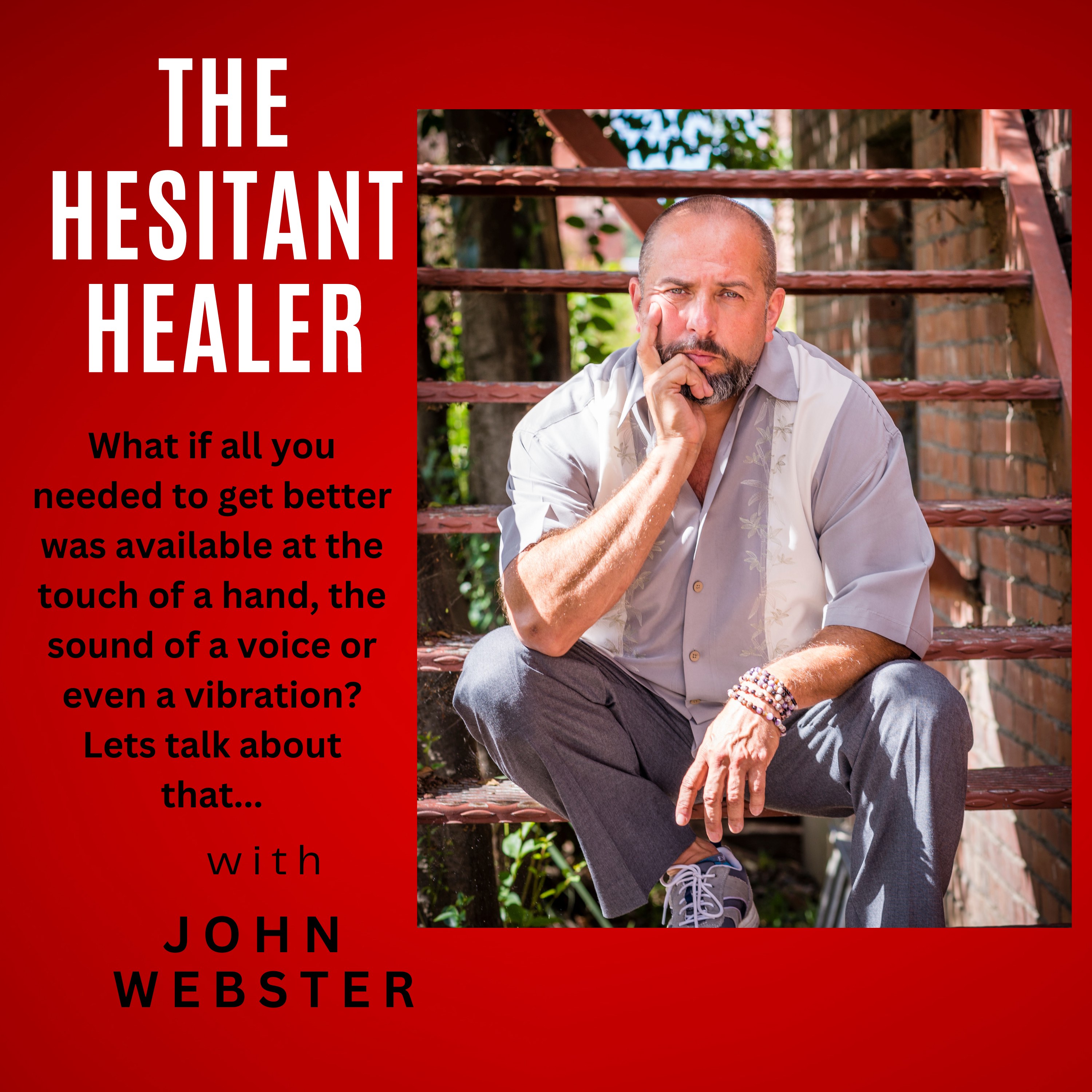
The Hesitant Healer · John Webster
In this episode John and Lisa sit down with teacher, director, playwright, and brother, Matt Webster, to talk all things creativity! Follow us on Instagram Watch on Youtube Contact Us [email protected] (909)557-4415
speaker-0: Hey, Wazookei. Let's do something. speaker-1: Get done. Okay. speaker-0: Let's get creative. ⁓ I got a friend, hang on, I will get him. What if all you needed to get better in every way was available at the touch of a hand or the sound of a voice or even a vibration? Let's talk about how that happens. Who can do it and where to find them. I'm John Webster and this is The Hesitant Healer. Welcome to yet another episode of The Hesitant Healer. I'm your host, John Webster. speaker-1: Ooh, all right. Okay. speaker-0: And hopefully with this one, we're on the YouTube. I think we're dangerously close to getting on the YouTube. So you can see my smiling face. ⁓ And I'm here with the ⁓ happy sidekick who is blind at this point, Lisa Kay. If you don't have us on YouTube, you can't see that she had her glasses off and she was poking herself in the eye. speaker-1: Wait wait wait wait Now I... Hi everybody. speaker-0: And you might notice that there's a third person here and that guy is Professor Matt Webster. Can I call you Professor? You can. I'm not officially currently a professor, but I was for many, many years. You're just a bum? For for-sorial bum, I think we can say. Academic bum. For-sorial, an academic bum. Wow. And you're like a really fart smeller and ⁓ and you ⁓ you direct plays and better. speaker-2: So. speaker-0: It's better that you say it than I say it. What are your credentials, sir? So my credentials are that I have a master's degree in theater education and an MFA in theater for youth. I was a professor of theater education at Theater for Youth for 15 years and ran a program that taught teachers how to teach theater. I've also been a teacher in a public high school. I am also director, ⁓ published playwright, and ⁓ book author on how to teach theater. in a school setting. So I'm a creative artist as well as being an educator and I'm also a consultant theater education. So ⁓ my world is theater and all things theatrical. And what do you do for money? ⁓ The educational consultant part. That's the part that works. Did you see how easy Kate took that as a serious, serious question? speaker-1: Nice. She's like, ⁓ my god. speaker-0: Oh my God. Lisa, he's my brother. He gets it. Me and him, me and him, we're like this. Okay. Yeah, we're like this. I'm the one over here. He's like, can you hear this? Let me turn it up. So we're going to talk about creativity today and creativity as it relates to what do you think Lisa? Healing? Well-being? Lisa K. speaker-1: Right. speaker-0: Hey, I'm going to ask you first. Why do you think creativity can be healing? speaker-1: Okay. Well, back in the ancient days of my life, I did. speaker-0: Did you just burp? I'm sorry you guys can't, if you're not on YouTube, I'm really sorry you guys can't see that. ⁓ Tell us about the ancient times. speaker-1: Well, we wrote to work on dinosaurs. ⁓ I was a preschool teacher and an administrator in an early childhood development program. So here's an observation. All kids All kids are creative. They like to play with finger paint. They like to color. ⁓ All kids are athletic. They run. They jump. They play. ⁓ All kids are smart. They learn. I mean, they learn at different levels, but everybody has these innate abilities as youngsters. speaker-0: They all get a trophy now too. speaker-1: Okay, that may be a well-being, but here's the point. At some point, we tell them they are not good drawers. They are not good at singing. You know, I can think of all those little pageants I had with the kids and they all stood up on the stage and they all sang their little songs. We tell them at some point, you're not a good singer. You're not good at art. You're not good at this. You're not very fast. And so they stop doing the things that they think they aren't good at. I think that we know innately that it's fun and ⁓ it's good for us. It helps us express. ⁓ I had one of my own children who was a little wild as a child and they would put him off away from everybody and give him a crayon and let him just drop. I think it's just innately a part of us and at some point in our lives, a lot of us turn it off. speaker-0: So Lisa, let me piggyback. So the answer. Let me piggyback on that for a second because you make a really good point and I can add on to it based on ⁓ the things that I've learned and ⁓ the times I've had in classrooms. Children learn with their bodies. Children, small children from the time they're born to the time they enter school learn through their bodies. They learn through touch. They learn through movement. They learn through interacting with the world and they physically want to, need to learn in that way. And then they get to kindergarten first grade and they are told to sit in a desk, to sit still and to learn only between your ears, not with the entirety of your body. And for many children, That is the beginning of the end of liking learning, of liking school, because it's incredibly constrictive and it's limiting their input from areas that they have used up to now their entire life. They no longer get to touch things and taste things and smell things and roll around on the floor and interact with things and very... tactile and active ways. And the further they move up the scale of education, the more and more confined they get. So creativity is in fact taken out of the equation and then made very regimented on top of it. Right? We go to art class, we go to music class. And as you say, we learn that there are ways to do these things wrong. If they even have them anymore. Absolutely right. Let's take the art programs away. Let's take the theater programs away. Let's take wood shop away. Let's take mechanics away. Right. Let's drop the sports unless they're making us a shitload of money. And let's have robots and learn online. Right. And is it any wonder that kids get absolutely dejected with what happens in the classroom? They lose interest. There's attitude issues. There's Attendance issues, there's all these other things. And in fact, John, I know you for a fact and probably you too, Lisa, at some level. There were students, there were plenty of students that I had who the only reason they came to school on any particular day was because they were going to have art class that day. They were going to have theater class that day. ⁓ They had a recital rehearsal in music. That was the one thing that got them out of bed and dressed and drag their butt to the bus stop to go to school. They're not excited about the big math test that's coming up. It's about those creative outlets that give them the opportunity to connect. So. speaker-1: That's funny. I agree. Yeah. Totally. speaker-0: I did excited about this stuff. I do too. And so I've told the story several times on the podcast here about the only way I learned about anatomy in massage school was through the coloring book and then through touch and then actually seeing the thing. ⁓ Cause I could not learn it from the book. I could not learn it by looking at the, can't see through the thing. speaker-1: Please don't use that on camera. speaker-0: I look I do you can't do that on camera they say that's bad to do on camera so sorry ⁓ speaker-1: ⁓ I'm so glad we're professionals. This is awesome. Okay, keep going. speaker-0: ⁓ very, good. speaker-2: There it is. speaker-0: There it is. The audience likes it when, ⁓ wait, the audience really likes it. speaker-1: you speaker-0: ⁓ so learning is for me in in a lot of ways, a tactile thing and, and never by book, right? I, I, to this day, I still like being read to as a learning tool. Right. And, and so creativity for me, ⁓ speaker-1: I that. speaker-0: In a depressive state, I don't feel creative at all. speaker-1: But see, I think that's a clue. speaker-0: That's a clue. And the first thing that came back when I started microdosing mushrooms was creativity and didn't realize that the absence of it had been a thing. Now, when I get creative, I can get a lot of stuff done because it sparked my brain. At the age of 50, that's so not true. 60, 61, because I'm 63 now. speaker-1: I agree. speaker-0: ⁓ I went to a class last year, an art class for the first time in decades. And that for pastel and that lit my brain up. And I'm an artist and a creative guy. I'm real particular about what I get creative about. You know, I wasn't a reader for a long time. Then I started reading and that that sparks the imagination. But I get creative with things I want to get creative with. Well, I don't get creative with things that don't excite me. So, know, John Kelly says, I used to say, ⁓ I hate change. And he says, no, you don't. And I'm like, yes, I do. He goes, no, don't. Because if you hated change and you won the lottery, I don't think you'd hate that change. So you just hate change that you don't like. ⁓ that's true. So, ⁓ towards Matt's point, creativity, ⁓ I think the onus sometimes, at least early on, is on the teachers to find the spark that sets the kid to go in the direction that sets that creativity off. I mean, that's their whole job. And I think the industry as a whole has probably gotten away from that because you don't see the kind of teachers that you see in movies these days anymore because they're not allowed to. The administration and the way things are going and blah, blah, blah. Seeds to the past. Yeah. All that. I don't want to get too much into that, but we've taken creativity away and we need to bring that shit back. speaker-1: think there's another point too. speaker-0: But how is it healing? How can it heal? That was really the question. speaker-1: Again, healing, I think it's more about your well-being. I think it's about you as a whole person. ⁓ speaker-0: There you go. Good job. That's exactly where I was going. The healing has to do with the healing as a whole. We are not whole if we are not using our creative process. We're not whole if we're not using our logical processes either. Some people are more creative, some people are more logical, but there's still a little bit of both in each. And you can't sequester or deaden the one without having the other one be affected one way or the other. speaker-1: I we've talked about moving as we get older. You can't take that out of your life. You are a whole person and anything you take out of it, it makes you a lesser person. speaker-0: If you're not moving your rust, and if you're rusting, you're dying. And if you're dying, the bugs are eating you. That's that's yes or no. Yeah. Yes. Because I'll show you videos. speaker-1: So I'm good, thank you. I think too. speaker-0: ⁓ hang on, hang on, hang on. I saw this, Lisa and I, for those of you who don't know, one of the things Lisa K and I do for funsies is that we send each other the ugliest, nastiest, accident, medical, hurtful things. So the guy with the arrow through his head, not Steve Martin, the other guy, or motorcycle accidents with, we just go back and forth on stuff like that. And last night I saw one. and I didn't send it to Lisa K. Because it was so disturbing, and I know it's one of her biggest fears in life. What's your biggest fear in life, Lisa? speaker-1: I'm very thankful that you did not dying alone and having the cats beat me. ⁓ speaker-0: I found the video. ⁓ speaker-1: This sounds stupid when you make me say it. speaker-0: I found a little bit of a meme about some lady that had a seizure and she was catatonic but still awake but couldn't feel anything and her dog turned on her and ate her face. And I get kudos for not sending that to you. Thank you, you do. Right before you went to bed. So appreciate that. But creativity, go on. speaker-1: Peace. Yes. So I think ⁓ I was thinking about, because I've revisited some creative things that I started again in my advanced stage. I was thinking about like my mom, was she creative? And I think she was an amazing cook and she ⁓ could, she was a great seamstress. So she could look at something go home, make her own pattern, cut it all out, sew it, and it would look just like that. It's just amazing. speaker-0: Was your dad creative? I know what you're thinking because we're gonna have to go there anyway. What? Because this is, I'm getting somewhere with this. Okay. Because we talk about left side, right side brain. Correct. Was your dad creative like that? No. No. Was your dad creative at all? speaker-1: ⁓ no. Sure. Well, OK. Here. My father had a gambling problem. speaker-0: Are you sure? So is there creativity in it? speaker-1: I think to be very good poker player, probably have to be pretty creative. speaker-0: See, now we're not talking healthy, we're just talking creative. If you're a gambler, you're probably pretty creative. If you're an alcoholic, you're real creative. It doesn't make you a good person, but the creativity's there. Matt and I, if we talk about mom, mom was super creative, right? Musically and artistically. And let's just think about all the things we took out of that house. We had bands instruments, yes or no? There was an entire... There were a piano, a trombone, a saxophone, an accordion, a guitar, a ukulele, lots of maracas and lots of gourds. Was there a flute? Did we find a flute? I don't think we found a flute. That was just the music. There was a lot of art stuff, paper and pencils and pens. And I remember doing lots of art projects. speaker-1: think there were some raw... speaker-0: We'd go outside and do outside stuff. mean, mom was super creative that way and musical, musical, musical. Dad, did you say dad was creative? No, dad was extremely logical. He was a numbers guy. But there's a creativity in numbers. And I think I've told the story before, growing up, when I'm doing math and he's trying to teach me, I'm in tears. He may as well as been speaking Greek and trying to explain to me how the planets work, it made no sense to me. speaker-1: I think there must be. Especially. speaker-0: Art-wise, he would sit and watch me draw. He said it's the only time he was ever able to watch me sit down and not move was when I would be drawing. And later in life, after I got into the army, once I got into ice carving and once I transitioned, I tried to transition from ice carving to wood carving, he went with me one time up into the mountains of San Bernardino and I bought some big pieces of wood and I was carving wood and he sat with me for hours one time and just looked at me like this. speaker-1: Hahaha! speaker-0: He's like, how do you take that stump and turn that into an eagle? I'm like, how do you not? Left brain, right brain. We were both creative, just differently. speaker-2: you ⁓ speaker-1: See it. Right. I think, you know what, I'm gonna go back to something. Like there are different kinds of creativity. My dad was a hunter and a fisherman. There you go. That's super. speaker-0: and super important to the survival of this species. Absolutely. speaker-1: But he could see where the fish were. He would say, can see where they are. And I would be like, ⁓ But I mean, there's some creativity in that. He taught me to hunt and fish because, you know, he didn't have boys. So you got to go with what you got, I guess. speaker-0: Your dad was a fish whisperer? I think, I think what I think one of the big takeaways with this is the necessity for human beings to utilize their creativity. And if you are not in a position where you can tap into your creativity, that's when you begin to have problems. That's when you begin to be out of balance and out of whack and you begin to suffer. mentally and emotionally and you begin to feel that lacking and you may not be able to understand why you may not be able to put your finger on the reason behind it. John, one of the things I can point out is trench art. You know what that is, That in World War I, trench, trench art in World War I in the trenches. There were soldiers who would create things by whatever they had. So empty shells, ⁓ artillery shells, they would carve into. A single piece of wood, they would carve into a really ornate, yeah. It's a very specific ⁓ category of folk art. And it is strictly about these guys who were literally up to their knees in mud with death all around them all the time and found a way to create art because they had to. That's what kept them alive in the trenches. speaker-1: I love that. That is amazing. Good. You think too, we go all the way back to the cave paintings. Why did men do paintings on walls? speaker-0: I like that. Well, they didn't have any porn. They made their own. speaker-1: I don't think that was it. Was I? No, but I think that speaks to well. I think that speaks to. speaker-2: No. speaker-0: I can't do this anymore, this is over. speaker-1: ⁓ I think it speaks to that innate ⁓ knowing that I need to represent ⁓ what I see in an artistic creation. speaker-0: Well, I think it speaks to humanity. can find it in every single civilization across the board. And they were advanced and extinct and art was one of the highest levels of expressions that they had throughout that culture. Rome and the Mayans and the Egyptians. Let me give you a practical aspect if you want to go back to like cave painting times. There's a very practical reason for a lot of that and that is speaker-1: especially extinct ones. speaker-0: Language didn't exist as we know it. And certainly writing did not exist at all. And in order to be able to tell stories and remember those stories, they would create art as a way to visually represent the stories that they're telling, that we had a great buffalo hunt or don't eat these particular plants. They'll kill you. And if you don't have a way to record that, if you don't have a way to record that, you're going to not pass on your genes far enough to have your ⁓ prodigy survive. art was... Well, we're back to humanity and wanting to... speaker-2: See you at the end. speaker-0: Exists I want you to know I was here. Yes. Yes, right I want a record of of existence right where creativity is the meaning of life There we are and the podcast. Thanks for coming. There we go speaker-2: See. speaker-0: Here, hurry up. speaker-1: ⁓ I would agree with you on the like there are times when the I don't want to do it right I speaker-0: Yeah, I mean that speaks to the opposite of it. And there's days where I just don't feel creative, no matter how hard I try. But are there times where you force the creativity and it's kind of sparked it? speaker-1: Yeah. Yeah. speaker-0: And keep in mind that the creativity doesn't have to be high art either. It can be throwing a different spice into a recipe that you haven't done before. It can be ⁓ rearranging the furniture in your living room because you're bored with the way that the old setup was. There are a myriad of ways to express creativity that don't need to be, ⁓ you know, hanging on the wall of the Louvre. Creativity can be expressed in any number of ways from the intimate to the extravagant and the fact that we have so many different ways of expressing it and sometimes we're expressing it to ourselves. Sometimes it's incredibly private. It's not meant to be public. And that goes back to some of what you're talking about, John, that it's about the human condition. It's about a human need and whether or not what you create is meant for public consumption or just for your own sense of well-being, the urge is the same. Correct, I agree. Yeah, in high school it was whatever you could turn your peachy into. Remember the peachy? All kinds of graffiti. Or could you fold a piece of paper like a flag and play football with it? There you go. speaker-1: Oh, do the, And the answer would be in my case, no, I could not do that. I was not in my wheelhouse. speaker-0: But you had boobs and you could rest. speaker-1: So, okay, I guess I survived. From what I understand, it's easier to do without food. So you were okay. You know, I think it's innate and I think it has to do with tuning into being your whole personage. You know, we are a mind, body, spirit. And when you take any part of that away, you've taken away a part of your wellbeing. speaker-0: I didn't have boobs and I could run. Do you think, here's a question for everybody because you just had a birthday brother. Creativity slows down as you get older. speaker-1: I'm gonna say no. Follow those stories. speaker-0: It doesn't happen. speaker-1: You think it has? speaker-0: No, it doesn't have to. It doesn't have to. speaker-1: ⁓ that's not okay. I think of all those stories of like guys who retired and then took a painting class because now they have time and you're doing woodworking. speaker-0: I'm doing woodworking. Do you think when I'm 80 I'll still have these? speaker-1: Stab like us. speaker-0: You I'll be creative then? I hope so. speaker-1: I, you know, I think, yeah, like I saw something like an article about... Saw something too. It was Robert De Niro, I think, who has taken up painting. Has he? I don't know. Anyway, it just, and he's, it intrigued me because he's one of the actors who happens to be older than me. So that's always a good speaker-0: You know, that's a coincidence. He's always been a painter, And there's very few of them anymore. Clint Eastwood. No, he's just older than speaker-1: Thank you. Did you ask? No. OK. All right. So ⁓ I think sports is creative as well. I think there's a. speaker-0: Absolutely, mean, that feeds physical, but discipline too. And you don't necessarily have to have discipline to be creative, but if you're disciplined and creative, ⁓ what, you make money? Not necessarily. John, question for you with the age and the creativity section here. Speaking of age, they're always older than... ⁓ do you think it's necessary or important for people to maintain their creativity as they get older? And if so, why? Yeah, it's the same as staying physically fit because there's a ⁓ mentality to ⁓ I'll tell you why. I'll tell you why. David Eagleman is a guy that I listen to on a pretty regular basis. He is a Stanford brain neurologist guy and he has ⁓ a podcast. You should listen to it. It's David Eagleman and the podcast. I think so. All right. speaker-1: That's not very creative. speaker-0: Well, okay, now you're gonna make me look this shit up, which I can... speaker-1: That's your point and I will look it up and we'll put it up. speaker-0: And I have it right here. It's right here with me. is it here. It is shut up. It's called Inner Cosmos with David Eagleman. It looked just like it doesn't look like that. That's wrong. It looks just like that. Everybody. There we go. Inner Cosmos. There you go. So I've told this story before. It's the thing that got me into this guy. I think he wrote this article and it ended up in the Atlantic. But when he was a young boy. He thought he could fly and he got up on his roof and he jumped off the roof with a parachute of his making, like a bed sheet, and he was trying to parachute and it didn't work out so good. And he remembers falling backwards and as he did, time stood still before he hit. He's the one, right? ⁓ Now you know, it's funny because I don't know if you remember Matt before You were pretty young, but when we moved to California, we lived in the first house on that cul-de-sac. And I tried doing that on that house. I remember jumping off that roof with the, and it didn't work out so good either. Anyway, he remembered this and it stuck in his brain about time and standing still and not moving. And as he went to college and became a neurological guy, he decided to chase that. and try and figure out what made time stand still like that and could he reproduce it? And eventually he came up with several experiments that had to do with the same type of thing that he had done, falling and time constraints. ultimately he tried roller coasters and he tried scaring people and he tried a lot of different things. And there was an option that had a clock where... if you were super scared and you looked at the clock, did it change time, that kind of thing. Ultimately, the experiment ended. I think this place is in Ohio. It's a giant chimney, giant chimney, like a stack of a chimney. And there's a net over the top of the chimney. And you lay down backwards in the chimney. And they yank the net and you fall backwards into this dark abyss. Or it's a ride, people. speaker-2: for speaker-0: So he put people in this and he put the clock up and he wanted to measure them. He had them wired up and wanted to measure them ⁓ and see if time stood still while they were doing this. Doesn't that sound horrific? People who think this is fun. Ultimately, it didn't work out, but it forced him to get to the point of trying to figure out what made it work. Take ⁓ that and put that little story over here. speaker-1: That's horrible. That's like everything I... speaker-0: I've told the story before. think I just told it recently. It may even been on this podcast a couple of times ago. Matt, you've seen Blue Man Group? You ever been to Blue Man Group? In Vegas? The first one, the big one, because you and I went and saw it one time in Vegas. It was not the same show, but the original big show on the right hand side of the stage when they're getting ready and whatnot. Big cylinder, big cylinder. And ⁓ I think I just told this one. I just told this, yeah? With the big cylinder and there's water in the pipe and all of that and then they have these several different figures that look like foil figures in various forms of dance and sometime during the show they explain TV and brain gaps in the way movies work and your brain fills the gap. of what it actually sees because it's locked in this vault and doesn't have any input except for eyes and ears and taste. Your brain can't see nothing. It takes input and it makes its best guess. That's why you can have five people look at a crime scene and you're gonna get five different stories because they all saw it from a different perspective based on their entire life of experience and based on their best guess. So. The answer to the question of how can you drive the work every day and you don't even remember going from point A to point B, is it because your brain shuts off things that it already knows ⁓ and only gets excited when it sees things that it doesn't know. So you hear old people talking about life is moving so fast and I wish I could slow it down. speaker-1: news. speaker-0: Those people are in rote memorization and doing the same thing every day in and out. It's the ones who go do different things. Take a different path to work. Take a different walk. Walk somebody else's dog. Tell them you're gonna do it first. Go on different trips. Go find new friends. Join a club. Lots of different things. Your brain has different input and keeps you younger and keeps time from from standing still and you don't lose those gaps, right? It excites it. So the long answer to the short question of, I think it's important as you get older? A thousand percent. Because if you want to stay young, if you want time to not feel like it's going too fast, you want to try different things. New foods, new smells, new sensations. I'll tell you, I think I told you this, Matt, when we went through COVID, one of the ways I figured out, because I didn't have a lot of the symptoms, even though I knew I had COVID, and then we were at the house, we were at mom and dad's house, we were cleaning the house, we were with our other brother, me and my brother, Mark, and I farted, and ⁓ I didn't smell it, so I didn't say anything. And then Mark walked in front of me and went, dude. And I went, my sense of smell. speaker-1: I us. speaker-0: But right away, because I do what I do, ⁓ I had a ⁓ great chef teacher at the end of my apprenticeship when I was a chef. I'd go to work every morning at 6 a.m. He would blindfold me and put three things in front of me and make me smell them and identify them, or make me taste them and identify them. And each one had to do with the different part of the tongue. Each one had to do with different smell sensations. ⁓ Very strong memory, but so when I realized I'd lost my sense of taste and smell because it made no sense to me that this thing was doing that ⁓ I went back to that. I went back to basics I started scraping lemon peels and smelling the lemon super strong smells Sticking my face into the coffee grounds and smelling the coffee grounds tasting bitter sweet sour ⁓ Umami there's one other one salt sweet salt salt and forcing my tongue, because if you do that, a lot of you have never experimented with this, but if you take the different taste sensations and put them on your tongue, if you put it in the wrong place, you won't taste it until it gets to the part that you can taste it at, right? So when you don't have a sense of taste, force it, because what that does is excite one brain cell, brain cell, but area of the brain at a time, so that it can turn those sensory perceptions back on. And so I did that with my sense of taste and smell. took two weeks and it came back. To this day, I still know people and so do you who had COVID and they never got the taste, the sense of smell back. And I think you people should have done what I did. speaker-1: I did what you did and I did lose my sense of smell. There are some smells that never came back for me. speaker-0: Which is why I can fart in my office all the time. So John, let me ask you this. I no idea. So the idea of retraining your brain, very important, right? And challenging your brain, especially when you talk about aging and well-being and things to that effect. So you have done art for years and years and decades and decades. but you've only recently really taken pastel seriously. What challenges do pastels provide you that are causing your brain to refocus, that is causing you to think about art differently, that is creating a new creative avenue that you have not tapped into heretofore? My brother Matt the teacher, ladies and gentlemen. Matt the teacher. speaker-2: Wait, wait, wait, here we go. ⁓ speaker-0: Wow. ⁓ speaker-1: really wish you'd never seen that puppy. ⁓ speaker-2: easy way. speaker-0: I'm gonna get better at that. All right, so to answer the question, I have another story that I don't tell a lot of people, because it's not a thing that comes up, which is the drawing you speak of when I first started had to do with pencil. And when I discovered drawing and when I discovered I could draw, because I don't understand how everybody can't draw, I realized it was a very natural thing, right? Like ice carving. I don't know how you can't carve everything that doesn't look like a swan. It just seems natural to me. It took a long time to realize that was a thing I had that not everybody has. ⁓ But I did pencil drawing for a long time. I didn't train. I didn't go to an art class. I just inherently knew how to draw, and I used a pencil, and that made the most amount of sense to me. ⁓ I think that first picture I have of the rose that I drew for mom, 13, 14 years old, I still have that today, in... So before I got into culinary arts, I was in college for art, because I decided that's what I wanted to do. And I went to a real class with a real art teacher who taught about shading and perspective and all of those things. And then it's like, ⁓ and light, how light shines and what normal artists do to, you know, the different shapes and all of that stuff. And then When I have something I'd been doing for a long time and then I see these things, my brain's like, ⁓ shit, ⁓ you know, popcorn goes off. And then my art elevated. I did ⁓ some painting and some chalk back then, but what I really liked was the black and white. And eventually in that timeframe, ⁓ I discovered ⁓ pens, black and white, because I liked black and white, right? speaker-1: It's a really, really fine pin. speaker-0: Right, unbeknownst to me now, but I did pastels at the time in college, but you get these big sheets of paper and you have a model in the middle and you sketch all this stuff out and you play with colors or whatnot, but it wasn't really focused and it wasn't really driven, it was just a creative outlet and then I discovered cooking. Again, I've told the story of All those pieces of art that I did in college that I really liked were rolled up and taped and put in the garage for years because it was me and a piece of me and you weren't gonna have it. And I couldn't price it, I couldn't sell it, I wasn't doing it for masses, I did it for me and it was a part of me that came out of me and you can't fucking have it because it's my stuff. It was a part of my soul and it felt so personally. speaker-1: It's a part of your soul. speaker-0: I didn't understand why I couldn't sell it or why I wouldn't sell it. I just couldn't do it. Shortly thereafter, when I got into cooking and cooking really made sense, somewhere in the middle of that, I bumped into that drinking buddy, slash friend slash person. ⁓ When we were having this conversation and she was a ⁓ medical person and she said, I said, I just, I don't want to sell myself. I don't understand why I can't sell myself. She says, look at. Look me dead in eye. She goes, if you're sick, you won't hesitate to spend any amount of money to go to a doctor because he's been to school and he knows what he's doing and he has what you You have a gift. You know how to do something that most people can never do and they will pay any amount of money to get it. And I went, ⁓ shit, that totally makes sense. It was a long time before I got that because I was still cooking. Now what I learned when I got Ann drinking. when I got sober because I had those things in my garage for a long time and couldn't get rid of them. And then I was in a marriage that didn't allow creativity to come at all. I sequestered all creativity because it was made fun of. My mother hated my art, by the way. The wife hated my art, ⁓ mostly because I like drawing naked people. ⁓ speaker-1: But, but. speaker-0: And it blah, blah, blah. But I mean, I was not in a place where creativity was allowed or fostered. Therefore I didn't do it. The caveat was I didn't realize my creativity was in cooking. And the chef who saw that in me locked me in a room with three carousels worth of slides from culinary exhibits all over the world. The stuff that you guys see on TV right now and take for granted hadn't happened yet. And so he had pictures from all of those things, the Culinary Olympics, food shows, ice carvings, chocolate sculptures, sugar sculptures, high-end food from the 70s and 80s of jello molds and... speaker-1: and pate is an aspect, but. speaker-0: But he locked me in that room and said, don't come out until you've seen all these pictures. And then I'm like, ⁓ my God, cooking, yes. And then he taught me to ice carve. And then I surpassed him in ice carving because it made sense to me. What I learned when I got sober almost 10 years later was... I could make the same amount of art to the same degree of art that you would pay any amount of money for and the ice carvings would melt or you would eat the food. And so I could create, you couldn't keep it and I made money and that made sense to me. So my creativity came out of artistic want and ended up in... speaker-1: this speaker-0: a sidebar of a thing that totally made sense to me. in that learning, I learned my craft. When I went back to drawing at the end of that or in the middle of that career, I didn't want to do pencil anymore because I had done pencil. there was a part of me was like, I've already done that. And I did it at the height that I thought would be as good as I ever needed to get. And what came out next was ⁓ acrylic no ⁓ water gel pen and watercolor paper. So black and white, black and white. Which at the time, five, 10 years sober, was the way I saw stuff. I only saw it black and white. And pre-therapy, right? So everything was black and white and really anxious, but a lot of my art became that and that's what the creative process was. And that long story, which I've told before, that long story ended in a culmination of selling a piece for 16, 1700 bucks that I... created on the couch for three hours in front of the TV and the engaging and marrying of Lisa, my wife. And so that solidified art, creativity, making money, love, and being able to give it to people and make money for it. speaker-1: But you know what? speaker-0: And then that kind of disappeared and I got into more creativity and I was still cooking and blah, blah. And then I got into a funk and I haven't done, I've done a little bit of this a little bit. I've done murals over time. I've done people's ceilings over time. I've done kids' paintings over time. It kind of fostered that. But I hadn't done anything and for years, decades I said, I don't want to do this as a job. I don't want to make art. as a job. don't want to, I thought it would take the fun out of it. So I did learn to paint. I learned acrylics. I was good at it. I started painting again. Two years ago, I started painting just for fun and I fell in love with it all over again. And just for, I went to a art show and bumped into a lady who did pastels and I really liked the pastels that she was doing. And I really, really saw something in it. There's also a local guy that I've seen here for years who it's like, would try, tried it actually 10 years ago and I was not good at it. And I'm fucking it. I'm not good at it. I'm not doing it. I can't be like that. I'm not going to do it. Anyway, but this lady, she's teaching a local class here. You know what I told the wife, I'm going to, I'm going to take this class and just go see five minutes into this thing. I'm on fire again, because I see that it's got a possibility. speaker-1: guys. speaker-0: and I get it and I have somebody that can teach me and guide me in a way where I've learned something that clicked in the middle of the brain. And ⁓ right away I start getting feedback from the other members in the class who are all doing like the teacher. And they're all coming up and looking at mine going, I've never seen anybody do something like this. So it feeds the ego, which is a big part of how the art works. But for years, I've taken thousands of pictures that someday I'm going to paint. And now I found a medium that I can do that in. it really zippered together the ego and the money and the joy and the love and all the things that make it work. Did that answer the question? Yes, go ahead. I want to hear Lisa. speaker-1: I get that you want to sell your art and you should sell your art because it's amazing and everybody should own a John Webster. ⁓ There's some gorgeous stuff on the wall that we have in our office that ⁓ we have available for sale if anybody's interested. ⁓ It's still a beautiful piece, even if you haven't sold it. I don't know that the judge of art or the judge of creativity is that I get, ⁓ it's monetized. speaker-0: Right? No, you create, that's exactly right. mean, in ⁓ a, buys a piece. Patron? Collector? No, keep going. Curator? Somebody wants me to paint a piece for them. okay. a commission piece, thank you. For a commission piece, you're doing exactly what they want. In fact, I just did one for my sister-in-law or the brother Mark's wife. speaker-1: Hey. We're so smart now. speaker-0: Sarah and it's the first time I've ever done a commissioned piece where I got feedback in real time. Right. I've always commissioned like I did ice carving. You're going to fucking take it and if you don't like it, you're still going to pay me. Right. In this case, it was like I did it. What do you think? I don't like this. I don't like that. I changed it. What do you think? Try this and this. And she got to make it a way that she wanted it. And then I sold it to her because it was and she loved it. That was new for me. So there's another new avenue. But It's always been take it or leave it and I'm starting to push and pull away from that in a commission piece. With what you're talking about, I'm doing it because I love it. And I don't care if you don't like it or not, I did it because I loved it. And what's over the years, what's really ⁓ caused a great deal of joy in my art, which has really only been a couple of times, is that somebody loved it as much as me and... and they wanted to put it on their wall because they truly, truly got it. ⁓ speaker-1: But see, that's affirmation rather than monetization. speaker-0: What that does to my heart and my soul when they see it the way that I see it, makes it worth it across the board. It's a lifetime. Even if it's only been four or five times, those four or five times have made the entire process worth it. Exactly. Including the rejection. So let me talk for a second about my art, because my art is different from yours. The plastic arts are very different from the performing arts. One of the major things about the performing arts is that they are transitory. That means that the performance I create, the art that I make, if you see a production of a show, if you go to the theater or you go to a concert and you see that show, that show, what you saw will never be again. Yes, they will play the show again the next night, but the person who coughed at the wrong time. ⁓ It will never be the same. And even if you capture it on film, it's not the same as what happened in that live moment because what happens in the live moment is something that we refer to as the audience feedback loop, which is I'm on stage. I said something that something is funny. The audience hears the funny thing. They laugh. I hear them laugh. that causes me to react in how I'm performing and do something that maybe I haven't done before that gets another reaction. I hear it and we are now in this loop between audience and performers. And it's an amazing feeling. It's that validation that you're talking about, John, in real time, second by second, moment by moment. And at the end of the night, the curtain falls, you take a bow and it's gone. And you cannot ever go back and get it again. You create something that exists tangibly. Even if it leaves your possession, you can go back later and look at it, or you can look at a picture of it and have a decent facsimile of it. What happens in the performing arts is that once those moments are gone, those moments are gone forever. There are certain productions of plays and things that People talk about they were they they changed the world but will never see them and will never experience them and more than that Let me add one more thing that this is something just absolutely blows my mind ⁓ It's possible in the performing arts and theatrical arts to have a failure as well You have a bad performance a bad night. The audience doesn't laugh. You don't get the reactions I've talked to friends of mine who are musicians And it's a different mindset with musicians. With musicians, if all of them are on stage and are really jamming and really enjoying it, they don't care about the audience. It's not about the audience. It's more of what you're talking about, John, that it brings you joy. And the fact that then somebody else gets joy from it is a secondary idea. It's icing on the cake, but it's not necessary. for the value of that creativity, for the value of that moment of joy and ⁓ community that these people are having and sharing their creativity that they feel and appreciate and enjoy. The fact that we as audience members get to share that with people is the real magic of those moments. And so what you're talking about that there's someone who says what you have created, this piece of art. that you have created brings me joy. The same kind of joy that you feel looking at it or in the thought of creating it is that same kind of shared moment, which I think is something to be considered when we talk about the importance and the healing and the well-being nature of creativity. It is part of humanity. It is a necessity component of humanity because it allows us to share with each other on levels that we can't normally share. speaker-1: Right, exactly. There aren't necessarily words that can express everything that you are sharing with people through your creativity. There are not necessarily, ⁓ but you get to come together and understand and you're on a level where everything is flowing. There you go, flowing. speaker-0: Right. And there are moments that... So many. Yeah. speaker-1: Go ahead and I'll ask in a minute. speaker-0: Well, are moments of time where people have created things that transcend time. Think in terms of something like Guernica, Picasso's Guernica, right? Based on an event and a moment, but that so much emotion, raw human emotion was poured onto that canvas that for the rest of its existence on this earth, human beings can walk up, look at that canvas and feel those emotions. How do you begin to put value to that? How do you even begin to define that? How can you not talk about the importance of creativity when it allows the ability to express emotion, as you're saying, Lisa, beyond words, beyond words. And you can try to find the words that that express it, but at some point those words will fail because as human beings, can express beyond it. We might not be able to effectively communicate it in language, but there are other ways to communicate and that's where art and creativity comes in, that ability to connect with emotion and share emotion to emotion with other, not just human beings, but strangers and potentially strangers across space and time. That's really fucking cool. speaker-1: I think ⁓ I was just thinking that's so funny when you were saying that that experience because I was thinking of some theater experiences I've had in my life and I saw the original cast of Dreamgirls in Los Angeles. Yes in Los Angeles and ⁓ when ⁓ Jennifer was the first Jennifer Hudson not Hudson. It was the other. speaker-0: Lopez, Jason Lee. speaker-1: ⁓ She was big girl. She was a very big girl. ⁓ when she sang, there's a huge song that closes the first act. And she sings, ⁓ you're going to want me. And it's just, it's a heartbreaking song. It's, for anyone who's ever lost at love, you know exactly what it feels like. ⁓ I, my emotional reaction was, ⁓ my God, because she was so amazingly good. She hit notes and held them that nobody should be able to do. And those experiences are, even though it's one of the saddest songs I've ever heard in a show probably, they, they are life affirming in that there are other people out there who have felt the things that I have felt and they, she's expressing the things that I have felt in a way that I can't do it. And it's... speaker-0: So there's a connection. So you're connected to her creativity. Correct. speaker-1: But it affirms speaker-0: Go ahead. There's also the importance of catharsis when you talk about that. It allows you to feel those emotions vicariously and feel those emotions and connect to those emotions in a safe, nurturing environment that allows you to process them, understand them, work through them, and come to understand them without necessarily being damaged by them. So to share that creativity at that level that allows people to have catharsis, that allows people to delve into those emotions and cry those tears amongst an entire audience of people crying the same tears is powerful. It is just not Argentina. speaker-1: Don't cry for me, Argentina. was ⁓ Tati LaBelle. No, not LaBelle, Tati, whoever. It was Madonna. That was in the movie and that was so bad. Right. So, Matt, my question is what are you doing? I mean, you are well-versed and much experienced. speaker-0: Yeah, don't you ever. speaker-1: What are you doing right now that's creative, that's feeding your soul? speaker-0: So I've been in a little bit of a dry patch creatively and I have felt it. ⁓ It has caused ⁓ some unease and some imbalance and it took a while to put my finger on the fact that that's where that sense of unease is coming from. That I haven't been in a theater, I haven't directed a show, I haven't been on stage or worked with ⁓ actors in a way that feeds my creativity. But thankfully, I've got another avenue, and that avenue is writing. And so I've started the process of starting to put the foundation down for the next thing that I might want to write. And so that process begins for me with some research and some reading and a couple, you know, writing down some scenes or creating some characters and seeing where they go. So as the creative process starts, John, you said it and you said it, the popcorn starts going off, right? You start to get those connections in your brain rewired and you start to feel the blood flow in that way and you start to get excited about the possibility of where these things may go. And you know that there will still be some frustrating moments. There's going to be times when you hit dead ends or you... take this idea a certain direction and it only goes so far and you can't figure out where to go from there. But knowing at least that you're on the path and being able to think in terms of what can be. What if I do X, and Z? What if I create this? Where will it go? What does it look like? Can I put the pieces together in such a way that not only it makes sense to me, But hopefully if all goes well, again, somebody across the other side of the world, time and space, will read what I wrote, will say words that I have written and make a connection to it, find some kind of joy. The idea that that creativity is possible, the idea that that creativity exists within all of people is something that I think binds us together as people and makes it easy to relate to one another provided we allow ourselves to recognize it. A good point. Yeah. speaker-1: Well said. Well said. Well, I'm glad that you are out of your dry spell. That's a good thing. So. Right. Right. speaker-0: Me too. Good. What are you doing creatively? speaker-1: ⁓ I don't even know what to call it. speaker-0: You do a form of art that makes sense to you. speaker-1: I do. It is multimedia. speaker-0: But you're also grandma creatively. speaker-1: ⁓ yeah. speaker-0: There's something about grandkids or a new baby that sparks our creativity in a different way. We get to see the world through childlike eyes. Yeah. And watch them turn on. And you're about to be a new grandma and you're getting excited. speaker-1: Yes. I'll be a grandma again, because I have one. Little Tatum is here and little Quinn should be here ⁓ within a week or so. Take away. Yes. yeah, that's, I mean, that's fun and exciting. And ⁓ I did do one of my paintings for each of the girls so they each have something of me to put in their room. So that's kind of fun, I guess. speaker-0: a new grandma times two. You're a weak speaker-1: Yeah. Yeah. speaker-0: Cool. All right, I think we've stomped the grapes out of this bitch. Is that a saying? speaker-1: I don't know. It is now. speaker-0: That was very creative. Well done, John. We've stumped the wine out of these grapes. That's what I meant to say. Stumping the wine out of this bitch is a whole different thing. speaker-1: I'm sorry, is that the wine? Okay. And that's where it all went down. speaker-0: They got internet sites and people can get arrested for that. All right. Well, my brother, it's been a hoot. Thanks for bringing that up. If you have other stuff you want to talk about, holler and we'll just do this. I like this new platform. Teresa K, what else you got? Anything? speaker-1: ⁓ Do I have anything? ⁓ If you have any ideas out there in YouTube and Podcast land, if there's something you'd really like to hear us talk about, because we're fun, ⁓ please let us know. speaker-0: I'm ready talk about a client too. We need to find a client we can talk to and tell us their healing. If you have a healing story and you want to be on this thing, give us a call. Yes. And we'll put you on. What the hell? speaker-1: Yep. Or if you'd like to buy smart. speaker-0: Or if you like to buy some art, because I got lots of art for sale. Yes. All right. Be good humans. Sorry. Y'all, y'all do the best you can possibly do. speaker-1: No, that's my line. Be good humans. All right. See, it's just you blew my line. speaker-0: If I had a dollar. speaker-1: You you