
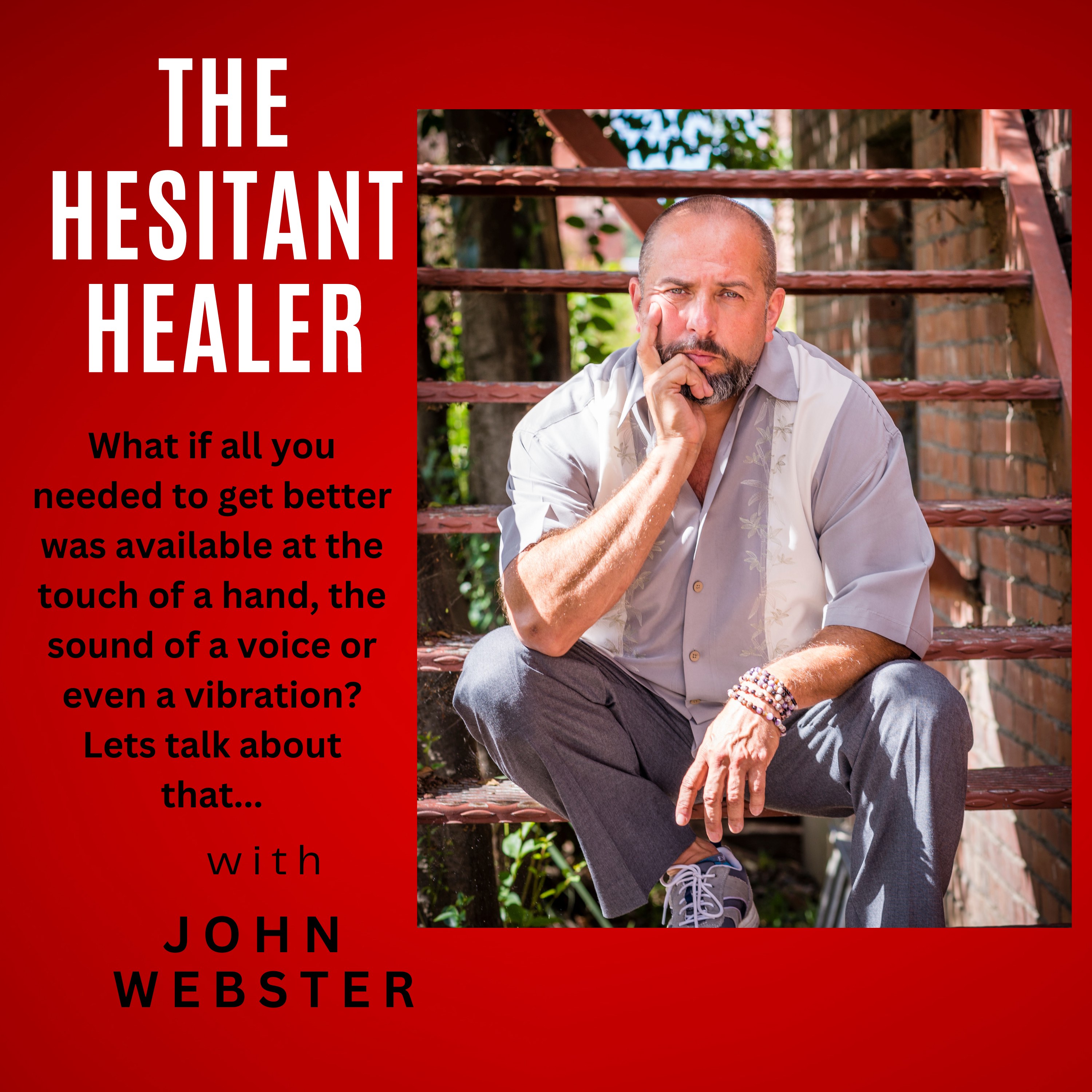
The Hesitant Healer · John Webster
In this episode John and Lisa continue their conversation with Daphne Mosko. They talk about working with emotions, processing trauma and how the Blue Man Group can relate to the brain. Follow us on Instagram Watch on Youtube Contact Us [email protected] (909)557-4415
speaker-0: What if all you needed to get better in every way was available at the touch of a hand or the sound of a voice or even a vibration? Let's talk about how that happens, who can do it and where to find them. I'm John Webster and this is The As It Tends. speaker-1: So tell me, because we both, I mean, you know, I do a lot of emotional stuff and I'm curious because I don't know anybody who treats the emotions in the body the way that I do. So I want to know how you do it. So give me like either like, me an antidote, me like, tell me a tale from your table of an example of how you might work with the... speaker-0: This is where I can do a whole nother hour. We can do that, but I'll go from point A to point B. Because oftentimes people are like, don't you love the ones who go, what are you feeling? You're in your process, right? You're in your process and you're thinking and you're in a minute and they'll go, what are you feeling? What's my body telling you? And like my first thought is like, stop asking. We're busy, right? speaker-1: I didn't use my story. I usually ask them what they're What do you notice? speaker-0: Because of all the Because of all the things that we've discussed. That's a good explanation as to what's going on in my head when I'm working on somebody. It's never just, I'm touching the thing better. There's an entire 20 year history of knowledge and expansive learned technique going into me doing this. Right. And, and so when I'm asked, well, backtrack into all the things that got me there because I see it. speaker-2: the thing and make It's. What are you doing? I got a bad. in the room. speaker-0: So part of my shtick is that yes, you're gonna fill out a thing online and you're gonna tell me all the things and I'll look at it. But when you come in, I'm already watching you. How are you standing? What are you looking like? Where are your eyes going? How are your shoulders? What did you just say to me? And I'll usually ask pretty pointed questions. What's going on with you? If you're brand new, what's going on with you? Why did that happen? What it is? speaker-2: Why, what? speaker-1: And I would say about a third of the time when brand new client walks in and you say, tell me what's going on with you. About a third of the time they'll say, well, I filled all that out. But, he is, is it? Well, it is. And the key is how do they answer? What did they say first? You know, speaker-0: dancer in itself. And then your voice inflection, of that, all that stuff. So I pull from the emotional parts to the backtrack to, to original story. When I was in massage school, almost immediately when I would go work on people to practice during massage school, I found that there would be the minute I touch people, I would get a lot of people crying. I would go back to school and go, is anybody else have clients that are crying on the table? And they'd look at me like I was a freak. Right. And so I'm like, well, why me? speaker-2: begin with. speaker-0: Right. And so a great deal of my first five or 10 years was I would have somebody on the table and the thing would happen. And I don't know why the thing happened. then intuition or spirit guide or life or the universe or person X would point me in a direction that would lead me to the book that I'd find and go, there's the thing. Right. I found a book early on in some library, somewhere called, ⁓ vibrational energy. And I'm like, well, this looks interesting. And I started reading that thing and went, ⁓ my God, I'm feeling that. Right. I can think of another time I was on a cruise up to Victoria, Canada, and we were just walking around nine name. and, ⁓ and I went down an alley like Diagon Alley. just saw Harry Potter this morning, like Diagon Alley. And I wanted to go left into the store and I ended up going right into this other store with incense and witchcraft stuff and books. And I'm like, what crystals? I'm like, what the fuck am I doing here? And I kept walking and I stopped and I looked and I pulled the book out and it was a book I'd been looking for for months. And I'm like, when you learn to follow that intuition, that's kind of how the body works. So. I found my connection with people was in that emotional area most, but that's the thing that drew me in and attached me to these people so that that was where the connection worked the most. Along those lines. of the things I started was the biology of belief was another big, big book that I read and then got on tape and listened to all the time, which the basic premise is in the three trillion cells or how many cells you got. speaker-2: The noticing with. speaker-0: There's a behavior to each one of those cells and how those cells behave is how you behave and how you behave is how those cells behave and they have biological and scientific. Re-explanations of how and why that worked and it made so much sense to me and and so I started following along those lines Because I have my own trauma there was a like resonance. So along the lines of if somebody throws up, you're going to throw up. If somebody's crying, you're going to cry. I'm one of those people, right? I cry at Kodak commercials. I cry at the freaking Budweiser commercials because it's so sad. but, there's a reason for that, but I'm super empathic that way. And so I found that through touch, there was an empathy there. And as I started noticing that, ⁓ early on, if they were crying, I was crying. And then what I started figuring out was you could easily take all that. And what I learned was that they could toxic dump you and they're going to walk away feeling great and you're going to feel shitty. And there's a lot of therapists out there who take people's stuff because they think that's the way. ⁓ I learned that that is not the right way to do it. And you're going to make yourself very, very sick. speaker-2: to do it. speaker-0: if you take people's stuff. So I have to be a conduit. Upleger and Brawl both teach neutrality and I learned that very, very early on. If I'm on a body, regardless of what I think, see or feel, even though that information is downloaded, when I'm getting on the table and touching you for the first time, I have to go neutral. I don't get to make the judgment call. I love making those judgment calls, but I don't get to do that if I put hands on you. speaker-2: I'm a judge speaker-0: I have to listen back to listening. I have to listen to what your body's telling me because you're coming for a specific. Towards that end, it started segmenting into belief systems. Some of it was history. Some of it was ⁓ emotional. Some of it was how they process it. I would have somebody that was, in a horrific beating rape scenario who was processing the same as a person who was. speaker-2: ⁓ speaker-0: inappropriately in a Walmart one time, but the bodies were responding the same. But each one of those is a vastly different scenario. So each one gets to be dealt with individually. They're not blanket. As you well know, bodies are vastly different and experience counts and the story counts and how they process counts. Along those lines, what I started finding was ⁓ religion plays a big part in it as much as family structure does. And so one of the things I was through books I have on my bookshelf here. got the Bible. speaker-2: things I did as I was going through. I got the Book of Mormon. I got the Tibeson Book of the Dead. speaker-0: I got ⁓ one on Hinduism. I had to read all that stuff because how they think and how they believe directly relates to how they hear a lot. so all of those things started getting down. speaker-2: feel alive. loaded. speaker-0: Here's my story about this type of emotion and how I get from point A to point B. What I, what I eventually fell on is that you're in a car and your car is spinning out of control and you're trying to make that car work and it's not working. And then you hit the guard rail and then you spin out, there's smoke, the airbags gone off, you have an injury and then it comes to a stop. This was conscious processing. This is conscious processing damage here. And your brain did not know when this happened, what happened because it was busy doing this. It was busy doing. And what I found is the brain tends to turn off during the damage. And that's how it gets stuck in my head. That's what I feel. Now over time, what I also discovered was. speaker-2: that happened. this. speaker-0: That car accident is a one-time thing. What if there's a kid in the car? That mother is not even in her body when this happens. She's left her body to try and protect her kid. What if they're drunk? What if they're on heroin? What if they're high? In each one of those is a different segment and how the brain is processing stuff. So when this happens, it doesn't know, but it doesn't know when it was stoned. It doesn't know, but it doesn't know because it was protecting the child. And so I found. speaker-2: Dr. speaker-0: Each one of those is a very variable difference of how that body processed that trauma. Now let's physical trauma. Now let's add physical trauma from a parent. Now let's add sexual trauma. Let's add sexual trauma from multiple partners. Now let's add a beating specifically. Now let's add a beating in sex. Each one of those is a different take on how the body is accepting and responding to each one of those ⁓ different traumas and it holds it differently. And depending on where they are, I've actually had hands on people where we're golf, the body goes through the trauma when you get in there. A lot of times you've seen that. sure. And, and, I can feel like, ⁓ your arm fell out the window. She's like, ⁓ my God, my arm did fall out the window. And then it rolled, but it didn't roll on your arm. And then all of a sudden you can feel the entire system drop. What the upload your calls is still point. And it's like, ⁓ you got knocked out. That's where you got knocked out. As soon as they get knocked out, all the damage that happened, the brain has no memory of that. Body has the memory of that. And you can feel that in the systems that hold that trauma. Oftentimes what happens when we're doing that is it, is it my goal here is to connect the trauma. This is how I do it. I had this cool little toy. You ever seen one of these? This is a, this is a, a, a closed circuit indicator. There's a battery in here. And if I touch these two little things here, there's a light, right? They said, just put your hand over here and touch here. speaker-2: and speaker-0: Come all the way, you're gonna stand up, come all the way up over. And touch that here, and then touch my finger here. We're now connected. If we let go, we're not connected. We touch, we're connected. I knew that with 35 people. And if I have number 15 separate, the battery goes off. It shows how we're electronically connected, right? It's a physical thing. It's a kid's toy that shows us how we can be connected. When you're walking through a crowd, that energy's there. When you're touching somebody, that energy's there. When your brain turns off, that energy's there, but it's the dit-dit-dit part. It's not the... currency. And so a great deal of my emotional processing with the body has to do with connecting what happened and why this one doesn't understand. And so what I'll do is ⁓ walk them through the trauma. Tell me the story, tell me the story, tell me the story while holding the parts that were damaged. Tell me the story, tell me the story. Now their brains connected. And it can feel there's some kind of integration processing part that's where I'm touching. And then the brain understands the story. And when it understands a story, it tends to turn it back on. Sometimes it takes a while, but it tends to turn it back on. let's talk about Lisa, her original story. We go way back. You may not know this, but me and Lisa Kay met in 1980 at Disneyland. We were working at Disneyland. was both our first job out of high school. ⁓ Then we don't see each other for 30 years. And one day she contacted me on Facebook and we started, she was in a pretty not good marriage and ⁓ she was going through some stuff. And I had started doing this work and basically we got to a point where she wasn't getting better because she wasn't going to leave him and there was nothing I could do. She just. speaker-2: and ⁓ Talking again. E. speaker-0: pretty much wanted to bitch. And we know a lot of clients like that. If you're not going to do the things that are making you sick and get better with it, then we can't help you. It's not that we don't want to, it's that you have to have and be an integral part of your own ⁓ surgery. You have to be part of your own healing. speaker-2: ⁓ speaker-0: Then she calls what was a year, a year or two later. And she had a story and the story goes. speaker-1: Probably two. ⁓ I have run most of my life. ⁓ Women who have done sports such as running and gymnastics, volleyball, basketball, things with lots of pounding, ⁓ they have found that ⁓ they tend to have bladder issues ⁓ earlier than most women. A lot of women have an issue with bladder. But ⁓ it will happen earlier for those who did some rough sports kind of activity. ⁓ I had that problem and I had had a bladder sling put in years ago. ⁓ Five years later, it failed. And I went back to the same doctor, ⁓ same gynecologist, she was also a surgeon. And I said, it's happening again. Is there something else we can do? And she said, well, we'll just put another one in. And I said, so do you take the first one out? Not having a clear understanding of exactly what was involved in that whole thing. Because what they do now is they use a mesh, which is from hell. But ⁓ she said, no, we just put another one in. So when I had the surgery, ⁓ everything was easy, super easy for my part. ⁓ Went home, fell asleep on the couch, which was probably a really good thing because my first thought was I'll go fall asleep in the bedroom. Had I fallen asleep in the bedroom, I wouldn't be here probably. ⁓ I woke up about three hours later. I look about seven months pregnant. ⁓ I am in horrific pain, shouldn't be in pain at all. And I'm very, very, my belly is distended. My daughter called the nurse advisor and it was a Friday, ⁓ Friday afternoons. Most doctors are out playing golf. So Friday afternoon is when I wake up with this horrible pain. ⁓ She called the nurse, the nurse said, yeah, you see, know, let's, I'm not quite sure, but let's, let's have her go to the ER just, you know, to be safe. So get to the, ⁓ I go to stand up ⁓ to get off the couch and I. passed out, cold. My daughter called 911. The nice firemen came, the paramedics were the first to show up. I knew most of these guys. I'm laying on the floor, they're trying to take my blood pressure. My blood pressure was like 10 over two. I mean, literally nothing. And I'm in and out. My thought was, This is where I die. And my other thought was, ⁓ my daughter was at home with me, my two sons, I was in Northern California and they were living in San Diego. And my thought was, I don't get to say goodbye to Kyle and yet. That, ⁓ devastating, right? Should be devastating and make me super sad, but it was just, it's okay. So I knew, I mean, looking back now, that's one of the, speaker-2: Thank speaker-0: Signs that you're gonna die. Absolutely. speaker-1: Very peaceful about that whole thing. So get to ⁓ the emergency room, lots of questioning about, know, are you really having problems? Not a great experience. Finally, they take me in and they do an MRI. ⁓ what had happened is ⁓ the surgery is arthroscopic. And so they had made three or four incisions. insert a camera so that they make sure that they don't do anything to your bladder because they're very close and The very last thing that she pulled out was the camera and as she pulled out the camera she nicked the top of my bladder ⁓ Which is has a huge blood splot, so ⁓ I had been bleeding internally for about four hours by the time I got to the emergency room and by the time they figure out what was happening I had a ⁓ a hematoma that was larger than a softball and it was sitting on my bladder, pushing my bladder down. ⁓ It ran down the ⁓ eventually, they couldn't decide, you take it out or do we leave it and let it heal, take it out? And so that was 48 hours in the hospital. Do we take it out? Do we leave it? They decided to leave it. ⁓ I go home with a very large ⁓ blood clot. And ⁓ they said, ⁓ it will dissipate in three to four months. It took 18 months, by the way. ⁓ But what had happened is it pushed the mesh and my bladder into the neurogenital nerve that went all the way down my leg. So every time I took a step, it was a stabbing pain, a stabbing sharp pain. And I go from speaker-0: year. Good girl. speaker-1: being in really great shape, doing everything. I had a full-time job. had, you know, all of this stuff that was going on. And I literally couldn't get off the couch. And I asked, I went to the doctors, I went to their urogynecologist, I went to physical therapy. I went and did what I thought everything that I could do. And basically what the doctor said is, you know, we could try some Botox vaginally. but I'm not sure we'll hit the nerve. And if we do, I'm not sure how long it's gonna last. Really, think the best, you know, you're never gonna walk without pain. You're never gonna run again. Forget that. You're never gonna walk without pain. I'm not even sure you can swim without pain. So, sorry. speaker-2: I you to make me out of speaker-0: Good game. speaker-1: Yeah, they told me make a game out of it. See if you can ignore ⁓ the pain as you're walking. As long as you can. And then, you know, that was it. Now the other aspect of that is I was in a horrible marriage. ⁓ The moment it happened, I'm in the ER. know when you can read your partner, you know him that well. ⁓ I can still picture his face. He had his arms like this on the top of the railing and the nurse had come in and she said, ⁓ speaker-2: as long as you speaker-1: ⁓ Sir, it's it's the end of visiting hours and we're gonna move her up in about you know an hour or two You can stay if you want and he said yeah, no, I'm just gonna go home and I could read him and I could tell he is very disappointed that I didn't die so there was a lot of emotion in that pain a Lot a lot a lot of emotion in that speaker-2: So then she asked me, and I'm like, And she told me that story. I'm like, ⁓ my God, you needed to leave him. ⁓ speaker-0: That's when she calls. As I left them. ⁓ that she would call and say, the doctor said I'll never be able to run again and I'll never be able to walk again and it hurts so bad. And I'm like, you know, I can fix that. She's like, no, the doctor said, I had that conversation for a long time, right? And I'm like, you know what mesh is made out of? By the way, a kid's mesh is a horrible thing to put in a body. You and I have both seen what mesh in a body looks like. It's nothing, and it's the best. speaker-2: And we have. speaker-0: The newest best thing that they have to fix that stuff right now. When you put a foreign thing in a body like that, your body lashes onto it to cause adhesion, to keep stuff from falling apart. But it does this, right? I'm pulling my t-shirt and bunching it up. It does this inside the body and that causes scarring and that causes adhesion and it pulls on different systems and it's the kind of stuff Gaffney and I have been talking about pulling apart. speaker-2: Well. speaker-1: Well, would let me just I'm going to interject this just as ⁓ as someone who's lived through this ⁓ years ago, they didn't use mesh. They would take a tendon from inside your body or a cadaver tendon. And those were very successful surgeries. However, my surgery took about 25 minutes. ⁓ Using a real tendon would have taken easily an hour, hour and a half. So putting in mash for 20 minutes, putting in a real tendon, hour and a half. It becomes an economic thing. And so that's just my own contribution. speaker-0: The way you're saying is the reason Western medicine doesn't work is because money? speaker-2: as well. speaker-1: surprise. Yes, Lisa said that. don't say this. So huge emotion ⁓ and disappointment and ⁓ I'm a failure and my body's failing me and ⁓ I literally cannot walk without pain. speaker-2: That's Lisa Montana said that. speaker-0: And I would know that I could. speaker-2: I would say, you know, fix it. And she's like, no, no, no, no, the doctor said, and that went on. got together. You came down. made a deal with you. And eventually I said, fix it. speaker-0: and on and on and finally we If I f*** this, you're gonna work for me and you're gonna be my mouthpiece. Look where she's at now. speaker-2: ⁓ speaker-0: What, three sessions maybe? full disclosure. speaker-2: ⁓ speaker-1: did you do? speaker-2: ⁓ speaker-0: ⁓ Very good question. Basically it was, I had to see the parts in my head of where the problem was. And then I went to the anatomy and looked at the mesh is about an inch by half inch rectangle right along the outside of the bladder. And it was yanking on the femoral, urogenital nerve. speaker-2: ⁓ speaker-1: Europe. speaker-0: And so it was yanking on her every time she took a step. So in the inguinal canal, the femoral artery, the femoral nerve and the urogenital nerve, along with the fascia along the outside of the pubic mons on the inside of the inguinal ligament and the fascia coming down from the stomach that makes the inguinal ligament. was all bunched together and adhesed. So a nerve that should be sliding through this ⁓ sheath was latched and every time she took a step, it was yanking on the nerve and it was yanking it right down the base of the spine. So every time she took a step it hurt. So what I did was long, slow, gentle traction to get the sheaths to slide and work through. speaker-2: ⁓ speaker-0: their normal movement phases. And by doing that, like you said, a little while ago, that brought more liquid and elasticity into those systems. I see it as pulling Velcro apart, but also pulling the sheaths apart. This doesn't look bad, right? Pulling the sheaths apart. and, by doing that, the nerves are able to slide inside their sheaths and don't get attached. So three, four sessions, you were a lot better. And then maybe four months later, you had a little tick. And then six months later you have a little tick, because this goes back, God, are we going 10 years now? But it's a couple of years, but about every six months I find in fashion work and scar tissue work, about every six months is when you kind of have to readdress it because it sends the latch onto things. What eventually happened was, we can talk about this, yeah? What eventually happened was literally a corner of that ⁓ square poked through her vaginal wall and she was feeling it on the inside of the vaginal wall. And so eventually over two years, three years, she had to go back in and have that surgically pulled out of that wall because that wasn't a thing I could fix. it actually, the core of that damn thing, it actually permeated the soft tissues of that wall and she was feeling it on the inside of her vagina. speaker-2: But. ⁓ speaker-0: That also caused discomfort in a different place. She could feel it, yank and tug a little bit in other places, in the original places. But when that happened, it was a thing that had to be fixed. And then you had two different surgeries as a result of that. Just the one as a result of it. And there was also after 10 years or something, a major lawsuit where they admitted, yeah. speaker-1: Nice. speaker-2: expression without that in. speaker-0: there was a payout for people who had those kind of messy things too, which is. ⁓ speaker-2: So. speaker-1: is regular a lot of the meshes get recalled. speaker-2: Yeah. All the time. speaker-0: the time, but you run all the fucking time now and you walk all the time. They're a surf city marathon, half marathon and, and, ⁓ and it's a lot better. And that's a story that a bunch of us have. to the original question about emotional attachment. A great deal of her story in the initial working on her had to do with the trauma of the actual accident. speaker-1: I have on my. speaker-2: a speaker-0: because she did get knocked out at the end there before she went into surgery. The trauma of waking up and realizing her marriage had ended, seeing it in real life, he looked at her and thought, I'm really glad, I'm really sad that she didn't die and getting it because a lot of people in really bad relationships will try and hang on as much as they can like we do. I mean, you gotta do what you gotta do. But she saw it and that eventually led to a decision where she got out of that. and was able to make better decisions about herself and her body so that she could eventually get to this kind of thing. If she had stayed in that marriage, she'd probably still have that pain and that thing in there and be miserable if not suicidal on a daily basis. So when I have people come in who are specifically looking for emotional work, we will start with the story. I want to hear the story and I'll have hands on them. Usually in the heart or the solar plexus, because there's a lot of stuff. speaker-2: ⁓ speaker-0: right in here just below the rib cage that kind of ties the whole body in together emotionally for me. That's where I tend to find it. Or heart or head. speaker-2: ⁓ And then, speaker-0: We'll walk through the story and then I'll listen and follow the body to where it tells me. And it's usually in a few different places. Coincidentally, I'm using air quotes for people who aren't watching on the YouTube. Coincidentally, all of those places mirror the chakra system. And the chakra system mirrors the endocrine system. And the endocrine system mirrors speaker-2: ⁓ speaker-0: the meridian system. And it turns out if that kind of medicine has been around for thousands of years, there might be something to it. And so those energy centers tend to hold a lot of emotional stuckness. I don't see it in all four of those systems. I just see it in the system that I'm working on, which is usually Western medicine. So we're following endocrine and we're specific plexuses of nerves. speaker-2: ⁓ and ⁓ speaker-1: have a quick story that goes with that. So, ⁓ Dawn Corn, who is a yoga trauma instructor, so she does yoga for trauma. And she has a great, and I use this explanation with some of our clients ⁓ often, she has this thing where she says, you know, something happened, you have a trauma. ⁓ And it's like your body takes a Polaroid all the way down to What was your blood pressure? How what was your heart rate? ⁓ What chemicals are flowing through your body at that moment when that happens? it's like your body takes picture of that it you know in that that instant and ⁓ We all remember well We remember Polaroids and you know Then there's the Polaroid and you just have the picture and she said then your body just holds on to that and then you get into something really similar your body pulls that Polaroid out and says ⁓ I know what to do with this. Our heart rate's gonna go here, our blood pressure's gonna go here, we're gonna release some histamine, we're gonna do this and this and this. And until you let go of that trauma, until you let go of that Polaroid and rip that damn thing up, it's gonna happen over and over and over again until you let it go. And I think that's a great picture of the process. speaker-0: I call it trauma default mode. What I found is that whatever your initial trauma is and whatever the behavior pattern that got locked in, all initials will continue to mirror that. I think the best example I have for that one is ⁓ early on had a guy, chiropractor gave me a guy, said he can't come visit me because he can't get out of his chair. So I went to his house and he was literally had been sitting in a chair and he was like this. and he had been in a car accident and he'd seized up and he hadn't been able to sleep in his bed for almost a month and he'd just been sleeping in his chair. And it took the better part of three or four months, twice a week, to get him to loosen up enough to where he could actually lay down and didn't hurt as much. One day I walk in and he's sitting in the living room and he's like this, and I'm like, what the happened? Like in my head I'm like, I just did all that work, dude. What'd do? speaker-2: I hope. speaker-0: And he's like, I don't know. don't know. just woke up like this. I'm like, well, what happened to you yesterday? He goes, nothing. went to work. He goes, but I was on the freeway and I saw a car accident next to me. I'm like, right. His brain saw that and he seized up and in that thought process in this part right here, his brain went, well, I know what to do with that. And it went right back to the system where the brain had put the body in a position of trying not to hurt. speaker-2: Ha. and and he speaker-0: because he associated it with the accident that he saw. Two months later, same thing, not quite as bad. It lessened a little bit each time. This time he had been in a near accident. He had to skid and didn't hit the car in front of him. But when he woke up the next day, he was like that. So the body will default back into that trauma. I've seen a lot. So a lot of times when they come in, I had one yesterday come in and she was just on fire. And I was like, what's going on? What's going on? What's going on? speaker-2: ⁓ speaker-0: current state of affairs, current political affairs, current. ⁓ speaker-2: state of the ⁓ speaker-1: world. speaker-0: Well, the place she works and the establishment she works and some personal stuff just add her just like this. But what she kept talking about didn't sound like her as a 50 year old woman. It sounded like her as a 14 year old girl. Aha, right? What does this remind you of X? And her trauma, her initial trauma. was triggered by this external trauma of current state of affairs, but she was behaving like she did back then. So we didn't have to address the current state of affairs. We had to address because she's done a lot of work, a lot of therapy. She's gotten a lot better in the years that I've worked on her. This is a regression. Why now? What happened? What didn't you fix? And then we go back in there and we talk about a couple of things and we work on body parts where she felt it the most, which is a thing we hadn't worked on before. because there's always something, right? And when we did that by the time she left, 100%. So a lot of times stuff can get stuck in there and the body knows it's stuck in there, but until it's triggered or until there's ⁓ some kind of ⁓ triggering event, then you don't know. A lot of times with anniversaries, death anniversaries is a big one, right? I can use my wife's trauma as one of the ones. speaker-2: Right? ⁓ ⁓ speaker-0: One of the podcasts we have, one of the early ones, we talk about my lysis cancer. For those of you who are new to me, I have ⁓ a vortex of lysis. My wife's name is Lisa. My manager and partner's name is Lisa. Our yoga teacher's name is Lisa. Lisa's roommate's name is Lisa. I got a lot of lysis. So, but my Lisa is number one. So my Lisa went through out of stage four recurrent metastatic melanoma almost 20 years ago. speaker-2: about speaker-0: And when she went through that, listen to the story, but in the surgery, the morning she had surgery, which was nine hours and was only. I remember distinctly walking down the sidewalk in LA to go to a Starbucks to get a coffee. And it was dark and dreary and heavily overcast. have a picture of some trees I took, which is just black and white. speaker-2: supposed to be two. speaker-0: with dead trees up in the clouds or whatnot, it had a feeling to it, an ambient temperature, an ambient feeling of external pressure that you can feel from the outside. Go walk outside, you'll know what I'm talking about. speaker-2: And ⁓ speaker-0: The next two years on that anniversary date, we're And even though we recognized it and we kept a diary of this, so we even 20 years later can still go back and go, my body feels funny. I don't understand what's going on. And Lisa will pull up her diary and go, oh, this was, yeah, this is this. But three years later on that day, it was cloudy where we live, which is 60 miles away from where this surgery was. And I'll wake up or can't wake up and just. My head is heavy, I'm foggy, I breathe heavy, my heart hurts, my shoulders are slunk, and there's no cognizance of what the hell's going on on this Tuesday. What is wrong with me? And then all of a sudden it'll be like, let's look at the diary, and this was the day she had surgery, and this is the energy that was outside that my body knows when you feel this way, this is how you're supposed to feel. So we are. speaker-2: fuel. ⁓ speaker-0: We are electrical beings. We are beings that feel pressure and static and electricity and heat and feeling and emotion. And every single one of those goes into how we process constantly. But when it comes to emotions and trauma or hurt or pain, it tends to stick. We do the same thing with happiness and joy, but it doesn't feel bad. So speaker-2: ⁓ speaker-0: It's a thing we like, right? used to tell as an alcoholic and an Al-Anon guy, used to tell my Al-Anon sponsor, I don't like change. And he'd say, bullshit. I'm like, do mean bullshit? He goes, you don't like change. don't like. I'm like, well, what do mean by that? He goes, cause if you won the fucking lottery, you'd like that. Good point. So we tend and when we don't like things and when we're heavy and when we hurt, we just kind of sit in it because it's, it's stagnation. It's non-movement. We don't want to move. speaker-2: ⁓ speaker-1: Yeah, would be a great speaker-2: You got it. speaker-0: We're back to this, right? And so the very long answer to the very short question is I treat the story in a way that I can bring the brain on board to connect with the body so that what it knows and what it's learned can release the emotion that's stuck within the physical form. speaker-2: The end. Wait, wait, wait, wait, The... The end. speaker-0: I am so glad to introduce him like a DJ. ⁓ my god. It's like, okay, I thought that was ⁓ my goodness. ⁓ my goodness. So, did that answer your question? speaker-1: Yeah, sit down. speaker-0: Did you get more questions out of that? speaker-1: Did I? No, not in this moment. All right, cool. speaker-0: Lisa, you got anything? speaker-1: I have a really quick question. So you gave the example of the car accident. There was this and then here's where it all happened. then there was this surgery I would imagine is super similar because you are out. speaker-0: Right. Okay. So that's a, that's a good point. It's the same thing. It's a different take. ⁓ in surgery. So, ⁓ Christina, I can use your name. A client that I've had for a number of years, her mom, her daughters, all that, I work on everybody, but she calls me from the hospital and she says, oh my God, I need you. I'm like, what happened? She goes, I appendicitis. I had appendix taken out. Emergency appendicitis. Okay, what happened? She goes, I can't move. My neck won't turn. It's horrible. I'm in a lot of pain. I'm like, all right, I'll come down. So I go visit her in hospital. speaker-1: and emerge. And I have to say the medical people around her were like, ⁓ whatever, you know, here's some more. speaker-0: Well, they weren't addressing that because that's not what she was there for. ⁓ But she's sitting up in bed. She's like this. She's got her head stuck in her in her shoulder. I'm like, tell me the story. She's at her daughter's graduation party. Boyfriend's there. Family's there. There's a lot going on. She's eating. She doesn't feel good. Party, party, party. She's hosting the party. She's busy. She's busy. She's busy. Doesn't feel even worse. She feels even worse. Going, going. Pretty soon she's like, uh-oh, I got a problem. And then it burst and she was very sick and the emergency rushed her to the hospital. ⁓ She's not somebody who likes or wants surgery anyway. So she literally went under like this because she was in so much pain. Right. That doesn't get addressed by an anesthesiologist. That's not his job is to relax you before you go into surgery. His job is to knock you out. So her brain went. into, they turned it off while she was in middle of this. So when she woke up, that's this, when she woke up, the appendix was better. The stuff was out of her intestines. She got all that done. They stitched her up. They didn't fix this. And so the nervous system, which was like, Hey, we've been waiting here. What's going on? The brain's like, ⁓ right. Brain's like, I'm not in danger with this stuff anymore. So I don't know what's wrong with you guys. Right. So it took. maybe 20, 30 minutes and I had to access her nervous system from her spinal cord coming out of her head and talk her through this and relax muscles and kind of feathered, right? I just kind of feathered the nerves to loosen, loosen, loosen and talk to her. I addressed a little bit of the surgical site without touching because you don't really want to get in there and do that. But say, you you guys talk to the brain and work a little bit on her head, work a little bit on her shoulder, work a little bit on her neck. 20 minutes later, she's like, okay. I don't have to use the bedpan, I'm gonna walk to the bathroom now, right? And her daughter, who is a medical student, is like, what the fuck did you just do? How'd you do that? speaker-2: Cause they don't teach that stuff in school. speaker-0: He was currently in school learning that stuff. goes, ⁓ that's amazing. did what, what, you know, now I got to backtrack and explain all that stuff. ⁓ I worked on her one more time after that, and then it loosened up. But since then in the six, eight months, she's had two episodes where she's come in because she's all locked up again, but it's a trauma that set that system off because it mirrored the same kind of thing. You had a question. was that question? ⁓ that's surgery. So in my head, a lot of times it's a little bit different than the car accident scenario or the, the extended trauma scenario. It's important to ask for me what they were like going in. like, ⁓ cancer, right? Hey, you have cancer, come back and see us in a month for the next appointment. Right. Right. Or we're going to schedule surgery. It's going to be in six months from now. You got this thing that's speaker-1: Were you speaker-0: killing you and growing in you and we're gonna wait six months to fix it. And send you on your way without addressing what your brain is doing of, my God, I'm dying. ⁓ All the stuff that goes with that. There's big emotional aspects that can make you worse if you're not acting healthy, right? You and I are gonna go, you and I, both of you, are gonna go and do all the healthy things that are gonna take that away. There's a lot of people who are just gonna worry themselves sicker. And if they come in, we need to address that worry themselves sicker because we want them to worry themselves better. And so surgery automatically, chemically turns the brain off. reach out, touch your computer, turn it off right now. Turn it right back on. It's not going to turn right back on. It's got to go through system checks and it's got to go through a series of things electronically that are going to allow it to turn back on. And it's not going to turn on where you turned it off at. Right. And you got to get back to where it was when you turn it back on. do the same thing with the brain, especially in surgery. Right. What were you like before you went into surgery? Okay. They turned you off here. They did this thing. I'm going to touch those areas that they worked on surgically. We're going to turn them back on and we're going to talk about how you felt when you came out of it. Right. We're going to teach you the rest of the story. Right. We're going to tell you how this fixed your body and made you better. And we're going to bring the, the, bring the brain on board so that All the systems can be on the same informational network so that the brain can do what it's supposed to do with that system and you don't have to worry about it anymore. speaker-1: So I know the story, I'm using air quotes, friends. I know the story because the doctor told me what happened or my kids told me what happened, but my body doesn't know. Well, I can tell you verbally what I think happened, but my brain has not communicated with my body. We haven't caught up. speaker-0: If your body does know, your brain doesn't know. One of the guys I love listening to is a guy named Dr. David Eagleman. He is a brain guy. He's a Stanford neurologist and he has a podcast and I love listening to this guy. And one of things he talked about is a couple different examples is your brain, believe it or not, does a best guess. Your brain does not, it's not a constant stream. Your brain takes the next thing that's coming at it based on all the information that's coming in. and takes next best guess at what's going to happen. If you've ever been to Vegas or if you've ever seen Blue Man Group, right? This, I cannot tell you how geeked out I was when I saw this. And you're going to have to try and imagine it with me. But on the side of the stage at Blue Man Group, they had this large columnal tube filled with water. You could see bubbles going up through the tube, right? And it had a light that shone through the tube with the bubbles. Around the tube, they had a series of what were like foil figures. So they were men that were kind of made out of foil that looked like this and looked like this and one was like this. And they were like 15 of them all around this circle. It was just sitting on the side of the stage. They do the show, they do their show, they do their show. One of the things they talk about in the show, they're holding these cue cards and they're dropping these cue cards. And they talk about how film, you've all seen film, is A square and then another square and then another square and a series of movements that go together. When projected, your brain fills those gaps. It's the same thing with CDs versus record albums. Record albums were continuous streams of music. When they changed that CDs have gaps, right? Your brain filled the gaps. In movies, your brain fills the gaps. speaker-2: ⁓ speaker-1: when they're Right. speaker-0: So they kind of explain this with the cue cards. And then they turn the lights off and they go over to this column and they light this column up and they start spinning these men around. And you just see these men spinning around. I get so geeked out. Then they strobe light it. And when the strobe light hit it, dancing. ⁓ my God, it's the coolest fucking thing. I get so excited every time I see it. It's so fucking cool. But it explains in perfect visualization how your brain fills those gaps and what it does to fill those gaps. Without filling those gaps, it's a series of manipulated people in a circle in a lit tube. So when you wake up from surgery, that's all you see. a series of people in a lit too. I got to, I got to turn the strobe light on, right? And the strobe light connects the electricity to the thing that allows you to light it up, to fill the gap so that you understand what happened. You know the parts, you know, you went in for surgery, you know, they stuck you with a needle, you know, you woke up better, you know, there's surgical stitches there and whatnot. But you don't really know what happened. Turn the strobe light on and now you know what happened. And when that happens. Everything flows and everything starts to work again. You see the dance. ⁓ see, wait, hang on. ⁓ speaker-2: Hang on, we can do that. You see the dance. speaker-0: And you think you're a w- So... Yeah. speaker-2: ⁓ Cool. speaker-1: And I think that once you let go of that emotion, that ⁓ the body gets better. And the body gets better and you can let go of the emotion. ⁓ speaker-0: I agree because there's parts of that kind of emotion that keep you stagnant, keep you stuck. Right? And I would posit that Perhaps that's a way for the brain to keep you from hurting the same way a postural position works. speaker-1: It's defensive. It's self-defense. speaker-2: It's speaker-0: doesn't make it true. Correct. But it's the way that it understands that it needs to heal. you and I, three of us know that if there's any part in your body that's not moving on any level, spiritually, emotionally, or physically, dying. Some part of you is dying, right? I know from working in the morgue, working in the coroner's department, minute you die, speaker-2: ⁓ You're and end. it. speaker-0: I think Gil said, the minute you die, things that are designed to eat you. And if you're outside, things are designed to eat you. I mean, there's bacteria and there's mold and there's growth and there's bugs and there's dirt and all those things. The minute you stop. speaker-2: to them. right start, right? speaker-1: Yeah. speaker-2: whole nother thing. ⁓ speaker-0: Lisa's biggest fear is if she dies in the house, the cats are going to eat her before she's down. speaker-2: But take it. speaker-1: You're not the only person I know with that fear. speaker-0: That's a big one, absolutely, absolutely. speaker-2: Yeah. speaker-0: But I mean, that's part of life. It's a circle of life. When you die. speaker-2: ⁓ Things are going to eat you. speaker-1: Well, okay, but getting back to the getting better part. ⁓ I could have chosen to listen to the doctor. Let's go back to mine. I could have chosen and sat there and done nothing. ⁓ I would definitely. And when this happened. speaker-2: be 400 pounds right now. speaker-1: 2013 so how many years ago is that 13 years ago? I was I was literally 50 years old and they told me sit on the couch That's it. So ⁓ to your credit. I'm not going to give myself any credit for this to your credit. speaker-0: You have to give yourself credit because without you it doesn't happen. I'll let you all day long, but if you don't do anything about it, you're not getting better. speaker-1: Well, okay, bye. But I had hope and I think that that is the spiritual aspect of it. There's a hope that I was going to get better. And I worked and I did things to make myself better. One of them being the work that you did. And I let go of some of that emotion of the ex-husband and the... speaker-0: Well, the marriage was a stagnation point for you as well, for sure. You weren't moving forward in an area of your life. speaker-1: So I think a lot of that, it all came together. All of the little tentacles came together and I let it go and it got a lot better. speaker-2: It's a good place to stop. It's two fucking hours, Cool. speaker-0: Daphne, you're one of my favorite people on the planet and I'm glad you're here. For sure let's do this again. For sure let's do our idea. I like the idea of maybe let's do some multi hands or maybe a retreat somewhere in the world someday. We'll continue to work on that idea. I'm gonna let you go and I will let you know when we put this up. And I love you to pieces and there's nothing you can do. speaker-1: Thank you for your time, Daphne. We really, really, really appreciate you. Yeah. Love you guys. Talk to you later. speaker-0: ⁓ my god, how cool was that? We talked f- speaker-2: to find. speaker-0: She talked for the first hour, I talked for second hour. You know what I like is prompts because she really asks some questions like I can't really think of what to say until somebody asks me like that and then when they ask at the level I know she's asking, then it's like, I hear myself getting super excited and talking super loud because I get really animated and loud and so that kind of worked. But that was kind of cool, we did two whole hours with the deaf. She is the coolest human, she's such a hippie dippy person. speaker-1: That was basic. speaker-2: ⁓ And ⁓ speaker-0: Really she had me when she was standing on that chair holding the brain with the entire spine and nervous. Just incredible, incredible. And we have done, ⁓ we've worked together a couple of times and ⁓ she's one those magical people the minute we touch a body we're on fire with each other. speaker-2: system. just do it. ⁓ and she's like stupid smart too. She's kind of been around the block a bit. So. speaker-1: didn't know her origin story that why speaker-0: knew she was part of Tom Meyer's circle. didn't realize her dad had did that. know her dad was a pretty big he- speaker-2: Healer guy too, so. ⁓ speaker-0: Yeah, she's got some chops for sure. She's got some chops. In the dissection class, I was talking about this in the dissection class. Um, I went over to her house one time. She was writing a house in San Francisco and went over, we're going to work on each other. And, uh, this is where I learned she was super hippie dippy to this day. I still don't even know why she did it. I'm gonna have to ask her next time. I was just like, I was laying, was, we didn't, we didn't have tables or anything. So I'm like laying on the ottoman and half a couch in my underwear and, and speaker-1: Read it down your nose. speaker-0: She goes, can I put my finger up your nose? I'm like, at that point I was like, fuck it, you do whatever you want, because I'm learning here. Like she's brain, man. I don't know what the hell she did with my nose, but it was. speaker-2: and test my. ⁓ It was life changing. was very different. ⁓ that's me folks. speaker-0: Anyway. speaker-1: She's an amazing woman. speaker-0: Do yourself a favor and get on the YouTube and check out her hair, because I think she has the hair ever. The other person that had great hair at that place was Fana Moore and her hair is purple and she's in North Carolina. And I would hope that we get to talk to her someday too. speaker-2: the ⁓ some of the best. speaker-1: Anyway, what? My daughter-in-law's hair is purple. speaker-0: That's right, you got a purple girl in your world too. What's going on with your daughter-in-law? speaker-1: Right now it's purple. She's gonna have a big. speaker-0: Lisa Kay is gonna be a grandma at times too, very soon. You see a look on her face, she's so. speaker-1: yeah, be sure to speaker-0: All right kids, that's it for today. Thank you so much for listening to us. Get ahold of us if you need to get ahold of us and we will continue to put out more great content for you. Have a great. speaker-2: ⁓ speaker-1: Bye, you good human. speaker-0: you