
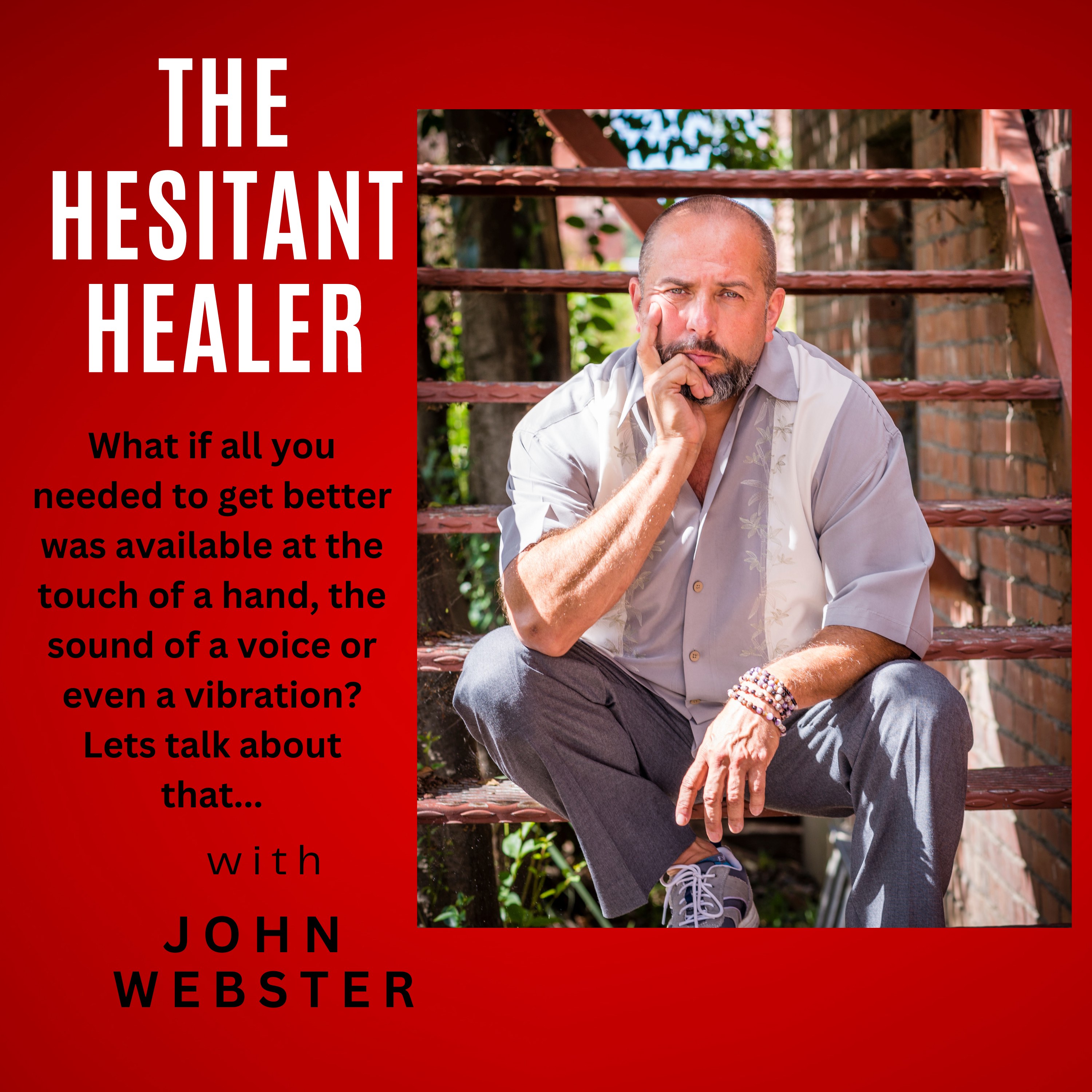
The Hesitant Healer · John Webster
John shares about his wife Lisa (his wife Lisa, not his business partner Lisa Kay). He talks about Lisa's cancer diagnosis, the alternative healing modalities they sought out and the lessons he learned as a healer through this journey. Follow us on Instagram https://www.instagram.com/redlandsmassagetherapy Watch on Youtube https://www.youtube.com/@redlandsmassagetherapy3534 Contact Us [email protected] (909)557-4415
John: What if all you needed to get better in every way was available at the touch of a hand or the sound of a voice or even a vibration? Let's talk about how that happens, who can do it, and where to find them. I'm John Webster, and this is the Hesitant Healer. Hi, welcome to the Hesitant Healer. I am John Webster and I am here with Sidekick Lisa Montano. Hey, how's everybody doing? We're gonna talk about a thing today that has to do with my honey, my Lisa, and how I got into holistic healing jumping in with both feet. So we're just gonna get right into it. ⁓ real quick, cause I can turn this into a long Hallmark story. My wife and I met in jail. No, I was not incarcerated. I was working there. Come on now. I was a cook in the county jail. And the county jail that I worked in was for San Bernardino County, which is the biggest county in the United States. Get a map, look it up. It fits into several different states if you look at it. It's a huge piece of land. The jail that I worked in called West Valley Detention Center held thirty two hundred inmates. And ⁓ I think I said in the other thing when I was cooking, we were making 10,000 meals a day. It's a huge jail. In fact, I heard at one point that it was the largest single story jail facility in America at one point. I I don't know if it still is. Anyway, I worked there as a cook. My lovely wife, we were not married, worked there as ⁓ an admin in ⁓ fiscal, and we would eat lunch and whatnot. So we became friends. There was a third one of us that we would all eat lunch together. Her name was Cindy. And me and Lisa and Cindy would eat lunch a lot and we became friends and we talked a lot and ate a lot and hung out a lot. That lasted for a couple of years and then Lisa quit the jail and went and got her degree, her college degree, and started working for San Bordino County probation department. She was a probation officer. So I didn't see her anymore. Unbeknownst to either one of us for a while, I was talking to Cindy about Lisa, and Lisa was talking to Cindy about me. And finally, Cindy said, Why don't you two just go out? And ⁓ I asked Lisa out. Now I will tell you, at this time in my life, I was not a well individual. I was ⁓ a sober alcoholic, but not very sober, probably my first five years. And ⁓ I had been going to therapy, but there was still a lot of therapeutic things that need to be fixed. I was still kind of an angry individual. I was still a sarcastic asshole. And I believe everybody or anybody that knew me back then would tell me I had issues, including Lisa. So in my head, as I remember it, we went out on one date, saw one movie, it was a rainy day, and it didn't quite work out. And I went back and talked to Cindy about it. And I told Cindy I thought she had some issues. I'm so glad my wife is not here right now because it's a different story if she tells it. She called Cindy and told Cindy that I had some issues too. And I'm like, Well, fuck her, right? And that was pretty much the end of that. So now segue three years later. We do not see each other literally for three years. She was working probation. I was working sheriff department. And ⁓ in that jail really quick story, we were doing a lot of catering out of that jail. There was a grant that allowed the ⁓ facility to take some state and federal funding that had to do with teaching inmates a skill. In this particular case, it was a skill of cooking, so we could actually certain inmates had passed criteria, we could cater with them. We could take them off facility and do catering. And we were doing a lot of catering throughout the county, only county functions. So it was an in-house thing. It's totally approved. It wasn't scary taking inmates out. It's a whole different thing. But I I went to do a party at an off facility place. I was carrying a pan of food. I came around the corner and I literally, this is three years later, bumped into Lisa. And she looked fantastic. She had ⁓ gotten her life together and had made some changes in her life. I thought she was gorgeous. We got all googly and starry-eyed. We started talking. It's like we picked up where we left off. I think at the time she had a wedding that she needed a plus one and asked if I wanted to go, kind of thing, but we started hanging out again with ⁓ friends and whatnot, and we started dating. I had some issues at the time and I was learning how to do relationships and I was ⁓ learning how to interact with the female species and and work on myself in regards to relationships and how I interacted with because I was starting to look at intimacy. I was starting to look at interpersonal relationships. I was starting to look at how to treat people like they were people and not my belongings. And ⁓ so there were a lot of things I was learning about myself and how to interact with people. And ⁓ and I was also learning boundaries. I'm gonna say that again. Boundaries. If I had an echo machine, it'd go boundaries, boundaries, boundaries, right? Because I didn't have any. Right. Well in fact, one of the first things that happened was when when I we went on that first date was that I was calling her five, six, seven, eight, nine, ten times a day like an obsessive asshole. And ⁓ And that's when Cindy told me that Lisa said I had issues. Whatever. So anyway, here we are three years later, and I'm working on that stuff. And we bump into each other. Literally, not kidding, turn the corner, bumped into each other. And ⁓ and we started dating and we started going out. Now I was learning about dating, and I will pump this book up because anybody that has any relationship or dating issues should get this book. It's by a man named Terrence Gorsky, and the name of the book is Getting Love Right. Now at the time, in addition to being being a member of Alcoholics Anonymous, I was also a member of Al-Anon, because I was addicted to alcoholic women, let me tell you. And ⁓ my sponsor had a tape of this guy. So I would listen to this tape all the time about how to the seven effective habits of healthy people, how to have a healthy relationship. So I was putting these things into effect. I was learning how to do these things. And I was practicing on Lisa, unbeknownst to her, because I didn't know how to do it, right? So it took some time, but we all went to a baseball game and I had a buddy there with me. And the buddy says to me after the game, dude, you know she's way more into you than you're into her. And I'm like, What? He goes, She's got that look, man. She's looking like you're like you're the prize. And I let that get into my head a little bit. There was another incident, and I I'm saying this incident specifically so my wife can hear it, where she came over one night and she left a pillow. And I thought, fuck, she's leaving furniture, right? She's leaving clothing. We hadn't discussed the drawer, right? Wait, can I ask a question? ⁓ yes. It's just a pillow. It was a pillow. That's what she says. It was just a pillow. I'm like, whatever, man. She left her fucking pillow in my house. I was single. It's like I I y yo man, you don't understand, right? You don't you just you don't understand. Anyway, yeah, and to this day she's like, motherfucker, it was just a pillow. So I freaked out, right? I freaked out and I started looking and and there was a an emotional displacement in in different areas of where we were emotionally in this relationship. And I did talk to a lot of people about this and and the right thing to do because I wasn't interested in a relationship long-term committed. I I was just messing around, but I was having a good time and it it just wasn't a I I wasn't ready for a long term committed relationship. And ⁓ I had intimacy issues. I'll say it, I was scared to death of that shit. So I I did a horrible thing. I broke up with her, I took her to a public place, it was after Valentine's Day. So we sat in the car for two hours while she was crying, telling me why are we breaking up? And I'm like, you don't need a reason to break up. She's like, Well, that's not how you break up. I'm like, Well, it's there's an emotional displacement. We're in two different places. I I it's not that I don't like you. It's not that we're not having a good time. I just I think we should break up. I mean, it was two hours of pure hell. And and after that, ⁓ she pretty much motherfucked me to all her friends. I was a bad subject to bring up. And ⁓ we didn't see each other for three years. Swear to God, another three years. And I also swear to God, three years later, I'm carrying a pan of food at another party in another place and I turn a corner and I literally bump into her again. Now, you know, I'm kind of a big believer in karma and fate and God and all that stuff, and when this stuff happens it's like, well, it can't be much of a coincidence then. At least my heart knew that, right? My head was like, huh. She looked even better, folks. Let me tell you. I bump into her again. She looks even better. She's done more work. And here's the extra added hallmark twist. We had begun seeing the same therapist. I'd been seeing the same therapist I'd always seen, but she had started seeing the same therapist, and neither one of us knew. So we started dating again. And we're going to the same therapist bitching about each other. And she thinks this is just the cutest thing ever. Things started to take a hold, and I was by this time, because this is six years later, a lot better. I had gotten a lot of my collective shit together. She had worked out a lot of things. We started going out and eventually we moved in together and things got serious. And we could communicate better. There were two pivotal conversations. The first one was Look, I'm about to graduate massage school and I'm going to be locked in rooms with naked women. And if that's going to be a problem with you, or if you're going to freak out, or if this gonna turn into something where I come home and tell you about somebody I worked on and and there's gonna be insane jealousy, I I don't know that that's gonna work out. And she looked me dead in the eye and said, Look, if you do something wrong, that's on you. It's not on me. If you feel you need to cheat on me, I didn't do anything wrong, you did it. Which is the correct answer. That's a healthy response. I went, okay, cool. So we got engaged. And to make up for the horrible breakup story, it was two days later, truth be told, but on that time frame, I had made a decision to ask her to marry me. And I went to her best friend who worked at the jewelry store and I bought the ring and I hung on to it for a bit until I found the right day. I could not lie to her every single day. And I had to pick a day and I picked a day close to the day I broke up with her. I think this is two years later. So now we're on eight years past the point. It was ⁓ romantically on the beach in a cave with the waves crashing. It was it was nice. Okay, so there's a story of me and Lisa. In that time frame, we picked a day to have the wedding and get married. And we were close to that date. I had just graduated massage school. She had been dating me. We had been dating during massage school. ⁓ I would work on her. I would do massages on her. And ⁓ one day she shows me this thing under her left arm, close to where she had had a surgical procedure eight years prior. The surgical procedure was because she's a redheaded girl. She had had a melanoma scraped out of her armpit. It's just in between her armpit and her elbow, right in the middle between the bicep and the tricep. And ⁓ she had a pretty decent score there because they had gone in and scraped it out a second time. So eight years prior, she had had this procedure. And now there was a pretty good sized lump, about the size of ⁓ I'm gonna say a peanut ⁓ and ⁓ or a gumball. She went to her regular doctor who felt it and said, ⁓ it's probably just a swollen gland or node and ⁓ take some antibiotic. She took some antibiotic and the swelling did go down, but it went down to the size of a jelly belly, a really small, hard piece of round tissue. So that was all good. I think we even went in. Eventually she went in and they said they couldn't biopsy it, but they would just take it out. So they went in and took that out, and that was that. Shortly after that surgery, we still weren't married yet. I was working on her and I would work on her maybe once a week. And ⁓ not extensive massages, just kind of lovey dovey massages, but there was nothing there one week and I did it the next week, and there were three. And we became concerned. So we go into the doctor who says, Because of your age, because of your hair color, because you have a history of this and a family history of this, I would be very concerned and we need to get in there and take it out and look at it. And she said, I'm getting married in two weeks and I'm going on a honeymoon. And I'm not doing nothing until that gets done. He goes, All right, but when you come back. We're going to do a biopsy. And we're like, okay. So we get married, we go on the honeymoon. We had a good time. She comes back. She schedules it. I remember the day very vividly. He was a general surgeon local here in Redlands. And ⁓ she scheduled it. Her mother and father and sister were all in the recovery room with me. It was a day in which my youngest daughter was doing her driving test. So I went and prepped her and and hung out with her and gave her a kiss on the forehead when she got all gowned up and then I left, said I'll be back in an hour. And I went to my daughter's driving test, passed, and then I went back to the hospital to find her sister on the floor in the fetal position crying hysterically, and her mom and dad hugging each other. And I'm like, what the fuck? They said they couldn't speak to me. They said, go talk to the doctor. I went out and talked to the doctor. He came out in his scrubs. He says, I opened her up from her elbow to her armpits. He says, and everything I could see was tumors. He says, I took out as many as I could. He says, but I don't feel comfortable taking the little ones out. He goes, but I stuck my finger up into her brachial plexus. And as far as I could stick my finger, I could feel nothing but tumors. And everything on her ribs is black. Black in a body is not good. And that's what I said. So he says it's not good. And I can't do this surgery because it's it's too extensive past this point. So reeling is the word that comes to mind after that. You you you don't know what happens. Your world goes into a tizzy. It's just like the movies. You can't think, you can't breathe, everything's foggy, and time is your enemy because you don't No. In fact, I've come to call this phase of any kind of surgical procedure or bad diagnosis, I don't know land. Because in that world of I don't know land, a lot of crazy shit can happen in your head. And you go to worst case scenarios and you can get very dark, very deep, very quick. So in that time frame, we started making phone calls. And one of the interesting things that had happened was ⁓ we had a friend who worked in our insurance group and she helped us get a second opinion at John Wayne Cancer Center in LA with a doctor by the name of Mark Ferries. Swear to God, this guy looked like Doogie Hauser. And Mark Ferries ⁓ had done a biopsy the second time when he had said, well, before this surgery, he said, Yeah, it's it's cancer and we need to get rid of it. And that's how we got to the surgery we just went through. So A few days later, while she's still healing, I'm gonna say a week or two, because it, you know, the medical community does not work very quickly overnight. We went in to see our primary oncologist. Now, this was the second oncologist we had had, because the first oncologist, who we kindly have named Dr. Death, who was a Middle Eastern man, when we first went in there with the biopsy results, said This is a bed cancer. Bed cancer. One cell gets through your liver or your brain, you will die. You must have a major surgery now. And we're like, ⁓ and he was pushing. He was pushing hard for a major surgery. In fact, we found out later from the doctor who did that biopsy surgery that he had been at the cancer board listening to this guy who had told the cancer board that he wanted to cut her arm off. No. That's how bad. Yeah. That's how bad he thought this cancer was and what he wanted to do. And we fired him. We got his partner, who was an older oncologist, who had a better bedside manner. And this is who we went to when we were getting the results from this major biopsy that the that the doctor had just told us about. He also informed us that they had made a mistake. ⁓ during the surgery and they had cut one of her major veins in her arm and that that took a little bit of time to fix as well. We go in and he reads this thing to us and he read it, all the doctors speak. He read all the things that said it was. He he told us and shook his head and basically he said, ⁓ the best we can do is interferon, which is going to give you major flu symptoms for nine months with a 13% per 13% chance of recovery. And we said, no, thank you. What other options do we have? And he says, you should go to the CDC on the East Coast and see if you can get into a clinical trial. And that's where we lost it. We drove home in a day. I went into the other room and I started calling friends and family on the east coast to see if there was anybody that was nearby that we could go to. I was willing to sell the house at this point. We were going to do whatever it took to get her better. Unbeknownst to me, she's in the other room and gets a phone call. And it's just a courtesy phone call from Dr. Fairies just to see how she was doing. And she went, blah, right? And vomited the last two, three weeks on him. And he said, Whoa, whoa, whoa, whoa, whoa, whoa. Check it out. First of all, I don't know I I can do that surgery. He goes, I can do that surgery easy. Second of all I don't know why he told you to go to the East Coast, because we're doing more clinical trials here on the West Coast than they're doing the East Coast. And I can help you with this. Come see me. And we're like, deal, right? So we go see him and he set up a protocol that that would pretty much envelop our lives for the next year. The first was ⁓ getting her into surgery. And in order to do that, you gotta heal from the surgery you just had. They can't really go right one on top of the other without having some healing done. So the surgery was a few months out. Here's I don't know land, right? Hey, you got this thing in you and it's growing and it could kill you, but you're gonna have to wait. It's maddening. So what we did was start looking at alternative therapies, right? And in these alternative therapies, we found some very interesting stuff and we were willing to do whatever it took. I found a book called like the psychobiology of cancer that talked about German cancer therapies. I I learned about Ayurvedic medicine. We went to Ayurvedic Meditation Healer. We went and saw Deepak Chopra and Deepak Chopra's doctor, Dr. David Simon, and and learned about all the different medical things that you could do: juicing, diet, exercise. We did Reiki once a week. We did massage once a week. We did craniosacral therapy once a week. We got into antioxidants and pH levels and oxygen in the water. And there was a thing that my massage teacher had called the steamy wonder, which is pretty much a tent that goes over the massage table that you put a steam vent into and you bring the body up into a hundred and 120 degree fever state. And then you pull that thing off and you ice the body down with cold ice water and it triples your white blood cell count. We did everything. At one point in our research, she stopped eating for three days because everything you eat causes cancer at some point, right? The fear that surrounds this disease is unbelievable. And here's a super important part about this story. At some point in that time frame, she also made a decision that she did not want to die. Now I'm not saying if you should be in this position that making that decision is going to save your life. But for me, in this case, with this particular thing, and I've seen it time and time again, the will to live makes a difference. And if you choose to live and do whatever it takes to live, it helps with your fighting chances. So we finally got in to see Dr. Ferries with the surgery. It was supposed to be a two hour surgery. We went out to LA. ⁓ she went in, I put the timer on, two hours came and went. Three hours came and went, four hours came and went, nobody told me anything. Five, six, seven, eight, nine hours later, he comes out and he says, Look, because by now we've been doing alternative stuff for almost six months. He says, ⁓ I went in there and took every possible tumor I could see out of her. He goes, and surprisingly, they're smaller than I thought they would be. I thought they would be growing and they don't seem to have grown much. He goes, in fact, I brought a team into biopsy stuff as I pulled it off of her. He says, I took the tumors off and had them biopsy didn't. A lot of the cancer wasn't thriving. He says, and all that black stuff on her ribs, he says, it's it's dead. It's just dead cancer. None of it's alive. And he says, This is hard to talk because I start crying when I tell this story. He says There was a thing in her arm we couldn't figure out. We had to call up the surgical notes from the last surgery and come to find out they had made a mistake and cut one of her veins in her arm. I went, ⁓ yeah, I forgot about that. He says, Yeah, her whole arm has has re rooted itself. All All the veins have rerouted themselves in the arms pretty healthy. And so a lot of what he said was, I don't really understand how it looks, but it looks like it's it's getting better. And I'm in a mess. I'm in tears. It's it was a pivotal moment where I started to believe that alternative medicine might be a thing, right? And to this day I can't tell you which one of those things worked. Maybe they all worked, maybe one of them worked, but whatever it was, there was something going on in her body that was working the opposite. Of what was happening when she first had her melanoma. I haven't told you yet, but it was stage four, metastatic, recurrent melanoma. And at one point, deeply into this saga, we found a book. Again, I'll never forget this, where she just went ballistic reading this book. I was watching TV, I'm like, what, what, what, what, what? And in this book, it said this type of cancer that she had. ⁓ Within three years had an eighty-five percent probability of death. And at five years, a hundred percent probability of death. A hundred percent she was gonna die with this thing. And we had seen a ton of doctors, and nobody had told us that. Nobody had told us how bad it was. They told us it was bad, but they didn't put those kind of numbers to it, right? And when you're in the middle of that fight and you find out that what you've got is gonna kill you and nobody's fucking told you yet, not cool, man. Not cool. But we did have a doctor who said he could fix it and he was gonna help us. After that surgery, he set the next state of affairs for radiation. And ⁓ if you've never had radiation, especially this kind of radiation, they have to mark it. So she got tattoos around the area. when he did the surgery, he took out twenty-eight lymph nodes. They did a full lymfectomy of her left axillary region. So she didn't have any lymph nodes in there to fight anything else. You ever get cancer there again, she's kind of screwed because there's nothing to fight it. The lymph nodes, those little bastard soldiers were taking that shit on and they were kicking its ass. And ⁓ once he sewed her up, he he he set in motion to get ⁓ radiation and so they tattooed little markers. Cause you have to pinpoint where you're gonna put that radiation. And then ⁓ what should have taken ⁓ I think it was three months of radiation, he put into five sessions over the course of two weeks. They radiated the shit out of that arm, right? And ⁓ if you've never had the the benefit of touching radiated tissue as a massage therapist, let me tell you what it does is you may as well be taking a blowtorch to it, right? It it it burns the tissue and bear with me here because I used to be a chef and because it's the way I see things, when you radiate human tissue, it mirrors cooking a steak. Right? It feels like a piece of meat that has been shriveled and shrunk right down to the gristle. Same materials, folks. You add fire to that, that's what happens to us. And when you radiate those fine tissues within a human body, they're going to shrink, they're going to tighten up, they're going to turn into hard gristle. It's going to make movement. Difficult, right? And that's what she had in that arm for a long time. To me, it felt like hard burnt plastic. And myofascial release, long, slow, steady tractioning of those tissues over time, plus heat, the heat of my hand and the friction of my hand. Turned those tissues back into pliable tissues that allowed movement. It took time. It is possible to change and reverse some of the things that happen through radiation. I will tell you since then I've had a couple of cancer patients, one of them who was way overradiated, where I couldn't get it to come back because it had burnt been burnt too much and it had literally stuck to the bone. So it depends on the surgery, it depends on the surgeon, it depends on the procedure. But we can make a difference, right? We can make a much bigger difference through manual palpation, through manual movements, through different techniques that we have available to us as healers that will allow some of these tissues to change and grow and regenerate. Yeah. So After the radiation, he put her in a clinical trial. And if memory serves, he got her in, because it was his clinical trial, ⁓ last. She was the last one to be in the clinical trial for immunotherapy, the immunotherapies that are used today. So basically, what they did was, and this was after after radiation, you gotta wait for the body to heal. So here's another two, three months, right? And then when she finally did go in, and it was three times a week, two times a week, one time a week, every other week, every three weeks, once a month, once a month, every six months, that was almost nine years of that, right? But over that time when we first started, right out of that that surgery, there was there was weekly blood draws. And then eventually when we got into this immunotherapy, they put a pen, like a ballpoint pen sized catheter. into her femoral artery. She passed out immediately. It is not a fun thing you want to happen to you. They put ⁓ blood through a machine that separated white blood cells from red blood cells. And then they took her white blood cells and sent them to a lab down in La Jolla, I think, and then ⁓ sent that back with some killer T cells in it and ⁓ her immune system killed her cancer. The first time they did that, they didn't get all the red blood cells out, so they had to do it again. So she went through that procedure twice. Shortly after that, interesting things started happening. Numbers started to change because I've told you she's a red haired girl. She has a lot of ⁓ moles, and some of her moles started disappearing. In fact, they they turned her into a little bit of a test case because they'd never seen that. The ⁓ the immunotherapy Was taking the moles that she had had for years and eradicating them because they saw them as dangerous and they just took her moles away. Not all of them, but a lot of them. Pretty interesting stuff. Gradually she started getting better and better and better. And ⁓ we're at 17 years now, and we're still married, and she ain't got no cancer, and that guy saved her life, right? So The body is an amazing thing. And it's how I came to view that we could work with the medical community and we can work side by side with the medical community and we can work independent of the medical community. As I was learning these things, I'd go into Dr. Ferries and say, Hey, blah, blah, blah, I learned about this, and he'd say, Yeah, we don't think it works that way. And in some of those cases it's like, I know it works that way 'cause I just saw it happen, but I'm not gonna argue with the guy, right? A lot of times with the medical community, ⁓ they've been trained a certain way and that's the way that they're gonna stick with and they have to, and I don't I I ain't mad at You know, I break my arm, I'm not going to a healer, I'm going to a freaking doctor who can put a cast on it, right? There there's room for all of us here. And and I am not saying the medical community doesn't work. There's parts of it that are pretty broken these days, but don't hesitate to go to a doctor or or a psychologist or a therapist or an alternative healer. You're all about your own healing. Here's what I know about this kind of thing, and we had to learn this the hard way. If you're going through a huge medical problem, become your own doctor. You have the right to learn as much about it as you can. Do your own Homework. Learn about it. Talk to other people. Find books. Find healers. Find doctors who will talk to you. Don't put up with assholes. You don't like your doctor, get another one. You don't like your hospital, get another one. I understand insurance is a problem. I understand paying for it is a problem. But if you want to get better and it's serious and you're going to die, you do whatever it takes. Cause there are methods out there that can heal a lot of things. that people who are waiting for appointments and medical establishments to refer to the right doctor are dying while they wait. And I don't think that's okay. Yeah? So Can I ask a question? Yeah, yeah, yeah. So let's just circle back to that very, very first doctor, the one you called Dr. Death. ⁓ and again, you and I and Lisa are all ⁓ the same age. Well, I I say we're the same age. I happen to be the oldest, but I and I will admit that. ⁓ but we all kind of grew up with if the doctor says it, we listened to it and we went with it, right? That correct. Right. So if you had listened to that very first doctor, it would have been okay. Like ⁓ get your ⁓ get your affairs in order, that's it. My understanding is if we listened to that first doctor, he would have cut our arm off. And and her cancer probably would not have been alleviated. It would have probably continued to go. If we had listened to the second doctor, more than likely she would have died as well. Wow. And and you know, that's just not okay. Right. And and so you know, I mean, we learned a lot. I I I like a lot of the methods that I found during the alternative healing phases, right? I I networked with a lot of healers at that point who taught me a lot about the way the body works, right? How cancer loves sugar. You know, I mean and and I don't know about y'all, but I love sugar. I'm addicted to sugar. It's what made me a great alcoholic. I didn't like straight whiskey. I like my tice. Right? And and and Bicardi one fifty one and Coke with the sugar. You know, I mean I I I love sugar. So but it's not always healthy for us, right? My mother was right. Let me tell you how much that hurts to say. So alternative healing. Is a thing that you need to research, you need to find what works for you and and take what you what you want and leave the rest, right? I I don't necessarily believe that crystals are healing. However, I don't negate the fact that they do. And I don't negate the fact that people who do believe in that or who do use those aren't doing something great. I just haven't learned how to do it yet, right? There's people out there who see auras. I don't see auras, right? I I just never have. I have seen people who have turned green, which means they're pretty close to death and they're not healthy. I have seen people that have no pupils and their eyes are completely black, and that's usually not a good sign as far as the spiritual realm is concerned. And I haven't seen either one of those in a long time. I may have grown past that. But I know people who can look at auras and see and tell things about you right away. Right. I think if you're in an interview with me and you come sit down and I've never met you before, the first thing I'm gonna say is what's going on? Tell me about yourself, tell me about that injury. Because I can see bodily movements and behavioral ticks and psychological traits that jump out at me in response to the injury or the trauma that you've had. I can see unspoken things, I can see spoken things, and a lot of times that questioning leads to. ⁓ interesting pieces of the puzzle of the injury. Yeah. Perhaps we'll talk about that at a different time because I don't want to to degrade from where we're at today. But my Lisa is a hundred percent healthy these days. And there were, let me tell you, we're not, we're not saints, right? I mean, there were some times the next year or two, and every once in a while she brings it up where she's like, My God, I was going to die of cancer. And here I am eating this. Chocolate, right? Or I'm going back to eating what I used to eat and I didn't even pay any attention to it, right? But the wake up call was there and the cognizance is there and the reality of A equals B equals the big C. ⁓ if you don't pay attention to it, you're gonna go back. My dad smoked for 70 years. For a number of years, we thought he was going to die of cancer. That's not what killed him, right? I distinctly remember my grandfather when I was seventeen, we were at a family party, he had emphysema, he went into a coffin fit where he lost all of his air. And there were fifteen of us sitting around watching him tank. Nobody could do anything, and he could not pull that air back into his lungs until he did. And I remember telling my dad, I watch years later, as a matter of fact, but it stuck with me, right? Years later. I don't want to watch you do that. I don't want to be the guy who watches you do that. Didn't change the fact that he smoked for another 40 years after that, right? Right up until the end, he was 85, and a few months before he died, they discovered a tumor in his lungs, right? And they they he had lung cancer. But that's 70 years of smoking. And although it was a contributing factor to what killed him, it was not the thing that killed him, right? So who's to say? There are a lot of people with some. tenacity when it comes to their body that can last a long time with some fucked up stuff and and they're still kicking. And then there's some people where one single thing takes them out. There is no rhyme or reason to this, right? When it is your time, it is your time, right? We we have today. It's the best we can do today with the information that we have today. And today I choose to be the hesitant healer. I choose to hang out with a wife who has survived cancer. I got Lisa Kay in my corner who's been through a pretty good medical emergency. And there's people out there who I have known and who I've helped who have learned to follow the breadcrumbs of alternative healing that are much better today because of it. And I believe that's the message that I want to share today. I Thank you all for listening. I appreciate it. Please like and subscribe and tell your friends, right? If you think this is fun, if you think this is good, tell your friends. If you want to leave some comments, we got a Facebook page called The Hesitant Healer. Go ahead and subscribe onto that and start leaving me some messages. And ⁓ we'll get this baby off the ground and turn it into some fun hesitant healing. Y'all have a good day.