
The Health Pulse · SAS
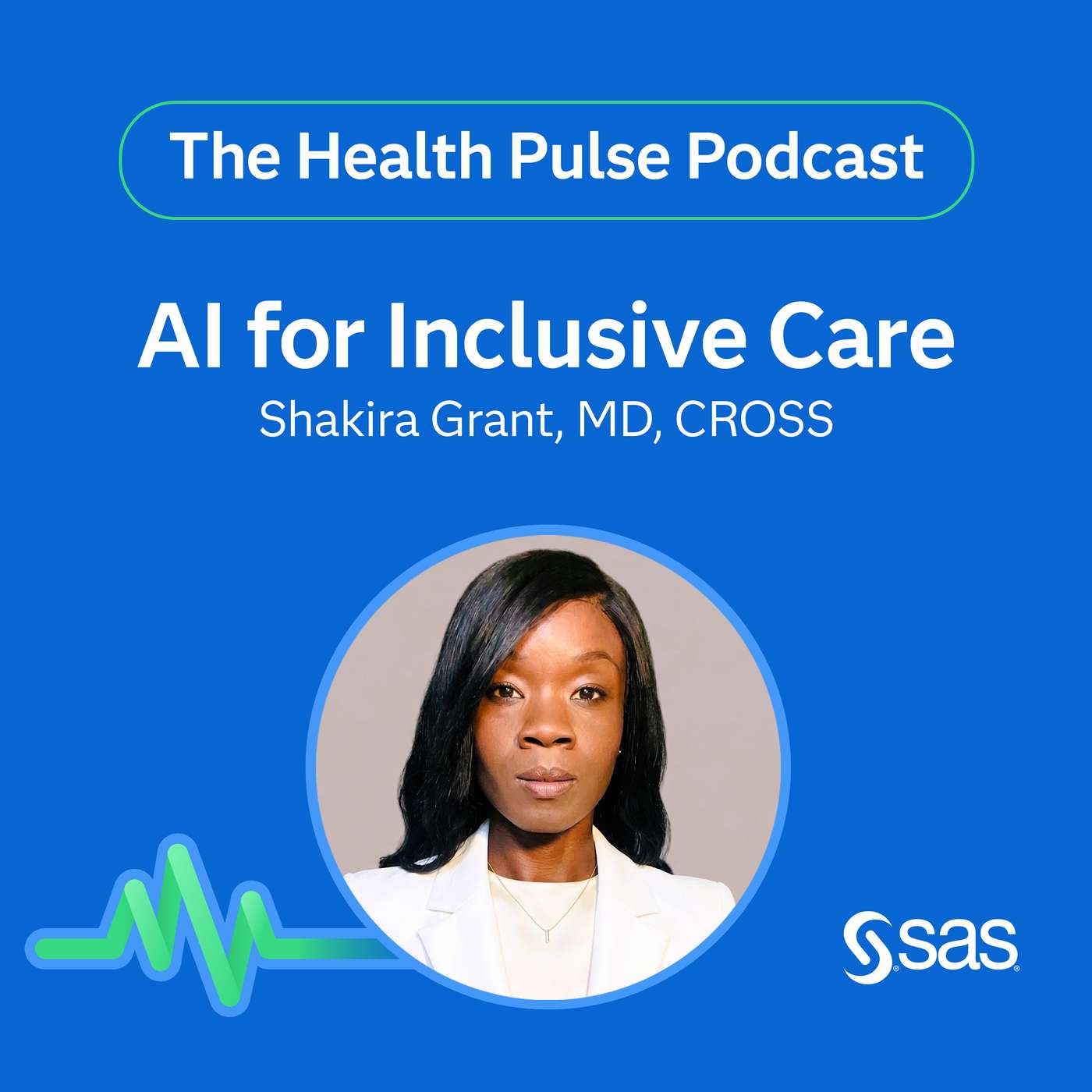
How can AI help create a more equitable future for health care? On this episode of The Health Pulse, Dr. Shakira Grant, cancer physician and CEO of CROSS Global Research and Strategy, shares her vision for using AI to expand access to clinical trials, improve patient understanding and support more inclusive health care. She explains how AI can help identify more patients for clinical trials and enhance patient education. Dr. Grant discusses why patients and physicians should help shape AI from development through deployment and the importance of transparency and trust. She also explains why human empathy remains essential in cancer care. She also explores how AI can help close diversity gaps in clinical trials. Dr. Grant emphasizes why ensuring AI is fair, safe and equitable is critical to improving outcomes for all.
SHAKIRA J. GRANT: I believe if there is one principle that I want people to think about with AI is that when we have conversations about bias and equity and fairness and access, that we need to move beyond just thinking about the data. We need to think about all the way through to what is happening and who has access to this tool. ALEX MAIERSPERGER: Dr. Shakira Grant, a cancer physician, joins us today to give us the rundown of how AI will make it easier for patients to get into clinical trials, why humans will always be the ones holding hands at a diagnosis, and how we can make sure AI doesn't leave anyone behind. [UPBEAT MUSIC] Dr. Grant, you describe yourself as someone who's passionate about making sure AI serves everybody. What in your clinical work led you to believe that this would be a challenge with technology in the future? You sort of came before the time of full AI adoption. So you saw the early bits and said, hey, this might be a challenge going forward. What led you to believe that? SHAKIRA J. GRANT: It was really what I was seeing at the bedside. In medicine, we are taught to practice evidence-based medicine. And every single day in the clinic, I needed to make tough decisions for patients about what cancer therapies they would actually be receiving. And oftentimes I needed to make that decision based on available clinical trial data, which sometimes did not include patients who look like them. And for me, when I saw that, I recognized that we also had a challenge with data missingness and underrepresentation when it comes to AI in health care. And what that means is that AI tools are being developed. And there are some populations that are just not represented. And I saw an opportunity where the same thing that we've experienced with clinical trials, where fewer than 1 in 10 patients with cancer actually participate in a clinical trial, that we were likely to see the same thing with AI, where we had to make decisions about AI solutions in health care, using data that actually was not used to train on these models where these patients were represented. And that was the a-ha moment for me that really said, the same patterns that we've historically seen for decades in clinical trials we are likely to see with AI coming into health care. And that was my moment that I knew this was something I needed to jump into. ALEX MAIERSPERGER: From your work with older adults and cancer patients, where do you see technology really helping, and then where does it risk leaving people behind? SHAKIRA J. GRANT: So I think where technology can really help is really in helping to close a lot of those gaps that we've longstanding had in clinical trials and the ability to recruit participants, especially older adults. So historically, when we think about clinical trials, in particular in the cancer setting, clinical trials tend to select for younger, fitter, and more well-resourced individuals. And here we now have AI as this new technology that can help us to screen and identify patients who historically may not have even been surfaced for the opportunity to participate in the trial. And that is really, really exciting. But it also highlights a gap because, at the same time, while we're saying, hey, we can use AI to screen massive amounts of data in the electronic health record, that misses the people who actually aren't represented in that EHR. And that could be some older adults. It could be those who live in rural and frontier communities. It could be others who are uninsured and who have difficulty paying and accessing the health care system. And so that makes it really challenging to say that everyone will be captured by using AI in this way to help identify people for clinical trials and get them towards appropriate therapies. But it's also very exciting that if done responsibly, that we can definitely see some of those gaps in the diversity of participants in these trials start to close. ALEX MAIERSPERGER: You talked a little bit about the communication side being where technology will help closing some of those gaps or just surfacing the ability to participate in a clinical trial. And so some of that is communicated to them. There's a few reports and studies out and obviously early. And some sort of have different opinions on this. But people have reported that they like the way AI communicates with them better than their physician. And so they say it shows more empathy, or it connects with me better. Is that going to be true over the long term? If you have to give someone a cancer diagnosis, would they rather that be from a chatbot that tells them in a nice way? Or if they have to understand that they're available or eligible for a clinical trial, do they want that to come in a text message? Or will it be-- is this the area of just humans? SHAKIRA J. GRANT: I think there are some things where, definitely, I've seen that body of evidence emerging where patients have elected to talk to these chatbots and really develop these close relationships and bonds and use words such as, they're more empathetic and more available to them than when they're in the clinic with their doctor. The biggest challenge, I would say, with cancer is that cancer, there is something deeply personal and different about sitting across from a patient and having to tell that person, I'm sorry that you have cancer, especially when we're dealing with terminal or incurable types of cancer. And that is something that I believe that an AI chatbot, no matter how great it may be at conversation, it can never convey the level of empathy. It can never replace what it means to be a physician and reach across and touch that person's hand or just pause and give them the space they need to process this diagnosis. So I do believe that AI has a role to play in these conversations but not in the clinic room, where we're delivering this type of news about a patient having cancer. On the other part, with helping patients understand clinical trials, I do believe that is where we will see a lot of momentum. And the reason I say this is because if you think about the modern health care system, and you think about how much time do you really have with your physician, generally, it's about 15 to 30 minutes, if you're lucky. And if you need to actually talk to a patient and explain a clinical trial and all of the complexities, there's just not enough time in that visit to do it. And so this is where I believe AI chatbots have an essential role because patients can then, on their own time, ask that chatbot for information about what is a clinical trial. Help me to understand this trial in language that I usually communicate with or in a language that I speak. And so that opens up more possibilities. So that one I am the most excited about. ALEX MAIERSPERGER: We had a gentleman on that was diagnosed with what was likely terminal stage IV cancer. Now it's been over 10 years. And so he's sort of beat the odds, continues to beat the cancer. He talked about his personal preference was that we don't talk about putting patients at the center because then it's everything happens around the patient. And I think we're seeing some of that with the way AI is designed or deployed at health care systems. What does it actually mean to keep humans maybe not at the center, but involved, especially patients, when AI tools start showing up in care decisions? How do you make sure that the patients know what you're using, when you're using it, where you're using it? Is that something? Is it a conversation? Is it patient panels to make sure that they see the technology before it's implemented? How do you go about those decisions? SHAKIRA J. GRANT: So I would say-- I wouldn't say move the patient from the center. I think whenever we have a health care AI conversation, patient centeredness needs to be the starting point. So when I think about the tech teams that I've engaged with through my work, I always try to convey this point, even though you may feel as if you are really far removed from the clinic, every single decision that you make upstream is going to have a downstream impact on the patient. And so when I think about patient centeredness, I think about all the way from the beginning of the AI life cycle, from when you were even conceptualizing what AI solution am I going to build, what problem am I trying to solve? What communities am I trying to impact? That is where you start with patient centeredness, and you let that be the grounding light as you move forward. When you think about, as you get further upstream, and these tools are in the clinic, patient centeredness looks like myself, as a physician, and other clinicians working in partnership with that patient on a one-to-one basis to let them know how AI is being used in their care, give them the option, if possible, to opt out of having AI used in decision making, and allow them to feel as if they're a part of this shared decision-making model of care, which is something that we really try to advocate for, especially within older adult oncology. And that is how I believe that we need to keep patients at the center, by the way we design and ultimately the way that we deploy these tools in real life in the clinic. ALEX MAIERSPERGER: We talked about the patient side and keeping the patient at the center, keeping the patient involved. How about the physician side? Why is it so important that physicians are directly involved in the building of AI and not just being end users of it? SHAKIRA J. GRANT: So I like to think about this in the stethoscope analogy. When I started medical school 25 years ago, I remember getting my first stethoscope. And I immediately knew what to do with it. I could put it into my ear. I knew that I needed to put it on this patient's chest. And I needed to ask them to take a deep breath in and out and then stay quiet when I was listening to their heart sounds. AI is not that. AI is not a tool that we simply bring into the clinic and expect that everyone is just going to know, especially physicians, how to use it. And this is why I strongly advocate for physicians having a seat at the table as early as possible. This means in tech communities and tech building that physicians should be in the room, helping to guide what type of problem you are developing and solving for and be with you as you walk through that entire AI lifecycle, from development to validation, all the way to deployment and post-deployment monitoring. And here's the other argument I would make for physicians in the room. Physicians are bringing front line experience that tech teams that are far removed from the clinic, they don't have that reality. We can tell you what is likely to work within our workflows, what is likely to be received well from a patient perspective, and then take a step back and say, hey, from a health care system perspective, from an economics perspective, the health care system that we are in, we're not just really going to buy into this particular tool because maybe this is a different model in which we've been able to deliver care that is cheaper and more economical. So we're able to bring that multifaceted lens that I think really helps tech teams as they're building. And so I really strongly advocate for physicians and clinicians, in general, having a seat at the table where these tools are being developed and built. ALEX MAIERSPERGER: Talking about actually using it, just day-to-day life-- this could be on the personal side or the professional side. Using AI, are you experimenting in daily life with it? Are you testing out these tools, seeing how they help? Does that translate into the bedside yet? SHAKIRA J. GRANT: Yes. So I use AI, I would say, quite a lot. My entire workflow is AI driven. And some of the work that I do, I actually work in model training and working with some of the larger frontier models and developing professional tasks and prompts for those and writing rubrics. And that has been a really eye-opening experience for me. So I could tell you from a professional perspective, I am always mindful about what I'm putting into the AI system, how it's making decisions. And while I use a lot of AI agents to help coordinate my everyday workflow, I make sure that I am doing a manual override, and I'm constantly checking. And so things like drafting emails and sending them automatically, that is a no for me. I will do first drafts with my AI agents, but I will always check, and I will edit, things like summarizing the evidence. I'm always cross-checking citations to make sure those are real, outreach to people, planning for events. I use AI in that way. From a model development perspective, I think this is where clinicians do not recognize that their front line knowledge is really helpful. And so being able to work with a lot of these frontier models, as they're being built, to actually build out tasks as we would think about them in our workflow-- and then test these models to see how it compares to how we make our general medical decision making in real life. And then grading them-- this is an exercise that I think physicians and clinicians should definitely be involved with because it helps with model development, and it also helps the model to understand where it may be making decisions that may be outside of its scope and actually should be escalated to a human. ALEX MAIERSPERGER: I was ready for you to say, I'm building the grocery list. You're like, I'm building models and national rubrics for other physicians to follow. We went beyond. SHAKIRA J. GRANT: I haven't used it for building my grocery list, but maybe I should try that. But no, I'm very hands on when it comes-- I'm probably one of these rare physicians who has really taken this approach to dive in early and to really become hands on. Because the way that I saw it, you could either wait for other people to build it and give it to you and tell you how you should use it, or I could move myself upstream, and I could be a part of the conversation and help guide how this is being developed and also bringing my policy lens and my AI governance lens and help people understand why these best practices are important. So that was the lane that I chose to swim in. ALEX MAIERSPERGER: And you're swimming. We talked earlier about some of the communities that may get left behind. It could be older adults. It could be in the rural areas. It could be other marginalized communities. Let's talk about the builder responsibility. You've talked about how important it is to have both patients, both to have physicians at the table. What responsibilities do AI builders have to marginalized communities from day one? SHAKIRA J. GRANT: I think the biggest one is the idea of do no harm. One of the key principles that medicine and as physicians and clinicians we take is an oath to say, do no harm. And I think this should be the same principle that should hold true for AI developers. And what this looks like is, in order for you to do no harm, you need to have a comprehensive understanding of what the challenges are within that community. And that only comes by community partnerships. So one of the key things that I believe is missing from the conversation and where AI developers tend to skip over is the need to engage with communities and give them a seat at the table to help co-design and co-develop models with them. And why this is important is because building these relationships, it takes time. And it takes trust building. And I know a lot of people will push back and say, we just don't have that time. They don't have the expertise. But this is how I would counter that. And I would say in all of my work engaging and doing community outreach work, if you have a problem that you're trying to solve from the outside for a community, the chances are that community has already thought about that problem. They've already synthesized many different solutions to it. And the rate-limiting step is often they just don't have the resources, whether it be financial or people, to actually mobilize and get the actual solution in place. And so I believe strongly that communities have the solutions. And so if we're going to be building and developing AI solutions for them, we need to do it with them and not build for them only. ALEX MAIERSPERGER: I love that. It goes back to that principle of, like you said, with them and just including physicians, including the end communities at the table from day one, especially important not to build and then go talk, but to talk as you build. SHAKIRA J. GRANT: Exactly. ALEX MAIERSPERGER: Really important. You talked a little bit about being at the bedside. And whether it's holding the patient's hand, talking through a cancer diagnosis, or whether it's informing them about their options and treatment options or clinical trial options, one thing that comes up with AI is liability. And so, obviously, if it's a prescription that's being solely written by AI and delivered, that kind of goes on the company that's building the AI. But if you're the physician, and you're saying, hey, I'm going to go research this case before I go talk to the patient, and I'm going to use every available tool at my disposal, and one of those tools gets it wrong-- doesn't include the community member type, doesn't include some type of information-- how do we think about this? How do we think about the liability issue? And is there harm in this? Does this come back to, hey, this physician was an advisor to that company, and now it goes on that physician? Do you think about this in the practice that you have? SHAKIRA J. GRANT: I mean, I think about this a lot. And I would say there's no clear-cut answer as to where liability stands when a physician actually uses an AI tool in the clinical setting and harm comes to the patient. Everyone kind of tries to kick-- I'm going to use a football analogy, even though I'm not into sports. But I'm going to say everybody tries to punt the football here because physicians, we are the end users. And ultimately, we're the ones with malpractice insurance. We're the ones who will be seen as liable and held liable. Many have pushed back against this and said, hey, physicians should not be the only ones held liable. We need to move upstream and also think about the role that the developer played in building this tool. Did they adequately disclose, for instance, that their tool may be not performing as well for some populations because when it was tested and validated, it didn't include those groups of people. So I believe that when we talk about liability-- and I'm not a lawyer here, full disclosure. But I think we need to be thinking more about a shared liability model because putting it all on the physicians, in addition to all that we face in general against malpractice and just outside of AI, I think that will discourage physicians from actually wanting to use AI solutions in clinical care because people are going to be fearful of being sued if something goes wrong. But instead, we need to really come up with a model that says how to really assess where the error occurred and identify whether a shared model is more appropriate, rather than saying that there's one person in this entire life cycle that is ultimately responsible for the harm that comes to a patient. ALEX MAIERSPERGER: That was a really helpful thought process of thinking about it. And I guess we both have to give the disclaimers of, we're over here talking legal without legal advice. But I think we're all trying to think through what does that mean. How do we build things that are helpful to people without harming them in ways that we maybe haven't even thought of yet, as these models get used in places and with people that we don't intend to in some regards? SHAKIRA J. GRANT: And then one thing I would just say as a follow up to that is just, in terms of when you use the model, I do agree that physicians, we ultimately have the decision about whether or not we take the advice of the AI model. But what that doesn't factor in is, again, the way the visits are structured. We are crunched for time. We're trying to see patients. We're trying to do the best that we could. I don't know of any physician who goes into a visit and say, my intent is to cause harm to this person. That's never our intent. But you're so crunched for time, you now have this AI solution is spitting out this recommendation. And people fall into this idea of automation bias, so where even if you know better as a physician, and this recommendation feels against what is the best clinical judgment that because AI said it, that you're just going to automatically just take that advice. And ways that I think we need to start thinking about this beyond just even the liability question is we need to start with education. And we need to help our clinicians, our front line health care workers understand how to have good relationships, positive relationships with using AI in health care and knowing when they need to rely on their own medical knowledge and training to supersede what the AI solution may actually be recommending. So I think that is a lens, the education aspect, that we don't often talk enough about, again, because it's time consuming. It's expensive to pour into education. But we really need to think about how we're training people to use these models in clinical care. ALEX MAIERSPERGER: I'll probably butcher the quote, but there's a quote out there of just like, "Technology, adoption is ultimately behavior change." SHAKIRA J. GRANT: It is. ALEX MAIERSPERGER: Or it's like, no matter how good the technology is, it's still people that have to implement the technology. And so it's truly about the education and about building behaviors in people. SHAKIRA J. GRANT: And relationships. ALEX MAIERSPERGER: Great call. If there's one principle you want people building health care AI to hold on to, what is it? SHAKIRA J. GRANT: I think for me is the idea around bias that develops across AI. And I want people to understand that bias in AI is a life cycle issue. And the reason I say this is we talked a lot about different populations, which falls under the bucket of equity and fairness. But when we think about bias and the decision making within a model, because perhaps it wasn't trained on data that is representative, or there are missing groups of people, that is just one aspect of it. And what it truly misses is the idea that if we truly want everyone to benefit from AI in health care, this means that we need to think about the ways in which equity is implicated from design to model development and validation, all the way through to deploying and post-deployment monitoring and beyond. Because in the post-deployment stage, that is where you need to be thinking about how is this tool differentiating between different populations. Is there a benefit for some and not a benefit for others? Is that a potential area for bias developing? And even before that, we need to think about whether or not everybody will have access. Because the tool is available, everybody doesn't have access. I can assure you that when we look across where AI is being implemented in health care systems, it tends to cluster around larger health care systems that are well resourced financially and have the people. But if you go into rural communities, and there are so many rural communities in America where there are critical access hospitals, or if they're just barely getting by on thin margins, those health systems do not have the resources, the people, the finances to pour into health care AI. So this is why I believe if there's one principle that I want people to think about with AI is that when we have conversations about bias and equity and fairness and access, that we need to move beyond just thinking about the data. We need to think about all the way through to what is happening and who has access to this tool because that, to me, is one of the more important questions that we seem to be not thinking and giving enough attention to. ALEX MAIERSPERGER: I was going to say just the United States, but I think it's everywhere in the world is populations are getting older. Or most places around the world, populations are getting older. It's challenging margins, as you said. So health care costs keep going up. You have an older workforce. People are living longer while sicker. And so we've got all-- and technology is rapidly advancing. And so you've got all of these ways that it could go wrong. But you strike me as optimistic that we're going to get this right. And so what is it that makes you optimistic that we will get this right, even amidst all the rapid disruption and change and potential challenges that you see? Why are we going to get this right? SHAKIRA J. GRANT: I think we're going to get it right because we're going to invest in having the right people at the table to help drive the decisions that ensure that when AI is being developed and when it's being rolled out, that it's being done so in a way that is fair, that it safe, and that it is equitable. And so I believe in the power of people. And I believe that, uniquely, regardless of whether or not you are impacted by AI today or tomorrow, that we all want to see everyone living their best and their healthiest lives. And we recognize that we have an opportunity to use technology to actually help get us there. But we also need to bring the right people together to focus on the issues that could derail that promise and to ensure that we are actually closing gaps in care rather than actually widening them. ALEX MAIERSPERGER: Dr. Shakira Grant, thank you so much for being on The Health Pulse Podcast. This was so much fun. SHAKIRA J. GRANT: Thank you so much for having me. ALEX MAIERSPERGER: Thanks for joining us. If you've used AI to make a grocery list, and you'd like to share it with us, please email us, [email protected]. See you next time. [UPBEAT MUSIC]