
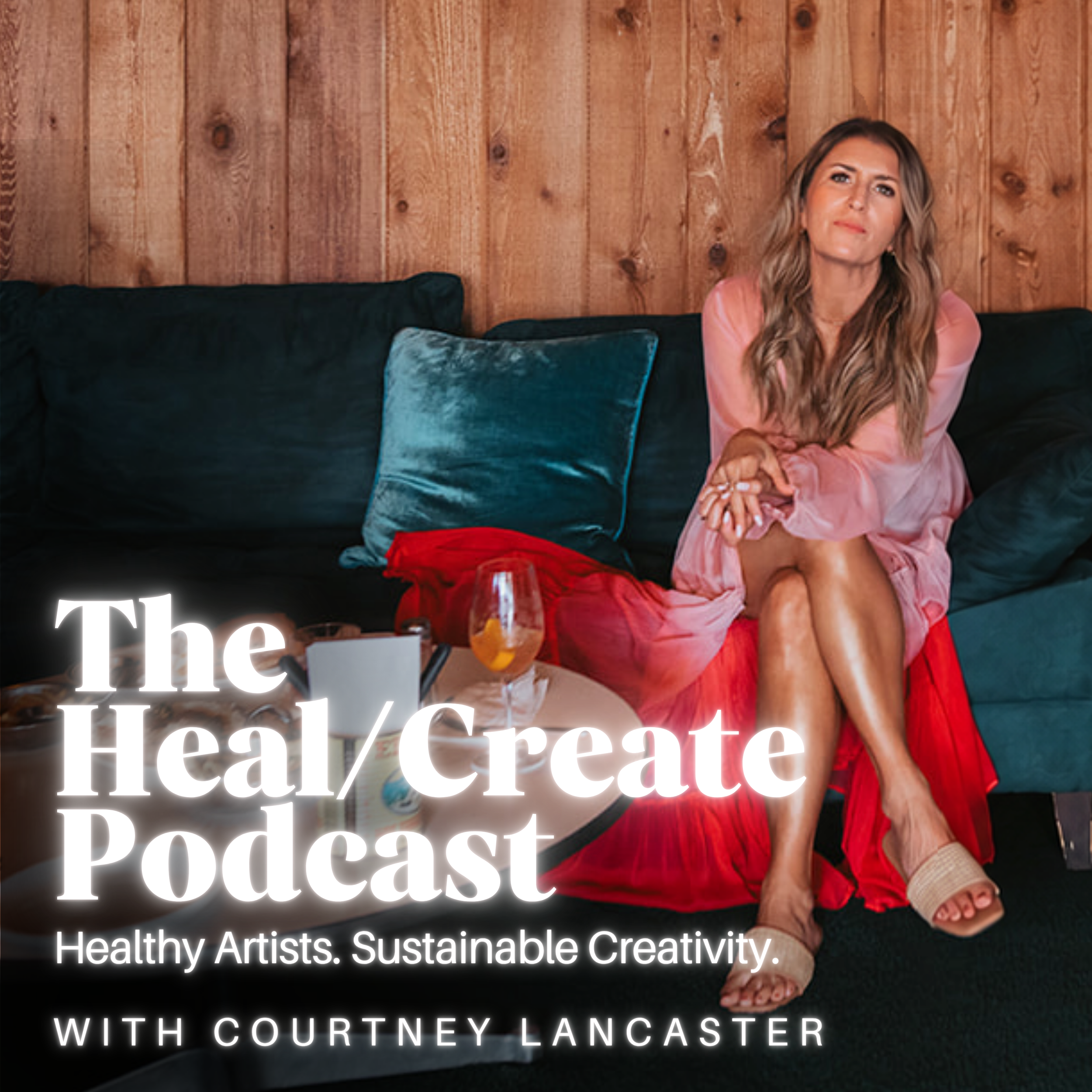
The Heal/Create Podcast · Courtney Lancaster
Season 5 of the Heal/Create Podcast begins with a new invitation: to explore what it means to be an “artist mother”—a woman who deeply nurtures the people, dreams, work, and creative gifts in her care while refusing to abandon her own aliveness. Courtney shares her own journey of learning to mother herself, heal her relationship with her femininity and creativity, and step more fully into her identity as an artist after decades of leading worship and caring for others. This season is a celebration of women who are ready to tend to their dreams with the same compassion, patience, and devotion they bring to everything else they love—and to discover what becomes possible when we do. Connect with Courtney: Instagram or website
Courtney: We don't give back a baby when they don't stop crying. we figure out, we pivot, we look for resources, we look for support, we try a bunch of different things, but we stay with. And the turning towards the hardest parts of my own life was the thing that healed me. The mother inside of me had to turn towards my own pain as if it was a child. Welcome to another episode of the Heal Create Podcast. Can you believe we are live, video live? If you are listening, if you've always listened, you can now check us out on YouTube because this is a video recording. An absolute labor of love. And labor is a great segue into the theme of season five. This is season five. I want to talk about, give you an update on where I'm at. I will actually introduce myself. I'm Courtney Lancaster, just in case you're new. I am a life coach. I am an artist. I am a mother and wife. I live in Orange County, California, and I help people figure out and face what is in the way, what is in between them and the dreams that will not leave them alone. It's something that I've been passionate about ever since going through my own journey. About more than a decade ago, wrestling with anxiety and depression and panic, a lot of postpartum. and really trying to figure out what the invisible wall was for me. What was the thing that was keeping me from stepping towards the life that I really actually wanted to live? Actually, for a long time, I didn't even know the details of what I really wanted. I just knew that I was so stuck. And so After going on my own healing journey, I sought out two sort of certifications, one of them in muscle music, a certification for nervous system and mental health for artists and performers, and another one in the compassion method with my mentor and teacher and friend Laura Duncan, who you'll probably hear this season again. She's been she's been here before if you want to listen to an episode that I've done with her. And the compassion method certification is Allowed me to help people walk through their own inner world with deep, deep self-compassion. it's an inner heal healing modality. And with that training and my own healing, I have been lucky enough to coach people all over the world for the last seven years. Where I'm at now, I still coach, I there's group coaching, there's one-on-one coaching, but I am also trying to Step into my own artist journey more fully. It's something that I've talked about so, so much, especially in the last couple of years. I've really pivoted towards helping artists and creative people more and more and more. And for myself, I kind of realized this last year that there was an artist journey that was waiting for me, inviting me to move forward, recording music, songwriting, collaborating with other artists. And immediately the The issues that came up for me in this last year, year and a half of really walking towards this and pursuing this, I knew were universal for women. And that has led me to wanting to talk this season about what it means to be what I I mean, I I'm not the only one, I'm sure, but what I have identified myself as, which is an artist mother. A somebody who is Deeply committed to the things that are in her care. It does not have to be children. As a matter of fact, every woman that I know is mothering something. Whether it's her kids, her sisters, her friends, her job, she's her dreams. Maybe she's really in the middle of a of a healing journey herself and she's learning to mother herself. That's something that we're gonna talk about a lot. Whatever it is, every woman that I know is mothering something. And wants to be fully attentive and nurturing and nourishing to those things that are in her care. And at the same time, we know deep down that we also deserve to be fully alive. So I felt like this wrestle between and we've seen it obviously, there's so many famous stories of like artists who have completely crashed. And you think about like mother like actresses or musicians or you know maybe mother artists whose kids grow up to tell stories of like really toxic dys dysfunctional situations. and then on the other hand, more often than that are the stories that I hear from my friends, from my clients, story that I felt like I was living for a long time, of feeling like I was really devoted to my family and really like Trying to understand my identity as a mother, trying to figure out what my values were, what I wanted to do for my kids, the legacy that I wanted to leave, the things I wanted to impart to them, and felt like my own vibrancy, the things that lit me up, the things that I was really passionate about, just kind of got put on the back burner, sort of naturally. And I just am more convinced than ever that it is possible to be. Deeply fully alive and also deeply fully devoted to the things that are in your care. That's what I want to talk about this season. I am wanting to start by sort of laying the groundwork for like what what is a mother? What does a mother actually do? And again, children or no children, every woman that I know is mothering something. I think about like the very first things that an An actual like biological mother does for her baby. first of all, she creates it in her body. She creates this life inside of her body. Then she goes through a ton of pain to bring this baby into the world. And then she holds this baby, and then she feeds this baby, and then it's her job. To care for this baby at every stage of development. And while I have learned, like so many other na biological mothers or legal mothers, what that process of is like of taking care of a child, the parallels to birthing a dream are like. So many. You first you imagine it inside your head. You do go through a ton of pain to bring it to fruition, to make it tangible, to bring it earthside. You feed this dream. You walk with it through heartbreak, through failure, through every iteration of what it's here to be. And it is the hardest and most rewarding thing that you will ever do. If you have a dream, there is a there is a parent that is being invited inside of you to come out and tend to this dream. So while I have had the privilege of like talking to men and women over the last seven years, w I really feel called to speak specifically to women artists. I think the journey of discovering and cultivating and healing femininity, healing your relationship with your body, with your sensuality, with your your desire, with the things that, you know. femininity, like embodying your femininity, that has been something that there's no handbook for as a woman. There's no not a lot, especially if you grew up in a religious culture like I did. There's so much mystery to it and it feels like a giant mountain. And so when I was healing my relationship with all of these different parts of my feminine experience, it became such a very quick passion for me to want to help as many women as possible do the same things. And the women that tend to find me are also in the same place. Creative women that feel disconnected from their femininity, that want to be, that really wanna take care of the things that are in their care. And so this season you are welcome to listen no matter what gender you are. But I will say this is for the ladies. And I celebrate you. I I feel so much Gosh, more bonded to this like just the general sisterhood than ever before. And I believe, I believe in men and women. I believe that everybody has something beautiful and powerful to offer. But what I want to speak to is what I believe the artist mother has to offer to this world that is so in need of our unique giftings. I think the first place that the artist mother starts at is mothering herself. So it's something that we'll talk about throughout the season. We've certainly talked about it already if you've been following along. But mothering yourself, one of the most powerful things I found about being a mother, or I I should say, that has inspired me to be a good mother are the mothers that can be with their children in anything that do not turn their face away from struggle. And I think that that was such a key to my own personal healing was recognizing that the darkest, craziest experiences inside of myself, the the darkest thoughts, the detours, the real depression, the frozen feelings, trying to get rid of those is a lot like trying to get rid of a crying baby. Like you innately no, that's not the answer. We don't give back a baby when they don't stop crying. We've we we figure out, we pivot, we look for resources, we look for support, we try a bunch of different things, but we stay with. And the turning towards the hardest parts of my own life was the thing that healed me. The mother inside of me had to turn towards my own pain as if it was a child. And if you look at developmental psychology, they are children. Yes, there are neural networks in your brain. Yes, there are emotional experiences. Yes, they're somatic experiences of freeze and shutdown and fight or flight. All true. But your brain knows what family is. Your brain knows what mother is. And so even using your imagination to imagine loving those parts of you as if they were these wounded, fragile, angry, scared little kids is what A good mother does. And I learned, I wish, I so wish that I would have known this, that I would have walked through this before I had kids. Unfortunately, or maybe fortunately, maybe both, I learned how to do this while I was parenting my kids. I learned how to parent myself while I was parenting my kids. And there were a lot of things that I learned in tandem. There were some areas that inspired me to bring back to other areas of my life. And I'm grateful for my story. But I think a lot of us can relate where I mean even when you look at how much information is available now versus like when we were kids, like our parents would have had to go to like deep university libraries to find some of the information that's available on our social media accounts every day if you current curate your account to be a helpful resource for you, which you should. But I didn't know a lot of this stuff and I had a lot of unprocessed trauma, a lot of us do, that my body was not reminded of until I had kids that were the same ages as I was when the trauma occurred. and so I found myself like building the plane as I was flying it, sometimes wishing that I didn't have to, you know, w Not loving how challenging that process was, but grateful now because I think it's really common and I love being able to speak to the potential for things working out, the potential for real deep lessons, integration, self-compassion, and expanded capacity for your actual children or the things that are in your care. like it really does get easier and The work really does work. Mothering yourself expands to every part of your life. Loving the hardest things in you only increases your capacity to hold the dreams that you've always had. So when we talk about being an artist's mother, the first thing we're going to talk about is mothering ourselves. Loving every single part of you as if it was a scare child. and as you do that, what I love about the idea of like an artist mother. Actually funny story. I was telling talking to a friend. And I was like, Yeah, I just feel like I'm I love being a mother. Immediately I have emotion saying this because it's true. And I I promise this is a funny story, at least it was to me. I love being a mother now more than I ever have. I love my kids so deeply. I love Almost every part of it. And I really do mean that because there are parts that are so challenging. I have a teenager and I have a preteen. Boys. And I am like so like doggy paddling a lot of the time. But there's so much magic here that I was not awake enough for in their early years. And I love being a mother now more than ever. And as a woman, I feel more alive. than ever before. So outside of, not that you can ever be fully outside of, but outside of the things that I I I care for, my business, my dreams, my husband, my kids, outside of being a mother, I love being a woman. I love my femininity. I'm like, I feel sometimes like not the youngest I've ever been, but I feel s I genuinely feel like so young and silly and free. And I I'm just a lover girl. Like that's who I have found myself to be. And I know that I'm not alone in that. and I told my friend, yeah, I feel like I'm like a I'm like a mother lover. Like a mother lover. They were like, immediately no. It's not a it's not how you want to say that. Isn't that an arrested development like thing? Buster with the something like that. Please email me what reference that I'm talking about because I can't think of it now. But like being a woman has never f meant more to me and been more exciting than it is at this season of my life. Being a mother has never been more meaningful than it is than it is at this point in my life as well. So let's get into it, you guys. I want to be talking to my gosh, some incredible artists, like musicians that are in the trenches of Creativity and artistry, songwriting, singing, a musicianship, performing. women who are like out there actually doing it. And also experts in the field of emotional health and mothering, parenting, reparenting self, also like mothering kids. Like, what is there's so many nooks and crannies of parenting that are so confusing. So we're gonna talk to people that can give us some insight, ladies, on how to help our kids grow up to have done a lot of the work that we found ourselves having to do after they were born. And I'll also be sharing about my own artist journey. So, in case you're interested, I am going into the studio to record what I hope will in about a year be a full album. I have a lot of the demos. A demo is just a rough draft of a song that you've written. I have a lot of the demos, I have been working. I have a there are people that I've been working with, one of my best friends. We've been writing songs for a while, creating demos, going into the studio. And I myself come from a conservative Christian background where I have led worship for more than 20 years. So most of my musical experience is on a worship stage. And that's a really beautiful place to be. I love Jesus. We have walked through. deep deconstruction of a lot of toxic religion, but have found ourselves back in just being so in love with the message of Christ. I I love I identify as a Christian and I love this faith tradition so much in all of its problems and issues and questions and mystery. but coming from that background, it is kind of a huge identity shift to let go of everything that worship music afforded you as an as if you identify as an artist, it naturally gave you a your purpose. It already gave you the story to tell. It actually most of the time already gave you the words to say. It there was not a lot of room for creative artistic identity as like an actual artist because that's not really what that was. That stage is for. you are a part of something bigger, you're there to play a role, you're there to share in that story. Leaving all of that, I haven't left worship leading, I still lead worship, but leaving all of that to step into becoming my own artist, holy crap, there's so many questions. This is from scratch experience of taking my own self seriously as an artist, cultivating my own artist identity. Figuring out all of the steps to performance, how to hold, how to allow your nervous system to hold a performance where you are not guiding people's focus away from yourself and to God. There's nothing wrong with that, but you are actually relating to people, connecting on all of the stories that you wouldn't tell on a worship stage. All of the stories that honestly, as a middle-aged woman that I have now that are hard won and precious and not anything I could say when I was twenty and wishing that I could be whatever, like the winner of American Idol. So, I mean, and I'm not alone, like you guys, us us middle aged people that have done the work, we've we got some stories to tell. Coming of age stories, we have failures. People that have hurt us, people that we have hurt. Parts of our lives that we have absolutely burned down, sometimes on purpose, sometimes on accident. We got stuff to say, and we also face like sort of the cultural cringe of being an older artist that is absolutely there. You have to believe in yourself so deeply, and you also have to have a nervous system capacity for the secondhand embarrassment that people might have for you trying to step into being an artist. Anyways, that is what we're doing this season. I would love to have you here. If there is anything that you feel like is also on your heart to pursue at this point in your life, no matter what stage of life you're at. I know 20-somethings who were in their second half of life, as Richard Rohr would call it, where they have gone through such deep, life-changing, like either trauma or situations that has invited them into like doing things wholeheartedly with sustainable emotional health. I know people that are in their 60s and 70s that are like just coming around to discovering who they are. for all the artist mothers out there, you are so welcome here. And please email me Courtney at Courtneyandheart.com and tell me what dreams are on your heart. What things are you holding? What things are you looking forward to? What questions do you have about this journey that we can figure out the answers to together? I want to know all of it. And if you could like and subscribe to this podcast so it gets out to as many artists mothers as possible, that would be beautiful as well. I love you. I'm so glad you're here. You are welcome in this little hall of sisterhood that we have of as swirly creative women. And I think that's all for me. I hope you have a beautiful week and I will talk to you later. Bye.