
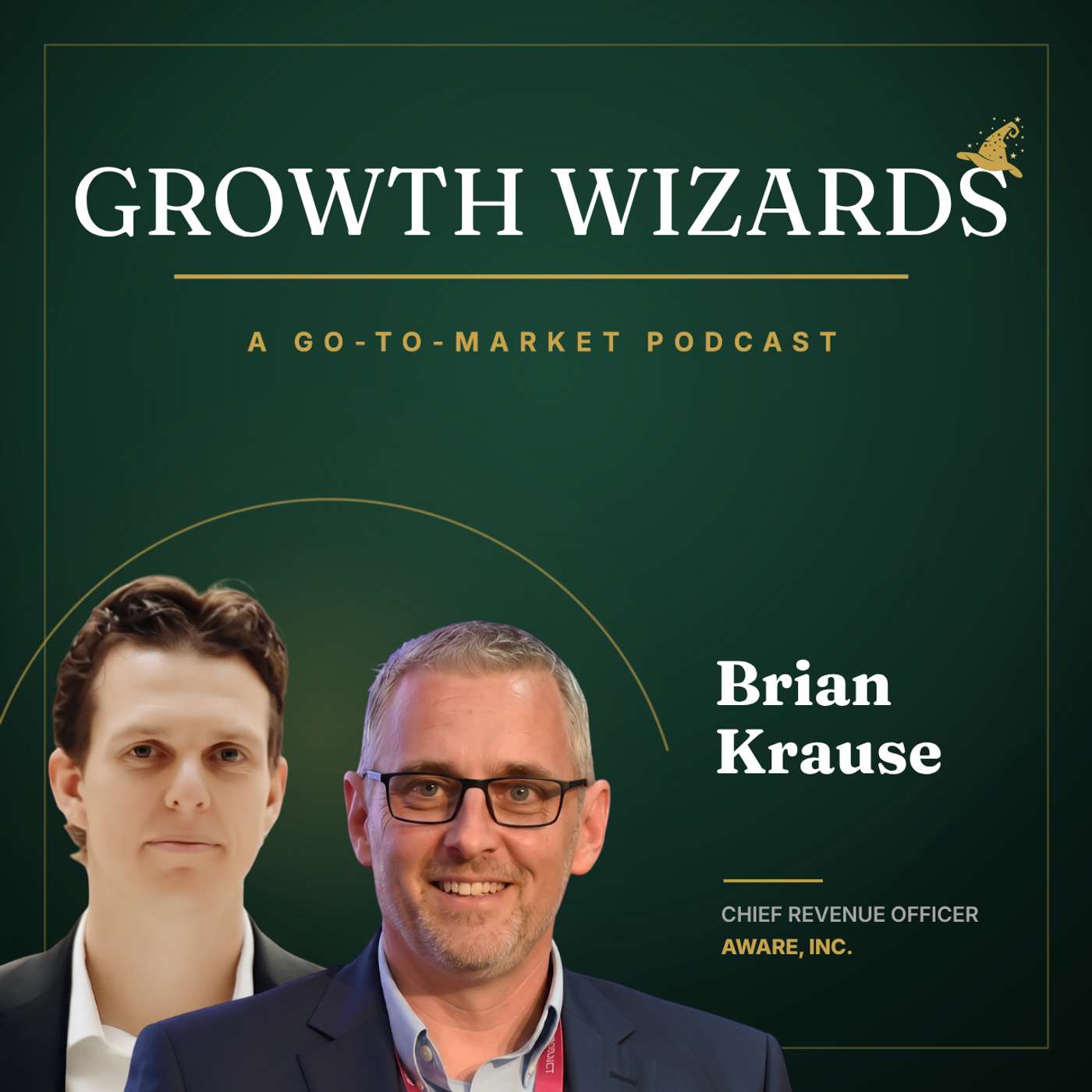
The Growth Wizards Podcast · Tanner Green
Summary Where does the AI agent end and the human seller begin? In this episode of Growth Wizards, host Tanner Green sits down with Brian Krause, Chief Revenue Officer at Aware, Inc. (NASDAQ: AWRE), who has spent more than a decade selling biometric and digital identity technology at Incode, Veriff, and AnyVision. Brian makes the case that the top of the funnel runs on the two assets AI is built to increase, information and time, while enterprise deals deeper in the funnel stay a people business. He breaks down what it takes to sell regulated technology far beyond the business unit, why nobody should ever sell alone, and the problem his industry created by winning: biometric sprawl, where business units buy their own biometrics with no central oversight. He also shares why proof of concepts are vanishing from enterprise deals and how Aware's new platform gives CIOs a single API and a bird's eye view. This conversation is for revenue leaders, founders, and go to market teams deciding where AI actually belongs in their funnel. Chapters 00:00 Welcome and Brian's background in biometrics 01:45 A $25 million bet on go to market agents 03:15 Why sales is still a people business 06:00 Information and time, the two assets AI increases 06:45 How Incode doubled North America ARR 09:15 Selling beyond the business unit in regulated markets 12:15 Global coverage, sales cycles, and the death of the POC 14:30 Automate first, hire second 16:15 Biometric sprawl and Aware's new platform 18:45 Where to connect with Brian Takeaways - AI's natural home is the top of the funnel, where information and time are the two greatest assets and velocity wins; deeper in the funnel, enterprise sales stays a people business. - In regulated industries the sale goes far beyond the business unit: the full lifecycle of biometric data pulls compliance, regulatory, and security into every purchase decision. - Nobody ever buys alone, so nobody should ever sell alone; leaders who stay in the trenches and earn their team's trust can supercharge growth. - Biometric sprawl is the industry's unsolved problem: business units buying their own biometrics leave no central oversight, and upwards of 95% of CIOs want it solved. - Proof of concepts are disappearing as biometrics become pervasive, so deals now turn on proof of value and technical fit, with cycles at five to six months and improving. Connect with the Guest Brian Krause LinkedIn: https://www.linkedin.com/in/krause-brian/?skipRedirect=true Company Website: https://www.aware.com Sponsor
Growh Wizards - Brian Krause === Tanner Green: [00:00:00] All right, everyone. We are super excited to have another episode of "Growth Wizards." Thanks Brian Krause for coming on the show. Brian, thanks for being here Brian Krause: Hey, Tanner. Thanks for having me Tanner Green: Yeah. Right on. Well, Brian, I'll jump right into the bio here. Brian is a chief revenue officer at Aware Inc., the biometrics platform company where he has owned end-to-end revenue since March 2025. He has spent more than a decade selling biometric and digital identity technology. Before Aware, he was managing director, North America at Incode, where he more than doubled the region's ARR, and before that, VP of global revenue at Veriff with full responsibility for the revenue engine. And he also led the North American expansion of AnyVision And earlier held sales leadership roles at AT&T, Panasonic, and Pivot3 after starting his career on Wall Street at Smith Barney and Babson Capital - Management. He [00:01:00] holds a Bachelor of Science in Accounting and Finance and an MBA from Boston University's Questrom School of Business. So Brian, we're really excited to have you on the show. That's quite the resume you got there. Excited for everything, and especially from a biometrics perspective, it's definitely a unique business to be in. And I know out there in the Northeast, they're really into all the biometrics and all of the biotech stuff out there. So that's really exciting. It's really cool. But I'm really excited to have you here. And before we get started, I wanted to jump into a little bit of news that I saw this week. So there's a company called Alta, altahq.com if you're curious that just raised a $25 million Series A round, and they are a go-to-market, fully encompassed go-to-market agent. So basically from research and ads to all the way [00:02:00] through making outreach and booking calls and basically just everything top of funnel from scratch, right? And it's all agents. So I know there's a lot of tools out there. Brian mentioned, you mentioned that you're working on top of funnel, and you have lots of different outreach out that you're doing. But I wanted to get your thoughts on like an SDR agent versus a marketing agent versus a full-fledged go-to-market agent. Like where does the line draw of doing human interaction for all these things, and how does a agent really make a difference here, and if it does at all? I'm curious. Brian Krause: Great question. Great question. So yeah we're definitely experimenting around this, this very topic area, so ex-exciting to, hear about Alta and learn a little bit more about Alta through, through this conversation. I'm kind of an old school guy a little bit. I believe that sales is still a people business at the end of the day particularly when you get into enterprise. And [00:03:00] so I think that will probably remain the case. That doesn't mean in any stretch that AI is not a super valuable tool for go-to-market teams. I think, particularly around top of funnel where, you know, information can be challenging, can be sparse, can be distributed. The use of AI and agents to organize and help prepare sellers and you know, our product teams and our marketing teams around the information that's changing in the market is, is super, super valuable. It's really about, working with a higher capital efficiency of teams working with a much faster pace and being able to collate all the information that, that sales teams ultimately need. You know, I think top of funnel is the perfect place for AI to live because it's about awareness, it's about messaging, it's about velocity. And so, augmenting our sales teams and our, our human labor with AI agents was the perfect choice for us because we're also launching an entirely new product to the market. Aware's, you know, a [00:04:00] thirty-five-year-old company that's been, developing and building biometrics for a long time, but what we're really focused on now is a new problem that no one in our industry has really ever solved. And so for us and for me and my teams looking at, you know, how do we get the word out as fast as possible? AI is, is a natural selection for us to augment the efforts that we would traditionally do. Tanner Green: Yeah. I love that. I love what you said about the top of funnel is all about velocity and staying top of mind and, being always there on your radar, right? And just being ready to take advantage of any opportunity that comes your way to get in your foot in the door, right? And I think everyone knows that about sales. Everyone knows that speed to lead is super critical and it's all about creating the right experience for somebody that fits their needs. And so I like what you said, that AI is a perfect kind of fit for that because that's exactly what it can do really well, [00:05:00] you know, is at high scale velocity, stay top of mind and be very aware of what's going on in the space, in the industry. So I really like that. I think it's important to know and coming in that the top of funnel really is an agent's better friend. I'm not gonna say best friend, but a better friend to be an agent there than it is to more towards the bottom of the funnel. So I really, I... Brian Krause: Yeah, top of funnel is all about information and time, right? Those are the two greatest assets to anyone working at the top of the funnel, and that's exactly what AI is designed for, is it's designed to increase. And so if you can consume and collate and shape information faster and then, get that information in front of relevant buyers faster it's a, it's natural fit. It's really a perfect fit and we're a little bit early days here in using it, utilizing it. Like I said it's timed with the launch of a new product here, so we're fairly early days with it. But we're excited to see, what kind of returns it [00:06:00] can deliver Tanner Green: Yeah. Awesome. I love it. I know, Brian, that you took over North America for Incode and you doubled the region's ARR. And walk me through that whole event, what that looked like from the beginning when you came in, and how you created that doubling of the ARR, and, you know, what worked, what didn't, and what kind of were the results that you walked away from thinking, "This is what I will do in future endeavors"? Brian Krause: Incode's a company with a really great product and a a DNA in the Mexico and South America markets. And when I joined, it was really under a specific remit, was to help them really supercharge North America, right? The USA market, where, you've got thirty-nine of the, of the Fortune fifty here. It's, it's a prime market for the product they were selling. It's the biggest market in the world for the product they were selling. And so the strategy was to [00:07:00] really get that market going for them. So I was very focused on just that. And, what we deployed was really a strategy around focus, which was, okay what is the true TAM that or sales addressable market anyway that our product fits really well. And of course, that we want to win. There, there's part of choosing your addressable market is where you want to sell. Do you want to operate mid-market, SMB? Do you want to be an enterprise software only? And so we went through a lot of that work in the early days of figuring out or refining where exactly we wanted to win. And then just went sequentially through the process of, okay, how do we do that? What does our team look like from a talent perspective, from a tooling perspective, from an enablement perspective? And really focused. I spent my first couple quarters there really focused on team and process. The product has always been really good and sound. And not having to worry about the product part of it necessarily and really focus on people and process was a distinct advantage. And had a lot of talent over there on the [00:08:00] sales team and was able to really just coach them into how to sell properly and more effectively into large enterprise. And the results were really fantastic. And, I stay in touch, and they continue to grow, and they continue to do super well. They've acquired two companies since I left, so they've continued to make a really interesting run and I'm excited to see what they do next. Tanner Green: That's awesome. And it's cool that you know how to teach your team leading from the front, right? 'Cause there's a, really important difference between telling people what to do and showing them how to do it. And so I think that's a really cool differentiator for you to be able to do that. And I wanted to talk about, you know, what's curious to me is you've been in the biometric space for a long time, and so it's very... a lot of regulations, a lot of trust is needed, a lot of... it's very complicated. It's, it's different than just your normal enterprise software sale. So what do you do differently to really move the needle in that space? Brian Krause: Good question. It is [00:09:00] definitely different. We deal with information that is regulated, that is highly sensitive. And so our sales motion is probably likely very different than a lot of enterprise softwares. We have to sell well beyond just the business unit, right? That we're trying to help, with our solution. The sort of standard problem of, how do we do this really well? How do we get really high accuracy, good results, good speed, good user experience, lives in the business unit. But we focus very highly on what we call the life cycle of biometrics, which is, it's, it goes well beyond just capturing someone's face and determining if that's the same person they're claiming to be. It goes well into what do we do with that data when we have it? How is it stored? How is it secured? Is it shared? Is it used for training? All of the things that go outside of the business unit and into compliance and regulatory and, you know, other folks in the organization generally that have to be involved in purchase decisions. And so our motion includes, you know, enablement and, and training for our sales teams [00:10:00] and, and obviously product development and design that accommodates all of the considerations there we can't launch to market a product that isn't highly secure that doesn't provide regulatory compliance in lots and lots of different markets, and the rules are very different globally in our world. And so you have to have a lot of flexibility in, in your product offering. And from a go-to-market perspective, that can be difficult to make sure that everyone on the team is really up to speed on all the different rules and regs and all the different ways to, to comply and, and things you need to be careful of during a sales process to help make sure that we, we satisfy just beyond the buyer. Because in our world, and I always argue in enterprise in general you talk about leading from the front, but I've always believed and subscribed to the fact that, you know, this is enterprise sales. Nobody ever buys a loan, so nobody should ever sell a loan. And so you really have to be with your team, and they have to trust you and know that you add value to their process. And if you do that, you can really supercharge growth. [00:11:00] I'm not on every single deal, of course. We've got super talented people that can operate independently. But in many cases being in the trenches and being involved Brian Krause: Sales team right now globally is about fourteen. We've got a heavy presence in Brazil, where we've got a lot of big flagship banking customers. So we've got a local outpost down there with a team. We've got presence in the UK, and then obviously our home office in Boston here, and our, our US sales team is distributed. So we've got pretty good coverage. Those are our core markets for selling today is the EU, South America and North America Tanner Green: Cool. Is is your sales cycle pretty huge, I would imagine? Pretty long Brian Krause: Depends on your definition of pretty long, but we generally-- it generally runs somewhere in the five to six month range. Yeah, I mean, it's not too bad. It's not too bad. It's actually improved, you know, since I got here, and it continues to improve. And, and that's really just all about focusing on process and, and enablement of the team and making sure that, you know, the different functions of our organization are working cohesively to make sure that things go quickly, people get information they need [00:12:00] and stage gates are cleared quickly. But the great thing about our industry is that biometrics are becoming so pervasive that, we don't really have to do proof of concepts any longer. The idea of-- the concept of using biometrics for application security is that ship has sailed. I think most people in the world agree that, you know, biometrics is a really safe way to secure an application. I personally believe that biometrics will be used to secure every application in the near future. And so it's really more about just a quick proof of value and a proof of performance perfor-performance and technical, you know, integration. And so that has definitely helped a little bit from the tailwind perspective to speed up some of our cycles. You really just have to prove efficacy and fit of the technology in the customer's environment, and you can go a little bit faster. We do a lot of government work as well where we still get into sort of proof of concept design and execution, where biometrics might be a, a new workflow for them or, or a new method of application security. But in the enterprise space, generally biometrics are fairly pervasive today, which gives us a little tailwind Tanner Green: Yeah. [00:13:00] So how does it look like managing a team, a global team? You know, some in Brazil, some in the UK, some here. , That's gotta be kinda hectic sometimes, I bet Brian Krause: Yeah, a lot of time on Zoom, a lot of time on airplanes and the usual. It's not too bad. It all comes down to just really having competent people that you can trust and you can enable properly to, to run their own business effectively. We've got some really talented people here some great team members that we spend time together every week. And then when they're not with the group or myself, they're out running their business, locally and trying to drive Aware, into more, more biometric opportunities in both government and enterprise Tanner Green: Love it. Awesome. Well, Brian, I'm curious to hear your thoughts. Where is your plan for Aware and in the next 12 to, 12 to 24 months in the GTM space, how do you see it shifting? What do you see in the future? Brian Krause: So I'm probably like a lot of go-to-market leaders now, where the sort of old [00:14:00] mantra of scaling up, physical headcount to satisfy demand or to grow sequentially was the pattern and that has shifted into more tooling. How can we really focus on capital efficiency as an organization and productivity of a go-to-market team, and not necessarily scale it up as quickly? Hire really well. Give them the tools and the enablement that they need to deliver much more production than a rep might have been expected to deliver in the past by way of the tooling and the enablement. And so I think that, we'll continue to see tooling and AI augment, the sellers. Inevitably you will have to grow your team as your organization grows. That could be geographically, that could be, vertically or segment-wise. But I'm probably, a lot like others right now, which is saying can we do things automated first before we just staff up on FTEs?" I'd much rather have a smaller sales team, making a lot of money, being very happy and productive than have a large team fighting for territory. [00:15:00] And so that's generally what I subscribe to, is trying to help our sellers meet our corporate and their individual goals without having to, dilute the headcount in, in, in the go-to-market teams. Tanner Green: Yeah, absolutely. And so with that go-to-market team, what is your kind of go-to strategy top of funnel for getting more leads, more clients? What's that for you? I know you guys are testing out some AI material, but what's been kind of tried and true for you? Brian Krause: Yeah. So our company is a little bit different than some of the others in our industry in the fact that we have a, a, a big legacy in government work. And so government business development is very different than commercial and enterprise business development. And that effort is very focused on relationships with the agencies, getting out in front of, big contracts, task orders, big SI partnerships and those things that you really need to be successful growing in the US Fed and, other federal markets. On the commercial side, it is much [00:16:00] more traditional. We're using, AI top of funnel, as I mentioned. We're experimenting with some agents specifically to coincide with this awareness platform product that we're launching, which is, as I mentioned earlier a new product to market that's really designed to solve a problem that has really shown up in the last couple of years for this industry that no one is really solving and that is, orchestration of the core technology. And so AI at the top of funnel for a new product launch for me is a really good fit because it's about making sure that people know what we're doing. It's about awareness no pun intended. But it's about driving awareness of our platform so that people know that, hey, this problem that you've had that you may not know is solvable, is now solvable. And we're interested in showing you how we're approaching it and how we're doing it. And so with this platform, essentially what we're looking to solve is a problem that the industry-- we talk about biometrics being as very pervasive earlier in the discussion. And really what [00:17:00] that's led to is a lot of companies are now deploying biometrics all over their enterprise, but they're doing so with different providers, and the functions are buying their own technology solutions and trying to solve the problem individually as business units. And that's created what we refer to as biometric sprawl. And so that's a big problem when you circle back to the sort of regulatory compliance and governance that we talked about earlier, where you've got all these systems running biometric data and really sensitive information and no one has central oversight of it. And no one has that bird's eye view of, okay, all these systems running this, processing all this sensitive information who actually owns it from an enterprise perspective? And so our platform is designed to give, CIOs, CTOs, VPs of technology a single API connection to give a bird's eye view to all the biometrics running within their environment and tap into the best biometric manufacturers in the world that are sitting on the platform and can be consumed. So this is something that no one's really tried before. We've done a lot of [00:18:00] research in this space over the last year and found that, upwards of ninety-five percent of CIOs are super interested in solving this problem. So we're, we're very excited about it. But from a GTM perspective, you know, we're, we're essentially starting over you know, on this product launch. It's all about awareness and how we can get the information out as fast as possible to relevant buyers. And that's where we're really trying to tap into, to AI. Tanner Green: Yeah, I love it. Awesome. Well, Brian, it's been a ton of fun. Thanks for coming on the show. How can people go find you and connect with you? Brian Krause: Yeah, always interested in connecting with people on LinkedIn, so you can find me personally there. From a company perspective you can check out aware.com, learn more about the Awareness platform, some of the work we do in government, some of the other products that we still offer and market. And we're always happy to hear from folks that are looking to use biometrics to up their security game and learn more about how our technology and our team might be able to help Tanner Green: Great. Awesome. Thank you so much, Brian, for coming on the show, and thanks to the listeners for tuning in Brian Krause: You got it, Tanner. Thanks. Appreciate the time[00:19:00]