
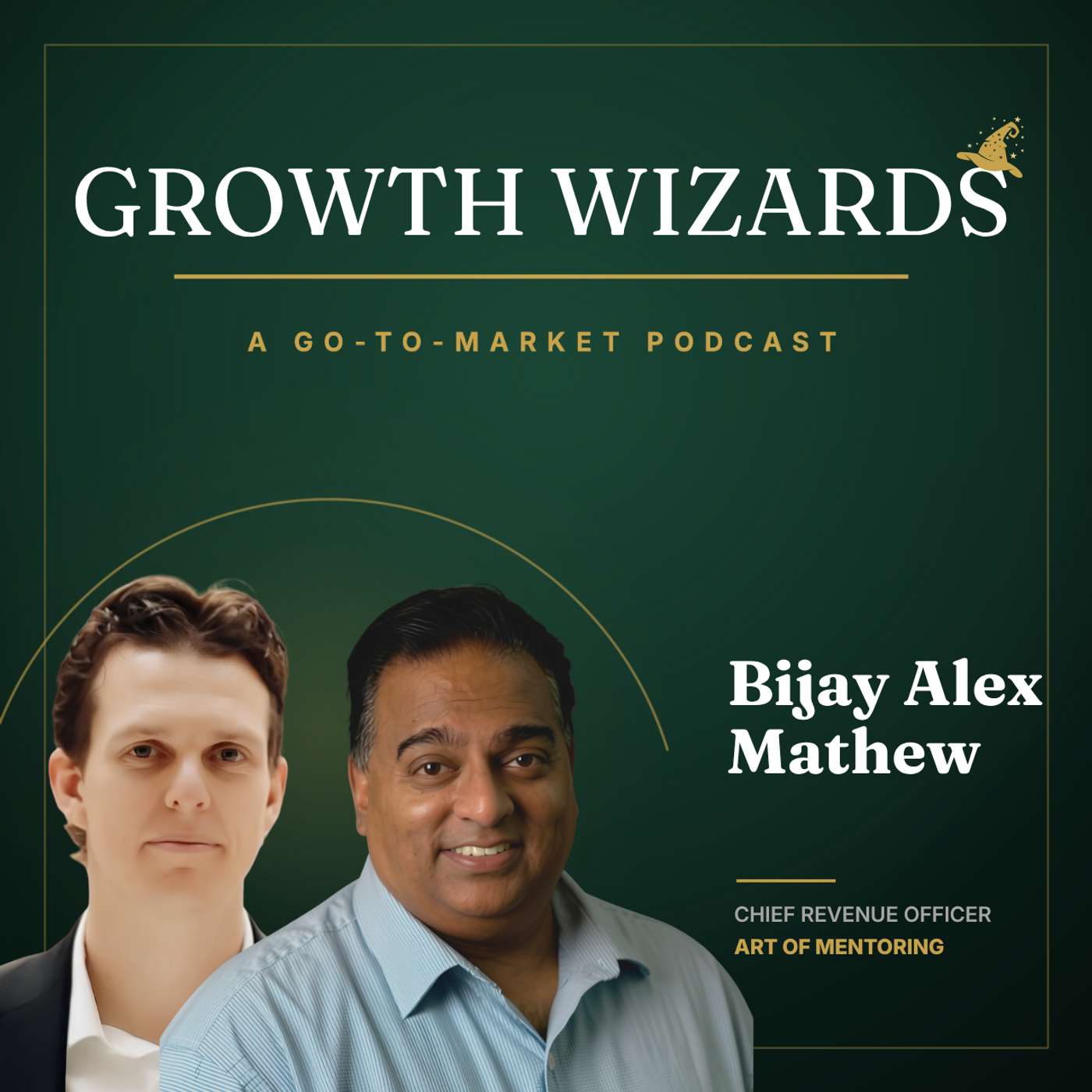
The Growth Wizards Podcast · Tanner Green
Summary What do you do when your buyer has made up their mind before ever entering your funnel? In this episode of The Growth Wizards Podcast, host Tanner Green sits down with Bijay Alex Mathew, Chief Revenue Officer at Art of Mentoring, to unpack the trust gap behind a striking stat: 96% of marketing leaders say AI is transforming marketing, yet only 8% run autonomous campaigns. Bijay explains why AI-powered outbound keeps sounding the same, where automation is actually earning its keep, and why he stopped trying to out-shout the market and started borrowing the trust that communities and associations have spent decades building. He walks through his DEAR operating system for community led growth (develop, engage, activate, retain), the naming rights play that costs less than a conference booth, and why co-owning what a community values most is the new moat now that feature parity is dead. A must-listen for CROs, CMOs, and revenue leaders selling into categories their buyers don't have a line item for. Chapters 00:45 Welcome and meet Bijay Alex Mathew 01:55 The AI trust gap: 96% believe, only 8% go autonomous 04:05 Human in the loop at Art of Mentoring 06:30 Selling a category nobody has a line item for 08:50 The potter's shop: build, buy, or borrow a community 10:30 The DEAR framework: develop, engage, activate, retain 13:45 Be a resource, not a vendor 16:55 The secret sauce: fund the association's laundry list 19:05 An association for every profession: the market size 20:55 The future of go to market and the Centeno story Takeaways - 96% of marketing leaders say AI is transforming marketing but only 8% run autonomous campaigns; the gap is trust, and the biggest real gains today are in fast AI-assisted inbound response, not outbound. - 70% of the buyer's journey happens before your funnel, so optimizing the funnel can't fix pipeline; you have to get into the communities where decisions are actually formed. - Faced with build, buy, or borrow, borrow the trust of existing communities and associations; building takes 18 to 24 months and buying is expensive, while 50,000+ associations already hold your buyers. - Run community led growth on the DEAR operating system: develop the right communities, engage as a resource instead of a vendor, activate relationships into pipeline, and retain by making your presence part of your moat. - Ask associations what they would do for members if money were no object, then fund that thing and take the naming rights; it costs less than a conference booth and makes you nearly impossible to cut as a sponsor. Connect with the Guest Bijay Alex Mathew LinkedIn: https://www.linkedin.com/in/bijaym/ Company Website: https://artofmentoring.net
Growth Wizards - Bijay Alex Matthew === Tanner Green: [00:00:00] everyone. Welcome to another episode of Growth Wizards. Today, we are super excited to have BJ Alex Matthew on the show. BJ, thanks for coming on Bijay Alex Matthew: Yeah, I'm glad to be here. I'm excited for this one Tanner Green: Yeah, me too. Me too. So BJ, without further ado, is the Chief Revenue Officer at Art of Mentoring, the SaaS platform that helps organizations build and scale structured mentoring programs to develop, engage, and retain their talent. He brings more than 20 years of experience building and leading high-performing technology sales teams with prior roles including VP of Enterprise Sales at Panopto. Did I say that right? Panopto? Yeah. Yeah. Okay. Head of Sales at Chatfuel and sales leadership at Community Brands and Verizon. He also serves as the awesome executive chapter head of Pavilion, the go-to-market leadership community. BJ holds an MBA from Western Governors ~U-~ University and dual degrees in [00:01:00] economics and political science from the Ohio State University. BJ, super excited to have you, man. It's gonna be a lot of Bijay Alex Matthew: Yeah. This is gonna be fun. I'm glad to be here Tanner Green: Yeah. So I wanted to start off with a little bit of news, and this is an interesting stat line that I saw, and I wanna get your feedback on this, Bijay. So 96% of marketing leaders say that AI is transforming marketing, and yet only 8% are running autonomous marketing campaigns or essentially just AI ~cam-~ campaigns. So there's a huge gap there, obviously. Everyone's like, "Oh, yeah, AI's doing the, doing all this awesome work," and yet nobody really trusts it still, and there's still some kinks to work out. So where do you see that gap? What is that gap telling you? Bijay Alex Matthew: Yeah, I think it's interesting because what AI solves is some of the problems that you had before in terms of time and scale. So with AI, you can create a lot of things much more quickly. There's still [00:02:00] some review that needs to happen. There's still some quality things and some judgment that's important. But I think there's a trust gap, right? So at the same time that everyone can now produce a lot more very quickly, everything kind of sounds the same. So everyone's outbound, like you can see the AI outbound when it lands in your inbox or in your LinkedIn messaging folder, right? And it's impressive in this sense because before customization was tricky. It was hard, like you had to work hard or put in these little variables. Now you can do very deep semi-relevant customization at scale, but now everyone has those same tools, so everyone's doing it. So I think there's ~w-~ that's one of the problems. The other thing is the trust. So everyone's a little afraid to sign off on fully autonomous, right? So then one thing I see a lot of the vendors in the space saying is giving you options of fully autonomous or, human in the loop. So I think that's a key factor. But~ my,~ my sense is this will continue to get better. I don't think email responses are gonna get better. I think they're gonna continue [00:03:00] to get worse. I think that's the problem. The other interesting thing is I've been getting some AI calls lately some of them are pretty good and can handle my off-the-wall objections, and some of them are terrible, and they feel like an IVR from 1995. So Tanner Green: That's hilarious. So where do you stand on your campaigns that you guys run at Art of Mentoring? Like, how much have you guys adopted AI? Is there anything that you've found that's been really successful to leave with AI and things that you thought, "Nah, let's keep this on the human side"? Bijay Alex Matthew: Yeah, so I think we're doing a lot of AI-assisted but human in the loop. And I think that kind of is on brand for us because we are a purposely human mentoring software platform. But I am experimenting with a lot of automation, so we'll see, the next few weeks will tell us ~whether~ whether we embrace that or not. Tanner Green: Yeah. I love that. And I think it's important like what you said, there's a pathway to get to autonomous for some things. Not for [00:04:00] everything but definitely there's a pathway to build that and there's a system and an approach to make that happen. You need to first, know what you're doing, know what your end goals are, create the system, implement the system by hand manually, then have the human in the loop AI assisted, and then see how far you can get from there. Some stuff can get further than others, but I think there's definitely a way and approach ~to,~ to make that happen. So I definitely, I agree with that. I think that's awesome what you guys are doing over there at Art of Mentoring. Bijay Alex Matthew: Yeah, I think there's a lot of training required, and I think the place where it's really earning its way is in automation on the inbound side, right? So an AI agent that can answer an inbound question or, book a meeting or do all these things that, you would normally take, maybe if you're really good, you'll take five or 10 minutes to respond, but most likely it'll take you 24 hours to respond to some inbound requests. I think that's where the real productivity gains are showing up. Tanner Green: Yeah, definitely. I [00:05:00] know ~my,~ my brother is working at a company called Broccoli AI. You ever heard of it? Bijay Alex Matthew: I have not, but I love the name. Tanner Green: Yeah. Yeah. Kind of fun. But Broccoli is an AI call service that does exactly that. Takes inbound calls for homes, home service businesses. So like a very specific niche and very highly applicable to what you're saying is, inbound people, they're not really super interested if it's an AI person or not. Really what they're interested is, "Can you solve my problem?" ~"Is this going to,~ is this going to make a difference?" And, maybe at first people might be like, "Oh, stupid AI," "I can't believe it. Hand me off to a real agent." But if the AI does a good job, which I've heard those guys in a demo and it does a pretty amazing job. If it does a great job, then they're like, "Oh I guess my problem is solved. This is great." But with outbound, I think you're right. Outbound is a little bit tougher, more nuanced for Bijay Alex Matthew: is Tanner Green: Yeah. Cool. So you came into Art of Mentoring in 2023 to lead the revenue for a category a lot of [00:06:00] buyers don't have a line item for. So walk me through the motion and what that actually looked like when you stepped in, and how selling mentoring software changed where you think pipeline comes from and how you approach it. Bijay Alex Matthew: Yeah. This was an interesting journey for me. So it's kind of a weird category, mentoring software. We have a lot of clients like Lululemon and Intel, but we also work with a lot of associations. And the thing I noticed about those organizations is they've been doing what I call community-led growth for decades. They just don't call it that. in my situation, I sit on both sides of the table. So during the day, I'm a CRO trying to create budget for a category nobody has a line item for. And on the side, I'm the chapter head for Pavilion, which is ~it-~ itself one of those communities, right? And I kinda see the dynamic from both sides. So there was a go-to-market software company that was looking for advisors for their new AI offering, and the community sourced me and a few other [00:07:00] people. So there was no prospecting. ~There's--~ We kinda got served up by the community. So these two things collided Tanner Green: voluntold is what you're Bijay Alex Matthew: Yeah. Yeah, I got volun-told, but it's actually a really good opportunity. But so this thing collided for me, and I realized my buyer is already inside of communities like this. These communities spent decades building up trust, and that's the thing I'm trying to manufacture one deal at a time, right? And our traditional levers, which would be like hire more reps or get more leads or run more campaigns, we were getting just really loud in a room where nobody was listening. And everyone hears this stat that 70% of the buyer's journey is done before someone enters your funnel. Making your funnel better or more efficient doesn't change that fact. So the really question is like, how do I get into the room where these decisions are being formed? Because if you're not in that room and you're not in the conversation, your competitor probably is. So that's why I decided to build this idea of [00:08:00] community-led growth around these kind of associations and other communities where people gather and vest their trust. Tanner Green: So let me rephrase it into ~a, a-~ an analogy. I like to bring out metaphors and stuff. So it's messing with the potter's clay. Not messing with it, but like handling the potter's clay where before you're like trying to sell this specific pot that's already been made, and some people might not like that pot. Some people might not appreciate it, or it might not be where they're buying. They might not be looking at that store or on Etsy or whatever. But where you're going to and ~you're--~ where your customers are at is in the potter's shop and like messing around with the mold itself and actually getting your hands dirty and working with them and creating something, saying, "Hey, this is how I can help you create something really cool instead of just buying a pot over there that you don't even really that's what you're saying, right? Bijay Alex Matthew: Yeah, I like it. I might have to borrow [00:09:00] that, Tanner Green: Yeah, of course. Bijay Alex Matthew: in my phrasing. But yeah, 'cause if you think about it in terms of build, buy or borrow, right? You could build your own community that's gonna take you 18 to 24 months. If you're like me, I've got a number to hit this fiscal year, so I might need to build a type of community, but that's a, maybe a project for another day. I could buy one. Some of these for-profit ones are probably, everyone has a price, right? Like you could probably buy one at-- but that's expensive. Instead you could borrow an existing community, right? So get into the potter's shop and use the structure that's already there, and that's the thing that most people aren't doing systematically. Tanner Green: Yeah. So when you do it systematically, like what does that approach look like for you and your team? I obviously don't wanna share any trade secrets or anything, but is there a specific approach you could be willing to share a few tips? Bijay Alex Matthew: Yeah. So I have an operating system for community-led growth, and I call it DEAR, D-E-A-R. So that's develop, engage, activate, and retain. So the develop [00:10:00] step is finding the right communities and the right people inside. Engage is showing up with value, sponsorship, presence. The ultimate thing here is getting naming rights, and I'll talk more about that. But that's really finding the thing that's most important to the people in that community and making it happen, making it possible, co-owning it with them, and get naming rights for it, just like you would name a stadium, right? So for us, it's we sell mentoring programs, so it'll be Better Together mentoring program sponsored by insert sponsor name here, right? Activate is turning the relationships into pipeline, and retain is making your community presence part of your competitive moat and retention engine. So if they're leaving you, they're not just leaving you this software vendor that does this. They're also leaving you the company that made this thing that's most important to their association possible, right? And look, I wanna pretend that my software is better than all the other ones, and, ostensibly I think it is. [00:11:00] But more importantly, the things we do that make the programs work is our key differentiator. But when you look across software categories, there are a lot of competitors, and they mostly do the same things, right? So why are they leaving you? It might be the experience they had with you. It might be price. ~It might--~ It's rarely a feature difference, right? And now developing software is faster than ever, so feature parity is not the moat that it used to be. So I'm offering you a different kind of moat. Tanner Green: Yeah. So I love the approach. I love coming in, providing value. You may have heard of Alex Hormozi before. He's-- That's what he did and a few of his approaches. He would go to these communities, these get-togethers, you know, like conferences, and then he would say, he would just bring value. Whatever he had, whatever value he had, whatever stuff he knew how to do, he said, "Hey, I'll show you how to do that." And then, oftentimes they would reciprocate and, and in your case it could be a little bit different, but that's what you're saying is go in, provide value, build relationships, and join together rather than pitch at [00:12:00] somebody and walk in like you own the place. Be a part of it. And so I think that's a really wise way to go and helpful for everyone. It's a win-win. It's no longer like this, "Hey, what is this guy trying to do?" It's, "Hey, this guy, BJ's coming in providing all this value. This is awesome." Or Bijay Alex Matthew: I love being in the same conversation with Alex Hormozi. So I'm a big Alex and Leila Hormozi fan, and back when I was at Chatfuel, they used to live in Austin, so I actually had dinner with them. We-- They were, a prospect of ours, and this is before they became super famous on social media. Yeah they're like hitting all the right beats in everything they do, Tanner Green: yeah. It's props to them. They're killing it. It's awesome. I love looking at their stuff and learning from them all the time. It's amazing. Bijay Alex Matthew: Yeah, very smart people and very good humans. So Tanner Green: Yeah, Bijay Alex Matthew: glad to see it Tanner Green: Love it. Cool. So when you're trying to do something like this I think one of the things that can get caught up, and this might be me just thinking off the top of my head, but to walk me through, like, how do you do this in a [00:13:00] effective timeframe? Because you don't-- you can't take forever, right? And you don't wanna go too fast, you don't wanna go too long. Where's the sweet spot? How do you find that? Bijay Alex Matthew: Yeah. I think you can get to work pretty quickly, right? The first thing is pick the right community and start engaging. Be present, sponsor things, but be a resource, not a vendor. So a lot of people will go in and just, get a booth at the conference and then immediately start pounding the membership list with offers and things like that. I think that's the way that you kinda spoil a trust. Like they understand, ~the s-~ the people that buy the booths make the conference ~f-~ happen, right? So they know that ~y- that~ you have an important role, but they also don't wanna be bombarded with your message. And look, 90% of them aren't, in market anyway, right? So I think the way to ~g-~ go in is more, like you mentioned, as a partner, as a peer, provide value first before you ask, and then you'll become the trusted person [00:14:00] for that thing. So I'm not an expert on email deliverability, but I know a guy who is, and it's because he shows up inside of Pavilion as the expert. He's not selling his service, he's answering the questions that people have. And then when they actually have a need, they remember him and they call that guy. Or if someone needs a recommendation, I always wanna make a recommendation 'cause I want you to go to my person 'cause my person's the best. It just so happens that's that person. So you can be that person inside of the association without it being like an extractive relationship. Tanner Green: Yeah, I love that. I love that a lot. And what are some pitfalls that somebody falls into? Obviously you can come in and just balls to the wall, say "Hey, check out my stuff. Go buy my stuff. Do all this, do this, take this." ~W-~ beside, is there anything else that you can think of that's like a common misconception if people wanna do this method? Bijay Alex Matthew: Yeah. I think you have to have a little bit of patience, right? Like you have to let it percolate a little bit. And then you have to know how to [00:15:00] navigate. ~So ~so that means you need to hire someone who knows the space and understands, where to direct you or partner with someone who can. So if I ask an LLM, like which associations should Art of Mentoring partner with, it's gonna give me a bunch of examples, and they seem plausible because they're a mentoring association, right? But one of those that it would recommend turns out to be a very academic-focused one. So there aren't a lot of corporate buyers there and very good organization, very good people, but not the right place for us to spend our marketing dollars, right? So you gotta make sure ~you're,~ you've got the right map for that. Tanner Green: I love that. That makes a lot of sense. So if I'm trying to treat it as a map I think it's easy as a CMO, as a CRO like yourself, it's easy to get caught up in throwing some cash at the wall, like spaghetti at the wall, and just seeing if it sticks, right? So how do you treat this as like ~a,~ a continuous flow channel ~that,~ that [00:16:00] is ~sub-circular ~circular motion, ~cyclical~ cycle to be able to provide value, receive value, provide value, receive value, provide value instead of just being like, "Hey, let's just sponsor something and see if it works," Bijay Alex Matthew: yeah. I think the most important thing, this is kinda like the secret sauce, right? Figure out what's most important to their members and make that thing happen. So I was talking to an association just earlier this week - and I said, "Give me your laundry list. What are the things that you would do if money wasn't an object?" And I had some thoughts about what they would say, but they actually came up with three things that are really interesting that they would love to do for their members. They just don't have a budget for it. And at the same time, they have a list of their typical suspects, ~the s-~ people that sponsor them all the time. They can't keep asking those same people to spend more. So it helped me figure out, oh, here's this thing that you really want. It'll impact your members in a big way, and if I can bring a different sponsor to it, like that sponsor, what they're gonna get, if [00:17:00] I'm the sponsor, what I'm gonna get is ~I'm gonna get--~ I'm gonna be associated with the highest value thing their members want, and I'm the person that made it possible, right? And it's powered by my company. I get the naming rights for it. It's gonna cost me a lot less than a booth at a conference, right? I'm not gonna be exhausted by sending me and three people from my company there for four days. I'm not gonna spend all this time and money and effort. Instead, I'm gonna be attached to the thing that their members find most valuable. Two things are gonna happen. One is they're gonna have a hard time getting rid of me as a sponsor for that thing, right? And two, everyone's gonna... If my buyer is in there, now all of a sudden I'm breaking through in a way that sponsoring the Wi-Fi at the conference doesn't do. Tanner Green: Yeah, you become invaluable. You become almost like a, a pseudo sponsor of the community itself. Like one of the founders of the community. Bijay Alex Matthew: the outcome, right? We co-own this thing. That's super important Tanner Green: I love that. That's super ~m-~ smart, genius way to approach that. And then, ~it, it--~ a follow-up question on [00:18:00] that. I could be wrong, so correct me if I'm wrong. There aren't very many hoops to jump through to figure that out. It can be hard, but if you can connect to the right people who are connected to that community it probably has a really good trickle effect after that, I would assume. Bijay Alex Matthew: Yeah. And look, for every profession, there is an association from tree surgeon to brain surgeon and everything in between, right? And so the key is you gotta, yeah, you gotta find the space. And look, this is a little bit easier for me. So I used to work for a company called Community Brands. It's now called Momentive Software. They're the biggest software player in the association space. And but ~before,~ before that experience, ~I-- ~these things exist, but you don't think of them, right? I was a long time ago, I was a nuclear engineering student, so the first association I was a member of was the American Nuclear Society, right? But I had forgotten Tanner Green: impressive and crazy, by the way. Bijay Alex Matthew: ~Yeah. I'd forgotten all about... ~Yeah, I'd forgotten all about it, right? But then [00:19:00] working at Community Brands kind of opened up my eyes to all these associations that are doing really great work, and there's one literally for every profession. And that's kind of the unlock. I think that's the magic. And again, it's underappreciated. This is a very large industry. Depending on how you count, there's probably 50,000 or more trade and professional associations, and they're doing 50 to 60 billion in revenue. And the thing that's adjacent is like people spend about 16 billion a year going to conferences, buying booths and sponsorship, right? So it's not like a crazy thing. I'm not saying like you're gonna sponsor a space alien thing, right? But what I am saying is like rethink the way you're deploying that capital. Tanner Green: I love that. That's really cool. With your nuclear engineering background, I have a hard time believing you on that last alien thing, but ~we'll slide--~ we'll let it slide. Bijay Alex Matthew: Yeah. Maybe they are, maybe they're real, and if they are, they probably know how to do fusion in a commercially viable way. So we should probably chat with them about Tanner Green: Yeah, we [00:20:00] should probably get some info from him, I bet. It's cool. So We're coming up to the end here, BJ, and I wanted to ask you a couple of things before we wrap up. One is, where do you see ~the,~ the future of go-to-market in the next ~two,~ two to five years-ish? And then what are you guys doing to really stay on top of that and be successful in this space at Art of Mentoring? Bijay Alex Matthew: Yeah, I think... Tanner Green: besides the associations, besides Bijay Alex Matthew: Yeah, besides the association Tanner Green: sauce Bijay Alex Matthew: Yeah, my favorite topic. I think a lot more automation starting on the back end on, and on the inbound side, but I'm starting to see really interesting autonomous agents on the outbound side. There's a company called OneMind, it's the number one and M-I-N-D. I'm a big fan of them and their CEO, Amanda Kahlow, but the things they're doing with their autonomous agent, they can join calls and take over calls. They have an autonomous an AI sales engineer. A couple companies ago, the limiting [00:21:00] factor wasn't account execs, it was sales engineer availability, right? And we had one sales engineer for every X account execs. And so there were some calls where we just couldn't afford to put a sales engineer on or an account exec because, the cost was too high, and they're able to do this, at a very low marginal cost. And then, and these, go to their website, go to onemind.com and play around with with their AI agent they call Mindy. You'll be really impressed. So I think that's kind of the future. And how do we get there? 'Cause they're like the most interesting advance, and there's a whole lot of stuff that's a lot less advanced that I think is giving people a bad taste. And like somehow all these companies need to get closer to where they are, and I think you'll see a lot of that. And then ultimately it's probably not people like us on these calls, but rather your autonomous AI agent taking the call. Tanner Green: I love it. Amazing. And with your association channel, like your channel partnership approach or method, what do you call it? What's the name [00:22:00] for it, by the way? Is it Bijay Alex Matthew: Yeah. So I have this entity that I spun up I call Centeno. So Centeno is-- So my last name is Mathew, which has one T and no S, and if you spell out one T, no S and then make it backwards, you get Centeno. So this is a thing I've been saying my entire adult life, 'cause y- as you can imagine, people wanna spell my name with two Ts and an S. And it was so problematic that my parents, when I was a little kid, my parents legally changed their last name to Matthews. So my parents were both physicians, and imagine in the '80s before automation, they were getting all these handwritten insurance checks, and the checks would be written with their names spelled wrong, and it created all kinds of problems. So for them, the simple thing to do was just change the name. Funny thing is, my brother and I were difficult kids, and we were like, "We don't wanna do that. I already ~w-~ spell my name this way at school. I don't wanna change it." And they let us not change our last name, which is crazy 'cause my parents are Indians and they're strict, but they let us do this. But it created all kinds [00:23:00] of problems because ~we would travel~ we would go to India in the summers to visit relatives, and we were traveling and the, the customs officials would stop our family and they're like, "Why are you traveling with these ~chil-~ these minors who aren't your children?" 'Cause we have different names. When I applied to college, it created all kinds of problems. So it was probably more headache than worth, but that is that's how I came up with the name of Centeno. So if you want help doing community-led growth, I can help you. Tanner Green: The Centeno Method. I love Bijay Alex Matthew: That's right Tanner Green: Awesome. BJ, this has been a ton of fun, man. Thanks for coming on. Where can people go find you and connect with you and talk to you more about Centeno? Bijay Alex Matthew: Yeah, you can find me on LinkedIn. I'm BJ Alex Matthew or you can email me [email protected] Tanner Green: Love it. Awesome. BJ, thanks for coming on the show, and thanks for all the listeners for tuning in Bijay Alex Matthew: Thanks, Tanner. Super fun