
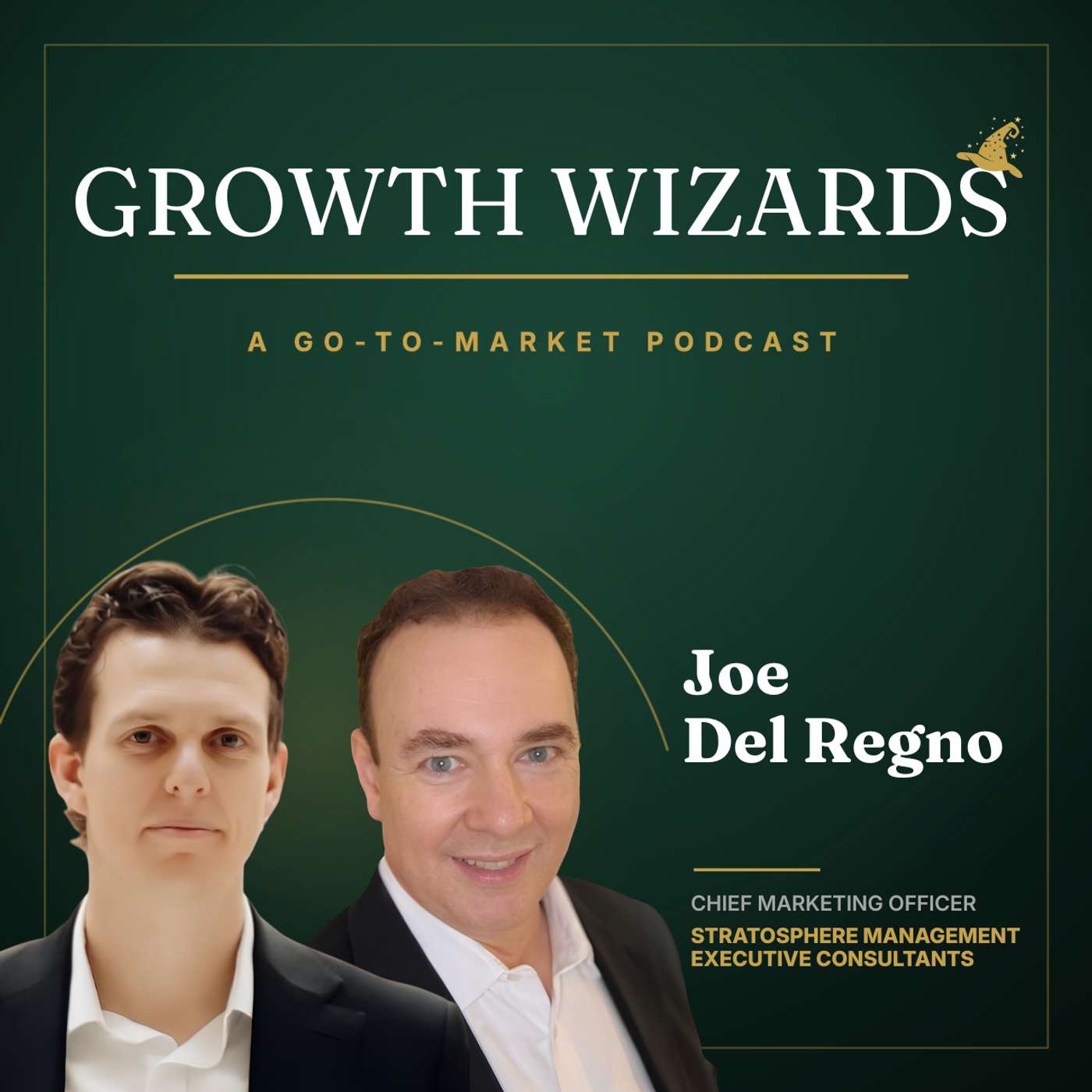
The Growth Wizards Podcast · Tanner Green
Summary In this episode of Beyond the Paycheck, host Tanner Green sits down with Joe Del Regno, a growth and marketing executive who has doubled revenue for consumer brands across CPG, food, and DTC and now serves as chief marketing officer at Stratosphere Management Executive Consultants. Joe shares the principled approach behind his biggest wins: start with core purpose and people, find the one foundational growth insight that unlocks everything, and build marketing that reaches the emotional high ground in an authentic, fact based way. Along the way he tells the stories behind Welch's sad banana fruit bites, the Family Dinner Night movement at Home Market Foods, and the Feel Better, Fight Harder cancer campaign at Intrinsic Bioscience, and explains where he sees AI helping and where it still cannot compete. This one is for growth leaders, marketers, and founders who want purpose driven work that also drives results. Chapters 00:00 Introduction 01:05 Meet Joe Del Regno 02:25 HubSpot's Revenue Hub rebrand 04:30 A principled approach: core purpose and people 05:15 The sad banana insight at Welch's 06:25 Partnering with Starbucks to save family farms 09:15 Intrinsic Bioscience and hiring for mission 10:45 Feel better, fight harder and the boxer story 13:15 Home Market Foods and Family Dinner Night 16:45 AI and the future of mission driven marketing Takeaways - Mission and purpose driven companies achieve roughly three times the success of those that are not, but only when the mission is authentic. - Every major growth win starts with one foundational insight you unlock, like Welch's sad banana or families eating dinner together fewer than 2.4 times a week. - Hiring people who are personally connected to the mission can matter more than domain experience; Joe's team made Enteraid standard of care at 700+ cancer centers with no pharma background. - The strongest marketing ladders up to the emotional high ground in a way that is authentic and fact based, not manufactured. - AI is a powerful augmenter across content, efficiency, and building tools, but it cannot replace passion for a mission. Connect with the Guest Joe Del Regno LinkedIn: https://www.linkedin.com/in/joedelregno/ Company Website: https://joedelregno.com
Growth Wizards - Joe Del Regno === Tanner Green: [00:00:00] All right, everyone. Thank you so much for tuning in. We're excited today to have Joe Del Regno on the show. Joe, welcome Joe Del Regno: I'm glad to be here. I love the name of your show, by the way, and I love the show Tanner Green: Love it. Awesome. Thank you so much. To start off, I wanted to give a little bio for Joe, and then we can jump right into some news after that. So let me read this for the audience and for Joe and everyone, including myself. So Joe Del Regno is a growth and marketing executive with a track record of doubling revenue for consumer brands across CPG, food, and DTC. He currently serves as the chief marketing officer at Stratosphere Management Executive Consultants, where he advises organizations on marketing, innovation, and growth. As chief growth officer at Home Market Foods, he built the brand's first evergreen consumer campaign, Family Dinner Night, acquiring six hundred thousand plus new users for cooked perfect and lifting baseline sales by over forty percent.[00:01:00] Pretty awesome, Joe. Love to have you. I'm excited to talk about some news and, and what's going on in GTM, and then also to, learn a little bit more about your experience and really gain some, some knowledge of what you got going on Joe Del Regno: Absolutely Tanner Green: Right on. So I wanted to start off with a little bit of news, and this is something a little off the cuff. I like to do this with all my guests. It's just kind of a fun intro, some news going on around, around the world right now. One of the things that caught my eye, I'm a huge HubSpot guy. Some people are Salesforce, some people like HubSpot. I like HubSpot. But one thing that HubSpot did was they rebranded to what's now called their new Revenue Hub, and they have a lot of different hubs. You know, they have the Commerce Hub, they had the Marketing Hub, they have all these different hubs. So what do you see as HubSpot's main point here to say, "Hey, we're focused on Revenue Hub"? What does that mean for you? Joe Del Regno: Yeah. [00:02:00] So, marketing 101 segment, target, and position. So clearly they see an opportunity to go after more of a revenue-seeking vertical. I think so on the pro, they're trying to get after new revenue streams. The con is when you spread your message too thin and you try to stand for everything, do you really stand for anything? So you gotta be really careful about how many audiences and how many verticals that, that you go after. But, they're a smart organization, and clearly they, they see an opportunity Tanner Green: Yeah, I love it. So have you used HubSpot before, Joe? Joe Del Regno: In the past, yes Tanner Green: In the past. Okay, what do you think about their marketing hub and maybe some other marketing software tools? I'm curious. This is just totally random. Curious to get your thoughts Joe Del Regno: Yeah. I think it could be more automated and a little more user-friendly. I like things that you can see the headlines at a glance and then double-click down on your own. But the more automated some of those marketing tools can be, I think there's [00:03:00] efficiencies to be had Tanner Green: Hmm. Yeah. Love that. . Well, Joe, I wanted to go over some of the things , we talked about before the show actually began, and I really wanted to dive into what you did at Welch's and what you did by doing that complete, segment, double segment sales from 50 million to 100 million in a year and the flagship process that you went through in order to make something like that happen. 'Cause that's a huge feat, and that's something that's awesome, and everyone knows the company. It's, like, a really well-known brand. And if you don't know Welch's, they're, like, the juice box company, and that's how I know them. They have... I'm sure they have lots of other products, but that's what I know them as, especially after, like, youth soccer games and stuff with the orange slices and the juice boxes and all that. So tell me a little bit more about that and how did that come about? Joe Del Regno: Yeah. So, how it came about is I'll just take one really quick step backwards is, throughout my career, I've really followed the same [00:04:00] approach a principled approach. I, I don't wanna call it a system but essentially it really starts with core purpose and people. Every organization has a core purpose. With Welch's, it's literally saving small family farms and preserving a way of life. And when you get people who are passionate about that mission and really buy into it and align with it authentically, that's where the magic happens. And the reason for that is you'll run through walls. You'll put your heart into it. Instead of giving up, you'll say, "Well, what would need to be true for X or Y to happen?" So the next step is for every success I've been fortunate enough to be a part of, there's always a foundational growth insight something that you unlock. That's where you get all the growth. And, in the case of, I think you were referring to the fruit food side of the house at Welch's the foundational growth insight is what we called sad banana because somebody drew a sad face on a banana [00:05:00] that was rotten. And the meaning behind that is almost two-thirds of all fruit in America that people buy at the grocery store goes bad. Tanner Green: Really? Two thirds? Joe Del Regno: almost two-thirds. Yes Tanner Green: that is insane Joe Del Regno: It is. And I try to be so conscious of it, but, even in my house like stuff just goes bad so fast. So that, that created an opportunity. How do you make a highly nutritious, no sugar added fruit bite that has the whole of the fruit that's shelf stable? And that led to a whole line of innovative fruit food products. The go to market strategy was to partner with Starbucks, where we literally would co-develop products together. We co-developed brands together, the packaging together, and they would have exclusive rights to it for a certain period of time. And then we'd be able to then take it to market ourself with the cachet, as I like to say, of being the cool kid [00:06:00] in school because you had Starbucks, which made it a lot easier to go to market on our end. And the great thing about that it really was something I was very passionate about is Welch's is a co-op of small family farmers who were really struggling. Years ago there were like 4,000 or 5,000 of these farmers and it's down to like 800. It's just a really tough way to make a living. And They get, only get paid when the crop is moved. So This whole division at Welch's was dedicated to trying to find new, innovative ways to move the crop to help the farmers Tanner Green: Wow. Interesting. I love that. So this is totally off topic, and I'm just curious how much you know about this. Where is the industry for farming going? What is happening there? I feel like it's just, it just doesn't make a lot of sense. So I'm in Utah, right? And I know my wife's in Idaho. When you drive up there, there's a lot of farms, right? But people are selling them left and right. The owners [00:07:00] are, dying off or retiring, and all their kids are like, "We're not doing this farm thing. We're selling it off." So what what does that look like? I have no idea. Joe Del Regno: What you just described is exactly what's happening. They're being bought out by the bigger conglomerate-type players. It's like that way of life is going by the wayside. Not in all cases and there are I gotta tip my hat. There are small family farms that are using it as a marketing and positioning and go-to-market advantage, where they're saying, "We are an authentic four-generation. We're on 50 acres. We do it all ourself. We're not owned." And they, they turn, 100%, and they turn a disadvantage into a really powerful story that works to their advantage. Some of the beef players do that really well Tanner Green: Yeah, I love that. I love the way that you work with, with these folks and how you guys set it up and where you start and your approach. I like your approach, and I'm assuming you've taken that approach to, like, [00:08:00] other companies too, right? So Tell me about when you get to a company and you have this approach in your mind and you're like, "What do I, where do I start? What do I do? How do I ask the right questions to take this approach and make it a consistent viewpoint from the rest of your team?" Joe Del Regno: Yep. So I'll give you the best example. The most inspiring of my career So, every one of us has been hit by cancer, either ourselves or with someone we know. My family certainly has. And I left Welch's to take a flyer. It was a pure passion play on a startup biotech company with a revolutionary product, clinically proven to reduce the side effects of cancer treatment. I've had family members go off treatment because the side effects were so bad. So that brought me to Intrinsic Bioscience. And so to answer your question, the first thing you do is you really-- I mean, you listen, you learn, you ask questions, but you, you drive to understand the core purpose. And at Intrinsic, the core purpose, and the core [00:09:00] purpose of this product, Enteraid was giving cancer patients back their lives. And then it starts with people. And believe it or not, when it was a startup, I came in as chief marketing officer of a department of one, me, and then we grew out the team. And everyone I hired, there were two unique things about them. One was they had all been impacted by cancer and were very passionate about it, and that made all the difference. When you are mission-driven, like I've seen miracles happen. And the second thing that I still shake my head at to this day, but I understand why it had the impact it did, not one of us had any healthcare medicine, or pharma background. And that led us to take a really unique approach, really disruptive storytelling where the foundational growth insight here, there are a lot of insights with cancer, but the one to rule them all is you have to have your fight if you're gonna have a [00:10:00] chance. You gotta have that fighting spirit, and you can't-- You lose your fight if you're knocked out by the chemo and the radiation and suffering all the side effects. So we came up with the Feel Better. Fight Harder. campaign, and I'm a big believer in that the best marketing ladders up to the emotional high ground in an authentic way, and that's what we did. It was the most emotional work I've ever been associated with. A lot of patient testimonials a lot of stories about the direct impact that it had on people's lives. And I'll give you my favorite one. There was a boxer who was given a 5% chance to live from his cancer. He took Enteraid faithfully, and he lived in China, which they have much higher levels of radiation, so he was nuked And after his five weeks of radiation, he came out and he had a fight, and the doctors couldn't believe it. Like, "How are you doing [00:11:00] that?" And we made an ad out of it, and here's the punchline. That boxer is my brother. And his statement in the ad was authentic. It was right his words, "I'm going to win my fight. I'm going to win my fight," and he did. So that, that's the type of emotional high ground that I talk about. It's authentic, it's fact-based, but it taps into that emotion. And so far, just a quick aside, I have not seen AI effectively be able to do that. AI is wonderful, and there's there's we could talk for hours about it, but that's the one place I haven't seen Tanner Green: Yeah. Well, to me also, Joe, it sounds like you have chosen these companies well, because a lot of... These companies are not just your average kind of SaaS company or anything like that. Like, these have impact. They have meaning. They have, they have a real opportunity to help people [00:12:00] and change lives, you know? And so I like that approach because with your approach, you have to also choose wisely. So What would you say to someone who may not have that 100%, let's go get 'em all together, fighting cancer or joining farmers together? Those are really great causes. What would you do if there wasn't something like that? Like, how would you approach that? Joe Del Regno: So yeah, so that's a great question. And my experience at Home Market Foods is a great example. Certainly the company does a lot of very noble things and community service, but not as part of its core business strategy necessarily and its marketing. And we came up with the foundati-foundational growth insight here was that American families are eating dinner less together than ever before in history, less than 2.4 times a week. And as you can imagine, there are incredible benefits to sitting around the dinner table [00:13:00] together as a family. So that mission of helping families have dinner together wasn't there. We created it. So the strategy was to start a movement, literally, Family Dinner Night. And as the sponsor of the movement it had a huge impact on sales. As you mentioned, we-- it ended up being well over a million new users to the brand we were able to capture. We got people to take a pledge, literally a written pledge, To have dinner one more night a week with their family, and thus we have their data, and we can send them recipes featuring our products, coupons. other companies got involved and wanted to sponsor it. To answer your question, I just so believe, and I think this is really important, in the power of mission and purpose-driven growth and marketing. And not only do I believe it delivers better results, every study shows that. In fact, mission and purpose-driven companies and nonprofit foundations [00:14:00] they achieve three times the success as non-mission and purpose-driven companies. There's a l- a huge body of literature on that, and it has to be authentic. But yeah, that's what I look for. And I feel like I've been on a journey where I continue moving in this direction of mission-driven. I do a lot of nonprofit work. I've headed up foundations before. But I'm continuing to evolve in that direction, and I really am looking to take it to the next level and become even more mission-driven, either for a for-profit and for a nonprofit as well. Tanner Green: I love that. That's amazing. I think driving people to a same mission and purpose and, and having them be in one heart and one mind, so to speak, it's unstoppable really. Like, if you get everyone cooking the same way and, and have the train rolling, every car you add to that train, it is gonna be a head full of steam. I love that. Joe, with AI and with all this, the new modern technology and remote [00:15:00] work and, all of these things that kind of... Distractions that get in the way, how do you keep your team focused on that mission? Like, how do you keep them continuously, engaged and active and, and behind it? Joe Del Regno: Yeah, because one, it's authentic, and two, you walk the talk and you live it every day. I'll give you a great example. At Intrinsic, we had the overall core purpose, but then every position on the team had its own core purpose that laddered up to the macro core purpose. And so people in their job description, it literally talked about it. You live it, you walk the talk. And as a result of that Enteraid became standard of care at over 700 cancer centers by a team of people with no experience in healthcare Tanner Green: Wow. Amazing. I love it. It definitely makes me wanna focus more on my business and getting a mission and purpose and honestly just keep it g- keep the whole team... We're a small team, but still, I'm like, "Man, we gotta do this, you guys." But so Do you see it changing [00:16:00] much, the future of marketing and with all the new technology and this? 'Cause to me, And you correct me if I'm wrong, you're kind of the expert in this space. The approach that you have, the purpose, mission-driven company, it's never really gonna go away. No matter how much technology you have, where do you think it's gonna go? What do you think is going to change, and what do you think is gonna be better? What do you think we need to look out for? Joe Del Regno: I see a trend where the companies that are succeeding are becoming more mission-driven. So I definitely see that as a long-term trend. I do not think, like, that's something that AI can replace that passion for the mission and coming up with the mission. So I see things trending in that direction. What I do see is I see a lot of efficiencies. I call it level one, level two, level three. Level one, content creation. Level two is efficiency, you know, doing more faster with AI. And then level three is actually building something that you have a need in your business or your [00:17:00] nonprofit, and you build something with it that can do that work that enables you then to focus on other things. So I see it as augmentive. But we're definitely in white-whitewater times. I think this is one of the biggest changes I think it's, probably a no-brainer here, but I think it's bigger than the creation and the proliferation of the internet Tanner Green: Yeah, it is unbelievable. And how fast it's going and everything that it's doing, it's just, it is crazy. Whitewater is a good way to you're, it's like level five whitewater rafting, Joe Del Regno: no, you got it Tanner Green: insane. Wow. Joe, this has been awesome. Thanks so much for coming on the show. How can people find you and connect with you online? Joe Del Regno: Yeah, so they can find me at Joe DelRegno, two words, DelRegno on LinkedIn. My contact info's on there. You can check my website out at joedelregno.com and connect with me. I'm always looking to connect with growth leaders and, and interesting people and so feel, feel free to reach out. Tanner Green: Awesome. Love it so much, Joe. Thanks for coming on the [00:18:00] show, and thanks for the listeners tuning in Joe Del Regno: All right. Awesome. Have a great day