
The Growth Podcast · Aakash Gupta
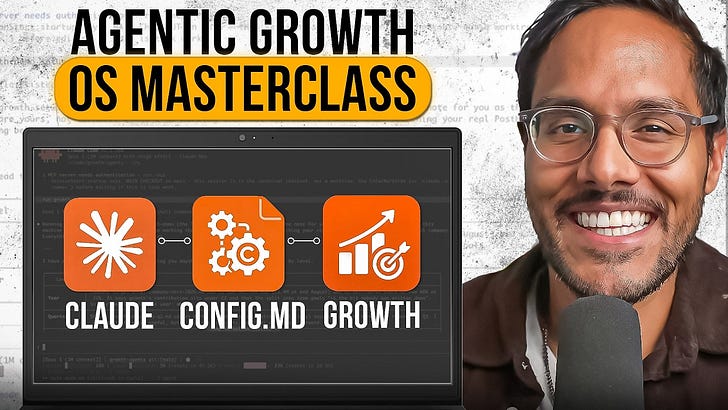
This is a public episode. If you'd like to discuss this with other subscribers or get access to bonus episodes, visit www.news.aakashg.com/subscribe Brought to you by Fingerprint: Identify good and bad visitors with industry-leading accuracy Ariso: Ship AI agents and features faster, with fewer regressions Customer.io: Send smarter messages using your product data Amplitude: The market leader in product analytics Product Faculty: Get $150 off their #1 AI PM Certification via code AAKASH150 Today's Episode "We no longer need to wait for engineers to build growth experiments." That's what James McAulay told me. Halfway through our recording, he showed me what he meant, on my own site. He ran one Claude Code skill, and a few minutes later I had a list of SEO fixes I'd been ignoring while my search traffic slid. So I made this episode for every PM and founder doing growth with no team behind them. James led Creator Growth at ElevenLabs, and now he runs his whole business from one folder in Claude Code. I asked him to open it up. He walks through: The goal cascade that stops Claude (and you) from building features nobody asked for An SEO audit skill wired to Firecrawl, DataForSEO and Lighthouse, run live on my site Multi-agent refine, the panel of critic agents he runs on every plan before anything gets built He runs his actual business on every piece of it, and that's why it holds up. If you own growth and never seem to have time for it, start here. Key Takeaways 1. Run growth from one folder - James's growth OS is one folder with three layers: tools with real APIs, skills he uses every day, and weekly routines that improve the setup. If the agent can't read a tool's data, the tool doesn't make the cut. That rule alone keeps the whole stack usable by an agent. 2. Tie every session to your goals - A goal cascade runs from a yearly mission file to quarterly OKRs, monthly and weekly retros, and a daily standup. A session hook shows Claude the mission at the start of every session. When you drift, it pushes back. 3. The weekly retro is the one that matters - James sometimes skips the standup, but never the Friday retro. Connected to his to-do list and GitHub, it caught him refactoring for fun while outreach tasks went stale for weeks. Your gut says one thing, the data checks it. 4. Do the long onboarding - The full setup is an interview with Claude that can run two hours. It feels like a slog. But once your context lives in files, every answer after it gets better. 5. Close every experiment - Each test starts from a template with a hypothesis, baseline, primary metric, confounders and stop conditions. The weekly retro and daily standup flag finished and stale tests. Every one ends in a documented learning instead of a forgotten dashboard. 6. Pull baselines, don't type them - When you set up a test, numbers like baseline conversion and traffic should come straight from PostHog, Mixpanel or Amplitude. James says nobody should be answering those...
0:00SPEAKER_02AI has just completely unlocked what growth people can do.
0:03SPEAKER_02We no longer need to wait for engineers to build growth experiments.
0:07SPEAKER_02You can simply ship to production with permission from your engineers yourself.
0:11SPEAKER_02We're seeing these full-stack growth hires achieve incredible amounts.
0:15SPEAKER_02I think this operating system will help you get better growth results.
0:20[music]
0:30SPEAKER_02It's my sort of take on how to work with Claude as a growth person.
0:33SPEAKER_01Meet James McCauley,
0:34SPEAKER_01who helped Eleven Labs double from 100 million to 200 million ARR in nine months
0:39SPEAKER_01and helped AI startups like Jack and Jill and Wonder Studios with their growth.
0:43SPEAKER_02When I was at Eleven Labs in 2025,
0:45SPEAKER_02we were definitely ahead of the curve with AI,
0:47SPEAKER_02but actually our launch processes were mostly custom GPTs,
0:50SPEAKER_02and that's because skills hadn't been formalized across the AI ecosystem.
0:54SPEAKER_02How the hell did you scale up this