
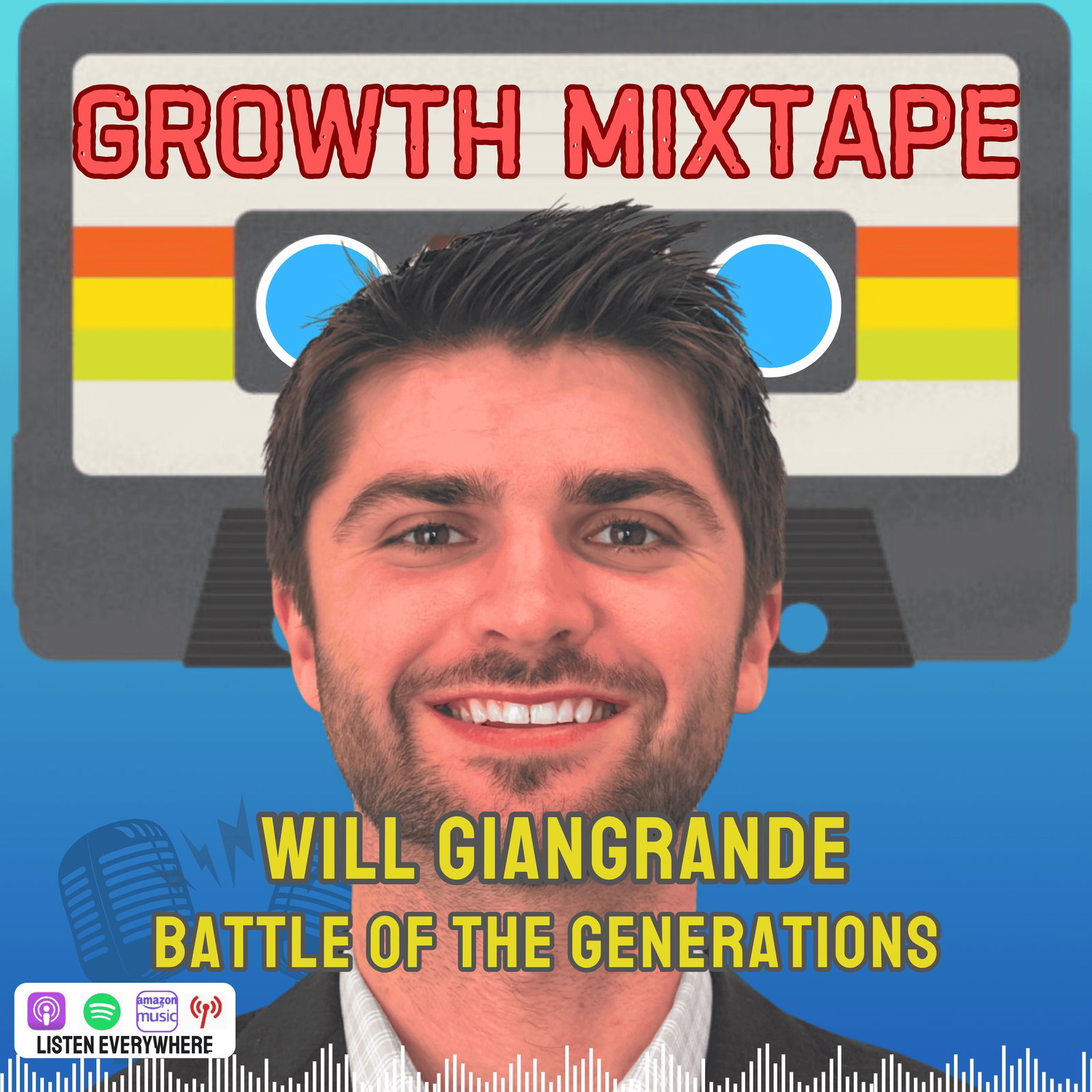
The Growth Mixtape · Bob Mathers
Today we talk to Will Giangrande, founder of The NextGen Playbook and someone who has made it his mission to help bridge the gap between generations in the workplace. I met Will a little over a year ago, and despite being nearly the youngest person in the room, he struck me as an old soul. He's spent the last few years helping leaders better understand Gen Z, but what I loved most about this conversation is that he flips the usual script. Instead of a fifty-year-old HR professional explaining how to relate to younger workers, here's someone from inside that generation translating both directions — and refusing to point fingers about which generation has it figured out. We covered everything from dating apps and long-distance relationships to remote work, feedback, work-life boundaries, purpose, AI, and why a 25-year-old might already be wrestling with questions previous generations didn't start asking until midlife. More than anything, this conversation reminded me that most of the friction between generations comes from misunderstanding. We're all just products of the world we grew up in — and if we can stay curious and ask one more question, we usually find we have more in common than we think. Please enjoy, Will Giangrande. Key Takeaways Every generation has accused the one behind it of being lazy, entitled, and bound to ruin everything. Will literally collects these quotes and has audiences guess which era they're from — the complaints are ancient. "Gen Z" isn't one group. Smartphones and COVID created sub-generations inside the label: someone who got a phone at 15 forms relationships differently than someone five years older, and where you were during the pandemic (17 or 22) changed everything. Most workplace tension is a projection problem. We assume the only upbringing we ever had — the way we learned to communicate and build relationships — is the "normal" way, and judge everyone else against it. Wanting feedback isn't neediness. In a remote setting, the hallway moments and quick door-knocks vanish, so mentorship has to be scheduled and asked for. That makes it look constant and formal when it's really just become visible. The work-life boundary fight isn't about laziness either — it's about control over time, not fewer hours. The 9-to-5 is an industrial-era leftover, and younger workers are the first to feel empowered to push back on it. Most of us never felt we could. Your first job becomes the baseline. Whatever you experience first — remote or in-person, one set of norms or another — quietly becomes the standard you judge every job after it against. Purpose is arriving early. The questions about meaning and balance that used to trigger a midlife crisis at 45 are now showing up in people's twenties — and with longer lives and AI reshaping work, careers are becoming less linear. Reinvention and curiosity may matter more than sticking to one path. We make sweeping claims about millions of people from a sample size of five. Social...
0:00Speaker 0: Look.
0:01Speaker 0: The your twenties is just your time to work your ass off.
0:04Speaker 0: You don't have kids.
0:05Speaker 0: You don't have, responsibilities.
0:07Speaker 0: You might not have a mortgage.
0:08Speaker 0: Then now is the time to work eighty hours a week because that's what
0:11Speaker 0: I did and that's the way it's supposed to be.
0:13Speaker 0: Now you've got a generation going, why would I work for thirty years before
0:16Speaker 0: looking for some purpose?
0:18Speaker 0: You know, the old generation, you're all freaking alcoholics.
0:21Speaker 0: You're all have got heart disease.
0:23Speaker 0: You're all freaking miserable.
0:25Speaker 0: You're all burnt out.
0:26Speaker 0: Maybe they're on to something.
0:28Speaker 1: I know that if I'm doing something