
The Future of Education · Michael B. Horn
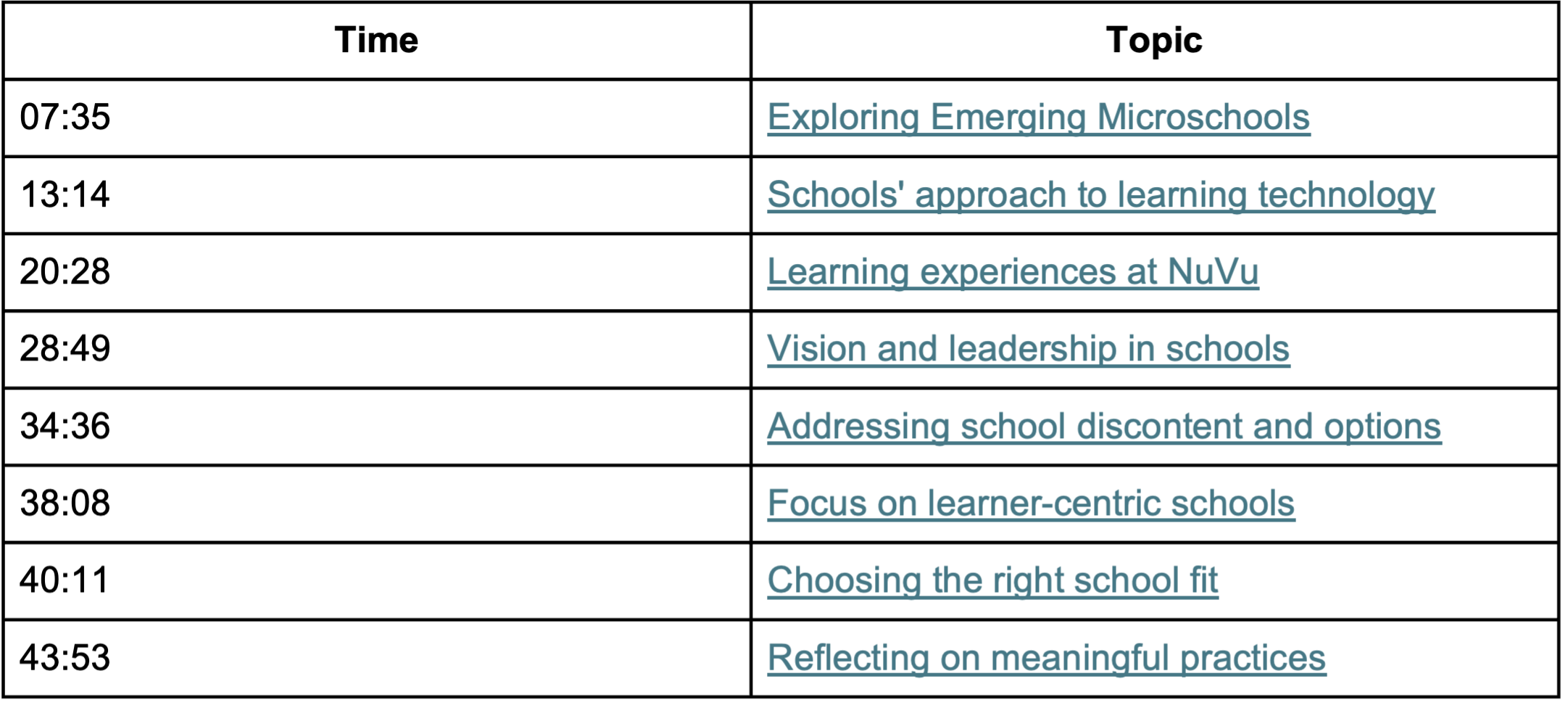
Four of my former Harvard master’s degree students—Ruben Villarreal-Halprin, Matthew Millikin, Jaysan Shah, and William Wiltshire—joined me to discuss their independent study project exploring seven diverse microschools across the United States: the Village School, Elizabeth City-Pasquotank Public Schools microschool, NuVu, the Levitt Lab, Khan Lab School, Red Bridge, and Alpha School. Several of these I’ve featured here before; others are new. The conversation dove into the range of models, philosophies, and uses of technology and AI within each school to reflect on the spectrum of innovation in schooling, the challenges and opportunities of choice, and the importance of creating learning environments that both lift the floor and blow through the ceiling for students. I look forward to your thoughts and where you all want to learn more! Show Notes: Tomorrow Schools on LinkedIn: https://www.linkedin.com/in/tomorrow-schools-50881b3b6 Michael Horn Welcome to the Future of Education. I’m Michael Horn. You’re joining the show where we’re dedicated to creating a world in which all individuals can build their passions, fulfill their potential and live lives of purpose. And to help us think through that, today I’m, I’m really excited. I’ve got four of my former students. I say former because not only did I teach them several months ago at this point, but they’re all graduates now at, at Harvard. So congratulations to them. They all made it through the rapid fire year that is the Harvard Graduate School of Education experience. But welcome guys. We’ve got Jaysan, Matthew, William, Ruben, all just amazing. You’re all amazing. You all come from really cool different backgrounds with education. And, first, welcome. And then second, I, I’ll say the reason I wanted to talk to you guys is because in the second semester you chose to do an independent study with me for some, you know, inane reason of wanting to continue to work with me, but you did it around a series of microschools that are emerging that in your words, like start to allow us to question the principles of what is a school? What’s the purpose of schooling in this era of AI? What are the things that are most important perhaps, or how can we think about things perhaps differently from how we have? And you did these deep dives into these seven microschools around the country and got to visit and spend time in all of them and create some really cool rapport and reflections around them. And I wanted to dig deeper with you on the podcast about it. So welcome. Maybe let’s start, just go around, if you will, the proverbial virtual studio and, and just sort of give the thumbnail sketch of who you are, your background. Why this was an interesting conversation for you to do research in for an entire semester. And we’ll, we’ll start there. So William, why don’t you jump in first? William Wiltshire Sure, yeah. Thank you so much, Michael, for having us. I was a middle school math and history teacher in New...
0:00SPEAKER_02We always raised the floor.
0:02SPEAKER_02Kids were not falling through the cracks,
0:03SPEAKER_02kids were doing well,
0:04SPEAKER_02but in the same time as doing that,
0:07SPEAKER_02we often constricted the ceiling of where kids could go.
0:10And I think these schools really bust through that glass
0:14ceiling and say like,
0:15SPEAKER_02if this is the right fit for you,
0:17SPEAKER_02if you found the right place,
0:19SPEAKER_02then the sky's the limit because you'll have the autonomy,
0:22SPEAKER_02the support,
0:23the resources that really feed into you as a learner that
0:27allows you to accomplish
0:28SPEAKER_02amazing things.
0:34SPEAKER_00Welcome to The Future of Education.