
The Future of Education · Michael B. Horn
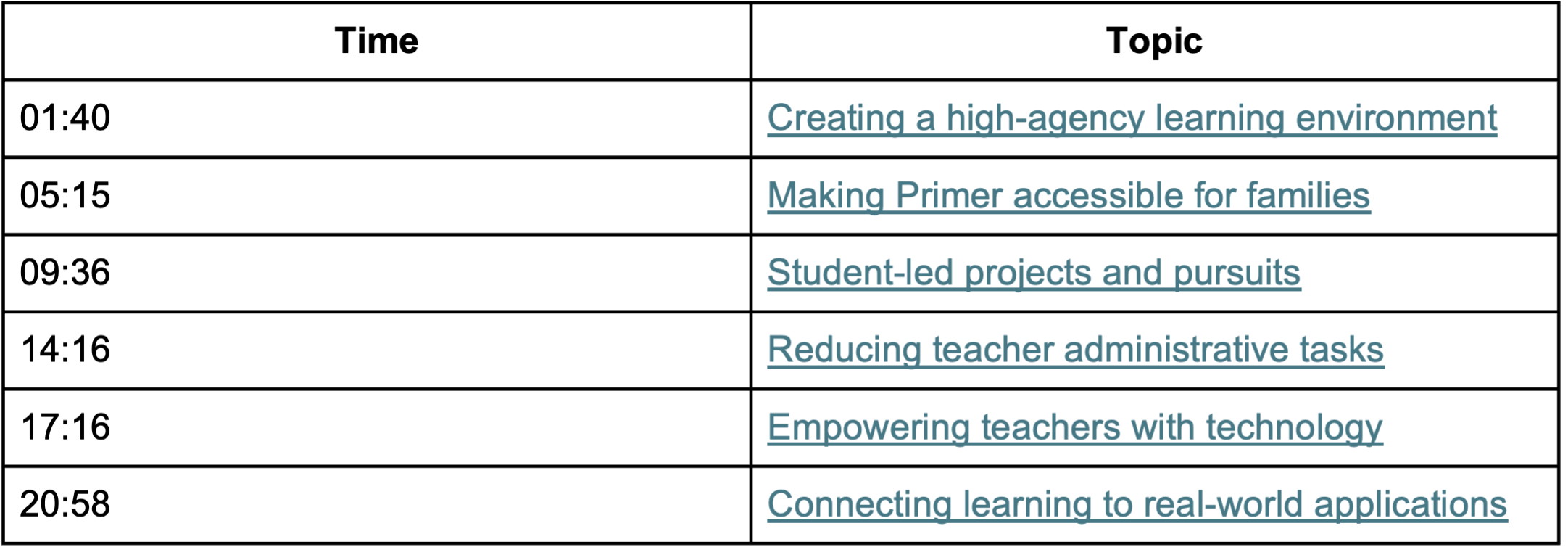
Ryan Delk, the founder of Primer, an innovative K–8 private school network focused on accessibility, mastery, and student agency, sat down with me at a Primer school in Florida to help me learn about Primer’s schooling model. Ryan explained how Primer partners with passionate educators to launch flexible, community-focused campuses that prioritize affordability and transparency for families. Our discussion showcased how Primer leverages technology to personalize academics through regular assessment, supports teachers by reducing administrative burdens, and cultivates real-world skills and student empowerment through project-based “pursuits.” And we have clips throughout of teachers and students interacting in the school, as Ryan gave me a tour of the school. I can’t wait to hear all of your thoughts in the comments. Michael Horn Welcome to the Future of Education. As I’ve discussed, for the last decade-plus, we’ve seen a wave of microschools and, more accurately in my view, low-cost private schools, emerge across the country. Many are local schools with one or two sites. But a few have scaling ambitions through different mechanisms—names like Acton Academy, Prenda, OpenEd, Wildflower, KaiPod arguably, Flourish, and a few others. And then there’s another school network with such ambitions called Primer. I had long heard about the Primer model from many folks and knew several of the team members. But I had never had the opportunity to visit a Primer School. Knowing I would have the opportunity to interview Gov. Jeb Bush and Primer’s founder, Ryan Delk, in Florida at a Primer School, I was also excited to visit and learn more about the model. What follows is some of the conversation Ryan and I had and a look into the school itself. For those listening, you’ll miss a lot of the video of the actual schools but you should be able to get the basic flavor. For those watching, I hope you enjoy and learn from the accompanying video of students and teachers. Creating a high-agency learning environment Michael Horn Ryan, I’ve been wanting to see a Primer school for I don’t know how many years now. We’re here, we’re here at Coconut Grove. Tell us about the Primer model. That’s the first thing I always hear when I hear about Primer schools is you have to understand the Primer school model. What is it? Ryan Delk So it’s, I’ll talk about it from the family, teacher and student perspective. So from an educator perspective, Primer exists to empower these great educators who have dreamed of starting a school or want to start a school and want to serve their communities. But that’s a quite arduous process if you want to get a school ground. And so we partner with these great educators, we help them open these schools across Florida, now Alabama, soon Texas. And these are sometimes former administrators, they’re sometimes longtime teachers, sometimes Teach for America alums. But they’re people that see that the traditional system is not meeting kids needs, not...
0:01SPEAKER_00Welcome to the Future of Education.
0:13SPEAKER_02As I've discussed for the last decade plus,
0:16SPEAKER_02we've seen a wave of micro-schools and,
0:19SPEAKER_02perhaps more accurately in my view,
0:21SPEAKER_02low-cost private schools emerge across the country over the last many,
0:25SPEAKER_02many years.
0:27SPEAKER_02Many of these are local schools with one, maybe two sites.
0:31SPEAKER_02But a few have scaling ambitions through different mechanisms.
0:35SPEAKER_02These are the names like Acton Academy,
0:37SPEAKER_02Prenda,
0:38SPEAKER_02OpenEd,
0:38SPEAKER_02Wildflower,
0:39SPEAKER_02Kypod,
0:40SPEAKER_02Flourish,
0:40SPEAKER_02and a few others.