
The Future of Education · Michael B. Horn
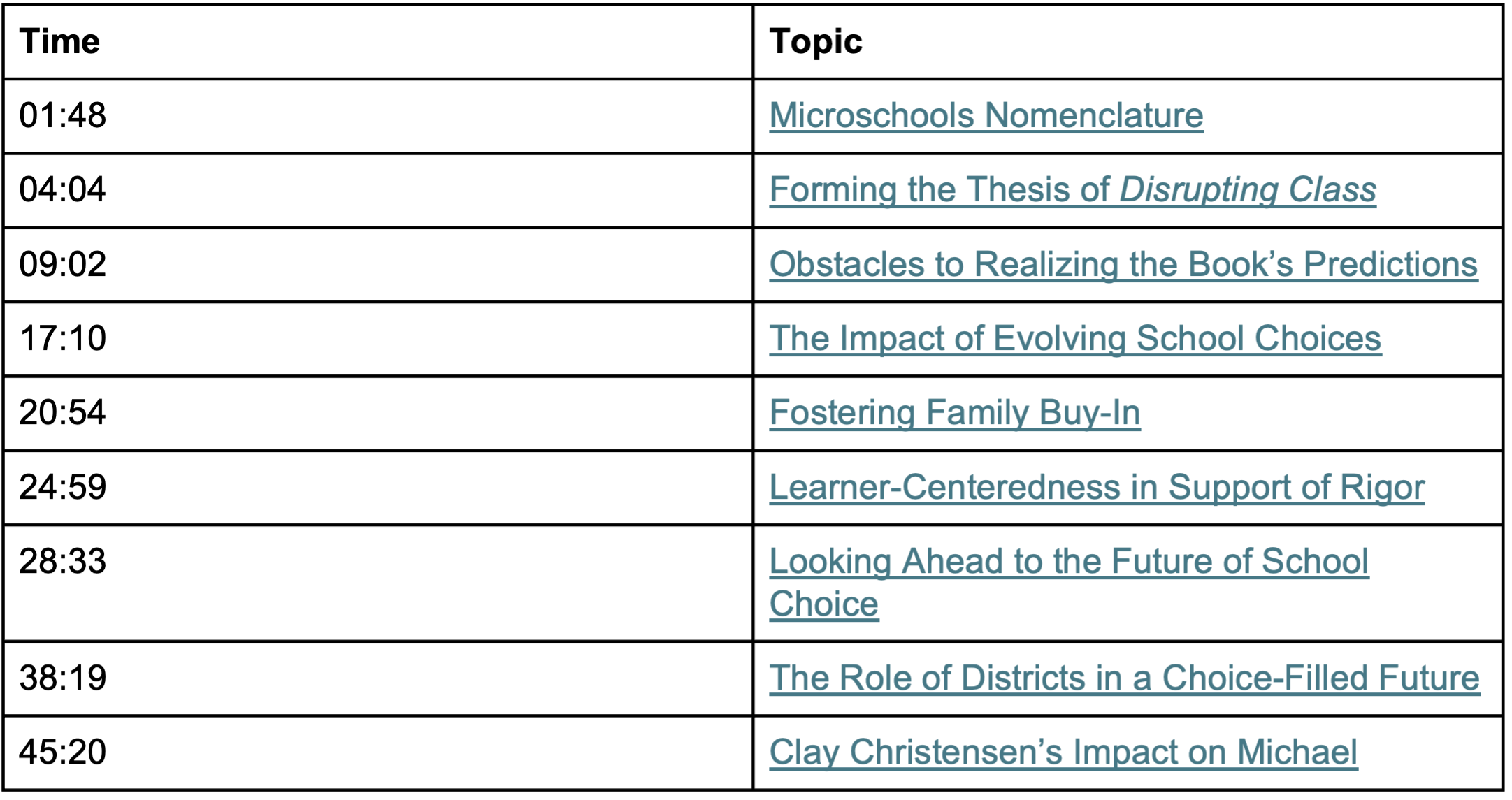
I’m normally the one asking the questions on this podcast. But when Kelly Smith, founder of the microschools solutions provider, Prenda, reached out with a bigger question around how has disruptive innovation in education evolved since Clay Christensen, Curtis Johnson, and I published Disrupting Class, I was thrilled to join him in a conversation on his KindlED podcast (check it out!)—with the idea that I’d also post it here. In this conversation, we discussed why technology alone did not (and will not!) produce the student-centered transformation many expected, how entrenched school structures and family habits can slow change, and how microschools, homeschooling, and education savings accounts are creating new pathways for more customized learning. We also reflected on the growing role of parents in shaping educational choices, the relationship between learner-centeredness and rigor, and what a more pluralistic, choice-filled future for schooling could look like. I hope you enjoy our conversation—and look forward to your thoughts. Michael Horn: A school doesn’t move to mastery-based learning, but they move to mastery-based grading, which I think is the wrong way to organize the world, but they’ll make that move first. And parents are like, whoa, like rebellion, right? Like, what are you doing? So like, you can see when you jump ahead of them, yeah, you get pushback. But if the parents are in the driver’s seat and they’re sort of piece by piece, like, wait, can I do that? Wait, can I have that? Like, they start to assemble the pieces in community. Kelly Smith: Hello and welcome to the Kindled Podcast for another exciting episode. I’m Kelly Smith. I’ll be your host today. I’m excited to be talking to Michael Horn. Michael’s an award-winning author. He’s written 8 books, including a national bestseller, Job Moves: 9 Steps for Making Progress in Your Career. He’s also teaching at the Harvard Graduate School of Education, and he co-founded the Clayton Christensen Institute for Disruptive Innovation, which is a nonprofit think tank, along with Clayton Christensen. We’ll be talking about that in today’s episode. Michael strives to create a world in which all individuals can build their passions, fulfill their potential, and live a life of meaning through his writing, speaking, and work with a portfolio of education organizations. I’ve known Michael for years. He’s influential in my personal story. I’m very grateful that he took the time to sit and talk with us. I think you’re going to love the insights on what’s happening in the education world, How does disruptive innovation as a theory apply to what we’re seeing right now? And where does this all go from here? So with that, Michael Horn. All right, Michael Horn, thank you so much for joining me on the KindlED Podcast. We’re excited to talk today. Michael Horn: I’m thrilled to be with you, Kelly. Like, I was thinking about it when you were starting up Prenda, man, what is it like 10 years at this...
0:00SPEAKER_01A school doesn't move to mastery-based learning,
0:03SPEAKER_01but they move to mastery-based grading,
0:05SPEAKER_01which I think is the wrong way to organize the world.
0:07SPEAKER_01But they'll make that move first.
0:10SPEAKER_01And parents are like, whoa, like rebellion, right?
0:13SPEAKER_01Like, what are you doing?
0:14So,
0:15like,
0:15you can see when you jump ahead of them,
0:18yeah,
0:18you get pushback.
0:20But if the parents are in the driver's seat and they're sort of
0:24piece by piece,
0:25SPEAKER_01like,
0:25SPEAKER_01wait,