
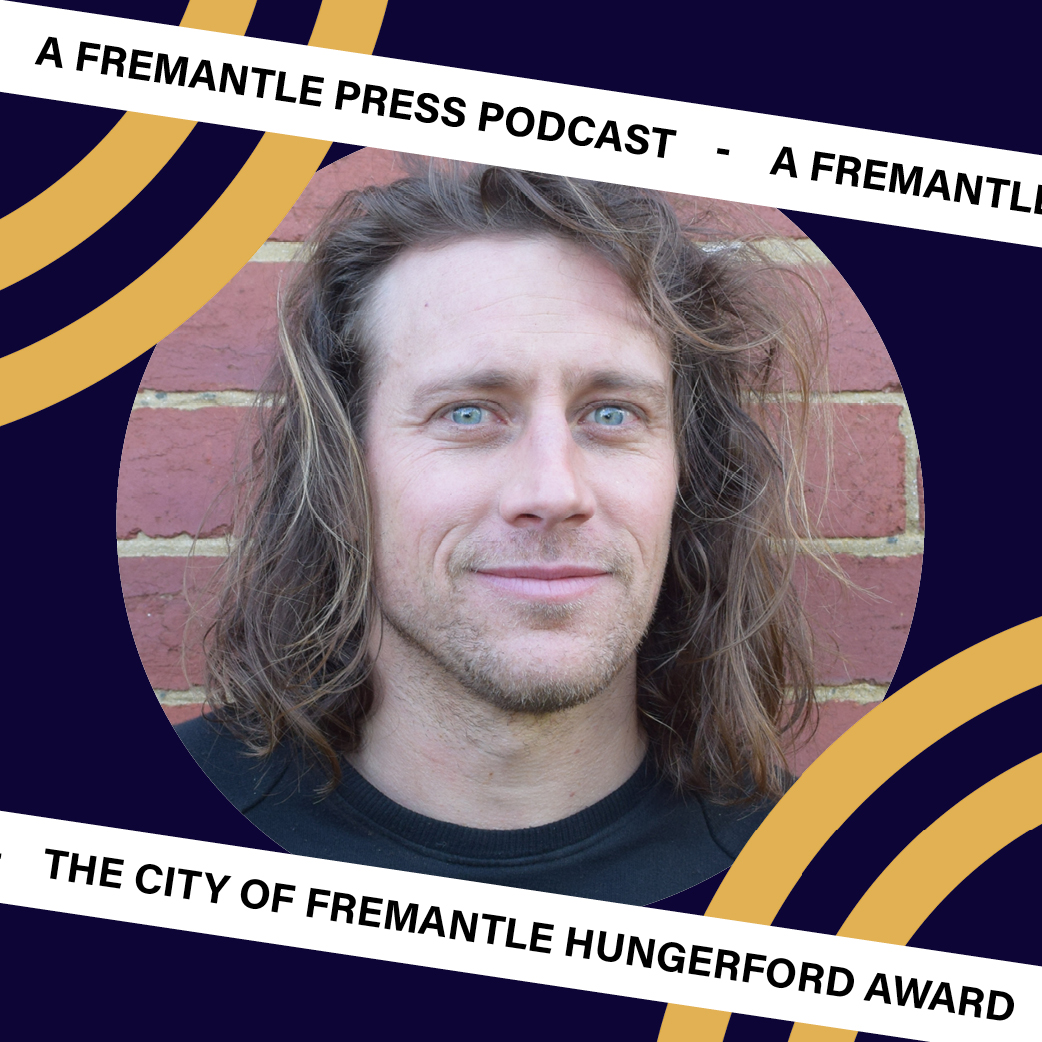
The Fremantle Press Podcast · Fremantle Press
Howard McKenzie-Murray says his main character was inspired by a road trip, Huckleberry Finn and his own sister. He says, ‘Far From Wonderful is somewhere between a coming-of-age and a journey-home story set in Perth and narrated by 21-year-old med student Maud Tarkington. Maud brings you with her through a 24-hour period spanning her 21st birthday and her […]
0:14Speaker AHello and welcome to this special City of Fremantle Hungerford Award edition of the Fremantle Press podcast. Today we are recording on Wali Lap in Wadjak Nogabuja, and I'd like to acknowledge our first storytellers along with noongar elders past and present. My name is Clare Miller and I'm here with fiction publisher Georgia Richter to introduce you to one of four writers shortlisted for the city of Fremantle Hungerford award and anxiously awaiting the announcement.
0:45Speaker BHey, Claire, don't you love Hungerford season?
0:47Speaker AI do. I do feel sorry for some of the writers.
0:50Speaker BThat's a tough gig.
0:51Speaker AIt is a tough gig. And today's guest is Howard Mackenzie Murray, whose manuscript is called far from wonderful. Speaking of tough gigs, Georgia, tell us why you've shortlisted this manuscript.
1:03Speaker BClare, far from wonderful was a real standout for me. It's funny and it's sad and engrossing and it's really distinctively quirky. It's got this sorrowful, lovable main character whose name is Maude, as well as some superb scene work and a really unforgettable supporting cast. There's some difficult subject matter, but this is a really assured author who has a very light touch. And to quote Maud, this one really hit me right in the breadbasket. I've been very curious to meet Howard Mackenzie Murray. He's a writer who's born on Wajuk land in the settler state of Western Australia and he writes for the theatre as well as writing fiction. After studying languages and philosophy at UwA and Murdoch University, he lived abroad and he also travelled widely. These days he lives in Fremantle, travels when possible, reads gardens and practises Zen.
1:59Speaker AHoward, welcome and congratulations.
2:01Speaker CThanks very much.
2:02Speaker ACan you start by telling us a little bit about your manuscript?
2:05Speaker CI'd probably describe it as a funny, sad story. The arc of it is loosely arranged around the odyssey in that it's like a journey home story. The heroine of my novel, she goes through a series of trials. She faces her demons and maybe the demons of the world in order to arrive home or to make a home. Maybe it's told in the first person, so it's more Tarkington telling the story. She's a 21 year old med student and she lives in Perth and it spans a 24 hours period. It encompasses her 21st birthday and her brother's funeral. So it's a big day for her and it starts with this sort of big, chaotic energy and she's running from her friends and her family. She's running from her sadness, the loss of her brother. And so the reader is sort of invited to follow along and, I guess, see if Maud can slow down that crazy momentum and face life, face reality, and maybe find a home for herself.
3:09Speaker BHoward? I absolutely loved the way that it was set within the parameters of 24 hours, a night and a day, and that kind of rushing, tumbling narrative. It's interesting to me that you describe it as the odyssey, too, because it's also like a whirlpool if we descend through layers. But what's interesting is you set yourself as a writer. This challenge of 24 hours, when a lot has to happen, we have to understand a whole history and a whole lifetime within that. Was that a challenge that you set yourself, and was it challenging to do so?
3:43Speaker COh, my God, yes, it was. It wasn't a challenge I set myself. I thought. I thought I was playing to my strengths because I like that compactness. I like reading plays because you read them virtually in real time, and there's this intimacy that I love. So I wanted to do that. Only when I finished the original first draft of the manuscript that I realized the challenge of it did I realize that in that 24 hours period, I actually had to fit a lot of information, a lot more information than I had originally given to kind of give it context, to catch it and to frame it so that the reader would know why all these characters are behaving so, so crazily. Because it's a very. It's a very emotional 24 hours, and it's a lot of backplot and a lot of stories that lead up to it. So I had to go back through and work out novel, entertaining, subtle ways of getting all of this. Of this stuff in. But I had no idea about that.
4:40Speaker BSetting out, writing it, that was part of my aghastness. As I read it, I was thinking, how the hell is the author going to pull this thing off? You know, this is a really ambitious timeframe, but I reckon you did it.
4:54Speaker CIt's funny you mentioned that. I'm reading to the lighthouse at the moment. It's my first Virginia Woolf. Really loving it. But it does that. It's microscopic. It just sits on a moment, and it has all the characters view that moment, critique that moment, and you realize, I don't know. You've read 40 pages. It's like one conversation at the dinner table, but it's gripping, you know?
5:15Speaker BThat's right. And the challenge is to make it entertaining, but to sew all the details that you need. And, yeah, technically, I was so impressed.