
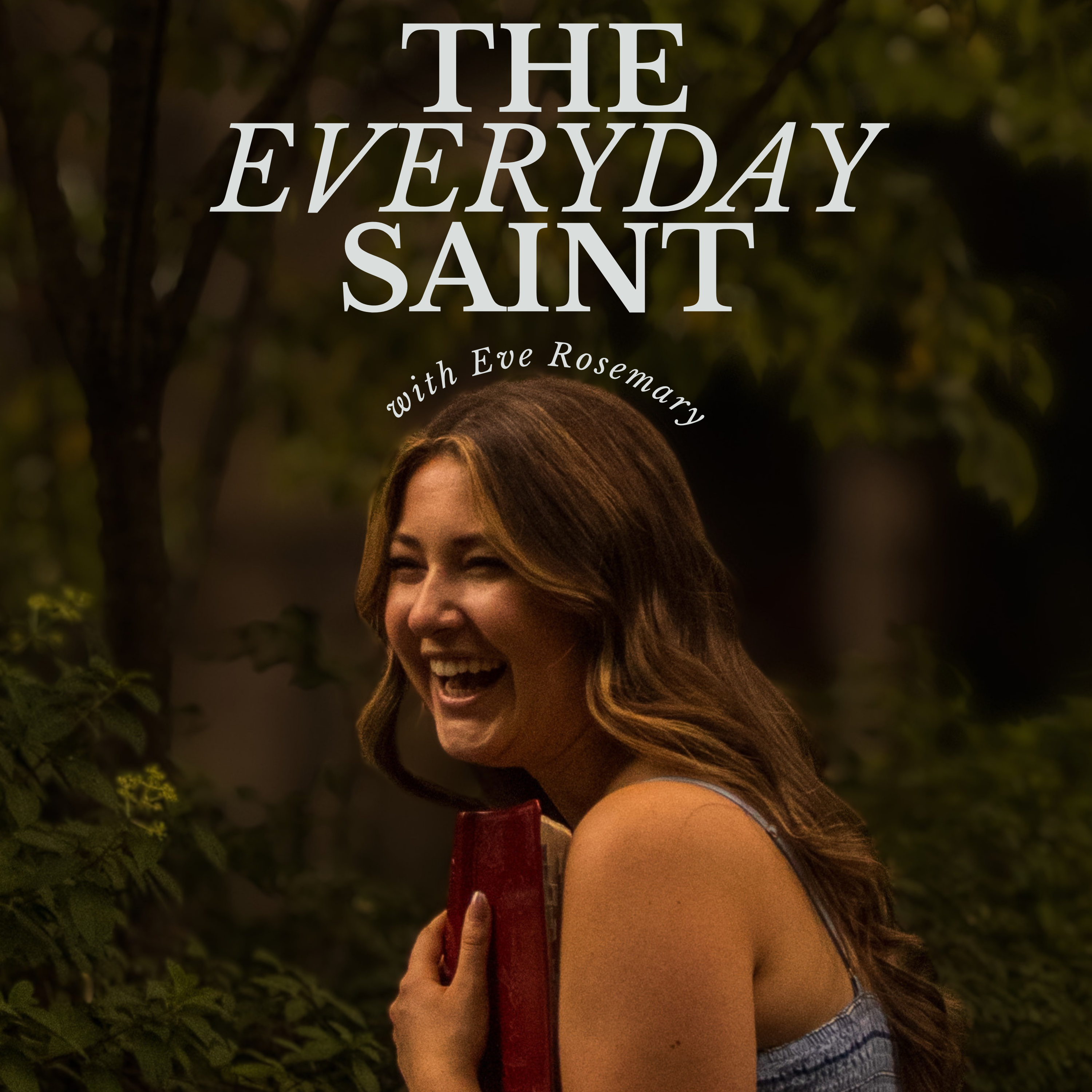
The Everyday Saint · Eve Rosemary
Sr. Phoebe from the Daughters of St. Paul sits down with us to discuss her journey from growing up Catholic, to experiencing hurt within the Church, leaving the Church for Orthodoxy, and eventually finding herself drawn back to Catholicism. This vocation journey is one of redemption. What Satan could've used for poor, Sr. Phoebe has instead been brought to a place of faith and deep encounters with God. She shares her perspective on suffering, being with someone within their suffering, and meditating on the face of Christ within each interaction. This episode is great for the heart learning to trust in God, needing encouragement in their vocational journey, and searching for how to encounter the Lord in the day to day. Learn more about Seton Teaching fellows: www.fellows.setonpartners.org/saint Shop Gloria Patri Coffee with code "EVE" for 20% off: www.gloriapatri.com Follow on Instagram: @theeverosemary Eve Rosemary is currently booking Catholic speaking engagements for the 2026–2027 school year. Learn more or inquire at: theeverydaysaint.com/speaking The Everyday Saint Catholic goods designed to support everyday holiness: theeverydaysaint.com/shop If this podcast has blessed you, please consider supporting the mission. Your generosity helps bring faithful, honest formation to teens and young adults across the country: theeverydaysaint.com/donate Subscribe, leave a review, and share this episode so we can pursue Something Greater together.
speaker-0: Welcome to the Everyday Saint Podcast. Today we are here with Sister Phoebe of the Daughters of St. Paul. And I am so excited for this episode because actually a a former podcast guest may put us in touch and recommended that I come talk to you about your vocation journey and your faith journey. And these are just some of my favorite episodes ever to sit down and talk with the sister about all that God has done in her life and and how you've ended up here. So I'm really excited to talk with you today. So welcome, Sister Phoebe. speaker-1: Yeah, thank you so much. It's a blessing to be here with you. speaker-0: Yeah, thank you. Well, I really want us to get the full picture of your vocation journey. So would you be able to kind of take us back to the beginning of your faith journey and what that looked like? speaker-1: Sure. I mean, what's kind of funny is in a way we're sitting in the beginning. So ⁓ this is the book center or bookstore of my community, the Daughters of St. Paul, here in Alexandria, Virginia. And this is my hometown. So I grew up just a ten minute walk from where we're sitting right now. ⁓ this was the closest tabernacle to where I lived, the closest place to pray. and so I kind of ambiently ⁓ knew the sisters, like in the background of my life, but I wasn't actively born discerning or anything like that. ⁓ rather I got to know my faith through my ⁓ parish and school community of St. Rita's, which is a parish ⁓ near here. And I was very blessed to grow up at ⁓ in a parish community that was really like friendly. All the families knew each other. ⁓ there was a lot of faith sharing and Just love surrounding me. I really was blessed with like an amazing ⁓ environment in which to grow up. But at the same time, I experienced what I think a lot of cradle Catholics can fall into, which is like sometimes I would phrase it as I knew how to say my prayers, but I didn't know how to pray. It was it was that kind of thing where I would identify readily as being Catholic, loving being Catholic, being on fire for my faith in a in a true way, and ⁓ in a a way that was like full of graces from the Lord. But also a little bit superficial at times, like just kind of the culture and not necessarily the relationship, if that makes sense, the relationship with God. And so I felt that begin to change ⁓ when I was actually preparing for confirmation. So I was in eighth grade, ⁓ or actually I should say I started preparing when we were in seventh grade. so I would have been around 12 years old. And I did what ⁓ a lot of us do at that age when we're asked to prepare. Pick a confirmation saint and prepare. ⁓ so we had at our school kind of a, you know, write a report about the saints, ⁓ kind of ⁓ assignment to help us get ready for that. And it was during that time that I just got really obsessed with the saints, which is why when I saw the name of your podcast, The Everyday Saint, I was like, yes, because I love that. Because the Saints for me are what brought me into a closer relationship with Jesus. I literally carried around the Encyclopedia of Saints. That is fully the name of the book that I would carry around as a child, the Encyclopedia of Saints, because I was a nerd. And what I loved about it was this sense that what I experienced as this this place that I loved, this world that I loved of the Catholic Church, it wasn't just like, ⁓ this is a nice culture or a nice environment. All of a sudden it became like, ⁓ this is the path to become. Amazing. Like, you know, I would love to say that I had a strong sense of holiness and becoming holy. That came eventually. But to be honest, I just thought they were interesting, cool, heroic, fascinating. I loved how all the saints had totally different personalities. They came from all over the world. And the saints were this way that I I kind of fell in love with humanity. I just I came to really appreciate like the beauty of. Who God has created by making all of us and and this worldwide church that we are blessed to be in. ⁓ And I became passionate about the idea of becoming a saint. And so I really credit like the sacrament of confirmation with kind of the beginning of my faith journey in that stronger sense. It's, you know, it's it's always hard to have like a really pinned down, a linear sense of one's journey. There's always like stop and go. But ⁓ when it comes to like particular lights on the way, I would definitely say that like confirmation for me. in the sense of the Holy Spirit gave me the gift of the desire to become a saint. Like that for me was a really big light that I can point to as a starting point for my faith journey. speaker-0: That's amazing. Especially because I think sometimes confirmation gets a little bit of a bad rap. Like it's kind of like the sacrament that we I think throw under the rug a little bit. It's kinda f in a little bit, right? Like or like the least understood and because I remember when I I got confirmed, I didn't really understand what it was. And even at that point, like I was pretty solid, like speaker-1: Forgotten. speaker-0: passionate about my faith. I knew at that point I even wanted to like go study theology, right? Like it wasn't like I was just there to take the classes, but it it was really like difficult to understand. So I love that you can pinpoint the specific sacrament as like a pinnacle of your faith journey because that's what like sacraments are for. They give us this incredible grace. speaker-1: They really do. And and I agree with you. It is a sacrament that is not well understood. I think because it is not well understood, sometimes people avoid talking about it at all. But I think it is it's never too late to renew. Like in the way that people often beautifully like there's been a lot of growth lately in people talking about living out their baptism and renewing their baptismal promises, which we do at Easter. And I think you can do the same thing with confirmation. Like you can, in a sense, quote unquote renew your confirmation every time For example, that we participate in the Feast of Pentecost. Because like our confirmation is our share in that Feast of Pentecost. It's it's the day or like the moment that we get to participate in that beautiful gift given to the Church of the Holy Spirit. And so it I never get tired of remembering that, you know. And for me, it it it was very tied up in this very concrete desire to become a saint in this in this literal sense of like I was looking at these saints' lives and I said, I want that. But I think It doesn't necessarily have to take that form for everyone, but I do think that this tradition ⁓ that we have in the church in the United States where we associate confirmation so strongly with the idea of a confirmation saint and like taking this name, ⁓ I think that has this beautiful benefit of like helping us all to see that the plan for our life ends there. Like it ends with us becoming a saint. So let's get started. And I think that that kind of that might not be the literal. theological meaning of the sacrament, which as we like is much more tied to the Holy Spirit, but it's impossible to separate the Holy Spirit in the church. Like it's impossible to separate the bride and the bridegroom, you know? So it's a beautiful thing to be able to reflect on your own confirmation. Even if at the time it didn't mean a lot to you, or or maybe you think it didn't mean a lot to you. ⁓ it is never too late to reconnect and just say, I am a temple of the Holy Spirit. What does that mean? That's pretty impressive. And you have been from the day of your baptism, but from the day of your confirmation in this fuller, mysterious way. And and especially thinking about the ecclesial element, if I can use that word, like there's a reason that the bishop has to come for confirmation. You know, I mean, there are occasions where a priest is given permission to do it, but it's really intended to be this event of the church. It's intended to be this moment where, much like the Pentecost is the birthday of the church, like it's not just a me and the Holy Spirit. Holiday, as it were. It's no, this is a moment where I am receiving the fullness of the Holy Spirit, not just as my own self, but as a member of this church who holds that Holy Spirit together in our hands that are so unworthy to hold him. So, like I personally really feel that, like, especially in terms of vocation, in terms of the calling that we all have to holiness. Like we cannot overlook the sacrament of confirmation because everything is in there. Like all the gifts that we will need to live our vocation, all of the the love that we are destined to live, like all of it is right there in that sacrament. So thank you for coming to my TED Talk about confirmation. I really love it. speaker-0: Sister, that's so encouraging too because like I just know like I r remember at my confirmation, like there were people there who just like did not want to be there. ⁓ shit. There was a girl there that was ⁓ her parents promised her to give her AirPods if she went through with her confirmation. You know? So like your message of just because at one point in your life confirmation didn't mean what it needed to mean doesn't mean that those graces were any less powerful, any less significant because that mark is like It's on you. Hundred percent. speaker-1: I have a great picture with my best friend when we were in second grade outside of our church posing in our first communion outfits. And it's like very clear that I'm just interested in showing off my shoes. Like I have my I have my foot like sticking out of my dress and I'm like, look how cool my shoes are. And that doesn't mean that I didn't receive Jesus, you know what I mean? But it's like when I was in second grade, that's what that day meant to me. It was like, I'm a princess, look at my outfit. That's life sometimes. And like Jesus doesn't spurn that. He doesn't he doesn't say, ⁓ she's has such the wrong motivation. It's like He's happy to be with me and he's glad that now I know what that means. But you know, it's like he's really merciful and I just give thanks that like our own worthiness is not a factor in whether or not the sacraments work, because then we would never have them. So praise God, you know. speaker-0: Yeah, now you're the bride of Christ, so maybe those shoes really did you know, like I was planting seeds. speaker-1: And how beautiful is that? That like now something that at the time seems like kinda superficial and kinda silly, but now it's very meaningful to me, you know? So praise God for all of it. ⁓ speaker-0: I love that. Why do you think it was confirmation particularly that God chose to reveal himself a little bit more to you? Like very it seems like that was a kind of a personal invitation in speaker-1: Yeah. I mean I think it it very much is. I think to some extent it's mysterious why God does what he does. But I think one of the fruits of that was, you know, now having been a couple of years in the community and having had the privilege of participating in some vocational events and different ⁓ opportunities to get to know young people who are discerning their vocation as well, I have come to realize that that age of like middle school, you know, in the US school system is what we would refer to it. But basically that age around like, you know, 10, 11, 12, that is actually an age where a lot of people start thinking about their their life direction for the first time. ⁓ and sometimes it takes this really like innocent flavor of you'll meet a kid who's like, you know, just starting to experience how talented they are in arts and starting to think maybe I could do that when I grow up. ⁓ But sometimes in this really serious way too of feeling yourself called or or made for something in particular. And that is often an age where that that comes forward. And then ⁓ there are other people who have that moment, you know, at diff at different times. I mean, every story is different to be clear. But there are people who especially ⁓ another time that that's kind of comes up a lot is toward the end of high school, like when someone is sixteen or seventeen years old. And it's, you know, it's not that's not to say it's universal, but just to say there are these like moments in our human development when people do start to think about their purpose in life. And I think God put that in our nature for a reason. Like in the way that everything about us is part of his beautiful design for the human person. Like all of us in the journey of maturity have these moments where we step back and think, this is gonna sound so existential, but there's no there's no reason that things had to be this way except that God made them. Like He made me. What does it mean that He made me, that I didn't just happen? What does it mean that, you know, I am this particular person from this place and this time and I have these talents and I have these worries and these fears and these experiences? Like there are these certain points in our human journey where people tend to reflect on these things more. And God uses that to help you be open to his input. But I do think that. Among the many reasons that he he did that for me when I was in in middle school in that particular time is because like he was using the community that I was in to form me into the person I would become. ⁓ you know, to take a really practical example. Seventh grade was also the time I started learning Spanish, ⁓ because I was in a bilingual community. The ⁓ my parish growing up was and is ⁓ in a mostly Spanish-speaking neighborhood. Well I didn't know at the time that that would end up being like a huge part of my life. I spent many years studying and teaching Spanish before I entered. And now as a missionary, I speak Spanish all the time. Like ⁓ our bilingual outreach here in Alexandria I am a big part of because again of that seed that was planted when I was in seventh grade. So for me it's it's kind of like seeing now the reasons for things that at the time I could never see. I could never possibly know. ⁓ And it it's a real joy to uncover more and more Easter eggs that God put in my life that I never could have seen coming. So speaker-0: That is so sweet. Because it is one of those things, like the the life that God has for us is one that is exciting and like he's always preparing us for. And I love those little reminders of like, you know what, like this is a an incredibly exciting life because we know who's in control of it and we can trust in that and that he's already preparing us for things that we have no idea what what like where that's going to come into play later. ⁓ and speaker-1: ⁓ yeah. speaker-0: Kind of where we're at, I guess, in your faith journey at this point is like that confirmation moment and that's twelve or thirteen years old. So I would love to know like after that, was your faith something that really took root in your life from then on out? ⁓ what did what did that look like for you? speaker-1: Yeah, no, I love this question because I like that image of taking root, because I think that that's very true to the reality of how it was, which is that it was something that grew over time, as it is for everybody. ⁓ certain things felt very set in stone from early on. Like even before my confirmation, from a very young age, I did have this sense of I belong to God. And I wouldn't have even characterized that as a seed of religious life until later. Like I wasn't thinking about that necessarily. But it was just kind of a fact about me. It was like, I belong to God, the sky is blue, this is what's happening. Like it was just like Exactly. The Popus had like it was just a fact. It wasn't even a romantic fact. It was just a fact. And then there were little things that God would do to help me uncover another aspect of what that meant. So, if you don't mind the lack of chronology here, like when I was in fourth grade, so it would have been, I don't know, ten. ⁓ So we had sisters who taught at our school, Sisters of Saint Joseph out of Chestnut Hill, Philadelphia. and they had invited our class, our fourth grade class, over to the convent, which was attached to the school, to see it, which was a huge deal. ⁓ not primarily 'cause it was a convent but but because like teachers existing outside of school was shocking, you know, it's very exciting. You see where a teacher lives, it's like wow. know right. That's not that's crazy. And so going over to the convent was like this big reveal, you know, wow, where this is where the sisters live. And I remember walking in and we were invited to visit their chapel, and I saw the sanctuary lamp lit in the corner, that little red candle that tells us that Jesus is present in the Eucharist. And I said, nuns get to live with Jesus? Sign me up. Like I want to live with Jesus. That's amazing. Now I could not have told you. what that meant on a deeper level. You know, I did not, I mean, as previously established by my first communion story, like I was not deep into the Eucharistic devotion at that time. But I knew this fact of like I belong to God. And then I had this additional fact of God lives in this building. Therefore I must live in this building. Like in a way that I think God used the way that a lot of children are, which is like very innocent and very able to believe wild things, to help me like grasp that before I could really understand it. ⁓ Could I have explained any of that in any kind of meaningful way to you at the time? Absolutely not. And yet, like something was taking root. A seed was being planted. So I would say that for me, ⁓ I had a really positive experience of my faith and my church and my school community, both ⁓ when I was growing up and then as it moved into high school. I was blessed to go to a Catholic school around here as well for high school. And I I just had I had very positive experiences overall. ⁓ something that really helped nurture my faith at that time was I was blessed to be able to go to daily mass ⁓ before school. and that really helped me grow, especially in my love of the word, like being able to hear the readings every day. I just I got to know what God sounded like and what he sounded like for me. but then the other thing was because I had made this connection between my call to holiness and Confirmation, the desire to be a saint, the desire to belong to God, religious life, like all of these seeds were starting to germinate, if I can use the metaphor, you know. It was all starting to come together for me. I did have this instinct when I was in high school to look into religious life and to want to learn more about discernment, which was I learned that was the word that you use when you're trying to understand God's will for your life. So I said, okay, let's learn about discernment. And what's kind of funny is that I ⁓ Even though I lived very close to this convent to the Daughters of St. Paul, I was not thinking about our community at all. I barely would acknowledge the nuns when I would come in here. I was way too shy. I would just come in here, look at the books, visit Jesus, and leave. To the point where, like, years later, one of the sisters who was stationed here at the time like, ⁓ I remember you. You never talked to us. That's how we knew you were interested. Which is so real. And like the same thing happens to me now, and I'm like, ⁓ she'll be back, you know. It's like it's very real. And so, like, as a result, you know, that part of my journey was not immediately obvious. But what did happen is ⁓ one of my parents had a coworker who just so happened to also have a daughter who was interested in a religious life. The two of them, I guess, were talking at the water cooler about what are your kids up to, and they were like, ⁓ becoming a nun, I guess. And they're like, What? And they just decided to make us friends, you know. So we were both in high school. ⁓ she went to a different school than me, but ⁓ she at the time was coming to a series that our sisters put on, which is called Discernment 101. ⁓ it's actually a series that we still do. it is exactly what it sounds like, which is an introduction to discernment. So understood in the really broad sense, like you don't have to be thinking about religious life to come, although it's helpful if you are. ⁓ but rather discerning God's will in general is like a skill that you can learn. It is a tradition that the church has. ⁓ especially through St. Ignatius, where you can learn how to listen for God's voice. And I said, ⁓ that sounds good. So I started coming to that, and that's how I met the daughters of St. Paul. So I again I wasn't interested necessarily in discerning with us, but what I realized is that by attending Discernment 101 here, I got an education in prayer. I really honestly would have told you before that that I knew how to pray, and yet I remember. Coming to make an hour of adoration with the daughters of St. Paul as part of discernment 101. And the number of times the sisters would address Jesus directly. They'd be like, Jesus, thank you for being here. And I'd be like, This is so weird. What are they talking about? Or later they'd say, You know, I really felt like Jesus was inviting me to blah, blah, blah. And I'd be like, These people are crazy. They heard Jesus talking to them. Like, what are they talking about? I really was so put off by the whole thing. And I'm always joking with my sisters now about how, yeah, you know, when I first met the daughters of St. Paul, I thought you guys were weird because you talked about Jesus like you know him. speaker-0: Hmm? speaker-1: And I realized over time, I mean not immediately, that what was coming out as that's weird, in my very teenage way, was actually, honestly, kind of jealousy. I wanted what they had. I didn't feel like I heard Jesus talking to me. I didn't feel any level of confidence about being able to say, I feel invited to this, or the Lord said to me this. I didn't feel that at all. And I said, Well If this is the method of prayer, the style of prayer that has led these sisters to be able to speak that way with such confidence about who Jesus is to them, how he communicates with them, like sign me up. Again, I was just like, all right, this is what they have, I want it. Because for me, again, whether or not it was religious life with these sisters, I knew that like the school of prayer that they were offering was something that I wanted. And so that's how it started for me, in terms of not just my vocational discernment, but really And I appreciate that you ask it this way. My faith journey was it had kind of begun in this beautiful little greenhouse of my my childhood parish in school. It had really been like nurtured and watered by the sacraments. But the place where I felt that it really started to bloom and grow and become stronger was through prayer that I learned, I really truly learned how to pray from the daughters of St. Paul. And I I continue to give thanks every day for that because again, I'm blessed that this ended up being my vocation. But even if it hadn't been, the time that I spent in that discernment one ⁓ one has borne so much fruit in my life, just learning how to pray, learning how to listen for God's voice. I'm beyond grateful that that was kind of a a way that God set my faith journey on a really good foundation. speaker-0: Yeah, from that time in your life, can you like for anyone listening, like I'm hearing some like, ⁓ like how to pray and I'm like, I think I'm doing it right but can you share was there anything in that discernment or that time of prayer that really like has formed your prayer life as a whole or any advice that you have for people who are still kind of figuring that part out of their prayer life? speaker-1: ⁓ for sure. I mean, for one thing, I I never want to imply that there's only one way to pray. There's a many, many ways and many traditions in the church for a reason. But just to share a little bit about ours, since that's the one that, you know, God apparently made my heart to use. the Pauline method of prayer, it draws on a lot of existing wisdom in the church. So our our founder, Blessed James Alberione, was brilliant, but he also drew on the wisdom of many saints, ⁓ including St. Ignatius of Loyola and others. So what I'm about to describe comes from the fruit of the church as a whole. But really our method of prayer is modeled after or in response to, I should say, our understanding of Jesus Christ, which is that he is the way, the truth, and the life. And the way our founder understands that, ⁓ Jesus defined himself as the way and the truth and the life in response to or in a way that corresponds to. ⁓ so we are made in the image of Christ. We have the the way is Reflects the human will, the ⁓ the truth reflects the human mind, and the life reflects the human heart. And so the idea is that Jesus wants to, in his wholeness and his fullness, be entirely with us in our wholeness and in our fullness. We call it the whole Christ for the whole person. And so what that looks like in a practical sense is that we dedicate parts the first part of our prayer. ⁓ and I'm gonna describe our hour of adoration, but this overall method is is really it can be applied in any format. This is just one way in which ⁓ we pray every day. But we take the first part of our prayer to adore Jesus as truth by experiencing him in the word of God. So we meditate on the scripture in particular. You know, God can speak to us through anything, but why not start with what he wrote for us? And so we are very devoted to the Word of God as the place where we submit our mind. To Jesus' truth, and we try to just expose our minds to Jesus truth. There's kind of this underlying understanding of rather than doing what I'm constantly trying to do against my better judgment, which is root out the bad thoughts, you know, crowd out the bad noise, crowd out the the untruths or the lies. It's like, how about instead of worrying about that, you just focus on exposing yourself to the light, like spending time with the truth that is expressed in God's word. So that's kind of the first part. Healing our minds, you could say, or sanctifying our minds through adoring Jesus truth in Scripture. Jesus way, we understand as corresponding to the will of the human person. So my will, my ability to choose the good or the bad, to follow Jesus or not, it's one of the ways that makes us like God. It's it's one of the aspects of us that images God. And so really, you know, I think a lot of us resent our free will sometimes. We're like, I wish someone would just tell me what to do. The reality is our freedom is something God loves about us and He wants to educate us on how to use it well. And so by studying the life of Jesus, by asking, well, what was the way of Jesus? What was he like? How did he act in this situation? And comparing it to our own life, well, what did I live today? How did things go? Where did I find God? Where did I struggle to find God? You know, that's traditionally called an examination of conscience in that fuller sense, not just what sins did I commit, which is often what people think of, but How did my day unfold and where was God in it? So comparing our life and what's going on in our everyday life to the life of Jesus and how he lived, learning from where we fall short, but also thanking him for the ways that he's showing up for us and teaching us and speaking in our everyday life. So that's kind of our way of educating our will, helping us to make better decisions by studying Jesus' way. And then our last part, if we can put it that way, corresponds to Jesus' life. He came to give us life and life in abundance. That is one of my favorite verses in scripture in John. Just this understanding that Jesus always has more to give, that he wants the human person to be fully alive, as Saint Irenaeus said, that he has so many graces waiting for us, but not only for us, but for others. So Jesus' life, we would say, corresponds to intercessory prayer and contemplation. We always make sure that we are not only focused on asking for graces for ourselves, the things we need, although it's important to ask, but also asking for things that the world needs, noticing the needs of the people around us, of the world around us, and bringing it before Jesus and just saying, Hey, we need you. What is your plan for us? Please help us with this. So, altogether, just taking that as a whole, that can look like a very structured hour of adoration. Or it can look like just inviting Jesus into whatever you were already doing, because he is the whole person for my whole person. So there is no part of my life that he doesn't want to be a part of. So that can look like when I'm washing dishes and I'm irritated with it. Irritated, right? That's a movement of the heart. I say, ooh, he wants to bring life and healing to that heart. Okay, Jesus, what's in your heart when you're doing dishes? Like when you were doing stuff around the house with the Blessed Mother, like, how did you handle it? You know? In in a way that ultimately what all of that is meant to do is just train us to be in constant interior dialogue with the Lord rather than like interior monologue with ourselves. ⁓ so that's the method of prayer really that we've received. It's there are many ways to listen for God's voice, but those main three are kind of the Pauline like gift of the Holy Spirit or charism. Listening for Him in the Word, listening for Him in our everyday lives. And then listening for him in the needs of humanity and the the needs in our own heart. Like whatever he's helping us to notice, that's because he wants to do something about it and he's asking us to participate in how he wants to redeem that. So ⁓ that's it in a nutshell. But yeah I have spent many years trying to learn ⁓ it. I I started coming to the convent when I was fifteen and I'm 32 now, so that tells you how long I've been trying to pray this way. And I still have a long way to go. speaker-0: One year of self-gift could change your faith, your career, and your vocation. Whether living and working in the Bronx, Cincinnati, Ohio, or South Texas, each Seton Teaching Fellow models after the greatest example ever, Christ the teacher. This experience doesn't end after that year. Fellows join a growing alumni network who make an impact in Catholic education, enter religious life, or even excel in careers ranging from medicine to marketing. You'll grow so much professionally and spiritually, even well beyond your fellow year. I would highly recommend this if you have a zeal for mission and really want to make an impact, especially when it comes to education. If you want to bring Christ's love in the everyday life, this mission is for you. You can visit fellows.seatonpartners.org slash saint. That link is also in the description below. That's fellows.seatonpartners.org/slash saint. Besides daily prayer, what's the one thing you can almost always count on in your daily routine? If you're anything like me, it's your cup of coffee. So I want to tell you about Gloria Potri Coffee Company. Gloria Potri's mission is to create invitations to pray throughout your day. Their coffee blends are named after beloved Catholic prayers, acting as a beautiful reminder that even in ordinary everyday moments like enjoying a cup of coffee, that can actually also become an opportunity for prayer. Something that is so fun about their coffee is that their prayers are actually printed right on the back of each bag. So every single morning you make your coffee, you have a simple invitation to pause. Pray and start your hoodet with your heart turned toward God. If you'd like to try Gloria Potri Coffee for yourself, which I'd highly recommend their blends, you can visit GloriaPotry.com and use code EVE for 20% off your first order. Again, that's GloriaPotri.com, code EVE for 20% off your order. That link is also in the description below. speaker-1: We remain in the school of Jesus our whole lives. so if you ever are tempted to think you've learned how to pray, there's something more for sure. speaker-0: Right it's never ending. Like the that that is never ending. That's the I love that you point this out and it kind of touches on that pray without ceasing. Yeah. Which can sometimes be a tricky thing to understand and be like, what do you mean I'm supposed to like never stop praying? Like I have a life to live. Absolutely. Absolutely. And that was just a really helpful picture to paint of like Jesus is in everything. And the moments that we feel a little agitated, it's like, Where are you here? Where are you here? Noticing just what you're feeling and I like that you point out it's ⁓ turning away from an interior dialogue to just a dialogue with Jesus. Absolutely. Because we all have that interior dialogue. Like you're going to be speaking to something, so mine is my should be yeah, right. Which takes time to put that in practice, I know too. And so you mentioned you started coming to these discernment one on ones at fifteen. speaker-1: Because we'll be the Lord. Is that right? I did. speaker-0: Okay, that's pretty young to start thinking about even having a vocation. speaker-1: It is and you know, I I am very grateful that the Lord stepped into my life at that time because ⁓ I did not enter the convent at fifteen. I it was a long journey from then. You were in St. Teresa of the Sou? I was not. ⁓ We generally encourage people to be adults who have some experience ⁓ so that they can make fully ⁓ informed and decisions and full freedom. ⁓ but there are definitely people for whom their story starts really young, and there are people for whom their story starts when they're older. It is all beautiful, it's all given from God. Minus somehow both. So I ⁓ I started thinking about having a vocation when I was young. but I actually end and this is a bit of a sad story, but I I claim it as a blessing and I thank God for it every day. because I learned a lot from this experience. I actually had a pretty intense crisis of faith toward the end of high school. ⁓ it was not due to anything happening in my ⁓ immediate community that as I've shared was extremely positive and beautiful. But ⁓ through the experience of some people I knew, I was confronted really face to face with the reality of sin within the church, specifically in the abuse crisis that hit the the US church in a very hard way during those years. But again, that reality of sin is something we all have to face sooner or later. And that was the form it took for me. But I think that crisis of faith happens for a lot of people, ⁓ even if it takes different forms. So for me, what that looked like was all of a sudden I was facing this question of revisiting a little bit what I shared with you earlier about, okay, I see myself and identify myself as someone who's really Catholic, who's really passionate about my faith. But on some level, it had to be kind of superficial because that shattered really easily when it hit the jagged edge of like human brokenness. It became really hard for me to reconcile the reality of this sin and this sadness and this heartbreak with how could that exist in this place that I trust to be the voice of God? How could that be happening? And at the same time, I feel safe and at home here. And so I entered into this period of my life where, on the one hand, I didn't really feel that my beliefs had changed at all. Like I still believed everything I believed. I didn't have as strong of a relationship with Jesus that I would later have, but I did still feel that he was calling me to be in some kind of relationship with him. And yet at the same time, you know, I would go to Mass and cry. I would find that everything that was culturally Catholic and familiar was tinged with this heartbreak and this confusion. And so I found myself really a bit spiritually homeless at that time, like knowing that I was seeking God but not really sure where to go, that wouldn't be triggering, honestly. And I was very blessed by an invitation from a friend that God put in my life around that time. ⁓ actually a a few friends who happened to be Orthodox Christians. And they invited me to attend church with them while I was looking for somewhere to worship. In a very low-key way, not like a hey, you know, come convert, we have all the right answers. No, that was not the attitude they took at all. It was very much an attitude of openness, of hospitality, of just saying, hey, your God, our God, same God. If you need a place to pray, that's totally culturally foreign to you, so you won't have any negative associations with it, you're welcome to join us while you're figuring it out. And I'm so grateful that they opened that door for me because to be honest, I now see it as the way that God kept me. in the faith. Like he kept me Christian in a time when I was very ready to walk away. And so when I was I had graduated high school, I was going into college. That during the time I was in college, I ⁓ attended Orthodox services, so ⁓ divine liturgy, which is Mass and ⁓ Vespers and all these things, ⁓ I ultimately asked to be received into communion with the Orthodox Church through the sacrament of chrismation, which is it's kind of funny, it's their equivalent of confirmation. So Again, like, you know, God uses everything to to speak to you. And and that was his way of saying, you know, we still have a relationship. Like, you are not foreign to me, you are not lost. And so I was ⁓ a member of the Orthodox Church for a few years. And what I learned during that time, I continued this faith journey. I continued this experience of prayer that I'd learned from the sisters, even though now I was developing it in a different church context. I was still very much Feeling that I'm in relationship with God, it's developing, it's changing, I don't know where it's going. But I came to have a relationship with God that was strong enough that it was no longer so brittle. Like the idea of if something were to happen with the church, I would still have my relationship with God. And it's important not to go too far with that, because of course you can't separate God from his church. And It's important that all these things go together and that we are not fragmenting our relationship with God into, you know, this is my church life and this is my me in Jesus time. It's all one. And at the same time, it is important to not identify the painful reality of the sins of the human beings who are in our beautiful church with the supernatural nature of the church. You know, the church is like Christ has her divine nature and her human nature. And when they come into moments that seem like conflict, that is a place that God wants to wrestle with us. He wants to speak to us. But one thing he's not as afraid of it. I learned that in the Orthodox Church, and I'm very, very grateful for that time. Because ultimately what happened is I had a very similar experience in the Orthodox Church where, because naturally, like every institution made up of human beings, It is also touched by the reality of sin. And when I confronted it in that church, I realized, ⁓ I'm never gonna get away from this. Like I'm not just gonna be able to if I leave this church and go to another one, it's still gonna find me. Like I'm never gonna get to a place where there are no sinners. Especially because every time I go to a church, I'm a sinner and I'm bringing the sin with me. So when I returned from college, ⁓ Back to my hometown. I actually ended up back here in Alexandria after that. I was in this place of, okay, it's not quite a crisis of faith, because at this point I still felt really solid about my relationship with God. But I wasn't sure where that was to be lived out. I was like, sin is everywhere. I don't know how to make peace with this. Lord, you gotta help me. And then the Lord does what he tends to do for me, which is just something very dramatic and helpful. Which is dramatic and helpful. Yeah, he's he's very direct with me, you know, he has his ways. He leaves us free, but if we need really direct help, he'll give it to us. And ⁓ that year when I re graduated from college and returned to Alexandria was the year that Pope Francis visited the United States. So it's twenty fifteen. And I was a journalist at the time and I was assigned to cover it. And I gotta tell ya speaker-0: Ha ha speaker-1: If the Pope's in town and you're an Orthodox Christian and you're really excited, you have to ask yourself, like, am I still an Orthodox Christian? Because like the Pope is the one thing that Catholics and Orthodox disagree about. Like honestly. Everything else we basically have in common. ⁓ theologically, there's not a lot of distance there. But when it comes to what do we really profoundly disagree about, it's pretty much the primacy of the Pope. That's really it. ⁓ and so I had to sit there and confront this little movement of the heart, because it was a movement of the heart. speaker-0: Right. speaker-1: I was feeling very excited. I was feeling very at home in all the Catholics who were lining the streets, waving their flags. And at the same time, I had a very profound experience in my home parish that ⁓ it sadly, I lost a classmate to suicide that year. ⁓ he was a family friend, and he was also a member of ⁓ the same parish that I grew up in. And so his Funeral was an opportunity for many of us who had gone to school together and grown up together to gather and to pray. And I remember witnessing the I mean, unbelievable tragedy, and at the same time the incredible beauty of all of these people, some of whom who had not spoken in years, who had moved on, just immediately at the drop of a hat. Of course we're gonna be there. Of course we're gonna organize the meal train. Of course we're gonna show up for these parents, this sister who was left behind. Like There was no question that everybody was gonna be there, who until that moment, I don't think I knew I could always count on to be there. Like seeing this the body of Christ, this church, so show up in this very real and very raw way, it made so concrete for me that when I speak about the church or I think about the church, I cannot only think about this big institutional reality that it has its problems and its pain. I have to also remember it's that. It's it's these Beautiful, like moms and kids and dads, like coming together to help each other in the most painful moments when one of us is on the cross and like everyone else is standing at the foot. That's also the church. And in a those two things coming together of like for whatever reason, Pope Francis' visit and this family's grief and the way that the church responded, like those two things God used to say, this is home. I can never give a intellectual or theological explanation of my journey into and out of the Catholic Church and the Orthodox Church. That's not what it was for me. It was it was a movement of grace the whole way through. And so when I when I came back to the Catholic Church. And you know, it was so funny. I remember I met with ⁓ the priest of my parish. I was like, Do I need to do something? Do I have to like proclaim the creed in front of everybody? And he's like, I mean, if you want to be a drama queen, you can, but just go to confession, like it's really fine, you know? I was like, Okay, you know, I the but that's part of it, like the gentleness of the Lord of He's teaching me. He was just teaching me, he was present, he was working, and he didn't need to make a big production out of it. He just kept going. And so I share all of that also because I think sometimes, especially with you know, with stories like mine that were I was very blessed to to feel a calling when I was really young, and sometimes people jumped to the conclusion that that meant that I had a very straightforward path and I did not. But at the same time, sometimes people think if they had any part of their life that went off script, you know, in any way, if they spent time away from the church, if they spent time not in the state of grace, if they spent time away from whatever they have decided is like the script. For what would have looked like a good vocation story, it can be very easy to convince yourself that you are the exception and that you are uniquely terrible. And guess what? Like God is always working. He is always working. There is no place we can go that he won't come and find us. And I experienced that in my life in a very concrete way. But I've been delighted to watch it in the lives of people around me as well. So that that was a beautiful chapter of my story. And ⁓ It's also not only mine. I have seen how he has done that in the lives of many of the saints who I love. And I've seen how he's done that in the lives of many of the people I've ended up calling sisters. It's very easy to assume that ⁓ people are just born nuns, but let me tell you, we get here through some very interesting paths and I praise God. You know, to me it's like this is all part of the body of Christ. speaker-0: So yeah. I wanna go back just to something you said. I loved the imagery you painted of like when someone's on the cross and we get to be at the foot of the cross 'cause so often we kind of turn it to like when when we think of the cross, it's a lot of times like our own suffering. Like we're on the one we're the ones on the cross with Jesus. But I really love that point to make like we also have a duty as a church to be at the foot of the cross, the foot of other people's crosses. Absolutely. I mean that's the life of our lady. That's the life of Hundred ⁓ Saint John. Yes. To be there and to be supportive and point people back to like like I see you here, like I see that you're suffering and like I'm gonna be here with you and this is all part of the journey. So I just really loved that imagery and I I am like I need to pray with that one. speaker-1: No, by all means. And it's and it's beautiful that you identified it so deeply with Our Lady because absolutely that and this is another legacy of the Orthodox Church in my life, but there's a wonderful saint in the Orthodox tradition, Saint Maria Skopsova, or Saint Maria of Paris. ⁓ she was a Russian nun who was a refugee in Paris. ⁓ she has a beautiful essay about this where she speaks about how all of us are called to be the icon of Madonna and child, basically. All of us are called to image both Christ and Mary. Christ in the sense that we're all called to the cross, and Mary in the sense that we're all called to bear the swords of others in our hearts. That's the way that she speaks about what we were just talking about, either being on the cross or at its foot, right? We are all called to both. We are all called to both. And I think there are different moments in our lives where we embody each of those things. ⁓ but all of us, men and women, all of us married or religious or single, all of us are called to image Christ and to image Mary. speaker-0: Yeah. speaker-1: And there's different emphasis at different times, but like they're both very important because I and especially that dimension of reparation, that doesn't always mean making up for in the sense of, you know, I think sometimes we have this image of of the prayer of reparation, meaning, you know, for all the times that Jesus has not been loved, we're gonna put love where there wasn't. That's beautiful and that's important. But another aspect of it is also. Just witnessing the suffering of Christ and acknowledging that there's nothing we can do about it except be there with him because that's actually enough for him. That's really what he wants. That aspect of reparation, you know, our sisters live it in a very particular way ⁓ as part of our prayer life, but but each Christian is really called to that in some way. And it can look all kinds of ways. I mean, one thing that's a reality for me in our ministry here at the book center is that we're downtown. There are a lot of people here. ⁓ who live on the streets as our neighbors, who are very mentally unwell, who are homeless, and they'll come in and I'm not a social worker, I'm not a physician, I can't do anything that is gonna help this person in a in a very literal health sense. But that's not what God is asking. I wish, right? But no, he he is asking me for where what Pope Francis called it the apostolate of the ear, the apostolate of listening. He's like, I just want you to be at the foot of that person's cross. I don't need you to fix it. That's not your job. It's amazing how we are so not the savior of ourselves or of each other. Only God, only Jesus. And most often we are called to let Jesus be Jesus. And that leaves us to be merry. And ⁓ that can be so hard. There are t because the the temptation to make ourselves the hero of the story by saying, And now I'm gonna take up this cross, you know. Yeah, no, often it's a blow to the ego to be like, and we're just gonna sit here and have our heart pierced by a sword, but like that's actually what God wants from us a lot of the time. And it does not always sound like it's gonna be beautiful. And when you're face to face with something as ugly as as what I was describing, of the the great tragedy that my my friends were experiencing in mourning their son, or or the the difficulty of Man, I I wish I could help this person in front of me who's suffering, but I can't. Like, that doesn't always sound attractive. And yet I have seen the Lord in it. Like I have really witnessed, ⁓ wow, I just contemplated Christ crucified for an hour. Okay, like what a grace, you know. I wish I could tell you I always see it that way. I don't. I have my days where I'm like, Lord, this is irritating and I don't know what to do. But when we have the grace to see Christ crucified in the people suffering around us, like That is a very profound experience of communion. speaker-0: Mm. Right. Yeah, it's not our job to take people down from the cross, right? Like it's Jesus wasn't until you know, and then yeah, like our job is just to be there and and to sit and to rest with them. And I think we get that practice even in prayer, right? Our personal prayer is just to sit and to listen and then we get to use that when we get to encounter people. and I really appreciate you sharing You know, the suffering that you've been through and how that's been a part of your faith journey because sometimes it's things that we don't want to talk about or we don't want to face. ⁓ but to hear that like this suffering has happened and yet here you are sitting as a religious sister, I mean like that's phenomenal. And just shows the providence of God and how He can work in someone's life. So ⁓ you kind of mentioned that you started making your way back to the Catholic Church. So what point in your life are you at here? You said you were you were a journalist at the time, so like how long had you been Orthodox Christian and kinda what did that process look like? speaker-1: Yeah, it's a bit of a whirlwind, I'm not gonna lie. God fit a lot in a few years. ⁓ so when I graduated high school is when I started attending the Orthodox Church. ⁓ when I graduated college, which I I happened to do college in three years. It was a it's not a humble brag. speaker-0: It's speaker-1: It's important to the timeline. I was like it was it was slightly financially motivated. I was like, well, I can I can finish this major fast, let's do it. But the reason it's it's relevant is because I I had one year in between that and actually I ended up deciding to go back to school to to grad school. and it was during that year that I reverted to the Catholic Church. So all of that took place pretty fast. ⁓ like I graduated, I came back to the Catholic Church, and then I moved To a town three hours south of here, Charlottesville, Virginia, for grad school. And that's where I was for the next five years. And really, that time, you know, it's it's amazing how God arranges things. Honestly, I did not plan to go to grad school for any reason that made sense. I was just like, well, I was good at school. It was easier than this job, and so I'm just gonna go do that. Well, it turns out it wasn't easier, but anyway, I just, you know, in my innocence, I was like, ⁓ school was nice, let's do that again. Anyway. speaker-0: What effort. speaker-1: But you know what that really was what that really was was again God working through something that I didn't see coming, which was it basically got me five years of discernment. ⁓ in that deeper sense of not just discerning my religious vocation, although I I was, but rebuilding, healing my relationship with the Lord, with the Catholic Church, in the form of another beautiful parish community that I was blessed to be a part of during that time. And also ⁓ through through my education, you know, I just had a lot of opportunities to to read the saints. Actually, I I studied Spanish literature in translation, and so, well, you what Spanish literature is full of is the saints, you know? Saint John of the Cross, Saint Teresa of Avila. I ultimately ended up writing about ⁓ kind of an obscure one named ⁓ Saint Rafael Arnais. These were the people I was spending my my days contemplating, and and you know, God used that unexpected turn of events of me going to school to give me an education in prayer. But all of that, you know, contributed toward me building up my relationship with the Lord. And I had also remembered ⁓ from my time in high school, you know, you know, when I really felt good about my relationship with Jesus? When I was learning how to pray from the daughters of St. Paul, maybe I should go back and start learning from them again. And so that's how I got reconnected with my sisters. And part of it also was that ⁓ you know, my sense of being called to a religious life had never really gone away. And one of the only things that I felt really uncomfortable with in the Orthodox Church is that they don't have this same ⁓ tradition of active religious life for women. They have monastic life ⁓ for both men and women, but they don't have the same apostolic, active religious life for women that I had always felt very called to and very attracted to that we do have in the Catholic Church. And so I had never been able to figure out, well, if if that's what I'm called to and that's not here, how is that gonna work? And so the journey back into the Catholic Church and the journey back into religious discernment kind of went b side by side for me. ⁓ I mean it was good that I took my time and I didn't just jump right back into discernment because it's important to make sure you're building on a good foundation with the Lord and with the church. But I I will say that like I I continue to be attracted to this vocation and that was part of what helped me clarify, you know, speaking of discernment of decision making, that's what helped me realize, okay, well I don't think God is trying to mess with me. So if this is the church where that vocation exists, then that's probably the church that I should be in, you know? And and God used that to lead me in the direction of where He knew I needed to be, but it took me a little longer to get there. ⁓ so yeah, that was all all of these different ways that God was building up my relationship with him during that time when I was in grad school. And you know, I can't tell you that there were particular moments where I had like a revelation that I was called to the daughters of St. Paul, because that's not how it happened for me. There are people for whom that's the case and that's beautiful, but for me it was much more a slow, steady process of growth in a relationship. I would visit the sisters here in Alexandria for discernment one-one. I would ⁓ sometimes visit to volunteer or spend time with the sisters or get to know our mission a little better. Over time I started attending ⁓ retreats that would take, you know, more of a come and see or more of a live in format where I would spend more time in a convent. Sometimes this one that I already knew in Alexandria, but often I would visit ⁓ our other houses, like in Boston or New Orleans. You know, I had these other experiences of our life. And the more time I spent with the sisters, it wasn't just I mean, it was beautiful that I felt comfortable and at home with the sisters that was important. But at the same time, it was really how I realized my relationship with the Lord is growing stronger and stronger the more time I spend here, the more I pray this way, the more I'm involved in their mission. That has to mean something. That has to be important. But it wasn't actually until after I had entered the convent that I felt sure. And I like to share that because I think often people understand vocation stories as ending with entrance into the community. Like, okay, well, she felt sure and then she signed up and the rest is history. And occasionally I am sure that that has happened to someone somewhere, but I find that, and this goes back to something I was mentioning earlier, because the Lord loves our freedom, he will do everything to secure it. And so often he does not give a calling from on high, a very clear sign. Sometimes he does, to be clear, and that's beautiful. But often, because he wants us to be free, he will lead us gently, like a gentleman. That he is. And he will invite us, but he will not force us. He will not coerce us. And I know that if I were to have had a vision where he told me what to do, I would have felt like, well, okay, there's no other choice now. I guess this is it. Let's do it. And that's not the kind of yes he wants. He wants enthusiasm and he wants freedom. And so because of that, he I would say leads us, but certainly led me in this very gentle way. And so When I entered religious life, it was because I felt that I had exhausted the ability to get to know it from the outside. And there was just something I said, well, if I don't try it, I'll never know. So, you know, and it's also a two-way street, the community had also discerned the same thing that, okay, we've gotten to know this person as much as we can get to know her without her actually being a member of the community. It's time. So when I entered the community, ⁓ which for us, ⁓ our postulant house, which is like the the first ⁓ step in our ⁓ official formation journey. that is in St. Louis, Missouri for for our province. We are actually an international congregation. We are all over the world. ⁓ So when I say our province, I just mean like our sisters in the US and Canada. We ⁓ we all start out in St. Louis, Missouri. And it was about a year after I had entered, we have a two year postulancy, it was about a year in that we had a class on the Apostolate, which is what we call our mission. And I remember reading this absolutely beautiful letter that had been written by ⁓ the superior general of our our brothers, our men's community, which is called the Society of St. Paul. So we have the same mission, they're the priests and brothers, and we're the the sisters. Society of St. Paul, daughters of St. Paul. So the documents written about their spirituality often apply to us, and vice versa. And so we we often study each other's works. And I remember reading this, and it in it it had this beautiful quote. that and I'm translating it from Italian, so you know, God help me, hopefully this makes sense. But it went along these lines. The Paw line is a person consecrated to Christ to translate his or her faith experience, her experience of Christ into the different forms of media. To translate that experience into writing, into art, into Podcasts into any number of means of communication and those that the Lord will provide in the future. Now that's not necessarily a complete definition of archarism, there's a lot more to it. But when I read that and I I saw that the Pauline is fundamentally a translator, a translator of one's personal and community experience of God into the means of communication, I was like, ⁓ that's me. That's my life. It w it was like this unbelievable experience of and again, it's almost like when I would when I described to you that experience of saying, Well, I belong to God. It's just a fact about life, the way that it's a law of gravity, you know. When I read this, I had a very similar experience where I said, It is a fact about me that I am a called to be a translator of Christ into the media. Like I just I just saw it and I said, That's me. I had no idea that some stranger wrote it down, and here I am. But I think God waited until after I entered to give me that because again, He likes to help us grow in freedom, to reveal things slowly. This is his way. But also because I needed to have that experience. Like it wasn't until I had had, and I've had many experiences of, you know, I shared that I was a journalist, I was a teacher, I had a variety of careers that touched on ⁓ communication and language in some way. But it wasn't until I had the experience of doing that. In the convent as a person called to be consecrated, in community, doing it together, you know, not just me and Jesus and what does he say to me? How can I share that? But who is he to us as a community? How can we radiate that in the world? Like until I had experienced that, I didn't know I was called to that. And praise God that I got the opportunity to experience that so that I could be sure. So there's never certainty in the sense that, you know. It's a community discernment. It's not only me and what I think about my vocation, it's also the sisters and what God is revealing to them and we're discerning together. but that doesn't mean that it's never a sure. Like he the Lord does give us the mercy of over time in the same way that there are people who have the blessing of love at first sight, but for most people you gotta get to know someone over time and you do eventually have the certainty, but the certainty is given in the sense that, okay, Lord. I have given you many years of being able to tell me otherwise. At this point, I'm just gonna move forward in faith, knowing that if I've messed this up somehow, if I've really got you wrong, you have every opportunity to let me know. But in the meantime, I've made a commitment and here I am. And ⁓ you know, obviously in marriage, when you ⁓ we make the commitment, it's a sacrament and we are given the graces to live that vocation the rest of our life. In religious life, the way that that's done is we have this time of formation, which is what we call the process of like discerning and Preparing for our religious vocation. So in our community, we have two years of being a postulant, two years of being a novice, which is the first official stage of religious life, and then about five years of temporary religious vows. Now, temporary does not mean incomplete, it doesn't mean ⁓ partial, it means temporary. So we renew our vows of poverty, chastity, and obedience every year for a couple of years. And that's the stage I'm in right now. So I I just made my first commitment, my first vows in February. ⁓ we're speaking now in September, so I'm just six months in. but that commitment is made in view of forever. And so after a few years of temporary commitment where you get to know the sisters and they get to know you even more deeply, you get to know God even more deeply, you sink your roots deep into this vocation to use the image we had earlier, ⁓ then you may ask. To make perpetual profession, and if you receive permission to do that, you renew your vows once and for all, and then you're a sister forever, including in heaven, which is amazing. How great is that? I always give thanks for this that our vocation is meant to be forever. We are gonna be gods forever. And so I never have to worry about it expiring, you know? It's like, yes, I get to start now what God is calling me to be for all eternity. ⁓ ⁓ so anyway, I have no idea where I was going with that, but I ended up in Eternity. That's a good place to end up. speaker-0: Wow, there's just so much goodness in this story and even in that answer and honestly so much encouragement because I mean I talk to so many people, especially at like this like I just graduated from college a year and a half ago. So we are in the thick of it. Like the last year of of life is so different than anything I've ever known before. And then that just brings up so many questions about who am I? Who is God? What is what am I meant to do? So the fact that you're like One painting the picture of like most times people know their vocation in w in one single second. And I think that's actually a really beautiful part about God's plan for us because it's almost it's almost a romantic part of God's plan for us. But he like is so excited to give us these little moments that we know with certainty what he wants us to do. And I could just imagine his like little anticipations of like, ⁓ today's the day they're gonna find out. Today's the day I'm gonna like Show them this. Like I can't wait to tell them this. And we're just like in get to be part of this romantic story of God's love for us. And that's that's every single day. But then there's these moments where it's so, so clear to us what God wants us to do. And I just love that about him. speaker-1: And I love it is romantic. I mean, because love is very mysterious. Mm-hmm. I mean, God put that in our human nature for a reason. Like in the same way that a married couple can tell you all the good scientific reasons why they are a good match, but ultimately the fact that they love each other is a total mystery, given. It is a gift. Like being enamored of someone, falling in love with them is a very mysterious thing. You don't know where it starts or ends. It's highly confusing for a lot of people. It can be even like Physically overwhelming, you get nervous, you get butterflies in your stomach, right? That's a gift that protects our freedom. Because and it doesn't always feel like that. Sometimes it's like, ⁓ Lord, why am I interested in this person? Why? I could have so many better choices. And with the convent, it can feel the same way at first for some people. It can be like, Lord, why? That vocation seems so hard. My parents are gonna hate this. They want grandkids. And yet that mystery of being attracted to something, that mystery of falling in love with something or someone, because it's always a someone. That protects our freedom because then we can say yes. Again, if it was just, well, objectively, this is the correct thing to do, I must, I shall proceed. Well, it's not very romantic, is it? That doesn't sound like love, the person who God is, love. It doesn't sound like him. And and so the the mystery that's part of love protects our freedom and it makes love possible. And so I that's not always the most consoling answer when you're in the thick of it, when you're like, I wish the Lord would just tell me what my vocation is. I wish he would tell me which job he wants me to get. I wish he would provide for me in this way. Like and I I'm not saying that that somewhat complex theological reality is going to be immediately consoling at all times. But I think if we have a little patience with it, it can be very consoling and very liberating because it says, Okay. The mystery is part of it. The mystery is not an obstacle that I have to overcome in order to access God's secret plan. It's like, no, no, no. The mystery is part of it. That's Him. That sounds like Him. And ⁓ and that safeguards us, I think, from jumping to conclusions. So I I'm very grateful for this romantic way of the Lord. And ⁓ and it is a romantic way of the Lord, no matter what vocation he's calling you to. It it will end with profound 100% love with him. And so That's gonna be his way with all of us. speaker-0: Mm. Right. And you just received your you said your temporary vows. Or you made your temporary vows for the ⁓ first time. So leaning up to that, I mean, that seems like it's pretty like a big decision to make those vows. Can you share with us just what that was like, maybe making that decision and just like what have been the joys since then? speaker-1: ⁓ my goodness, yes. So many. I I will say that it is in part my decision and it's also in part the community's decision. You ask permission to make vows and you receive it from the community. So that is a blessing because then it also means, ⁓ look, there's a whole bunch of people who had to agree that this is a good idea, you know? It it wasn't just me, exactly. Like speaker-0: It's like you think this is good too? Okay, good. speaker-1: That's another safeguard, you know. It says, okay, they're really listening to the Lord, and I'm really listening to the Lord, and together we think we're both hearing the same thing. So that process of decision making is a discernment process, like I said, that in a way it takes place over those years that you're getting to know the community both before you enter and after you enter, those years of preparation, particularly in novitiate, which is the time that the church has set aside as a specific preparation for profession of vows. There's also this very immediate preparation where at a certain point, I was asked, okay, it's time. Let's really consider this question of whether you should ask for permission to make vows. And there's a whole bunch of prayer exercises that I did. There's a whole reflection that I wrote, but ultimately it was a very easy decision. I was like, of course. Like for me it was almost like it it seemed like the natural next right thing. In a way that was so low stressed that I was almost I was kinda surprised. I I think because I'm such a drama queen, I thought it was gonna be like a big to do. And then it was like, ⁓ I just like I wrote a love letter to the person I already spent all my time with, which is Jesus, and it was a little awkward letting letting someone else read it, but you know, they're my they're my sisters, they know. And then it was like, Yeah, of course. Let's let's set the date. So the actual discernment in the end, because I had made a good discernment leading up to it, it w you know, it wasn't that that laborious or complicated. I I had the great blessing of actually making speaking of the Lord's romance, of making my first profession on Valentine's Day, ⁓ which is not at all something we could have seen coming. It was kind of funny. ⁓ the timing of my profession, just like when the two year anniversary would have fallen of my noviciate, and you know that's the time that we make profession, happened to fall at the time of year where we said, well, do we really want to be having a big party in Lent? No, let's try to schedule the profession for before Lent. And so the last Saturday before Lent was Valentine's Day. And we said, Okay, well, that's perfect. You know, so it's kind of the unofficial feast of God's love. And so we ended up ⁓ celebrating the actual profession mass that day, which was an absolutely beautiful occasion. ⁓ but that is of course the beginning. It's a big deal, it's a big step, and ⁓ You know, it's it's in a way, even our constitutions, our rule of life refer to it as in a way the most definitive step that is taken. Not in the sense that, you know, of course, as I said, it's it's temporary vows, we still have the opportunity to continue discern, and there are certainly people who discern that God is calling them to a different way of life. But it alters your state in life. Like publicly in the church, you become a religious in a way that before you were not. Even though I've been living in the in the convent for several years, you know, I am I am a religious now in a way that I was not in January. And so it is a big decision. And it's not just about you. It's a decision on the part of the community also. They're vouching for me. And it's a decision on the part of the church. Like the church receives these vows as well. It's not just a me and Jesus thing, you know. And so for that reason, it's a public event, you know, it's a mass. ⁓ people are invited. It's it's part of the church. It's ⁓ and it's also it comes from the sacrament of the church that is baptism. It's rooted in that baptism and confirmation that Consecration that we have all received. And so because it's rooted in the church and it's for the church and everything is in the church, it can't just be about me. ⁓ So that that occasion, that that day was absolutely beautiful. But the time since, almost all the more so, if I can say that. It's hard to top one's wedding day, and it's certainly hard to top one's profession day. But I think any married person will tell you that, of course, the meaning of a marriage is not the wedding day, it's everything after. And and much is the same in our life and it's still unfolding. I'm still very new, so I have no idea what else the Lord has in store. But these first couple of months, I was blessed to as as we all do, after we make our first profession, we receive our first assignment. And so I was sent here to our mission in Alexandria, Virginia, which just happens to be my hometown. ⁓ that's a huge blessing. That was totally unexpected. Part of the reason that it's unexpected is that because we are missionary sisters, it is very helpful for us to have the experience of living in unfamiliar places, of knowing whether we're ready to sacrifice like not being near our families all the time. and so it is good that we have the experience of being in these different places so that we can make a full and free decision when we say, Yes, this is the way of life I'm called to. ⁓ In my case, I have the unusual circumstance that even though I grew up here, my family doesn't live here anymore. So it's it's still a very new experience for me to be here as an adult. ⁓ because the last time I lived here full time was that was 18, you know, it was a long time ago. ⁓ But really it was a long time ago. And so it is also this new experience in many ways. so yeah, so being here, I've been blessed to be ⁓ of course, fully immersed in the life of a sister for the first time. Fully immersed in the life of living as a professed sister with my sisters and community, working together in the apostolate in our mission. ⁓ Here I've been assigned to work primarily in our center of mission here, which is our book center, where we ⁓ serve at our bookstore in Old Town Alexandria. But also in ⁓ a lot of different ways, kind of behind the scenes. I when I was a novice, I started working in our IT department and so I continue to do that as part of my ministry. ⁓ we call that the technical apostolate. and I also am part of our Hispanic outreach in a very strong way. ⁓ of course, like due to my background as someone who ⁓ speaks Spanish and spent some time in Latin America. So because of all of that, I get this experience that's really helpful to have when you're in temporary vows of experiencing a whole variety of things so that you have a really You don't get attached to one particular experience, but rather the person of Jesus who's at work in all of it. ⁓ and so it's it's been a whirlwind. I'm learning so much every day, so much about myself, so much about my sisters, so much about the Lord. ⁓ but it's been beautiful. It's it's been a really interesting and amazing ride so far. speaker-0: That's amazing. I mean this has all just been so wonderful to hear your journey and all the little things that God has done along the way to lead you to this point and ⁓ to you know, be here like be back in your hometown and be back where God kind of gave that original call to. I mean I I can ⁓ only imagine ⁓ just the reflections from that. And just would love to maybe leave off if ⁓ as you've like explained your your journey, you've given us so many really great pieces of advice, but maybe for anyone who's listening, could you just give us some last tidbits of advice when it comes to discerning God's mission for us? speaker-1: Absolutely. Yeah. So I'll I'll land on some advice and then I'll also say a little bit more about the mission of our sisters, just beyond like because my experience is only one experience and I wanna make sure people have a fuller picture. ⁓ but in terms of advice, it's so funny, but the only thing anyone ever says is pray. And it's true. You gotta pray. You just gotta pray, you gotta pray. You gotta sit with the person that you love, you gotta sit with the Lord, you gotta get to know what his voice sounds like to you, so that when you hear it in the wild, as it were, you recognize it. Because that's what we're trying to do when we're looking for our vocation in life. We're trying to hear the Lord's voice. What is he saying? What does he want for me? And if you don't know what the Lord sounds like, how are you going to hear it when he says, hey, marry this guy? You know, how are you going to know that? So it it takes some getting used to, and it takes some silence and it takes some practice and it takes some willingness to ask for help and, you know, actually spend the awkward five minutes in the morning where you're like, I'd rather Go back to sleep, then sit here and like try to read the gospel for the day. But Lord, I want to know what you sound like, so I'm gonna listen to your word. Like building prayer into your life, whatever you're comfortable with, do five more minutes. Like just to be slightly uncomfortable in the amount of effort you're putting in. Only in this sense that that's how you grow and that's how you stretch. ⁓ we when I entered as a postulant, we had like solitude practice where literally we had a class where it was just like for five minutes. Go away and do nothing and then come back and we'll talk about how hard that was. And then the next week it'll be 10 minutes and then it'll be 15, you know, and it works. So the number one thing is to pray. But the second thing is is to act, because in the same way that you can't really discern marriage without dating, because there's no marrying in the generic, there's only marrying a particular person. You also cannot discern religious life without visiting communities. You cannot Enter religious life in the generic, you can only ever enter a particular community. And God is very specific. This is something that we learn from Him in the Word. He does not enter the people of Israel generically, he enters the family of Abraham. And he does not enter humanity generically, he enters the people of Israel. So when the Lord decided to come to earth, he did not become generic human being, he became Jesus of Nazareth from a very particular time and place. There's so much in that that says, okay, I have to stop thinking in abstract. I have to stop acting like I'm gonna figure this out and then act, because you're not. The incarnation says God is working through the here and now, the place where he has put you. So whatever is in front of you, make that decision and move forward. ⁓ you know, I I was speaking with a friend recently who is having some some dating woes. speaker-0: Mm-hmm. speaker-1: And ⁓ s you know, which I'm so qualified to preach about. And so I was serving as our sounding board and she was like, I don't know if I should go out with this guy, you know, we have some pretty ⁓ you know, unlikely you know, it's an unlikely fit when it comes to I don't know about his job, it takes him away from home a lot and I was like, Well he has he asked you out and she's like, No Why are you worried about it? Like when he asks you out, you can decide if you want to go out with him. Now I'm not I'm not saying that to give her a hard time, by the way, because I did this too. I I belabored the point of should I enter this community before I ever even called them on the phone? So it's like we all do this. We all do this. So let let no one make fun of people who get into these crazy moments dating because we do it when we're discerning religious life. We do it when we're deciding whether we should take a job but we haven't been offered. Like all of us do this. So That's not to say that there's nothing to think about there. But it's just to say make the decision that's in front of you with the Lord and let him provide the next one. ⁓ but yeah, take it into reality and and that's that's what I'll say on that. ⁓ but just to just to wrap up a little bit with ⁓ just to if people want to learn more about our community, the daughters of St. Paul are named after St. Paul for a reason. He was The Apostle Par excellence, the person who took his personal experience of Christ in prayer in his conversion, and translated it into ministry using the means of communication available to him at that time. Saint Paul wrote letters, he preached the word out loud, he went around visiting people. And so he is someone who is our model as Daughters of St. Paul in that same mission. We try to be Saint Paul living today by taking our community life of prayer. And translating that into different forms of media so that people will know God's word using the means available today. So, like St. Paul, we still visit people and speak with them aloud. We still preach, we still teach the way that he did. But we also write the way that he wrote, and we use all the means of communication that were not available to him that are available now. So we engage with social media, digital media, and all kinds of technology that is waiting to be discovered, we will take up in its time. ⁓ but the fundamental reason that we do that is not because St. Paul just independently had a good idea. It's because it reflects the truth of who God is, which is that God is a communicator. He has something to say to us. That's the whole lesson of the fact that he revealed himself as Word and He revealed Himself as the human person of Jesus Christ. He has something to say to us. And so it's just our hope to be his instruments in helping him say whatever it is he needs to say that he wants to communicate to the world today. So if anyone wants to learn more about us, ⁓ Daughters of Saint Paul, Google us, we're around. You know, because we're media nuns, we are kind of everywhere you could look for us. But I particularly recommend checking out our website, which is daughters of saintpaul.com. So daughters of stpaul dot com is where you can find us. speaker-0: Wonderful. ⁓ that's so good. And I love that we can like keep following. Yeah, absolutely. Keep seeing more of what you're doing. And thank you so much for just coming on and sharing all this. It's been so wonderful to hear about your journey and just I think there's so many different aspects of this journey that people are going to take from. So I'm really excited for people to listen and be encouraged. So th thank you so much for coming on and sharing. speaker-1: Absolutely. Thank you. Thank you for listening. Thank you all y'all who are listening. And know that my sisters and I pray for every single one of you truly. We are praying for you and for whatever discernment you're going through in your life, your sisters are praying for you. speaker-0: Yeah, you guys are the best. Thank you. speaker-1: Thank you.