
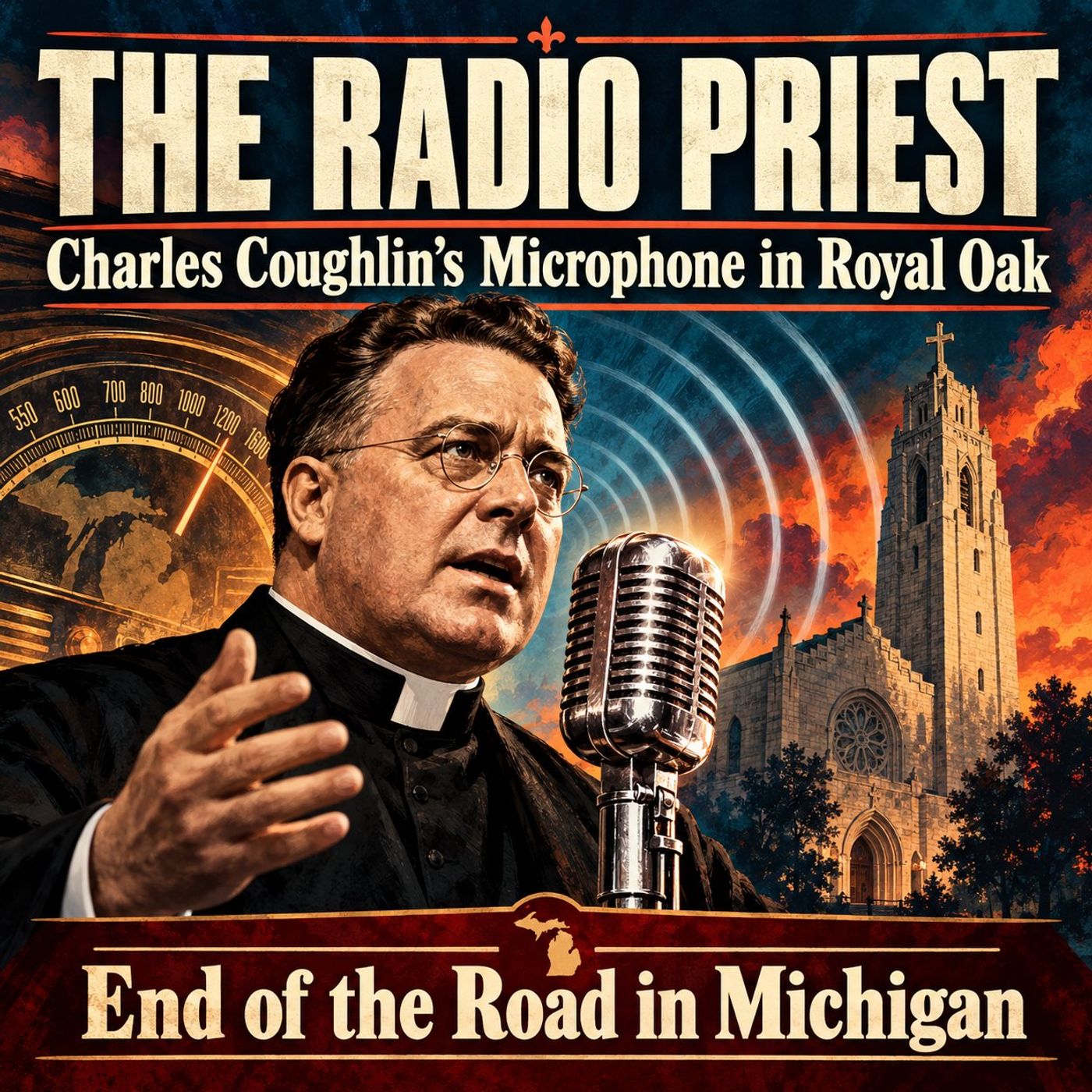
The End of the Road in Michigan · Thumbwind Publications
How did a parish priest in Royal Oak, Michigan, become one of America's most powerful voices—and what happened when that familiar voice began spreading hate? In this episode of End of the Road in Michigan, we trace Charles Coughlin’s rise from local religious broadcaster to national political force during the Great Depression. His broadcasts promised answers to Americans facing unemployment and uncertainty. But his economic crusade increasingly embraced antisemitic conspiracy theories, culminating in a broadcast that excused Nazi persecution after Kristallnacht. Drawing on Coughlin’s sermons and newspaper, along with contemporary broadcast reports, we explore how listeners, Catholic leaders, and radio stations responded. Some defended him. Others challenged his message and restricted his access to the airwaves. It’s a Michigan story with national consequences: a gripping look at radio, religious authority, and the dangerous distance between offering hope and assigning blame. Content note: This episode discusses antisemitism and Nazi persecution. The End of the Road in Michigan is a production of Thumbwind Publications This episode includes AI-generated content.
0:00A church has walls. Radio offers a way around them.
0:04In Royal Oak, Michigan, a parish priest discovers that his congregation can include people who
0:10will never sit in his pews. People making dinner, people out of work, people searching for
0:16someone who sounds certain when everything else feels uncertain. His name is Charles Cofflin,
0:23his instrument is a microphone.
0:26And his story turns on a question that becomes more disturbing the longer you sit with it.
0:31What happens when the voice you trust starts telling you whom to blame?
0:36This is End of the Road in Michigan. Today, the radio priest, Charles Cofflin's microphone
0:43in Royal Oak. This episode examines anti-semitism and Nazi persecution. We'll describe Cofflin's
0:50false claims in context without replaying his attacks as entertainment.
0:57Act 1 - A parish with a very long reach
1:02Start north of Detroit at the shrine of the little flower in Royal Oak.
1:07Cofflin is Canadian-born, ordained in 1916 and already an accomplished speaker before becoming
1:14nationally famous. In 1926, he begins broadcasting sermons through Detroit Station WJR. His
1:22early support for Franklin Roosevelt and his advocacy of a more compassionate capitalism