
The Emergency Management Network Podcast · Todd T. De Voe
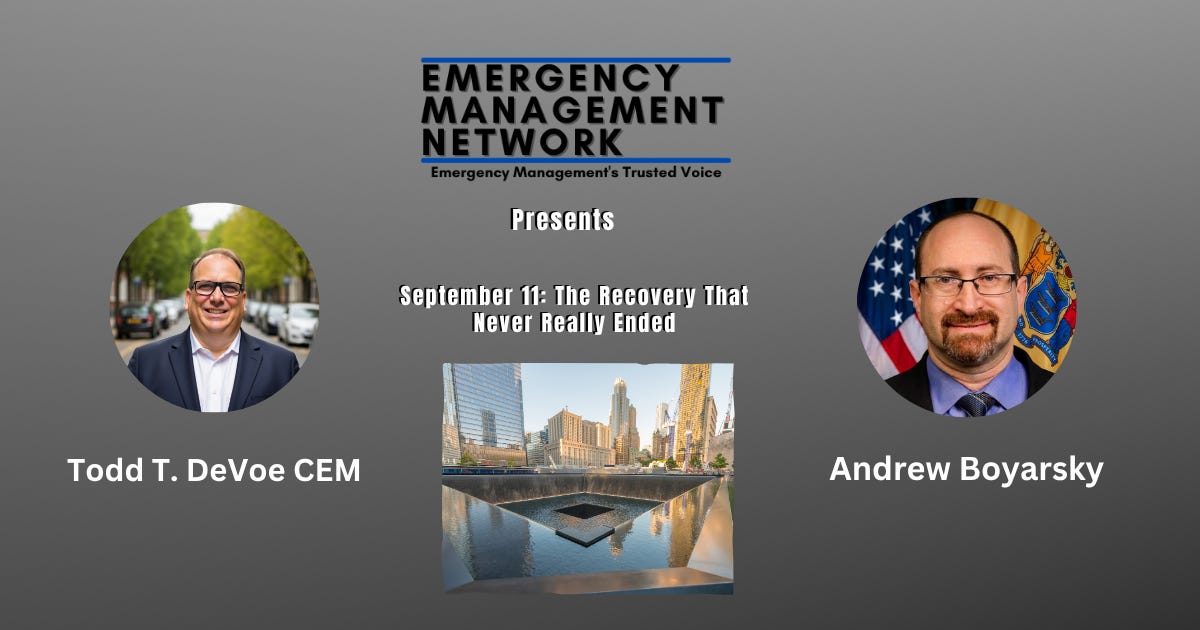
Episode Description September 11: The Recovery That Never Really Ended Twenty-five years after the attacks of September 11, 2001, the skyline of Lower Manhattan has been rebuilt—but recovery is about far more than buildings. In this episode of Emergency Management Network, Todd DeVoe examines the long aftermath of 9/11: rebuilding Ground Zero, caring for responders and survivors, confronting World Trade Center-related illnesses, preserving memory, and understanding why the emotional wounds of that morning remain so powerful a quarter-century later. Recent confrontations near Ground Zero during the 25th anniversary observances remind us that disaster memory does not follow an emergency manager’s recovery timeline. Places become symbols. Grief becomes generational. Anger can survive long after debris has been removed. The episode also explores a sobering reality of long-term recovery: more FDNY members have now died from World Trade Center-related illnesses than were killed in the attacks themselves. Thousands of responders and survivors continue to receive monitoring and treatment, while researchers are still examining health consequences that may span generations. September 11 challenges the way emergency managers think about recovery. Infrastructure can be restored. Businesses can reopen. Memorials can be built. But how do we measure the recovery of people? Perhaps the lesson 25 years later is that we need to add something to “Never Forget.” Never stop recovering. Show Notes Emergency Management Network Episode: September 11: The Recovery That Never Really EndedSubtitle: 25 Years of Rebuilding, Recovery, Memory, and HealingHost: Todd DeVoe Twenty-five years after September 11, 2001, this episode looks beyond the attacks themselves and examines what happened afterward. The World Trade Center site has been rebuilt. Lower Manhattan has transformed. Transportation, businesses, residences, and public spaces returned. The 9/11 Memorial and Museum now preserve the physical memory of what happened there. But rebuilding a place and recovering from a disaster are not necessarily the same thing. In This Episode Todd examines September 11 through the lens of long-term disaster recovery, including the physical reconstruction of Lower Manhattan and the much longer process of human recovery. The episode explores the continuing health consequences facing firefighters, police officers, construction workers, volunteers, survivors, residents, and others exposed to the World Trade Center disaster environment. It also considers the idea of the long disaster—that deaths and consequences associated with a catastrophic event may continue years or even decades after the response phase has ended. The 25th anniversary also demonstrated how powerful disaster memory remains. Confrontations near Ground Zero during anniversary demonstrations showed that the site is more than a geographic location. For many Americans, responders, survivors, and families, it remains sacred...
0:02SPEAKER_01Welcome to the EMN Podcast,
0:04SPEAKER_01where philosophy meets disaster,
0:07SPEAKER_01and uncomfortable truths meet the profession we call emergency management.
0:11SPEAKER_01This is not safe space thinking, this is the arena.
0:15SPEAKER_02Let's begin.
0:21SPEAKER_01Good morning,
0:21SPEAKER_01good morning,
0:22SPEAKER_01good afternoon,
0:22SPEAKER_01depending on where you are at in this fine nation,
0:24SPEAKER_01I'm Todd DeVoe, and with me, of course, my Co-host, Ann Dabrowski.
0:31SPEAKER_01And we're kind of just coming off of Friday,
0:34SPEAKER_01which was the 25th anniversary of 9-11, which is amazing.
0:37SPEAKER_01That's 25 years ago,
0:38SPEAKER_01because for those of us who experienced it,
0:41SPEAKER_01it probably still feels like yesterday for most of us.