
The Emergency Management Network Podcast · Todd T. De Voe
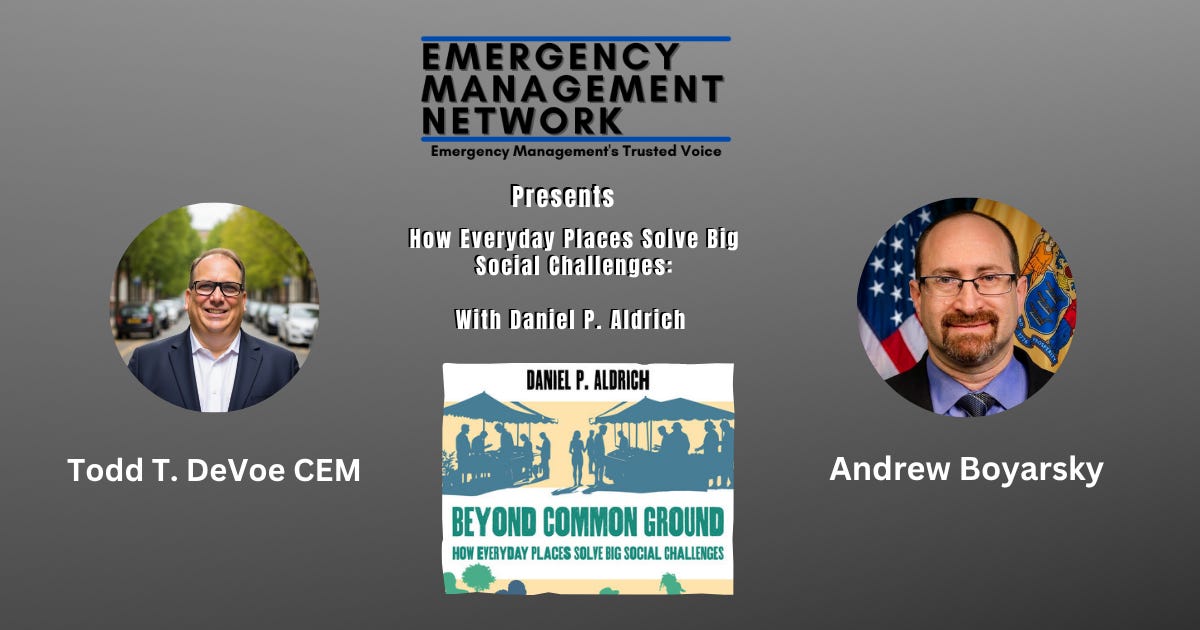
Episode Description What if the key to building stronger, safer, and more resilient communities isn’t another seawall, a bigger emergency operations center, or more concrete, but the relationships we build in everyday places? In this episode of EMM Hope, hosts Todd DeVoe and Andrew Boyarsky welcome Dr. Daniel P. Aldrich, author of the new book Beyond Common Ground: How Everyday Places Solve Big Social Challenges, published by the University of California Press. Dr. Aldrich challenges conventional thinking about how communities prepare for and respond to crises. Rather than focusing exclusively on physical infrastructure, he explores the power of social infrastructure—libraries, parks, community centers, neighborhood gathering spaces, and even radio programs—to strengthen social connections, build trust, and help communities confront some of society’s most difficult challenges. Drawing on examples from Japan, Philadelphia, and Africa’s Sahel region, Dr. Aldrich demonstrates how investments in relationships and shared spaces can help reduce disaster vulnerability, prevent crime, and counter violent extremism. For emergency managers, community leaders, and anyone interested in resilience, this conversation raises a fundamental question: Are we investing enough in the people and places that hold communities together before disaster strikes? Because when disaster happens, the first person to help you probably won’t be a government official. It will be someone who knows your name. Show Notes The Power of Social Infrastructure In this conversation, Todd DeVoe, Andrew Boyarsky, and Dr. Daniel P. Aldrich explore the often-overlooked connections between everyday community spaces, social capital, and resilience. Topics We Explore 1. Beyond Concrete and Steel Why social infrastructure deserves as much attention as traditional investments in physical infrastructure, and why stronger communities require more than buildings, roads, and emergency equipment. 2. The Importance of Social Capital How trust, relationships, and community networks influence disaster survival, emergency response, and long-term recovery. 3. Japan’s Ibasho Centers How elder-led community spaces demonstrate the importance of social connections, particularly among older adults living in communities exposed to tsunami hazards. 4. Greener Neighborhoods, Safer Communities What Philadelphia’s neighborhood greening initiatives reveal about the relationship between shared spaces, neighborhood investment, and crime reduction. 5. Radio as a Resilience Tool How community broadcasting in Africa’s Sahel region can help counter extremist recruitment, strengthen local relationships, and create opportunities for community engagement. 6. A Polysolution Approach to Complex Problems How a single investment in social infrastructure can help address multiple challenges, including climate change, public safety, social isolation, and disaster resilience. 7. Lessons for Emergency Managers Why building...
0:02SPEAKER_02Welcome to the EMN Podcast,
0:04SPEAKER_02where philosophy meets disaster,
0:06SPEAKER_02and uncomfortable truths meet the profession we call emergency management.
0:11SPEAKER_02This is not safe space thinking, this is the arena.
0:14SPEAKER_03Let's begin.
0:21SPEAKER_02Good morning,
0:21SPEAKER_02good afternoon,
0:22SPEAKER_02depending on where you are at in this fine nation,
0:24SPEAKER_02I'm Todd DeVoe,
0:24SPEAKER_02and with me I have my esteemed colleague Andrew Barsky with me,
0:28SPEAKER_02and well,
0:29SPEAKER_02We've got a special guest too coming up,
0:30SPEAKER_02but Andrew,
0:31SPEAKER_02I'm going to let you go ahead and do the introduction and the announcement.
0:35SPEAKER_00Absolutely.